THE LEVEL OF INFLUENCE OF ORGANISED PHYSICAL ACTIVITY ON MEETING
THE HEALTHY CRITERION OF 10,000 STEPS DAILY:
APPLICATION OF REGRESSION AND FORMAL CONCEPT ANALYSIS
Dagmar Sigmundová, Jiří Zacpal*, Erik Sigmund
Faculty of Physical Culture, Palacký University, Olomouc, Czech Republic *Faculty of Science, Palacký University, Olomouc, Czech Republic
Submitted in April, 2010
BACKGROUND: Organised physical activity (PA) belongs among factors signifi cantly infl uencing the amount of realised PA.
OBJECTIVE: The objective of our study is to fi nd out with the use of classical statistical methods and formal concept analysis (FCA) how organised PA infl uences the meeting of the healthy criterion of 10,000 steps per day on a particular day. What daily frequency of participation in organised PA is benefi cial for meeting this healthy criterion?
METHODS: Men (1,749) and women (2,293) aged 12 to 84 years participated in the research. Their weekly PA was monitored using the pedometer Yamax Digi-walker SW700. We used logistic regression and FCA for data analysis.
RESULTS: Organised PA markedly increases the number of realised steps per sport/exercise day compared to non participation in organised PA. Logistic regression revealed that participation in organised PA 1–2 times per week raises, by more than four times, the chance to meet the above mentioned healthy criterion. Men have got about a 30% higher chance for meeting 10,000 steps per day than women. People with normal weight have got a greater chance of meeting this criterion. On the other hand, obese people have diffi culty in meeting the criterion. According to the FCA, women who participate in organised PA more than 4 times per week are more likely to meet this healthy criterion (88% compared to 66%); men are more likely to meet the criterion if they participate in organised PA 3 times and more per week (91% compared to 70%).
CONCLUSIONS: For better understanding of the results we recommend using a combination of statistical and other assessment methods, for instance FCA. Participation in organised PA at least once a week positively infl uences the meeting of the above described healthy criterion.
Keywords: Yamax Pedometer, logistic regression, age, obesity, fuzzy logic.
INTRODUCTION
In our contemporary technologically modernised world there is less and less room for PA as people devote themselves to computers, television and other passive entertainment. Very often researchers use the criterion of 10,000 for the evaluation of PA with the use of pedometers, which is a well known and popular crite-rion for health promotion. People who perform 10,000 steps per day are very likely to meet the criterion of the American College of Sport Medicine (Le Masur-ier, Sidman, & Corbin, 2003). This also supports the statement that reaching 10 thousand daily steps is the amount of PA bringing health benefi ts (Bernard, Pak, Choi J., & Choi E., 2007; Tudor-Locke & Bassett, 2004). Physical activity is, during a typical week, infl uenced by one’s working routine, family duties and other obliga-tions. That is why it is necessary to study relationships also regarding particular days of the week. Participation in organised PA belongs among crucial factors positively infl uencing the amount of PA (Van Mechelen, Twisk,
Post, Snel, & Kemper, 2000). Poor participation in sport (organised PA) in childhood and adolescence is con-nected with the higher occurrence of physical inactivity in adulthood and, on the other hand, sport participation during adolescence has got a positive eff ect on health in adulthood thanks to the reduction of the probability of adult inactivity (Tammelin, Näyhä, Laitinen, Rintamäki, & Järvelin, 2003). Organized PA can markedly raise the amount of PA realised in a given day (Tudor-Locke et al., 2004). Apart from organised PA, the amount of realised PA is infl uenced by other factors, such as age, gender, obesity, socio-economic status, educational attainment but also weather and the season (Frömel, Mitáš, & Kerr, 2009; Pelclová, Vašíčková, Frömel, & Djordjevic, 2010; Pratt, Macera, & Blanton,1999; Sallis, Prochaska, & Tay-lor, 2000; Sigmund et al., 2008; Suchomel, Sigmundová, & Frömel, 2008).
arti-cles do not present a measure of the pseudo-variance ex-plained (Pampel, 2000). In these cases we recommend using the Formal Concept Analysis (FCA) method that is based on searching for concepts (clusters) in a data table. Concepts then represent common characteristics of the object group. Its strength is not only in searching for concepts but also in the creation of structures of concepts (lattices) and that fi ndings can be specifi ed or generalised.
The aim of this study is that, with the use of a com-bination of classical statistical methods and formal con-cept analysis, we can fi nd out to what extent organised physical activity infl uences the meeting of the healthy criterion of 10 thousand steps per day on a certain day. What weekly frequency of participation in organised PA creates the preconditions for meeting this healthy criterion? What other factors influence meeting the healthy criterion?
METHODOLOGY
The current study was undertaken in the Czech Re-public after approval by the Institutional Research Eth-ics Committee at Palacký University. Participation was voluntary and participants received no incentives and could withdraw from the study if they wished. Partici-pants were provided with information about the aims, objectives and methods of the survey before the start of the monitoring of their physical activity. Data were anonymous and confi dential and data protection was observed at all times. Each participant (or legal repre-sentative) signed an informed consent form for inclu-sion in the study.
The survey and monitoring of physical activity were undertaken during the years 2008–2010 in the Czech Republic. We used Microsoft Excel to randomly select addresses. Trained research coordinators visited each selected household, and family members were informed about the study’s aims/objectives and asked if they wished to participate in the study. If in agreement, each participant signed an informed consent form, completed the questionnaire and participated in the physical activ-ity monitoring.
Men (1,749) and women (2,293) aged 12 to 84 years participated in the research. Their weekly PA was moni-tored using the pedometer Yamax Digi-walker SW700. We eliminated respondents with implausible or missing data or because they wore the pedometer for a short period of time during the day (less than 10 hours). We analysed data from 2,157 women (with a mean age of 29.87 ± 13.03 years) and from 1,648 men (with a mean age of 29.73 ± 12.37 years).
For data evaluation we used logistic regression and basic statistical methods. Regression analysis of the
meeting of the healthy criterion of 10,000 steps daily (0 = does not meet the criterion) was calculated for each day of the week and also in total for the whole week. Independent variables entering into regression were organised PA (physical activity led by a teacher or trainer), gender (males, females), groups according to BMI (underweight, normal weight, overweight, obese), and age (age categories 12–18, 19–25, 26–39, 40–54, 55 and more years). Age categories were created to re-spect the proportionality in the data fi le. The category of 12–18 years was created with regard to age diff erences in children and youth, e. g. the assessment of BMI is dif-ferent for the adolescent and adult population (CDC, 2009). Logistic regression was calculated using the For-ward Stepwise method (Likelihood ratio).
A further method which was used is called Formal Concept Analysis (from here onward in this text to be referred to as FCA). Formal concept analysis uses terms like formal context, formal concept and formal concept lattice (Ganter & Wille, 1999).
From the point of view of these terms, a question-naire can be understood as providing a formal context where respondents create a group of objects, ques-tionnaire questions create a group of attributes and respondent’s answers to each question creates binary relationships. Considering that most of the answers to questions are not bivalent and it is a special type of con-text, it is called multivalued. With this type of context FCA cannot work. It’s necessary to transform it into bivalent form. This process is called scaling.
The result of scaling is a formal context where the objects are individual respondents. In most cases we are not interested in the relations among respondents but in the group of respondents indicating some common features or attributes. The method of construction of so called “aggregated objects” works based on this funda-mental thought. This method is described in detail in the study of Belohlavek, Sklenar, Zacpal, and Sigmund (2007).
RESULTS
Regardless of their participation in organised PA, men performed an average of 11,200 steps per day (SD = 3,652), while women performed an average of 10,612 steps per day (SD = 3,444). From Fig. 1 and 2 it is evident that organised PA increases the number of realised steps taken on sport/exercise days as opposed to the days with non participation in organised PA. These diff erences in men range between 2,750 steps on Mon-day up to 4,830 steps on FriMon-day. In women the small-est diff erences are between the days with and without organised PA on Monday (the diff erence is 2,013 steps) and the biggest diff erences are on Sunday (3,539 steps). Regardless of a deeper knowledge of someone’s weekly routine, Friday is the day with the highest number of steps both in men and women.
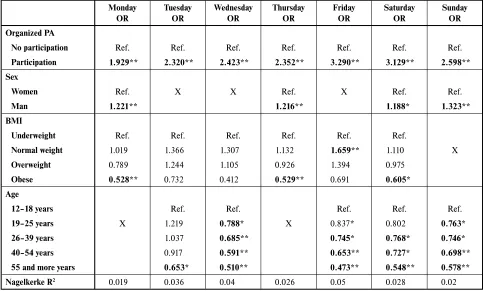
From TABLE 1 we can see the positive infl uence of organised PA on meeting the healthy criterion of
10,000 steps per day. People participating in organised PA have got a 3 times better chance of meeting this cri-terion. Moreover, on some days men have got a better chance of meeting this criterion as compared to wom-en. TABLE 1 shows that obese people have only half a chance of meeting the standard of 10,000 steps per day as compared to underweight people or people with normal weight. This chance is on the decrease with age. Nevertheless, logistic regression showed, on a particular day, a low coeffi cient of Nagelkerke R2.
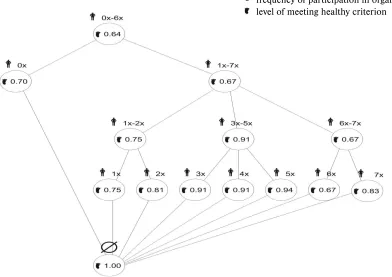
The method of logistic regression is, unlike the FCA method, based on analysing a formal (fuzzy) concept lattice. From the adjusted context of data about the number of steps and the frequency of participation in weekly organised PA in all respondents we create a for-mal fuzzy concept lattice and compare “interesting” con-cepts. Final sub units classify respondents according to their participation in organised PA and are displayed separately for women (Fig. 3) and for men (Fig. 4).
Fig. 1
The mean number of steps in females with regard to organised PA on certain day (steps/day)
12,466
13,727
13,368 13,732
14,506
13,375
12,482
10,453 10,830
11,081
10,653 11,130
10,131
8,943
(n = 130) (n = 2,027) Monday
(n = 165) (n = 1,992) Tuesday
(n = 159) (n = 1,998) Wednesday
(n = 154) (n = 2,003) Thursday
(n = 111) (n = 2,046) Friday
(n = 47) (n = 2,110) Saturday
(n = 54) (n = 2,103) Sunday
females with organized PA females without organized PA
Fig. 2
Mean number of steps in males with regard to organised PA on certain day (steps/day)
13,750
14,865
14,373
16,180
14,766
13,460
11,000 11,277
11,692
11,218 11,350
10,791
9,694
(n = 77) (n = 1,571) Monday
(n = 105) (n = 1,543) Tuesday
(n = 104) (n = 1,544) Wednesday
(n = 96) (n = 1,552) Thursday
(n = 95) (n = 1,553) Friday
(n = 68) (n = 1,580) Saturday
(n = 59) (n = 1,689) Sunday males with organized PA males without organized PA
Visualised values range from 0 to 1 and as a percentage express the number of respondents from a certain group who have got a given feature. In this case, as a percent-age, it illustrates the results of respondents according to their participation in organised PA, who meet the healthy criterion of 10,000 steps per day.
Fig. 3 and 4 show that a considerable increase in the degree of meeting the healthy criterion of 10 thousand steps daily occurs in women participating in organised PA 4 times and more weekly (88% compared to 66%), while occurring in men participating 3 and more times per week (91% compared to 70%). An interesting fact is the decline in the number of men who participate in organised PA 6 times per week. It can be explained by the small number of respondents in this group (n = 9).
From Fig. 5 it is evident that also the mean number of steps per day rises with the higher frequency of par-ticipation in organised PA. This trend occurs both in men and women. Also we can see that participation in organised PA once a week is not suffi cient for meeting the healthy criterion of 10 thousand steps per day.
In our sample 50% of the respondents do not par-ticipate in organised PA, 38% parpar-ticipate in organised PA once a week, 6% participate twice a week, 7% par-ticipate in organised PA 4 times per week and 3% of the
respondents participate in organised PA more than four times per week.
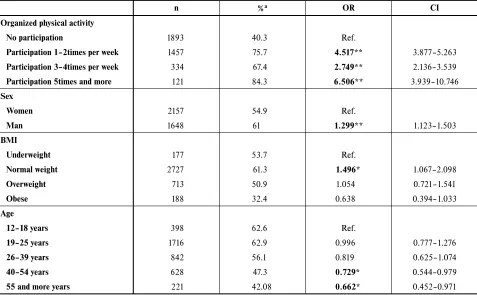
Logistic regression revealed that participation in or-ganised PA multiplies the chance of meeting the healthy criterion compared to people who do not participate in organised PA. Men have got about a 30% greater chance of meeting the limit of 10,000 steps per day than women. Further, people with normal weight are more likely to meet this criterion than obese people. Crucial factors for the number of realised steps are also age; with aging the likelihood of meeting the criterion declines (TABLE 2).
The FCA method also revealed a decline in over-weight and obesity in respondents with organised PA. Among women without participation in organised PA we discovered 20% of overweight or obese women as compared to women with participation in organised PA at least once a week where the occurrence of overweight and obesity decreased to 10%. In men without participa-tion in organised PA we found that 34% of the respond-ents were overweight or obese, whereas 28% (resp. 26%) of the respondents were found to have participated in organised PA once a week (resp. twice a week). The frequency of participation in organised PA of 3–7 times a week is associated with an occurrence of overweight
TABLE 1
The infl uence of organised PA and other factors on meeting the healthy criterion of 10,000 steps per day
Monday OR
Tuesday OR
Wednesday OR
Thursday OR
Friday OR
Saturday OR
Sunday OR Organized PA
No participation Ref. Ref. Ref. Ref. Ref. Ref. Ref.
Participation 1.929** 2.320** 2.423** 2.352** 3.290** 3.129** 2.598**
Sex
Women Ref. X X Ref. X Ref. Ref.
Man 1.221** 1.216** 1.188* 1.323**
BMI
Underweight Ref. Ref. Ref. Ref. Ref. Ref.
Normal weight 1.019 1.366 1.307 1.132 1.659** 1.110 X
Overweight 0.789 1.244 1.105 0.926 1.394 0.975
Obese 0.528** 0.732 0.412 0.529** 0.691 0.605*
Age
12–18 years Ref. Ref. Ref. Ref. Ref.
19–25 years X 1.219 0.788* X 0.837* 0.802 0.763*
26–39 years 1.037 0.685** 0.745* 0.768* 0.746*
40–54 years 0.917 0.591** 0.653** 0.727* 0.698**
55 and more years 0.653* 0.510** 0.473** 0.548** 0.578**
Nagelkerke R2 0.019 0.036 0.04 0.026 0.05 0.028 0.02
Fig. 3
Visualization of the probability of meeting the healthy criterion regarding the frequency of participation in organised PA – FEMALE
Fig. 4
Visualization of the probability of meeting healthy criterion regarding the frequency of participation in organised PA – MALE
frequency of participation in organised PA per week level of meeting healthy criterion
Fig. 5
Number of daily steps according to frequency of participation in organized PA during the week (0–7×)
TABLE 2
Infl uence of organised PA and other factors on meeting the healthy criterion of 10,000 steps per day
n % a OR CI
Organized physical activity
No participation 1893 40.3 Ref.
Participation 1–2times per week 1457 75.7 4.517** 3.877–5.263
Participation 3–4times per week 334 67.4 2.749** 2.136–3.539
Participation 5times and more 121 84.3 6.506** 3.939–10.746
Sex
Women 2157 54.9 Ref.
Man 1648 61 1.299** 1.123–1.503
BMI
Underweight 177 53.7 Ref.
Normal weight 2727 61.3 1.496* 1.067–2.098
Overweight 713 50.9 1.054 0.721–1.541
Obese 188 32.4 0.638 0.394–1.033
Age
12–18 years 398 62.6 Ref.
19–25 years 1716 62.9 0.996 0.777–1.276
26–39 years 842 56.1 0.819 0.625–1.074
40–54 years 628 47.3 0.729* 0.544–0.979
55 and more years 221 42.08 0.662* 0.452–0.971
Le gend: %a – participants, who meet the criterion; OR – odds ratio; CI – confi dence interval; *p < 0.05; **p < 0.01; Nagelkerke R2 = 0.19
and obesity ranging from 6 to 20%. Furthermore, ac-cording to FCA, we found out that the greatest rep-resentation of respondents who are the most likely to
meet the healthy criterion of 10,000 steps daily is in the age category of 19–25 years regardless of gender and frequency of participation in organised PA.
steps/day
18,000
16,000
14,000
12,000
10,000
8,000
6,000
Frequency of participation in organized PA during the week
DISCUSSION
The main goal of this study is, by means of using a combination of classical statistical methods and for-mal concept analysis, to fi nd out to what extent organ-ised PA infl uences the meeting of the healthy criterion of 10 thousand steps per day on a particular day. What frequency of participation in organised PA is benefi cial for meeting the healthy criterion? What other factors infl uence meeting the healthy criterion?
Data are quite often adjusted to the applied statisti-cal method and it can partially devalue their predictive value. Regression analysis often shows the low reliability of a model that is represented by a Nagelkerke R2 coef-fi cient. Moreover, often this coeffi cient is not mentioned in the results section of studies. Results with a low Nagelkerke coeffi cient are then very diffi cult to interpret because the model encompasses only a small part of the observed phenomenon. The FCA method is based on a relationship of equivalence, which is why we can speak of the probability of a phenomenon’s occurrence. A calculated value range from 0 to 1 and expressed as a percentage gives us the number of respondents from a certain group who have a certain attribute. Even FCA, because of its complicated methodology can ap-pear to be limited; in easier models (units) it gives a clear summary about the extent of reaching an observed phenomenon regarding chosen categories. For better understanding of such results it is required that we com-bine both methods.
In this study we register a relatively high (38%) de-gree of participation in organised PA once a week. On the other hand, no organised PA is mentioned by half of the respondents. Diff erent results were obtained in a study by Duda (2006) who, during her observation of PA regarding respondents’ professions found out that 14–17% of the respondents exercise once a week. She found out that 10% of teachers and up to 71% of nurses are engaged in PA irregularly. Respondents most often mentioned 2–3 times per week participation in sport and recreational exercise (Duda, 2006).
Participation in organised PA more than once a week is associated with an extensive increase in the number of steps per day (Sequeira, Rickenbach, Wietlis-bach, Tullen, & Schutz, 1995). Participation in leisure time PA more than doubly increases the chance to meet the standard of 10 thousand steps daily (McCormack, Giles-Corti, & Milligan, 2006). We obtained similar re-sults in our study when we found out that organised PA 1–2 times per week increases, by more than four times, the chance of meeting healthy criterion for PA. If we deal with the infl uence of organised PA on one’s total PA on particular days, then we can say that organ-ised PA expressively increases the number of realorgan-ised steps per sport/exercise day as compared to days with
non participation in organised PA. These diff erences are more considerable in men than in women. Until recently the emphasis was put on the realisation of PA three and more times per week (WHO, 2009) for at least 10-minute periods (Strath, Holleman, Ronis, Swartz, & Richardson, 2008). Currently, the summation of PA performed at intervals shorter than 10 minutes are supposed to be benefi cial. Moreover, it is evident that participation in PA once a week markedly contributes to meeting the healthy criterion of 10 thousands steps daily.
Analysis on individual days showed that respondents reach the lowest level of PA on Monday and Sunday. One study that compared the realised number of steps in relationship to the participants’ weight came up with the same results. In respondents with normal weight a lower number of steps was registered on Monday and Sunday as compared to other days of the week. In over-weight people the lowest number of steps was observed on Sunday (Clemes, Griffi ths, & Hamilton, 2007). In our society Sunday is regarded as a day for relaxing, not only due to the Christian tradition but also for the reason of preparation for the following working day. Evidently we cannot expect, on this day, a signifi cant change in movement behaviour. On the other hand, the men and women who participate in organised PA on Friday reached the highest number of steps. Friday af-ternoon provides a bigger opportunity for PA realisation or participation in cultural events due to the following free day as compared to other working days. With regard to technological possibilities allowing for the analysing of PA each day, the classifi cation of days into working and weekend days seems to be insuffi cient
Regardless of participation in organised PA men performed 11,200 steps/day and women performed 10,612 steps/day on average. Bohannon (2007) or McCormack, Giles-Corti, and Milligan (2006) found a lower mean number of steps/day in women and men but, as in our study, they confi rm the eff ect of age and BMI on meeting the standard of 10 thousand steps per day. Moreover, FCA proved that with increasing fre-quency of their participation in organised PA, the oc-currence of overweight and obesity in people declines. The decline is less signifi cant in men than in women.
LIMITATIONS
time PA. Another limitation is the absence of data about the available off erings of organised forms of PA in the respondents’ places of residence.
CONCLUSIONS AND RECOMMENDATIONS
For a detailed understanding and the visualisation of results we recommend using a combination of statistical and other assessment methods, as for instance a combi-nation of regression analysis and FCA. Participation in organised PA at least once a week positively infl uences meeting the healthy criterion of 10 thousand steps per day. For increasing the number of people participating in organised PA and increasing the chance of meeting the healthy criterion for PA it is necessary that attrac-tive forms of PA be extended and off ered, especially for overweight and obese people, people older than 26 years of age and for women.
Next research projects in this fi eld should take into account the infl uence of profession on total PA together with participation in organised PA. Furthermore it is warranted to study the association between the total quantity of realised PA and the off erings of organised PA in the place of residence as well as considering peo-ple’s participation in this PA.
ACKNOWLEDGEMENTS
The study has been supp o r t ed by the research grant from the Ministry of Education, Youth and Sports of the Czech Republic (No. MSM 6198959221) “Physical Activity and Inactivity of the Inhabitants of the Czech Republic in the Context of Behavioral Changes”.
REFERENCES
Belohlavek, R. (2002). Fuzzy relational systems: Founda-tions and principles. New York: Kluwer Academic/ Plenum Publisher.
Belohlavek, R., Sklenar, V., & Zacpal, J. (2005). Crisply generated fuzzy concepts. In R. Godin & B. Ganter (Eds.), Formal concept analysis: Third International conference, ICFCA 2005, Lens, France, February 14–18, 2005, Proceedings (pp. 269–284). Berlin: Springer-Verlag.
Belohlavek, R., Sklenar, V., Zacpal, J., & Sigmund, E. (2007). Evaluation of questionnaires supported by formal concept analysis. In P. W. Eklund, J. Diatta, & M. Liquiere (Eds.), CLA 2007 (pp. 96–108). Montpellier: University of Montpellier II.
Bernard, C. K., Pak, A. W. P., Choi, J. C. L., & Choi, E. C. L. (2007). Daily step goal of 10,000 steps:
A literature review. Clinical and Investigative Medi-cine, 30(3), 146–151.
Bohannon, R. W. (2007). Number of pedometer as-sessed steps taken per day by adults: A descriptive meta-analysis. Physical Therapy, 87(12),1642–1650. Center for Disease Control and Prevention (CDC).
(2009). Healthy weight: About BMI for children and teens. Retrieved 19. 1. 2011 from the World Wide Web: http://www.cdc.gov/healthyweight/assessing/ bmi/childrens_bmi/about_childrens_bmi.html Clemes, S. A., Griffi ths, P. L., & Hamilton, S. L. (2007).
Four week pedometer determined activity patterns in normal weight and overweight UK adults. Inter-national Journal of Obesity, 31, 261–266.
Duda, B. (2006). Charakterystyka aktywności fi zycnej osób dorosłych. Medycyna Sportova, 22(6), 329–332. Frömel, K., Mitáš, J., & Kerr, J. (2009). The associa-tions between active lifestyle, the size of a com-munity and SES of the adult population in Czech Republic. Health and Place, 15(2),447–454. Ganter, B., & Wille, R. (1999). Formal concept analysis:
Mathematical foundations. Berlin: Springer-Verlag. Le Masurier, G. C., Sidman, C. L., & Corbin, C. B.
(2003). Accumulating 10,000 steps: Does this meet current physical activity guidelines? Research Quar-terly for Exercise and Sport, 74(4), 389–394.
McCormack, G., Giles-Corti, B., & Milligan, R. (2006). Demographic and individual correlates of achieving 10,000 steps/day: Use of pedometers in a population based study. Health Promotion Journal of Australia, 17(1), 43–47.
Pampel, F. C. (2000). Logistic regression: A primer. Thou-sand Oaks, CA: Sage publications.
Pelclová, J., Vašíčková, J., Frömel, K., & Djordjevic, I. (2010). Leisure time, occupational, domestic, and commuting physical activity of inhabitants of the Czech Republic aged 55–69: Influence of socio-demographic and environmental factors. Acta Uni-versitatis Palackianae Olomucensis. Gymnica, 39(3), 13–20.
Pratt, M., Macera, C. A., & Blanton, C. (1999). Levels of physical activity and inactivity in children and adults in the United States: Current evidence and research issues. Medicine and Science in Sports and Exercise, 31(11 Suppl.),526–533.
Sallis, J. F., Prochaska, J. J., & Taylor, W. C. (2000). A review of correlates of physical activity of children and adolescents. Medicine and Science in Sport and Exercise, 32(5), 963–975.
Sequeira, M. M., Rickenbach, M., Wietlisbach, V., Tul-len, B., & Schutz, Y. (1995). Physical activity as-sessment using a pedometer and its comparison with a questionnaire in a large population survey. American Journal of Epidemiology, 142(9), 989–999. Sigmund, E., Mitáš, J., Sigmundová, D., Frömel, K.,
Řep-ka, E., Feltlová, D., Suchomel, A., Mičan, O., Klo-bouk, T., Lukavská, M., & Bláha, L. (2008). The use of formal concept analysis in evaluation of the relationship between the environment and physical activity of the residents in Czech regional cities. Acta Universitatis Palackianae Olomucensis. Gymnica, 38(2),65–74.
Strath, S. J., Holleman, R. G., Ronis, D. L., Swartz, A. M., & Richardson, C. R. (2008). Objective physi-cal activity accumulation in bouts and nonbouts re-lated to markers of obesity in US adults. Preventing Chronic Disease, 5(4),131.
Suchomel, A., Sigmundová, D., & Frömel, K. (2008). The role of physical activity in the lifestyle of the inhabitants of the Liberec region. Human movement, 9(1), 19–26.
Tammelin, T., Näyhä, S., Laitinen, J., Rintamäki, H., & Järvelin M. R. (2003). Physical activity and so-cial status in adolescence as predictors of physical inactivity in adulthood. Preventive Medicine, 37(4), 375–381.
Tudor-Locke, C., & Bassett, D. R. Jr. (2004). How many steps/day are enough? Preliminary pedometer indi-ces for public health. Sports Medicine, 34(1),1–8. Tudor-Locke, C., Ham, S. A., Macera, C. A., Ainsworth,
B. E., Kirtland, K. A., Reis, J. P., & Kimsey, C. D. (2004). Descriptive epidemiology of pedometer de-termined physical activity. Medicine and Science in Sports and Exercise, 36(9),1567–1573.
Van Mechelen, W., Twisk, J. W. R., Post, G. B., Snel, J., & Kemper, H. C. G. (2000). Physical activity of young people: The Amsterdam longitudinal growth and health study. Medicine and Science in Sports and Exercise, 32(9),1610–1616.
WHO. (2009). Recommended amount of physical activity. Retrieved 27. 7. 2009 from the World Wide Web: http://www.who.int/dietphysicalactivity/factsheet_ recommendations/en/
MÍRA VLIVU
ORGANIZOVANÉ POHYBOVÉ AKTIVITY NA DOSAŽENÍ ZDRAVOTNÍHO KRITÉRIA 10 000 KROKŮ DENNĚ: VYUŽITÍ REGRESNÍ
A FORMÁLNÍ KONCEPTUÁLNÍ ANALÝZY
(Souhrn anglického textu)
VÝCHODISKA: Organizovaná pohybová aktivita (PA) patří mezi faktory výrazně ovlivňující celkové množství realizované PA.
CÍLE: Cílem této práce je kombinací klasických sta-tistických metod a formální konceptuální analýzy (FCA) zjistit, do jaké míry ovlivňuje organizovaná pohybová aktivita dosažení zdravotního kritéria 10 tis. kroků denně v konkrétním dni. Jaká týdenní frekvence účasti
v organizované PA je přínosná pro dosažení zdravotního kritéria.
METODIKA: Výzkumu se účastnilo 1749 mužů
a 2293 žen ve věku od 12 do 84 let, jejichž týdenní PA byla monitorována pomocí krokoměru Yamax Digi--walker SW700. K hodnocení dat byla využita logistická regrese a FCA. Organizovaná PA výrazně zvyšuje počet realizovaných kroků ve dni s účastí v organizované PA oproti dnům s neúčastí v organizované PA.
VÝSLEDKY: Logistická regrese odhalila, že účast v organizované PA 1–2× týdně víc jak čtyřnásobně zvy-šuje šanci dosáhnout zdravotního kritéria. Muži mají zhruba o 30 % větší šanci dosáhnout hranice 10 tisíc kroků denně než ženy. Lidé s normální hmotností mají tuto šanci největší, naopak šance na dosažení zdravotní-ho kritéria je u obézních lidí nejmenší. Dle FCA dochází k výraznému nárůstu pravděpodobnosti plnění zdravot-ního kritéria 10 tis. kroků denně u žen až od četnosti účasti v organizované PA 4× týdně (88 % proti 66 %), zatímco u mužů již od účasti 3× týdně (91 % proti 70 %).
ZÁVĚRY: Pro lepší pochopení výsledků doporučuje-me využít kombinace statistických a dalších vyhodnoco-vacích metod, jako je např. FCA. Účast v organizované PA 1× týdně už pozitivně ovlivňuje dosažení zdravotní-ho kritéria.
Klíčová slova: krokoměr Yamax, logistická regrese, věk, obezita, fuzzy logika.
Mgr. Dagmar Sigmundová, Ph.D.
Education and previous work experience
Since 2005 – Research worker at Center for Kinanthro-pology research;
2000–2005 – Ph.D. study program at Palacký Univer-sity, Faculty of Physical Culture, Olomouc, Czech Re-public;
1996–2000 – Palacký University in Olomouc, Faculty of Physical Culture (Mgr.); Specialization – high school teacher; State examination (Mathematics – Physical Education).
Scientifi c orientation
Scientifi c-explorational activity in the fi eld of kinan-thropology with orientation on statistical analysis and regional aspects of physical activity. Teaching practise
Palacký University Faculty of Physical Culture tř. Míru 115
in fl orbal and basic statistics within Faculty undergradu-ate program. Floorbal trainer of elementary school chil-dren.
First-line publications
Sigmundová, D., El Ansari, W., & Sigmund, E. (2011). Neighbourhood environment correlates of physical activity: A study of eight Czech regional towns. In-ternational Journal of Environmental Research and Public Health, 8(2), 341–357.
Sigmundová, D., Sigmund, E., Frömel, K., & Vlková, P. (2009). Pilot study on the application of the NQLS questionnaire in a study of physical activity in in-habitants of villages and towns. Acta Universitatis Palackianae Olomucensis. Gymnica, 39(4), 25–32. Sigmund, E., Sigmundová, D., & El Ansari, W. (2009).