Vol. 5, No. 6 (2017): 1375-1379 Research Article
Open Access
I
ISSSSNN::22332200--22224466
Evaluating harvesting of
Chlorella
sp. biomass and
chemical composition under the influence of
different concentrations of nutrients
Hadeer M. Mahmood¹
,*, Ibrahim J. Abed¹ and Mahmood K. H. Al-Mashhadani
21 Biology Department, College of Science, University of Baghdad, Baghdad-Al-Jadiria, Iraq.
2 Department of Chemical engineering, Collage of Engineering, University of Baghdad, Baghdad-Al-Jadiria, Iraq.
* Corresponding author:Hadeer M. Mahmood; e-mail: [email protected]
ABSTRACT
The freshwater microalga Chlorella, is highly productive species that can substitute terrestrial plants in biofuel production due to significant lipids and carbohydrates production. The biomass and chemical composition of these microalgae are highly influenced by nutrients availability. Understanding the effect of the nutritional factors is required to develop efficient productive system. The aim of this study was to investigate the influence of NaNO₃, K2HPO4, and MgSO₄ on the biomass, lipids and carbohydrates contents of the dominant species in Iraqi
freshwater Chlorella sp.. The influence of different concentrations of these nutrients on the pH value was reported and the relation with the harvesting technique. Modified Chu-10 medium was used to culture the microalgal species Chlorellasp. for 17 days under initial pH 6.5. The maximum biomass corresponding to 0.453 gm/L was obtained when the concentrations of MgSO₄, NaNO₃, and K2HPO4 were 83.3 mM, 94 and 23 mM
respectively. In the current study, three harvesting methods were tested including centrifugation, chemical flocculation and auto flocculation. The experimental data showed that auto flocculation is the most suitable technique, In addition the biomass recovery using this method was very high. Moreover, the time and energy saving were easy to apply. By auto flocculation method, the mass culture was harvested with efficiency up to 97%. The results also showed that the increasing in NaNO₃ concentration could raise the carbohydrates contents up to 70%, while decreasing the concentration of NaNO₃ lead to lipid accumulation. The variation in K2HPO4
concentration had a positive effect on lipid and carbohydrate accumulation, whereas effect of MgSO₄ was significant on lipid accumulation rather than carbohydrate with 13% increasing in lipid under 2-folds of MgSO₄. In conclusion, the Chlorella sp. has the ability to accumulate both carbohydrates and lipids under different nutritional concentrations, which make it a very promising species as a source of biofuel production.
Keywords:
Chlorella sp., biomass, chemical composition, biofuel, harvesting, pH.1. INTRODUCTION
The production of biofuels from microalgae has become an important topic for many modern researches. The high growth rate due to photosynthetic efficiency as well as the content of energy-rich compounds with their potential for large-scale growth, are among the most important driving force of attention to this source [1]. Cheap biomass could be produced from the dominant species Chlorella which is a freshwater alga that has high growth rate and able to grow in high temperature up to 40° C. Moreover this microalgal
the media. It was reported that the nutrient uptake is a function of many factors including pH, light intensity, temperature and population density [3]. The microalgal biomass and its chemical constitutions is greatly influenced by the element concentration in the media [4]. Many researchers reported that both nitrogen source and concentration in the media can be responsible for the changes in chlorophyll contents, proteins, lipids, carbohydrates and biomass productivity [5], the depletion in nitrogen concentration leads to accumulation in lipids [6], while phosphate depletion had a severe effect on various aspects of microalgal metabolism and led to drop in biomass density [7]. Moreover, the low level of MgSO₄ slow down the reproduction in the cell and hence the biomass productivity reduced [8]. On the other hand, oversupplying the culture with nutrients may have a negative impact on the biomass especially under un-controlled pH condition, since the pH determines the availability and solubility of the nutrients [9]. Significant raise in pH due to the uptake of CO2 is well known in algal culture which limit the algal growth by inhibiting the metabolic processes [10]. However, one of obstacles for industrial production of biofuel from microalgae is the harvesting of biomass, which is the separation and recovery of biomass from the culture medium. It is regarded as a critical step that account 20-30% of the total production cost [11]. Until now, many methods have been applied for biomass recovery, such as centrifugation, filtration, gravity sedimentation and flocculation. Despite the disadvantage of centrifugation as a traditional method for harvesting microalgae, high efficiency in biomass recovery make it the method of choice for many existing commercial systems. [12]. The disadvantages of this method include high energy consuming and high cost as well as to the rupture of the cell under high speed. Therefore flocculation has many advantages over the centrifugation in term of economy and technology [13]. The chemical flocculation seems to be the most promising methods for dewatering of algal biomass [14]. The principle of flocculation is concentrating the cells and then settlement to the bottom of flasks. Two types of chemicals are used as a flocculants: inorganic compound (e.g. ferric sulfate, aluminum sulfate, ferric chloride, aluminum chloride) and organic compounds [15]. In fact the flocculation use these compounds affects greatly by pH. The greater harvesting efficiency could be obtained under low pH (4-8) [16, 17]. Some microalgae have the ability to spontaneously flocculate under certain stress factors such as pH, oxygen content, nitrogen concentration, magnesium, calcium and phosphor ions availability in the solution [14, 15]. This type of flocculation is enhanced by increasing the pH due to consumption of CO2 and the precipitation of inorganic precipitates [14]. In this study, Chu-10 medium is one of the common used media for green algae cultures, was used to culture Chlorella sp. under different concentration of MgSO₄, NaNO₃, and K2HPO4. Three harvesting methods were tested for biomass harvesting, centrifugation, chemical flocculation and autoflocculation under uncontrolled pH condition.
2. MATERIALS AND METHODS
2.1 Isolation and purification of algae samples The microalgae samples were collected from the waterway in the University of Baghdad-Al-Jadiriya, uni- algal cultures of the dominant species Chlorella was obtained using serial dilution method with 1ml of sample inoculated into 9 ml of Chu-10 nutrient solution. The procedures were repeated many times with microscopic examination until one species was obtained. The uni-algal culture was then transferred to Chu-10 medium and incubated in illuminated incubator.
2.2 Media preperation
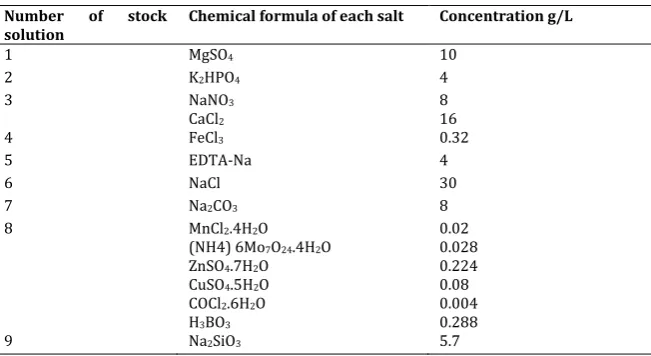
Chu-10 medium was prepared according to [18]. Stock solution (250 mL) for the following salts were prepared (Table 1): MgSO4.7H2O, K2HPO4, NaNO3, CaCl2, FeCl3,
EDTA-Na, NaCl, Na2CO3, MnCl2.4H2O, (NH4)
6Mo7O24.4H2O, ZnSO4.7H2O, CuSO4.5H2O, CoCl2.6H2O,
H3BO3, and Na2SiO3. 2.5 ml from each stock were taken
and completed the volume to one liter by distilled water, while the medium was autoclaved and used to culture Chlorella sp.
2.3 Growth curve estimation
The growth rate were estimated according to [19] as an indirect method for chlorophyll estimation. The pigments can be completely extractable in acetone and exhibits characteristic absorbance at 663 nm wave length. 5 ml of microalgae cultures was centrifuged at 5000 rpm for 10 minutes. The pellet was washed twice with distilled water. Then the pellet was resuspended in 80% acetone and vortexed thoroughly. The tubes were incubated in water bath at 60 °C in dark for 1 hour with occasional shaking. After 1 hour incubation, the suspension was centrifuged again and the supernatant was stored in dark. The procedure was repeated for the pellet to ensure complete extraction. Absorbance of the supernatant was read at 663 nm in UV-Vis spectrophotometer using 80% acetone as blank. The growth was estimated spectrophotometrically every 2 days, and the curve was plotted using the absorbance versus time.
2.4 Experimental design
a. Media development: Two concentrations for each of the following nutrients were prepared; MgSO4.7H2O, K2HPO4, and NaNO3, the concentration that were used was 0.1 mM, and 2-folds of the original medium concentration. For MgSO4.7H2O the concentrations were (0.1 mM and 166.6 mM), for K2HPO4 were (0.1 and 46 mM) and for NaNO3 were (0.1 and 188 mM). Algae were grown in a total of 7 different concentrations. One liter flasks were used for each concentration, while the initial pH was adjusted to 6.5 by 0.1N of sodium hydroxide or hydrochloric acid before sterilization and didn't controlled during the experiments. The media were inoculated by 2ml/ L of algae and the cultures were incubated in illuminated incubator with light intensity 167.48 µE m−2s−1 and
Table 1: Chu-10 medium composition
Number of stock
solution
Chemical formula of each salt Concentration g/L
1 MgSO4 10
2 K2HPO4 4
3 NaNO3
CaCl2
8 16
4 FeCl3 0.32
5 EDTA-Na 4
6 NaCl 30
7 Na2CO3 8
8 MnCl2.4H2O
(NH4) 6Mo7O24.4H2O
ZnSO4.7H2O
CuSO4.5H2O
COCl2.6H2O
H3BO3
0.02 0.028 0.224 0.08 0.004 0.288
9 Na2SiO3 5.7
b. Harvesting: Three harvesting methods were tested, 100 ml of algal cultures were used for each method. The pH was measured for each flask before applying the harvesting procedure. In centrifugation 100 ml of cultures was centrifuged in 5000 rpm for 30 minutes in cooling centrifuge to prevent the spoilage of the chemical components. The harvested biomass was washed twice using distilled water and then dried at 60 °C for 24 hour, then the dried biomass was weighted by Sensitive balance. Then the remained media were centrifuged again to ensure complete recovery of biomass. For chemical flocculation ferric chloride in concentration 30 mg/ L was used, for 100 ml of culture 3 mg was added. After that the cultures were left for 2 hours, then the pellet were taken and washed twice by distilled water. Then The recovered biomass was dried at 60 °C for 24 hour. The third method was auto-flocculation, while 100 ml of algal cultures were left to settle down for 4 hours. The biomass were collected and washed with distilled water then dried at 60 °C for 24 hour.
2.5 Extracting procedures
a. Carbohydrates extraction : The carbohydrates was extracted using anthrone method [20], which is a simple colorimetric method based on a reaction between the carbohydrates and anthrone reagent developing a green color. Solution with 0.1 of anthrone were prepared in 75% H2SO4, the reagent must be prepared freshly at the day of measurement. Glucose standard curve were prepared with final concentration 100 mg/L. 100 mg of freeze dried algal biomass were weighed and transferred to COD tube and placed on ice, 2 mL of 75% H2SO4 were added to the samples and vortexed thoroughly to mix the acid and the biomass. Anthrone reagent were added to all the tubes including glucose tubes (4 mL) and vortexed again to ensure the mixing of the reagent with the carbohydrates. Tubes were placed in water bath 100 °C for 15 minute and then cooled down to room temperature. The absorbance was measured at 625 nm for all the tubes and calibration curve was drawn from the glucose
concentration and the total carbohydrates were obtained using this calibration curve.
b. lipids extraction: The lipids were extracted according to [21]. For 1 gm of dried algal sample, 2 mL of methanol and 1 mL of chloroform were added, the mixture was kept at room temperature for 24 hours, and the mixture was then vortexed for 2 minute. 1 ml of chloroform was added again and mixed well. Then 1.8 ml of distilled water was added. The mixture was vortexed again for 2 minute followed by centrifugation for 10 min at 2000 rpm. The resultant upper layer was discarded and the lower layer was filtered with Whatmann No. 1 filter paper. The vial were weighted and recorded as (weight 1). The vial was put in a water bath until evaporation, the vial was weighed again and expressed as (weight 2). The lipid yield was calculated as w2-w1 and the result was expressed as % dcw gm/ L.
3. RESULTS AND DISCUSSION
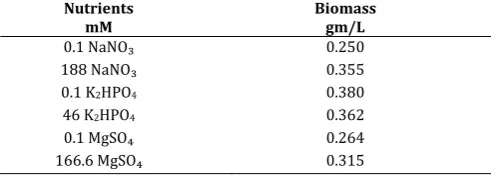
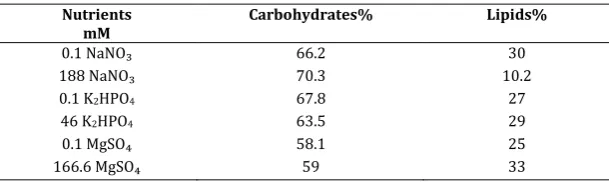
166.6 mM of MgSO4, in contrast to [22] in which 90% harvesting efficiency was obtained under 41.15 mM. High concentration of NaNO3 (188 mM) results in harvesting efficiency reached to 93% with pH value 11.6, while the K2HPO4 concentration (46mM) results in the lowest harvesting efficiency with 90% under pH of 11.4. When the low concentration of the nutrient was used the auto flocculation was low due to the low pH value ( 7.5-8.1) therefore, chemical flocculation was accompanied with auto flocculation by using ferric chloride (30 mg/L). The biomass recovery reached 91%, 88%, 90% for NaNO3, K2HPO4, MgSO4 respectively. The biomass was reduced significantly under high concentration of NaNO3, MgSO4, and K2HPO4 ( Table 1-1), this could be explained by the effect of the high pH on the nutrient availability since the high pH reduce the availability of CO2 and hence suppresses the growth [23]. The metabolic processes also effects negatively by the high pH and thus results in lowering the biomass [10]. Despite the biomass reduction in the high concentration of NaNO3 stimulated the carbohydrate accumulation to reach 70.3%, the lipids sharply reduced to 10.2%. It is proved that the lipid accumulation is inversely proportional to nitrogen concentration [24]. Furthermore the high concentration of MgSO4 enhanced the lipid accumulation to reach 33% which is the higher one among our results and the carbohydrates also increased slightly to about 59%. While the high concentration of K2HPO4 increased the carbohydrate to 63.5%, the lipids accumulation increased to 29%. Under the nutrient deficient condition (0.1 mM of each NaNO3, MgSO4, and
K2HPO4) the biomass reduced markedly (Table1-2). The NaNO3 and MgSO4 had the greatest effect on the biomass while K2HPO4 was the factor that had the less effect on the biomass. The deficiency in NaNO3 results in low biomass productivity but associated with increasing in the lipid productivity from 20.1% to 30%. This result is in well agreement with many previous results which suggest that under nitrogen deficiency the biomass lowers but the lipid accumulation could be enhanced [4, 25, 26]. It was noticed that under nitrogen deficient condition the carbohydrates increased notably to 66.2%. On the other hand, when the algae were grown in 0.1 mM of K2HPO4, the carbohydrates increased to about 67.8%, since the accumulation of carbohydrates take place when the intracellular phosphorus drops below the limitation level [27]. However the lipids also raised to 27%, this results also obtained by [28]. The MgSO4 deficient condition had a slightly positive effect on both carbohydrates and lipids productivity. Hence; the algae that were grown under 0.1 MgSO4 produced 58.1% and 25% of carbohydrates and lipids respectively, in contrast to the results of [29] who suggested that the MgSO₄ limitation is more suitable than phosphorus or nitrogen limitation to produce carbohydrates in large scale. The current results suggest that both NaNO3 and K2HPO4 limitation could be economically suitable to produce carbohydrates for bioethanol production as well as to enhance lipid accumulation for biodiesel production. Despite the fact that 2-folds of MgSO4 produced the higher lipids productivity and NaNO3 2-folds produced 70% carbohydrates, the cost saving goal still applies.
Figure 1: Growth curve of Chlorella sp
Table 1: The effect of different concentration on the biomass under un controlled pH conditions
Nutrients
mM Biomass gm/L
0.1 NaNO₃ 0.250
188 NaNO₃ 0.355
0.1 K2HPO4 0.380
46 K2HPO4 0.362
0.1 MgSO₄ 0.264
© 2017; AIZEON Publishers; All Rights Reserved
This is an Open Access article distributed under the terms of the Creative Commons Attribution License which permits unrestricted use, distribution, and reproduction in any medium, provided the original work is properly cited.
Table 2: The effect of nutrients different concentration on the contents
Nutrients
mM Carbohydrates% Lipids%
0.1 NaNO₃ 66.2 30
188 NaNO₃ 70.3 10.2
0.1 K2HPO4 67.8 27
46 K2HPO4 63.5 29
0.1 MgSO₄ 58.1 25
166.6 MgSO₄ 59 33
4. CONCLUSION
The current study investigated the effect of different concentrations of nutrients on chlorella sp., the experiments concluded that this type of algae is affected by the changing in nutrient concentrations positively and negatively. The positive side has represented a marked improvement in lipids and carbohydrates content in the cell. While the negative side to that change was the overall decline in biomass. The pH as one of the most important operational conditions plays a key role in the algae's ability to consume nutrients. In fact, the rise of pH along with the increasing in nutrients concentrations has reduced the biomass. However, this increase in pH was useful in the harvest experiment.
5. REFERENCES
1. Chisti, Y. (2007). Biodiesel from microalgae. Biotechnology advances. 25(3):294-306.
2. Doucha, J. and K. Lívanský. (2009). Outdoor open thin-layer microalgal photobioreactor: potential productivity. Journal of applied phycology. 21(1):111-117.
3. Rai, L., P. Rai, and N. Mallick. (1996). Regulation of heavy metal toxicity in acid-tolerant Chlorella: Physiological and biochemical approaches. Environmental and experimental botany. 36(1):99-109.
4. Van Iersel, S. and A. Flammini. (2010). Algae-based biofuels: applications and co-products.
5. Fábregas, J., A. Muñoz, J. Llovo et al. (1989). Differentiation of Candida guilliermondii varieties by lectin-like substances from marine algae. Research in microbiology. 140(5):373-378.
6. Li, Y., M. Horsman, B. Wang et al. (2008). Effects of nitrogen sources on cell growth and lipid accumulation of green alga Neochloris oleoabundans. Applied microbiology and biotechnology. 81(4):629-636.
7. Fan, J., Y. Cui, M. Wan et al. (2014). Lipid accumulation and biosynthesis genes response of the oleaginous Chlorella pyrenoidosa under three nutrition stressors. Biotechnology for Biofuels. 7(1):17.
8. Finkle, B.J. and D. Appleman. (1953). The effect of magnesium concentration on growth of Chlorella. Plant physiology. 28(4):664.
9. Chen, C.Y. and E.G. Durbin. (1994). Effects of pH on the growth and carbon uptake of marine phytoplankton. Marine Ecology Progress Series.83-94.
10.Hansen, P.J. (2002). Effect of high pH on the growth and survival of marine phytoplankton: implications for species succession. Aquatic microbial ecology. 28(3):279-288. 11.Wu, Z., Y. Zhu, W. Huang et al. (2012). Evaluation of
flocculation induced by pH increase for harvesting microalgae and reuse of flocculated medium. Bioresource technology. 110:496-502.
12.Chen, L., C. Wang, W. Wang et al. (2013). Optimal conditions of different flocculation methods for harvesting Scenedesmus sp. cultivated in an open-pond system. Bioresource technology. 133:9-15.
13.Divakaran, R. and V.S. Pillai. (2002). Flocculation of algae using chitosan. Journal of Applied Phycology. 14(5):419-422. 14.Uduman, N., Y. Qi, M.K. Danquah et al. (2010). Dewatering of
microalgal cultures: a major bottleneck to algae-based fuels. Journal of renewable and sustainable energy. 2(1):012701. 15.Al hattab, M., A. Ghaly, and A. Hammoud. (2015). Microalgae
Harvesting Methods for Industrial Production of Biodiesel: Critical Review and Comparative Analysis. J Fundam Renewable Energy Appl. 5:154.
16.Briley, D.S. and D.R. Knappe. (2002). Optimizing ferric sulfate coagulation of algae with streaming current measurements. Journal (American Water Works Association). 94(2):80-90. 17.Tenney, M.W., W.F. Echelberger, R.G. Schuessler et al. (1969).
Algal flocculation with synthetic organic polyelectrolytes. Applied microbiology. 18(6):965-971.
18.Kassim, T., H. Al-Saadi, and N. Salman. (1999). Production of some phyto-and zooplankton and their use as live food for fish larva. Iraqi J. Agric. Proc. of. 2:188-201.
19.Mackinney, G. (1941). Absorption of light by chlorophyll solutions. J. biol. Chem. 140(2):315-322.
20.Raunkjær, K., T. Hvitved-Jacobsen, and P.H. Nielsen. (1994). Measurement of pools of protein, carbohydrate and lipid in domestic wastewater. Water research. 28(2):251-262. 21.Bligh, E.G. and W.J. Dyer. (1959). A rapid method of total lipid
extraction and purification. Canadian journal of biochemistry and physiology. 37(8):911-917.
22.Nguyen, T.D., M. Frappart, P. Jaouen et al. (2014). Harvesting Chlorella vulgaris by natural increase in pH: effect of medium composition. Environ Technol. 35(9-12):1378-88.
23.Azov, Y. (1982). Effect of pH on inorganic carbon uptake in algal cultures. Applied and environmental microbiology. 43(6):1300-1306.
24.Li, X., P. Pribyl, K. Bisova et al. (2013). The microalga Parachlorella kessleri--a novel highly efficient lipid producer. Biotechnol Bioeng. 110(1):97-107.
25.Converti, A., A.A. Casazza, E.Y. Ortiz et al. (2009). Effect of temperature and nitrogen concentration on the growth and lipid content of Nannochloropsis oculata and Chlorella vulgaris for biodiesel production. Chemical Engineering and Processing: Process Intensification. 48(6):1146-1151. 26.Illman, A., A. Scragg, and S. Shales. (2000). Increase in
Chlorella strains calorific values when grown in low nitrogen medium. Enzyme and microbial technology. 27(8):631-635. 27.Cade-Menun, B.J. and A. Paytan. (2010). Nutrient
temperature and light stress alter phosphorus and carbon forms in culture-grown algae. Marine Chemistry. 121(1):27-36.
28.Liang, K., Q. Zhang, M. Gu et al. (2013). Effect of phosphorus on lipid accumulation in freshwater microalga Chlorella sp. Journal of Applied Phycology. 25(1):311-318.
29.Branyikova, I., B. Marsalkova, J. Doucha et al. (2011). Microalgae-novel highly efficient starch producers. Biotechnol Bioeng. 108(4):766-76.