Design of a Tunable Active Low Pass Filter by
CMOS OTA and a Comparative Study with
NMOS OTA with Different Current Mirror Loads
T. K. Das and S. Chakrabarti
Future Institute of Engg. and Management/ECE Department, Kolkata, India Email: [email protected], [email protected]
Abstract—The operational amplifiers (OPAMP) are basic building blocks in implementing a variety of analog circuits such as amplifiers, filters, integrators, differentiators, summers, oscillators etc. OPAMPs work well for low-frequency applications, such as audio and video systems. For higher frequencies, however, OPAMP designs become difficult due to their frequency limit. At those high frequencies, operational transconductance amplifiers (OTAs) are deemed to be promising to replace OPAMPS as the building blocks. This paper illustrates an application of OTA as an active low pass filter. The primary building block of an OTA is the current mirror. In this paper different current mirrors are used to design the LPF & the corresponding frequency and phase responses are comparatively studied. Also a comparative study of CMOS OTA & NMOS OTA is also illustrated in this paper. Finally, the applications of OTA based LPF are also studied.
Index Terms—complementary MOSFET, current mirror, low pass filter, operational transconductance amplifier
I. INTRODUCTION
An active low pass filter is an analog circuit that is widely used in communication systems and signal processing to pass a range of frequencies & reject the higher frequency [1]. It can be easily designed by a conventional operational amplifier. But CMOS operational transconductance amplifier can be used to design a LPF resulting reduced power dissipation & fabrication cost [1]-[5]. Some earlier works are enlisted in the references [6]-[11] where CMOS OTA is used. But in this paper we have started our work with NMOS OTA with different current mirror loads. Then we have designed the LPF by CMOS OTA with different current mirror loads. Finally a comparative study was investigated to draw the conclusion that CMOS OTA is much more superior to NMOS OTA in designing analog circuits.
II. THEORY AND PRINCIPLES
A. Basic Concept of OTA
An OTA is a voltage controlled current source, more specifically the term “operational” comes from the fact
Manuscript received January 24, 2014; revised October 20, 2014.
that it takes the difference of two voltages as the input for the output current conversion. The ideal transfer characteristic is therefore,
( )
out m in in
I g V V (1)
where Vin+=Input voltage applied at the non-inverting input terminal of the OTA, Vin-=Input voltage applied at the inverting input terminal of the OTA and gm=Transconductance of the OTA.
An ideal OTA has two voltage inputs with infinite impedance (i.e. there is no input current). The common mode input range is also infinite, while the differential signal between these two inputs is used to control an ideal current source (i.e. the output current does not depend on the output voltage) that functions as an output. The proportionality factor between output current and input differential voltage is called transconductance. Fig. 1, Fig. 2 and Fig. 3 show the macro model, ideal model and small signal equivalent model of OTA respectively.
Figure 1. Macro model of OTA.
Figure 2. Ideal model of OTA.
The amplifier’s output voltage is the product of its output current and its load resistance:
OUT
out load
V I R (2)
The voltage gain is then the output voltage divided by the differential input voltage:
out
m load m
in in
V
G R g
V V
(3)
B. Current Mirror Fundamentals
An OTA is basically a differential amplifier with active current mirror load to accomplish high gain. As the name itself suggests a current mirror is used to generate a replica (if necessary it may be attenuated or amplified) of a given reference current. If we look at the electric function of the circuit, a current mirror is a current controlled current source (CCCS).
A current mirror is basically nothing more than a current amplifier. The ideal characteristics of a current amplifier are:
Output current linearly related to the input current, Iout=Ai.Iref
Input resistance is zero Output resistance is infinity
In addition, we have the characteristic Vmin which applies not only to the output but also the input. Vmin (in) is the range of input voltage over which the input resistance is not small and Vmin (out) is the range of the output voltage over which the output resistance is not large. Fig. 4, Fig. 5 and Fig. 6 show the block diagram, transfer characteristics and output characteristics of a current mirror respectively.
Figure 4. Block diagram of current mirror.
Figure 5. Transfer characteristics of current mirror.
Figure 6. Output characteristics of current mirror.
Therefore, we will focus on Rout, Rin, Vmin (out), Vmin (in), and Ai to characterize the current mirror. We can design a number of circuits which can accomplish the current mirror function. The ones mostly used are:
1. Simple Current Mirror 2. Wilson Current Mirror 3. Cascode Current Mirror Simple current mirror (Widlar)
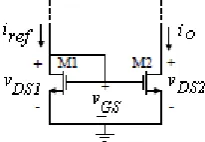
Fig. 7 below shows the schematic circuit diagram of a simple current mirror.
Figure 7. Schematic circuit diagram of simple current mirror.
We assume that VDS2>VGS –VT2 then,
2
2 2
1 2 2
2 1 1 1 1
1 '
1 '
out GS T DS
ref GS T DS
i LW V V V K
i L W V V V K
(4)
If the transistors are matched, then K1’=K2’ and VT1=VT2 to give:
2 1 2
2 1 1
1 1
out DS
ref DS
i L W V
i L W V
(5)
If VDS1=VDS2 then, we have
1 2
2 1 o
ref
i L W
i L W
(6)
Therefore the sources of errors are: 1) VDS1 and VDS2 are not equal. 2) M1 and M2 are not matched. 3) Channel length modulation (λ) and 4) Threshold offset.
Fig. 8 shows the small signal equivalent model of a simple current mirror.
Figure 8. Small signal equivalent model of simple current mirror.
Finally,
2 1
1 2 1
/ 1 ( ) /
out m m
ref gs gs m
i g g
i S C C g
(7)
Wilson current mirror
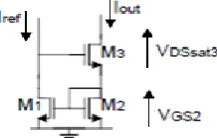
Figure 9. Schematic circuit diagram of Wilson current mirror.
here, VGS1=VGS2, so ID1 is almost equal to ID2. Then,
2 1
1
2
1 1
out DS
ref DS
W
i L V
W
i V
L
(8)
Since, VDS1=VDS2+VGS3
2 1
2 3
2
1
1 ( )
out DS
ref DS GS
W
i L V
W
i V V
L
(9)
The output voltage swing is limited to
2
,min GS ,3 2
out DSsat Th DSsat
V I V V V (10)
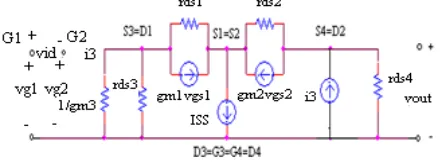
It uses negative series feedback (M3) to achieve higher output resistance. Fig. 10 shows the small signal equivalent model of a Wilson current mirror.
Figure 10. Small signal equivalent model of Wilson current mirror.
Cascode current mirror
Fig. 11 below shows the schematic circuit diagram of a cascode current mirror.
Figure 11. Schematic circuit diagram of cascode current mirror.
An alternative way to increase the output resistance is to use the cascade configuration. The output stage consists of two transistors M2, M3 in the cascade arrangement. They are biases result from two other transistors M1 M4 which are diode connected. Again, as for the previously started current mirror the VGS voltage of M1 and M2 are set equal. Therefore a replica of current in M1 is generated by M2. The output resistance increases because of the cascode arrangement. Here,
2
1 DS 3 4
DS GS GS
V V V V (11)
If VGS3=VGS4 then, VDS1=VDS2. Finally,
2
1 1
1
2 2
1 1
out DS
ref DS
W W
i L V L
W W
i V
L L
(12)
Fig. 12 below shows the small signal equivalent model of a cascode current mirror.
Figure 12. Small signal equivalent model of cascode current mirror.
The output swing is limited to
1
,min GS 4 3 ,3
out GS GS DSsat
V V V V V (13)
2
,min GS ,3 2
out DSsat TH DSsat
V V V V V (14)
Hence, the output resistance is increased without feedback.
C. NMOS OTA Design with Current Mirror Loads
Fig. 13, Fig. 14 and Fig. 15 show the circuit diagram of NMOS OTA with simple, Wilson and cascode current mirror loads respectively.
Figure 13. Circuit diagram of NMOS OTA with simple current mirror load.
Figure 15. Circuit diagram of NMOS OTA with cascode current mirror load.
Principle of operation (simple current mirror load) In NMOS OTA the M1 and M2 transistors are operated in saturation region i.e. they satisfy the equations:
1
1 GS 1& 2 2 2
DS T DS GS T
V V V V V V (15)
The current equations are:
1
1 0.5 1( GS 1)
D n T
I K V V (16)
2
2 0.5 2( GS 2)
D n T
I K V V (17)
The sink current,
1 2
SS D D
I I I (18)
M1 and M2 are assumed to be perfectly matched i.e. Kn1=Kn2 and VT1=VT2. Two cases may be possible.
Case 1: If VGS1>VGS2, then ID1 increases with respect to ID2 since ISS=ID1+ID2. This increase in ID1 implies an increase in ID3 and ID4. However, ID2 decreases when VGS1 is greater than VGS2. Therefore the only way to establish circuit equilibrium is for IOUT to become positive and VOUT decreases.
Case 2: If VGS1>VGS2, the accordingly it can be seen that IOUT becomes negative and VOUT increases.
In this way a differential voltage is converted to output current and hence the name “operational transconductance amplifier” is justified. Other configurations of NMOS OTA can also be explained accordingly. Fig. 16 shows the small signal equivalent model of NMOS OTA with simple current mirror load.
Figure 16. Small signal equivalent model of NMOS OTA with simple current mirror load.
Limitations of NMOS OTA Power dissipation is high. Bandwidth is less. Noise Margin is low.
CMRR is low. Slew rate is low. Fabrication cost is high. Tranconductance is low.
D. CMOS OTA Design With Current Mirror Loads
The best suited component for design of OTA is CMOS devices as it has the following advantages:
Very less power dissipation as the feature size of CMOS processes reduce.
CMOS provides the highest analog-to-digital on-chip integration.
Overall fabrication cost is less.
Noise margin is high and stability performance is better.
CMRR, Slew rate, and PSRR are improved. Switching speed is very high.
Figure 17. Circuit diagram of CMOS OTA with simple current mirror load.
Figure 18. Circuit diagram of CMOS OTA with Wilson current mirror load.
In CMOS OTA the differential amplifier part is exactly same as NMOS OTA, consisting of two NMOS enhancement mode transistors. But the current mirror part (I-V conversion) is made of PMOS enhancement mode transistors as shown in the following figures. Fig. 17, Fig. 18 and Fig. 19 show the circuit diagram of CMOS OTA with simple, Wilson and cascode current mirror loads respectively.
Fig. 20 below shows the small signal equivalent model of CMOS OTA with simple current mirror load.
Figure 20. Small signal equivalent model of CMOS OTA with simple current mirror load.
E. Low Pass Filter Fundamentals
A filter is a device that passes electric signals at certain frequencies or frequency ranges while preventing the passage of others. The active filters differ from passive filters (simple RC circuits) by the fact that there is the ability for gain depending on the configuration of the elements in the circuit. It consists of active elements like BJT, Opamp, FET, and MOSFET. In our design we have used NMOS OTA & CMOS OTA to design an active Low Pass Filter (LPF).
The low pass filter is one that allows low frequencies to pass and stops (attenuates) higher frequencies The design of a low pass filter needs to take into consideration the maximum frequency that would need to be allowed through. This is called the cut off frequency (or the 3dB down frequency). Based on the type of filter that is used (e.g. Butterworth, Bessel etc.) the attenuation of the higher frequencies can be greater. This attenuation is also based on the order (e.g. 1st, 2nd, 3rd…) of the filter that is used. Based on the order of the filter the roll-off of the filter can be calculated using the formula –n*20 dB/decade. This means that a first order low pass filter has an attenuation of -20dB/decade, while a second order filter should have -40dB/decade roll-off and on down the list for higher orders. Fig. 21 shows the typical frequency response curves of low pass filter for different orders.
Figure 21. Frequency response curves of low pass filter.
III. PROPOSED 1ST ORDER LPFDESIGN BY NMOS OTA
Fig. 22 shows the circuit diagram of our proposed low pass filter by OTA.
Figure 22. Circuit diagram of proposed low pass filter.
The transfer function of the filter section is,
( ) 1/ 1 1 1 ( )
( ) 1/ 1 1 1 1 1
in
in
V s R C
A s
V s S R C SR C
(18)
where the complex frequency variable, s=σ+jw allows for any time variable signals. For pure sine waves, the damping constant, σ becomes zero and s=jw. For a normalized presentation of the transfer function, s is referred to the filter’s corner frequency, or –3 dB frequency, wc in rad/sec, and has these relationships:
s
jw
jf
s
wc
wc
fc
(19)The magnitude of the gain response is:
1
( )
1
A w
w
wc
(20)
At w=wc the magnitude of the gain is 0.707 or -3dB. Hence, the pass band is: 0≤w≤wc, and the stop band is: w>wc.
We have wc=1/R1C1. The roll off factor for 1st order LPF is -20dB/decade. The phase angle of the sinusoidal transfer function of the 1st order LPF is formulated as follows.
1
( ) tan ( 1 1)
A w wR C
(21)
At w=wc, the phase angle becomes –45o and as w tends to infinity, the phase angle tends to -90o which concludes that the order of the filter is 1.
IV. RESULTS OF SOFTWARE SIMULATION
set, Vdd=5V, Cload=1pF for all the circuits and tuned ISS to get positive output voltage. The calculations are done according to the following definitions of the parameters.
1) Output Offset Voltage (Voo) is the output voltage, Vout with Vin+=Vin-=0V
2) CMRR dB( ) 20 log Ad Acm
(22)
where, Ad=Differential Voltage gain and Acm=Common mode voltage gain.
3) ( ) 20 log / ( 0 )
/ ( 0 )
O O
V Vid Vdd V
PSRR dB
V Vdd Vid V
(23)
4) Siew Rate SR ( ) VoutV/ s
V
(24) For Vin+=u(t), unit step signal with Vin-=0V.
Figure 23. Gain (db) vs. frequency (Hz) plot of a 1st order LPF using
NMOS OTA with simple current mirror load
Figure 24. Phase angle (degree) vs. frequency (Hz) plot of a 1st order LPF using NMOS OTA with simple current mirror load
Figure 25. Gain (dB) vs. frequency (Hz) plot of a 1st order LPF using NMOS OTA with Wilson current mirror load
Figure 26. Phase angle (degree) vs. frequency (Hz) plot of a 1st order
LPF using NMOS OTA with Wilson current mirror load
Figure 27. Gain (dB) vs. frequency (Hz) plot of a 1st order LPF using NMOS OTA with cascode current mirror load
Figure 28. Phase angle (degree) vs. frequency (Hz) plot of a 1st order
LPF using NMOS OTA with cascode current mirror load
Figure 29. Gain (dB) vs. frequency (Hz) plot of a 1st order LPF using
CMOS OTA with simple current mirror load
Figure 30. Phase angle (degree) vs. frequency (Hz) plot of a 1st order LPF using CMOS OTA with simple current mirror load
Figure 31. Gain (dB) vs. frequency (Hz) plot of a 1st order LPF using
CMOS OTA with Wilson current mirror load
Figure 32. Phase angle (degree) vs. frequency (Hz) plot of a 1st order LPF using CMOS OTA with Wilson current mirror load
Figure 34. Phase angle(degree) vs. frequency (Hz) plot of a 1st order LPF using CMOS OTA with cascode current mirror load
Fig. 23-Fig. 28 show the gain (dB) vs. frequency (Hz) and phase angle (degree) vs. frequency (Hz) plots for 1st low pass filter designed by NMOS and Fig. 29-Fig. 34 those for CMOS OTA with different current mirror loads
as discussed earlier. For the design we have chosen R1=10kΩ and C1=0.01μF, Vin=1Vpp sine wave. The theoritical value of high cut-off frequency, fH =1/2π.R1.C1=1.59kHz. We assume the pass band gain as unity. In Fig. 23 the maximum pass band gain in dB, high cut-off frequency and its corresponding gain in dB are indicated. In Fig. 24 the phase angel at high cut-off frequency and also that as frequency tends to infinity are indicated. In Table I a parameter values of NMOs OTA and CMOS OTA are listed. In Table II all the specifications of the designed low pass filter are listed for all the circuits. In Table III the static power dissipations for all the circuits are listed.
TABLE I. PARAMETERS OF NMOSOTA AND CMOSOTA
Type of OTA
Type of current mirror load
Output offset voltage
CMRR (dB)
PSRR (dB)
Slew Rate (V/μs)
Bias Voltage (Vdd) (Volts)
Sink Current (ISS)
NMOS
Simple 11.95nV 152.07 190.39 35.08 5 500 μA Wilson 527.86mV 7.1027 32.44 30.79 5 100 μA Cascode 527.86mV 0.31 32.53 4.41 5 100 μA
CMOS
Simple 13.57nV 168.81 190.06 184.45 5 500μA Wilson 12.81mV 9.54 13.98 41.63 5 10pA Cascode 527.86mV 15.86 32.40 51.76 5 100uA
TABLE II. SPECIFICATIONS OF NMOS AND CMOSOTABASED 1ST ORDER LPF
Type of OTA
Type of current mirror
load
High cut-off frequency (fH) (kHz)
Maximum pass-band gain
(dB)
Slope of the magnitude plot
(dB/Decade)
Phase angle at fH
(degree)
Phase angle as frequency tends to infinity (degree)
NMOS
Simple 1.5903 -9.54 -19.89 -44.88 -89.03 Wilson 1.5901 -6.05 -19.89 -44.89 -89.03 Cascode 1.5903 -7.94 -19.89 -44.24 -89.23
CMOS
Simple 1.5901 -2.81m -19.89 -44.88 -89.77 Wilson 1.5901 -5.53m -19.89 -44.88 -89.91 Cascode 1.5901 -9.65m -19.89 -44.95 -89.93
TABLE III. STATIC POWER DISSIPATION
Type of OTA
Type of current mirror load
Bias voltage,
Vdd (Volts)
Sink Current
ISS
Static Power Dissipation
NMOS
Simple 5 500μA 2.5mW Wilson 5 122μA 0.61mW Cascode 5 43μA 0.22mW
CMOS
Simple 1 168.81 5pW Wilson 1 9.54 3pW Cascode 1 15.86 2.1Pw
V. APPLICATIONS OF OTABASED LPF
A. In Phase Locked Loop
The Phase locked loop (PLL) is a frequency-selective feedback system which can synchronize with a selected input signal and track the frequency changes associated with it. It is the basic building block of FM demodulators, stereo demodulators, tone decoders, frequency synthesizers, television display systems & many other circuits. Fig. 35 shows the basic block diagram of a PLL with our proposed OTA based LPF as the loop filter.
B. In DSB-SC Demodulator
In Double Side Band Suppressed Carrier (DSB-SC) demodulator circuit our proposed OTA based LPF can be used as shown in Fig. 36 below.
Figure 35. Basic block diagram of PLL
Figure 36. Basic block diagram DSB-SC demodulator(synchronous detection method)
VI. CONCLUSIONS
From Table III we can conclude that the CMOS based OTA reduces the static power dissipations drastically & also the pass band gain is nearer to 0dB i.e. unity gain which is our objective. It may be further noted that the bias voltage for CMOS OTA is reduced greatly. We call our proposed OTA based LPF as tunable because by adjusting the values of power supply and sink current we can get different pass band gain less than unity. Again, the high cut-off frequency can be adjusted by changing simply the values of resistor, R and capacitor, C of the input RC section. The other advantages of our design over conventional OPAMP based LPF are (1) a single power supply is required, (2) CMRR, PSRR, slew rate are better. (3) noise margin is high, (4) design is very simple, (5) fabrication cost is reduced greatly.
VII. FUTURE SCOPE
Here we have designed a 1st order LPF with different current mirror loads and a comparative study was analyzed. The OTA can be used to design higher order filters to get more ideal frequency response by simply including more RC sections at the non-inverting terminal of the OTA. Also the higher pass band can be obtained by changing the value of R and C. Again, pass band gain can be increased by adding a feedback resistor voltage divider section at the inverting input terminal of the OTA. The OTA can be designed practically in IC fabrication lab and the practical applications of OTA based LPF can be studied. In our design for the CMOS OTA we have used NMOS transistors to design the differential amplifier with PMOS transistors for the current mirror section. These transistors can be interchanged & the change at the output can be studied.
REFERENCES
[1] C.-L. Hsu, M.-H. Ho, Y.-K. Wu, and T.-H. Chen, “Design of low-frequency low-pass filters for biomedical applications,” in Proc. IEEEAsia Pacific Conference on Circuits and Systems, Dec. 2006, pp. 690-695.
[2] E. R. Villegas, A. J. Casson, and P. Corbishley, “A subhertz nanopower low-pass filter,” IEEE Transactions on Circuits and Systems II, vol. 58, no. 6, pp. 351-355, Jun. 2011.
[3] H. Liu, X. Peng, and W. Wu, “Design of a Gm-C low pass filter with low cutoff frequency,” in Proc. Asia Pacific Conference on Postgraduate Research in Microelectronics and Electronics, Jan. 2009, pp. 125-128.
[4] P. K. Mahapatra, M. Singh, and N. Kumar, “Realization of active filters using operational transconductance amplifier (OTA),” Journal of the Instrument Society of India, vol. 35, no. 1, pp 1-9, 2009.
[5] R. L. Geiger and E. Sánchez-Sinencio, “Active filter design using operational transconductance amplifiers: A tutorial,” IEEE Circuits and Devices Magazine, vol. 1, pp. 20-32, Mar. 1985.
[6] H. S. Malvar, “Electronically controlled active filters with
operational transconductance amplifier,” IEEE Transactions on
Circuits and Systems, vol. CAS 29, pp. 333-336, May 1982.
[7] F. Rezzi, A. Bashirotto, and R. Castello, “A 3V 12-55MHz BiCMOS pseudo-differential continuous-time filter,” IEEE Transactions on Circuits and System I, vol. 42, pp. 896-903, Nov. 1995.
[8] A. Timar and M. Rencz, “Design issues of a low frequency low-pass filter for medical applications using CMOS technology,” in Proc. IEEE Design and Diagnostics of Electronic Circuits and Systems, Apr. 2007, pp. 1-4.
[9] S. Solis-Bustos, J. S. Martinez, F. Maloberti, and E. Sanchez-Sinencio, “A 60-dB dynamic-range CMOS sixth-order 2.4-Hz low-pass filter for medical applications,” IEEE Transactions on Circuits and Systems, vol. 47, no. 12, pp. 1391-1398, Dec. 2000. [10] T.-Y. Lo and C. C. Hung, “A 1-V Gm-C low-pass filter for uwb
wireless application,” in Proc. IEEE Asian Solid-State Circuits Conference, Nov. 2008, pp. 277-280.
[11] W. R. Grise. Application of the operational transconductance
amplifier to voltage controlled amplifiers and active filters. TECHNOLOGY INTREFACE: The Electronic Journal for Engg. Technology [Online]. Available: http://et.nmsu.edu/~etti
Tarun Kumar Das was born in Kolkata, India
in 1979. He received the B.Tech. degree in Electronics & Communication Engineering from Murshidabad College of Engg. & Technology under West Bengal University of Technology, India in 2003, M.Tech. degree in software engineering from West Bengal University of Technology, India in 2008. Currently he is an assistant professor in Electronics & Communication Engineering Department at Future Institute of Engineering & Management under West Bengal University of Technology. His research interest includes microelectronics & VLSI technology, control system and signal processing.
Sreya Chakrabarti was born in Barakar, India