COMPUTER SCIENCE & TECHNOLOGY
www.computerscijournal.org
September 2013, Vol. 6, No. (3): Pgs. 307-314 An International Open Free Access, Peer Reviewed Research Journal
Published By: Oriental Scientific Publishing Co., India.
INTRODUCTION
Wireless communications is, by any measure, the fastest growing segment of the communications industry. As such, it has captured the attention of the media and the imagination of the public. Cellular systems have experienced exponential growth over the last years and there are currently around two or more billion users worldwide.
Comparative Study and Performance Analysis of
DSDV, OLSR, AODV, DSR and MAODV Routing
Protocols in MANETs
HAIDER AYAD KHUDAIR
1and MOHAMMED A.NASER
21College of Science, Babylon University 2College of Science for Women, Babylon University.
(Received: July 31, 2013; Accepted: August 16, 2013)
ABSTRACT
Mobile Ad-Hoc Network (MANET) is a wireless network without infrastructure and decentralized network which need a robust dynamic routing protocol and it is becoming an important concept of modern communication technologies and services. There are various routing protocols available for MANETs. In this work, we focus on the most popular ones are Destination-Sequenced Distance Vector (DSDV), Optimized Link State Routing(OLSR), Ad-hoc On-demand Distance Vector (AODV), Dynamic Source Routing (DSR) and Multicast Ad Hoc On-Demand Distance Vector Routing Protocol (MAODV) routing protocol. This paper is an attempt to study, analysis and compare these five routing protocols on the basis of various performance metrics such as throughput of received packets, throughput of dropped packets, packet delivery ratio, end to end delays, jitter and normalizes routing load .This performance evaluation have been perform under different environments. The simulation results indicate that none of the routing protocols we selected have shown best performance in all the six different performance metric. Therefore, the efficiency of a network can be achieved by choosing the best suitable protocols based on the network requirement.
Key words: DSDV, OLSR, AODV, DSR, MAODV, MANETs.
innovative and challenging areas of wireless networking and this technology promises to become increasingly present in everybody’s life. Ad hoc networks are a key step in the evolution of wireless networks.
The routing is not the same as in the wired networks. In wired networks routers are the central elements. In MANETs, there is no such element, but all the nodes can perform as a router, transmitter or receiver element. Hence, the routing is made by the node executing a specific routing protocol for MANETs.
As it has been said, MANETs are necessary to have different routing protocols from the wired networks.
Analysis and study of routing protocols in MANETS
Routing protocols in MANETs can be classified as Proactive (Table driven), Reactive (On demand) and Hybrid.
Table-driven (Proactive protocols)
In the proactive protocols, each node has a routing table, updated periodically, even when the nodes don’t need to forward any message. In this work, we focus on the two important and popular proactive routing protocols are DSDV and OLSR.
Destination-Sequenced Distance-Vector Routing (DSDV)
Is a distance-vector protocol with extensions to make it suitable to MANET. Every node maintains a routing table with one route entry for each destination in which the shortest path route (based on number of hops) is recorded. To avoid routing loops, a destination sequence number is used5.
DSDV Advantages
• It does not bloat packets. Source routing algorithms, on the other hand, put the whole route in packets, adding to their size, increasing the chance of collisions, and reducing throughput.
• Routes to all destinations are always available.
• Less delay for route setup.
DSDV Disadvantages
• It discovers routes even if they are not needed.
• Heavy control overhead because of updates.
• Updates can choke the whole bandwidth. • Not scalable.
• Very bad for large networks or high mobility8.
Optimized link state routing (OLSR)
Is an optimization for MANET of legacy link-state protocols. The key point of the optimization is the multipoint relay (MPR). Each node identifies (among its neighbors) its MPRs. By flooding a message to its MPRs, a node is guaranteed that the message, when retransmitted by the MPRs, will be received by all its two-hop neighbors.
OLSR Advantages
´ It needs that each host periodically sends the updated topology information throughout the entire network. This increases the protocol bandwidth usage.
´ The use of MPRs minimizes the flooding in comparison with other proactive routing protocols.
• It is well suited for the application which does not allow the long delays in the transmission of the data packets.
• It does not require that the link is reliable for the control messages, since the messages are sent periodically and the delivery does not have to be sequential.
• It has also extensions to allow hosts to have multiple OLSR interface addresses and provide the external routing information giving the possibility for routing to the external addresses. Based on this information there is the possibility to have hosts in the ad hoc network which can act as gateways to another possible network.
OLSR Disadvantages
Demand-driven (Reactive protocols)
In the reactive protocols, the routes are calculated only when required. When a source wants to send information to some destination, it calls on route discover mechanisms to find the best route to this destination. In this work, we study and analysis three of important and popular reactive routing algorithms: AODV, DSR, MAODV.
Ad-Hoc On-Demand Distance Vector algorithm (AODV)
Is based on hop-by-hop routing approach. To find a route to the destination, the source broadcasts a route request packet. This broadcast
message propagates through the network until it reaches an intermediate node that has recent route information about the destination or until it reaches the destination. When intermediate nodes forwards the route request packet it records in its own tables which node the route request came from.
AODV Advantages
´ Routes are established on demand and destination sequence numbers are used to find the latest route to the destination. ´ Lower delay for connection setup11.
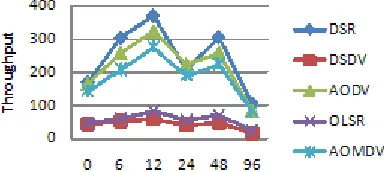
Fig. 1: (a) Throughput Vs Pause Time for 10 Nodes Fig. 2: (a) Throughput of dropped packets Vs pause time 10 Nodes
Fig. 2: (b) throughput of dropped packets Vs pause time 20 Nodes
Fig. 2: (c) throughput of dropped packets Vs pause time 40 Nodes Fig. 1: (b) Throughput Vs Pause Time for 20 Nodes
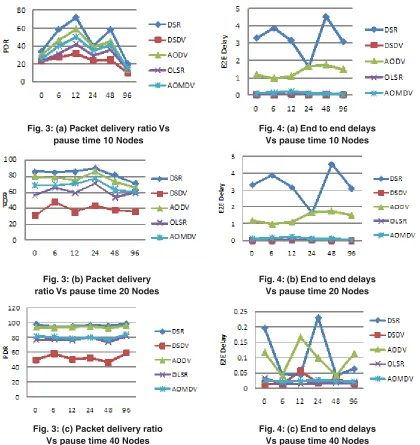
Fig. 3: (a) Packet delivery ratio Vs pause time 10 Nodes
Fig. 3: (b) Packet delivery ratio Vs pause time 20 Nodes
Fig. 3: (c) Packet delivery ratio Vs pause time 40 Nodes
Fig. 4: (a) End to end delays Vs pause time 10 Nodes
Fig. 4: (b) End to end delays Vs pause time 20 Nodes
Fig. 4: (c) End to end delays Vs pause time 40 Nodes AODV Disadvantages
´ AODV doesn’t allow handling unidirectional links.
´ Multiple Route Reply packets in response to a single Route Request packet can lead to heavy control overhead.
´ Periodic beaconing leads to unnecessary bandwidth consumption11.
The Dynamic Source Routing protocol (DSR) Is a simple and efficient routing protocol designed specifically for use in multi-hop wireless
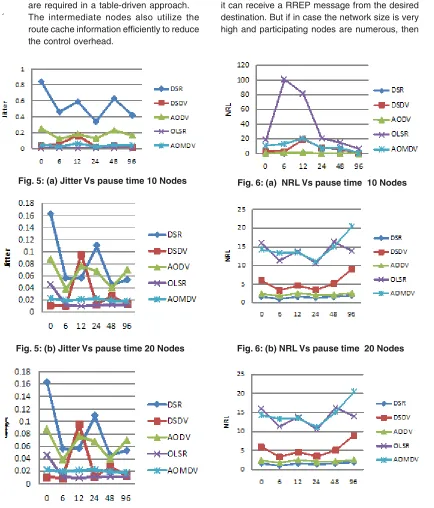
Fig. 5: (a) Jitter Vs pause time 10 Nodes
Fig. 5: (b) Jitter Vs pause time 20 Nodes
Fig. 5: (c) Jitter Vs pause time 40 Nodes
Fig. 6: (a) NRL Vs pause time 10 Nodes
Fig. 6: (b) NRL Vs pause time 20 Nodes
Fig. 6: (c) NRL Vs pause time 40 Nodes
received the message and its address is not present in the route record of the message7.
DSR Advantages
´ DSR uses a reactive approach which eliminates the need to periodically flood the network with table update messages which are required in a table-driven approach. ´ The intermediate nodes also utilize the
route cache information efficiently to reduce the control overhead.
DSR Disadvantages
there will be a possibility to have so many routes to the destination. It may result in the reply storms this may cause collision of packets and it may increase the congestion at the nodes while sending reply11.
Multicast Ad Hoc On-Demand Distance Vector Routing Protocol (MAODV)
Is the extension of the AODV protocol. It uses sequence numbers to ensure most recent route to the multicast group. Two phases of this routing protocol are tree initialization phase and tree maintenance phase, where MAODV uses the notion of group leader which updates the
sequence number periodically and broadcasts it using group hellos. The first node to join the group is the group leader. The new node that wish to join group, it sends a unicast a route request (RREQ) to the group leader. If it does not have the address of the group leader, they broadcast a RREQ packet to its neighbors and it is rebroadcasted by nodes which are not members of the multicast tree.
Simulation environment and parameters
For the simulation of our study, latest version of NS-2 has been used. Ns-2 is a discrete event simulator targeted at networking research.
The simulation parameters that used in this work show in the following:
No. of Nodes 10,20,40
Area 1000m*1000m
Simulation time 96 sec Phy and MAC Model 802.11
Node Placement Random
Mobility Random Way point(0-25msec)
Bandwidth(B/S) 2000000
Radio Frequency 2.4e9 Hz
Routing Protocol DSDV,OLSR,AODV, DSR and MAODV
Performance metrics for analysis and comparison
There are number of performance metrics that can be used to compare routing protocols. This performance metric determines the completeness and correctness of the routing protocol. We have used the important and popular metrics for analyzing the performance of mentioned routing protocols:
Throughput of received packets
This represents the number of packets received within a given time interval.
Throughput of dropped packets
This represents the number of packets dropped within a given time interval.
Packet Delivery Ratio (PDR)
It is the ratio of the number of data packets successfully delivered to destination nodes to the
total number of data packets sent by source nodes.
End to End delays
It represents the delay encountered between the sending and receiving of the packets.
Jitter
It represents any unwanted variation in one or more signals generated during the packet transfer. The term jitter is often used as a measure of the variability over time of the packet latency across a network. However, jitter is the variation of the packet arrival time.
Normalizes Routing Load (NRL): is the number of routing packets transmitted per data packet delivered to the destination.
Simulation Results, Performance Evaluation & Analysis
following sections in the form of line graphs which are show comparison between the five routing protocols by varying different number of parameters on the basis of the above mentioned performance metrics as a function of pause time.
Throughput of received packets
Figure 1(a,b,c) line graphs for throughput of received packets Vs pause time .This performance metric has been evaluated for DSDV , OLSR , AODV, DSR and MAODV of Ad-hoc routing protocols using 10 , 20 , 40 nodes respectively .
The throughput varies with increase the pause time. Where DSR performs better results, while DSDV routing protocol is the lowest in term of throughput.
Throughput of dropped packets
Figure 4-2(a,b,c) line graphs for throughput of dropped packets Vs pause time .Also this performance metric has been evaluated for DSDV , OLSR , AODV, DSR and MAODV of Ad-hoc routing protocols using 10 , 20 , 40 nodes respectively .
We see with increase the pause time of the mobile nodes, the number of dropped packets will vary according pause time. DSR is better than other routing protocols, while DSDV presents large number of dropped packets.
Packet Delivery Ratio (PDR)
Figure 4-3(a,b,c) line graphs for packet delivery ratio Vs pause time. This performance metric has been evaluated for DSDV , OLSR , AODV, DSR and MAODV of Ad-hoc routing protocols using 10 , 20 , 40 nodes.
The packet delivery fraction varies with increase the pause time. DSR routing protocol is the best in the packet delivery fraction. While DSDV presents low packet delivery fraction.
End to End delays
Figure 4 (a,b,c) line graphs for end to end delays Vs pause time .This performance metric has been evaluated for DSDV , OLSR , AODV, DSR and MAODV of Ad-hoc routing protocols using 10 , 20 , 40 nodes respectively .
End to End delays
Figure 4 (a,b,c) line graphs for end to end delays Vs pause time .This performance metric has been evaluated for DSDV , OLSR , AODV, DSR and MAODV of Ad-hoc routing protocols using 10 , 20 , 40 nodes respectively .
End to End delays
Figure 4 (a,b,c) line graphs for end to end delays Vs pause time .This performance metric has been evaluated for DSDV , OLSR , AODV, DSR and MAODV of Ad-hoc routing protocols using 10 , 20 , 40 nodes respectively .
From the above figure , DSR and AODV show the best performance measure . While OLSR seems introduce the lowest performance in term of jitter.
Normalizes Routing Load (NRL)
Figure 6 (a,b,c) line graphs for Normalizes Routing Load Vs pause time .This performance metric has been evaluated for DSDV , OLSR , AODV, DSR and MAODV of Ad-hoc routing protocols using 10 , 20 , 40 nodes respectively As shown, DSR and AODV performs low normalize routing load than other routing protocols(the better), while OLSR introduces high range of it (the worse).
CONCLUSIONS
In this paper, we provide descriptions of several routing protocols for ad hoc mobile networks (MANETs). We also provide a classification of these schemes according to the routing strategy (i.e., table-driven and on-demand) and present a comparison and performance analysis of five prominent routing protocols i.e. DSDV,OLSR,AODV,DSR and MAODV on the basis various performance metrics such as throughput of received packets, throughput of dropped packets, packet delivery ratio, end to end delays, jitter and normalizes routing load under different network scenario environments such as no. of nodes ,simulation time, physical and MAC model, node placement mobility, bandwidth and others.
disadvantages, and is well suited for certain situations specially after the field of ad hoc mobile networks is rapidly growing and changing, and while there are still many challenges that need to be met, it is likely that such networks will see
widespread use within the next few years. Finally, the results after analysis and performance evaluation have been reflected in many line graph figures.
REFERENCES
1. Behrouz A. Forouzan with Sophia Chung Fegan, “ Data Communications and Networking”, Fourth Edition, DeAnza College, p.40 (2007).
2. Andrea Goldsmith,” WIRELESS COMMUNICATIONS “, Stanford University, p.1 (2005).
3. Stefano Basagni, Marco Conti, Silvia Giordano and Ivan Stojmenovic,”MOBILE AD HOC NETWORKING”, Willey Inter Science IEEE Press, ISBN 0-471373133, p.18 (2004).
4. Luis Gironés Quesada, “A Routing Protocol for MANETs”,NTNU Department of Telematics, May 10, .21..23 (2007). 5. Elizabeth M. Royer,” A Review of Current
Routing Protocols for Ad Hoc Mobile Wireless Networks”, University of California, Santa Barbara Chai-Keong Toh, Georgia Institute of Technology (1999).
6. Nisarg Gandhewar and Rahila Patel,”Performance Evaluation of AODV protocol in MANET using NS2 Simulator”,2nd National Conference on Information and Communication Technology (NCICT), Proceedings published in International Journal of Computer Applications® (IJCA) (2011). 7. Andrés Lagar Cavilla,”Robustness of
simplified simulation models for indoor manet evaluation”,Graduate Department of Computer Science University of Toronto, p. 25 (2005).
8. Luis Gironés Quesada, “A Routing Protocol for MANETs”,Norwegian University of
Science and Technology Department of Telematics, p.32 (2007).
9. Habib-ur Rehman ,” Multihop Connectivity in Wireless Ad hoc Networks “, Technische Universität Braunschweig , Carl-Friedrich-Gauß-Fakultät , p.35 (2009).
10. Yamsani Ravikumar & Sarath Kumar Chittamuru ,” A Case Study on MANET Routing Protocols Performance over TCP and HTTP “,Master Thesis, Electrical Engineering, June p.24 (2010).
11. Vivek Kumar, “simulation and comparison of aodv and dsr routing protocols in manets”, Computer Science And Engineering Department Thapar University, July 2009.
12. M. Anupama and Bachala Sathyanarayana, “Survey of Cluster Based Routing Protocols in Mobile Ad hoc Networks” , International Journal of Computer Theory and Engineering, 3(6): (2011).
13. Tim Daniel Hollerung, “The Cluster-Based Routing Protocol”, University of Paderborn, P.8 (2004).
14. Ratish Agarwal and Dr. Mahesh Motwani,” Survey of clustering algorithms for MANET”, International Journal on Computer Science and Engineering 1(2): 98-104 (2009). 15. h t t p : / / e n . w i k i p e d i a . o r g / w i k i /
Zone_Routing_Protocol .
16. h t t p : / / e n . w i k i p e d i a . o r g / w i k i / Fisheye_State_Routing.