INTRODUCTION
Materials research and development (R&D) has shifted from monolithic to composite materials, adjusting to the global need for reduced weight, low cost, quality, and high performance in structural materials1. The demand for new materials with higher specifications led to the concept of combining different materials in an integral-composite one. Such integral-composite materials result in perfor mance that cannot be attained by the individual constituents. An additional advantage is that composite offer flexibility in design2.
Some of researchers have developed models and software for estimating properties of composite. Chunping et al.,3 carried out a study aimed to model fundamental bonding characteristics and performance of wood composite. In their work, a mathematical model and a computer simulation
Software for Computing Properties of Composite
Materials from Sawdust/Palm Kernel Shell
J. O. OSARENMWINDA* and J.C NWACHUKWU
Department of Production Engineering, University of Benin, Benin City (Nigeria). E-mail: [email protected]
(Received: July 29, 2011; Accepted: September 07, 2011)
ABSTRACT
Software was developed using visual basics for computing properties of developed composite materials from agro waste (sawdust and palm kernel shell). Visual Basic was used as a rapid application tool to compute the properties from previous experimental data and developed empirical models. The properties of the produced composite materials from agro waste estimated using the soft ware were hardness, yield strength, ultimate tensile strength, modulus of elasticity; modulus of rupture, internal bond strength, density, thickness swelling and water absorption .The values obtained from the software were found to compare favourably with the analytical values. The mean percentage error were determined to be 0.01% (hardness), 0.287% ( yield strength),0.003% (ultimate tensile strength), 0.00158% (modulus of elasticity), 0.2857% (modulus of rupture), 0% (internal bond strength), 00073%(density), 0.019% (thickness swelling) and 0.00768% (water absorption). These values were insignificant and below the maximum recommended error of 10%. The software performance was also found to be satisfactory, showed good predictability and user friendly.
Key words: Agro waste, Composite material, Empirical model, Software, Visual basics.
rupture (MOR)) and internal bond (IB) strength of the panels while flexural stiffness and modulus of elasticity (MOE) was best described by a quadratic regression model.
Visual basic is one of a range of programming languages that have been developed for the environment of Microsoft windows. It was wr itten by the Microsoft corporation in about 1993 to allow programmers to code programs for windows. Visual Basic is an object – oriented language, developed from basic, which was also written by Microsoft. Visual Basic has the advantages of Basic, in that it is easy to use, and has a fairly comprehensive command set, but also allowing the programmers to write programs for Microsoft windows quickly and efficiently. The user writes the program using a number of frames, into which the code is inputted, the frames are then linked together to form the whole program. One of the biggest advantages of this sort of programming technique is that it allows the programmer to constr uct a user interface that can interact with the windows interface quickly, and because it is object oriented the programmer can assign bits of code to be activated if a certain action occurs5.
Repeatedly altering a commercial composite board manufacturing process to produce a predetermined properties was observed to be undesirable from economic and production standpoints6,7. There also seems to be lack of an software to estimate the properties of composite materials from agro waste in particular composite from sawdust and palm kernel shell combination. This study therefore focuses on the development of computer software using visual basics 6.0 for estimating proper ties of produced composite material from agro waste (sawdust and palm kernel shell) making use of previously obtained experimental data and empirical model8,9. This software it is hoped will help make the production and properties estimation of composite material from agro waste (sawdust and palm kernel shell) easier ,more accurate and faster, making of immense benefit to researchers, industrialist and small-scale manufacturers involved in composite material production.
MATERIAL AND METHODS Materials
Sawdust from mahogany and palm kernel shell used to produced the composite material were obtained from Benin City, Edo State, Nigeria, while urea formaldehyde was used as binder8 . Composite material production
Osarenmwinda and Nwachukwu8, have previously discussed the production of the Composite material from agrowaste (sawdust and palm kernel) using Table 1.They were produced with a par ticle size of 300µm and Urea formaldehyde binder concentration of 20% of the oven dry weight of agro waste7.
The Composite materials were evaluated for the following properties: thickness swelling ( 24hr immersion), water absorption ( 24hr immersion), modulus of rupture , modulus of elasticity , hardness, density, yield strength and ultimate tensile strength and Internal bond according to European Norm (EN) specifications10-12.
Model Formulation
In this work all empirical model was developed using the values obtained from previous experimental investigations for composite material properties8. The empirical model was developed using "Mathmatical Product" software program expressing the outputs in the quadratic form as shown in Equation 1
Output = a0 + a1x+ a2x2+ a 3 y+ a4 y
2 ...(1)
Where the input are as follows: x andy are sawdust composition and palm kernel shell composition in percentages respectively and a0, a1, a2, a3, a4 are constants.
The outputs are as follow: hardness (HRc),yield strength(N/mm2),ultimate tensile strength (N/mm2), modulus of elasticity (N/mm2), modulus of rupture(N/mm2), internal bond strength (N/mm2),density (Kg/m3), thickness swelling (%) and water absorption (%) respectively.
Percentage Error
using Equation (2)
Analytical value-Software value Percentage error = 100
Analytical value × ...(2)
The assumptions made in this model and software development are as follows:
1. The composite was of sawdust and palm kernel
2. The test binder was Urea formaldehyde applied at a concentrations of 20% (percentage of oven dry weight of agro waste) throughout the study.
3. Only agro waste (sawdust and palm kernel shell) particle size of 300µm was used . 4. All the composite production parameters
were kept constant except composite agro waste constituent(sawdust and palm kernel)
RESULTS AND DISCUSSION Developed empirical model
The empirical models developed are as shown in Equations 3-11 9.They are as follow: Hardness= –19.7016 – 0.344849x- 0.00511875x2
+ 0.076577y- 0.00125447y2 ...(3)
Yield strength = –1.01189 + 0.006555x -0.0000584226x2+ 0.0680746y - 0.0043363y2 …(4) Ultimate tensile strength= –1.56324 + 0.0114774x -0.0000353483x2+ 0.0964542y + 0.000354991y2 ...(5)
Modulus of elasticity = 741.366 + 6.99665x +0.015754x2+ 35.716y - 0.128611y2 ...(6) Modulus of rupture= –3.94653 + 0.0381715x+ 0.000152525x2+ 0.184151y + 0.000395689y2 …(7) Internal bond strength=0.15064 + 0.0015024x+ 0.00000594036x2+ 0.0067673y - 0.0000148689y2 ...(8) Density =252.2 + 2.98596x + 0.0260344x2
+8.254722y + 0.0452549y2 ...(9)
Thickness swelling = 3.68561 + 0.0741048x + 0.00127468x2
- 0.0762456y + 0.00122683y 2
...(10) Water absor ption= 8.97721 + 0.149617x+ 0.00204826x2+ 0.0136251y - 0.00122683y2...(11) The model was validated and found to be
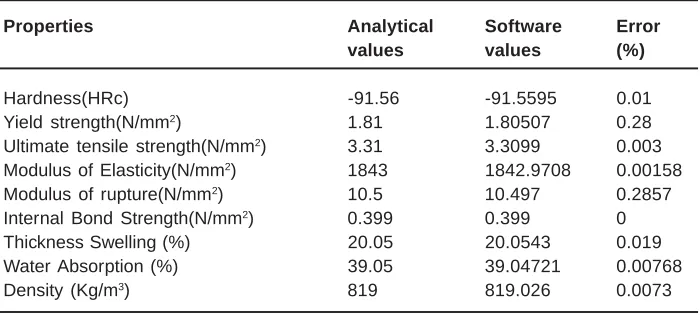
Table 2: Analytical,Software and Error values of composite materials (sawdust: palm kernel 90%:10% )
Properties Analytical Software Error
values values (%)
Hardness(HRc) -91.56 -91.5595 0.01
Yield strength(N/mm2) 1.81 1.80507 0.28
Ultimate tensile strength(N/mm2) 3.31 3.3099 0.003
Modulus of Elasticity(N/mm2) 1843 1842.9708 0.00158
Modulus of rupture(N/mm2) 10.5 10.497 0.2857
Internal Bond Strength(N/mm2) 0.399 0.399 0
Thickness Swelling (%) 20.05 20.0543 0.019
Water Absorption (%) 39.05 39.04721 0.00768
Density (Kg/m3) 819 819.026 0.0073
Table 1: Details of the composition of the composite materials panels tested8
Composite Sawdust Palm kernel
material (%) Shell (%)
A 100.00 0.00
B 90.00 10.00
C 80.00 20.00
D 70.00 30.00
E 60.00 40.00
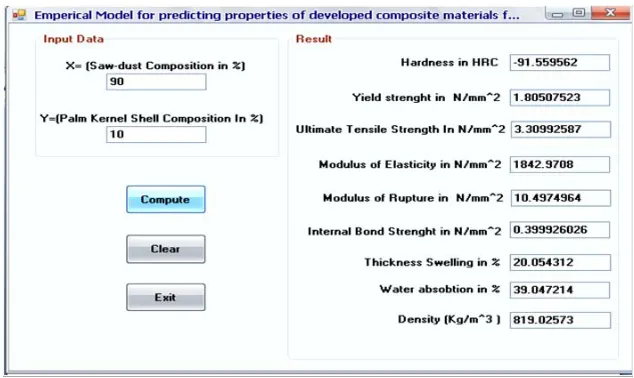
Fig. 1: Computed software composite properties for sawdust to palm kernel shell ( 90% :10%)
Fig. 2: Computed software composite properties for sawdust to palm kernel shell ( 65% :35%) satisfactory and show good predictability of the
model9.
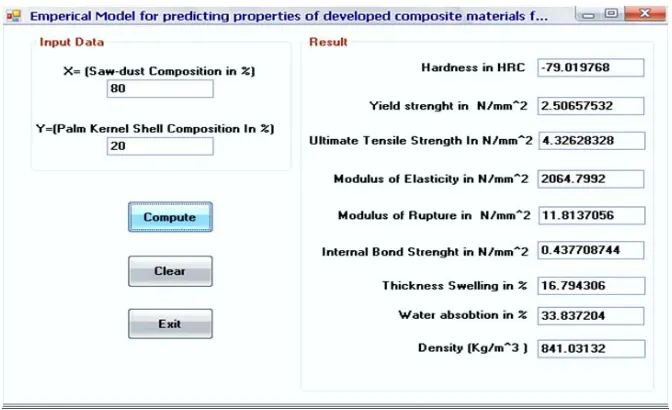
Visual basic application to computing predicted values software was developed using Visual Basics 6.0 for computing predicted composite materials properties. Visual Basic was used as a rapid application tool to compute the properties from empirical models. Figs. 1 - 4 show a samples of computed values, when the sawdust : palm kernel shell composition was 90% : 10%, 65%:35%, 73%:27% and 80 %:20% respectively. The values
from this software program were found to be in conformity with the analytical values from developed model.
Accuracy of software
(modulus of elasticity), 0.2857% (modulus of rupture), 0% (internal bond strength), 00073%(density), 0.019% (thickness swelling) and 0.00768% (water absorption). These values were insignificant and below the maximum recommended error of 10% proposed by Liping and Deku13. The software performance was also found to be satisfactory, showed good predictability and user friendly.
CONCLUSION
The software developed using visual
basics for computing properties of composite material from agro waste(sawdust and palm kernel shell) have been achieved. The software was user friendly and its performance were found to be satisfactory and show good predictability. This software it is hoped will help make the production and properties estimation of composite material from agro waste (sawdust and palm kernel shell) easier ,more accurate and faster, making of immense benefit to researchers, industrialist and small-scale manufacturers involved in composite material production.
Fig. 3: Computed software composite properties for sawdust to palm kernel shell ( 73% : 27%)
1. J.U Ejiofor and R.G Reddy, Developments in the Processing and Proper ties of particulate Al-Si Composites. JOM49(11): 31-37 (1997).
2 F.A Gasser, A three-phase constitutive model for macrobr ittle fatigue damage of composites. A PhD Dissertation Submitted to College of Engineering and Mineral Resources at West Virginia University, Department of Mechanical and Aerospace Engineering Morgantown, West Virginia.pp 1-5 (2000).
3 D. Chunping, Y. Changing and Z. Cheng , Theoretical modeling of bonding characteristics and performance of wood composites: part 1.inter-element contact. Journal of wood and fiber science., 39(1): 48-55 (2007).
4 K. Carlborn and L. M. Matuana, Modeling and optimization of formaldehyde-free wood composites using a Box-Behneken design. Polym. compos., 27: 497-503 (2006). 5. V . Gupta, Comdex .Net programming course
Kit. DreamTech Press, New Delhi, India (2010).
6. T.E.G Harless, F. G. Wagner, P. H. Short, R. D. Seale, P. H. Mitchell, and D. S. Ladd., A model to predict the density profile of particleboard. Wood and Fiber Sci. 19 (1):81-92 (1987).
7. Osarenmwinda, J.O, Development of
composite material from agro waste for industrial and domestic application .PhD Thesis , Depar tment of Production of Engineering ,University of Benin, Benin city, Nigeria (2009).
8. J.O Osarenmwinda and J.C Nwachukwu J.C, Development of Composite Material from Agricultural Waste. International Journal of Research in Africa 3: 42-48 (2010). 9. J.O Osarenmwinda and J.C Nwachukwu,
Empirical models for estimating properties of developed composite material from Agrowaste. Journal of Emerging Trends in Engineering and Applied Sciences 1(2): 178-182 (2010).
10. EN 310. Wood based panels, Determination of modulus of elasticity in bending and bending strength. European standardization committee, Brussells (1993).
11. EN 317. particleboards and fiberboards determination of swelling in thickness after immersion, European Standardization committee, Brussels (1993).
12. EN 319. Particleboards and fiberboards deter mination of tensile strength per pendicular to plane of the board. European standardization committee, Brussels (1993).