http://ijessr.com Page 175
THE INFLUENCE OF INTERNAL SERVICE QUALITY ON THE PERFORMANCE OF COMMUNITY HEALTH CENTER EMPLOYEES WITH WORK SATISFACTION AS THE
MEDIATING VARIABLE
Ni Luh Ayu Fitriani and Desak Ketut Sintaasih
Masters of Management Program, Faculty of Economics and Business Udayana University, Indonesia
ABSTRACT
Internal Service Quality (ISQ) is an important matter for employees in realizing high quality of service. Community Health Center as the spearhead of health services, it is crucial to provide high quality services (ISQ) to employees, both medical and non-medical so that they can provide satisfactory services to the community or patients. The purpose of this study is to analyze the influence of ISQ on job satisfaction and employee performance, and also to explore the mediating effect of job satisfaction on the influence of ISQ towards employee performance. This study was conducted at Community Health Center in Kuta area of Badung Regency, with a sample of 71 people. The sample size determination method used saturated sampling technique and data analysis method used Partial Least Square (PLS). The results of study showed that ISQ influences positively and significantly on employee performance. ISQ also has a positive and significant effect on job satisfaction. From the results of mediation testing, it is proven that job satisfaction partially mediates the influence of Internal Service Quality on employee performance.
KEYWORDS: Internal Service Quality (ISQ), job satisfaction, employee performance
Note: The corresponding author: Desak Ketut Sintaasih. Email: [email protected]
1. INTRODUCTION
Community Health Center (Puskesmas) is the spearhead of health care system in Indonesia. As the front line of health service facility, a community health center has a duty to implement health policies to achieve health development goals in its working area in order to support the realization of a healthy sub-district. In providing services, community health center is oriented to individuals, families, groups and communities and also to prioritize the safety and security of patients, officers and visitors (Regulation of the Health Minister of the Republic of Indonesia No. 75 2014). As an executor of public services, community health center is obligated to provide high quality services to the community.
http://ijessr.com Page 176 services to the community. Quality of services which satisfy community or patient reflects the good performance of medical and non-medical personnel.
In realizing good services, it is important for community health center to provide high quality services or internal service quality (ISQ) to employees to support their performance. ISQ refers to services provided by a different organization unit or department to other units or employees in an organization that significantly influences employee performance (Singh, 2015). ISQ includes job design, workplace design, and work tools provided by the organization to serve patients. ISQ also involves recognition and appropriate rewards given to employees in order for them to work well and comfortably. With ISQ, employees will feel satisfied in their job which in turn has a positive impact on the service to the community as a reflection of service providers’ performance (medical and non-medical personnel).
Some studies showed that employee performance is influenced strongly by internal service quality (Purwanto, 2011; Sharma, et al., 2016; Setiawan, 2016). Sharma et al. (2016) confirmed that ISQ positively supports the employee performance, seen from the support and facilities provided by organization, so that employees could work well. Besides, ISQ is also observed by a suitable and comfortable workplace design, job planning which determines the tasks to be done specifically, appreciation and recognition of employees’ work results and provision of work tools for the interest of serving customers (Hesket (1997) in Ariansyah, 2013). Similarly, Setiawan (2016) stated, commitment of the management by providing internal services to employees is capable to make their performance better seen from the increase of service intensity.
Internal service quality also has a positive impact on employee job satisfaction (Bakri & Alwie, 2014; Osahon & Kingsley, 2016; Al-Ababneh, 2018). On the other hand, job satisfaction can affect employee performance positively and significantly (Saranya, 2014; Javed et al., 2014; Inuwa, 2016). High quality of internal service affect employee job satisfaction, which further makes them able to show a good performance resulting on external customer satisfaction and improvement on organization performance.
http://ijessr.com Page 177 This research focused on Community Health Center employees (medical and non-medical) in Kuta area, Badung Regency, Bali Province, to explore the relationship between internal service quality, job satisfaction and employee performance in an integrated manner. The objectives of this research are: 1) to examine the influence of ISQ on employee performance; 2) to verify the effect of ISQ on employee performance; 3) to analyze the effect of job satisfaction on employee performance; and 4) to explore the mediating effect of job satisfaction on ISQ relationship and employee performance.
2. LITERATURE REVIEW AND HYPOTHESIS
Internal Service Quality (ISQ) is a service provided by different organizational unit or department to other units or employees in an organization (Singh, 2015; Umaheswari, 2014). Internal service quality is also interpreted as the quality of work environment, which contributes to employee’s job satisfaction Hesket (1997) and Ariansyah, 2013). Further explained, there are five dimensions of Internal Service Quality (ISQ), namely:
1) Work place design is the design of a suitable and comfortable workplace provided by the company.
2) Job design is a work designing with process of determining the tasks to be done specifically. 3) Employee selection and development is the development of employees and their career which
carried out by the company.
4) Employee rewards and recognitions is appreciating and acknowledging employee’s work result. 5) Tools for serving customers is the tools provided by the company for the benefit of serving the
customer.
Purwanto (2011) emphasized that the profit and growth of an organization is greatly determined by ISQ given to employees. With ISQ being developed in the organization, works will provide more satisfaction to employees and further employees will provide the best service for customers. By facilitating employees with ISQ, they can work better, so that their performance will also improve. Performance is the level of achievement of work results on the implementation of certain task of a person or a group of people in the organization, in accordance with their respective authority, in an effort to achieve organizational goals legally, not violating law, and correspond with morals and ethics (Mulya & Japarianto, 2014). According to Pradhan & Jena (2017), employee performance is measured from three dimensions, namely task performance, adaptive performance and contextual performance.
http://ijessr.com Page 178 in higher education level can affect the performance of lecturers, so that the lecturer’s process of teaching is getting better.
Based on the above description, the research hypotheses can be formulated as follows:
Hypothesis 1: Internal Service Quality (ISQ) has a positive and significant influence on employee performance
Bakri & Alwie (2014) measured ISQ from several aspects such as work tools, policies, procedures, teamwork, management support, and training. In their research, it was stated that ISQ has a positive and significant influence on the employee satisfaction of Bank of Riau, Riau Islands. Wang (2012) also concluded that the quality of internal services significantly affects the job satisfaction of international tourist hotel’s employees in Taiwan. Likewise, Akhmad (2015) stated that ISQ provided by the company makes employee satisfaction even higher. Meanwhile Rismayanti (2016) stated that internal marketing and internal service quality have an effect on doctors’ satisfaction, which further influences their performance.
Job satisfaction reflects workers’ feelings toward their work, which is the difference between the amount of rewards received with the rewards that are believed to be accepted (Robbins & Timothy A, 2015). Furthermore, Robbins & Judge (2015) explained that there are four dimensions of job satisfaction, namely need fulfillment, discrepancies, value attainment, and equity.
On the other hand, Osahon & Kingsley (2016) stated that ISQ components such as Reliability, Assurance, Tangibles, Empathy, and Responsiveness, contributed significantly to customer satisfaction. Kwan & Isa (2016) stated that high ISQ may lead to higher job satisfaction among agents. Similarly, Al-Ababneh (2018) stated that there is a good influence between ISQ on employee perception which makes them feel a sense of job satisfaction.
Based on the explanation above, the research hypothesis is formulated as follows.
Hypothesis 2: Internal Service Quality (ISQ) has a significant positive effect on employee satisfaction.
http://ijessr.com Page 179 On the other side, Saranya (2014) described that satisfaction given by the organization to employee is able to foster employee performance. Inuwa (2016) in his research at one university in Nigeria, concluded that there is a positive and significant relationship between job satisfaction and the performance of non-academic staff. The study serves as a policy guide for university management in fields related to improvement in employee performance through job satisfaction. The effect of satisfaction on employee performance results from the existence of good facilities and communication from the company (Wahyu, 2015). Meanwhile Any (2015) and Javed et al. (2014) stated that there is a positive relationship of job satisfaction with employee performance. Job satisfaction has an impact on job performance.
Based on the description above, the research hypothesis is formulated as follows.
Hypothesis 3: Job satisfaction has a positive and significant effect on employee performance.
Internal Service Quality and job satisfaction have an impact on improvement of employee performance in an organization. Research results of Rismayanti et al. (2016) revealed that service quality has an effect on employees’ satisfaction, which in turn influences their performance. Nazeer et al. (2014) stated that ISQ has a positive and significant influence on employee job satisfaction. Job satisfaction also has a positive effect on employee performance. Setiawan (2016) stated that an organization that is committed to provide internal services to employees is able to provide job satisfaction for them so that their performance is getting better. This is reflected in the increasing intensity of service to customers. Utami (2015) stated that ISQ has a positive effect on employee performance through job satisfaction. Likewise, Ariani (2015) also stated that there is an influence of ISQ on performance through job satisfaction.
Based on several research results that have been revealed, therefore the research hypothesis can be formulated as follows:
Hypothesis 4: Job satisfaction mediates the relationship between Internal Service Quality (ISQ) and employee performance.
RESEARCH METHOD Research Design
http://ijessr.com Page 180 Measurement of Research Variables
The research variables were identified as exogenous variable, namely Internal Service Quality (X) and endogenous variable, namely employee performance (Y) and job satisfaction (M). Measurement of Internal Service Quality (ISQ) variable referred to Heskett (1997) and Ariansyah (2013). ISQ was measured by five indicators, namely: 1) Work place design, 2) Job design, 3) Employee selection and development, 4) Employee rewards and recognitions, 5) Tools for serving customers. Each indicator consists of several items described in the questions in the questionnaire
.
Employee performance variable (Y) was measured from three indicators referring to Pradhan & Jena (2017). The three indicators are: 1) task performance, 2) contextual performance, and 3) adaptive performance. Like ISQ, each of these indicators was also measured by a number of items which formed the basis for compiling the questions in the questionnaire.
In measuring job satisfaction variable (M), referred to Robbins & Judge (2015), which consists of four indicators, namely: 1) Need fulfillment, 2) Discrepancies, 3) Value Attainment, and 4) Equity. Each of these indicators was also measured by several items as a basis for compiling the questions in the questionnaire.
Data measurement for each variable was using a Likert scale, with each question on the questionnaire was given a choice of answers from strongly disagree (score 1) to strongly agree (score 5). The questionnaire as an instrument for collecting data has been tested for its validity and reliability. The testing of instrument’s validity was using correlation of product moment. The instrument was valid which shown from the correlation value between the scores of questions with a total score of each positive and significant indicator with a correlation coefficient greater than 0.30 (r > 0.30). instrument reliability testing was using internal consistency reliability, by calculating Cronbach’s Alpha (α). From instrument reliability testing was also shown reliable results, seen from the value of Croanbach’s Alpha for each variable above 0.60 (α > 0.60).
Data Analysis Technique
http://ijessr.com Page 181 In data analysis, from the research model, the measurement model (outer model) and the structural model (inner model) were evaluated. Measurement of latent variables Internal Sevice Quality, job satisfaction, and employee performance were reflective indicators. In evaluating measurement model, validity and reliability of indicators in measuring variables was seen from convergent validity, discriminant validity, and composite reliability.
Evaluation of structural model (Inner Model) was done by looking at the value of R-Square (R2) and Q-Square Predictive Relevance (Q2). Q2 has a value ranging from 0 (zero) to 1(one), the closer to the value of 1 (one), means the research model is getting better or fit.
Hypothesis testing was done by t-test. If the p-value < 0.05 (α =5%), it means that there is a significant effect of one latent variable towards other latent variables. The testing of mediating effect of job satisfaction (M) on the relationship of Internal Service Quality (X) with employee performance (Y) was done by calculating the Variance Accounted For (VAF). If the value of VAF is above 80 %, it means job satisfaction (M), as full mediation. If VAF valued between 20%-80%, it is categorized as a partial mediator. However, if VAF is less than 20%, it can be concluded that there is no mediating effect (Hair et al., 2013).
RESULT
The results of this study presented the characteristics of respondents, description of each variable, the results of evaluation of measurement model (outer model) and structural model (inner model), hypotheses testing, and the testing of mediation effect of job satisfaction (M) on the relationship of Internal Service Quality (ISQ) (X) with employee performance (Y). Characteristics of respondents
Y3. 3 Y3. 1 X5.1 X5.2 M4. 1 M4. 2 X4.1 X2.2 X2.1 X3.1 X3.2 M2. 1 M2. 2 M2. 3 vv M3. 1 Internal Service Quality (ISQ) (X) Employee Performance (Y) Work Satisfaction
(M) Y1.
3 Y2. 1 Y2. 3 vv M1. 1 M1. 2 X1.1 X1.2
Y1. 1
Y1.
2
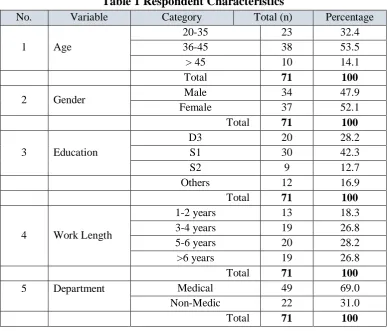
http://ijessr.com Page 182 were grouped based on age, gender, education, years of service and department of the health centers’ employee, which are fully presented in Table 1 below.
From Table 1, it can be seen that most respondents or employees of community health center in Kuta area were between 36-45 years old (53.5 percent). Female and male employees were almost similar in proportion with 47.9 percent compared to 52.1 percent. Reviewing from their education, most of them have a degree or undergraduate education (42.3 percent) with the most working period between 5-6 years (28.2 percent). Lastly, seen from the field of duty, dominantly they were medical personnel.
Table 1 Respondent Characteristics
No. Variable Category Total (n) Percentage
1 Age
20-35 23 32.4
36-45 38 53.5
> 45 10 14.1
Total 71 100
2 Gender Male 34 47.9
Female 37 52.1
Total 71 100
3 Education
D3 20 28.2
S1 30 42.3
S2 9 12.7
Others 12 16.9
Total 71 100
4 Work Length
1-2 years 13 18.3
3-4 years 19 26.8
5-6 years 20 28.2
>6 years 19 26.8
Total 71 100
5 Department Medical 49 69.0
Non-Medic 22 31.0
Total 71 100
Source: Processed primary data, 2018
http://ijessr.com Page 183
No. Score Range Interpretation of Variable
1 1,00 - 1,80 Very Bad
2 1,81 - 2,60 Bad
3 2,61 - 3,40 Moderate
4 3,41 - 4,20 Good
5 4,21 - 5,00 Very Good
Respondent’s perceptions of the Internal Service Quality (X), job satisfaction (M) and employee performance variables, were respectively presented in Table 2, Table 3, and Table 4 below.
Table 2 Description of the Internal Service Quality (ISQ) Variable
No. Indicator Mean
Score Description
Work Place Design 4,31 Very Good
1 The work place design makes work activities much easier 4,23 Very Good
2 The work place is designed in accordance with the job 4,39 Very Good
Job Design 4,01 Good
3 The detailed job design makes work much easier 4,16 Good
4 The task design is in line with the job description 3,87 Good
Employee Selection and Development 4,14 Good
5 The community health center has provided trainings for its
employees to achieve their work standards 3,90 Good
6 Appropriate selections has been conducted for the employee’s
career development 4,39 Very Good
Employee Rewards and Recognitions 4,15 Good
7 The community health center provides rewards for employees
that perform their job well 4,38 Very Good
8 The community health center provides recognition for employees
that perform their job well 3,92 Good
Tools for service Customer 4,07 Good
9 Enough work equipment are provided to facilitate the employees
in their work 3,92 Good
10 The facilities provided by the community health center greatly
helps employees in their work 4,22 Very Good
Internal Service Quality (ISQ) Variable 4,13 Good Source: Processed primary data, 2018
http://ijessr.com Page 184 do the job. In addition, ISQ was also shown by the availability of facilities provided by the community health centers that were very supportive for employees at work.
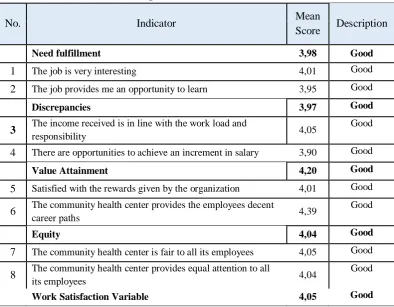
Table 3 Description of Job satisfaction Variable
No. Indicator Mean
Score Description
Need fulfillment 3,98 Good
1 The job is very interesting 4,01 Good
2 The job provides me an opportunity to learn 3,95 Good
Discrepancies 3,97 Good
3 The income received is in line with the work load and
responsibility 4,05
Good
4 There are opportunities to achieve an increment in salary 3,90 Good
Value Attainment 4,20 Good
5 Satisfied with the rewards given by the organization 4,01 Good
6 The community health center provides the employees decent
career paths 4,39
Good
Equity 4,04 Good
7 The community health center is fair to all its employees 4,05 Good
8 The community health center provides equal attention to all
its employees 4,04
Good
Work Satisfaction Variable 4,05 Good
Source: Processed primary data, 2018
From Table 3, it appears that employee job satisfaction was also classified as good (average score of 4.05). Employees satisfied in their work because the health center offers career paths that employee desire. In addition, the health center was also fair and gives equal attention to all employees. The income received by employees was also appropriate with the workload and responsibilities.
For employee performance, from Table 4 it appears that employee performance was classified as good (score 4.20). Good employee performance could be seen from their ability to coordinate with colleagues and adapt with the job in any situation. The employees were also able to maintain the image of the health centers and complete the work they are responsible for.
Table 4 Description of Employee Performance Variable
No. Indicator Mean
http://ijessr.com Page 185
No. Indicator Mean
Score Description
Task Performance 4,10 Good
1 The work load is appropriate for the job 4,11 Good
2 The amount of work completed is in accordance with the given
tasks 4,21 Very Good
3 The tasks are completed on time 4,08 Good
Contextual Performance 4,22 Very Good
4 Able to help maintain the community health center’s reputation 4,30 Very Good
5 Provide creative solutions for any new problems faced at work 4,19 Good
6 Search for alternative solutions related to work 4,18 Good
Adaptive Performance 4,25 Very Good
7 Help colleagues when they request for it or need it 4,07 Good
8 Able to adapt to their work in any situation 4,32 Very Good
9 Capable of coordinating well with co-workers 4,36 Very Good
Employee Performance Variable 4,20 Good
Source: Processed data, 2018
From the results of data processing with Smart PLS Program, the research model was obtained by measuring it as shown below.
http://ijessr.com Page 186 From the model above, the following wasthe result of evaluating the outer model and inner model. Evaluating outer model was seen from convergent validity, discriminant validity, and composite reliability.
The variables in this study were measured by indicators that were reflexive, so the validity measurement of indicators in reflecting variable was seen from convergent validity. Evaluation was done by looking at the outer loading coefficient of each indicators on the latent variables. Indicator was considered as valid, if outer loading coefficient was above 0.50 (Ghozali, 2014:62), and was significant at the alpha level 0.05 or t-statistic 1.96.
Based on the results as in Figure 2, it can be seen that the overall indicators of each variable had an outer loading coefficient above 0.50, therefore it could be interpreted that this measurement met the convergent validity requirement which means that the indicators were valid in measuring variables.
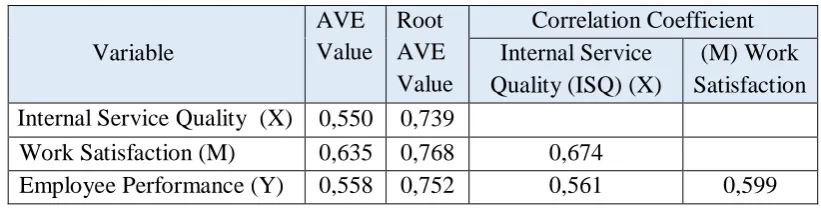
The indicators validity in measuring variables was also seen from discriminant validity. In this test, we observed the value of Average Variance Extracted (AVE) and compare the root value of AVE with the correlation between variables. In this evaluation, AVE value must be greater than 0.50 and the root value of AVE must be greater than the correlation coefficient between variables. The results of processing the data were presented in Table 5.
Table 5 AVE Value, AVE Root and Inter-Variable Correlation
Variable
AVE Value
Root AVE Value
Correlation Coefficient Internal Service
Quality (ISQ) (X)
(M) Work Satisfaction Internal Service Quality (X) 0,550 0,739
Work Satisfaction (M) 0,635 0,768 0,674
Employee Performance (Y) 0,558 0,752 0,561 0,599
Source: Processed primary data, 2018
Based on Table 5, it is known that the value of Average Variance Extracted (AVE) was greater than 0.50 and root value of AVE was also greater than the value of correlation coefficient between variables. Thus, it could be said that in the measurement model, the discriminant validity requirements had been met.
http://ijessr.com Page 187
Table 6 Composite Reliability and Cronbach Alpha Test Results
No. Variable
Composite Reliability
Value
Cronbach
Alpha Value Description
1 Internal Service
Quality (ISQ) 0,894 0,861 Reliable
2 Work Satisfaction 0,882 0,843 Reliable
3 Employee
Performance 0,923 0,902 Reliable
Source: Processed primary data, 2018
By paying attention to the results in Table 6, it can be explained that reliable indicators in measuring variables were shown by composite reliability and Cronbach alpha values which greater than 0.70. From the results of evaluating the outer model, it can be explained that all indicators that measure Internal Service Quality (X), job satisfaction (M), and employee performance (Y) variables were valid and reliable. Therefore, the evaluation results of the structural model (inner model) can be further explained.
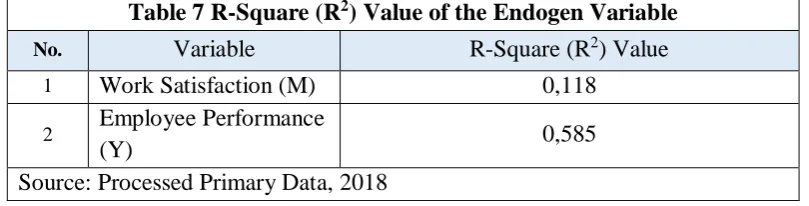
Evaluation of structural model in this study was carried out by considering R-Square (R2) and Q-Square Predictive Relevance (Q2), which was a testing of goodness of fit model. From the results of data processing, the R2 values of the endogenous variables job satisfaction (M) and employee performance (Y) were obtained, as in Table 7.
From these R2 values, Q2can be calculated with a formula: Q2 = 1 – (1 – R
m2) (1 – Ry2). From this
formula, the value of Q2 = 1 – (1 – 0.1182) (1 – 0.5852) = 0.643 can be found. The value of Q2 was 0.643, indicating that the research model was good or fit because Q2 was close to the value of 1 (one)
From the model that has been tested for its accuracy, the following was the result of hypotheses testing path coefficients value related to variables as in the model were presented in Table 8.
Table 7 R-Square (R2) Value of the Endogen Variable
No. Variable R-Square (R2) Value
1 Work Satisfaction (M) 0,118
2 Employee Performance
(Y) 0,585
http://ijessr.com Page 188
Table 8 Path Coefficients
No Variable Path
Coefficients
T-Statistics
P-Values Description
1 ISQ (X) Employee
Performance (Y) 0,636 8,926 0,000
Significant
2 ISQ (X) Work
Satisfaction (M) 0,344 4,356 0,000
Significant
3
Work Satisfaction (M)
Employee
Performance (Y)
0,561 3,084 0,002 Significant
Source: Processed primary data, 2018
From the data in Table 8, the results of hypotheses testing can be explained as follows. In the relationship of Internal Service Quality (ISQ) with employee performance, it was known that path coefficients 0.636 and t-statistic value 8.926, greater than ttabel 1.96 (α = 5%), and p value 0.000. This result can be interpreted that Internal Service Quality (ISQ) has a positive and significant effect on employee performance. Thus, hypothesis 1, Internal Service Quality (ISQ) has a positive and significant influence on employee performance, was supported. In the relationship of Internal Service Quality (ISQ) with job satisfaction appeared that path coefficients 0.344, t-statistic value 4.356 was greater than t table 1.96 (α = 5%), and p value 0.000. From these values can be interpreted that ISQ has a positive and significant effect on job satisfaction. Thus, hypothesis 2 that Internal Service Quality (ISQ) has a significant positive effect on employee satisfaction, was supported. Path coefficients value of the relationship between job satisfaction and employee performance was 0.561 and t-statistic value 3.084 greater than ttabel 1.96 96 (α = 5%), therefore it can be concluded that hypothesis 3 (H3) which stated that job satisfaction has a positive and significant effect on employee performance, was supported.
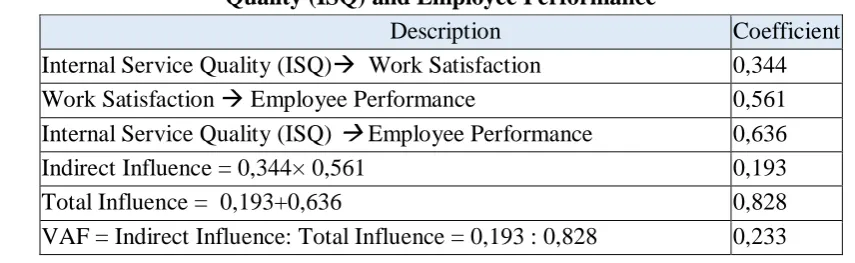
Testing job satisfaction variable as a mediator was observed from the value of Variance Accounted For (VAF), by calculating the value of indirect effect and total effect, as presented in Table 9.
Table 9 Mediation Test Results for Job Satisfaction on the Relationship of Internal Service Quality (ISQ) and Employee Performance
Description Coefficient
Internal Service Quality (ISQ) Work Satisfaction 0,344
Work Satisfaction Employee Performance 0,561
Internal Service Quality (ISQ) Employee Performance 0,636
Indirect Influence = 0,344× 0,561 0,193
Total Influence = 0,193+0,636 0,828
http://ijessr.com Page 189 Considering Table 9, it can be seen that the VAF value of 0.233 or 23%, which can be interpreted that job satisfaction played as partial mediation on the relationship of Internal Service Quality (ISQ) to employee performance. Thus, hypothesis 4 (H4) that Job satisfaction mediates the relationship between Internal Service Quality (ISQ) and employee performance, was supported.
DISCUSSION
Effect of Internal Service Quality (ISQ) on Performance
The results of hypothesis testing indicated that Internal Service Quality (ISQ) has a positive and significant effect on Employee Performance. It can be said that the better the internal service quality (ISQ), the better the employee performance. This can be seen from Internal Service Quality (ISQ) implemented by community health center, such as design of workplace that suitable with the job (Work Place Design), the availability of facilities and sufficient work tools (Tools for service Customer), which can facilitate employees at work so that they can work comfortably, able to complete work on time (Task Performance), and can coordinate well and conductively with other employees (Adaptive Performance). In addition, training for employees to fulfill work standards, as well as holding appropriate selection in employee career development (Employee Selection and Development), can add insight and skills for employees in their work that ultimately supports employees in finding alternative solutions to new problem encountered (Adaptive Performance).
The results of this study were supported by previous studies, such as (Purwanto, 2011), (Latif et al., 2016), (Setiawan, 2016), (Singh, 2015), which explained that there are positive and significant effect of internal service quality on employee performance. Similarly, the research results by Nazeer et al. (2014) and Sharma et al. (2016) which also stated that internal service quality has a significant effect on employee performance, seen from individuals who can work well because of the support and facilities prepared by the company. Susanti (2015) also stated that the quality of internal services applied by institution can affect performance of lecturers, so that the lecturers teaching process is getting better.
Effect of Internal Service Quality (ISQ) on Job Satisfaction
The results showed that internal service quality had a positive and significant effect on job satisfaction. These results indicated that the better the internal service quality perceived by employees, the better their job satisfaction will be. This can be seen from the condition of the Internal Service Quality, such as holding trainings for community health center employees to fulfill their competency standards and skills in working to gain insight (Employee Selection and Development). In addition, the existence of career development makes employees feel satisfied on their work, seen from the opportunity to learn, the desired career level offerings, and the capability of health center to provide equal interest and be fair to employees.
http://ijessr.com Page 190 proven to increase employee satisfaction. Likewise, (Bakri & Alwie (2014) in their research stated that internal service quality (ISQ) such as work tools, policies and procedures, teamwork, management support, goals alignment, training, communication, and rewards, have a significant positive effect on employee satisfaction at Bank of Riau. Research by (Wang , 2012) also concluded that internal service quality has a significant influence on the job satisfaction in international tourist hotel employees registered in Taiwan. In addition, Kwan & Isa (2016); Al-Ababneh (2018) showed in line results, that high internal service quality (ISQ) can lead to higher job satisfaction among employee.
Effect of Job Satisfaction on Employee Performance
The results of hypothesis testing indicated that job satisfaction has a positive and significant effect on employee performance. The results can be interpreted that the better the job satisfaction, the better the employee performance. From the results of this study, the job satisfaction perceived by the health center employees was considered high, which shown by the availability of offers made by health center for career paths the employees desired (Value Attainment), the income received at the time was suitable with the workloads (Discrepancies), and the health center’s fairness towards all employees (Equity). These conditions can encourage employee performance, such as helping maintain the image of the health center (Contextual Performance), coordinating well with fellow employees, being able to adapt with work in any situation (Adaptive Performance).
The results of this study were supported by previous studies, such as Indrawati (2013), Khan et al. (2012 ), Javed et al (2014), Saranya (2014) who all stated that job satisfaction has a positive and significant impact on performance. Similarly, the research by Inuwa (2016), Wahyu (2015), and Any (2015), showed that employee job satisfaction is able to significantly improve the performance. The Role of Job Satisfaction in Mediating the Effect of Internal Service Quality (ISQ) on Employee Performance.
Based on VAF calculation, it is proven that job satisfaction mediates partially (partial mediation) the relationship between internal service quality (ISQ) and employee performance. These results indicated that job satisfaction is able to make internal service quality (ISQ) affect employee performance better and significantly. This can be seen from ISQ occurs in health centers are able to make employees more satisfied, thus encouraging them to show better performance. The existence of learning opportunities provided by the health center and the holding of trainings for improving skills make employees able to complete their tasks on time and able to provide solutions to problems arise in work.
http://ijessr.com Page 191 described above, it is clear that job satisfaction is the partial mediator of the relationship between ISQ and employee performance.
CONCLUSION
Internal service quality has a positive and significant effect on employee performance. ISQ also has a positive and significant effect on job satisfaction. Job satisfaction has a positive and significant effect on employee performance. These results indicated that ISQ and job satisfaction are important factors in improving the performance of community health center employees in serving patients and the community. This means that it is important for health center to implement ISQ in order to make employees satisfied in their work, thus encouraging them to carry out their duty to serve patients and the community well. This condition ultimately has a positive impact on employees’ performance as indicated by their ability to provide good health services to patients and the community in their working area.
This research is still limited only to health service organizations in Kuta I Health Center and North Kuta Health Center in Badung Regency. Future research can expand the scope of the studied institutions, or conduct research at different companies engaged in services or other fields.
REFERENSI
Ariani, D. W. (2015). Employee Satisfaction and Service Quality: Is There Relations? International Journal of Business Research and Management (IJBRM), Volume (6) : Issue (3) : pp. 33-44.
Akhmad Dardiri, D. S. (2015). Pengaruh Internal Service Quality Terhadap Kepuasan Pegawai dan Dampaknya Terhadap Loyalitas Pegawai BPS Provinsi ACEH. Jurnal Manajemen, 4, 159- 166. Al-Ababneh, M. M. (2018). The Impact of Internal Service Quality on Job Satisfaction InThe Hotel Industry. Reseacrh in Hospitality Manangement, Volume (8): pp 55-62.
Any, M. (2015). Pengaruh Kepuasan Kerja dan Komitmen Organisasional Terhadap Pegawai Bank Kalsel. Jurnal Wawasan Manajemen, Vol 3 No. 3 pp 269-279.
Ariansyah, K. ( 2013). Kualitas Pelayanan Internal Direktorat Jenderal Sumber Daya Dan Perangkat Pos Dan Informatika Internal Service Quality Of Directorate General Of Resources And Equipment Of Post And Informatics. Buletin Pos dan Telekomunikasi , Vol.11 No.3. pp :209-222.
Bakri, S., & Alwie, A. F. (2014). Pengaruh Internal Service Quality Terhadap Kepuasan Karyawan Pada PT. Bank Riau Kepri. Jurnal Tepak Manajemen Bisnis , Vol. VI No. 3 pp 127-1139.
Hair, J., Hult , R. C., & Startstedt, M. (2013). A Primer On Partial Last Squares Structural Equation Modelling (PLS-SEM). Los Angeles: Sage.
eskett, J. T. (1997). The service-profit chain. USA: Simon & Schuster Inc.
IIndrawati, A. D. (2013). Pengaruh Kepuasan Kerja Terhadap Kinerja Karyawan dan Kepuasan Pelanggan Pada Rumah Sakit Swasta di Kota Denpasar. Jurnal Manajemen, Strategi Bisnis, dan Kewirausahaan, Vol. 7, No. 2 pp. 135-142.
http://ijessr.com Page 192 Javed , M., Balouch , R., & Hassan, F. (2014). Determinants of Job Satisfaction and its Impact on Employee Performance and Turnover Intentions . International Journal of Learning & Development, Vol. 4, No. 2, pp 2164-4063 .
Khan, A. H., Nawaz, M. M., Aleem, M., & Hamed, W. (2012 ). Impact of job satisfaction on employee performance: An empirical study of autonomous Medical Institutions of Pakistan. African Journal of Business Management , Vol. 6 (7), pp. 2697-2705.
Kwan, C. S., & Isa, F. M. (2016). The Relationship Between Leadership, Span of Control, Perception of Islamic Products and Services, Perception of Internal Service Quality and the Agents’ Job Satisfaction: A Case of Unit Trust Agents in Johor Bahru. International Review of Management and Marketing, , 6(S8) 149-152. .
Latif, K. F., Baloch, Q. B., & Rehman, S. u. (2016). Role Of Internal Service Quality (ISQ) In The Linkage Between Percieved Organizational Support And Organizational Performance. City University Research Journal, Volume 06 Number PP 01-22.
Mulya, A. C., & Japarianto, E. (2014). Analisa Persepsi Pelanggan Terhadap Kinerja Agen Properti Dan Pengaruhnya Terhadap Kepercayaan di Surabaya. Jurnal Manajemen Pemasaran Petra, Vol. 2, No. 1, pp. 1-8.
Nazeer, S., Zahid, M., & Azeem, M. F. (2014). Internal Service Quality and Job Performance: Does Job Satisfaction Mediate? Journal of Human Resources Management and Labor Studies March, Vol. 2, No. 1, pp. 41-65.
Osahon, O. J., & Kingsley, O. (2016). Statistical Approach to the Link between Internal Service Quality and Employee Job Satisfaction: A Case Study . American Journal of Applied Mathematics and Statistics, , Vol. 4, No. 6, pp 178-184 .
Pradhan, R. K., & Jena, L. K. (2017). Employee Performance at Workplace: Conceptual Model and Empirical Validation. Business Perspectives and Research, Volume: 5 : pp. 1-17.
Peraturan Menteri Kesehatan Republik Indonesia Nomor 75 Tahun 2014 Tentang Pusat Kesehatan Masyarakat.
Purwanto, A. H. (2011). Pengaruh kualitas Layanan Internal Dan Orientasi Pemberi Layanan Terhadap Kinerja Pegawai di Kantor Perijinan Kabupaten Lamongan. Jurnal Psikosains, Vol. 3 No. 1 pp. 55-72.
Rismayanti, M. I. (2016). Effect of Internal Marketing and Service Quality BPJS Kesehatan Through Doctors Satisfaction Against Doctors Performance in Ulin Hospital Banjarmasin. Jurnal Manajemen Kesehatan Indonesia, 4, No. 01.
Robbins, P., & Timothy A, J. (2015). Perilaku Organisasi. Jakarta: Selemba Empat.
Saranya, K. (2014). Influence of Job Satisfaction on Employees’ Performance – A general Perspective . International Journal on Global Business Management and Research , Volume 2 ;Issue 2; pp. 2278-8425 .
http://ijessr.com Page 193 Sharma, P. (2016). Internal Service Quality as a Driver of Employee Satisfaction, Commitment and Performance – Exploring the Focal Role of Employee Well-being . Journal of Service Management Vol. 10 Pp. 1-43.
Singh, K. (2015). Influence of Internal Service Quality on Job Performance: A Case . Procedia - Social and Behavioral Sciences, 224, 28 – 34.
Susanti, E, Sule, E.T, Sutisna, H (2015) The Impact Internal and External Service Quality (A Case Study among Lectures and Students. Mediteranian Journal of Social Science). Vol. 6 pp. 77-83. Umaheswari, D. (2014). Exploring Internal Service Quality in Manufacturing organization0-A in Lucus TVS, Chennai. Procedia Economics and Finance 11, 710-725.
Utami, M. A. (2015). Pengaruh Perceived Service Quality Terhadap Unibrand Performance Melalui Satisfaction pada Universitas Swasta. Jurnal Manajemen dan Pemasaran Jasa, Vol.8 No. 2 Pp. 71-86. Wahyu Supartono, R. M. (2015). Analisis Pengaruh Kepuasan Kerja Terhadap kinerja Karyawn Dengan Pendekatan Kansei Engineering Perusahaan XYZ. Agritech, Vol. 35 No. 1 pp 78-87.