Benjamin Noys
University of ChichesterThe Recirculation of Negativity:
Theory, Literature, and the Failures
of Affirmation
AbstractThe contemporary theoretical moment is dominated by “affirmationism,” as the affirming of a superior economy of excess
that can inscribe and rupture any actual economy. This article reconstructs and critiques this affirmationism through an analysis of how it subordinates negativity as trapped within a restricted economy, and insists on a “savage negativity” that
escapes all relation. I do so by retracing the core features of affirmationism and particularly its turn to the forces of creativity
and play, figured through literature, posed against the “labor of the negative.” Probing this downgrading of “labor,” as a result of the collapse of worker’s identity, I suggest that it results in a fatal
detachment of negativity from any political or social instantiation. Instead, the return to negativity must be a return to
the possible relational forms of negativity that attend to the impossibility of labor within capitalism.
Keywords
№1
2013
The Exit Door Leads In
I want to begin with an ending (which is also a beginning) and a be-ginning (which is also an ending). First, the ending is the last word of James Joyce’s Ulysses (1922), which is “Yes” (capitalized), the final “yes” of a sequence of yeses in Molly Bloom’s soliloquy: “yes I said yes I will Yes” (Joyce 1994: 933). It is this “yes,” this repeated “yes,” from which Derrida will derive the “double affirmation” that is the beginning of deconstruc-tion as an opening to the event (Derrida 1992: 253–309). Second, the be-ginning is from Joyce’s Finnegans Wake (1939), a bebe-ginning which com-pletes the Viconian circle of the book and is looped back from the last word “the” to the first line: “riverrun, past Eve and Adam’s, from swerve of shore to bend of bay, brings us by a commodius vicus of recirculation back to Howth Castle and Environs” (Joyce 1992: 3). This “recirculation” would seem to imply a closed circle, a recapturing and totalization that, in Der-rida’s words, “circulates through all languages at once, [and] accumulates their energies” (1989: 102). In this endless accumulation without reserve it seems Joyce’s textual machine becomes a perpetuum mobile. Yet, Der-rida argues that we recirculate between the “yes” of “recapitulative con-trol and reactive repetition” (Derrida 1992: 308), and the “yes” of affirma-tion and opening. The doubling of “yes” breaks the circle and opens a spi-ral of affirmation.
This “double scene,” which tellingly is literary, is one of the “primal scenes” of what I have called “affirmationism”—that emphasis on novelty, production, excess, and the fundamentally affirmative nature of thought (Noys 2010: xi). In this schema, as we will see, the recourse to affirmation is made to break up any “restricted economy” of circulation and totaliza-tion by inscribing it within a “general economy” of excess (Derrida 2001: 317–350). From the perspective of “restricted economy,” negativity is what remains within a circle, remains bound to what is, and can never ac-cede to creation and the new; negativity is always only the “reassuring other surface of the positive” (Derrida 2001: 328). “General economy” is the perspective that traces a spiral that does not simply abandon negativ-ity to this fate, but re-inscribes it; negativnegativ-ity is transfigured into “a nega-tivity so negative that it could not even be called such any longer” (Der-rida 2001: 391, n. 4), which we could call a “savage negativity.”
concomitant reification of a hyper-negativity. At the root of this double maneuver is, I will argue, an anxiety concerning the role and form of labor as the once privileged figure of negativity. In response to the seeming failure of labor to incarnate a disruptive negativity, “affirmationism” aligns itself with the literary as the site of creativity and play detached from the forms of capitalist economy and value. I argue that this detach-ment figures and mediates the tendency to regard labor as a failed coun-ter-form to capital, but that this detachment, ironically, serves to recon-nect “savage negativity” to the creation of value: the exit door leads in.
Joyce’s Spiral and Hegel’s Circle
The figure that stands behind Joyce and his textual machine is, for Derrida, Hegel; and it is the reaction against Hegel that structures the general scene of affirmationism. The desire to find a superior economy of excess is the desire to exceed the Hegelian “circle,” which is always taken as the restraint of negativity1. Derrida inscribes Joyce’s excessive “spiral”
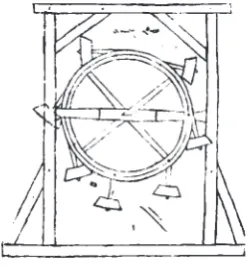
of affirmation as the excess of Hegel’s restricted “circle” of negativity. If, as Derrida notes, there is “ever so little literature” (1992: 73), that most literature, we could say, is saturated by philosophy, and if any literature remains it is only as a remainder, then Joyce is the philosophical double of Hegel, but with that remainder, that “recirculation” or “riverrun” of af-firmation that overflows from any perpetuum mobile. It is telling that one of the earliest examples of such a perpetual motion machine, that of Vil-lard de Honnecourt from about 1230, was a water wheel (see Figure 1).
Figure 1: Perpetuum Mobile of Villard de Honnecourt (circa 1230)
1 In contrast, Jean-Luc Nancy argues that the “circle” in Hegel is a privileged
№1
2013
We should also note that it is literature, as this tiny margin of excess, which figures affirmationism. Joyce’s machine, true to his name, is joyous, comic, and affirmative, beginning from a desire to totalize everything, all the languages of the world, only always to end with an equivocal affirma-tion that always displaces and exacerbates that desire (Derrida 1984); Hegel’s machine only ever begins from negativity, operating through the tragic and a certain form of mourning, to return, through “the negation of the negation,” to totality. Negativity, it is presumed, is saturated in its closure, with absolute negativity equivalent to the interiorization of ab-solute knowledge, a recirculation that does not and cannot, it is assumed, overflow its channeling. Literature, in contrast, overflows. Joyce, then, is the figure of hyperbolic affirmationism. Embedded in the theoretical so-phistication is the cliché of the mournful philosopher and the joyous and creative writer. In our moment this affirmationism takes on the “popular” form of the ideology of creativity, which always and everywhere insists on the overflowing powers of creativity against the strictures of the critical and the constraints of the market.
In regards to Joyce, the construction of his “joyous” image involves the neglect of the paralysis probed in Dubliners (1914). Instead, we have the Joyce of the affirmative “line of flight,” who precisely aims to “fly by those nets” of paralysis (bad negativity) and so accede to the nomadic and endless affirmation of a-national and rhizomatic immanence. This con-struction is mocked in advance by Flann O’Brien’s comic, and malicious, portrait of a retired James Joyce living secretly in post-war Ireland in The Dalkey Archive (1964). This “Joyce” claims only to have co-written Dublin-ers with Oliver Gogarty and a series of pamphlets for the Catholic Truth Society of Ireland. He violently disavows the “[p]ornography and filth and literary vomit” (O’Brien 1993: 167) of Ulysses, which he claims was the result of plot by Sylvia Beach and was not written by him but by a cabal of [m]uck-rakers, obscene poets, carnal pimps, sodomous sycophants, ped-lars of the colored lusts of fallen humanity” (O’Brien 1993: 167). Finally, he has no knowledge at all of Finnegans Wake. Far from the international modernist, Joyce is reduced to the parochial and local “paralysis” his im-age was constructed to contest, not a man of “silence, exile, and cunning” but “the garrulous, the repatriate, the ingenuous” (O’Brien 1993: 168).
designated as the form of affirmation in its “pure” state, before the com-promises of philosophy.
Beckett’s Beautiful Soul
The “war” on the dialectic (as motor of negativity) is a guerrilla war that strikes not only at the strongest point of the chain but also at the weakest points, ambushing Hegel’s text in its various “figurations” of negativity. The “form” I want to select for examination is that of the “beautiful soul,” which “lives in dread of besmirching the purity of its in-ner being by action and an existence” and so “flees from contact with the actual world” (Hegel 1977: 400). Of course, from Hegel’s point of view the “beautiful soul” is the classic example of the failure to accede to negativ-ity, i.e., action, in the world. This refusal to negate makes it a disposition of “empty nothingness” which is “disordered to the point of madness, [and] wastes itself in yearning and pines away in consumption” (Hegel 1977: 207). And yet, if dialectical negativity qua action is correlated with an unacceptable limitation on negativity, the “inner disorder” of the “beautiful soul” can be reversed into the preservation of an intractable and unsublateable negativity. What for Hegel is only “interior” becomes, in this reading, a hemorrhaging of negativity.
At the moment when negativity idles or, in Bataille’s formulation (and valorization), appears as “unemployed” (Bataille 1988), the con-straints of negativity in action are refused. Drew Milne has noted that, in relation to Samuel Beckett’s fictional re-tooling of the beautiful soul, “The process is dynamic, but the dynamism animating this process moves between the vanity of minor differences and absolute indifference, refus-ing to become dialectical or to recognize its negativity as a process of de-terminate negations” (Milne 2002: 78). In Beckett’s fiction, per Milne’s reading, negativity is “recognized” as what cannot ever be sublated fully into action, hence the “actionless” nature of delay and prevarication that seems to haunt his works. It is the dialectical indetermination of the “beau-tiful soul,” treated as a failure by Hegel, which opens a potential rupture in the dialectic to locate a perpetual negativity of failure2. What the figure of the “beautiful soul” offers is the disarticulation of negativity from la-bor and action, its reinscription in terms of the affirmation of negativity itself, beyond “economic” coordination, or only in a superior economy of play.
The difficulty remains, however, of the pejorative status of the “beau-tiful soul” from within Hegelianism. For Hegel, the “beau“beau-tiful soul” is “the
2 This deployment of the “beautiful soul,” and the related figure of the
№1
2013
one-sided shape which we saw vanish into thin air, but also positively externalize itself and move onward” (Hegel 1977: 483). Without this ex-ternalization and realization the “beautiful soul” would remain “object-less” and “one-sided.” From within Hegelianism, the “beautiful soul” is accounted for, and to remain at this point amounts to a regression within the dialectic. The valorization of this regression therefore risks, even if couched in the affirmation of a hyper-negativity, remaining enfolded within the dialectic, accounted in advance within the “economy” of nega-tivity. As Milne rightly notes, our skepticism or indifference to the achievement of absolute knowledge threatens to leave us “remaining restless within the literary and philosophical shape of Spirit represented by the beautiful soul[?]” (2002: 81). This troubling position would seem to leave us without a means for intervention into the world, leaving us un-able to accede to any “labor of the negative” and so merely in impotent contemplation of “restless” or “unemployed” negativity.
Of course, it is the very “uselessness” of this kind of negativity that leads to its valorization by affirmationism. Hence, we have the perpetual circle of exchanged accusations in which Hegel or Hegelians can reply that this “uselessness” is merely consolatory and, precisely, “useless” in the bad sense, while affirmationists argue that the economy of “use” merely reproduces a philosophical capitalization on negativity that re-produces capitalist value extraction. While the affirmationist valorization of the inactive and the inoperative tries to assert the affirmative and pos-itive dislocation of radicalized negativity (Agamben, 2000), it attracts the Hegelian rejoinder that this is merely the celebration of artistic and po-litical failure or, perhaps worse, the celebration of an artistic and creative exceptionalism that feeds the circuits of capitalist accumulation.
Breaking the Circle
Hence Deleuze’s fear, an anxiety I share, is that the abandonment of the dialectic will only lead to its replacement by “respectable, reconcilable or federative differences” (Deleuze 1994: 52). In the case of Deleuze, this fear leads to a constant insistence on the affirmative, on the “proper de-gree of positivity,” as the only means to break the circle of constrained negativity. The result is that every case or suspicion of negativity must be eliminated. This is most evident in Deleuze’s account of art and literature, where any sign of morbidity or negativity in an artist or writer is regarded as our own failure to properly register their truly affirmative function. So, we find Deleuze attracted to the radical re-reading of oeuvres we might usually regard as “negative”: Kafka (Deleuze and Guattari 1986), Beckett (Deleuze 1995), Francis Bacon (Deleuze 2005), and so on. In each of his readings, “negativity” is reversed into affirmation, precisely to exclude any trace of a form of difference that would become mired in the “weak-ness” of negativity as such. In this way, Deleuze redeems difference from any correlation with the “beautiful soul,” taken as an internalizing figure of negativity.
Exactly the same power of the creative operates in the political do-main, which is again defined by the exclusion of any negativity. In this case, Deleuze codes revolution as the breaking with negativity in the name of “the social power of difference, the paradox of society, the par-ticular wrath of the social idea” (Deleuze 1994: 208). What we can again see is that the power of difference is associated with “wrath,” with a rage that refuses a stabilized difference for an affirmative difference. What haunts Deleuze’s project, an anxiety that has only increased in the cur-rent conjuncture, is the problem of “the counterfeit forms of affirmation” (Deleuze 1994: 208). Hence the repetitive task of Deleuzian reading is to constantly insist on the elimination of traces of negativity, and so it im-plies that affirmation cannot be stabilized into capitalist forms. He does so by linking artistic works and political activity to a superior economy of production. The reiterated argument is that this superior production, which can incorporate negativity as “anti-production,” always deterritori-alizes beyond the limited deterritorialization of capital, which only ever posits its own limit (Deleuze and Guattari 1983).
№1
2013
“bad” sense, is characterized as relational, and hence never escaping from restricted economies. In contrast to the compromises of philosophy and economy, literature, or certain forms and elements of literature, is called on to embody this infinite singular power.
Circuits of Capitalism
In the end, the final perpetual motion machine is capitalism. For af-firmationism, the “dialectic” of capital is taken as a dialectic that “inte-grates” difference, that operates through negativity, to organize the re-production of capitalism. Contrary to the dialectic being a weapon against capitalism, it now embodies capitalism. Deploying the Deleuzo-Guattari-an couplet deterritorialization-reterritorialization, negativity (in its usual form) is aligned with reterritorialization and recapture of the fundamen-tally positive forces of deterritorialization. Negativity is taken as the mo-tor of capital and the device of recirculation to the benefit of accumula-tion. In this way, Hegel’s logic is capital’s logic, and the “labor of the negative” is assimilated to the extraction of value from labor by capital. The philosophical machine—with Hegel as its figure par excellence—is identified with the capitalist machine. In this alignment labor serves cap-ital and we must go elsewhere for a radicalized and affirmed negativity— embracing creativity, production, and play as alternative schemas of a savage negativity that breaks the capitalist circuit of value. It is a sepa-ration from the circuit of value that affirmationism claims, in the name of this infinite power.
again, we can see this as another variant of the recovery of the “beautiful soul.” In this way, we might speak of a “soft affirmationism,” which blunts the heroic tone of ontological power, but retains the necessity to affirm even weakness by some transcendent reference.
This symmetry can be demonstrated by the common sites in which these “competing” formulations articulate themselves. The first is that of the writing of Beckett, the current replacement for Joyce as the leading modernist adopted by theory3. Beckett suits the contemporary taste for
an inexhaustible negativity, and fulfills this function for both forms of affirmationism. We witness an interpretive competition over whether Beckett’s “negativity” has the pathos of failure (Gibson 2006) or whether it reinscribes itself within a generic capacity for human patience and courage (Badiou 2003). The extremity of Beckett’s negativity, as we saw with Milne’s discussion, makes him the figure from which to extract a negativity that (supposedly) cannot be correlated to capitalism or exis-tent artistic formations. Despite Milne’s cautions, Beckett becomes valo-rized as a figure of hyperbolic or savage negativity. This can be taken in the form of “minor” negativity that escapes “beneath” capitalist valoriza-tion or the “major” form of negativity that exceeds the circuit of capitalist valorization.
In a parallel, we can also see that comedy is another site of this com-petition, which is often linked to Beckett. The contest here is between comedy as deflationary strategy of political subversion (Critchley 1999), and comedy as a tracing of infinity (Zupančič 2008). The desire to avoid the “tragic,” in dialectical terms, becomes an embrace of a comic that ex-ceeds the negativity. In the case of Alenka Zupančič’s work, however, this is disrupted by her careful tracing and reconstruction of the comic as cen-tral to Hegelian discourse (Zupančič 2008). In this way, she is one of the few contemporary thinkers trying to evade the false choice between the pathos of weak negativity and the pathos of high affirmationism. This case, however, is only the exception that proves the general rule.
What I have traced is a recirculation, a vicious circle even, between affirmation — savage negativity — weak negativity — and affirmation. We can start at different points on the circle, but still seem only to permutate the terms. We could begin, like Simon Critchley, from the weak negativity of the suffering body to return to the affirmation of absolute alterity or, like Badiou, subsume any weakness of the body under the affirmation of a generic procedure of fidelity to the event. Of course, this circle is only hegemonic, and the question then is of the desire to break this circle. This circle, as I have intimated, is also a political circle—no matter how skepti-cal we might be concerning the reality of such a politics, or the politiskepti-cal
3 As we have seen, Joyce is the key figure for Derrida’s articulations, and he was
№1
2013
claims made for “difference” or “affirmation,” the stakes of affirmationism always insist on the political stakes of a rupture with negativity; of course, the “settling of accounts” with Hegel, who radically implicated philosophy in actuality, plays a key role here. Hegel is taken as the philosopher of ac-tuality, which is to say the misery of contemporary (capitalist) actuality. What has been lost is Marx’s faith that the dialectic could be returned to a “rational” form: a “scandal and abomination to bourgeoisdom” that both recognizes “the existing state of things” and recognizes “the negation of that state,” and is “in its essence critical and revolutionary” (Marx 1991).
Instead, we are returned to clichés of Hegel as “state philosopher,” which permeates the quasi-anarchist affirmationist opposition to what Deleuze and Guattari call “state thinking” in contemporary thought (De-leuze and Guattari 1987: 361–374). Allied to this, as we have seen, the assimilation of the dialectic to capitalism closes the circle from the other, Marxist, side: the dialectic is powered by negativity and so the state and capital are mirrored in the dialectic; therefore, negativity is subordinated to the function(ing) of the state and capitalism. We could argue that in this conception the state/capital play the role of reflexivity, the return of negativity into an interiorization. Capital becomes “subject,” as the for-mation of negativity harnessed to the production of value. Against the integration of negativity, affirmationism posits an integral negativity that brooks no compromise with the “circle” of the dialectic. It is the “broken” dialectic, the “broken” promise of the imbrications of rationality and ac-tuality, which fuels the detachment of negativity into “total alterity,” and the primacy of affirmation as point of ontological or evental resistance.
Totalizing Labor
Beyond the clichés used to characterize Hegel or Marx, I would sug-gest that much here turns on the perception of labor, which is the classical model of negativity as relation. Here I want to make some preliminary remarks concerning the problems with the unequivocal affirmatist identi-fication of labor with limited and constrained negativity. It is, I would ar-gue, the failure of negativity as instantiated in labor that releases the new models of artistic creativity and play as the social forms that might incar-nate an affirmative economy. In fact, we could track this “turn” and the emergence of these signifiers as political signs of the post-1973 collapse of organized labor as even a residual incarnation of negativity. Such for-mulations gain resonance, but remain problematic. We find the equivoca-tion of “play” and “creativity” as they become embedded in certain (lim-ited, it is true) forms of contemporary labor (Boltanski and Chiapello 2007). We also find that the abandonment of labor as a theoretical or metaphysical category can lead to an inattention to labor as a social or political form, or the desire to transform it that offers little close atten-tion to its structure and funcatten-tions.
Of course the identification of labor with a constrained negativity gains license in Hegel, through his perspectival shifting of “tarrying with the negative” into the “labor of the concept” (Hegel 1977: 10), and also through Bataille’s breaking with Hegel and this constraint through the formula of “unemployed negativity” (Bataille 1988). Bataille, in this sche-ma, would form the proto-affirmationist rejoinder to Hegelian labor through his own metaphysics of “play.” This identification, however, is also vectored through social reality and politics, in terms of the general-ized suspicion that labor does not form a counter category to capital, but remains dialectically tied to capital.
№1
2013
positivity as absolute immanence, a figural force of rupture at once “with-in and aga“with-inst” capitalism.
In terms of the conflicts and realignments emergent from 1968 and the capitalist crisis of 1973, we can suggest what emerges is an affirmative incarnation of positivity in the new modes of struggle, coupled to a longer drift of anxiety at the failure and recuperation of these alternatives. While “play power” seemed subversive, now it seems to serve the circuits of val-ue accumulation that require our affective and “joyous” labor. It is Beckett rather than Joyce who is to the taste of our moment precisely because his work captures the ambiguity of the duration of defeat without recomposi-tion. In this way, he can be mined as a source of affirmative rearticula-tions, and as a signal expression of the difficulty of holding on in the ex-perience of capitalism as total horizon. Beckett’s sobriety stands, in this kind of reading, against the totalization of Joyce. While Derrida played Joyce against the totalization of Hegel, now the characterization is of Joyce as figure of totalizing and “joyous” capture; which is to say, of capi-talism. The Joycean textual machine appears as the mega-machine of capital, while Beckett’s subtractive asceticism figures the disenchantment with “joyous” play, associated with the variants of post-structuralism, and the need to discover a truly integral and irrecuperable savage negativity.
In that sense, we could say, there is something laborious about Joyce’s playfulness, which is what makes him the figure of the recuperation of play. This point was presciently made by Deleuze and Guattari, when they argued that:
But the former [Joyce] never stops operating by exhilaration and overde-termination and brings about all sorts of reterritorializations. The other [Beckett] proceeds by dryness and sobriety, a willed poverty, pushing de-territorialization to such an extreme that nothing remains except inten-sities. (1987: 19)
It is this symmetry that shapes the present deployment of literature within the theoretical field. I have no wish to take sides in this dispute or to question the accuracy of these characterizations (which could certainly be done). I am, instead, pointing to the ideological use of literature to in-carnate the loss of faith in relational negativity.
“ political poetry,” and the interrogation of what this might mean, within what might be called “neo-modernist poetry.” To cite only some possible figures, we could consider the work of Keston Sutherland, Sean Bonney, and a range of other contemporary poets, in the “direct” interrogation of the commodity form that might structure poetic and literary “value.” This is merely one possible path, and I would suggest the necessity of theory to engage far more widely with both past and present experiments or, to be more accurate, the wider recognition and discussion of such attempts.
The projection of “heroic” modernism as a closed sequence, or even an anti-heroic modernism, serves the purpose of reserving a force of af-firmation located somehow “beyond” the horizon of capitalist dominance. This displacement creates an alignment of the pathos of affirmation with the “revolutionary” moments of literary production and creates an elision between politics and literature. On the one hand, this collapses and flat-tens the configuration of “modernism,” and not least the different politi-cal forces and effects involved in that configuration. On the other hand, it prevents any consideration of the present engagements and relations be-tween the political and the literary, which become flattened out into an attenuated “postmodernism.” Again, the irony is that while constant in-voking the value of affirmation, this type of thinking often condemns the present. It tries to excavate another value or force that could contest this present in the name of affirmative forces, but cannot consider in a mean-ingful fashion the continuing imbrication of the literary and the political, especially in regards to the commodity and the economic. The rightful hostility to the commodified world of capitalism is mistranslated into a desire beyond the commodity that cannot consider the form of the com-modity, and not least the central commodity of labor.
Moving Contradiction
Any reconsideration of labor and relational negativity does not im-ply a simple revalorization of labor. It is not a matter of the return to what we could call “social-democratic theory,” which would have labor as its placeholder. The various failures and constraints of “social-democratic” forms, as well as some of their limited successes in decommodification, need to be critically analyzed in regards to the place of labor. The contem-porary situation attests to the continued ideological deployment of labor, now often coded through austerity and sacrifice, as well as the structural impossibility of labor within the experience of capitalism4. This is to note
4 One of the best reflections on this situation, attuned to the limits of labor but
№1
2013
that affirmationism responds to a real problem, and its responses are not simply false. One of the central elements of the negativity of labor, I would say, is precisely its impossibility within the framework of capital-ism. This was well captured in Marx’s remarks on the contradictory exis-tence of labor as both “the living source of value,” and “not-value” or “ab-solute poverty” (Marx 1973: 296). The tendency of affirmationism is to try and break this contradiction by the valorization, beyond labor, of the sense of the “living source,” hence the popularity of various forms of neo-vitalism in the current conjuncture. Literature, I have suggested, is one of the sites that figures this “living source.” The choice of Beckett, however, suggests the awareness of the continued miring effects of the contradic-tory experience of capitalism that resists any arrival of Godot.
The difficulty is, however, both political and literary (if they can be separated, which I doubt). In the case of the political, there is nothing to be faulted with the search for alternative counterpoints to the dominance of capitalism, except that these often take forms detached from social actuality5. The condemnation of the present as atonal and eventless
reg-isters a certain truth, but inflates that truth into a metaphysics that oc-cludes the present. We are encouraged to an abandonment of labor at the same point in which capitalism is engaged in such an abandonment, and with little consideration of how the contestation of the “impossibility” of labor under capitalism might be translated into the possibility of an al-ternative and more just social order. At the same time, the claims made for affirmative and infinite power replicate the capitalist fantasy of a “re-serve” of ever-exploitable labor power. Casting this “rea “re-serve” in literary form condenses the difficulties. The detachment of “intensities” beyond capture resists, once again, the more difficult questions of literary prac-tice in the present. It risks valorizing the “reserve” of creativity that serves to construct another figuration of value extraction.
My claim is, admittedly and deliberately, modest. While not disavow-ing the ways in which “affirmationism” has articulated and persisted in maintaining a critical and political discourse through some of the worst times, I believe the acceptance of the correlations on which it depends need more careful thinking through. This is also not to deny that affirma-tionism itself provides many of the resources for this thinking through. What is true, however, is that the knee-jerk gesture that condemns any “relational” forms of negativity is one that, finally, refuses engagement in actuality. To simply declare, by fiat, all relation as constrained and delim-ited, is to refuse any strategic thinking at all. What I am arguing is that
5 This abandonment of actuality and acceptance of the radical rarity of the
persistence, today, has to take the form not of a repetition of affirmation but of a rethinking of negativity.
References
Agamben, Giorgio (2000). Means without End: Notes on Politics. Trans. Vincenzo Binetti and Cesare Casarino. Minneapolis: University of Minnesota Press.
Badiou, Alain (2003). On Beckett. Trans. and ed. Alberto Toscano and Nina Power. Lon-don: Clinamen Press.
Barchiesi, Franco (2012). Precarious Liberation: Workers, the State, and Contested Social
Citizenship in Postapartheid South Africa. Albany, N.Y.: State University of New
York Press.
Bataille, Georges (1988). “Letter to X, Lecturer on Hegel…” [1937]. In TheCollege of
So-ciology, 1937–39, ed. Denis Hollier, trans. Betsy Wing, 89–93. Minneapolis:
Uni-versity of Minnesota Press.
Boltanski, Luc, and Eve Chiapello (2007). The New Spirit of Capitalism. London & New York: Verso.
Critchley, Simon (1999). “Comedy and Finitude: Displacing the Tragic-Heroic Paradigm in Philosophy and Psychoanalysis.” In Simon Critchley,
Ethics–Politics–Subjectiv-ity: Essays on Derrida, Levinas and Contemporary French Thought, 217–238.
Lon-don: Verso.
Critchley, Simon (2007). Infinitely Demanding: Ethics of Commitment, Politics of Resis
-tance. London & New York: Verso.
Critchley, Simon (2012). The Faith of the Faithless: Experiments in Political Theology.
London & New York: Verso.
Day, Gail (2010). Dialectical Passions: Negation in Postwar Art Theory. New York: Colum-bia University Press.
Deleuze, Gilles (1994). Difference and Repetition [1968]. Trans. Paul Patton. London: Athlone.
Deleuze, Gilles (1995). “The Exhausted.” Trans. Anthony Uhlmann. SubStance 24.3, N 78: 3–28.
Deleuze, Gilles (2005). Francis Bacon: The Logic of Sensation. Trans. Daniel W. Smith. London: Continuum.
Deleuze, Gilles and Félix Guattari (1983). Anti-Oedipus [1972]. Trans. Robert Hurley, Mark Seem, and Helen R. Lane. Minneapolis: University of Minnesota Press. Deleuze, Gilles and Félix Guattari (1986). Kafka: Toward a Minor Literature. Trans. Dana
Polan. Minneapolis: University of Minnesota Press.
Deleuze, Gilles and Félix Guattari (1987). A Thousand Plateaus. Trans. Brian Massumi. Minneapolis: University of Minnesota Press.
Derrida, Jacques (1984). “Two Words for Joyce.” Trans. Geoffrey Bennington. In
Post-Structuralist Joyce: Essays from the French, ed. Derek Attridge and Daniel Ferrer,
145–159. Cambridge: Cambridge University Press.
№1
2013
Derrida, Jacques (1992). Acts of Literature. Ed. Derek Attridge. London: Routledge. Derrida, Jacques (2001). Writing and Difference. Trans. Alan Bass. London: Routledge. Gibson, Andrew (2006). Beckett & Badiou: The Pathos of Intermittency. Oxford: Oxford
University Press.
Gibson, Andrew (2012). Intermittency: The Concept of Historical Reason in Recent French
Philosophy. Edinburgh: Edinburgh University Press.
Hallward, Peter (2003). “The One or the Other: French Philosophy Today.” Angelaki 8, N 2: 1–32.
Hegel, G.W.F. (1977). Phenomenology of Spirit [1807]. Trans. A.V. Miller. Oxford: Claren-don Press.
Joyce, James (1994). Ulysses [1922]. London: Flamingo.
Joyce, James (1992). Finnegans Wake [1939]. Ed. Seamus Deane. London: Penguin. Lacan, Jacques (2005). Le Séminaire, Livre XXIII: Le Sinthome. Paris: Seuil. Marx, Karl (1973). Grundrisse. Trans. Martin Nicolaus. Harmondsworth: Penguin. Marx, Karl (1991). “Afterword to the Second German Edition” [1873]. Marxists Internet
Archive. http://www.marxists.org/archive/marx/works/1867-c1/p3.htm.
Milne, Drew (2002). “The Beautiful Soul: From Hegel to Beckett.” Diacritics 32, N 1 (2002): 63–82.
Nancy, Jean-Luc (2002). Hegel: The Restlessness of the Negative. Trans. Jason Smith and Steven Miller. Minneapolis: University of Minnesota Press.
Noys, Benjamin (2010). The Persistence of the Negative: A Critique of Contemporary Con
-tinental Theory. Edinburgh: Edinburgh University Press.
O’Brien, Flann (1993). The Dalkey Archive. London: Flamingo.