http://www.sciencepublishinggroup.com/j/css doi: 10.11648/j.css.20170203.13
Computer Simulation of the Dielectrics Properties in the
Dense Circles
Alioune Aidara Diouf
1, 2, *, Bassirou Lo
1, Famara Dieme
1, Abdourahmane Mbodji
1,
Aboubaker Chedikh Beye
11
Faculty of Sciences & Techniques, Cheikh Anta Diop University, Dakar, Senegal 2
Department of Nanoscience & Nanotechnology Research, Dakar American University of Science & Technology, Somone, Senegal
Email address:
[email protected] (A. A. Diouf) *
Corresponding author
To cite this article:
Alioune Aidara Diouf, Bassirou Lo, Famara Dieme, Abdourahmane Mbodji, Aboubaker Chedikh Beye. Computer Simulation of the Dielectrics Properties in the Dense Circles. Colloid and Surface Science. Vol. 2, No. 3, 2017, pp. 107-113. doi: 10.11648/j.css.20170203.13
Received: June 10, 2017; Accepted: June 27, 2017; Published: July 27, 2017
Abstract:
To investigate the dielectric properties in the dense circles a program based on the Lorentz model is implemented. So, to understand the importance of the certain physical parameters (spectral width, specific pulsation and the number of particle) on the dielectric properties of the dense media, one varied these parameters to observe their influence on the real and imaginary susceptibility as well as the indication of the environment. Besides knowing that the Drude model is a particular case of the Lorentz model, a comparative investigation has been done to observe their behavior according to certain parameters.Keywords:
Dielectric, Susceptibilities, Permittivity, Refractive Index, Pulsation, Width Spectral, Particles1. Introduction
The investigation of the physical properties in the dielectric and ferroelectric materials carries a particular interest at the researchers because of their applications in the field of the electronics and optoelectronic. Several authors have already worked in this domain with diverse applications such as in the field of the energy, electronics, optics etc. One knows that a material is dielectric if it does not contain electrical charges susceptible to move in a macroscopic way. Thus the environment cannot lead the electric current and by definition is an electrical insulator [1] such as the space, the glass, the dry wood, the plastics, etc. [2]. The dielectric are not however inert electrically. Indeed, the constituents of the material can present to the atomic scale of the electrostatic dipoles, which interact with an applied external field. This interaction is translated by the creation of a polarization P connected with the microscopic level in this electric field by the polarizability and in the macroscopic level by the electric susceptibility χ [2]. The dielectric materials [3-10] are classically likened to isolation materials. Insulators are materials of which the resistivity is extremely raised. They are characterized by an important width of the forbidden band (4eV) the kinetic energy due to the thermal motion is consequently insufficient.
Insulators are essentially materials with Ionic connections, in which the electrons of connection are strongly localized. There are several types of dielectric; however electric cables are often protected from a plastic cover to avoid the exit of the electric current.
Now a day, one puts dielectric materials [6] having a strong dielectric constant between the armatures of the condenser to increase their efficiencies. These materials belong to the ferroelectrics family, in particular the products from the titanate of Barium BaTiO3, which are used in the industry of the microelectronics for more than 50 years. One also notes ceramic, ancestrally used, knew new applications in the domains of the high technology, they play an important role in the technological challenges thrown to the industry. Most of the dielectric is also transparent in wide frequency bands, and are sometimes used to constitute one anti-reflection, for example on certain models of glasses. The dielectric [7] being difficult to ionize, the ambient air becomes a driver before them, that’s why one can use them for high-voltage condensers.
2. Model and Formalism
considered atoms as weakened oscillators bound between them by springs. By applying a variable electric field, Lorentz had noticed the appearance of a polarization. By making an assessment of strengths, he had defined the following strengths:
v
d r m
dt
f
= − Γ (1) With : Strength of amortization bound to the losses of energies by radiation which undergoes any electrical charge in uniform movement.0
r m r
f
= − ω (2) With : Strength of elastic abseiling of the electron towards the position of the studied atom.e eE
f
= − (3) With : Electric force.By considering the displacement r of an electron with regard to the core to which it is elastically connected. Such an electron obeys the equation of the movement given by the law of Newton [16], so we defined the radius (r) by:
2 2 2
0
e E
r
m ω ω iω
− =
− − Γ (4)
The polarization is thus defined from the position r of the electrons reason why we have:
2
2 2 0
1
ne
P ner E
m
ω
ω
iω
= − =
− − Γ (5)
One know
2
2 2 0
1
ne
P E E
m i
αχ
ω ω ω
= =
− − Γ with 2
ne m
α=
With
χ
: The susceptibility of the dielectric environment [11].So from the susceptibility one can define the permittivity [12-16] of the dielectric environment defines by the following relation:
2
2 2 0
4 1
( ) 1 4 ( ) 1 ne
m i
π
ε ω πχ ω
ω ω ω
= + = +
− − Γ (6)
By posing 2 2 4 p ne m π
ω = : spectral Weight [17]
We obtain:
2
2 2 0
( ) 1 p
i
ω
ε ω
ω ω
ω
= +
− − Γ (7)
3. Results and Discussion
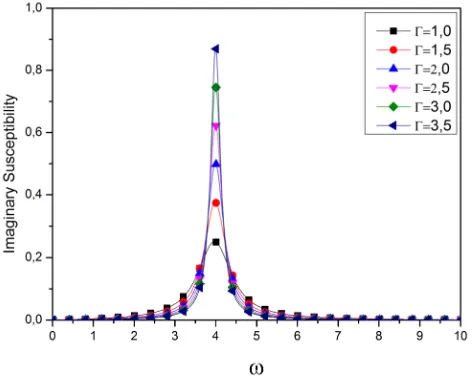
To investigate the dielectric properties in the dense environment, one choose to look at the behavior of the susceptibilities as well as the refractive index of the environment by making vary the spectral width, the specific pulsation (ω0) and the number of particle (N). The spectral width allows us to understand the complex aspect of the amortization in the dielectric circles. So, in the figure 1 one let us observe that for values ofω ω≺ 0, which represent the normal dispersion, the growth of the susceptibility is a function of the increase of the spectral width Г. For values
0
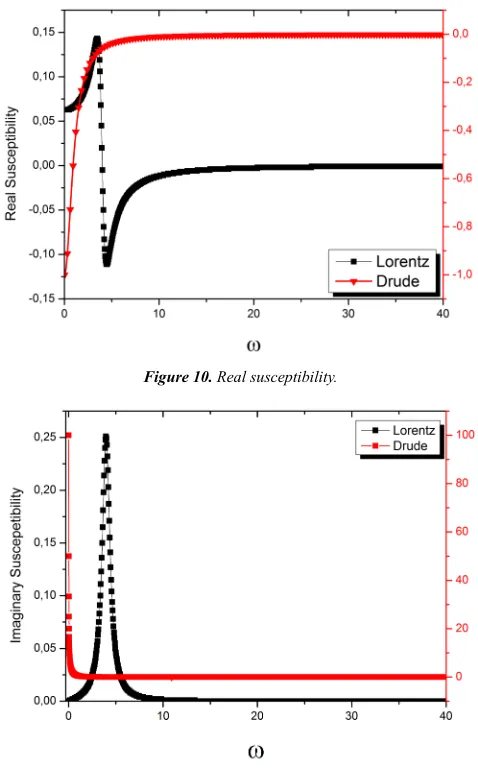
ω ω≥ , the susceptibility decrease rapidly, this phenomenon corresponds to an abnormal dispersion with positive and negative values of the susceptibility. Reason why, the growth of the spectral width influences the width of the peaks of the real susceptibility and more the spectral width is important more real susceptibility is acute and important. In the figure 2, with the imaginary susceptibility, the variation of the spectral width ( Γ ) influences the absorption of the dielectric environment. So for values of
ω
≺3 andω
≻5 the imaginary susceptibility is null for various values of Г. Forbut the goal of the investigations was the understanding of the behavior of the susceptibilities and the refractive index of the dense dielectric circles by varying the spectral width, the specific pulsation as well as the number of particle of the environment. So the Lorentz model is an ideal model to investigate the dense dielectric properties but also it is very used to study the behavior of phonons and transitions inter-bands. Reason why, certain authors have already used it to investigate the reflectivity of certain materials such as YMnO3 [21]. The figures 10, 11 and 12, show the difference between the Lorentz model and the Drude model. The Drude model is a particular case of the Lorentz model for ω0=0 and it is used to investigate the metallic circle. A comparative investigation is done with the curves of Susceptibility and the refractive index (ref. figure 10, 11 and 12) but the results are better with the Lorentz model. The Drude model [14] is often used to investigate the behavior of certain metals as well as the effects of the electronic interactions and the coupling in the collective modes. Reason why, the authors [22] used it to investigate the dynamics of heavy fermions in the case of the UPd2Al3 and UNi2Al3.
Figure 1. Evolution of the real susceptibility according to the spectral width.
Figure 2. Evolution of the imaginary susceptibility according to the spectral width.
Figure 3. Evolution of the reflective index according to the spectral width.
Figure 4. Evolution of the real susceptibility according to the specific pulsation.
Figure 6. Evolution of the reflective index according to the specific pulsation.
Figure 7. Evolution of the real susceptibility according to the number of particle.
Figure 8. Evolution of the imaginary susceptibility according to the number of particle.
Figure 9. Evolution of the refractive index according to the number of particle.
Figure 10. Real susceptibility.
Figure 12. Reflective index.
4. Conclusion
This paper was dedicated to model and investigate the physical dielectric properties of the dense dielectric circles. The work led during this study brought numerous answers on the influences of the number of particle, the spectral width and the pulsation in the dielectric properties. However several studies deserve to be pursued. In particular, the study of the dielectric properties in the artificial fibers but also the importance to see even the utility of the dielectric materials in the domains of the industry, the new technology and in the construction of buildings. Several researchers have already implanted a model to investigate the properties of materials according to their membership [23-24]. But in our case one of the perspectives is to implement a model which allows investigating any type of materials.
Computer Simulation
!***************************************************************** ! Program Dielectric_Simulation
!***************************************************************** implicit double precision (a-h,o-z)
parameter (alpha=3.5,a=5,e=1.6,cmass=0.91,Om0=4) parameter (epsi=1, tau=1 )
real bN1,bbN1, bbN2, bN2, DD, D, ffKRe, fKRe, ffKIm, fKIm
!***************************************************************** open (Unit=1, File=' Real Susceptibility Dense ')
open (Unit=2, File=' Imaginary Susceptibility Dense ') open (Unit=3, File=' Real Susceptibility Less Dense ') open (Unit=4, File=' Imaginary Susceptibility Less Dense ') open (Unit=6, File=' Permettivity')
open (Unit=7, File=' Reflective Index')
!***************************************************************** do Om=0.01,40,0.01
!***************************************************************** ! Dense Circle
!***************************************************************** bN1= (Om0**2 - Om**2)
bN2= (Om)/tau
D= ((Om0**2) - (Om**2))**2 + (Om/tau)**2
!***************************************************************** ! Real Susceptibility
!***************************************************************** fKRe=alpha*bN1/D
!***************************************************************** ! Imaginary Susceptibility
!***************************************************************** fKIm=alpha*bN2/D
!***************************************************************** ! Less Dense Circle
!***************************************************************** bbN1= (Om**2 - Om0**2)
bbN2= (Om)/tau
DD= ((Om**2) + (Om0**2))**2 + (Om/tau)**2
!***************************************************************** ffKRe=bbN1/DD
!***************************************************************** ! Imaginary Susceptibility
!***************************************************************** ffKIm=bbN2/DD
!****************************************************************** ! Permettivity
!****************************************************************** epsR= 1+(fKRe + fKIm)
!****************************************************************** ! Reflective Index
!****************************************************************** Refr=sqrt(epsR)
!***************************************************************** ! Display & Record
!***************************************************************** write(1,4)Om,fKRe
write(3,4)Om,ffKRe write(2,4)Om,fKIm write(4,4)Om,ffKIm write(6,4)Om,epsR write(7,4)Om,Refr format(2f7.3) enddo End
!******************************************************************
References
[1] S. S. Kulkarni, C. D. Lokhande, Materials Chemistry and Physics 82(2003) 151-156.
[2] K. G. Gatos, J. Mrtínez Alcàzar, G. C. Psarras, R. Thomann, J. Karger-Kocsis, Composites Science and Technology 67(2007) 157-167.
[3] Mengyang Li, Anibal A. Acero, Zhengqurg Huang and Stuart A. Rice, NATURE. Vol. 367. January 1994.
[4] Kenneth C. Janda, John C. Hemminger, Joh S. Winn, Stewart E. Novick, Stephen J. Harris, and William Klemperer, The Journal of Chemical Physics, Vol. 63, No. 4, 15 August 1975.
[5] John V. Dugan Jr. and John L. Magee, The Journal of Chemical Physics 47, 3103(1967).
[6] E. Özbay, A. Abeyta, G. Tuttle, M. Tringides, R. Biswas, C. T. Chan, C. M. Soukoulis, and K. M. Ho, Physical Review B Volume 50, Number 3, 15 July 1994-I.
[7] E. A. GUGGENHEIM «The conceptions of Electrical Potential Difference between two Phases and the Individual Activities of Ions», Copenhagen December 22, 1928.
[8] Robert M. Mc Meeking, Chad M-Landis, Journal of Applied Mechanics, July 2005, Vol. 72.
[9] Bertrand Dubus-Jean Claude Debus-Jocelyne Coutte, Revue Européenne des Eléments Finis. Volume 8-nº5-6/ 1999, pages 581 à 606.
[10] Ricardo A. Depine and Akhlesh Lakhtakia, arXiv: Physics/ 0311029v1 [Physics-Optics] 6. Nov 2003.
[11] D. Rytz, U. T. Höchli, H. Bilz, Physical Review B, Volume 22, Number 1, 1 July 1980.
[12] E. L. Colla, I. M. Reaney, and N. Setter, Journal of Applied Physics, Vol. 74, No. 5, 1 September 1993.
[13] Daniel Rinaldi, Jean-Louis Rivail, Theoret. Chim. Acta (Berl) 32, 57-70 (1973).
[14] Victor. M. Anisimov, Igor Vowbyov, Benoît Roux, and Alexander D. Mackerell, Jr. Journal of Chemical Theory and Computation. 2007, 3, 1927-1946.
[15] J. E. Sipe, Robert W. Boyd, Physical Review A, volume 46, Number 3, 1 August 1992.
[16] B. A. Woodahl, J. J. Coy, E. Fischbach, Physical Review Letters, PRL 98, 150805(2007), 13 APRIL 2007.
[17] E. Prodan, Allen Lee, P. Nordhander, Chemical Physics Letters 360(2002) 325-332, 10 July 2002.
[18] J. J. Hopfield, physical review, vol. 112, 5, 1555-1567(1958) [19] J. J. Hopfield, D. G. Thomas, physical review, vol. 132, 2,
563-572(1963)
[20] B. Lo, M. B. Gaye, A. Dioum, C. M. Mohrain, M. S. Tall, J. M. Chauveau, M. Doninelli Tesseire, S. Ndiaye, A. C. Beye, Appl. Phys. A (2014) 115: 257-261.
[22] Marc Sheffler, Martin Dressel, Martin Jourdan, Hermann Adrian, Physica B 378-380(2006) 993-994.
[23] Alioune Aidara Diouf, Bassirou Lo, Alhadj Hisseine Issaka Ali, Aboubaker Chedikh Beye. Comparative Investigation and Generalized of the Core/Shell Effects on the Magnetics Properties in the Ferromagnetic Cubic Nanoparticles by the Transverse Ising Model. American Journal of Nanomaterials. Vol. 4, No. 1, 2016, pp 1-7. http://pubs.sciepub.com/ajn/4/1/1
[24] Alioune. A. DIOUF, Bassirou. LO, Moustapha. BA, Mouhamed. B. GAYE, Ibrahima. NIANG, Mamadou. MBAYE, Pape. M. WADE and Aboubaker. C. Beye. (2016); TEMPERATURE AND POLARISATION DEPENDENT REFLECTIVITY OF THE C FREE EXCITON OF A-PLANE
ORIENTED ZNO EPILAYERS GROWN BY