This article is published under the terms of the Creative Commons Attribution License 4.0 Author(s) retain the copyright of this article. Publication rights with Alkhaer Publications. Published at: http://www.ijsciences.com/pub/issue/2017-01/
DOI: 10.18483/ijSci.1176; Online ISSN: 2305-3925; Print ISSN: 2410-4477
Yali Wen (Correspondence)
[email protected]
+0086-15-801631739, Fax: 010-62338109Assessment of Forest Resources Dependency for
local livelihood around Protected Area:
A Case Study in Popa Mountain Park, Central
Myanmar
Theint Theint Htun
1
, Yali Wen
1
, Aye Chan Ko Ko
2
1
School of Economics and Management, Beijing Forestry University, No (35), Qinghua East Road, Haidian District, Beijing, P.R. China, Post code –100083
2 1
School of Economics and Management, Beijing Forestry University
About: Forest resources play a crucial role for many livelihoods in the rural areas in Myanmar. Households in rural area of Myanmar, especially destitute households, depend on the forest related activities as one of the income diversification activities. This study estimated forest dependency and identified factors influencing dependency for households living around the Popa Mountain Park (PMP) in Myanmar. A sample of 75 households was randomly selected from three villages surrounding the Popa Mountain Park to analyze the significant of forest income in the rural household economy. The data were collected using structured questionnaire interviews, direct observation and group discussion. This study found that forest income contributes 38.82%, and farm income and non-farm income contribute 34.87% and 26.31% to the total household income respectively. Major forest products around PMP include firewood, medicinal plants, bamboo shoot, honey and others. OLS Regression analysis showed that agricultural income and non-farm income are scientifically and negatively correlated with the forest income. The findings go along with that of similar studies that, providing alternative source of income for the livelihood either through employment opportunities or by a source of income from cultivation would greatly reduce the dependence on the forest. The study concluded that consideration to socioeconomic characteristics of households living around PMP is essential in forestry conservation programs. Therefore, the government should consider measures to increase agricultural production and generate off- farm employment opportunities for rural communities in general and enhance conservation around Popa Mountain Park in particular. Also environmental education programmes should be encouraged in order to reduce dependence on the protected forests.
Keywords: Protected Area, forest dependency, livelihood, Popa Mountain Park, Myanmar
1. Introduction
Myanmar represents an important biodiversity reservoir with a great variety of different habitat types arising from its ecological diversity in Asia and Pacific Region. Diverse ecosystems with lots of genetic diversities can be found in Myanmar’s forests because of the tropical monsoon circulating system and its varied topography throughout the country. According to forest resource assessment (2015), about 42.92 percent of the total land area is still covered with forest. Forest resources are the most critical and principal suppliers for livelihoods of people and national economy as well. The total population of the country is about 51 millions and 68 % of this population were classified by the World
http://www.ijSciences.com Volume 6 – January 2017 (01)
35
largely dependent on these areas for subsistence andincome (Chao 2012). The importance of the forest in the survival life of the rural people in the developing countries is enormous. Moreover, forests are very important to local people for livelihoods and they depend on forests resources for various products such as fuel wood, construction materials, medicine, and food in most developing countries.
Conservation on forest resources has been practiced several years ago in Myanmar. Forest resources are conserved, managed and utilized in sustainable manner by the establishment of Reserved Forests (RFs), Protected Public Forests (PPFs) and Protected Areas (PAs). Protected area means ― an area of land/or sea especially decided to the protection and maintenance of biological diversity, and of natural and associated cultural resources, and managed through legal or other effective means (IUCN, the World Conservation Union). Generally, PAs in Myanmar can be classified as marine park, national park, wildlife sanctuary, nature reserve, and zoo park. Although Myanmar’s PAs do not fully conform to PA categories of the International Union of Conservation of Nature (IUCN), they are most similar to IUCN category IV (Aung 2007). Protected areas (PAs) are main tools for biodiversity conservation and sustainable development. Protected areas (PAs) are cornerstones for biodiversity conservation (Allendorf 2007; Walpole and Goodwin 2001) and are a major means of reducing deforestation (Andam et al. 2008). PAs safeguard ecosystems and their services, such as water provision, food production, carbon sequestration and climate regulation, thus improving people’s livelihoods.
Currently, Myanmar has 38879.89 sq km in 39 PAs representing diverse ecosystems, which cover 5.75% of the total area. Among the 39 PAs, seven PAs have been recognized as ASEAN Heritage Parks (AHP). The 1994 Protection of Wildlife and Protected Areas Law focuses on the identification of nature reserves, establishment of zoological gardens and botanical gardens, protection of wildlife and wild plants, permission for hunting, research studies, permission to establish zoological and botanical gardens, registration, search, arrest and administrative action, and offences and penalties. Recently, Myanmar has formulated National Biodiversity Strategy and Action Plan (NBSAP) with the multi-consultation process. NBSAP is a comprehensive framework for biodiversity conservation, management and utilization in a sustainable manner, as well as to support the National Sustainable Development Strategy. The development of NBSAP has given opportunity for practicing the alternative PAs management that favors not only biodiversity, but also livelihood development.
PA management in Myanmar rules and regulations restrict local people from using resources within PAs. Conflicts emerge as local people often have no other source of resource than the PA. Rao, Rabinowitz, and Khaing (2002) reported that nontimber forest products were extracted from 85% and fuelwood was collected from more than 50% of PAs in Myanmar. The mean annual population growth rate is 2.1% (Central Statistics Organisation 2006) and is highest in rural areas where most Myanmar PAs are located. Population increase is related to an increase in the number of people seeking land for grazing, collecting fuelwood, and extracting timber and other forest products. The rapid growth of protected areas and large pressure from the human population has become a great challenge to protected area management in Myanmar. Like many other developing countries, the conflict between the protected area and local people is the major threat which hinders to achieve the conservation objectives in Myanmar. Dependency on environmental income and forest products vary between households and communities. The major factors that influences the dependency level are five capitals; physical, human, social, financial and natural (Scoones 1998). Assessing how relationships can be developed between protected areas and local livelihood as well as understanding people’s attitudes and perceptions towards protected areas is important in understanding the linkages between protected areas and local people.
http://www.ijSciences.com Volume 6 – January 2017 (01)
36
medicinal, and income needs. The exploitation offorest resources like fuelwood , bamboo and medicinal plants affects wildlife habitat and the ecosystem of the forest. Increasing need for forest products, driven by demographic and market pressures, often becomes to accelerated extraction of forest resources that in turn drives habitat degradation.
Mohamed G.Shibia (2010) analysed the factors influencing forest resource use by the local population in Marsabit Forest Reserve, which is part of Marsabit National Park, Kenya. to assess the role of government policy in influencing household resource dependency and the implications of different resource uses for the conservation of biodiversity. He identified as the forced factors influencing resource use such as population pressure resulting from rural-urban migration, resource pricing policy, ill-defined property rights, low license fees etc. According to Wollenberg and Nawir (1998), income estimation for people whose livelihoods depend on forests is central to understanding their well-being and the use of forests. Gunatilake (1998) did study on forest dependency on the role of rural development in protecting tropical rainforests. Results of his study showed that more off-farm and non-forestry job, higher agricultural income, higher agricultural production, better education, and possibly the better access to the outside markets enhances biodiversity conservation through the reduction of dependency on forest resources.
PA management often includes strict regulations that exclude local people from areas that they may have previously used to gather resources such as fuelwood, materials for shelter and farming, fodder and non-timber forest products (Alkan, Korkmaz, and Tolunay 2009; Shrestha and Alavalapati 2006). Thus, the management of PAs may conflict with the economic highlights of local people (Khan and Bhagwat 2010; Shrestha and Alavalapati 2006). Xu et al. (2006) argue that local people’s attitudes are related to costs and benefits produced by PAs, their dependence on PA resources, and their awareness about PAs. Due to the many linkages that exist between protected areas and the surrounding areas, protected areas can no longer be considered in isolation from their neighbors. People are an integral part of the environment and therefore the human aspect should be taken into consideration in protected areas management (Garrant 1982). Reserved area managers have relied upon law enforcement approaches to resolve problems (e.g. illegal logging, over-graying, shifting cultivation) associated with local people. But, due to the lack of recognition to the needs of local communities living around the reserved areas the success is very limited (Studsrod & Wegge, 1995). It is now widely recognized that the
long-term survival of reserved areas in developing countries will be impinged if needs, aspirations, and attitudes of local peoples are not accounted for (McNeely, 1990; Ghimire & Pimbert, 1997). This reveals that understanding the dependency and conservation attitudes of local people towards reserved forests surrounding them are of great importance to formulate new or modify existing conservation strategies.
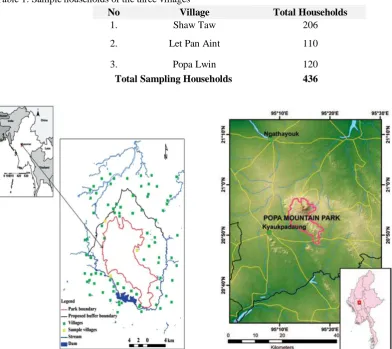
Popa Mountain Park possesses very diverse forest ecosystems with dry mixed deciduous forest being the dominant vegetation type, and most of the original forests have already vanished. PMP is surrounded by higher population density and the competition between local people who depend on natural resources from the park and the park’s conservation goals is relatively high because of the high population density together with the scarcity of resources in the surrounding area. This park has suffered more than others because of the conflict of interest between local livelihoods and conservation. Understanding household forest dependency in this study area is critical for designing conservation strategies. Therefore, the focus of this study is to describe resource use by local people around
Protected Area and how socioeconomic
characteristics determine household dependence on income from forest. The study helps to recognize potential solutions for developing appropriate strategy in order to maintain long term existence of the Park.
2. Objective of the study
The overarching goal of the study is to provide baseline data on resource use and dependency on protected area by local communities to promote future management plans for the study area. With the aim of identifying strategies that could be used to sustain the existing relationships at the study site, this paper tries to answer (i)what is the extent and nature of dependence on the forest around protected area by local communities (ii) how socioeconomic characteristics determine household dependence on income from forest ? (iii) what are the factors influencing resource dependency in these rural communities ?
3. Study area and data collection 3.1 Study Area
http://www.ijSciences.com Volume 6 – January 2017 (01)
37
declared a PA in 1989.The area of the park is about128.5 km2 and its adjacent area, about 103.6 km2, is being established as Public Protected Forest to be used as a buffer zone of the park. Average rainfall ranges from 630 - 1,500 mm per year but with most of area getting no more than about 750 mm. Formally Mount Popa was covered with a luxuriant growth of moist mixed deciduous forests. There are about 300 tree species and 150 medicinal plants. Important medicinal plants include the Sindonmanwe (Tinospora cordifolia), Taw Shauk (Atalantia manophylla),Tabin-shwe-hti(Intropha podagrica) and Ginseng (Panax schinseng).
The main objectives of PMP are forest conservation, protection of the watershed area, conservation of medicinal plants for sustainable use, preservation of existing religious sites, and ensuring sustainability of water sources (natural springs). The area surrounding Popa Mountain is somewhat densely populated and there are 45 villages scattered around the foot of the mountain. Total households were 6,842 in 1990 with the population of round about 36,761 and increased in to 50,919 in 2005(source: local administration
office). Agriculture is the most common livelihood of the local people. The people are mainly farmers and their main crops are rice, sesame, maize and tomato. Bananas are extensively cultivated in the eastern part of the park and some perennial crops such as mango, cashew, papaya, coffee etc. are intercropped with banana.. Collection of fuelwood, forest products and grazing are common human activities within the park. Volcanic plug, locally called Taung-kalat at the western foot of Mount Popa is a prominent landmark and is one of the famous religious sites in Myanmar and several thousand visitors including foreign visitors visit it each year and such tourism is the major income source for many people (Naing Z. Tun, 2008).
3.2 Data collection
Data collection was based on exploratory social survey research method. In total, 75 households were randomly selected from three villages around the Popa Mountain Park. A questionnaire survey was administered to the 75 households during fieldwork
from August to September 2016.
Table 1: Sample households of the three villages
No Village Total Households
1. Shaw Taw 206
2. Let Pan Aint 110
3. Popa Lwin 120
Total Sampling Households 436
http://www.ijSciences.com Volume 6 – January 2017 (01)
38
The survey was conducted using a developedquestionnaire to cover the required information from respondents. The primary data was collected through face to face interviews with the household respondents. Socio-economic conditions of the household such as household size, land holdings, forest resource use information, household expenditures and household income etc. were collected for primary data. Specifically, the respondents were asked to report on the size of the land they own, education level, age, gender, household size, food availability, the main crops and annual crop. In addition, the respondents were asked to list all capital assets they own. Focus group discussions were conducted in these three villages to get information about extraction activities, different types of forest products required for particular activities and local market prices. The income assessment was based on recall for one season in 2016. Key informant interviews were conducted with village heads, elders, government officials such as township forest managers, national park authorities. Direct observations were used to collect general information on the villages and to understand the real situation of the households and forest dependent activities. Secondary data related to the research was collected from Forest Department (FD), Township Forest Department and Ministry of Environmental
Conservation and Forestry (MOECAF). A
combination of descriptive statistics and logistic regression analysis model are used to determine which independent variables are significant in predicting forest resource dependency to address stated research objectives.
4. Methodology
4.1 Forest dependency model
Forest dependency was estimated in order to point out the contribution of forest income to total household income and to measure the degree of dependence on forest. In considering the share of forest income in total household income both subsistence and cash value were taken into account. Ordinary least regression was run in order to identify which socioeconomic variables influence on forest income. The forest income was considered as the dependent variable and household characteristics such as age of the household head, sex of the household head, education of the household head, household size, agricultural land holding, off-farm income, and agricultural income were considered as independent explanatory variables. The econometric model can be stated as follow.
Y = β0 + β1xi + u
Where, Y = forest income,
β0 = intercept, β1 = estimated coefficient of
explanatory variable xi,
xi = explanatory variables (household characteristics),
u = error term
Total household income was estimated as follow. Household annual income = Σ (income from agriculture + Non-farm income + income from forest). The information of these incomes was considered as follows.
Agricultural income
Agricultural income includes income from the cultivation of crops for purposes of both household consumption and selling. Information on crop yields was gathered from individual households through the questionnaire survey. Prices of crops were obtained from the local market. Monthly income from agriculture was gathered from respondents through questionnaires. This was converted into annual values.
Non-Farm income
Non-farm include all income form the wage labor, permanent employment such as pension, government staff, private shops, income obtained from property. Wage labor in the study area is mostly in the agricultural activities. The daily wages for man and woman are not the same. The wage rate and number of working days/hours reported by the respondents is used in the estimation. Income from pension, private shops, etc. is obtained from the individual household through the interview.
Forest income
Information about collection and sale of forest products was obtained from households. In addition, a different kind of all non-timer forest products (NTFP) was prepared with key informants. Products such as fuelwood can be traded commercially to generate cash while subsistence products such as medicinal plants. Income from commercial products was calculated by multiplying the quantities with market prices.
4.2 Data Analysis
Descriptive statistics were used to present the characteristics of households using frequencies and means. Econometrics analysis was used to analyze the relationships between forest income and household characteristics and to determine factors that influence households’ dependence on forest. The collected data were analyzed using Excel 2010 and STATA version 13.
5. Result and discussion
5.1 Socio-economic characteristics of the respondents
http://www.ijSciences.com Volume 6 – January 2017 (01)
39
Household size varied from 2 to 8 persons with amean of 4.49 (standard deviation sd = 1.77).The average education level is 2.01, it was found that 32 %,40 %, 22.67% and 5.33% of the population had primary, middle, high school and university education respectively. Average age of the household heads was 44. 33 years with a minimum of 25 years and maximum of 72 years old. Subsistence
agriculture is the major source of villages living around Popa Mountain Park. Only 13.33 % of the households are agricultural landless and the remaining households own agricultural land. The average agricultural land size is 3.27 (standard deviation sd =2.43). The descriptive statistics of household characteristics are shown in table 2.
Table 2: Descriptive analysis of household respondents Household
characteristics
Minimum Maximum Mean Standard Deviation Standard error
Gender 0 1 0.37 .49 0.06
Household size 2 8 4.49 1.77 0.20
Education level 1 4 2.01 0.88 0.10
Age (Year) 25 72 44.33 13.06 1.51
Agri-land(Ac) 0 8 3.27 2.43 0.28
5.2 Income Levels and sources
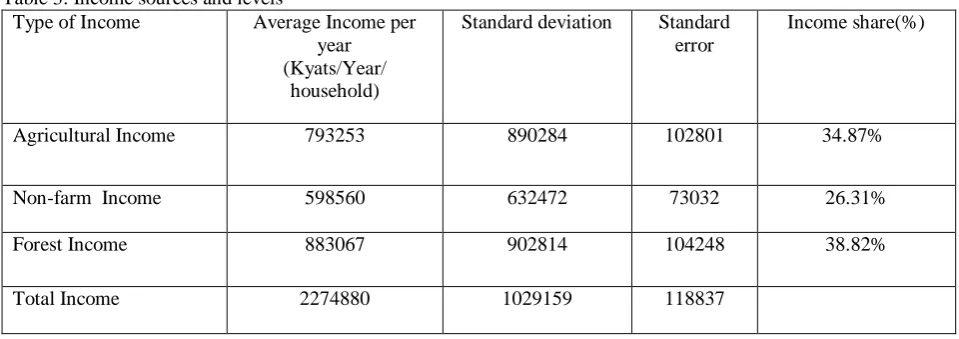
In the study area, Agriculture is the main livelihood, providing the second largest share with 34.87% to the total household income in three sampled villages .People's livelihoods are firmly connected to agriculture households. Gunatilake (1998) showed that higher agriculture productivity and agriculture income result in less extraction of forest resources. In general, people from farm dependent villages will depend less on forest resources. It is hypothesized that the forest dependency is inversely related to agricultural income. As shown in Table 3, non-farm income is 26.31% and income such as salaried jobs and business were collected from individual members. This also includes other sources of income such as remittances, and pensions for age old people. Household annual income from forest products is 38.82% to the total household income, the highest income source in this study area. The most important forest products were firewood, wild fruits, medicinal plants, bamboo shoot and mushroom. There is
widespread selling of handicrafts to tourists by both men and women at the market place (personal observation).The contribution of forest income to total income in PMP National Park is relatively high compared to other income sources.
A study made by Mamo, Sjaastad and Vedeld (2006) in Dendi District of Ethiopia estimated that income from forest resources contributed to 39% of the average household income which is roughly equal to agricultural income 40%. But the study of Pyi Soe Aung et al. (2014) revealed that the forest income is the most important source of household income, contributing to about 50 % to 55% of the total household income in two study villages around Natma Taung national park in Myanmar. Moreover Saha and Sundriyal (2012) also found that high dependence on wide variety of NTFPs in humid tropics of northeast India and NTFPs contributed to 19-32% of total household income for different tribal communities in northeast India.
Table 3: Income sources and levels
Type of Income Average Income per
year (Kyats/Year/
household)
Standard deviation Standard error
Income share(%)
Agricultural Income 793253 890284 102801 34.87%
Non-farm Income 598560 632472 73032 26.31%
Forest Income 883067 902814 104248 38.82%
http://www.ijSciences.com Volume 6 – January 2017 (01)
40
5.3 Contribution of different major forest products to forest income
The people living around the Protected Areas depend upon them for their livelihood in varying degrees. Forest products play an important role in generating income and employment among the rural poor. The extraction of forest products like firewood and fodder affects wildlife habitat and the ecosystem of the forest. Households were found to collect forest products both from the PA as well as from the RF .About 36% of the respondents collected forest products only from the PA, and 41% reported both PA and RF as their forest products source where the rest 23% mentioned RF as their sole source of collection. The major forest products reported by households include firewood, medicinal plants,
bamboo shoot honey and others. There is widespread selling of handicrafts to tourists by local people at the market place (personal observation). Income share from firewood, medicinal plants, bamboo shoot, honey and others are 43%, 36%, 15%, 4%, and 2% respectively. Firewood is the main source of energy and largest share in forest income, used especially for cooking by local people. Medicine is the second major forest products including utilization of the indigenous medicinal plants, herbs, grasses, trees, and animals by the rural people to mainly treat or cure illness of peoples within the community or outside community and sometimes they are sold outside. Figure 2 indicates different major forest products in the study area.
5.3 Factors influencing Forest Dependency
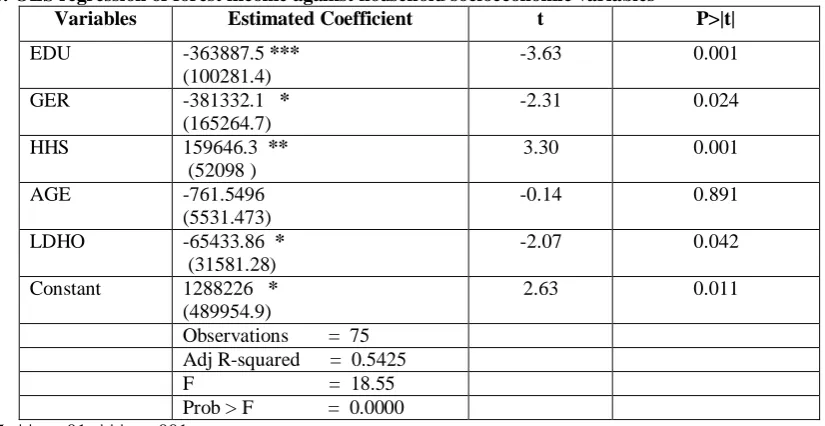
Results of the OLS regression explaining the forest dependency of the households near the PMP are presented in the following tables. Table 4 shows the significance and coefficient of each independent variable on the dependent variable .Five socio-economic factors such as (1) family Size, (2) education, (3) family income from non-forestry activities, (4) land ownership (5), family income from agricultural activities were hypothesized to influence the degree of forest dependency. To test these hypotheses, the OLS regressions analysis has been applied to study the effect of independent variables on dependent variable.
In this analysis, many explanatory variables have the expected effect on forest dependency. While coefficients on the GER and LDSZ are statistically significant at 5%, variable HHS and EDU are significant at 1% and 0.1 % respectively. Educational level of household heads showed a significant effect on forest dependence. In this study, the negative coefficient of education level suggests that educated people can easily get off farm employment opportunities than non- educated people. The
education allows people to go away from subsistence agricultural activities. Hedge and Enters (2000) showed that high educated people will have greater off- farm employment opportunities than less educated ones. Dovie et al. 2005, Campbell et al. 2002) found the study that less educated people are more likely to rely on forest income, as they have less access to alternative incomes such as wages or business. Gender is an important factor in utilization of forest products. Gender of household head was negatively and significantly correlated to the forest income.
http://www.ijSciences.com Volume 6 – January 2017 (01)
41
The variable AGE shows a negative relationship tothe forest dependency. This suggests that younger households are more dependent on forest resources. This may be due to the fact that forest dependent activities around PMP are illegal and it is risky to undertake them. Youth generally take greater risks relative to older people in the community. Furthermore, with limited off farm opportunities, younger people rely more on forest resources to meet their basic needs. A study by Andre and Platteau (1998) in Rwanda noted that younger households are being trapped in poverty due to limited alternative economic opportunities.
The negative coefficient of LDSZ suggests that respondents with larger landholdings are less dependent on forest resources. This is consistent with the findings of Reardon and Vosti (1995) that in Rwanda, land-poor is also poor in off-farm capital and therefore cannot afford to continue sustainable agriculture. Therefore, land poor will rely more on forest resources to meet their livelihood needs. Agricultural land is the most important factor that is likely to reduce the dependency of local community on forest products. This result supports the findings of other studies (e.g. Mamo et. al. 2007, Heubach et. al. 2011). Babulo et al. (2008) also found that households with large plots of land were less likely to engage in forest extraction as their dominant strategy.
Table 4: OLS regression of forest income against household socioeconomic variables
Variables Estimated Coefficient t P>|t|
EDU -363887.5 ***
(100281.4)
-3.63 0.001
GER -381332.1 *
(165264.7)
-2.31 0.024
HHS 159646.3 **
(52098 )
3.30 0.001
AGE -761.5496
(5531.473)
-0.14 0.891
LDHO -65433.86 *
(31581.28)
-2.07 0.042
Constant 1288226 *
(489954.9)
2.63 0.011
Observations = 75 Adj R-squared = 0.5425 F = 18.55 Prob > F = 0.0000 * p<.05; ** p<.01; *** p<.001
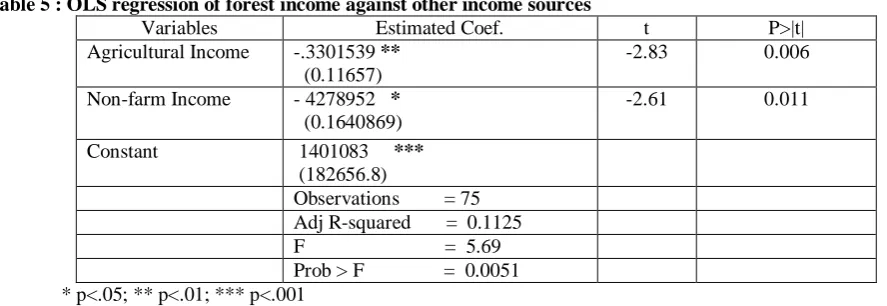
Agricultural income was (p<0.01) was negatively correlated to forest income and statistically significant. This implies that households with high total agriculture income are less dependent on forest resources. This finding is similar to the finding of Gunatilake (1998) wherein agriculture income was found to have a negative impact on forest dependency in Sinharaja forest community in Sri Lanka. Agriculture constitutes the main source of income for rural Rwandan households and contributes substantially to their income. Therefore, poor households with little income from agriculture may be more dependent on the forest (Cavendish, 2000; Godoy, 1993; Gutanilake et al., 1993). This result is in line with the finding of Illukpitiya & Yanagida (2008). They stated that forest dependency decreased for households with more diversified income sources and sources of diversify household income include agriculture, livelihood production, etc. But this result is opposite to the findings of Angelsen
et. al. (2014). They found in their global comparative analysis on environmental income study that agricultural land ownership is positively correlated with higher environmental reliance. Kamanga et. al. (2008) also found that households with lower agricultural income engage less in communal forest income generation.
Forest dependency was reduced if the household have better non-farm employment. Non-farm income was statistically significant and negatively correlated to forest income. Rayamajhi (2012) also reported that the more income from outside and the more savings, the fewer households rely on forests. The higher the non-forest income of households, the less dependent is the household on forest, which is in agreement with other findings (Sandker et al. 2009, Tieguhong
http://www.ijSciences.com Volume 6 – January 2017 (01)
42
Table 5 : OLS regression of forest income against other income sources
Variables Estimated Coef. t P>|t|
Agricultural Income -.3301539 ** (0.11657)
-2.83 0.006
Non-farm Income - 4278952 *
(0.1640869)
-2.61 0.011
Constant 1401083 ***
(182656.8)
Observations = 75 Adj R-squared = 0.1125 F = 5.69 Prob > F = 0.0051 * p<.05; ** p<.01; *** p<.001
6. Conclusion and Recommendation
Deforestation and forest degradation in Popa Mountain Park are caused by resource extraction by people from local communities. This paper analyzed the role of forest resources in local livelihoods and determined the forest dependence in PMP, Myanmar. Major income sources in the study area include agricultural income, non-farm income and forest income. This study found that forest income plays an important role in the livelihood of local community. Households engaged in forest products collection for different subsistence and commercial purpose. Thus the study found that forest income is the highest share in the total household income amounted to 38.82%, agricultural income is the second largest share after forest income amounted to 34.87% and non-farm income amounted to 26.31%. This study reveals that agriculture income and nonfarm income will reduce forest dependency. Farm income and non-farm income are negatively correlated with forest income. This means that local community less dependent on forest resources if they have access to better non-farm activities and agricultural land. It also found that agricultural land is significantly and negatively correlated with the forest income.
According to the study result, most of local people
depend on forest products especially
firewood .Among the different forest products, firewood is the most important forest product with highest income share in forest income with over 43%. Firewood collection for cooking is the major use of forest products by the local people. The conservation measures, mainly patrolling, alone will not be able to halt deforestation and forest degradation in PMP as people may collect forest resources from the areas where conservation measures are not effective. New alternative energy sources need to be provided to local communities while conservation measures are effectively conducted within the park. Establishing village-owned firewood plantations, introducing solar power and firewood substitutes and providing the people with firewood efficient stoves can reduce pressure on the park’s forest.
In order to resolve the conflict between local livelihoods and the conservation of the park, the government should consider measures to increase agricultural production and generate off- farm employment opportunities for rural communities in general and around Popa Montain Park in particular. Moreover, providing alternate source of income for the livelihood either through employment opportunities or by a source of income from cultivation will help reduce the pressure on protected area. Social forestry programmes should be extended to reserved and protected forest lands. Participation of local people in management of the protected area should be promoted by developing participatory management plan. These measures may improve rural livelihoods and conserve forest resources and biodiversity. In summary, to enhance greater cooperation from local people and achieve sustainable conservation and utilization of the forest reserve, greater stakeholder participation is recommended in the design of any management plan. Policy makers and park managers should consider improving awareness of local communities about sustainable use of forest resources and the importance of biodiversity conservation. The PMP staffs should conduct more environmental and conservation education programmes in surrounding villages.
Acknowledgement
http://www.ijSciences.com Volume 6 – January 2017 (01)
43
References
1. Allendorf, T., K. K. Swe, T. Oo, Y. Htut, M. Aung, M. Aung, P. Leimgruber, and C. Wemmer 2006. Community attitudes toward three protected areas in Upper Myanmar. Environ.Conserv. 33(4):344–352.
2. Allendorf, T. D. 2007. Residents’ attitudes toward three protected areas in south western Nepal. Biodivers. Conserv. 16:2087–2102.
3. Angelsen, A. et al. 2014. Environmental Income and Rural Livelihoods: A Global-Comparative Analysis. World Development Vol. 64, pp. S12–S28. 2014. http://dx.doi.org /10.1016/j. worlddev.2014.03.006
4. Andam, K. S., P. J. Ferraro, A. Pfaff, G. A. Sanchez-Azofeifa, and J. A. Robalino. 2008. Measuring the effectiveness of protected area networks in reducing deforestation. Proc. Natl. Acad. Sci. USA 105(42):16089–16094.
5. Alkan, H., M. Korkmaz, and A. Tolunay. 2009. Assessment of primary factors causing positive or negative local perceptions on protected areas. J. Environ. Eng. Landscape Manage. 17(1):20–27.
6. Bahuguna, V.K. 2000. Forests in the economy of the rural poor: an estimation of the dependence level. Ambio 29: 126– 129. (Cameroon)
7. Babulo, B. et al.. 2008. The economic contribution of forest resource use to rural livelihoods in Tigray. Forest policy and Economics 11(2009) 109-117.
8. Cavendish W. (2000) Empirical regularities in the poverty-environment relationship of rural households: Evidence from Zimbabwe. World Development, 28(11):1979-2003. 9. D. K. Langat,1 (2015) Role of Forest Resources to Local Livelihoods: The Case of East Mau Forest Ecosystem, Kenya Kenya Forestry Research Institute
10. Garrant, K. 1982. The relationship between adjacent land and protected areas: Issues of concern for the protected area manager. In. McNeely, J.A. and Miller, K.R. (eds). National Parks, Conservation and Development: the role of protected areas in sustaining society. Washington: Smithsonian Institution Press. pp. 65-71.
11. Gunatilake H.M. (1996), An economic impact
assessment of the proposed conservation program on peripheral communities in the Knuckles forest range of Sri Lanka. Journal of Sustainable Forestry, 3:1-15.
12. Gunatilake H.M. (1998) The role of rural development in protecting tropical rainforests: evidence from Sri Lanka. Journal of Environmental management, 53:273-292.
13. Ghimire K.B. Pimbert M.P. (1997) Social change and conservation: An overview of issues and concepts. Pages 1-45 in K.B. Ghimire and M.P. Pimbert, editors. Social change and conservation: Environmental politics and impacts of national parks and protected areas. London: Earthscan Publications Limited 14. Hedge R., Enters, T. (2000) Forest products and household economy: a case study from Mudumalai Wildlife Sanctuary, Southern India. Environmental Conservation, 27:250-259.
15. Illukpitiya, P. and Yanagida J. F. 2008. Role of income diversification in protecting natural forests: evidence from rural households in forest margins of Siri Lanka. Agroforest Syst (2008) 74:51–62, DOI 10.1007/s10457-008-9153-2
16. Julius Chupezi Tieguhong 2012 .Household
dependence on forests around lobeke National Park, Cameroon197-200
17. Kamanga, P., Vedeld, P., Sjaastad, E. 2008. Forest incomes and rural livelihoods in Chiradzulu District, Malawi. Ecological Economics 68(2009) 613-624
18. Mohamed G. Shibia(2010): Determinants of Attitudes and Perceptions on Resource Use and Management of Marsabit National Reserve, Kenya
19. Masozera, M. K. 2002. Socioeconomic impact analysis of the conservation of the Nyungwe forest reserve, Rwanda.
20. Masozera , M.K. and Alavalapati, J.R.R. 2004. Forest dependency and its implication for protected areas management: A case study from Nyungwe Forest Reserve, Rwanda. Scand.J. For. Res. 19(Suppl. 4): 85–92.
21. Mamo, G., Sjaastad, E. and Vedeld, P. 2006. Economic dependence on forest resources: A case from Dendi District, Ethiopia. Forest Policy and Economics 9 (2007) 916–927 22. Naing Z. Htun, March 2008, Effect of Protected Area on Forest Vegetation and Local People’s Responses, A Case Study in Popa Mountain Park, Myanmar.
23. NWCD. 2007. Lists of protected area in Myanmar, Nature and Wildlife Conservation Division, Forest Department, Myanmar.
24. Pyi Soe Aung, September 2012, Understanding Forest Dependency and Resource Extraction of Local Communities living around the Protected Area in Myanmar: A Case Study in Natma Taung National Park, Myanmar.
25. Rao, M., Rabinowitz, A. & Khaing, S. T. 2002. Status Review of the Protected-Area System in Myanmar, with Recommendations for Conservation Planning. Conservation Biology, 16, 360-368.
26. Rayamajhi, S., Smith-hall, C., HELLES, F. 2012. Empirical evidence of the economic importance of Central Himalayan forests to rural households. Forest Policy and Economics 20 (2012) 25–35.
27. Reardon T., Vosti S. (1995) Links between rural poverty and the environment in developing countries: asset categories and investment poverty. World Development, 23:1495-1506.
28. Pretzsch, J. (2003). Forest related rural livelihood strategies in national and global development. Paper presented at The International Conference on Rural Livelihoods, Forests and Biodiversity 19-23 May 2003, Bonn, Germany
29. Saha, D. & Sundriyal, R.C. 2011. Utilization of non-timber forest products in humid tropics: Implications for management and livelihood. Forest Policy and Economics 14 (2012) 28–40
30. S. Chao, Forest People: Numbers across the World, Forest Peoples Program, Moreton-in-Marsh, UK, 2012 page 7 31. Shrestha, R. K., and J. R. R. Alavalapati. 2006. Linking conservation and development: An analysis of local people’s attitude towards Koshi Tappu Wildlife Reserve, Nepal.
32. Sandker, M., Campbell B M., Nzooh Z., Sunderland T., Amougou V., Defo L. and Sayer J. 2009. Exploring the effectiveness of integrated conservation and development interventions in a Central African forest landscape. Biodiversity Conservation February 2009.
33. Shackleton, C. M. (2004). Assessment of the livelihoods importance of forestry, forests and forest products in South Africa (Manuscript). Grahamstown: Rhodes University. 34. Studsrod J.E., Wegge P. (1995) Park people relationships: the case of damages caused by park animals around the Royal Bardia National Park, Nepal. Environmental conservation, 22:133-142.
35. Scoones, I. (1998). Sustainable Rural Livelihoods: A Framework for Analysys. IDS Working Paper 72. Institute of Development Studies (IDS).