Journal of Experimental Biology and Agricultural Sciences
http://www.jebas.org
ISSN No. 2320 – 8694
Journal of Experimental Biology and Agricultural Sciences, June - 2018; Volume – 6(3) page 498 – 502
EFFECT OF CORN-SOYA DIET SUPPLEMENTED WITH COCKTAIL ENZYMES
ON PERFORMANCE AND CARCASS CHARACTERISTICS’ OF COBB BROILERS
Kavitha R*, Chandrasekaran D
Animal Feed Analytical and Quality Assurance Laboratory, Veterinary College and Research Institute,Namakkal -637002
Received – October 22 2017; Revision – February 21, 2018; Accepted – May 05, 2018 Available Online – June 20, 2018
DOI: http://dx.doi.org/10.18006/2018.6(3).498.502
ABSTRACT
Present study was conducted to access the effect of corn soya diet supplemented with cocktail enzymes on the performance and carcass characteristics of Cobb broilers. The cocktail enzyme consists of non-starch polysaccharidase- Cellulases-333 IU/g; Xylanase – 1385 IU/g; Pectinase – 654 IU/g and Phytase-441 IU/g. A total of 120 newly hatched Cobb broilers were distributed into four groups, the first treatment groups was kept as control, second group was fed with control diet supplemented with cocktail enzymes@250g/ton, third group was fed with control diet supplemented with cocktail enzymes@500g/ton and fourth group was fed with control diet supplemented with cocktail enzymes@1000g/ton. The birds were reared for a period of 42 days and production performance was assessed. No significant difference was reported in mean body weight of broilers fed on enzymes added and control diet. Similarly, in case of organs weight and intestinal length also, no significant difference was reported between the treatment containing enzymes groups and control group. Further, addition of enzymes significantly improved the feed efficiency than the control group. Hence, it can be concluded that addition of cocktail enzymes improved the feed taken efficiency of broilers.
* Corresponding author KEYWORDS
Corn-soy diet
Carcass characteristics
NSP enzymes
Phytase
Production performance
E-mail: [email protected] (Kavitha R)
Peer review under responsibility of Journal of Experimental Biology and Agricultural Sciences.
All the article published by Journal of Experimental Biology and Agricultural Sciences is licensed under a Creative Commons Attribution-NonCommercial 4.0 International License Based on a work at www.jebas.org.
Production and Hosting by Horizon Publisher India [HPI] (http://www.horizonpublisherindia.in/).
Journal of Experimental Biology and Agricultural Sciences http://www.jebas.org
Effect of corn-soya diet supplemented with cocktail enzymes on Cobb broilers 499
1 Introduction
Addition of non-starch polysaccharide (NSP) degrading enzymes in poultry diets has been followed for many years. However, the effects of exogenous enzymes can be variable and are depend on a large number of factors such as the age of the bird, the quality and type of diet (Olnood & Liu, 2012). The use of exogenous enzymes to improve the digestibility of corn-soybean meal diets in broilers is not well documented. Neither corn nor soybean meal is regarded as viscous feedstuffs even though they do not contain appreciable amounts of NSPs. Corn contains approximately 0.9% soluble NSPs and 6% insoluble NSP’s, whereas, soybean meal contains approximately 6% soluble NSP and 18-21% insoluble NSP (Bach Knudsen,1997). Further, Noy & Sklan (1994) reported that ileal digestibility of corn starch rarely exceeds 85% in broilers between 4 and 21 day of age, indicating opportunities to further improve the digestibility of resistant starch in the jejunum and ileum through amylase supplementation. Addition on NSP degrading enzymes usually result in numerous beneficial effects, such as increased utilization of nutrients (e.g. fat and protein), improved AME values, increased growth rate, improved feed to gain ratio, decreased viscosity of intestinal digesta, reduced incidence of sticky excreta, improved litter condition and reduced environmental pollution due to a decreased output of manure and gases such as ammonia (Broz &Ward 2007).
Enzyme supplementation can change the nutritional status and improve growth performance of broilers fed on corn-soya diet, but these are also closely related to the regulation of metabolism and functioning of the growth related endocrine system. Nutritional status is an important factor in the regulation of plasma hormones and intermediary metabolism in broiler chickens. Therefore, the objective of the study was to examine the effects of NSP enzyme supplementation on performance and carcass characteristics of broilers fed corn-soybean based diet.
2 Materials and Methods
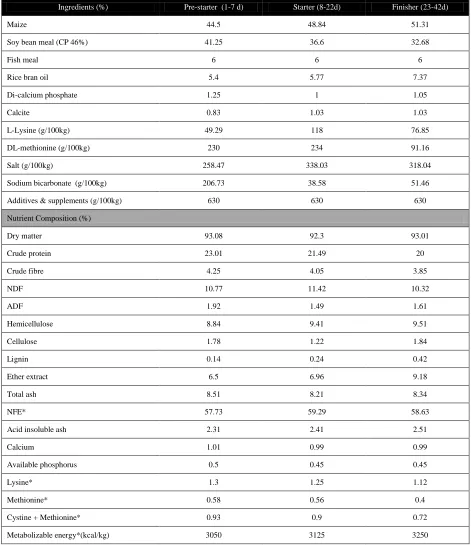
A total of 120 newly hatched straight run broiler chicks (Vencobb 400) belonging to a single hatch were used for this experiment. The experiment was carried out as per the Institute Animal Ethics Committee (IAEC) and CPCSEA guidelines. The chicks were wing banded, weighed individually and distributed randomly to the four experimental diets with three replicates of ten chicks each. The treatments include as control (Fed on corn-soya diet only), control + 250g/ton cocktail enzymes, control + 500g/ton and control +1000g /ton cocktail enzymes. Here cocktail enzymes have a combination of non-starch polysaccharidase- Cellulases (333 IU/g); Xylanase (1385 IU/g); Pectinase (654 IU/g) and Phytase (441 IU/g). Feed ingredients were procured locally and used for the formulation of experimental broiler pre starter, starter and finisher diets. The ingredients and nutrient composition of
broiler pre starter, starter, and finisher diets are presented in Table1. Feed intake, body weight were recorded at weekly intervals and weight gain and feed efficiency were worked out. Mortality, if any, was recorded at regular intervals. At the end of six week of age, birds were slaughtered as per the standard procedure to find out dressing percentage, the weights of gizzard, liver, heart, pancreas and intestinal length were measured and recorded. The data collected on various parameters were statistically analysed by one-way ANOVA as per the method of Snedecor & Cochran (1989). The means were compared for significance by Duncan’s multiple range test (1957).
3 Results and Discussion
The effects of enzyme supplementation on broilers at 10, 28 and 44 days are shown in the Table 2.The effect of multi enzyme preparation (0, 250,500 and 1000 g/ton) of broiler diet was evaluated in terms of weight gain, feed intake, feed conversion ratio and carcass characteristics. The data on body weight, weight gain, feed intake and feed efficiency of broilers fed the diet added with different levels of enzymes are furnished in the Table 2. The mean body weight gains among the experimental groups were 1942, 1992, 1998, and 2004g respectively at sixth week of age. Though a numerical increase in body weight gain was observed in enzyme added groups 250g, 500g and 1000g but this weight gain was not significantly different. Result of present study are contradictory to the findings of Torres et al. (2004) who has observed that supplementation of enzyme at 500g/ton to the corn soya based diet not only improved body weight gain over the control, but also observed increased body weight gain in the groups fed with reduced protein diet after 21 days.
Journal of Experimental Biology and Agricultural Sciences http://www.jebas.org
500 Kavitha & Chandrasekaran
Table 1 Ingredient and nutrient composition of experimental diets for different periods of the experiment
Ingredients (%) Pre-starter (1-7 d) Starter (8-22d) Finisher (23-42d)
Maize 44.5 48.84 51.31
Soy bean meal (CP 46%) 41.25 36.6 32.68
Fish meal 6 6 6
Rice bran oil 5.4 5.77 7.37
Di-calcium phosphate 1.25 1 1.05
Calcite 0.83 1.03 1.03
L-Lysine (g/100kg) 49.29 118 76.85
DL-methionine (g/100kg) 230 234 91.16
Salt (g/100kg) 258.47 338.03 318.04
Sodium bicarbonate (g/100kg) 206.73 38.58 51.46
Additives & supplements (g/100kg) 630 630 630
Nutrient Composition (%)
Dry matter 93.08 92.3 93.01
Crude protein 23.01 21.49 20
Crude fibre 4.25 4.05 3.85
NDF 10.77 11.42 10.32
ADF 1.92 1.49 1.61
Hemicellulose 8.84 9.41 9.51
Cellulose 1.78 1.22 1.84
Lignin 0.14 0.24 0.42
Ether extract 6.5 6.96 9.18
Total ash 8.51 8.21 8.34
NFE* 57.73 59.29 58.63
Acid insoluble ash 2.31 2.41 2.51
Calcium 1.01 0.99 0.99
Available phosphorus 0.5 0.45 0.45
Lysine* 1.3 1.25 1.12
Methionine* 0.58 0.56 0.4
Cystine + Methionine* 0.93 0.9 0.72
Metabolizable energy*(kcal/kg) 3050 3125 3250
Mineral mixture added at the level per kg feed supplied manganese (81 mg), zinc (78 mg), iron (30 mg), iodine (3mg), copper (3 mg) and cobalt (1.5mg). Vitamin AB2D3K added at the level per kg feed supplied vitamin A (16500 IU), B2 (10 mg), D3 (3200 IU) and vitamin K (2 mg). Vitamin
Journal of Experimental Biology and Agricultural Sciences http://www.jebas.org
Effect of corn-soya diet supplemented with cocktail enzymes on Cobb broilers 501
recorded a better feed efficiency than the control. The carcass characteristics in terms of dressing percentage, weights of gizzard, liver, heart and pancreas are presented in Table 3.
Dressing percentage of different treatment groups was 75.48 (control), 74.65 (control+250g), 78.24 (control+500g) and 74.30%(control+1000g). No consistent pattern could be observed in the dressing percentage in the various treatment groups, even though control+500g cocktail enzymes fed broilers have significantly (P<0.05) higher dressing percentage as compared to the control. Balamurugan (2004) observed no significant difference in dressing percentage of broilers fed with corn soya
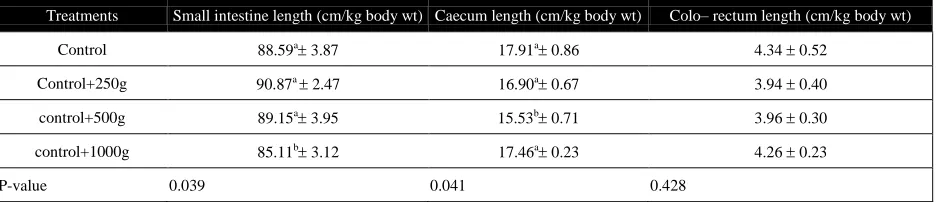
based diet supplemented enzymes. The mean weight (g/kg of live weight) of gizzard, liver, heart and pancreas of the birds fed diets among the groups were presented in Table 3. No significant difference in organs weight was observed between the control and enzyme added groups. Similarly, Balamurugan (2004) observed no significant difference in the weight of giblets due to supplementation of NSP degrading enzymes alone or in combination with phytase to corn soya based broiler diet. The mean length of different segments of intestine is presented in the Table 4.Variation was observed in the mean length (cm/kg body weight) of small intestine between the different treatment groups. A numerical increase in the length of the small intestine was Table 2 Effects of enzyme supplementation on body weight gain, feed intake and FCR in broiler chicks
Treatments Weight gain (g) Feed intake (g) Feed conversion ratio
Control 1942.50 + 39.51 3756.53a+ 9.67 1.93a +0.001
Control +250g 1992.43+ 46.96 3610.50b+ 22.25 1.82b +0.01
Control +500g 1998.83 + 43.14 3631.10b+ 3.83 1.82b +0.01
Control +1000g 2004.73 + 40.04 3716.67a+ 10.84 1.85b+0.01
P-value 0.345 0.031 0.027
Means with at least one common superscript in a column did not significantly differ (P>0.05)
Table 3 Effect of different levels of enzymes addition on carcass characteristics in broilers
Treatments Dressing percentage Gizzard
(g)/kg of live weight
Liver (g)/kg of live weight
Heart (g)/kg of live weight
Pancreas (g)/kg of live weight
Control 75.48b 0.91 16.44 0.41 19.84 1.07 3.72 0.40 1.90 0.14
Control +250g 74.65b 1.21 16.04 0.44 20.50 1.60 4.02 0.16 2.10 0.15
Control +500g 78.24a 0.50 15.40 0.30 20.56 0.77 4.09 0.20 1.85 0.12
Control +1000g 74.30b 0.48 14.85 0.46 17.03 0.71 3.78 0.25 1.78 0.07
P-value 0.042 0.845 0.249 0.521 0.301
Means with at least one common superscript in a column did not significantly differ (P>0.05)
Table 4 Effect of different levels of enzymes addition on intestinal length in broiler chickens
Treatments Small intestine length (cm/kg body wt) Caecum length (cm/kg body wt) Colo– rectum length (cm/kg body wt)
Control 88.59a 3.87 17.91a 0.86 4.34 0.52
Control+250g 90.87a 2.47 16.90a 0.67 3.94 0.40
control+500g 89.15a 3.95 15.53b 0.71 3.96 0.30
control+1000g 85.11b 3.12 17.46a 0.23 4.26 0.23
P-value 0.039 0.041 0.428
Journal of Experimental Biology and Agricultural Sciences http://www.jebas.org
502 Kavitha & Chandrasekaran
observed in the broiler fed on 250g and 500g cocktail enzymes while a reduction in length was observed in broiler fed on 1000g cocktail enzymes as compared to control.
Similar to small intestine length the mean length (cm/kg body weight) of caecum also varied among the treatment groups, but there was no significant difference when compared to the control. Colo-rectum length did not differ significantly between enzyme added groups and control group. Similarly, Balamurugan (2004) in his trial in broilers, fed with corn soya diet, though observed decreased length in the entire enzyme added groups, the differences were not significant. But Wang et al. (2005) observed a linear decrease in the length of ileum with the increase in the level of enzyme in the wheat based diet of broilers.
Conclusions
There was no significant difference in weight gain between the control and enzymes added groups. From this study, it could be concluded that the addition of combination of non-starch polysaccharidase enzyme with phytase at 250g/ton of feed improved the feed efficiency in broilers.
Acknowledgments
The authors are thankful to the Dean, Veterinary College and Research Institute, Namakkal and Director of Centre for Animal Production Studies, TANUVAS, Chennai for providing necessary facilities to carry out the present experiment.
Conflict of Interest
Authors declare that there is no conflict of interests arising from this study.
References
Bach Knudsen KE (1997) Carbohydrate and lignin contents of plant materials used in animal feeding. Animal Feed Science and Technology 67: 319-338.
Balamurugan R (2004) Performance and intestinal response of broiler chickens fed on multi enzyme supplemented diet. M.V.Sc., thesis, submitted to Tamil Nadu Veterinary and Animal Sciences University, Chennai.
Broz J, Ward NE (2007) The role of vitamins and feed enzymes in combating metabolic challenges and disorders. Journal of Applied Poultry Research 16: 150-159.
Duncan DB (1955) Multiple range and multiple F test. Biometrics 11: 1-42.
Meng X, Slominski BA, Nyachoti CM, Campbell LD, Guenter W (2005) Degradation of cell wall polysaccharides by combinations of carbohydrase enzymes and their effect of nutrient utilization and broiler chicken performance. Poultry Science 84: 37-47.
Noy Y, Sklan D (1994) Digestion and absorption in the young chick. Poultry Science 73: 366-373.
Olnood CG, Liu YG (2012) Effect of multi-NSP enzymes and phytase combination on growth performance of broiler chickens fed with different quality grades of ingredients. Australian Poultry Science Symposium 23: 287-290.
Snedecor GW, Cochran WG (1989) Statistical Methods, 8thEdn. Iowa State University Press, Ames, Iowa.
Torres DM, De Cotta JT, Teixeira AS, Fonseca JA, Da Fonseca RA, Dos Santos EC, Alves EL(2004) Corn and soybean meal based diets supplemented with enzymes in feed of broiler chickens. Nutrition Abstract and Reviews B74: 1415.
Wang ZR, Qiao SY, Lu WQ, Li DF (2005) Effects of enzyme supplementation on performance, nutrient digestibility, gastrointestinal morphology, and volatile fatty acid profiles in the hindgut of broilers fed wheat-based diets. Poultry Science 84:875-881.
Woyengo TA, Slominski BA, Jones RO (2010) Growth performance and nutrient utilization of broiler chickens fed diets supplemented with phytase alone or in combination with citric acid and multicarbohydrase. Poultry Science 89: 2221–2229.