R E S E A R C H A R T I C L E
Open Access
Preoperative hidden renal dysfunction add
an age dependent risk of progressive
chronic kidney disease after cardiac surgery
Jiarui Xu
1,2,3,4†, Jiawei Yu
1,2,3,4†, Xialian Xu
1,2,3,4, Bo Shen
1,2,3,4, Yimei Wang
1,2,3,4, Wuhua Jiang
1,2,3,4, Wenlv Lv
1,2,3,4,
Yi Fang
1,2,3,4,5, Zhe Luo
6, Chunsheng Wang
7, Jie Teng
1,2,3,4,5,8*and Xiaoqiang Ding
1,2,3,4,5,8*Abstract
Background:To study different value of estimated glomerular filtration rate with normal serum creatinine whether is a risk factor for hidden renal function of cardiac surgery outcomes.
Methods:A total of 1744 cardiac surgery patients with serum creatinine≤1.2 mg/dL (female)/1.5 mg/dL (male) were divided into 3 groups: estimated glomerular filtration rate≥90 mL/min/1.73 m2 (no renal dysfunction, n= 829), 60≤estimated glomerular filtration rate < 90 mL/min/1.73 m2 (hidden renal dysfunction, n= 857), estimated glomerular filtration rate < 60 mL/min/1.73 m2 (known renal dysfunction, n= 58) and followed up for 3 years. Multivariate regression analyses for risk factors of postoperative acute kidney injury.
Results: The proportion of preoperative hidden renal dysfunction was 67.1% among patients ≥ 65 years old and 44.1% among patients < 65 years old. Multivariate Cox regression analyses showed that for patients < 65 years, known renal dysfunction was a risk factor for postoperative acute kidney injury (P< 0.01) and progressive chronic kidney disease (P= 0.018), while hidden renal dysfunction was a risk factor for progressive chronic kidney disease (P= 0.024). For patients ≥ 65 years, only known renal dysfunction was a risk factors for 3-year mortality (P= 0.022) and progressive chronic kidney disease (P< 0.01).
Conclusion: Hidden renal dysfunction was common in patients with normal serum creatinine for cardiac surgery, with a prevalence of 49.1%. For patients < 65 years old, hidden renal dysfunction was an independent risk factor for progressive chronic kidney disease.
Keywords: Cardiac surgery, Estimated glomerular filtration rate, Acute kidney injury, Progressive chronic kidney disease
Background
Preoperative renal dysfunction is a high risk factor for outcomes in cardiac surgery, not only for postoperative acute kidney injury (AKI), but also for in-hospital mor-tality and even long-term outcomes [1–3]. Renal dysfunction is mostly evaluated by serum creatinine (SCr), but scholars have noted that patients with normal SCr had estimated glomerular filtration rate (eGFR) values < 60 mL/min and called it “occult renal
dysfunction”, which significantly increased the risk of renal replacement therapy (RRT), inpatient death and prolonged hospitalization after coronary artery bypass grafting (CABG) surgery [4, 5]. In the study of Volk-mann et al., patients with plasma creatinine (PCr)≤1.5 mg/dL who underwent CABG were divided into 2 groups, estimated creatinine clearance (eCrCl)≥60 mL/ min (normal renal function) or eCrCl < 60 mL/min (re-duced renal function), respectively. The results showed that reduced renal function had a double risk of death, a longer total hospital stay and post-surgical hospital stay than those patients with normal renal function [6]. How-ever, a considerable fraction of cardiac surgery patients may have normal SCr values and an eGFR under 90 mL/
© The Author(s). 2019Open AccessThis article is distributed under the terms of the Creative Commons Attribution 4.0 International License (http://creativecommons.org/licenses/by/4.0/), which permits unrestricted use, distribution, and reproduction in any medium, provided you give appropriate credit to the original author(s) and the source, provide a link to the Creative Commons license, and indicate if changes were made. The Creative Commons Public Domain Dedication waiver (http://creativecommons.org/publicdomain/zero/1.0/) applies to the data made available in this article, unless otherwise stated.
* Correspondence:[email protected]; [email protected]
†Jiarui Xu and Jiawei Yu are first co-authors.
1Department of Nephrology, Zhongshan Hospital, Shanghai Medical College,
min/1.73 m2, but above 60 mL/min/1.73 m2, particularly since eGFR declines with age [7]. In the present retro-spective, observational, single center study we analyzed whether patients with “normal” SCr and “hidden renal dysfunction”(60≤eGFR < 90 mL/min) have an enhanced risk of complications after cardiac surgery especially fo-cusing on age-related eGFR decline.
Methods
Patients
In this retrospective, observational study, we collected data from patients who underwent cardiac surgery and with preoperative SCr≤1.2 mg/dL (female) / 1.5 mg/dL (male) in Shanghai Zhongshan Hospital between Octo-ber 2012 and July 2013. Exclusion criteria were < 18 years old; preoperative SCr ≥ 1.2 mg/dL (female) / 1.5 mg/dL (male) and received deep hypothermic circulatory arrest or heart transplantation. The Ethical Committee of Zhongshan Hospital affiliated to Fudan University ap-proved the study (No. B2017–039) and written informed consent was obtained from all patients and our study was performed in accordance with the Declaration of Helsinki regarding the ethical principles for medical re-search involving human subjects.
Definitions and groups
Pre-operative hidden renal dysfunction was defined as SCr≤1.2 mg/dL (female)/1.5 mg/dL (male) and 60≤ eGFR < 90 mL/min/1.73 m2. AKI was defined according to the KDIGO 2012 criteria as the absolute value of the SCr increase ≥ 26.5μmol/L within 48 h or an increase > 50% compared to the baseline values within 7 days, or a urine output < 0.5 mL/kg/h≥6 h [8].
Progressive chronic kidney disease (CKD) was defined as CKD stages 4–5 (eGFR ≤ 30 mL/min/1.73 m2) includ-ing End-stage renal disease (ESRD) (receive maintenance renal replacement therapy or renal transplantation). CKD was diagnosed according to the Kidney Disease: Improv-ing Global Outcomes (KDIGO) 2002 criteria [9]. All en-rolled patients were divided into three groups: eGFR ≥ 90 mL/min/1.73 m2 (no renal dysfunction), 60≤eGFR < 90 mL/min/1.73 m2(hidden renal dysfunction) and eGFR < 60 mL/min/1.73 m2(known renal dysfunction). Low car-diac output syndrome (LCOS) was diagnosed when pa-tients had two or more of the following [10, 11]: (1) decreased systolic pressure > 20% of the basic preoperative value lasting≥ 2 h; (2) signs of impairment of body perfu-sion (cold extremities, lowered level of consciousness, or a combination of these signs) and lasting≥ 2 h; (3) need for at least three vasoactive drugs (dopamine, dobutamine, epinephrine or norepinephrine) or required an intra-aortic balloon pump (IABP). Intra-operative hypotension was defined as mean arterial pressure < 65 mmHg and lasting
≥ 10 min. High dose of vasoactive agents was defined as
need of at least three vasoactive drugs, or the dose of nor-epinephrine or nor-epinephrine more than 0.3μg/kg/min. All the patients were followed up for 3 years through tele-phone, e-mail and hospital visits until October 2016. The primary endpoint was all causes of mortality and progres-sive CKD.
Statistical analysis
Statistical analysis was conducted with SPSS Statistics for Windows (Version 22.0, SPSS Inc., Chicago, US). Normally distributed data are presented as means ± SD; groups were compared using two independent samplet -tests or ANOVA. Nonparametric data are expressed as medians (P25,P75). The Wilcoxon test was used to assess two dependent variables, a non-parametric Mann– Whit-ney test for independent variables, and a chi-squared test for group comparisons. Multivariate Logistic regression analysis was used to investigate the influence of multiple factors of AKI incidence. Multivariate Cox regression analysis was used to investigate the effects of multiple factors on 3-year mortality and progressive CKD. A P -value < 0.05 was considered to be statistically significant.
Results
Baseline characteristics
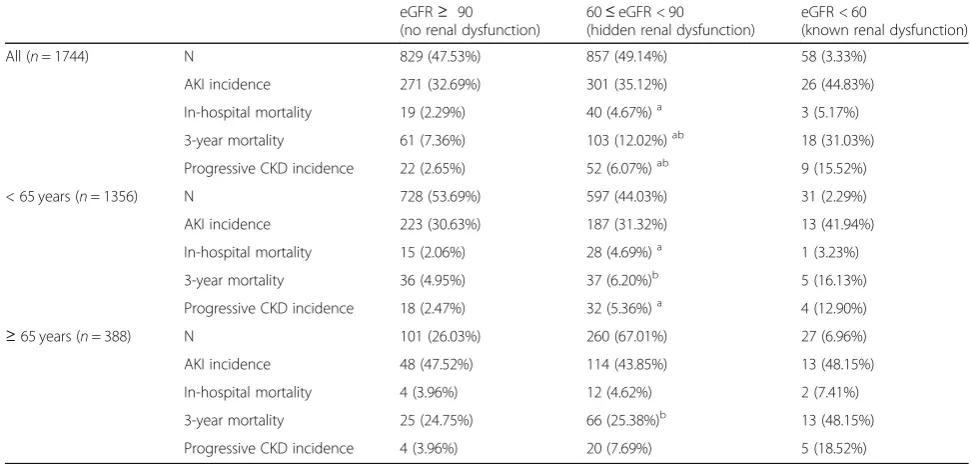
A total of 1744 patients were enrolled between October 2012 and July 2013. There were 47.53% (n= 829) in the eGFR ≥ 90 mL/min/1.73 m2 group (no renal dysfunc-tion), 49.14% (n= 857) in the 60≤eGFR < 90 mL/min/ 1.73 m2 group (hidden renal dysfunction) and 3.33% (n= 58) in the eGFR < 60 mL/min/1.73 m2group (known renal dysfunction) (Fig.1).
Ages in hidden renal dysfunction group was signifi-cantly higher than in the no renal dysfunction group. The preoperative blood urea nitrogen (BUN) and SCr and uric acid in the hidden renal dysfunction group was significantly higher than in the no renal dysfunction group, but significantly lower than in the known renal dysfunction group. The proportion of proteinuria and renal ultrasound abnormal in hidden renal dysfunction group was significantly lower than in the known renal dysfunction group. The incidence of intra-operative hypotension in hidden renal dysfunction group was sig-nificantly lower than in the known renal dysfunction group (Table1).
AKI incidence and 3-year outcomes
Fig. 1Groupings of patients. Abbreviations: SCr, serum creatinine; eGFR, estimated glomerular filtration rate
Table 1Baseline characteristics of patients with different degree of hidden renal dysfunction
Total (n= 1744)
eGFR≥ 90
(no renal dysfunction) (n= 829)
60≤eGFR < 90
(hidden renal dysfunction) (n= 857)
eGFR < 60
(known renal dysfunction) (n= 58)
Pre-operation
Age 53.00 ± 14.00 48 ± 15 58 ± 12a 61 ± 15
Gender (male) 1003 (57.51%) 485 (58.50%) 483 (56.36%) 35 (60.34%)
BMI (kg/m2) 22.8 ± 3.5 22.4 ± 3.6 23.1 ± 3.4a 23.5 ± 3.1
Hypertension (n, %) 540 (30.96%) 223 (26.90%) 290 (33.84%)b 27 (46.55%)
DM (n, %) 200 (11.47%) 89 (10.74%) 100 (11.67%) 11 (18.97%)
NYHA > II (n, %) 1055 (60.49%) 445 (53.68%) 571 (66.63%) 39 (67.24%)
LVEF (%) 63.00 ± 6.00 68.00 ± 6.00 61.00 ± 5.00a 60.00 ± 5.00
BUN (mmol/L) 6.60 ± 2.20 5.90 ± 1.60 7.00 ± 2.20ab 9.60 ± 3.40
SCr (mg/dL) 0.87 ± 0.22 0.74 ± 0.12 0.96 ± 0.15ab 1.09 ± 0.12
Uric acid (μmol/L) 366.40 ± 114.30 334.10 ± 98.80 390.20 ± 112.50ab 457.20 ± 126.70
Proteinuria (n, %) 140 (8.03%) 65 (7.84%) 63 (7.35%)b 12 (20.69%)
Urinalysis abnormal (n, %) 279 (16.00%) 132 (15.92%) 134 (15.64%) 13 (22.41%)
Renal ultrasound abnormal (n, %) 32 (1.83%) 9 (1.09%) 17 (1.98%)b 6 (10.34%)
Hemoglobin (g/L) 133.80 ± 19.60 134.30 ± 20.40 133.50 ± 18.60 130.40 ± 21.50
Platelet (109
/L) 181.00 ± 61.20 183.90 ± 64.40 178.10 ± 57.40 181.10 ± 68.10
Intra-operation
Types of surgery (n, %)
−Valve 903 (51.78%) 434 (52.35%) 445 (51.93%) 24 (41.38%)
−CABG/OPCAB 309 (17.72%) 111 (13.39%) 185 (21.59%) 13 (22.41%)
−Aneurysm 108 (6.19%) 57 (6.88%) 42 (4.90%) 9 (15.52%)
−Combined 140 (8.03%) 58 (7.00%) 74 (8.63%) 8 (13.79%)
CPB duration (min) 96.10 ± 40.90 94.40 ± 39.70 96.70 ± 41.20b 112.70 ± 50.10
Aortic clamping time (min) 47.40 ± 42.30 47.90 ± 43.40 46.90 ± 41.30 47.10 ± 39.30
Intra-operative hypotension (n, %) 135 (7.7%) 58 (7.0%) 68 (7.9%)b 9 (15.5%)
Post-operation
High dose of vasoactive agents (n, %) 271 (15.5%) 104 (12.5%) 153 (17.9%) 14 (24.1%)
LCOS (n, %) 118 (6.8%) 51 (6.1%) 59 (6.9%) 8 (13.9%)
Abbreviations:eGFRestimated glomerular filtration rate,BMIbody mass index,DMdiabetes mellitus,NYHANew York Heart Association,LVEFleft ventricular ejection fraction,BUNblood urea nitrogen,SCrserum creatinine,CABGcoronary artery bypass grafting,OPCABoff-pump coronary artery bypass,CPB
cardiopulmonary bypass,LCOSlow cardiac output syndrome
a
incidence of progressive CKD in the hidden renal dys-function group was significantly higher than in the no renal dysfunction group, but significantly lower than in the known renal dysfunction group (Table2).
Age < 65 years
The AKI incidence was 31.19% (n= 423) of patients under the age of 65 years. There was no statistical difference of AKI incidence between the hidden renal dysfunction and no renal dysfunction group or known renal dysfunction group. The 3-year mortality in the hidden renal dysfunction group was signifi-cantly lower than in the known renal dysfunction group. The in-hospital mortality and incidence of progressive CKD in hidden renal dysfunction was significantly higher than in no renal dysfunction group (Table 2).
Age≥65 years
The AKI incidence was 45.10% (n= 175) of patients > 65 years old. There was no statistical difference of AKI incidence between the hidden renal dysfunction and no renal dysfunction group or known renal dysfunction group. The 3-year mortality in the hidden renal dysfunc-tion group was significantly lower than in the known renal dysfunction group. There was no statistical differ-ence of in-hospital mortality and inciddiffer-ence of progres-sive CKD between the hidden renal dysfunction and no renal dysfunction group or known renal dysfunction group (Table2).
Analysis of risk factors for postoperative AKI
Age < 65 years
Multivariate Logistic regression analysis showed that age, gender (male), hypertension, aorta surgery, CPB time, LCOS, preoperative eGFR < 60 mL/min/1.73 m2 and intraoperative hypotension were independent risk factors of AKI after cardiac surgery (Table3).
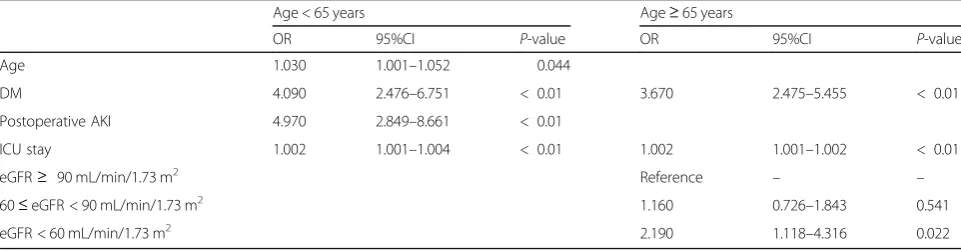
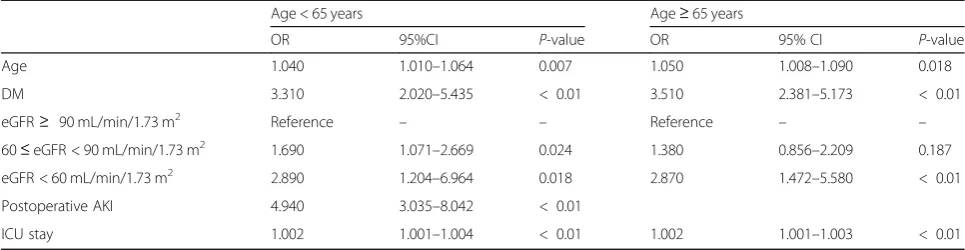
Multivariate Cox regression analysis showed that age, diabetes, postoperative AKI, length of ICU stay were in-dependent risk factors of 3-year mortality (Table4), and age, diabetes, 60≤eGFR < 90 mL/min/1.73 m2, eGFR < 60 mL/min/1.73 m2, postoperative AKI and length of ICU stay were independent risk factors of 3-year pro-gressive CKD (Table5).
Age≥65 years
Multivariate logistic regression analysis showed that age, gender (male), BMI, intraoperative hypotension and LCOS were independent risk factors of AKI after cardiac surgery (Table3).
Multivariate Cox regression analysis showed that dia-betes, length of ICU stay and eGFR < 60 mL/min/1.73 m2 were risk factors for 3-year mortality (Table 4) and age, diabetes, eGFR < 60 mL/min/1.73 m2 and length of ICU stay were independent risk factors of 3-year pro-gressive CKD (Table5).
Discussion
It is commonly accepted that preoperative renal dysfunc-tion is a risk factor for AKI, in-hospital mortality or even long-term outcomes after cardiac surgery [12]. Also
Table 2AKI incidence and 3-year outcomes of patients with different degree of hidden renal dysfunction
eGFR≥ 90
(no renal dysfunction)
60≤eGFR < 90
(hidden renal dysfunction)
eGFR < 60
(known renal dysfunction)
All (n= 1744) N 829 (47.53%) 857 (49.14%) 58 (3.33%)
AKI incidence 271 (32.69%) 301 (35.12%) 26 (44.83%)
In-hospital mortality 19 (2.29%) 40 (4.67%)a 3 (5.17%)
3-year mortality 61 (7.36%) 103 (12.02%)ab 18 (31.03%)
Progressive CKD incidence 22 (2.65%) 52 (6.07%)ab 9 (15.52%)
< 65 years (n= 1356) N 728 (53.69%) 597 (44.03%) 31 (2.29%)
AKI incidence 223 (30.63%) 187 (31.32%) 13 (41.94%)
In-hospital mortality 15 (2.06%) 28 (4.69%)a 1 (3.23%)
3-year mortality 36 (4.95%) 37 (6.20%)b 5 (16.13%)
Progressive CKD incidence 18 (2.47%) 32 (5.36%)a 4 (12.90%)
≥65 years (n= 388) N 101 (26.03%) 260 (67.01%) 27 (6.96%)
AKI incidence 48 (47.52%) 114 (43.85%) 13 (48.15%)
In-hospital mortality 4 (3.96%) 12 (4.62%) 2 (7.41%)
3-year mortality 25 (24.75%) 66 (25.38%)b 13 (48.15%)
Progressive CKD incidence 4 (3.96%) 20 (7.69%) 5 (18.52%)
Abbreviations:eGFRestimated glomerular filtration rate,AKIacute kidney injury,CKDchronic kidney disease
a
“occult renal insufficiency”defined as SCr≤100μm with CrCl ≤ 60 mL/min with an incidence rate of up to 13% has been shown to be associated with RRT [13], which is in accordance with our findings, that for patients with normal SCr under the age of 65 years, preoperative eGFR < 60 mL/min/1.73 m2was an independent risk fac-tor for AKI. However, interestingly for patients over the age of 65 years, preoperative eGFR< 60 ml/min/1.73 m2 was not an independent risk factor for AKI in our study, but was still a risk factor for 3-year death and progressive CKD. The senescent kidney already shares morphological features of CKD [7], and the weighing of aging was heavier than eGFR in a multivariate regression analysis, which may explain the result.
However, most studies about preoperative renal dys-function usually studied patients with eGFR < 60 mL/ min /1.73 m2 [6, 14], but the risk of patients with mild decreased eGFR (60~90 mL/min /1.73 m2) and normal SCr is less evaluated. In the study by Howell et al. in-cluding 7621 consecutive patients who underwent CABG, valve surgery or combined procedures, eGFR ≥ 90 mL/min /1.73 m2were considered normal renal func-tion (reference group), eGFR 60–90 mL/min/1.73 m2
were mild renal dysfunction (group 2), eGFR 30–59 mL/ min/ 1.73 m2were moderate renal dysfunction (group 3) and eGFR 15–29 mL/min/1.73 m2were severe renal dys-function (group 4) and the results showed that eGFR of 60–90 mL/min/1.73 m2 (mild renal dysfunction) was an independent predictor of in-hospital and late mortality as well as cardiovascular complications [15], which is in line with our results, which revealed that for patients with normal SCr under the age of 65 years preoperative 60≤eGFR< 90 mL/min/1.73 m2values became a risk fac-tor for 3-year progressive CKD.
The mechanism why mild renal dysfunction contrib-utes to poor outcomes is not clear. A possible explanation is that patients with impaired eGFR may have a more advanced cardiovascular disease and a re-duced cardiac output before surgery. Along with aging, inflammatory mediators, endothelial dysfunction, left ventricular hypertrophy, all factors may contribute to the poor outcomes [16] and when eGFR values de-creased to 60~90 mL/min/1.73 m2, it may be not obvious yet for the kidney to develop AKI, but the kidneys may be less able to recover from the injurious event of surgery.
Table 3Multivariate logistic regression analysis for the risk factors of postoperative AKI
Age < 65 years Age≥65 years
OR 95% CI Pvalue OR 95% CI P-value
Age 1.030 1.012–1.078 < 0.01 1.108 1.017–1.230 < 0.01
Gender (male) 2.451 1.890–3.378 < 0.01 2.125 1.435–4.160 < 0.01
BMI 1.078 1.011–1.146 0.023
Hypertension 1.389 1.028–1.785 0.022
Aorta surgery 1.809 1.088–2.847 0.013
CPB time 1.010 1.006–1.013 < 0.01
eGFR≥90 mL/min/1.73 m2 Reference – –
60≤eGFR < 90 mL/min/1.73 m2 1.729 0.764–3.021 0.257
eGFR < 60 mL/min/1.73 m2 1.326 1.078–2.897 < 0.01
Intraoperative hypotension 3.338 1.204–6.016 < 0.01 2.013 1.034–3.145 < 0.01
LCOS 2.834 1.124–4.576 < 0.01 2.126 1.018–3.896 < 0.01
Abbreviations:BMIbody mass index,CPBcardiopulmonary bypass,eGFRestimated glomerular filtration rate,LCOSlow cardiac output syndrome
Table 4Multivariate cox regression analysis for the risk factors of 3-year mortality
Age < 65 years Age≥65 years
OR 95%CI P-value OR 95%CI P-value
Age 1.030 1.001–1.052 0.044
DM 4.090 2.476–6.751 < 0.01 3.670 2.475–5.455 < 0.01
Postoperative AKI 4.970 2.849–8.661 < 0.01
ICU stay 1.002 1.001–1.004 < 0.01 1.002 1.001–1.002 < 0.01
eGFR≥ 90 mL/min/1.73 m2 Reference – –
60≤eGFR < 90 mL/min/1.73 m2 1.160 0.726–1.843 0.541
eGFR < 60 mL/min/1.73 m2 2.190 1.118–4.316 0.022
The cause of preoperative decreased eGFR is compli-cated and different for eGFR 60~90 mL/min/1.73 m2and eGFR < 60 mL/min/1.73 m2 cases. For patients with eGFR 60~90 mL/min/1.73 m2, aging and increased BMI may be the main causes for decreased eGFR [7, 17, 18]. In patients over the age of 65 years, the proportion of hidden renal dysfunction was up to 67.0% in our study. It is considered that intimal thickening and decreased compliance of the renal vasculature contribute to ob-served 10% decreases in renal blood flow (RBF) per decade of life [19] and a decline in eGFR has been ob-served in patients without histological evidence of nephrosclerosis [20]. Also our results showed that though the rate of abnormalities in urinalysis and renal ultrasound was significantly higher in the eGFR < 60 mL/min/1.73 m2 group, there was no statistical differ-ence between 60≤eGFR < 90 mL/min/1.73 m2 and no renal dysfunction cases, which confirmed that most patients with eGFR 60–90 mL/min/1.73 m2have no sub-stantial damage. However, 44.0% of our patients < 65 years old had hidden renal dysfunctions. Besides age-dependent changes in kidney structure and function, increased exposure to comorbidities including cardiac-renal syndrome (type II, IV), hypertension, diabetes and nephrotoxic drugs may together increase the susceptibil-ity of the kidney to develop AKI. The main cause may be the hemodynamic instability caused by cardiac-renal syndrome, since in our study, the proportion of New York Heart Association (NYHA) > II of the other three groups were significantly higher than in the no renal dysfunction group. Proportions of hypertension and dia-betes also increased along with the decreased eGFR. Thus non-age dependent hidden renal dysfunction may be functional and reversible, and efforts could be made for better prevention of AKI.
Our study has some limitations. First, it was an obser-vational and retrospective study in a single center, possibly not able to identify all potential confounding factors. Furthermore, mild renal dysfunction is always poorly defined. Our study used the cut-off of SCr≤1.2 mg/dL (female)/1.5 mg/dL (male) which was arbitrarily
chosen from the normal value of our hospital. We chose it because our aim was to raise the awareness of surgeons to concern about patients with conventionally regarded normal SCr but decreased eGFR,
Conclusions
Known renal dysfunction (eGFR < 60 mL/min/1.73 m2) was a significant risk factor of progressive CKD for both
≥65 and < 65 year old patients. However, hidden renal dysfunction (60≤eGFR < 90 mL/min/1.73 m2) correlated with progressive CKD only in < 65 year old patients. Awareness should be raised for these patient group.
Abbreviations
AKI:Acute kidney injury; BMI: Body mass index; BUN: Blood urea nitrogen; CABG: Coronary artery bypass grafting; CKD: Chronic kidney disease; CPB: Cardiopulmonary bypass; DM: Diabetes mellitus; eCrCl: estimated creatinine clearance; eGFR: estimated glomerular filtration rate; ICU: Intensive care unit; LVEF: Left ventricular ejection fraction; NYHA: New York Heart Association; OPCAB: Off-pump coronary artery bypass; PCr: Plasma creatinine; RBF: Renal blood flow; RRT: Renal replacement therapy; SCr: Serum creatinine
Acknowledgments
None.
Authors’contributions
JX, JY, XX, BS, YF, ZL, CW, XD and JT were responsible for the conception and design of the study. JX, JY, XX, BS, YW, WJ, WL and ZL were responsible for analysis of data; furthermore, JX, WJ and WL were in charge of statistical analysis. JX, JY and XX drafted the manuscript; YF, ZL, CW, XD and JT revised and commented the draft. All authors read and approved the final version of the manuscript.
Funding
This work was supported by the Science and Technology Commission of Shanghai Municipality (Grant no. 17140902300), Shanghai Key Laboratory of Kidney and Blood Purification (Grant no. 14DZ2260200), Shanghai Shenkang Hospital Development Center New Frontier Technology Joint Project (Grant no. SHDC12018127) and the Xiamen Science and Technology Plan in 2018 (Grant no. 3502Z20184009). The funder had no role in the design of the study and collection, analysis, and interpretation of data, in writing the manuscript of the manuscript and in the decision to submit the article for publication.
Availability of data and materials
The datasets used and/or analysed during the current study are available from the corresponding author on reasonable request.
Table 5Multivariate cox regression analysis for the risk factors of progressive CKD
Age < 65 years Age≥65 years
OR 95%CI P-value OR 95% CI P-value
Age 1.040 1.010–1.064 0.007 1.050 1.008–1.090 0.018
DM 3.310 2.020–5.435 < 0.01 3.510 2.381–5.173 < 0.01
eGFR≥ 90 mL/min/1.73 m2 Reference – – Reference – –
60≤eGFR < 90 mL/min/1.73 m2 1.690 1.071–2.669 0.024 1.380 0.856–2.209 0.187
eGFR < 60 mL/min/1.73 m2 2.890 1.204–6.964 0.018 2.870 1.472–5.580 < 0.01
Postoperative AKI 4.940 3.035–8.042 < 0.01
ICU stay 1.002 1.001–1.004 < 0.01 1.002 1.001–1.003 < 0.01
Ethics approval and consent to participate
The Ethical Committee of Zhongshan Hospital affiliated to Fudan University approved the study (No. B2017–039) and written informed consent was obtained from all patients and our study was performed in accordance with the Declaration of Helsinki regarding the ethical principles for medical research involving human subjects.
Consent for publication
Not applicable.
Competing interests
The authors declare that they have no competing interests.
Author details
1Department of Nephrology, Zhongshan Hospital, Shanghai Medical College,
Fudan University, No. 180 Fenglin Road, Shanghai 200032, China.2Shanghai
Medical Center of Kidney, No. 180 Fenglin Road, Shanghai 200032, China.
3
Shanghai Institute for Kidney and Dialysis, No. 180 Fenglin Road, Shanghai 200032, China.4Shanghai Key Laboratory of Kidney and Blood Purification,
No. 180 Fenglin Road, Shanghai 200032, China.5Hemodialysis Quality of
Control Center of Shanghai, No. 180 Fenglin Road, Shanghai 200032, China.
6
Department of Critical Care Medicine, Zhongshan Hospital, Shanghai Medical College, Fudan University, No. 180 Fenglin Road, Shanghai 200032, China.7Department of Cardiovascular Surgery, Zhongshan Hospital, Shanghai
Medical College, Fudan University, No. 180 Fenglin Road, Shanghai 200032, China.8Department of Nephrology, Xiamen Branch, Zhongshan Hospital, Fudan University, No. 668 Jinhu Road, Xiamen 361015, Fujian, China.
Received: 9 May 2019 Accepted: 15 August 2019
References
1. Mao H, Katz N, Ariyanon W, Blanca-Martos L, Adybelli Z, Giuliani A, et al. Cardiac surgery-associated acute kidney injury. Cardiorenal Med. 2013;3(3):178–99.
2. Boyle JM, Moualla S, Arrigain S, Worley S, Bakri MH, Starling RC, et al. Risks and outcomes of acute kidney injury requiring dialysis after cardiac transplantation. Am J Kidney Dis. 2006;48(5):787–96.
3. Thakar CV, Arrigain S, Worley S, Yared JP, Paganini EP. A clinical score to predict acute renal failure after cardiac surgery. J Am Soc Nephrol. 2005; 16(1):162–8.
4. Miceli A, Bruno VD, Capoun R, Romeo F, Angelini GD, Caputo M. Occult renal dysfunction: a mortality and morbidity risk factor in coronary artery bypass grafting surgery. J Thorac Cardiovasc Surg. 2011;141(3):771–6. 5. Marui A, Okabayashi H, Komiya T, Tanaka S, Furukawa Y, Kita T, et al. Impact
of occult renal impairment on early and late outcomes following coronary artery bypass grafting. Interact Cardiovasc Thorac Surg. 2013;17(4):638–43. 6. Volkmann MA, Behr PE, Burmeister JE, Consoni PR, Kalil RA, Prates PR, et al. Hidden renal dysfunction causes increased in-hospital mortality risk after coronary artery bypass graft surgery. Rev Bras Cir Cardiovasc. 2011;26(3):319–25.
7. Glassock RJ, Winearls C. Ageing and the glomerular filtration rate: truths and consequences. Trans Am Clin Climatol Assoc. 2009;120:419–28.
8. Group KDIgoKakiw. KDIGO clinical practice guideline for acute kidney injury. Kidney Int Suppl. 2012;2(1):1–138.
9. Foundation NK. K/DOQI clinical practice guidelines for chronic kidney disease: evaluation, classification, and stratification. Am J Kidney Dis. 2002; 39(2 Suppl 1):S1–266.
10. Maganti MD, Rao V, Borger MA, Ivanov J, David TE. Predictors of low cardiac output syndrome after isolated aortic valve surgery. Circulation. 2005;112(9 Suppl):I448–52.
11. Palomba H, de Castro I, Neto AL, Lage S, Yu L. Acute kidney injury prediction following elective cardiac surgery: AKICS score. Kidney Int. 2007; 72(5):624–31.
12. Jiang W, Teng J, Xu J, Shen B, Wang Y, Fang Y, et al. Dynamic predictive scores for cardiac surgery-associated acute kidney injury. J Am Heart Assoc. 2016;5(8):e003754.
13. Wijeysundera DN, Karkouti K, Beattie WS, Rao V, Ivanov J. Improving the identification of patients at risk of postoperative renal failure after cardiac surgery. Anesthesiology. 2006;104(1):65–72.
14. Zakeri R, Freemantle N, Barnett V, Lipkin GW, Bonser RS, Graham TR, et al. Relation between mild renal dysfunction and outcomes after coronary artery bypass grafting. Circulation. 2005;112(9 Suppl):I270–5.
15. Howell NJ, Keogh BE, Bonser RS, Graham TR, Mascaro J, Rooney SJ, et al. Mild renal dysfunction predicts in-hospital mortality and post-discharge survival following cardiac surgery. Eur J Cardiothorac Surg. 2008;34(2):390–5. 16. Shlipak MG, Fried LF, Crump C, Bleyer AJ, Manolio TA, Tracy RP, et al.
Elevations of inflammatory and procoagulant biomarkers in elderly persons with renal insufficiency. Circulation. 2003;107(1):87–92.
17. Kanasaki K, Kitada M, Koya D. Pathophysiology of the aging kidney and therapeutic interventions. Hypertens Res. 2012;35:1121.
18. Martensson J, Bellomo R. Prevention of renal dysfunction in postoperative elderly patients. Curr Opin Crit Care. 2014;20(4):451–9.
19. Musso CG, Oreopoulos DG. Aging and physiological changes of the kidneys including changes in glomerular filtration rate. Nephron Physiol. 2011; 119(Suppl 1):1–p5.
20. Rule AD, Amer H, Cornell LD, Taler SJ, Cosio FG, Kremers WK, et al. The association between age and nephrosclerosis on renal biopsy among healthy adults. Ann Intern Med. 2010;152(9):561–7.
Publisher’s Note