R E S E A R C H
Open Access
Genetic background modulates phenotypes of
serotonin transporter Ala56 knock-in mice
Travis M Kerr
1, Christopher L Muller
2, Mahfuzur Miah
2, Christopher S Jetter
1, Rita Pfeiffer
3, Charisma Shah
1,
Nicole Baganz
3, George M Anderson
4, Jacqueline N Crawley
5, James S Sutcliffe
1,6, Randy D Blakely
1,2,3,7and Jeremy Veenstra-VanderWeele
1,2,3,7,8,9*Abstract
Background:Previously, we identified multiple, rare serotonin (5-HT) transporter (SERT) variants in children with autism spectrum disorder (ASD). Although in our study the SERT Ala56 variant was over-transmitted to ASD probands, it was also seen in some unaffected individuals, suggesting that associated ASD risk is influenced by the epistatic effects of other genetic variation. Subsequently, we established that mice expressing the SERT Ala56 variant on a 129S6/S4 genetic background display multiple biochemical, physiological and behavioral changes, including hyperserotonemia, altered 5-HT receptor sensitivity, and altered social, communication, and repetitive behavior. Here we explore the effects of genetic background on SERT Ala56 knock-in phenotypes.
Methods:To explore the effects of genetic background, we backcrossed SERT Ala56 mice on the 129 background into a C57BL/6 (B6) background to achieve congenic B6 SERT Ala56 mice, and assessed autism-relevant behavior, including sociability, ultrasonic vocalizations, and repetitive behavior in the home cage, as well as serotonergic phenotypes, including whole blood serotonin levels and serotonin receptor sensitivity.
Results:One consistent phenotype between the two strains was performance in the tube test for dominance, where mutant mice displayed a greater tendency to withdraw from a social encounter in a narrow tube as compared to wildtype littermate controls. On the B6 background, mutant pup ultrasonic vocalizations were significantly increased, in contrast to decreased vocalizations seen previously on the 129 background. Several phenotypes seen on the 129 background were reduced or absent when the mutation was placed on the B6 background, including hyperserotonemia, 5-HT receptor hypersensivity, and repetitive behavior.
Conclusions:Our findings provide a cogent example of how epistatic interactions can modulate the impact of functional genetic variation and suggest that some aspects of social behavior may be especially sensitive to changes in SERT function. Finally, these results provide a platform for the identification of genes that may modulate the risk of ASD in humans.
Keywords:Serotonin, Monoamine, Transporter, Receptor, Autism, Compulsive
Background
The serotonin (5-hydroxytryptamine, 5-HT) system has long been implicated in Autism Spectrum Disorder (ASD) [1]. Elevated whole blood 5-HT, termed hyperserotonemia, is found in about 30% of ASD patients [2,3]. Blood 5-HT levels are more heritable than ASD itself [4-7], but the link
between hyperserotonemia and ASD pathophysiology has remained elusive. In the blood, 5-HT is found almost exclusively in platelets that cannot produce 5-HT, but take it up via the antidepressant-sensitive 5-HT transporter (SERT). Peripheral serotonin is synthesized and released by enterochromaffin cells that release 5-HT into the en-teric circulation. Consistent with a primary role in platelet 5-HT uptake, polymorphisms in the SERT gene (SLC6A4) have been associated with human whole blood 5-HT levels; however, this has been observed only in males and not females [8], with a similar pattern observed for the * Correspondence:[email protected]
1
Department of Psychiatry, Vanderbilt University, 465 21st Ave S, Nashville, TN 37232, USA
2
Vanderbilt Brain Institute, Vanderbilt University, 465 21st Ave S, Nashville, TN 37232, USA
Full list of author information is available at the end of the article
SERT-interacting protein integrin β3 [8-10]. Several link-age studies have implicated the chromosome 17q region containingSLC6A4in ASD, also with stronger evidence in males [11-15].
In contrast to linkage studies, multiple groups have found, at most, modest association between common
SLC6A4 variants and ASD [16-18]. Allelic heterogeneity
may account for difficulty in assessing association in this region. Indeed, multiple common functional variants have been identified in theSLC6A4gene (reviewed in [19]). We identified multiple, rare SERT coding variants in ASD families with evidence of linkage to 17q. We also found that the most common of these variants, SERT Ala56, was significantly associated with rigid-compulsive behavior and sensory aversion. Lending credence to a functional contribution of the SERT variants identified, each of the variants was found to confer increased 5-HT transport activity in cell models relative to wildtype SERT [14,20,21]. In our study, the Ala56 variant showed an approximately 2:1 transmission bias to affected versus unaffected chil-dren [14]. Importantly, however, some variant carriers were unaffected by ASD, and a case–control study has reported no association of ASD with rare SERT amino acid variants in the absence of linkage [22], indicating that other genetic or non-genetic risk factors likely impact the resulting phenotype.
To assess the functional relevance of the SERT Ala56 variant in vivo, we produced knock-in mice, expressing the variant on a 129S6/S4 inbred background. In these mice, we observed multiple biochemical and behavioral phenotypes that recapitulate some features of ASD, including hyperserotonemia, altered social function in the tube test and three-chamber sociability test, decreased ultrasonic vocalizations, and repetitive climbing/hanging behavior in the home cage [23]. We also observed hypersensitivity toin vivoactivation of 5-HT1Aand 5-HT2A receptors, reasonably attributable to diminished synaptic 5-HT availability and functional upregulation of 5-HT receptors. Unfortunately, this inbred strain background shows a low level of activity in novel environments across multiple behavioral tests [23], which limits the assessment of anxiety-like and social behaviors that are dependent upon spontaneous locomotion.
As 5-HT is a modulator of multiple CNS pathways subserving complex behaviors, we suspected that SERT coding variation could be influenced by genetic variation in other genes, which might account for the variable phenotype observed in humans with the SERT Ala56 allele. To explore this issue, we moved the SERT Ala56 allele to a C57BL/6 (B6) background for two purposes: 1) to examine autism-relevant behavior in a more active and social strain than 129, and 2) to study strain depend-ence of SERT function, the 5-HT system, and resulting be-havior. Previous work identified a functional and behavioral
impact of variation at two amino acids that differ between 129 and B6 inbred strains [24]. We therefore also backcrossed the 129 SERT onto the B6 background to allow a comparison with the mutant SERT on this background. Our findings reveal a striking influence of genetic background on the impact of the SERT Ala56 variant, suggesting that further dissection of strain differ-ences could illuminate other genes modulating risk of ASD.
Methods Mice
All animal procedures were in accordance with the National Institutes of Health Guide for the Care and Use of Laboratory Animals and were approved by the Vanderbilt University Institutional Animal Care and Use Committee.
Backcross
Male SERT Ala56 mice (Glu39/Ala56/Arg152) on a mixed 129S6/SvEvTac and 129S4/ImJ background [23] were crossed with B6 females, with male progeny from each generation crossed again to B6 females for at least eight generations. The Jackson Lab Genome Scanning Service (Bar Harbor, ME, USA) was used to verify congenic status with B6. In parallel, wildtype 129S6/S4 mice from the same colony (SERT Glu39/Gly56/Arg152) were backcrossed at least ten generations to B6 and verified congenic with B6 to serve as valid control an-imals. SERT Gly56Ala and SERT Arg152/Lys genotyp-ing was performed as described previously [23,24]. Sanger sequencing, as described previously, was used to verify that the SERT Ala56 was maintained after the full backcross [25].
Behavioral testing
Co-housed littermate progeny of heterozygous pairs (SERT Gly56/Ala56) were used for all behavioral testing. A cohort of 20 matched male Ala56/Ala56 and Gly56/ Gly56 littermates, as well as 16 co-housed matched male Ala56/Gly56 littermates, was used in behavioral exper-iments in the following order to minimize order effects on testing [26,27]: elevated zero maze, light–dark test, open field activity, three-chamber sociability test, tube test, Y maze spontaneous alternation, and von Frey filament test. A subset of this cohort was used for home cage monitoring (12 Ala56/Ala56 and 12 Gly56/Gly56). A co-hort of 20 matched female Ala56/Ala56, Ala56/Gly56, and Gly56/Gly56 littermates was used in behavioral experiments in the following order: elevated zero maze, light–dark test, and open field activity.
Elevated zero maze
Light–dark exploration
Anxiety-like responses were evaluated using activity monitors (Med Associates, Inc., St. Albans, VT, USA) divided in half to create a light compartment and a dark compartment, as described previously [29], with the subject mouse being placed in the light compartment at the begin-ning of the test and activity recorded for 5 minutes.
Open field activity
Exploratory locomotor activity was evaluated in activity monitors (Med Associates, Inc., St. Albans, VT, USA), as described previously [23].
Three-chamber sociability and preference for social novelty test
Social behavior was evaluated in a three-chamber poly-carbonate apparatus with 4-inch sliding gates separating the 7 × 9-inch chambers, as described previously [23,30]. The subject mouse was initially allowed to explore all three chambers for 10 minutes to acclimate to the apparatus. A stimulus mouse (social stimulus) was then introduced inside an inverted wire pencil cup (Spectrum Diversified Designs, Streetsboro, OH, USA) in one side chamber with a clean empty pencil cup (inanimate stimulus) introduced in the opposite side chamber. The stimulus mouse was an adult male 129S4/ImJ mouse, previously habituated to the pencil cup in six 30-minute sessions across 3 days. The subject mouse was then allowed to explore all three chambers for 10 minutes. A new stimulus mouse was then introduced inside a pencil cup in the previous inanimate stimulus chamber. The subject mouse was finally allowed to explore all three chambers for 10 minutes. A research assistant blinded to mouse geno-type coded videos for time spent in each chamber and within 1 cm of each pencil cup.
Tube test
The tube test was conducted in male mice as described previously [23]. The apparatus is a 30-cm-long, 3.5-cm-diameter clear acrylic tube with small acrylic funnels added to each end to facilitate entry into the tube. Mice were preconditioned to the tube to reduce novelty ef-fects and ensure that they will readily enter and progress forward through the tube. On two separate days before testing, each mouse was exposed to the tube, with progress through the tube resulting in the mouse being returned to the home cage. Mice that did not initially enter the tube were encouraged to run forward with a gentle pull of the tail. For each bout, a mouse was paired with a stranger mouse from a different cage. The ‘winner’ mouse was declared when the other mouse backed out of the tube. Trials were repeated from the opposite end to avoid a side bias. Each mouse was tested against four to five individuals from other cages.
Home cage monitoring
To evaluate possible repetitive behavior, 12 Ala56/Ala56 and 12 Gly56/Gly56 mice were video-recorded alone in their home cage for 24 hours while maintaining their light/ dark schedule, as described previously [23]. Automated video analysis was conducted by using HomeCageScan (CleverSys, Inc., Reston, VA, USA) to index time spent performing individual behaviors. The resulting data were condensed into 10 individual behaviors: awaken/ sleep, chew/eat/drink, rear, groom, hang, remain low, sniff, stretch, twitch, and walk. To normalize distributions for analysis, data were log10-transformed. Bouts of hanging behavior were defined as distinct periods of hanging from the wire lid of the cage separated by non-hanging behaviors. The number of bouts per animal was also log10-transformed for analysis.
Y-maze
To evaluate for perseverative exploratory behavior, mice were tested for spontaneous alternation in the Y-maze, with maze arms of 6 × 35.5 cm, as previously described [31]. The subject mouse was placed facing the center in one of the three arms of the maze and then allowed to explore for 6 minutes. Each trial was video recorded and then scored for spontaneous alter-nation, which was defined as entry into a different arm than on the previous two entries.
von Frey
Tactile sensitivity was assessed using plastic von Frey monofilaments applied to plantar surface of the sub-ject’s right hind paw [32]. Briefly, each subject was placed into a plexiglass chamber with a wire mesh flooring for experimental access to the mouse footpad. Subjects were allowed to habituate to the testing chamber for 5 minutes before the assessment of tactile sensitivity. Von Frey monofilaments (Stoelting Co., Wood Dale, IL, USA) of ascending diameter were applied to the subject’s hind paw until reaching the target force (that is, bending of the filament). The lowest force required to elicit a paw withdrawal response was considered a subject’s tactile sensitivity threshold.
Resident intruder
Ultrasonic vocalization
Progeny of heterozygous SERT Ala56/Gly56 pairs at postnatal day 7 were used to measure ultrasonic vocali-zations, as described previously [23]. Pups were removed from their cage and placed in a Styrofoam chamber with bedding. Ultrasonic vocalizations were measured for 5 minutes using a Condenser ultrasound microphone (Avisoft-Bioacoustics, Berlin, Germany) and Avisoft SASLab Pro software (Avisoft-Bioacoustics, Berlin, Germany). Thresholds were set to detect only small frequency-modulated vocalizations within a 250-kHz range lasting at least 5 ms and occurring at least 20 ms apart.
Dimethoxy-4-iodoamphetamine-induced head twitch response
A separate cohort of 12 littermate pairs was used to evaluate head twitch response to 2,5-dimethoxy-4-iodoamphetamine (DOI), as described previously [23]. Briefly, each mouse was administered an intraperitoneal injection of 1.0 mg/kg DOI (Sigma-Aldrich, St. Louis, MO, USA) and then allowed to acclimate to a standard housing cage with clean bedding for 34 minutes. Two research assistants who were blind to genotype then independently counted head twitches over 15 minutes.
8-hydroxy-2-(di-n-propylamino)tetralin-induced hypothermia A separate cohort of 10 littermate pairs was used to evaluate hypothermia response to 8-hydroxy-2-(di-n-propylamino) tetralin (8-OH-DPAT). Briefly, core temperature was mea-sured every 10 minutes for 80 minutes with a rectal probe (no. 50314; Stoelting, Wood Dale, IL, USA) connected to a BAT-12 thermometer (Physitemp Instruments, Clifton, NJ, USA). Immediately after the third temperature measurement, mice were administered a subcutaneous injection of 0.1 mg/kg 8-OH-DPAT (Sigma-Aldrich, St. Louis, MO, USA).
Whole blood and midbrain harvest
Twelve SERT Ala56 mice and matched littermate controls at postnatal day 7 were rapidly decapitated and trunk blood was collected in 1.5 ml microcentrifuge tubes containing 37 USP units of lithium heparin and mixed by inversion. Samples were immediately placed on dry ice and then stored at -80°C until analysis.
High-performance liquid chromatography
High-performance liquid chromatography (HPLC) was conducted as described previously [33]. Briefly, an internal standard solution (ISS) containing N-methylserotonin, ascorbic acid and sodium metabisulfite was added to the samples. After samples were vortex mixed, perchloric acid was added to the samples, which were mixed and then kept on ice for 10 minutes prior to centrifugation at 6000 g for 5 minutes. The supernatant was removed and stored
at −80°C until analyzed by HPLC with fluorometric detection. Serotonin was determined with intra- and inter-assay coefficients of variation of less than 5 and 10%, respectively.
Synaptosome 5-HT Uptake
Synaptosomes were prepared as described previously [34]. Briefly, 5-HT uptake was determined at 20 nM and 100 nM with tritiated 5-HT (Perkin Elmer, Waltham, MA, USA). Serotonin uptake was conducted at 37°C for five minutes, with SERT-specific uptake determined by subtracting S-citalopram blocked non-specific uptake. Resulting uptake data were normalized to total protein.
Statistics
The primary analysis for each comparison was SERT Gly56/Gly56 versus SERT Ala56/Ala56. Paired t-tests were used for littermate pair comparisons, except where noted. For experiments that included heterozygous an-imals, secondary analysis with one-way ANOVA was used to evaluate overall effects of genotype, with post-hoc Bonferroni testing used only when the main effect or interaction was significant. For the three-chamber so-ciability test, repeated-measures ANOVA, excluding the center chamber, was used to evaluate social versus novel object for each genotype. All statistical analyses were performed on GraphPad Prism (La Jolla, CA, USA) or on the accompanying website.
Results
As our previous work identified two sites of functional, coding variation in SERT between 129 and B6 inbred strains (Glu39Gly; Arg152Lys) [24], it was necessary to backcross 129-derived animals expressing wildtype Gly56 SERT in parallel with engineered 129 animals expressing SERT Ala56 onto the B6 background to permit a proper analysis of the unique effects of the Ala56 variant. This effort yielded animals with >99% C57BL/6 strain identity. A female C57BL/6 SERT ER-Gly56 mouse (SERT Glu39/ Gly56/Arg152, hereafter described as Gly56) was bred with a male C57BL/6 SERT ER-Ala56 mouse (SERT Glu39/Ala56/Arg152, hereafter described as Ala56) to establish animals heterozygous for the SERT Ala56 variant, permitting the generation of homozygous Gly56/ Gly56, heterozygous Gly56/Ala56, and homozygous Ala56/ Ala56 littermates used in the experiments reported.
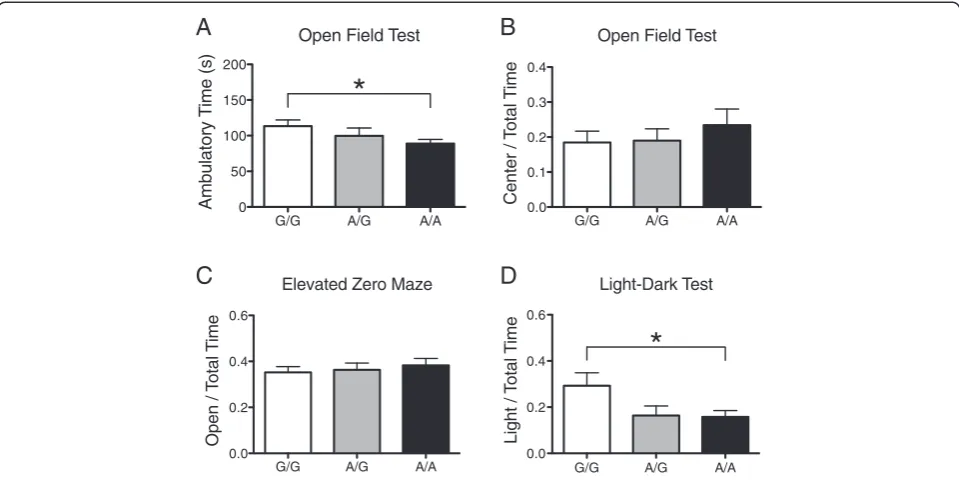
genotype effects in open field activity [See Figure S2 in Additional file 2; See Figure S3 in Additional file 3].
Results for anxiety-like behavior conflicted across three tests. The ratio of time spent in the center of the open field, compared to total time, over the first five minutes of the test was not different in males (t= 0.97,P = 0.35) or females (t= 0.79, P= 0.44) (Figure 1B, [See Figure S2 in Additional file 2]). Similarly, no difference was seen in the time spent in the open arms of the Elevated Zero Maze over 5 minutes for males (t= 0.79, P= 0.44) or females (t= 1.52, P= 0.15) (Figure 1C, [See Figure S2 in Additional file 2]). In contrast, a genotype effect was observed with SERT Ala56 males spending less time in the light compartment of the light–dark test than homozygous Gly56 littermates (t= 2.51,P= 0.02) (Figure 1D). Again, fe-males displayed no difference in this test (t= 1.55, P= 0.15) [See Figure S2 in Additional file 2].
Results on social testing were also mixed. In the three-chamber sociability test, all three genotypes showed a significant preference for the social stimulus over the non-social stimulus, both when chamber time was recorded (overall stimulusF= 96.6, P<0.0001 for each genotype) and when time <1 cm from the stimulus mouse was recorded (overall stimulusF= 135.1,P<0.0001 for each genotype) (Figure 2A,B). On the preference for social novelty portion of the three-chamber test, the Gly56 animal showed no significant preference for the novel social stimulus [See Figure S1 in Additional file 1], which makes
the comparison data uninterpretable. On the tube test, homozygous Ala56 animals showed a significant propensity to back out of the tube when encountering a homozygous Gly56 animal (McNemar’s exact testP <0.0001; n = 126 encounters), as well as when encountering a Ala56/Gly56 animal (P<0.0001; n = 119 encounters) (Figure 2C,D). No difference was detected when heterozygous Ala56/ Gly56 encountered Gly56/Gly56 animals (P= 1.0, n = 93 encounters) (Figure 2E). On the resident-intruder test, we observed no difference in latency to attack between genotypes (t= 0.41, P= 0.69) (Figure 2F). Similarly, of the homozygous Ala56 animals, 13/18 showed aggression toward the intruder during the 10-minute test period, as compared to 10/18 homozygous Gly56 animals (Fisher’s exact testP= 0.49).
In our prior study on the 129 background, we found decreased ultrasonic vocalizations (USVs) in homozygous Ala56 pups when separated from the dam at postnatal day 7. In contrast, on the B6 background, homozygous Ala56 pups displayed increased USVs in comparison to wildtype littermate controls (Mann–WhitneyU= 368.5,P= 0.017) (Figure 2G). Secondary Kruskal-Wallis comparison of all three genotypes showed a trend for an overall genotype effect (K-W5.59,P= 0.06).
No changes in repetitive or sensory behavior were induced by the Ala56 variant on the B6 background. Behavior in the home cage did not show any differences by genotype (Genotype x Behavior InteractionF= 0.82,
Open Field Test
G/G A/G A/A
0 50 100 150 200
Ambulatory T
ime
(s)
*
Elevated Zero Maze
G/G A/G A/A
0.0 0.2 0.4 0.6
Open /
T
otal
T
ime
Light-Dark Test
G/G A/G A/A
0.0 0.2 0.4 0.6
Light
/ T
o
tal T
ime
*
Open Field Test
G/G A/G A/A
0.0 0.1 0.2 0.3 0.4
Center
/ T
o
tal T
ime
A
B
C
D
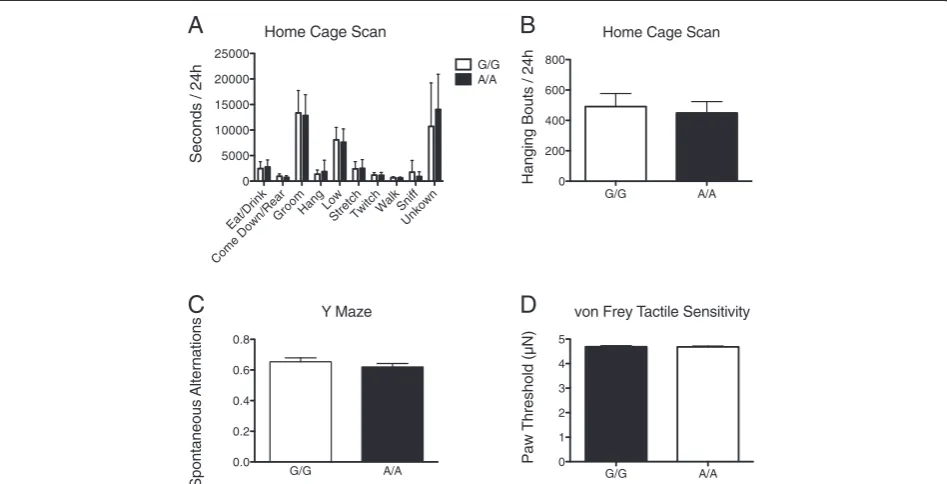
P= 0.60) (Figure 3A). There was also no difference be-tween the genotypes when hanging behavior, which was increased on the 129 background, was considered alone (t= 0.35, P = 0.73) (Figure 3B). Importantly, this behavior was less prevalent on the B6 background in general in comparison to the 129 background [23]. Further, no differences were observed in spontaneous alternations on the Y maze (t= 1.20,P= 0.25) (Figure 3C) nor in tactile sensitivity assessed using reaction to von Frey filaments (t= 0.07, P= 0.95) (Figure 3D).
Since we observed evidence of a genetic background effect on behavioral phenotypes, we examined whether Ala56-induced serotonergic phenotypes were preserved.
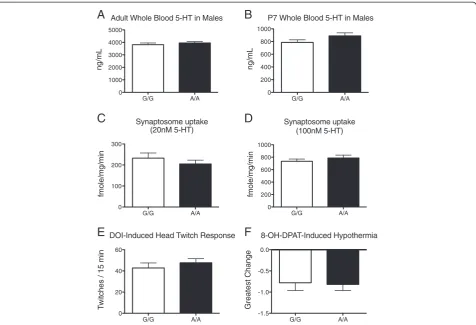
On the B6 background, we observed no genotype influ-ences on adult male whole blood 5-HT levels (Figure 4A). To decrease variability and maximize sensitivity to detect a differences, we moved to a fluorometric de-tection method at post-natal day 7 [35] and here ob-served a trend for higher whole blood 5-HT levels in males, but only when we performed a one-tailed test (t= 1.64, P = 0.058, n = 12 per genotype) (Figure 4B). No difference in whole blood 5-HT levels was observed with females (one-tailedt = 0.27, P = 0.40, n = 12 per genotype) [See Figure S4 in Additional file 4]. Other studies of serotonergic phenotypes were performed in males only.
Tube Test
G/G A/A
0 20 40 60 80 100
Wins
*
Tube Test
A/G A/A
0 25 50 75 100
Wins
*
Three-Chamber Sociability Test
G/G A/G A/A
0 100 200 300 400
T
ime <1 cm (s)
Inanimate Social
*
*
*
Tube Test
G/G A/G
0 20 40 60
Wins
Three-Chamber Sociability Test
G/G A/G A/A
0 100 200 300 400
T
ime in chamber (s)
Novel Object
Novel Mouse Center Chamber
*
*
*
Resident-Intruder Test
G/G A/A
0 100 200 300 400 500
Latency to
Attack
P7 Pup Ultrasonic Vocalizations
G/G A/G A/A
0 20 40 60 80 100
# / 5 minutes
*
A
B
C
D
E
F
G
Ex vivoandin vivomeasures of brain 5-HT phenotypes also suggested an attenuated impact of the Ala56 variant on a B6 background. Midbrain synaptosome 5-HT uptake showed no significant difference between genotypes at either 20 nM (t = 0.11,P= 0.93) or 100 nM of 5-HT (t= 2.93,P= 0.10) (Figure 4C,D). Sinceex vivo synap-tosome studies may not reproduce changes in 5-HT systems in vivo, we also assessed the impact of intra-peritoneal (i.p.) injections of 5-HT receptor agonists [23]. In contrast to our prior findings, injection of the 5-HT2A/2C agonist 2,5-dimethoxy-4-iodoamphetamine (DOI) induced a similar number of head twitches in Ala56 and Gly56 animals (t= 0.79,P= 0.44) (Figure 4E). Similarly, no significant difference was observed between the geno-types in the maximum hypothermia response to injection of the 5-HT1A/7 agonist 8-hydroxy-2-(di-n-propylamino) tetralin (8-OH-DPAT) (t= 0.16,P= 0.87) (Figure 4F).
Discussion
Strain comparisons have been profitably used to identify quantitative trait loci (QTLs) and specific genes that modify traits, as for example with the recombinant inbred (RI) mouse reference panel derived from C57BL/6 and DBA2/J parental strains [24,36]. In this regard, we recently identified functional coding variation in SERT that distin-guishes these two lines (SERT variation is the same in 129 strains as in DBA2/J) and were able to identify multiple
anatomical, biochemical and behavioral traits linked to this variation [24]. Strain-dependent genetic variation provides a significant opportunity to identify genetic background effects on the impact of risk alleles, including the SERT Ala56 variant.
Biochemical and behavioral assays displayed a striking divergence of phenotypes between SERT Ala56 knock-in mice on the 129 versus on the B6 genetic background. Whereas a few tests showed quantitative differences in 5-HT related biochemical measures on the B6 background in the same direction as seen for the SERT Ala56 allele on the 129 background, none of these assays achieved statistical significance. We suspect that the complexity of 5-HT homeostasis and signaling [37,38], allows variation in multiple different proteins to moderate the impact of the SERT Ala56 allele. Importantly, we previously showed that the native 129 SERT (Glu39) has higher 5-HT uptake than the Gly39 variant found in the B6 SERT [24]. It is conceivable that the effect of moving the Glu39 SERT onto the B6 background is large enough that additional effects of the Ala56 variant are not detectable. Further studies directly comparing Glu39 and Gly39 SERTs on a B6 background could shed light on this possibility.
Our findings of genetic background influences on behavioral measures are consistent with strain-dependent behavioral phenotypes observed in mouse models of other ASD-associated genes, most prominently including
Home Cage Scan
Eat/Drink
Come Down/Rear
GroomHang LowStretchTwitchWalk SniffUnkown
0 5000 10000 15000 20000 25000
Seconds / 24h
G/G A/A
Y Maze
G/G A/A
0.0 0.2 0.4 0.6 0.8
Spontaneous Alternations
Home Cage Scan
G/G A/A
0 200 400 600 800
Hanging Bouts / 24h
von Frey Tactile Sensitivity
G/G A/A
0 1 2 3 4 5
Paw Threshold
(µN)
A
B
C
D
Figure 3Home cage, exploratory, and sensory behavior in male B6 SERT Ala56 knock-in mice. A)Time (mean, standard error of the mean) spent performing individual non-sleep behaviors over 24 hours in the home cage in wildtype littermate controls (G/G, n = 12) and homozygous (A/A, n = 12) SERT Ala56 mice;B)Number of bouts of hanging behavior in 24 hours in the home cage;C)Ratio of spontaneous alternations, defined as entering a different arm than on the previous two entries, divided by total entries in the Y maze (n = 20 per genotype);
the Fragile X syndrome modelFmr1null mouse, which shows variable phenotypes across multiple inbred strains and hybrid crosses [39]. The NLGN3R451C knock-in mouse also shows differences in behavior between mixed 129S/B6 and pure B6 inbred strains [40-42]. Further, the SERT null mouse also shows variable behavioral phenotypes across inbred strain backgrounds [43].
The one behavioral phenotype that was consistent across both genetic backgrounds was the tendency for SERT Ala56 mice to back away from mice of other geno-types in the tube test. Not only did the homozygous mu-tants back out when confronted with wildtype animals, they also backed away when confronted with heterozy-gous animals. No difference was seen when heterozyheterozy-gous animals and wildtype animals were paired, suggesting that the Ala56 allele only has a significant effect on this phenotype in the homozygous state. From published data, the tube test appears to be a very sensitive test of altered social function in genetic mouse models related
to ASD, with significant findings in the Fragile X syndrome model [44], the Rett syndrome model [45], the Arx ((GCG)10+7) infantile spasms model [46], the Potocki-Lupski model Dp(11)/17/+ mice [47], and the Dhcr7 heterozygous model of Smith-Lemli-Opitz Syndrome [48]. On the other hand, the tube test may also reveal significant differences in mice with altered motor function or impulsivity, or under conditions of social stress [49], and was originally developed as a test of social hierarchy/ dominance, making it a sensitive but not specific test for ASD-relevant social behavior. Social interaction in the tube test does not generate aggression and usually includes only whisker contact. Dominance in this task sometimes [50-52] but not always [53] predicts territorial aggression, and we did not observe any genotype differ-ences in aggression on the resident-intruder test. We isolated resident mice for 7 days, and it is possible that a longer period of social isolation may have generated more aggression and a potential genotype difference. It
P7 Whole Blood 5-HT in Males
G/G A/A 0
200 400 600 800 1000
ng/mL
Synaptosome uptake (20nM 5-HT)
G/G A/A 0
100 200 300
fmole/mg/min
Synaptosome uptake (100nM 5-HT)
G/G A/A 0
200 400 600 800 1000
fmole/mg/min
DOI-Induced Head Twitch Response
G/G A/A 0
20 40 60
T
witches / 15 min
8-OH-DPAT-Induced Hypothermia
G/G A/A -1.5
-1.0 -0.5 0.0
Greatest Change
A
B
C
D
E
F
Adult Whole Blood 5-HT in Males
G/G A/A 0
1000 2000 3000 4000 5000
ng/mL
Figure 4Assays of the serotonin system in B6 SERT Ala56 knock-in mice. A)Whole blood serotonin levels (mean, standard error of the mean) in adult male wildtype littermate control (G/G, n = 6) and homozygous SERT Ala56 (A/A, n = 6) mice;B)Whole blood serotonin levels in male pups at postnatal day 7 (n = 12 per genotype);C)Synaptosome uptake of 20 nM3H5-HT during a 5-minute assay at 37°C, (n = 6 per genotype, with 3 replicates for each subject);D)Synaptosome uptake of 100 nM3H5-HT during a 5-minute assay at 37°C (n = 6 per genotype, with 3 replicates for each subject);E)Head twitch response to injection of the 5-HT2agonist 2,5-dimethoxy-4-iodoamphetamine (DOI) during a 15-minute
observation period (n = 12 per genotype);F)Decrease in rectal temperature from baseline in response to injection of the mixed 5-HT1A/7
seems more likely, however, that the tube test phenotype reflects some genotype difference in social judgment that is not simply a difference in territoriality or aggression.
Ultrasonic vocalizations on postnatal day 7 also showed a significant difference between genotypes on the B6 back-ground, but this difference was in the opposite direction of that observed on the 129 background. Importantly, B6 animals are well-known to have age-related hearing loss beginning around 2 to 3 months of age [54], particularly at higher frequencies, so it is possible that the maternal response to ultrasonic vocalizations would be altered on this genetic background. While maternal response could theoretically interact with pup genotype effects on social communication, it remains difficult to reconcile these opposite findings in the SERT Ala56 mice. Of note, some children with ASD are described as having been passive infants, with less crying, whereas others are described as more dysregulated, with more distress and crying [55,56].
Other subtle but significant differences were also found in the SERT Ala56 mice on the B6 background. Mixed results in anxiety-like behavior contrast with decreased anxiety-like behavior in the human SERT over-expressing mouse (hSERT OE) [57,58]. The attenuation of seroto-nergic phenotypes in the B6 SERT Ala56 mice may account for the difference in findings from reports in the hSERT OE mouse. Alternatively, these discrepant findings could be due to the difference in mechanism between increased (hSERT OE) and dysregulated activity (SERT Ala56 knock-in) [20,21,23].
The male SERT Ala56 mice also show a subtle but significant decrease in activity in the open field, which is actually convergent with findings in the hSERT OE mice, but also in the SERT null mice [43,58,59]. They do not show changes in locomotion in the home cage or in the Y maze, however, suggesting that this could also be a chance finding. A number of potential expla-nations could explain convergence in activity measures with increased or ablated SERT activity. Both SERT Ala56 and SERT null mice show a decrease in 5-HT neuron firing rate [23,60,61]. Further, Jennings and colleagues showed a loss of frequency sensitivity for evoked 5-HT release in both hSERT OE and SERT null mice, suggesting diminished information processing as a convergent phenotype for opposite disruptions of 5-HT homeostasis [62]. Multiple examples of convergent phenotypes with increased or decreased gene dosage or function have been described in ASD human genetic studies, including
MECP2deletion and duplication [63-65], chromosome
16p11 deletion and duplication [66], andSHANK3deletion and duplication [67].
Conclusions
In summary, the differences between serotonergic phe-notypes on the 129 and B6 backgrounds suggest the
presence of modifier loci that impact phenotypic expression of SERT Ala56 in mice, consistent with human genetic data. A cross between these two inbred strain backgrounds (F2 cross) could be used to identify gene variants that modify SERT Ala56-dependent phenotypes and could then be evaluated for epistatic effects withSLC6A4variants in human genetic studies. Significant changes in the tube test, despite little difference in many other behaviors or in serotonergic assays in adult animals, suggests that this test of social behavior may be more dependent on SERT activity or regulation. Possibly, this behavior reflects an impact of SERT functional alterations during development that is insensitive to later modifiers that obscure genotype influences on 5-HT traits in adults. Further studies that explore the impact of the SERT Ala56 variant during de-velopment are needed to more clearly identify temporal epochs through which SERT and 5-HT signaling impact behavior, as for example with conditional strategies that institute or limit expression of the variant at different stages in the life of the animal.
Additional files
Additional file 1: Figure S1.Additional activity, anxiety-like, and social behavior measures in male B6 SERT Ala56 knock-in mice. A) Distance traveled (mean, standard error of the mean) in the first 5 minutes in the open field in wildtype littermate controls (G/G, n = 20), heterozygous (A/G, n = 16), and homozygous (A/A, n = 20) SERT Ala56 knock-in mice; B) Number of entries to the open zone of the elevated zero maze; C) Number of total entries to either the open or the closed zone of the elevated zero maze; D) Time spent in the familiar social stimulus chamber (familiar mouse) or novel social stimulus chamber (novel mouse) in the three-chamber preference for social novelty test for wildtype littermate controls (G/G, n = 20), heterozygous (A/G, n = 16), and homozygous (A/A, n = 20) SERT Ala56 mice; E) Time spent within 1 cm of the familiar or novel social stimulus in the three-chamber preference for social novelty test. *P< 0.05.
Additional file 2: Figure S2.Activity and anxiety-like behavior in female B6 SERT Ala56 knock-in mice. A) Time (mean, standard error of the mean) spent ambulating during the first 5 minutes in the open field for wildtype littermate controls (G/G, n = 20), heterozygous (A/G, n = 20), and homozygous (A/A, n = 20) SERT Ala56 mice; B) Time spent in the center (>1 cm away from the side) of the open field divided by total time in the open field; C) Time spent in the open zone divided by total time in the elevated zero maze; D) Time spent in the light chamber divided by total time in the light–dark test.
Additional file 3: Figure S3.Activity and anxiety-like behavior in female B6 SERT Ala56 knock-in mice. A) Distance traveled
(mean, standard error of the mean) in the first 5 minutes in the open field in wildtype littermate controls (G/G, n = 20), heterozygous (A/G), and homozygous (A/A) SERT Ala56 knock-in mice; B) Number of entries to the open zone of the elevated zero maze; C) Number of total entries to either the open or the closed zone of the elevated zero maze.
Additional file 4: Figure S4.Whole blood serotonin levels in P7 female B6 SERT Ala56 knock-in mice. Whole blood serotonin levels (mean, standard error of the mean) in female wildtype littermate control (G/G, n = 12) and homozygous SERT Ala56 (A/A, n = 12) pups at postnatal day 7.
Abbreviations
transporter over-expressing; Lys: Lysine; SERT: Serotonin transporter; 5-HT1A: Serotonin 5-HT1A receptor; 5-HT2A: Serotonin 5-HT2A receptor; 129: 129S6/S4; 5-HT: 5-hydroxytryptamine (or serotonin); 8-OH-DPAT: 8-hydroxy-2-(di-n-propylamino)tetralin.
Competing interests
The authors have no direct competing financial interests. JV receives research funding for non-overlapping work from Seaside Therapeutics, Roche Pharmaceuticals, Novartis, Forest, and SynapDx. He has served on an Advisory Board for Novartis and Roche Pharmaceuticals. RDB receives research support for non-overlapping research from Amgen and is a member of the Lundbeck Psychopharmacology Scientific Advisory Board.
Authors’contributions
TK participated in study design, data collection, data analysis, and manuscript preparation. CM participated in study design, data collection, data analysis, and manuscript preparation. MM participated in data collection and analysis. CJ participated in data collection. RP participated in data collection. CS participated in data collection and analysis. NB participated in data collection and analysis. GA participated in data collection and analysis. JC assisted in study design and manuscript preparation. JS assisted in study design. RB participated in study design. JV participated in study design, data analysis, and manuscript preparation. All authors read and approved the final manuscript.
Acknowledgements
This work was supported by NIH grants MH081066 (JV), MH094604 (JV), HD065278 (RB), R25GM097634 (MM), an Autism Speaks Pilot Grant (JV), an American Academy of Child and Adolescent Psychiatry Pilot Award (JV) and Junior Investigator Award (JV), and an NIH grant to the Vanderbilt Kennedy Center (HD15052).
Author details
1Department of Psychiatry, Vanderbilt University, 465 21st Ave S, Nashville,
TN 37232, USA.2Vanderbilt Brain Institute, Vanderbilt University, 465 21st
Ave S, Nashville, TN 37232, USA.3Department of Pharmacology, Vanderbilt
University, 465 21st Ave S, Nashville, TN 37232, USA.4Child Study Center,
Yale University School of Medicine, 230 S Frontage Rd, New Haven, CT 06520, USA.5Department of Psychiatry and Behavioral Sciences, Medical
Investigation of Neurodevelopmental Disorders (MIND) Institute, University of California Davis, 2825 50th St, Sacramento, CA 95817, USA.6Department
of Molecular Physiology and Biophysics, 465 21st Ave S, Nashville, TN 37232, USA.7Silvio O. Conte Center for Neuroscience Research, 465 21st Ave S,
Nashville, TN 37232, USA.8Department of Pediatrics, Vanderbilt University,
465 21st Ave S, Nashville, TN 37232, USA.9Treatment and Research Institute
for Autism Spectrum Disorder, Vanderbilt Kennedy Center for Research on Human Development, 465 21st Ave S, Nashville, TN 37232, USA.
Received: 8 July 2013 Accepted: 27 August 2013 Published: 1 October 2013
References
1. Veenstra-VanderWeele J, Blakely RD:Networking in autism: leveraging genetic, biomarker and model system findings in the search for new treatments.Neuropsychopharmacology2012,37:196–212.
2. Mulder EJ, Anderson GM, Kema IP, de Bildt A, van Lang ND, den Boer JA, Minderaa RB:Platelet serotonin levels in pervasive developmental disorders and mental retardation: diagnostic group differences, within-group distribution, and behavioral correlates.J Am Acad Child Adolesc Psychiatry2004,43:491–499.
3. Cook E, Leventhal B:The serotonin system in autism.Curr Opin Pediatr
1996,8:348–354.
4. Abney M, McPeek MS, Ober C:Broad and narrow heritabilities of quantitative traits in a founder population.Am J Hum Genet2001,68:1302–1307. 5. Hallmayer J, Cleveland S, Torres A, Phillips J, Cohen B, Torigoe T, Miller J,
Fedele A, Collins J, Smith K, Lotspeich L, Croen LA, Ozonoff S, Lajonchere C, Grether JK, Risch N:Genetic heritability and shared environmental factors among twin pairs with autism.Arch Gen Psychiatry2011,68:1095–1102. 6. Folstein S, Rutter M:Infantile autism: a genetic study of 21 twin pairs.
J Child Psychol Psychiatry1977,18:297–321.
7. Bailey A, Le Couteur A, Gottesman I, Bolton P, Simonoff E, Yuzda E, Rutter M:Autism as a strongly genetic disorder: evidence from a British twin study.Psychol Med1995,25:63–78.
8. Weiss LA, Abney M, Cook EH Jr, Ober C:Sex-specific genetic architecture of whole blood serotonin levels.Am J Hum Genet2005,76:33–41. 9. Weiss LA, Veenstra-Vanderweele J, Newman DL, Kim SJ, Dytch H, McPeek
MS, Cheng S, Ober C, Cook EH Jr, Abney M:Genome-wide association study identifies ITGB3 as a QTL for whole blood serotonin.
Eur J Hum Genet2004,12:949–954.
10. Carneiro AM, Cook EH, Murphy DL, Blakely RD:Interactions between integrin alphaIIbbeta3 and the serotonin transporter regulate serotonin transport and platelet aggregation in mice and humans.J Clin Invest2008,118:1544–1552. 11. International Molecular Genetic Study of Autism Consortium:A genome
wide screen for autism: Strong evidence for linkage to chromosomes 2q, 7q and 16p.Am J Hum Genet2001,69:570–581.
12. Yonan AL, Alarcon M, Cheng R, Magnusson PK, Spence SJ, Palmer AA, Grunn A, Juo SH, Terwilliger JD, Liu J, Cantor RM, Geschwind DH, Gilliam TC:
A genomewide screen of 345 families for autism-susceptibility loci.
Am J Hum Genet2003,73:886–897.
13. Stone JL, Merriman B, Cantor RM, Yonan AL, Gilliam TC, Geschwind DH, Nelson SF:Evidence for sex-specific risk alleles in autism spectrum disorder.Am J Hum Genet2004,75:1117–1123.
14. Sutcliffe JS, Delahanty RJ, Prasad HC, McCauley JL, Han Q, Jiang L, Li C, Folstein SE, Blakely RD:Allelic heterogeneity at the serotonin transporter locus (SLC6A4) confers susceptibility to autism and rigid-compulsive behaviors.Am J Hum Genet2005,77:265–279.
15. Cantor RM, Kono N, Duvall JA, Alvarez-Retuerto A, Stone JL, Alarcon M, Nelson SF, Geschwind DH:Replication of autism linkage: fine-mapping peak at 17q21.Am J Hum Genet2005,76:1050–1056.
16. Devlin B, Cook EH Jr, Coon H, Dawson G, Grigorenko EL, McMahon W, Minshew N, Pauls D, Smith M, Spence MA, Rodier PM, Stodgell C, Schellenberg GD, CPEA Genetics Network:Autism and the serotonin transporter: the long and short of it.Mol Psychiatry2005,10:1110–1116. 17. Kim SJ, Cox N, Courchesne R, Lord C, Corsello C, Akshoomoff N, Guter S,
Leventhal BL, Courchesne E, Cook EH Jr:Transmission disequilibrium mapping at the serotonin transporter gene (SLC6A4) region in autistic disorder.Mol Psychiatry2002,7:278–288.
18. Cook EH Jr, Courchesne R, Lord C, Cox NJ, Yan S, Lincoln A, Haas R, Courchesne E, Leventhal BL:Evidence of linkage between the serotonin transporter and autistic disorder.Mol Psychiatry1997,2:247–250. 19. Murphy DL, Fox MA, Timpano KR, Moya PR, Ren-Patterson R, Andrews AM,
Holmes A, Lesch KP, Wendland JR:How the serotonin story is being rewritten by new gene-based discoveries principally related to SLC6A4, the serotonin transporter gene, which functions to influence all cellular serotonin systems.Neuropharmacology2008,55:932–960.
20. Prasad HC, Steiner JA, Sutcliffe JS, Blakely RD:Enhanced activity of human serotonin transporter variants associated with autism.Philos Trans R Soc Lond B Biol Sci2009,364:163–173.
21. Prasad HC, Zhu CB, McCauley JL, Samuvel DJ, Ramamoorthy S, Shelton RC, Hewlett WA, Sutcliffe JS, Blakely RD:Human serotonin transporter variants display altered sensitivity to protein kinase G and p38 mitogen-activated protein kinase.Proc Natl Acad Sci U S A2005,102:11545–11550.
22. Sakurai T, Reichert J, Hoffman EJ, Cai G, Jones HB, Faham M, Buxbaum JD:
A large-scale screen for coding variants in SERT/SLC6A4 in autism spectrum disorders.Autism Res2008,1:251–257.
23. Veenstra-VanderWeele J, Muller CL, Iwamoto H, Sauer JE, Owens WA, Shah CR, Cohen J, Mannangatti P, Jessen T, Thompson BJ, Ye R, Kerr TM, Carneiro AM, Crawley JN, Sanders-Bush E, McMahon DG, Ramamoorthy S, Daws LC, Sutcliffe JS, Blakely RD:Autism gene variant causes hyperserotonemia, serotonin receptor hypersensitivity, social impairment and repetitive behavior.Proc Natl Acad Sci U S A2012,109:5469–5474.
24. Carneiro AM, Airey DC, Thompson B, Zhu CB, Lu L, Chesler EJ, Erikson KM, Blakely RD:Functional coding variation in recombinant inbred mouse lines reveals multiple serotonin transporter-associated phenotypes.
Proc Natl Acad Sci U S A2009,106:2047–2052.
25. Veenstra-Vanderweele J, Jessen TN, Thompson BJ, Carter M, Prasad HC, Steiner JA, Sutcliffe JS, Blakely RD:Modeling rare gene variation to gain insight into the oldest biomarker in autism: construction of the serotonin transporter Gly56Ala knock-in mouse.J Neurodev Disord2009,1:158–171.
26. Yang M, Bozdagi O, Scattoni ML, Wohr M, Roullet FI, Katz AM, Abrams DN, Kalikhman D, Simon H, Woldeyohannes L, Zhang JY, Harris MJ, Saxena R, Silverman JL, Buxbaum JD, Crawley JN:Reduced excitatory
27. Brielmaier J, Matteson PG, Silverman JL, Senerth JM, Kelly S, Genestine M, Millonig JH, DiCicco-Bloom E, Crawley JN:Autism-relevant social abnormalities and cognitive deficits in engrailed-2 knockout mice.PLoS One2012,7:e40914. 28. Frederick AL, Saborido TP, Stanwood GD:Neurobehavioral phenotyping of
G(alphaq) knockout mice reveals impairments in motor functions and spatial working memory without changes in anxiety or behavioral despair.Front Behav Neurosci2012,6:29.
29. Bazalakova MH, Wright J, Schneble EJ, McDonald MP, Heilman CJ, Levey AI, Blakely RD:Deficits in acetylcholine homeostasis, receptors and behaviors in choline transporter heterozygous mice.Genes Brain Behav2007,6:411–424. 30. Yang M, Silverman JL, Crawley JN:Automated three-chambered social
approach task for mice.Curr Protoc Neurosci2011. Chapter 8: Unit 8.26. 31. McLaughlin B, Buendia MA, Saborido TP, Palubinsky AM, Stankowski JN,
Stanwood GD:Haploinsufficiency of the E3 ubiquitin ligase C-terminus of heat shock cognate 70 interacting protein (CHIP) produces specific behavioral impairments.PLoS One2012,7:e36340.
32. Chaplan SR, Bach FW, Pogrel JW, Chung JM, Yaksh TL:Quantitative assessment of tactile allodynia in the rat paw.J Neurosci Methods1994,53:55–63. 33. Anderson GM, Feibel FC, Cohen DJ:Determination of serotonin in whole
blood, platelet-rich plasma, platelet-poor plasma and plasma ultrafiltrate.
Life Sci1987,40:1063–1070.
34. Thompson BJ, Jessen T, Henry LK, Field JR, Gamble KL, Gresch PJ, Carneiro AM, Horton RE, Chisnell PJ, Belova Y, McMahon DG, Daws LC, Blakely RD:Transgenic elimination of high-affinity antidepressant and cocaine sensitivity in the presynaptic serotonin transporter.Proc Natl Acad Sci U S A2011,108:3785–3790. 35. Janusonis S, Anderson GM, Shifrovich I, Rakic P:Ontogeny of brain and blood
serotonin levels in 5-HT receptor knockout mice: potential relevance to the neurobiology of autism.J Neurochem2006,99:1019–1031.
36. Peirce JL, Lu L, Gu J, Silver LM, Williams RW:A new set of BXD recombinant inbred lines from advanced intercross populations in mice.BMC Genet2004,5:7.
37. Steiner JA, Carneiro AM, Blakely RD:Going with the flow: trafficking-dependent and -independent regulation of serotonin transport.Traffic2008,9:1393–1402. 38. Ramamoorthy S, Shippenberg TS, Jayanthi LD:Regulation of monoamine
transporters: Role of transporter phosphorylation.Pharmacol Ther2011,
129:220–238.
39. Spencer CM, Alekseyenko O, Hamilton SM, Thomas AM, Serysheva E, Yuva-Paylor LA, Paylor R:Modifying behavioral phenotypes in Fmr1KO mice: genetic background differences reveal autistic-like responses.Autism Res2011,4:40–56. 40. Chadman KK, Gong S, Scattoni ML, Boltuck SE, Gandhy SU, Heintz N,
Crawley JN:Minimal aberrant behavioral phenotypes o f neuroligin-3 R451C knockin mice.Autism Res2008,1:147–158.
41. Etherton M, Foldy C, Sharma M, Tabuchi K, Liu X, Shamloo M, Malenka RC, Sudhof TC:Autism-linked neuroligin-3 R451C mutation differentially alters hippocampal and cortical synaptic function.Proc Natl Acad Sci U S A2011,108:13764–13769.
42. Tabuchi K, Blundell J, Etherton MR, Hammer RE, Liu X, Powell CM, Sudhof TC:A neuroligin-3 mutation implicated in autism increases inhibitory synaptic transmission in mice.Science2007,318:71–76.
43. Holmes A, Lit Q, Murphy DL, Gold E, Crawley JN:Abnormal anxiety-related behavior in serotonin transporter null mutant mice: the influence of genetic background.Genes Brain Behav2003,2:365–380.
44. Spencer CM, Alekseyenko O, Serysheva E, Yuva-Paylor LA, Paylor R:Altered anxiety-related and social behaviors in the Fmr1 knockout mouse model of fragile X syndrome.Genes Brain Behav2005,4:420–430.
45. Shahbazian M, Young J, Yuva-Paylor L, Spencer C, Antalffy B, Noebels J, Armstrong D, Paylor R, Zoghbi H:Mice with Truncated MeCP2
Recapitulate Many Rett Syndrome Features and Display Hyperacetylation of Histone H3.Neuron2002,35:243.
46. Price MG, Yoo JW, Burgess DL, Deng F, Hrachovy RA, Frost JD Jr, Noebels JL:
A triplet repeat expansion genetic mouse model of infantile spasms syndrome, Arx(GCG)10+7, with interneuronopathy, spasms in infancy, persistent seizures, and adult cognitive and behavioral impairment.
J Neurosci2009,29:8752–8763.
47. Molina J, Carmona-Mora P, Chrast J, Krall PM, Canales CP, Lupski JR, Reymond A, Walz K:Abnormal social behaviors and altered gene expression rates in a mouse model for Potocki-Lupski syndrome.
Hum Mol Genet2008,17:2486–2495.
48. Korade Z, Folkes OM, Harrison FE:Behavioral and serotonergic response changes in the Dhcr7-HET mouse model of Smith-Lemli-Opitz syndrome.
Pharmacol Biochem Behav2013,106:101–108.
49. Crawley JN:What's Wrong with My Mouse? Behavioral Phenotyping of Transgenic and Knockout Mice.2nd edition. Hoboken, NJ: John Wiley & Sons, Inc.; 2007. 50. Hatayama M, Ishiguro A, Iwayama Y, Takashima N, Sakoori K, Toyota T,
Nozaki Y, Odaka YS, Yamada K, Yoshikawa T, Aruga J:Zic2 hypomorphic mutant mice as a schizophrenia model and ZIC2 mutations identified in schizophrenia patients.Sci Rep2011,1:16.
51. Irie F, Badie-Mahdavi H, Yamaguchi Y:Autism-like socio-communicative deficits and stereotypies in mice lacking heparan sulfate.Proc Natl Acad Sci U S A2012,109:5052–5056.
52. Semple BD, Canchola SA, Noble-Haeusslein LJ:Deficits in social behavior emerge during development after pediatric traumatic brain injury in mice.J Neurotrauma2012,29:2672–2683.
53. Moretti P, Bouwknecht JA, Teague R, Paylor R, Zoghbi HY:Abnormalities of social interactions and home-cage behavior in a mouse model of Rett syndrome.Hum Mol Genet2005,14:205–220.
54. Mikaelian DO, Warfield D, Norris O:Genetic progressive hearing loss in the C57-b16 mouse. Relation of behavioral responses to chochlear anatomy.
Acta Otolaryngol1974,77:327–334.
55. Barnevik Olsson M, Hoglund Carlsson L, Westerlund J, Gillberg C, Fernell E:
Autism before diagnosis: crying, feeding and sleeping problems in the first two years of life.Acta Paediatr2013,102:635–9.
56. Garon N, Bryson SE, Zwaigenbaum L, Smith IM, Brian J, Roberts W, Szatmari P:Temperament and its relationship to autistic symptoms in a high-risk infant sib cohort.J Abnorm Child Psychol2009,37:59–78.
57. Jennings KA, Loder MK, Sheward WJ, Pei Q, Deacon RM, Benson MA, Olverman HJ, Hastie ND, Harmar AJ, Shen S, Sharp T:Increased expression of the 5-HT transporter confers a low-anxiety phenotype linked to decreased 5-HT transmission.J Neurosci2006,26:8955–8964. 58. Line SJ, Barkus C, Coyle C, Jennings KA, Deacon RM, Lesch KP, Sharp T,
Bannerman DM:Opposing alterations in anxiety and species-typical behaviours in serotonin transporter overexpressor and knockout mice.
Eur Neuropsychopharmacol2011,21:108–116.
59. Murphy DL, Lesch KP:Targeting the murine serotonin transporter: insights into human neurobiology.Nat Rev Neurosci2008,9:85–96. 60. Gobbi G, Murphy DL, Lesch K, Blier P:Modifications of the serotonergic
system in mice lacking serotonin transporters: an in vivo electrophysiological study.J Pharmacol Exp Ther2001,296:987–995. 61. Lira A, Zhou M, Castanon N, Ansorge MS, Gordon JA, Francis JH, Bradley-Moore
M, Lira J, Underwood MD, Arango V, Kung HF, Hofer MA, Hen R, Gingrich JA:
Altered depression-related behaviors and functional changes in the dorsal raphe nucleus of serotonin transporter-deficient mice.Biol Psychiatry2003,
54:960–971.
62. Jennings KA, Lesch KP, Sharp T, Cragg SJ:Non-linear relationship between 5-HT transporter gene expression and frequency sensitivity of 5-HT signals.J Neurochem2010,115:965–973.
63. Amir RE, Van den Veyver IB, Wan M, Tran CQ, Francke U, Zoghbi HY:Rett syndrome is caused by mutations in X-linked MECP2, encoding methyl-CpG-binding protein 2.Nat Genet1999,23:185–188.
64. Ramocki MB, Tavyev YJ, Peters SU:The MECP2 duplication syndrome.
Am J Med Genet A2010,152A:1079–1088.
65. Van Esch H, Bauters M, Ignatius J, Jansen M, Raynaud M, Hollanders K, Lugtenberg D, Bienvenu T, Jensen LR, Gecz J, Moraine C, Marynen P, Fryns JP, Froyen G:Duplication of the MECP2 region is a frequent cause of severe mental retardation and progressive neurological symptoms in males.Am J Hum Genet2005,77:442–453.
66. Weiss LA, Shen Y, Korn JM, Arking DE, Miller DT, Fossdal R, Saemundsen E, Stefansson H, Ferreira MA, Green T, Platt OS, Ruderfer DM, Walsh CA, Altshuler D, Chakravarti A, Tanzi RE, Stefansson K, Santangelo SL, Gusella JF, Sklar P, Wu BL, Daly MJ, Autism Consortium:Association between microdeletion and microduplication at 16p11.2 and autism.N Engl J Med2008,358:667–675. 67. Durand CM, Betancur C, Boeckers TM, Bockmann J, Chaste P, Fauchereau F,
Nygren G, Rastam M, Gillberg IC, Anckarsater H, Sponheim E, Goubran-Botros H, Delorme R, Chabane N, Mouren-Simeoni MC, de Mas P, Bieth E, Rogé B, Héron D, Burglen L, Gillberg C, Leboyer M, Bourgeron T:Mutations in the gene encoding the synaptic scaffolding protein SHANK3 are associated with autism spectrum disorders.Nat Genet2007,39:25–27.
doi:10.1186/2040-2392-4-35