R E S E A R C H A R T I C L E
Open Access
Using qualitative synthesis to explore
heterogeneity of complex interventions
Bridget Candy
1*, Michael King
2, Louise Jones
3and Sandy Oliver
4Abstract
Background:Including qualitative evidence on patients’perspectives in systematic reviews of complex
interventions may reveal reasons for variation in trial findings. This is particularly the case when the intervention is for a long-term disease, as management may rely heavily on the efforts of the patient. Inclusion though seldom happens, possibly because of methodological challenges, and when it does occur the different forms of evidence are often kept separate. To explore heterogeneity in trial findings, we tested a novel approach to integrate qualitative review evidence on patients’ perspectives with evidence from a Cochrane systematic review.
Methods:We used, as a framework for a matrix, evidence from a qualitative review on patients’perspectives on helping them manage their disease. We then logged in the matrix whether the interventions identified in a Cochrane review corresponded with the patient perspectives on how to help them. We then explored correspondence.
The Cochrane review we used included 19 trials of interventions to improve adherence to therapy in HIV/AIDS patients. The qualitative review we used included 23 studies on HIV/AIDS patients’perspectives on adherence; it translated the themes identified across the studies into recommendations in how to help patients adhere. Both reviews assessed quality. In the qualitative review they found no difference in findings between the better quality studies and the weaker ones. In the Cochrane review they were unable to explore the impact of quality in subgroup analysis because so few studies were of good quality.
Results:Matrix tabulation of interventions and patients’ perspectives identified a range of priorities raised by people infected with HIV-1 that were not addressed in evaluated interventions. Tabulation of the more robust trials revealed that interventions that significantly improved adherence contained more components considered
important by patients than interventions where no statistically significant effect was found.
Conclusions:This simple approach breaks new ground in cross tabulating qualitative evidence with the
characteristics of trialled interventions. In doing so it tests the assumption that patients are more likely to adhere to interventions that match more closely with their concerns. The potential of this approach in exploring varying content and rates of success in trialled complex interventions deserves further evaluation.
Background
Complex multi-component healthcare interventions are challenging to evaluate [1]; variation between trials in the nature of an intervention and its effect can make it difficult to derive conclusions in systematic reviews [2,3]. The Cochrane handbook for systematic reviews acknowledges that inclusion of evidence on patients’
perspectives can potentially reveal reasons for trial varia-tion in effect [4]. Such insight, which is commonly derived from qualitative research, may inform the devel-opment of more appropriate interventions. This may particularly be the case for interventions for a long-term condition, where management can rely heavily on the patient as a co-producer of health [5]. Including such evidence with evidence on effectiveness rarely occurs. This is possibly because of the considerable methodolo-gical challenges involved [6,7]. As there are so few worked examples, a researcher attempting to do so is forced to make subjective decisions that will affect the * Correspondence: [email protected]
1Marie Curie Palliative Care Research Unit, UCL Mental Health Sciences Unit,
University College Medical School, Charles Bell House, 67-73 Riding House Street, London W1W 7EJ, UK
Full list of author information is available at the end of the article
outcome of the project. These include how the qualita-tive evidence is collected and analysed, and how it is used with the trial evidence.
In the worked examples available the different forms of evidence are often not brought together in analysis [8]. Instead they are reported in separate papers, where any integration of their findings is reserved for the dis-cussion section. However, combining analytically the dif-ferent types of data has the potential to reveal more about the relationship between the different forms of evidence. A realist synthesis does this by using other evidence to help explain the success or failure of a com-plex intervention, such as the theories or mechanisms postulated by the trial’s authors or that are generated from other sources including patients [9]. However this approach, described as ‘a logic of enquiry’ [10, p 32] rather than a method, lacks transparency, thereby departing from the more explicit and staged approaches to reduce bias, which have distinguished and helped legitimise systematic review methods [11].
We used a contrasting approach, which conforms more to the conventions of systematic reviewing. It uses the existing primary research on a topic that meets certain criteria. It is also explicit in how it assesses and analyses the evidence. The approach explores mixed data correspondence, by tabulating in a matrix the findings of difference sources of evidence. This way of mixing the data has been used by other researchers to combine two reviews; one on patient perspectives and one on effectiveness [12]. The researchers used two-by-two matrices to link the find-ings from qualitative studies about children’s perspec-tives on healthy eating with trial evidence on the effectiveness of an intervention to promote healthy eat-ing in children. Population of the matrix represented whether there was correspondence between the two sources of data. The matrices provided an explanation for how components of the intervention contributed to its effect; for instance, interventions that increased vegetable consumption the most were those that came closest to children’s views by not focusing on the health benefits, or conflating fruit and vegetables.
Constructing an evidence matrix that goes beyond four categories (i.e. two-by-two matrices) is undertaken in Qualitative Comparative Analysis (QCA) [13]. It is the first stage in data analysis, which then proceeds, if sufficient data are available, by using algorithmic logic to identify differences in data correspondence relative to the outcome of interest. By including more evidence the matrices as they are used in QCA can explore more of the relationships between the data. This approach has been used in public health topics, for instance in explor-ing across countries socio-economic factors relatexplor-ing to suicide and traffic injury [14]. We are not aware that
this way of combining data has been used to explore complex healthcare interventions.
In this study we took all evidence from a qualitative review of patient’s perspectives on helping them manage their disease and logged in matrices the degree to which interventions identified in a complementary Cochrane review corresponded with those perspectives.
Method
Data sources and selection criteria
relevant in that they can be generalised beyond settings in which they were generated.
Complementary reviews in HIV/AIDS
From searches in the Cochrane library and in Medline a complementary pair of reviews was identified that matched our inclusion criteria [19,20]. One review com-bined evidence from qualitative studies on what is known from the perspectives of HIV/AIDS patients about the problems associated with adhering to highly active antiretroviral therapy (HAART) [20]. The review identified 23 eligible studies, giving a combined total sample of 916 participants. The review authors’quality assessment found half the studies were rated as poor quality but, given their findings were in most respects comparable with the findings of the other studies, they were not excluded. The review authors describe the ana-lysis of the studies as proceeding by‘reading the publi-cation several times during which the findings were coded inductively in thematic groups and compared’. Thirteen primary themes were identified from the 23 studies and all themes, apart from one on homelessness, were identified in at least 7 studies. In their discussion of their findings the reviewers translated the themes into recommendations for promoting adherence. To help distinguish the type of recommendations they were grouped by WHO classification of risk factors influen-cing adherence to long-term therapies, namely relating to therapy, disease status i.e. having HIV-1, patient fac-tors such as motivation to take therapy, healthcare team and system, and socio-economic circumstances [21].
The Cochrane systematic review evaluated the effec-tiveness of support and education strategies in improv-ing HIV/AIDS patients’adherence to HAART [19]. This review included 19 randomised controlled trials (RCTs) giving a total sample of 2,159 participants. The reviewers did not combine trial data in a meta-analysis because of heterogeneity in population, intervention, and outcome assessment. They describe the populations across the trials as heterogeneous; specifically while most evaluated the intervention in a mixed general population others focused on high-risk groups, or parti-cular populations such as women, children or an ethnic minority group. However, likewise there were differ-ences in the study populations evaluated in the qualita-tive review. Whilst, all interventions were directed at the patient, and all were support and education-based inter-ventions intended to improve adherence to HAART, they differed in content. A few involved cognitive man-agement strategies, and one intervention indirectly tar-geted adherence by aiming to reduce risky sexual behaviours. Outcome assessment differed in how adher-ence was measured including, for example, pharmacy refill and self-report of the number of missed doses. The
Cochrane reviewers found ten interventions were effec-tive in increasing adherence to the prescribed medica-tion; these were delivered to individuals rather than in groups, included six out of the seven interventions pro-vided over 12 weeks, and six out of the eight interven-tions that aimed to improve practical medication skills such as by using memory aids. The reviewers used eight criteria to assess the validity of the trials findings and provided reasons for selection of the criteria based on design issues specific to adherence enhancing interven-tion studies [22] and the Consort Statement [23]. The criteria were: details on randomisation, concealment of allocation, an objective measure of adherence, interven-tion and control patients receiving similar trial contact time, follow-up for six months or longer, attrition of 20% of less in both trial arms at the end of the interven-tion and at six months follow-up, and that the data from all participants were analysed. Overall, the trials were reported as methodologically weak. The median criteria fulfilled were two out of a possible eight; three trials ful-filled none of the criteria. There were two distinct clus-ters of trials; a few fulfilling at least half of the eight criteria, and the majority fulfilling none or few criteria. As the reviewers were unable to undertake meta-analysis they could not explore in sensitivity analysis the impact of trial quality on their findings.
Data extracted from qualitative review
We first extracted from the qualitative reviews’ discus-sion section the recommendations for promoting adher-ence from the qualitative review. These we listed as 21 recommendations (Appendix 1). In accordance with the authors of the qualitative review we grouped the recom-mendations by the WHO classification of risk factors influencing adherence to long-term therapy [21].
Extraction and coding of data from Cochrane review
We extracted data, from the Cochrane review, on the effectiveness of the interventions. Given that the trials measured adherence in various ways we could not stan-dardise trial findings for the purposes of comparison. Instead we extracted data on whether the intervention was found to improve adherence significantly. One trial was excluded as it did not provide a between trial group comparison of the benefit of the intervention [24].
excluded [25,26]. We assessed the remaining 16 trial papers’descriptions of their interventions according to guidelines from the extension of the CONSORT state-ment to trials of non-pharmacologic treatstate-ment [27]. Spe-cifically, we found all trial papers provided a description of different components of the interventions, but two did not report that the intervention was tailored to the indi-vidual and so were excluded [28,29].
Review of the 14 remaining trials revealed that all inter-ventions aimed to improve medication management skills; this involved various techniques, for example, adaptation of dose schedules according to participants’ risk factors and/or provision of adherence gadgets such as timers [30-43]. Apart from one where the comparative trial arm involved additional medication monitoring [39], all the interventions were compared with usual care. For each trial we extracted, as appropriate, the details of the intervention on to a standardised data sheet listing the 21 recommendations derived from the qualitative review. We only entered data on the trialled intervention for matches identified between components and recommen-dations. For example, an intervention in one trial fulfilled
the recommendation ’Healthcare providers should
acquire and use insight into possible factors influencing each individual patient before starting treatment’because it was described as‘In the first visit the nurse determines the specific problems that exist with respect to knowledge and understanding of HIV infection and current antire-troviral medication adherence’. We assessed each corre-spondence between the trial intervention components on whether it was a full or, if appropriate to the recommen-dation, a partial match. For example, a partial match would be reported if for the recommendation’Clear information should be given on side effects how to manage side effect, including those that may be unpleasant and distressing’, the trial authors reported that side effects were discussed but did not report that they provided information on how to manage them.
Initially, one reviewer extracted the trial data. This extraction was checked independently by two additional observers, who, although not disagreeing with the matches identified, found a small number that were missed by the other. Therefore, a further independent data extraction was undertaken by a layperson masked to the findings of the trial. Each time a passage describ-ing the intervention matched a recommendation the lay-person underlined and marked it with which recommendation it matched. This transparent method of data matching allowed us to confirm that we had not missed any matches in the unmarked text.
Matrix for configuring and comparing the data
We used the data sheet extractions to build a matrix. Each column represented a recommendation for an
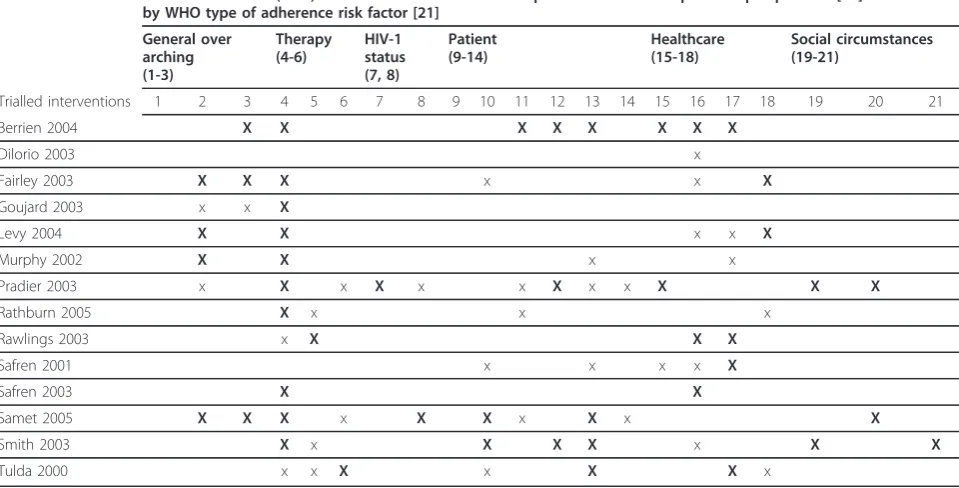
intervention component derived from the qualitative review, while each row represented whether an indivi-dual trial’s intervention matched any of the recommen-dations. We marked a cell ‘X’when a commonality (a correspondence) was found between a patient recom-mendation and an intervention component. It was marked ‘x’ if only a partial correspondence was identi-fied. It was left blank when the intervention content did not correspond with a patient-based recommendation. The final cell, per trial row, indicated whether or not the intervention was found to be effective. We used the WHO classification of risk factors influencing adherence to long-term therapy [21] as a framework to group the links found between the interventions and the recom-mendations. See Table 1.
We built two matrices. Many of the trials in the Cochrane review were methodologically weak. Therefore in our first matrix we used as a cut-off to explore het-erogeneity of effect the cluster of four trials that fulfilled at least half of the set quality criteria. We explored visually whether there were differences in configura-tional matches in the mixed review data between the two successful interventions and the two that had no effect. In the second matrix we entered the data extrac-tions for all trials to explore how well the patient recommendations were reflected in the components of the evaluated interventions.
Results
The two higher quality trials in which the intervention significantly improved adherence addressed a wider range of barriers and facilitators that patients felt were important to adherence than the two higher quality trials where the intervention did not improve adherence. These latter trials did not address three types of barriers and facilitators; namely, general and overarching factors, those relating to HIV-1 status, and those relating to social circumstances (Table 1). The effective interven-tions both matched two recommendainterven-tions that the inef-fective interventions did not; specifically’To get patients to describe their own behaviour so as to pick up any risky patterns’and ’To develop a trusting relationship with the patient’. There were also two recommendations that the effective trials either matched or partially matched and where no match was identified in the interventions found not to improve adherence. These were: ’To enquire for each patient before starting the treatment into the possible factors influencing adherence’
not matched in the effective interventions, namely’Clear information should be given on how to manage side effects, including those that may be unpleasant and distressing’.
When we brought together in the second matrix the data extraction sheets for all 14 trials, we found few trials had included recommendations relating to HIV-1 status, or for personal social circumstances (Table 2). This included, for example, the recommendations derived from the qualitative review that’Secrecy is threa-tened by taking treatment, therefore the possibility of dis-closure should be discussed as openness leads to higher adherence. If disclosure is not an option, the patient can be advised how to take medication in secret to avoid
skipping doses’and ’To acquire insight into a patient’s social support systems, and counsel the patient on how to use such support’.
Discussion
We used a simple approach to explore whether qualita-tive review evidence can explain the findings of a
sys-tematic review of effectiveness of a complex
intervention. The approach breaks new ground by com-paring in a matrix data derived from a qualitative review with data from a quantitative systematic review. By tabulating these two forms of data we were able to explore how patients’views matched the various compo-nents of trialled interventions.
Table 1 Tabulation of the four higher quality trials
Recommendations (1-21) for interventions drawn from qualitative review on patient’s perspectives [20]sub-divided by WHO type of adherence risk factor [21]and if Cochrane review [19]found trialled intervention increased adherence (Y, N)
General over arching (1-3)
Therapy (4-6)
HIV-1 status (7, 8)
Patient (9-14)
Healthcare (15-18)
Social circumstances (19-21)
Trialled interventions 1 2 3 4 5 6 7 8 9 10 11 12 13 14 15 16 17 18 19 20 21
Berrien 2004 X X X X X X X X Y
Pradier 2003 x X x X x X X x x X X X Y
Rathburn 2005 X x X x N
Rawlings 2003 x X X X N
’X’= correspondence between the patient recommendation and the content of the intervention,‘x’= the content of the intervention partially corresponded with the recommendation.
Table 2 Tabulation of all trials
Recommendations (1-21) for interventions drawn from qualitative review on patient’s perspectives [20]sub-divided by WHO type of adherence risk factor [21]
General over arching (1-3)
Therapy (4-6)
HIV-1 status (7, 8)
Patient (9-14)
Healthcare (15-18)
Social circumstances (19-21)
Trialled interventions 1 2 3 4 5 6 7 8 9 10 11 12 13 14 15 16 17 18 19 20 21
Berrien 2004 X X X X X X X X
Dilorio 2003 x
Fairley 2003 X X X x x X
Goujard 2003 x x X
Levy 2004 X X x x X
Murphy 2002 X X x x
Pradier 2003 x X x X x x X x x X X X
Rathburn 2005 X x x x
Rawlings 2003 x X X X
Safren 2001 x x x x X
Safren 2003 X X
Samet 2005 X X X x X X x X x X
Smith 2003 X x X X X x X X
Tulda 2000 x x X x X X x
The authors of the Cochrane review found that inter-ventions targeting practical medication management skills were more often linked to successful adherence outcomes than those that did not target such skills [19]. By using our approach other information about the intervention components was revealed. Firstly, successful interventions contained a broader range of components that worked on barriers and facilitators to anti-retroviral drug adherence considered important by people infected with HIV-1. This finding is perhaps of no surprise but on the other hand this has not, to our knowledge, been formally explored before. What is surprising is that not all types of priorities raised by patients had been fully evaluated in the interventions included in the most recent update of the Cochrane review.
Limitations
In this study any conclusions drawn on the differences between evaluated interventions are tentative as none of the trials was without risk of biased findings. Further-more, conclusions cannot be drawn on which compo-nents are essential or superfluous, or on whether the recommendations not taken up in the reviewed trials would have any impact on adherence if included in further trials. The reason for bringing quantitative trial data together with qualitative evidence on patients’ views is not to demonstrate a causal link; rather it is hypothesis generating by providing possible explanations for variation between trial findings.
Incomplete reporting in trial reports poses a threat to the validity of this approach, which is dependent on the quality of information provided on the interventions. We did attempt to ask for further information with the authors where an email address was provided. The approach was abandoned, as few responded and not all who responded provided information. However, to reduce the risk of incomplete reporting we only included trials that devoted a paragraph or more in their methods section to describing the intervention and which fulfilled the extension of the CONSORT State-ment to trials of non-pharmacologic treatState-ment on reporting of intervention content [27]. It could also be argued that while trial authors may not report all aspects of an intervention in the paper publishing their findings, they are likely to report the major components. While this has not been tested, a study of 80 papers describing evaluations of complex interventions found that the most common aspect missing from descriptions of treatments was detail on intervention process as opposed to content, such as timing of treatments [44]. Another limitation in this approach is our subjective evaluation of matches between the qualitative studies and the trials. However, to reduce this potential bias the matches identified were checked several times. Although
neither of the first two checks disagreed with what had been extracted in the first extraction, each identified matches that were missed. The third check was an inde-pendent data extraction by a layperson who was masked to the trial findings. The transparent method of data matching in this final check minimised the likelihood that any further matches were missed. Finally, we were reliant on the skills of the researchers of the two pub-lished reviewers we used. To reduce this limitation we only selected reviews of a high standard.
Implications
Systematic reviews select and combine all high quality randomised trials of a given intervention. They provide the highest quality evidence on effectiveness of a treat-ment or service. The approach presented here aims, by providing more evidence on intervention components, to increase the potential learning from a systematic review of a complex intervention. This information could lead to the development of more appropriate interventions.
The potential of the approach tested here should be further explored. While the number of reviews of quali-tative evidence on patients’ perspectives is small, it is slowly growing. The approach could be used to explore whether combinations of intervention components matching patients’views vary with the trials’effect sizes. Statistical analysis of the matrix data may be restricted because of the limited data points that mixed review evi-dence could provide but further analysis could explore, in a review with more methodologically robust trials, the value of using the algorithmic logic of QCA to explore variation in trial findings. The potential of QCA in combining qualitative and qualitative evidence synth-esis in health care research is recognised by review methodologists [7] and, while we were unable to explore its full potential in the study presented here, we are cur-rently doing so using evidence from a Cochrane sys-tematic review where there are more trials that can be combined with qualitative review evidence [49].
Conclusions
Our approach breaks new ground by combining qualitative and quantitative data in matrices that show whether effec-tive interventions are more likely to contain components patients believe are important than ineffective interven-tions. In short, it directly tests the assumption that patients are more likely to stick to interventions that contain more of their concerns. The value of this approach in exploring heterogeneity in trial content and findings deserves further evaluation. We encourage authors publishing trial findings to provide an adequate description of their intervention. We also call for more reviews of qualitative evidence on patients’perspectives and, in particular, qualitative reviews that complement existing reviews of trials.
Appendix 1: Recommendations for adherence interventions drawn from the qualitative review on HIV/AIDS patient’s perspectives*
General and overarching
1. Adherence is a dynamic phenomenon in which the interplay of a number of influences varies over time. Therefore ongoing attention to adherence should have highest priority.
2. To enquire into the possible factors influencing adherence for each individual patient before starting treatment.
3. To use insight into the possible adherence factors influencing each individual patient before starting treatment.
Therapy related
4. Medication should be adapted to life rather than life to medication: e.g. the provider should
encourage the use of a watch or pillbox with an alarm to remind a patient to take medication and to prevent (unwanted) disclosure.
5. Clear information should be given on side effects how to manage side effect, including those that may be unpleasant and distressing.
6. During every visit any ambivalence towards medi-cations should be discussed.
Condition related
7. Patients’acceptance of their HIV status should be discussed on a regular basis, bearing in mind that tak-ing medication can renew confrontation with diagnosis. 8. Secrecy is threatened by taking treatment. There-fore the possibility of disclosure should be discussed as openness leads to higher adherence: if disclosure is not an option, the patient can be advised how to take medication in secret to avoid skipping doses.
Patient related
9. Feedback about positive reactions of the body to treatment should be provided at each visit to pro-mote adherence e.g. decreased viral load.
10. Pointing out the value of treatment to a patient’s life enhances motivation.
11. Information transfer appropriate to a patient’s level of understanding will lead to the patient having correct knowledge of what constitutes good adher-ence practice.
12. It is important to get patients to describe their own behaviour so as to pick up any risky patterns. 13. Regular discussion of the circumstances that lead to forgetting medication can reveal aspects that need attention to improve adherence e.g. capacity to organise life and activities, and to anticipate risky situations. 14. Depression or substance misuse should be mana-ged as first priority.
Healthcare related
15. To develop a trusting relationship with the patient. 16. To give clear instructions on how to take medication.
17. To explain the relationship between adherence and viral load.
18. To offer good medical follow up.
Socio-economic related
20. Attention to possible negative social circum-stances e.g. mothers of young children may need help to fit medication into hectic schedules.
21. Social support has to be substantial and practical.
*Derived from Vervoort review [20]and grouped by WHO[21]type of adherence risk factor
Acknowledgements
Marie Curie Cancer Care funded this project. The funding body for this project had no role in the design or implementation, write-up or submission of this project. We are grateful to Drs Marc Lipman and Jason Myers for commenting on earlier drafts of this paper, Karen Harrison for checking our data extraction and Paul Tuckey for independently extracting the trial data.
Author details
1Marie Curie Palliative Care Research Unit, UCL Mental Health Sciences Unit,
University College Medical School, Charles Bell House, 67-73 Riding House Street, London W1W 7EJ, UK.2Michael King, Professor of Primary Care Psychiatry and Co-Director of PRIMENT Clinical Trials Unit, UCL Mental Health Sciences Unit, University College Medical School, Charles Bell House, 67-73 Riding House Street, London W1W 7EJ, UK.3Louise Jones, Head of Marie Curie Palliative Care Research Unit, UCL Mental Health Sciences Unit, University College Medical School, Charles Bell House, 67-73 Riding House Street, London W1W 7EJ, UK.4Sandy Oliver, Professor of Public Policy, EPPI-Centre, Social Science Research Unit, Institute of Education, 20 Bedford Way, London WC1H 0AL, UK.
Authors’contributions
All authors contributed to the conception, design and interpretation of the data. BC drafted the article and all authors revised it and approved the final version
Competing interests
The authors declare that they have no competing interests.
Received: 5 October 2010 Accepted: 26 August 2011 Published: 26 August 2011
References
1. Craig P, Dieppe P, Macintyre S, Michie S, Nazareth I, Petticrew M:Developing and evaluating complex interventions: new guidanceUK Medical Research Council; 2008.
2. Lenz M, Steckelberg A, Muhlhauser I:Patient education programmes and decision aids- evaluation of complex interventions.Av Diabetol2008,
24:443-452.
3. Shepperd S, Lewin S, Struas S, Clarke M, Eccles M, Fitzpatrick R, Wong G, Sheikh A:Can we systematically review studies that evaluate complex interventions?Plos Medicine2009,6:8.
4. Noyes J, Popay J, Pearson A, Hannes K, Booth A:Qualitative research and Cochrane reviews.InCochrane handbook for systematic reviews of interventions. Version 5.0.2. Volume Chapter 20.Edited by: Higgins JPT, Green S. The Cochrane Collaboration; 2009.
5. Tudor-Hart J:The political economy of health care: a clinical perspective Bristol, The Policy Press; 2006.
6. Lewin S:Methods to synthesise qualitative evidence alongside a Cochrane intervention review.Oceania Regional Qualitative Synthesis Symposium: The art and science of method2008 [http://www.jbiconnect.org/ tools/cqrmg/documents/Conference08/Synthesis.pdf].
7. Pope C, Mays N, Popay J:Synthesising qualitative and quantitative health research: a guide to methodsOpen University Press: Maidenhead, UK; 2007. 8. Pope C, Mays N:Critical reflections on the rise of qualitative research.
BMJ2009,339:737-739.
9. Pawson R, Greenhalgh T, Harvet G, Walshe K:Realist Synthesis: an introductionManchester: University of Manchester; 2004.
10. Pawson R, Greenhalgh T, Harvet G, Walshe K:Realist review: a new method of systematic review designed for complex policy interventions.
J Health Services Res Policy2005,10(Supp 1):21-34.
11. Sheldon T:Making evidence synthesis more useful for management and policy making.J Health Services Res Policy2005,10:1-5.
12. Thomas J, Harden A, Oakley A, Oliver S, Sutcliffe K, Rees R, Brunton G, Kavanagh K:Integrating qualitative research with trials in systematic reviews.BMJ2004,328:1010-1012.
13. Ragin C:Fuzzy Set Social ScienceChicago: University of Chicago Press; 2000. 14. Melinder KA, Andersson R:The impact of structural factors on the injury
rate in different European countries.Eur J Public Health2001, ,11:
301-308.
15. CASP (Critical Appraisal Skills Programme):10 Questions to make sense of qualitative research.2006 [http://www.casp-uk.net/index.aspx?o=1150]. 16. Shea BJ, Grimshaw JM, Wells GA, Boers M, Andersson N, Hamel C,
Porter AC, Tugwell P, Moher D, Bouter LM:Development of AMSTAR: a measurement tool to assess the methodological quality of systematic reviews.BMC Med Res Methodol2007,7:10.
17. Mays N, Pope C:Qualitative research in health care. Assessing quality in qualitative research.BMJ2000,320:50-2.
18. Giacomini MK, Cook DJ:Users’guides to the medical literature: XXIII. Qualitative research in health A.JAMA2000,284:357-62.
19. Rueda S, Park-Wyllie LY, Bayoumi A, Tynan AM, Antoniou T, Rourke S, Glazier R:Patient support and education for promoting adherence to highly active antiretroviral therapy for HIV/AIDS.Cochrane Database of Systematic Reviews2006,3.
20. Vervoort SCJM, Borleffs JCC, Hoepelman AIM, Grypdonck MHF:Adherence in antiretroviral therapy: a review of qualitative literature.AIDS2007,
21:271-281.
21. World Health Organisation:Adherence to long-term therapy: evidence for actionGeneva: World Health Organisation; 2003.
22. Sackett DL, Snow LC:The magnitude of adherence and nonadherence.In Compliance In Health Care.Edited by: Haynes RB, Taylor DW, Sackett DL. John Hopkins University Press; 1979:11-22.
23. Moher D, Schulz KF, Altman DG:The CONSORT statement: revised recommendations for improving the quality of reports of parallel-group randomised trials.Lancet2001,357:1191-1194.
24. Jones DL, Ishii M, LaPerriere A, Stanley H, Antoni M, Ironson G, Schneiderman N, Van Splunteren F, Cassells A, Alexander K, Gousse YP, Vaughn A, Brondolo E, Tobin JN, Weiss SM:Influencing medication adherence among women with AIDS.AIDS CARE2003,15:463-474. 25. Weber R, Christen L, Christen S, Tschopp S, Hansjoerg Znoj, Schnedier C,
Schmitt J, Opravil M, Günthard HF, Ledergerber B:Effect of individual cognitive behaviour intervention on adherence to antiretroviral therapy: prospective randomized trial.Antivir Ther2004,9:85-95.
26. Wyatt GE, Longshore D, Chin D, Vargas Carmona J, Burns Loeb T, Myers HF, Warda U, Liu H, Rivkin I:The efficacy of an integrated risk reduction intervention for HIV-positive women with child sexual abuse histories.
AIDS Behav2004,8:453-462.
27. Boutron I, Moher D, Altman DG, Schulz KF, Ravaud P, for the CONSORT group:Methods and process of the CONSORT Group: Example of an extension for trials assessing nonpharmacologic treatments.Ann Intern Med2008,148:w60-w66.
28. Knobel H, Carmona A, Lopez JL, Gimeno JL, Saballs P, Gonzalez A, Guelar A, Diez A:Adherence to highly active antiretroviral treatment: impact of individualized assessment.Enfermedades Infecciosas y Microbiologia Clinica 1999,17:78-81.
29. van Servellen G, Carpio F, Lopez M,et al:Program to enhance health literacy and treatment adherence in low-income HIV-infected Latino men and women.AIDS Patient Care STDS2003,17:581-594.
30. Berrien VM, Salazar JC, Reynolds E, McKay K:Adherence to antiretroviral therapy in HIV-infected pediatric patients improves with home-based intensive nursing intervention.AIDS Patient Care STDS2004,
18:355-363.
31. DiIorio C, Resnicow K, McDonnell M, Soet J, McCarty F, Yeager K:Using motivational interviewing to promote adherence to antiretroviral medications: a pilot study.J Assoc Nurses AIDS Care2003,14:52-62. 32. Fairley CK, Levy R, Rayner CR, Allardice K, Costello K, Thomas C,et al:
Randomized trial of an adherence programme for clients with HIV.Int J STD AIDS2003,14:805-809.
34. Levy RW, Rayner CR, Fairley CK, Kong DCM, Milch A, Costello K, McArthur C, Melbourne Adherence Group:Multidisciplinary HIV adherence
intervention: a randomized study.AIDS Patient Care STDS2004,
18:728-735.
35. Murphy DA, Lu Michael C, Martin D, Hoffman D, Marelich WD:Results of a pilot intervention trial to improve antiretroviral adherence among HIV-positive patients.J Assoc Nurses AIDS Care2002,13:57-69.
36. Pradier C, Bentz L, Spire B, Tourette-Turgis C, Morin M, Souville M, Rebillon M, Fuzibet JG, Pesce A, Dellamonica P, Moatti JP:Efficacy of an educational and counseling intervention on adherence to highly active antiretroviral therapy: French prospective controlled study.HIV Clin Trials 2003,4:121-131.
37. Rathbun RC, Farmer KC, Stephens JR, Lockhart SM:Impact of an adherence clinic on behavioral outcomes and virologic response in the treatment of HIV infection: a prospective, randomized, controlled pilot study.Clin Ther2005,27:199-209.
38. Rawlings MK, Thompson MA, Farthing CF, Brown LS, Racine J, Scott RC, Crawford KH, Goodwin SD, Tolson JM, Williams VC, Shaefer MS:Impact of an educational program on efficacy and adherence with a twice-daily lamivudine/zidovudine/abacavir regimen in underrepresented HIV-infected patients.J Acquir Immune Defic Syndr2003,34:174-183. 39. Safren SA, Otto MW, Worth JL, Salomon E, Johnson W, Mayer K, Boswell S:
Two strategies to increase adherence to HIV antiretro-viral medication: life-steps and medication monitoring.Behav Res Ther2001,39:1151-62. 40. Safren SA, Hendriksen ES, Desousa N, Boswell SL, Mayer KH:Use of an
on-line pager system to increase adherence to antiretroviral medications.
Aids Care2003,15:787-793.
41. Samet JH, Horton NJ, Meli S, Dukes K, Tripp T, Sullivan L, Freedberg KA:A randomized controlled trial to enhance antiretroviral therapy adherence in patients with a history of alcohol problems.Antivir Ther2005, ,10:
83-93.
42. Smith SR, Rublein JC, Marcus C, Brock TP, Chesney MA:A medication self-management program to improve adherence to HIV therapy regimens.
Patient Educ Couns2003,50:187-199.
43. Tuldra A, Fumaz CR, Jose Ferrer M, Bayes R, Arno A, Balague M, Bonjoch A, Jou A, Negredo E, Paredes R, Ruiz L, Romeu J, Sirera G, Tural C, Burger D, Clotet B:Prospective randomized two-arm controlled study to determine the efficacy of a specific intervention to improve long-term adherence to highly active antiretroviral therapy.J Acquir Immune Defic Syndr2000, ,
25:221-8.
44. Glaszlou P, Meats E, Heneghan C, Sheppard S:What is missing from descriptions of treatment in trials and reviews?BMJ2008,336:1472-1474. 45. Barnett-Page E, Thomas J:Methods for the synthesis of qualitative
research: a critical review.BMC Med Res Methodol2009,9:59. 46. Thomas J, Harden A:Methods for the thematic synthesis of qualitative
research in systematic review. ESRC National Centre for Research Methods, NCRM Working Paper Series. Number (10/07).[http://eppi.ioe.ac. uk/cms/Default.aspx?tabid=188].
47. Campbell R:Evaluating meta-ethnography: a synthesis of qualitative research on lay experiences of diabetes and diabetes care.Social Science & Medicine2003,56:671.
48. Atkins S, Lewin S, Smith H, Engel M, Fretheim A, Volmink J:Conducting a meta-ethnography of qualitative literature: Lessons learnt.BMC Med Res Methodol2008,8:21.
49. Haynes RB, Ackloo E, Sahota N, McDonald HP, Yao X:Interventions for enhancing medication adherence.Cochrane Database of Systematic Reviews2008,2.
Pre-publication history
The pre-publication history for this paper can be accessed here: http://www.biomedcentral.com/1471-2288/11/124/prepub
doi:10.1186/1471-2288-11-124
Cite this article as:Candyet al.:Using qualitative synthesis to explore heterogeneity of complex interventions.BMC Medical Research Methodology201111:124.
Submit your next manuscript to BioMed Central and take full advantage of:
• Convenient online submission
• Thorough peer review
• No space constraints or color figure charges
• Immediate publication on acceptance
• Inclusion in PubMed, CAS, Scopus and Google Scholar
• Research which is freely available for redistribution