Vol. 4, No. 2, Year 2012 Article ID IJIM-00200, 16 pages Research Article
Comparison between Rational Gegenbauer and
Modified Generalized Laguerre Functions
Collocation Methods for Solving the Case of Heat
Transfer Equations Arising in Porous Medium
K. Paranda∗, F. Baharifarda, F. Bayat Babolghania
(a)Department of Computer Sciences, Shahid Beheshti University, Tehran, Iran.
——————————————————————————————————
–
Abstract
In this paper, we provide the collocation method for natural convection heat transfer
equations embedded in porous medium which are of great importance in the design of
canisters for nuclear waste disposal. This problem is a non-linear, three-point boundary
value problem on semi-infinite interval. We use two orthogonal functions namely rational
Gegenbauer and modified generalized Laguerre functions which are defined as basis
func-tions in this approach and compare them together. We also present the comparison of
these works with Runge-Kutta solution, moreover, in the graph of the
∥
Res
∥
2, we show
that the present solutions are accurate and applicable.
Keywords
:
Rational Gegenbauer; Modified generalized Laguerre; Collocation method; Nonlinear ODE; Indirect multiquadric; Porous media.
—————————————————————————————————————-1
Introduction
1.1
Introducing of the problem
Natural convective heat transfer in porous media has received considerable attention during the past few decades. This interest can be attributed to its wide range of applications in ceramic processing, nuclear reactor cooling system, crude oil drilling, chemical reactor design, ground water pollution and filtration processes. External natural convection in a porous medium adjacent to heated bodies was analyzed by Nield and Bejan [39], Merkin [33, 34], Minkowycz and Cheng [35, 36, 37], Pop and Cheng [12, 47], Ingham and Pop [29]. All through these studies, it is assumed that the boundary layer approximations are applicable and the coupled set of governing equations are solved by numerical methods. Also, [1, 51] worked out this problem. Parand [40] Compared two common collocation approaches based on radial basis functions for the case of heat transfer equations arising in porous medium.
In present study, we consider the problem of natural convection about an inverted heated cone
∗Corresponding author. Email address: k [email protected]
embedded in a porous medium of infinite extent. No similarity solution exists for the truncated cone, but for the case of full cone similarity solutions exist if the prescribed wall temperature or surface heat flux is a power function of distance from the vertex of the inverted cone [12, 39, 54, 55]. Bejan and Khair [3] used Darcy’s law to study the vertical natural convective flows driven by temperature and concentration gradients. Nakayama and Hossain [38] applied the integral method to obtain the heat and mass transfer by free convection from a vertical surface with constant wall temperature and concentration. Yih [60] examined the coupled heat and mass transfer by free convection over a truncated cone in porous media for variable wall temperature and variable heat and mass fluxes, Also he [61] applied the uniform transpiration effect on coupled heat and mass transfer in mixed convection about inclined surfaces in porous media for the entire regime. Cheng [10] used an integral approach to study the heat and mass transfer by natural convection from truncated cones in porous media with variable wall temperature and [11] studies the Soret and Dufour effects on the boundary layer flow due to natural convection heat and mass transfer over a vertical cone in a porous medium, saturated with Newtonian fluids with constant wall temperature. Natural convective mass transfer from upward-pointing vertical cones, embedded in saturated porous media, was studied using the limiting diffusion [50]. The natural convection along with an isothermal wavy cone embedded in a fluid-saturated porous medium were presented in [48, 49]. In [54, 55] fluid flow and heat transfer of vertical full cone embedded in porous media were solved by Homotopy analysis method.
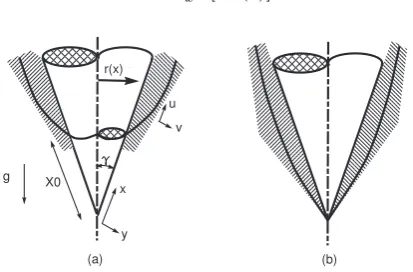
If we want to express the problem formulation of this model, we can consider an inverted cone with semi-angle γ and take axes in the manner indicated in Fig. 1 (a). The boundary layer develops over the heated frustumx=x0. In terms of the stream functionψis defined by:
u= 1
r ∂ψ
∂y, v=−
1
r ∂ψ
∂x. (1.1)
The boundary layer equations for natural convection of Darcian fluid about a cone are:
∂ ∂x(ru) +
∂
∂y(rv) = 0 (1.2)
u=ρ∞βKgcosγ(T−T∞)
µ (1.3)
1
r( ∂ψ ∂y
∂T
∂x −
∂ψ ∂x
∂T ∂y) =α
∂2T
∂y2. (1.4)
For a thin boundary layer,ris obtained approximatelyxsin(γ). Suppose that a power law of heat flux is prescribed on the frustum. Accordingly, the boundary conditions at infinity are:
u= 0, T =T∞, y→ ∞, (1.5)
and at the wall are
v= 0, y= 0. (1.6)
The surface heat fluxqwis prescribed by
qw=−k(
∂T
∂y)y=0=A(x−x0)
λ x
0≤x≤ ∞. (1.7)
For the case of a full cone (x0= 0,Fig.1(b)) a similarity solution exists.
In the case of prescribed surface heat flux, we let:
ψ=αr(Rax)1/3f(η), (1.8)
T−T∞=qwx
k (Rax)
−1 3θ(η),
η= y
where
Rax=
ρ∞βgKcos(γ)qwx2
µαk , (1.9)
is the local Rayleigh number for the case of prescribed surface heat flux. The governing equations become
f′ =θ (1.10)
θ′′+λ+ 5 2 f θ
′−2λ+ 1
3 f
′θ= 0.
Subjected to boundary conditions as:
f(0) = 0, θ′(0) =−1, θ(∞) = 0. (1.11)
Finally from Equations (1.10) and (1.11) we have: {
ODE. f′′′+(λ+52 )f f′′−(2λ3+1)(f′)2= 0,
B.C. f(0) = 0, f′′(0) =−1, f′(∞) = 0. (1.12)
It is of interest to obtain the value of the local Nusselt number which is defined as:
N ux=
qwx
k(Tw−T∞)
. (1.13)
From Eqs. (1.13), (1.8) and (1.9) it follows that the local Nusselt number which is of interest to obtain given by:
N ux=Ra1x/3[−θ(0)]. (1.14)
xxxxxxxxxxxxxxxxxxxxx xxxxxxxxxxxxxxxxxxxxx xxxxxxxxxxxxxxxxxxxxx xxxxxxxxxxxxxxxxxxxxx xxxxxxxxxxxxxxxxxxxxx xxxxxxxxxxxxxxxxxxxxx xxxxxxxxxxxxxxxxxxxxx xxxxxxxxxxxxxxxxxxxxx xxxxxxxxxxxxxxxxxxxxx xxxxxxxxxxxxxxxxxxxxx xxxxxxxxxxxxxxxxxxxxx xxxxxxxxxxxxxxxxxxxxx xxxxxxxxxxxxxxxxxxxxx xxxxxxxxxxxxxxxxxxxxx xxxxxxxxxxxxxxxxxxxxx xxxxxxxxxxxxxxxxxxxxx xxxxxxxxxxxxxxxxxxxxx xxxxxxxxxxxxxxxxxxxxx xxxxxxxxxxxxxxxxxxxxx xxxxxxxxxxxxxxxxxxxxx xxxxxxxxxxxxxxxxxxxxx xxxxxxxxxxxxxxxxxxxxx xxxxxxxxxxxxxxxxxxxxx xxxxxxxxxxxxxxxxxxxxx xxxxxxxxxxxxxxxxxxxxx xxxxxxxxxxxxxxxxxxxxx xxxxxxxxxxxxxxxxxxxxx xxxxxxxxxxxxxxxxxxxxx xxxxxxxxxxxxxxxxxxxxx xxxxxxxxxxxxxxxxxxxxx xxxxxxxxxxxxxxxxxxxxx xxxxxxxxxxxxxxxxxxxxx xxxxxxxxxxxxxxxxxxxxx xxxxxxxxxxxxxxxxxxxxx xxxxxxxxxxxxxxxxxxxxx xxxxxxxxxxxxxxxxxxxxx xxxxxxxxxxxxxxxxxxxxx xxxxxxxxxxxxxxxxxxxxx xxxxxxxxxxxxxxxxxxxxx xxxxxxxxxxxxxxxxxxxxx xxxxxxxxxxxxxxxxxxxxx xxxxxxxxxxxxxxxxxxxxx xxxxxxxxxxxxxxxxxxxxx xxxxxxxxxxxxxxxxxxxxx xxxxxxxxxxxxxxxxxxxxx xxxxxxxxxxxxxxxxxxxxx xxxxxxxx xxxxxxxx xxxxxxxx xxxxxxxx r(x) g X0 x y u v xxxxxxxx xxxxxxxx xxxxxxxx xxxxxxxx xxxxxxxxxxxxxxxxxxxxx xxxxxxxxxxxxxxxxxxxxx xxxxxxxxxxxxxxxxxxxxx xxxxxxxxxxxxxxxxxxxxx xxxxxxxxxxxxxxxxxxxxx xxxxxxxxxxxxxxxxxxxxx xxxxxxxxxxxxxxxxxxxxx xxxxxxxxxxxxxxxxxxxxx xxxxxxxxxxxxxxxxxxxxx xxxxxxxxxxxxxxxxxxxxx xxxxxxxxxxxxxxxxxxxxx xxxxxxxxxxxxxxxxxxxxx xxxxxxxxxxxxxxxxxxxxx xxxxxxxxxxxxxxxxxxxxx xxxxxxxxxxxxxxxxxxxxx xxxxxxxxxxxxxxxxxxxxx xxxxxxxxxxxxxxxxxxxxx xxxxxxxxxxxxxxxxxxxxx xxxxxxxxxxxxxxxxxxxxx xxxxxxxxxxxxxxxxxxxxx xxxxxxxxxxxxxxxxxxxxx xxxxxxxxxxxxxxxxxxxxx xxxxxxxxxxxxxxxxxxxxx xxxxxxxxxxxxxxxxxxxxx xxxxxxxxxxxxxxxxxxxxx xxxxxxxxxxxxxxxxxxxxx xxxxxxxxxxxxxxxxxxxxx xxxxxxxxxxxxxxxxxxxxx xxxxxxxxxxxxxxxxxxxxx xxxxxxxxxxxxxxxxxxxxx xxxxxxxxxxxxxxxxxxxxx xxxxxxxxxxxxxxxxxxxxx xxxxxxxxxxxxxxxxxxxxx xxxxxxxxxxxxxxxxxxxxx xxxxxxxxxxxxxxxxxxxxx xxxxxxxxxxxxxxxxxxxxx xxxxxxxxxxxxxxxxxxxxx xxxxxxxxxxxxxxxxxxxxx xxxxxxxxxxxxxxxxxxxxx xxxxxxxxxxxxxxxxxxxxx xxxxxxxxxxxxxxxxxxxxx xxxxxxxxxxxxxxxxxxxxx xxxxxxxxxxxxxxxxxxxxx xxxxxxxxxxxxxxxxxxxxx xxxxxxxxxxxxxxxxxxxxx xxxxxxxxxxxxxxxxxxxxx xxxxxxxxxxxxxxxxx xxxxxxxxxxxxxxxxx xxxxxxxxxxxxxxxxx xxxxxxxxxxxxxxxxx xxxxxxxxxxxxxxxxx xxxxxxxxxxxxxxxxx xxxxxxxxxxxxxxxxx xxxxxxxxxxxxxxxxx xxxxxxxxxxxxxxxxx xxxxxxxxxxxxxxxxx xxxxxxxxxxxxxxxxx xxxxxxxxxxxxxxxxx xxxxxxxxxxxxxxxxx xxxxxxxxxxxxxxxxx xxxxxxxxxxxxxxxxx xxxxxxxxxxxxxxxxx xxxxxxxxxxxxxxxxx xxxxxxxxxxxxxxxxx xxxxxxxxxxxxxxxxx xxxxxxxxxxxxxxxxx xxxxxxxxxxxxxxxxx xxxxxxxxxxxxxxxxx xxxxxxxxxxxxxxxxx xxxxxxxxxxxxxxxxx xxxxxxxxxxxxxxxxx xxxxxxxxxxxxxxxxx xxxxxxxxxxxxxxxxxx xxxxxxxxxxxxxxxxxx xxxxxxxxxxxxxxxxxx xxxxxxxxxxxxxxxxxx xxxxxxxxxxxxxxxxxx xxxxxxxxxxxxxxxxxx xxxxxxxxxxxxxxxxxx xxxxxxxxxxxxxxxxxx xxxxxxxxxxxxxxxxxx xxxxxxxxxxxxxxxxxx xxxxxxxxxxxxxxxxxx xxxxxxxxxxxxxxxxxx xxxxxxxxxxxxxxxxxx xxxxxxxxxxxxxxxxxx xxxxxxxxxxxxxxxxxx xxxxxxxxxxxxxxxxxx xxxxxxxxxxxxxxxxxx xxxxxxxxxxxxxxxxxx xxxxxxxxxxxxxxxxxx xxxxxxxxxxxxxxxxxx xxxxxxxxxxxxxxxxxx xxxxxxxxxxxxxxxxxx xxxxxxxxxxxxxxxxxx xxxxxxxxxxxxxxxxxx xxxxxxxxxxxxxxxxxx xxxxxxxxxxxxxxxxxx xxxxxxxxxxxxxxxxxx (a) (b) xxxx xxxx
Fig. 1. (a) Coordinate system for the boundary layer on a heated frustum of a cone, (b) full cone,x0= 0.
1.2
Spectral method
Many of the current science and engineering problems are set in unbounded domains. In the context of spectral methods such as collocation and Galerkin methods [31], a number of approaches for treating unbounded domains have been proposed and investigated. The most common method is the use of polynomials that are orthogonal over unbounded domains, such as the Hermite and Laguerre spectral method [14, 15, 16, 19, 24, 32, 52, 53].
and Chebyshev polynomials, are special cases of these polynomials also which have been used in sevral literatures for solving some problems [2, 30].
One more approach is replacing infinite domain with [−L, L] and semi-infinite interval with [0, L] by choosing L, sufficiently large. This method is named domain truncation [4].
There is another effective direct approach for solving such problems which is based on rational approximations. Christov [13] and Boyd [5, 6] developed some spectral methods on unbounded intervals by using mutually orthogonal systems of rational functions. Boyd [5] defined a new spectral basis, named rational Chebyshev functions on the semi-infinite interval, by mapping to the Chebyshev polynomials. Guo et al. [25] introduced a new set of rational Legendre functions which are mutually orthogonal inL2(0,∞). They applied a spectral scheme using the rational Legendre functions for solving the Korteweg-de Vries equation on the half-line. Boyd et al. [8] applied pseudospectral methods on a semi-infinite interval and compared rational Chebyshev, Laguerre and mapped Fourier sine methods.
Parand et al. [41, 42, 43, 44, 45, 46], applied spectral method to solve nonlinear ordinary differential equations on semi-infinite intervals. Their approach was based on rational tau and collocation methods.
In this paper, solve the model Eq. (1.12) numerically by using two orthogonal functions, namely rational Gegenbauer functions and modified generalized Laguerre functions in collocation method and compare our the obtained results. we also have a comparison with solutions of [55].
Sections 2 and 3 review the desirable properties of rational Gegenbauer functions and modified generalized Laguerre functions with solution of the problem with collocation method by these functions, respectively. In Section 4 we show our results via tables and figures. Finally, concluding remarks are presented in Section 5.
2
Rational Gegenbauer functions
In this section, firstly, rational Gegenbauer functions are introduced and some basic properties of them are presented. Then we approximate a function using Gauss integration with rational Gegenbauer-Gauss points.
The Gegenbauer polynomialsGαn(y) of orderαand of degreenare defined as follows [56, 57]:
Gαn(y) =
⌊∑n/2⌋
j=0
(−1)j Γ(n+α−j)
j!(n−2j)!Γ(α)(2y)
n−2j, (2.15)
wherenis an integer, αis a real number greater than−12 and Γ is the Gamma function.
The Gegenbauer polynomials are orthogonal in the interval [−1,1] with respect to the weight func-tionρ(y) = (1−y2)α−1
2 where α >−1
2.
The new basis functions, is denoted by RGα
n(x) = Gαn(y), where L is a constant parameter and
y = xx−+LL, y∈ [−1,1], the constant parameter L sets the length scale of the mapping . Boyd [7] offered guideline for optimizing the map parameterL.
RGα
n(x) is thenth eigenfunction of the singular Sturm-Liouville problem:
(x+L)
√ x L
d dx
[
(x+L)√x d
dxRG
α n(x)
] +α
(
x2−L2 L
)
d
dxRG
α n(x)
+n(n+ 2α)RGαn(x) = 0,
(2.16)
RGα0(x) = 1, RGα1(x) = 2α
x−L
x+L,
RGαn+1(x) = 1
n+ 1 [
2 (
x−L
x+L
)
(n+α)RGαn(x)−(n+ 2α−1)RGαn−1(x) ]
, n≥1.
(2.17)
The special cases of rational Gegenbauer functions are rational Legendre functions and rational Chebyshev functions, that were introduced by Guo [25, 26].
2.1
Function approximation with rational Gegenbauer functions
We determine w(x) = (x+2LL)2 [
1− (
x−L x+L
)2]α−12
as a non-negative, integrable and real-valued
weight function for rational Gegenbauer over the intervalI= [0,∞). Let us denote
ρ(y) = (1−y2)α−12, y= x−L
x+L, (2.18)
hence we have
dy
dx =
2L
(x+L)2, dx
dy =
2L
(y−1)2, w(x) dx
dy =ρ(y). (2.19)
Now we define
L2w(I) ={v:I→R|v is measurable and∥v∥w<∞}, (2.20)
where
∥v∥w= ( ∫ ∞
0
|v(x)|2w(x)dx)12, (2.21)
is the norm induced by the scalar product
< u, v >w= ∫ ∞
0
u(x)v(x)w(x)dx. (2.22)
Thus{RGαn(x)}n≥0denotes a system which is mutually orthogonal under Eq.(2.22), i.e.,
< RGαn, RGαm>w=
π21−2αΓ(n+ 2α)
n!(n+α)[Γ(α)]2δnm, (2.23)
where δnm is the Kronecker delta function. This system is complete in L2w(I). For any function
u∈L2w(I) the following expansion holds
u(x) =
∞
∑
k=0
akRGαk(x), (2.24)
with
ak=
< u, RGα k >w
∥RGα k∥
2
w
. (2.25)
2.2
Rational Gegenbauer interpolation approximation
Authors of [9, 18] introduced Gauss integration. Later, Guo introduced rational Legendre-Gauss points [25] and rational Chebyshev-Gauss points [26]. Now we want to define rational Gegenbauer-Gauss interpolation. Let
RGα
N =span {
RGα0, RGα1, ..., RGαN}, (2.26)
and yj, j = 0,1, . . . , N, be the N+ 1 roots of the polynomialGαN+1(y). These points are known
as Gegenbauer-Gauss points. The corresponding Christoffel numbers of them are [57]:
22−2απΓ(N+ 1 + 2α) (N+ 1)!Γ2(α) ×
1
(1−yj2)[dydGαN+1(yj)]2
. (2.27)
We define
xj=L 1 +yj 1−yj
j= 0,1, . . . , N, (2.28)
which are called as rational Gegenbauer-Gauss nodes. In fact, these points are zeros of the function
RGα
N+1(x). Using Gauss integration we have:
∫ ∞
0
u(x)w(x)dx = ∫ 1
−1 u
(
L1 +y
1−y
)
ρ(y)dy
= N ∑
j=0
u(xj)wj ∀u∈ RGα2N, (2.29)
where
wj=
22−2απΓ(N+ 1 + 2α) (N+ 1)!Γ2(α) ×
L
xj(xj+L)2[dxd RGαN+1(xj)]2
, (2.30)
are the corresponding weights with the N + 1 rational Gegenbauer-Gauss nodes, that can be obtained from Eqs. (2.27) and (2.28).
The interpolating function of a smooth function uon a semi-infinite interval is denoted byPNu. It is an element ofRGαN and is defined as
PNu(x) = N ∑
k=0
akRGαk(x). (2.31)
PNuis the orthogonal projection ofuuponRGαN with respect to the inner product Eq.(2.22) and the norm Eq.(2.21). Thus by the orthogonality of rational Gegenbauer functions, we have [20]
< PNu−u, RGαi >w= 0 ∀RGαi ∈ RG α
N. (2.32)
To apply a collocation method, we consider the residualRes(x), when the expansion is substituted into the governing equation. The ak’s have to be selected so that the boundary conditions are satisfied, but the residual zero is made at as many (suitable chosen) spatial points as possible.
2.3
Solving the problem with rational Gegenbauer functions
byPNf(η) in the model Eq. (1.12). By equalizing Res(η) to zero at rational Gegenbauer-Gauss points (ηj, j= 1,2, ..., N−1) plus two boundary conditions, we can find the coefficientsak:
Res(η) = d
3
dη3PNf(η) +
(
λ+ 5 2
)
PNf(η) (
d2
dη2PNf(η)
)
−
( 2λ+ 1
3 ) (
d
dηINf(η)
)2 ,
PNf(0) = 0,
d2
d2ηPNf(0) =−1. (2.33)
We note that the third boundary condition is already satisfied. TheseN+ 1 equations generate a set ofN+ 1 nonlinear equations which can be solved by a well-known method such as the Newton method.
3
Modified generalized Laguerre functions
This section is devoted to the introduction of the basic notions and working tools concerning orthogonal modified generalized Laguerre. It has been widely used for numerical solutions of differential equations on infinite intervals. Lα
n(x) (generalized Laguerre polynomial) is the nth eigenfunction of the Sturm-Liouville problem [14, 27, 46]:
xd 2
dx2L
α
n(x) + (α+ 1−x)
d dxL
α
n(x) +nL α
n(x) = 0,
x∈I= [0,∞), n= 0,1,2, .... (3.34)
The generalized Laguerre in polynomial manner is defined applying the following recurrence for-mula:
Lα0(x) = 1, (3.35)
Lα1(x) = 1 +α−x,
nLαn(x) = (2n−1 +α−x)Lαn−1(x)−(n+α−1)Lαn−2(x).
These are orthogonal polynomials for the weight functionwα=xαe−x. We define Modified gener-alized Laguerre functions (which we denote MGLF) ϕj as follows [46]:
ϕj(x) = exp(−
x
2L)L 1
j(
x
L), L >0. (3.36)
This system is an orthogonal basis [17, 58] with weight function w(x) = Lx and orthogonality property [46]:
< ϕm, ϕn >wL= (
Γ(n+ 2)
L2n! )δnm, (3.37)
whereδnm is the Kronecker function.
3.1
Function approximation with Laguerre functions
A functionf(x) defined over the intervalI= [0,∞) can be expanded as
f(x) =
∞
∑
i=0
where
ai=
< f, ϕi>w
< ϕi, ϕi>w
. (3.39)
If the infinite series in Eq. (3.38) is truncated withN terms, then it can be written as [46]
f(x)≃ N∑−1
i=0
aiϕi(x) =ATϕ(x), (3.40)
with
A= [a0, a1, a2, ..., aN−1]T, (3.41)
ϕ(x) = [ϕ0(x), ϕ1(x), ..., ϕN−1(x)]T. (3.42)
3.2
Modified generalized Laguerre functions collocation method
Laguerre-Gauss-Radau points and generalized Laguerre-Gauss-type interpolation were intro-duced by [28, 46, 59, 62].
Let
RN =span {
1, x, ..., x2N−1}, (3.43)
we choose the collocation points relative to the zeroes of the functions [46]
pj(x) =ϕj(x)−(
j+ 1
j )ϕj−1(x). (3.44)
Let w(x) = Lx and xj, j = 0,1, ..., N−1, be the N MGLF-Radau points. The relation between MGLF orthogonal systems and MGLF integrations is as follows [46, 57]:
∫ ∞
0
f(x)w(x)dx= N∑−1
j=0
fj(x)wj+ (
Γ(N+ 2) (N)!(2N)!)f
2N(ξ)eξ, (3.45)
where 0< ξ < ∞and wj =xj(L(N+1)![(Γ(NN+1)+2)ϕ
N+1(xj)]2), j = 0,1,2, ..., N−1. In particular, the
second term on the right-hand side vanishes whenf(x) is a polynomial of degree at most 2N−1 [46]. We define
INu(x) = N∑−1
j=0
ajϕj(x), (3.46)
it as: INu(xj) =u(xj) ,j= 0,1,2, ..., N−1. INuis the orthogonal projection of u uponRN with respect to the discrete inner product and discrete norm as [46]:
< u, v >w,N= N∑−1
j=0
u(xj)v(xj)wj, (3.47)
∥u∥w,N =< u, v >
1 2
w,N, (3.48)
thus for the MGLF Gauss-Radau interpolation we have
3.3
Solving the problem with modified generalized Laguerre functions
To apply modified generalized Laguerre collocation method to Eq. (1.12), first we expand f(η) as follows:
INf(η) = N∑−1
j=0
ajϕj(η), (3.50)
to find the unknown coefficientsaj’s, we substitute the truncated seriesf(η) into Eq. (1.12) and boundary conditions in it. Also, we define Residual function of the form
Res(η) =∑jN=0−1ajϕ′′′j (η) + ( λ+5
2 )
∑N−1
j=0 ajϕj(η)
∑N−1
j=0 ajϕ′′j(η)
−(2λ3+2)(∑jN=0−1ajϕ′j(η))2,
(3.51)
N∑−1
j=0
ajϕj(0) = 0,
N∑−1
j=0
ajϕ′′j(0) =−1, (3.52)
N∑−1
j=0
ajϕ′j(∞) = 0. (3.53)
By applyingηin Eq. (3.51) with theN collocation points which are roots of functionsLNα , we have
N equations that generates a set ofN nonlinear equations; also, we have two boundary equations in Eq. (3.52). Now, all of these equations can be solved by Newton method for the unknown coefficients. We must mention Eq. (3.53) is always true; therefore, we do not need to apply this boundary condition.
4
Result and discussion
In the following tables and figures we make a comparison between Runge-Kutta solution ob-tained by the MATLAB software command ODE45 [55] and the obob-tained results of two presented methods in this paper.
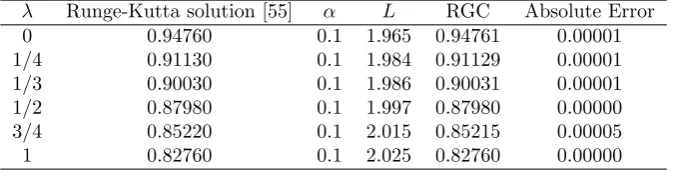
Table 1 shows a good agreement between rational Gegenbauer collocation method byN= 13 and Runge-Kutta method for f′(0) with various λ. The results for f′(0) with modified generalized Laguerre collocation method by the same N have been shown in Table 2 and comparison has been made between the Runge-Kutta solution. Absolute errors in these two tables show that the presented methods give us an approximate solution with a high degree of accuracy with the small
Ns.
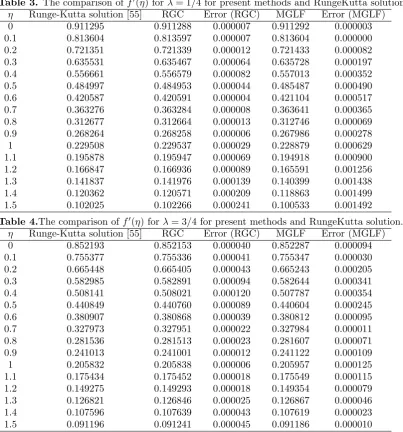
Some of the computed results for the variations withη of the functionsf′ forλ= 1/4 andλ= 3/4 are listed in Tables 3 and 4, respectively. In these Tables we compare the result of two methods together and with results presented by [55].
Table 1. Comparison of f′(0) for various λ between rational Gegenbauer collocation (RGC) method and Runge-Kutta solution.
λ Runge-Kutta solution [55] α L RGC Absolute Error 0 0.94760 0.1 1.965 0.94761 0.00001 1/4 0.91130 0.1 1.984 0.91129 0.00001 1/3 0.90030 0.1 1.986 0.90031 0.00001 1/2 0.87980 0.1 1.997 0.87980 0.00000 3/4 0.85220 0.1 2.015 0.85215 0.00005 1 0.82760 0.1 2.025 0.82760 0.00000
collocation method and Runge-Kutta solution.
λ Runge-Kutta solution [55] α L MGLF Absolute Error
0 0.94760 1 1.2985 0.94770 0.0001
1/4 0.91130 0.94869 1.2493 0.91129 0.00001
1/3 0.90030 1 1.15 0.90031 0.00001
1/2 0.87980 1 1.09 0.87933 0.00047
3/4 0.85220 0.04 1.0394 0.85229 0.00009 1 0.82760 0.655 1.115 0.82760 0.00000
Table 3. The comparison off′(η) forλ= 1/4 for present methods and RungeKutta solution.
η Runge-Kutta solution [55] RGC Error (RGC) MGLF Error (MGLF) 0 0.911295 0.911288 0.000007 0.911292 0.000003 0.1 0.813604 0.813597 0.000007 0.813604 0.000000 0.2 0.721351 0.721339 0.000012 0.721433 0.000082 0.3 0.635531 0.635467 0.000064 0.635728 0.000197 0.4 0.556661 0.556579 0.000082 0.557013 0.000352 0.5 0.484997 0.484953 0.000044 0.485487 0.000490 0.6 0.420587 0.420591 0.000004 0.421104 0.000517 0.7 0.363276 0.363284 0.000008 0.363641 0.000365 0.8 0.312677 0.312664 0.000013 0.312746 0.000069 0.9 0.268264 0.268258 0.000006 0.267986 0.000278 1 0.229508 0.229537 0.000029 0.228879 0.000629 1.1 0.195878 0.195947 0.000069 0.194918 0.000900 1.2 0.166847 0.166936 0.000089 0.165591 0.001256 1.3 0.141837 0.141976 0.000139 0.140399 0.001438 1.4 0.120362 0.120571 0.000209 0.118863 0.001499 1.5 0.102025 0.102266 0.000241 0.100533 0.001492
Table 4.The comparison off′(η) forλ= 3/4 for present methods and RungeKutta solution.
η Runge-Kutta solution [55] RGC Error (RGC) MGLF Error (MGLF) 0 0.852193 0.852153 0.000040 0.852287 0.000094 0.1 0.755377 0.755336 0.000041 0.755347 0.000030 0.2 0.665448 0.665405 0.000043 0.665243 0.000205 0.3 0.582985 0.582891 0.000094 0.582644 0.000341 0.4 0.508141 0.508021 0.000120 0.507787 0.000354 0.5 0.440849 0.440760 0.000089 0.440604 0.000245 0.6 0.380907 0.380868 0.000039 0.380812 0.000095 0.7 0.327973 0.327951 0.000022 0.327984 0.000011 0.8 0.281536 0.281513 0.000023 0.281607 0.000071 0.9 0.241013 0.241001 0.000012 0.241122 0.000109 1 0.205832 0.205838 0.000006 0.205957 0.000125 1.1 0.175434 0.175452 0.000018 0.175549 0.000115 1.2 0.149275 0.149293 0.000018 0.149354 0.000079 1.3 0.126821 0.126846 0.000025 0.126867 0.000046 1.4 0.107596 0.107639 0.000043 0.107619 0.000023 1.5 0.091196 0.091241 0.000045 0.091186 0.000010
Graphs of the approximations of f′(η) for different values of λ by rational Gegenbauer collo-cation method and modified generalized Laguerre collocollo-cation method are shown in Figs. 2 and 3, respectively. In this case we avoided comparing our solutions with the numerical solution because of having a good agreement.
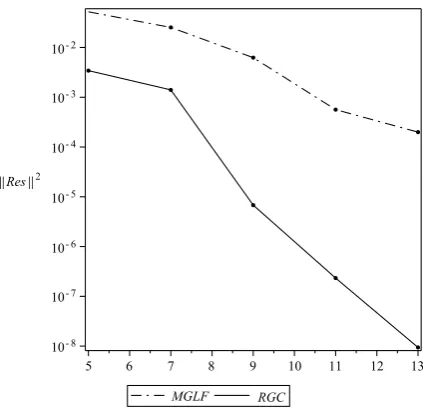
The logarithmic graphs of the∥Res∥2atλ= 1/2 for rational Gegenbauer and modified generalized
the methods. Furthermore, it shows that the accuracy level of the RGC method is higher in this problem.
Fig. 2. RGC approximation off′(η) for different valuesλ= 0,1/4,1/3,1/2,3/4 and 1.
Fig. 4. Graph of∥Res∥2 by RGCs solution and MGLFs solution.
5
Conclusions
In the above discussion, we applied the collocation method to solve three order nonlinear differ-ential equations arising from the similarity solution of inverted cone, embedded in porous medium. This method is easy to implement and yields the desired accuracy. An important concern of col-location the approach is the choice of basis functions. The basis functions have three different properties: easy computation, rapid convergence and completeness, which means that any solution can be presented to arbitrarily high accuracy by taking the truncationN to be sufficiently large. We used two set of orthogonal functions as the basis function in this method and compared the results. Through the comparisons between the Runge-Kutta solutions [55] and the current works, it was shown that the present works provided acceptable approach for this type of equations. Al-though both functions lead to more accurate results, it seems that the accuracy and rapidity of RGC method is higher than those of MGLF method in this problem.
6
Acknowledgments
The research of first author (K. Parand) was supported by a grant from Shahid Beheshti University.
References
[1] B. Alazmi, K. Vafai, Analysis of fluid ow and heat transfer interfacial conditions between a porous medium and a fluid layer, International Journal of Heat and Mass Transfer 44 (2001) 1735-1749.
[2] M. Barkhordari Ahmadi, M. Khezerloo, Fuzzy Bivariate Chebyshev Method for Solving Fuzzy Volterra-Fredholm Integral Equations, International Journal of Industrial Mathematics 3 (2011) 67-78.
[3] A. Bejan, KR. Khair, Heat and mass transfer by natural convection in a porous medium, International Journal of Heat and Mass Transfer 28 (1985) 909-918.
[5] JP. Boyd, Orthogonal rational functions on a semi-infinite interval, Journal of Computational Physics 70 (1987) 63-88.
[6] JP. Boyd, Spectral methods using rational basis functions on an infinite interval, Journal of Computational Physics 69 (1987) 112-142.
[7] JP. Boyd, The optimzation of convergence for Chebyshev polynomial methods in an un-bounded domain, Journal of Computational Physics 45 (1982) 43-79.
[8] JP. Boyd, C. Rangan, PH. Bucksbaum, Pseudospectral methods on a semi-infinite interval with application to the Hydrogen atom: a comparison of the mapped Fourier-sine method with Laguerre series and rational Chebyshev expansions, Journal of Computational Physics 188 (2003) 56-74.
[9] C. Canuto, MY. Hussaini, A. Quarteroni, TA. Zang, Spectral Methods in Fluid Dynamic, Springer-Verlag, New York, (1987).
[10] CY. Cheng, An integral approach for heat and mass transfer by natural convection from trun-cated cones in porous media with variable wall temperature and concentration, International Communications in Heat and Mass Transfer 27 (2000) 437-548.
[11] CY. Cheng, Soret and Dufour effects on natural convection heat and mass transfer from a vertical cone in a porous medium, International Communications in Heat and Mass Transfer 36 (2009) 1020-1024.
[12] P. Cheng, TT. Le, I. Pop, Natural convection of a Darcian fluid about a cone, International Communications in Heat and Mass Transfer 12 (1985) 705-717.
[13] CI. Christov, A complete orthogonal system of functions inL2(−∞,∞) space, SIAM Journal
on Applied Mathematics 42 (1982) 1337-1344.
[14] O. Coulaud, D. Funaro, O. Kavian, Laguerre spectral approximation of elliptic problems in exterior domains, Computer Methods in Applied Mechanics and Engineering 80 (1990) 451-458.
[15] D. Funaro, Computational aspects of pseudospectral Laguerre approximations, Applied Nu-merical Mathematics 6 (1990) 447-457.
[16] D. Funaro, O. Kavian, Approximation of some diffusion evolution equations in unbounded domains by Hermite functions, Mathematics of Computing 57 (1991) 597-619.
[17] G. Gasper, K. Stempak, W. Trembels, Fractional integration for Laguerre expansions, Meth-ods and Applications of Analysis 67 (1995) 67-75.
[18] D. Gottlieb, M. Y. Hussaini, S. Orszag. Theory and Applications of Spectral Methods in Spectral Methods for Partial Differential Equations edited by R. Voigt and D. Gottlieb and M.Y. Hussaini, SIAM, Philadelphia (1984).
[19] BY. Guo, Error estimation of Hermite spectral method for nonlinear partial differential equa-tions, Mathematics of Computing 68 (1999) 1067-1078.
[20] BY. Guo, Gegenbauer approximation and its applications to differential equations on the whole line, Journal of Mathematical Analysis and Applications 226 (1998) 180-206.
[21] BY. Guo, Gegenbauer approximation and its applications to differential equations with rough asymptotic behaviors at infinity, Applied Numerical Mathematics 38 (2001) 403-425.
[22] BY. Guo, Jacobi approximations in certain Hilbert spaces and their applications to singular differential equations, Journal of Mathematical Analysis and Applications 243 (2000) 373-408.
[24] BY. Guo, J. Shen, Laguerre-Galerkin method for nonlinear partial differential equations on a semi-infinite interval, Numerical Mathematik 86 (2000) 635-654.
[25] BY. Guo, J. Shen, ZQ. Wang, A rational approximation and its applications to differential equations on the half line, Journal of Scientific Computing 15 (2000) 117-147.
[26] BY. Guo, J. Shen, ZQ. Wang, Chebyshev rational spectral and pseudospectral methods on a semi-infinite interval, International Journal for Numerical Methods in Engineering 53 (2002) 65-84.
[27] BY. Guo, J. Shen, CL. Xu, Generalized Laguerre approximation and its applications to exte-rior problems, Journal of Computational Mathematics 23 (2005) 113-130.
[28] V. Iranzo, A. Falqu´es, Some spectral approximations for differential equations in unbounded domains, Computer Methods in Applied Mechanics 98 (1992) 105-126.
[29] DB. Ingham, I. Pop, Natural convection about a heated horizontal cylinder in a porous medium, The Journal of Fluid Mechanics 184 (1987) 157-181.
[30] Z. Lorkojori, N. Mikaeilvand, Two Modified Jacobi Methods for M-Matrices, International Journal of Industrial Mathematics 2 (2010) 181-187.
[31] T. Lotfi, K. Mahdiani, Fuzzy Galerkin Method for Solving Fredholm Integral Equations with Error Analysis, International Journal of Industrial Mathematics 3 (2011) 237-249.
[32] Y. Maday, B. Pernaud-Thomas, H. Vandeven, Reappraisal of Laguerre type spectral methods, Recherche Aerospatiale, La 6 (1985) 13-35.
[33] J. H. Merkin, Free convection boundary layers in a saturated porous medium with lateral mass flux, International Journal of Heat and Mass Transfer 21 (1978) 1499-1504.
[34] J. H. Merkin, Free convection boundary layers on axisymmetric and two dimensional bodies of arbitrary shape in a saturated porous medium, International Journal of Heat and Mass Transfer 22 (1979) 1461-1462.
[35] WJ. Minkowycz, P. Cheng, Free convection about a vertical cylinder embedded in a porous medium, International Journal of Heat and Mass Transfer 19 (1976) 805-813.
[36] WJ. Minkowycz, P. Cheng, Local non-similar solutions for free convective flow with uniform lateral mass flux in a porous medium, Letters in Heat and Mass Transfer 9 (1982) 159-168.
[37] WJ. Minkowycz, P. Cheng, F. Moalem, The effect of surface mass transfer on buoyancy induced Darcian flow adjacent to a horizontal heated surface. International Communications in Heat and Mass Transfer 12 (1985) 55-65.
[38] A. Nakayama, MA. Hossain, An integral treatment for combined heat and mass transfer by natural convection in a porous medium, International Journal of Heat and Mass Transfer 38 (1995) 761-765.
[39] DA. Nield, A. Bejan. Convection in Porous Media, third ed., Springer-Verlag, New York, (2006).
[40] K. Parand, S. Abbasbandy, S. Kazem, A. R. Rezaei, Comparison between two common col-location approaches based on radial basis functions for the case of heat transfer equations arising in porous medium, Communications in Nonlinear Science and Numerical Simulation 16 (2011) 1396-1407.
[41] K. Parand, M. Dehghan, A. Taghavi. Modified generalized Laguerre function Tau method for solving laminar viscous flow: The Blasius equation, International Journal of Numerical Methods for Heat and Fluid Flow 20 (2010) 728-743.
[43] K. Parand, M. Razzaghi, Rational Legendre approximation for solving some physica problems on semi-infinite intervals, Physica Scripta 69 (2004) 353-357.
[44] K. Parand, M. Shahini, Rational Chebyshev pseudospectral approach for solving Thomas-Fermi equation, Physics Letters A 373 (2009) 210-213.
[45] K. Parand, M. Shahini, M. Dehghan, Rational Legendre pseudospectral approach for solving nonlinear differential equations of Lane-Emden type, Journal of Computational Physics 228 (2009) 8830-8840.
[46] K. Parand, A. Taghavi, Rational scaled generalized Laguerre function collocation method for solving the Blasius equation, Journal of Computational and Applied Mathematics 233 (2009) 980-989.
[47] I. Pop, P. Cheng, An integral solution for free convection of a Darcian fluid about a cone with curvature effects, International Communications in Heat and Mass Transfer 13 (1986) 433-438.
[48] I. Pop, T. Y. Na, Naturnal convection of a Darcian fluid about a wavy cone, International Communications in Heat and Mass Transfer 21 (1994) 891-899.
[49] I. Pop, T. Y. Na, Natural convection over a frustum of a wavy cone in a porous medium, Mechanics Research Communications 22 (1995) 181-190.
[50] SU. Rahman, K. Mahgoub, A. Nafees, Natural Convective Mass Transfer from Upward Point-ing Conical Surfaces in Porous Media, Chemical EngineerPoint-ing Communications 194 (2007) 280-290.
[51] DAS. Rees, K. Vafai, Darcy-Brinkman Free Convection from a Heated Horizontal Surface, Numerical Heat Transfer, Part A 35 (1999) 191-204.
[52] J. Shen, Stable and efficient spectral methods in unbounded domains using Laguerre functions, SIAM Journal on Numerical Analysis 38 (2000) 1113-1133.
[53] HI. Siyyam, Laguerre tau methods for solving higher order ordinary differential equations, Journal of Computational Analysis and Applications 3 (2001) 173-182.
[54] AR. Sohouli, D. Domairry, M. Famouri, A. Mohsenzadeh, Analytical solution of natural con-vection of Darcian fluid about a vertical full cone embedded in porous media prescribed wall temperature by means of HAM, International Communications in Heat and Mass Transfer 35 (2008) 1380-1384.
[55] AR. Sohouli, M. Famouri, A. Kimiaeifar, G. Domairry, Application of homotopy analysis method for natural convection of Darcian fluid about a vertical full cone embedded in pours media prescribed surface heat flux, Communications in Nonlinear Science and Numerical Simulation 15 (2010) 1691-1699.
[56] I. Stegun, M. Abramowitz. Handbook of Mathematical Functions, Dover, New York, (1968).
[57] G. Szeg¨o. Orthogonal Polynomials, 4th edition, AMS Coll. Publ, (1975).
[58] H. Taseli, On the exact solution of the Schrodinger equation with a quartic anharmonicity, International Journal of Quantum Chemistry 63 (1996) 63-71.
[59] ZQ. Wang, BY. Guo, YN. Wu, Pseudospectral method using generalized Laguerre functions for singular problems on unbounded domains, Discrete and Continuous Dynamical Systems 11 (2009) 1019-1038.
[61] KA. Yih, Uniform transpiration effect on coupled heat and mass transfer in mixed convection about inclined surfaces in porous media: the entire regime, Acta Mechanica 132 (1999) 229-240.