ISSN: 2334-2986 (Print), 2334-2994 (Online) Copyright © The Author(s). 2014. All Rights Reserved. Published by American Research Institute for Policy Development DOI: 10.15640/jea.v2n2a13 URL: http://dx.doi.org/10.15640/jea.v2n2a13
Establishing Hazardous Waste List for a Developing Country: Palestinian Case
Study
Maher Al-Jabari1
Abstract
This paper establishes the Palestinian hazardous waste list; an essential prerequisite for setting up a hazardous waste management system. It presents the categories and items of the hazardous waste list, based on adopting the European hazardous waste system, which was customized to suite the Palestinian case. The methodology of this study is based on a descriptive approach, research tasks included desk research and literature review in addition to brainstorming discussions and meetings. Communications with regional and international experts were established for peer-review and feedback. For simplicity in application, the adopted system lists only hazardous wastes related to Palestinian current economic activities; no listing for non-hazardous waste as in the European system. The paper draws a road map for regional countries to follow for preparing their own waste list. The output list includes 7 waste categories and a total of 362 items (the hazardous wastes). Legal requirements for implementing the prepared system are summarized.
Keywords: waste, pollution, toxicology, sustainability, solid waste
Introduction
In accordance with international standards, wastes are substances or objects which are disposed of, or are intended to be disposed of, or are required to be disposed of. Hazardous waste, as a fraction of such wastes, creates threats to human health and environment.
The decision for differentiating hazardous from non-hazardous waste is usually made by legislators [1]. It is based on defining properties which render a waste hazardous (e.g. being flammable, corrosive, toxic, reactive … etc).
The characteristics for classifying waste as hazardous or non-hazardous vary throughout the world [2]. Consequently, some hazardous wastes are listed in some countries as hazardous and in others as non-hazardous. Legislators usually adopt generic hazardous waste lists including common hazardous waste types that are known to exceed minimum hazardous characteristics thresholds [2]. Radioactive wastes are usually dealt with through other regulations.
Wastes are generated from various economic activities, in solid, sludge or liquid from. Industrial gas emissions are usually treated under separate legislation for emission.
1
The types of waste generated in the West Bank and Gaza Strip include [1] include industrial, medical, agricultural, construction and demolition , municipal, and sewage sludge wastes. There are other types of wastes including wastes from scientific research and wastes from services like maintenance stations. Waste generators sometimes consider residues from production processes as by-products (that have a value) rather than waste (e.g. spent solvents, distillation residues, etc.). This emphasizes the need for a comprehensive waste definition with a detailed waste classification system. In some countries (Germany), there is a difference between "waste for recovery" and "waste for disposal". A route is established for this distinguishing between these types of wastes [2].
In the West Bank and Gaza Strip most of the hazardous waste is currently mixed with municipal solid waste and disposed mostly uncontrolled [3]. In some limited locations, it is separated from municipal waste, for some limited treatment of infectious waste (see [4]). Some companies separate their hazardous waste based on their own classification and management system and send it for treatment/disposal in "Israeli areas".
Various international systems are available for waste classifications and hazardous waste listing. These include: Basel convention for the control of trans-boundary movement of hazardous waste and their disposal [5], European waste catalogue and hazardous waste list [6], and EPA-Hazardous Waste Listings in USA [7].
This paper establishes the Palestinian Hazardous Waste List. It is a subsequent work published after two previous articles for the author [8 and 9].
1.1 Need Assessment
Article 11 of the Palestinian Environmental Law No.(7) 1999 [10] indicates that Environmental Protection Ministry (which was the Ministry before becoming EQA authority) shall issue in coordination with the competent authorities one list of hazardous materials and waste. Article 12 prevents the manufacture to store, distribute, use; treat, or dispose any hazardous substance or waste whether it is solid, liquid, or gas, unless in accordance with the orders and directives specified by the ministry in coordination with the competent agencies. EQA formulated and led a technical team that guides the preparation of this report and the resulting hazardous waste list.
The "Palestinian National Strategy for Solid Waste Management in the Palestinian Territory 2010-2014" (NHWMP) [11] constitutes the framework for all decisions, programs, and plans aiming at developing the solid waste sector in the West Bank and Gaza Strip. It aims at developing principles and mechanisms suitable for managing medical, hazardous, and special wastes. This aim includes creating appropriate inventory and tracking systems for hazardous waste, in addition to preparing and publishing a list of categories of hazardous waste. International development agencies have motivated activities and funded projects to proceed in achieving these aims. These include United Nations Environment Programme (UNEP) and German Development Agency GTZ/ GIZ.
This paper responds to the urgent need for improving the hazardous waste management situation in the West Bank and Gaza Strip, as reflected in the environmental strategy. The Environmental Quality Authority (EQA) led a technical team that followed up the preparation of this report and provided information and comments. This paper is an output of that essential work. This also responds to the needs of other regional countries through drawing a roadmap, since they did not develop their own hazardous waste list.
1.2 Literature Review
This waste composition is close to that in Jordan [12], where for example organic waste is at 55-70%, paper and cardboard at 11-17 % and plastic at 5-17 %. In "Israel", organic materials are also the main components of the waste stream, but forming smaller weight percentage at 40%, paper at 17%, cardboard 13% and plastic at 13% [13].
Solid waste and hazardous waste were identified among the major areas of environmental damage requiring urgent attention, as reported by UNEP Desk Study on the Environment in the Occupied Palestinian Territories [4]. Recent assessment of the existing situation revealed that there is an urgent need for handling hazardous waste as it poses serious negative impact on health and environment, which require urgent attention [3]. These issues are also among recent regional and international interests [1]. Extensive literature is available on classifying and managing wastes and hazardous waste, including European and American methods. A previous article for the author provided a full review of international and regional systems [8].
The Palestinian National Strategy for Solid Waste Management [11] calls for preparing a "Plan for Hazardous waste Management". In response to that, EQA in cooperation with UNEP conducted a study on hazardous waste [14], which aimed at "The Development of a National Master Plan for Hazardous Waste Management for the Palestinian National Authority (PNA)" (NHWMP), as its title indicates. It indicated that dealing with the problem of hazardous waste was still limited, despite several studies on solid waste management in the West Bank and Gaza Strip (mentioned in [14]). It highlighted that there was no system in place for inventorying or identifying hazardous wastes. The study focused on preparing an inventory of national hazardous waste; since data on quantities of hazardous waste was limited. The data in EQA study do not provide a solid base for hazardous waste system as discussed by the author in a previous publication [9]. Obviously, an efficient waste classification system is an essential prerequisite and important cornerstone for setting up a hazardous waste management system [2].
A previous paper of the author [8] reviewed and analyzes various international and regional laws, and methods for hazardous waste classifications and coding.
These include: Basel Convention, European Waste List, and USA Hazardous Waste Lists: The Basel convention is oriented mainly towards safe transport of wastes. It is not recommended as a national hazardous waste management system within a country. European approach for establishing the European Waste List (EWL) is a consistent and comprehensive classification system. The European hazardous waste lists are mainly source oriented, containing 405 hazardous waste codes marked with an asterisk, together with 434 codes for non-hazardous wastes. The American hazardous waste lists includes over 400 waste, which are mainly material (substance) oriented. The review paper [8] concluded that the European hazardous waste system provides a suitable model for Palestine to follow in preparing its waste list.
In another publication [9], the author reviewed the Palestinian legal framework and highlighted improvement and development requirements for preparing the hazardous waste lists. These are summarized in the proper place in this paper.
1.Problem Statement and Study Methodology
In order to answer this question, the study performed the following tasks:
1) Summarizing an inducted general approach for waste classification and hazardous waste listing systems. 2) Highlighting the Palestinian legal framework related to classifying waste categories and hazardous waste
listing in the West Bank and Gaza Strip.
3) Analyzing local activities that generate hazardous waste in Palestine.
4) Formulating a structure of the Palestinian hazardous waste system and creating its lists.
The mythology of the study is based on descriptive approach, utilizing the following tools and procedures: 1) Desk research and literature review activities.
2) Analysis of known systems and local laws according to descriptive approach.
3) Brainstorming discussions with official authorities represented by a formulated technical team for this project.
4) Presentations of preliminary outputs (including the recommended scope and methodologies for categorization and classification of hazardous waste) to technical team at EQA and other bodies.
5) Field visits and meetings with representatives of industry and other private sectors. 6) Communications with regional and international experts for feedback.
7) Documentation of the outputs for reviewing, modifying and then approving the recommended structure. 8) Workshop for releasing the output to stakeholders.
2. Results and Discussion
The main results of this paper are the tables of the Palestinian hazardous waste list. Selected parts of these tables are included in this paper (the link of the full list will be available on line).
In addition to that, the approach to obtain this list is an important output; it can be useful to regional countries in developing their hazardous waste system. Such approach is of special interest since reviewing the regional practices in hazardous waste listing indicated that there were no particular model to follow (the author documented this in a previous article [8]). Most of the of regional countries based their "systems" on Basel convention, which is not really valid for national purposes. It was designed in principle for controlling the transport of wastes across borders.
Creating a Ground for Hazardous Waste List
The task of establishing waste categorization system and hazardous waste lists does not have a unique approach, worldwide. A general route inducted from reviewing international systems is summarized here: Each country states or adopts environmental laws and other related regulations, that define waste, and then classify waste categorizations.
Waste legislation should address definition of waste, hazardous waste and any other related issues such classification systems. It must be adequate, coherent and enforceable within any legal system, and defines the responsible authority that is issuing the legislation [1]. Then, it defines hazardous waste based on a well-defined hazardous characteristics or properties.
Establishing an appropriate concise legal framework with clear definitions is a perquisite for establishing hazardous waste lists. The general legal requirements for hazardous waste listing systems include:
1) Sufficient Legal framework with proper and consistent definitions of waste and hazardous wastes. 2) Setting and approving hazardous characteristics
3) Approving waste classification system (e.g. based on sources/ economic sectors). 4) Choosing and approving structure of waste lists.
5) Choosing and Approval of coding system (e.g. reflecting source, phase, and properties ..etc)
Analysis of the Palestinian legal frame work by the author, [9] indicated that it is insufficient, and in some places inconsistent. These observations were made after considering all related Palestinian official documents [10, 15-19]), in addition to other official strategies and studies [8-11 and 20]. Preparing the Palestinian hazardous waste requires the followings legal efforts:
1) Redefining waste in accordance with "disposing off" concept: In the current legal framework, there
are various waste definitions: for example, in the Environmental Law [10] and in the Solid Waste Management System [16], waste (solid waste) is defined inappropriately as "non-hazardous waste", while in the Medical Waste Management System [17], waste is defined as hazardous medical waste. It also adds another expression as "normal waste [17].
Obviously, this is not in line with usual waste definitions (based on the concept of "disposing off"), and is not defined in one "independent" statement (e.g. Basel convention [5]).
2) Preparing and adopting waste classification system based on source: Currently, there are various
waste classifications: for example, there is a reasonable hint on waste classification in the Environmental Law [10] and in the Solid Waste Management System [16]. However, the Medical Waste Management System [17] provides different classifications.
3) Adopting a unique definition for hazardous waste: Currently: the hazardous waste definition refers to
undefined hazardous characteristics in the Environmental Law [10], while the Solid Waste Management System [16] does not define hazardous waste. The Medical Waste Management System [17] defines it based on "medical" hazardous characteristics.
4) Setting and adopting hazardous characteristics: Currently, Hazardous characteristics are not defined
in the Environmental Law [10], neither in the Solid Waste Management System [16]. There are two types of hazardous characteristics defined in the Medical Waste Management System [17] for "medical" wastes and for "chemical" wastes, for which it specifies the 4 known main characteristics (for chemical wastes) i.e. toxicity, flammability, reactivity, and corrosivity.
5) Designing a practical waste coding system: Currently, no coding system is available in any Palestinian
law, regulation or system.
These issues require preparing an introductory part that proceeds the hazardous waste list and meets the above requirements. Such legal introductory part shall be named "The Legal Framework for the Palestinian Hazardous Waste List". It shall include few legal articles that reflects the above requirements in addition to two annexes: listing the hazardous characteristics and hazardous limits. These annexes are adopted from equivalent parts in the European Law [6]. The scope of the Palestinian list shall be limited to hazardous wastes only. The legal introductory part shall state the exclusions from the applicability i.e. air pollution, wastewater, radioactive and medical wastes.
Palestinian Waste Classifications
Waste classification shall be based on sources i.e. activities that generate wastes. The main activities that generate waste in Palestine is the industry: types of local industries include fine industries that are mainly based on formulations and mixing, such as pharmaceutical industry, chemical manufacturing, paint manufacturing, manufacturing of textiles and food industry.
In addition to that, there are materials and fabrications such as manufacturing of ceramics and glass, manufacturing of wood, paper manufacturing (and recycling), leather industry, plastic industry, metal processing and stone cutting. Also, there are service industries such as printing and photographic industry. Other industrial common activities are dealt with separately since they belong to all types of industries. These include packaging, maintenance and electrical services.
Other Palestinian economic activities include agriculture and construction, in addition to the application of construction products. Other sources of wastes are those from oils, fuels, solvents and related materials. There are also typical municipal wastes and wastes resulting from handling and treatment of wastes and wastewater.
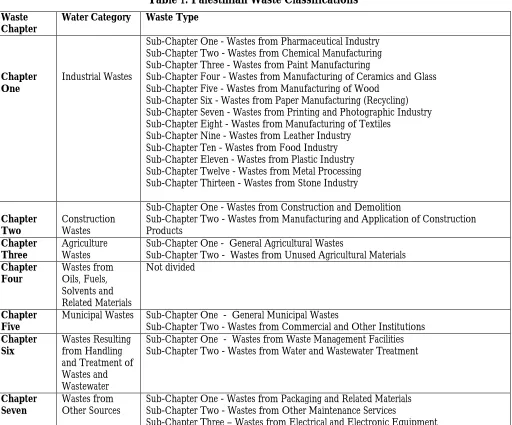
Based on this analyses of the Palestinian economic activities, wastes are classified into seven main categories , as summarized in Table 1. These categories are divided into sub-categories according to local activities. Industrial waste include the largest number of sub-categories (13), however, not all of them include hazardous waste (in the local situation).
Palestinian Hazardous Waste Listing
The hazardous waste lists are prepared in the form of 7 chapters reflecting the above 7 waste categories. Then, the chapters are divided into subchapters (representing for example industrial sub-sectors) as summarized above (Table-1). The waste lists are prepared to include only the hazardous wastes.
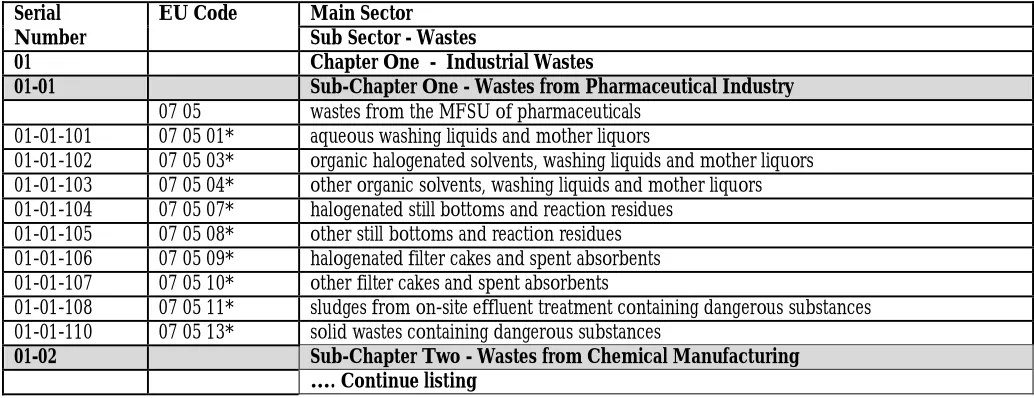
Tables 2-5 provides selected samples of the designed Palestinian hazardous waste list.
In these chapters, the hazardous wastes are described and listed based on their source. The items are comment with similar related sources in European system, but non-hazardous wastes and mirror wastes (from European system) are not listed for simplicity in the list application.
A simple Palestinian coding system is designed based on waste local source. It reflects the waste category (chapter) in the first two digits (from left), the sub-chapter (sector) in the second two digits, and the serial number in the sub-chapter starting with a number of 101. This systems helps in identifying the waste easily by knowing its code. Equivalent European codes are also listed in order to benefit from extensive literature available for European lists.
This code may be extended in future guides to include a hint/reference to waste phase and hazardous level (propriety). In this case, other letters are added to the code (e.g. S for solids, P for pastes and slurries, and L for liquids). The code may be extended to include for example Greek numbers (I, II, or III) in order to give a hint for hazardous propriety. This is important (particularly in a developing country) to set up action plans accordingly. Priorities may be identified based on some parameters like hazardous properties and wastes quantities.
The applicability of this list was tested through fields visits to local industry and through holding a workshop for stakeholders. The obtained list is really essential in raising the awareness among industry and local communities about hazardous waste. For example, leather industry is believed by community and by some officials to be as one of a producer of hazardous waste (in its solid waste containing residues of chromium).
However, this list clarifies that such waste is not hazardous since the used chromium III in leather tanning is not toxic and thus non-hazardous, although still considered to be polluting.
5 Concluding Remarks and Recommendations
The obtained Palestinian hazardous waste list includes 7 waste categories (chapters) and a total of 362 items. It meets the urgent need for official use in Palestine. European system for listing hazardous waste provides a good model to follow for developing countries after its customization to suite the local needs, and to simplify its application, in regions that have no sufficient knowledge in this field.
There are legal requirements for implementing hazardous waste listing and coding system. These are included in an introductory legal part of the list. The general recommendations for creating a ground to establish the required list include: stating sharp definitions for waste, hazardous waste and hazardous characteristics in order to eliminate any possible contradictions between various authorities and various laws.
It recommended to provide a clear definition of the scope of the list with regard to emissions to air, wastewater …etc. and regarding (by-)products.
Acknowledgment
This work was funded by Gesellschaft für Internationale Zusammenarbeit(GIZ). The author thanks Mrs. Anja Schwetje hired by GIZ as an international consultant for review and recommendations, and the Palestinian technical team lead by Eng. Marwan Yacoub from Environment Quality Authority.
References
Gesellschaft für Internationale Zusammenarbeit (GIZ), "Quick Start Guide For Competent Authorities In Low And Middle Income Economies On Hazardous Industrial Waste Management", Federal Ministry for Economic Cooperation and Development, Bonn, Germany 2/2011
Gesellschaft für Internationale Zusammenarbeit(GIZ), "Manual On Hazardous Industrial Waste Management For Low And Middle Income Economies", Federal Ministry for Economic Cooperation and Development, Bonn, Germany 2/2011
Palestinian National Authority, "Annex 2 for Reference: Evaluation of Current Situation of Solid Waste Management in Palestine (Part One and Two)", Ramallah, Palestine, October 2009.
UNEP, "Desk Study on the Environment in the Occupied Palestinian Territories", UNEP 2002.
Basel Convention Executive Secretariat, "Basel Convention on the Control of Transboundary Movements of Hazardous Wastes and Their Disposal', 11/2005
European Union, " COMMISSION DECISION of 3 May 2000 establishing a list of hazardous waste and its three amendments of 2001", 2001.
EPA, "Hazardous Waste Listings A User-Friendly Reference Document – DRAFT", USA, March 2008
Maher Al-Jabari, "Comparative Study of International and Regional Systems for Hazardous Waste Listing", International Journal of the Environment and Water, accepted.
Maher Al-Jabari, Analysis of Palestinian Laws and Systems within the Context of Preparing the Palestinian Hazardous Waste List, The Jordan Journal of Earth and Environmental Sciences, submitted.
Palestinian National Authority, "The National Strategy for Solid Waste Management in The Palestinian Territory 2010-2014". Ramallah, Palestine, May 2010.
International Business Legal Associates, "Solid waste Management: An Overview of the Legal Status in Jordan", 10/2004
Ministry Of Environmental Protection, "Environmental Policy And Institutional Framework Of Israel Brief Note To The Environment Policy Committee (OECD)", "Israel", December 2008
Amer EL-Hamouz, "The Development of a National Master Plan for Hazardous Waste Management for the Palestinian National Authority (PNA)", UNEP, Ramallah, Palestine, 21-10-2010
Environmental Quality Authority, "Regulations for Management and Handling Solid Waste", a draft copy issued by EQA (2004), Gaza, 2004 (obtained from G|aza EPA June 2011, from official website
http://www.environment.gov.ps/detailsezdar.php?id=24
Environmental Quality Authority, "Solid Waste Management System", a draft copy issued by EQA, Ramallah, 2010. Ministry of Health and Environmental Quality Authority, "Medical Waste Management and handling System", a draft
copy issued by EQA, Ramallah, 2010.
Palestinian National Authority, "Public Health Law, No.(20), 2004", Ramallah, Palestine, October 2004. Ministry of Environmental Affairs, "Environmental Management", Palestine, June 2000.
Environmental Quality Authority, "Environmental Sector Strategy", Ramallah, March 2010.
Table 1: Palestinian Waste Classifications Waste
Chapter
Water Category Waste Type
Chapter One
Industrial Wastes
Sub-Chapter One - Wastes from Pharmaceutical Industry Sub-Chapter Two - Wastes from Chemical Manufacturing Sub-Chapter Three - Wastes from Paint Manufacturing
Sub-Chapter Four - Wastes from Manufacturing of Ceramics and Glass Sub-Chapter Five - Wastes from Manufacturing of Wood
Sub-Chapter Six - Wastes from Paper Manufacturing (Recycling) Sub-Chapter Seven - Wastes from Printing and Photographic Industry Sub-Chapter Eight - Wastes from Manufacturing of Textiles
Sub-Chapter Nine - Wastes from Leather Industry Sub-Chapter Ten - Wastes from Food Industry Sub-Chapter Eleven - Wastes from Plastic Industry Sub-Chapter Twelve - Wastes from Metal Processing Sub-Chapter Thirteen - Wastes from Stone Industry
Chapter Two
Construction Wastes
Sub-Chapter One - Wastes from Construction and Demolition
Sub-Chapter Two - Wastes from Manufacturing and Application of Construction Products
Chapter Three
Agriculture Wastes
Sub-Chapter One - General Agricultural Wastes
Sub-Chapter Two - Wastes from Unused Agricultural Materials
Chapter Four Wastes from Oils, Fuels, Solvents and Related Materials Not divided Chapter Five
Municipal Wastes Sub-Chapter One - General Municipal Wastes
Sub-Chapter Two - Wastes from Commercial and Other Institutions
Chapter Six
Wastes Resulting from Handling and Treatment of Wastes and Wastewater
Sub-Chapter One - Wastes from Waste Management Facilities Sub-Chapter Two - Wastes from Water and Wastewater Treatment
Chapter Seven
Wastes from Other Sources
Sub-Chapter One - Wastes from Packaging and Related Materials Sub-Chapter Two - Wastes from Other Maintenance Services
Table 2: Sample Part of Industrial Wastes in the Palestinian Hazardous Waste List, for Wastes from Pharmaceutical Industry
Serial EU Code Main Sector
Number Sub Sector - Wastes
01 Chapter One - Industrial Wastes
01-01 Sub-Chapter One - Wastes from Pharmaceutical Industry
07 05 wastes from the MFSU of pharmaceuticals
01-01-101 07 05 01* aqueous washing liquids and mother liquors
01-01-102 07 05 03* organic halogenated solvents, washing liquids and mother liquors
01-01-103 07 05 04* other organic solvents, washing liquids and mother liquors
01-01-104 07 05 07* halogenated still bottoms and reaction residues
01-01-105 07 05 08* other still bottoms and reaction residues
01-01-106 07 05 09* halogenated filter cakes and spent absorbents
01-01-107 07 05 10* other filter cakes and spent absorbents
01-01-108 07 05 11* sludges from on-site effluent treatment containing dangerous substances
01-01-110 07 05 13* solid wastes containing dangerous substances
01-02 Sub-Chapter Two - Wastes from Chemical Manufacturing
…. Continue listing
Table 3: Examples of local Palestinian Sources that do not Generate Hazardous Waste as in the Palestinian Hazardous Waste List
Serial EU Code Main Sector
Number Sub Sector - Wastes
01 Chapter One - Industrial Wastes
…..
01-06 Sub-Chapter Six - Wastes from Paper Manufacturing (Recycling)
No hazardous waste
01-10 Sub-Chapter Ten - Wastes from Food Industry