[Alias* 5(4): April, 2018] ISSN 2349-4506
Impact Factor: 3.799
G
lobal
J
ournal of
E
ngineering
S
cience and
R
esearch
M
anagement
OPTIMISATION FREQUENCY DESIGN OF EDDY CURRENT TESTING IN
TITANIUM AND NICKEL METAL WITH DIFFERENCE THICKNESS
Elya Alias*, Fauziah Sulaiman, Abu Bakar Abdul Rahman
* Physics with Electronics Program, Faculty Science and Natural Resources, Universiti Malaysia Sabah,Jalan UMS, 88400 Kota Kinabalu
DOI: 10.5281/zenodo.1222130
KEYWORDS
:
Nondestructive Test of Metal Imperfection of Titanium (Ti) Metal.ABSTRACT
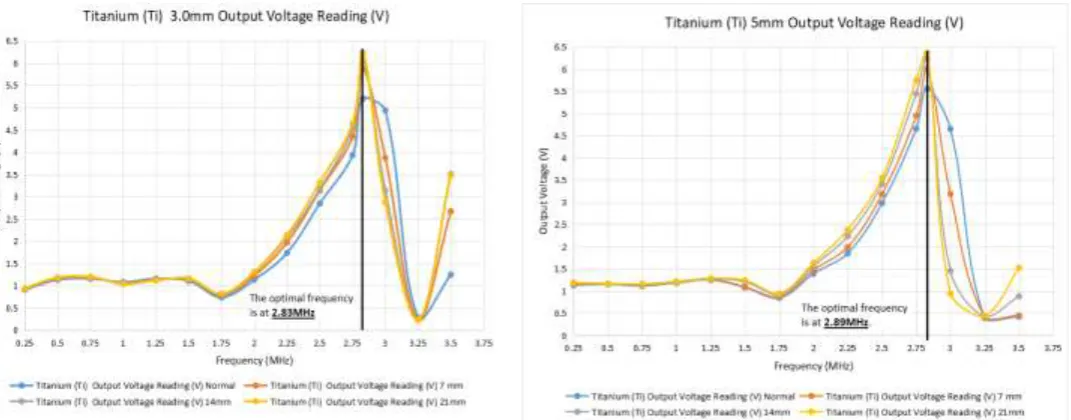
This paper is to find the optimisation frequency for designed non-destructive testing (NDT) metal instrument. The testing technique is Eddy Current Technique (ECT), where Titanium (Ti) and Nickel (Ni) metals in 100mm X 100mm and with different type of thickness (1.5mm, 3mm and 5mm) dimension were chosen as the metal testing. Three different kind of thickness in each metal were tested to identified the optimal frequency for the instrument with identical artificial defect that constructed on the metal testing. The input frequencies were ranged between 250kHz - 3.5MHz and a dual-sensors were designed and established to gather the output. The output signals of the voltage of testing from the sensor circuit then compared to analyse the optimal of range frequency for the testing instrument. The result of this research showed that the nondestructive metal testing instrument of dual-sensor by using eddy current method can be used to find different defect for Titanium (Ti) and Nickel (Ni) metal. The optimal frequencies for Titanium was 2.83MHz and Nickel was 2.85MHz. The categorisation of thickness on metal for the eddy current testing instrument is suitable at 2.83MHz for Titanium and 2.85MHz which are also known as optimal frequency.
INTRODUCTION
Eddy current technique is an important electromagnetic non-destructive evaluation technique that is widely used in many industries for detection of surface cracks and corrosion in components made of metallic materials.1 One reason for this is that general purposes, user-friendly eddy current instruments are a relatively
recent phenomenon.2 There are some advantages on using eddy currents for NDT purposes. It quick, simple,
and reliable inspection technique to detect surface and near-surface defects also can be used to perform several tasks like thickness measurements, corrosion valuation electrical and magnetic permeability measurements.3
There is no need for consumables and the inspection surface preparation is minimal and results are drawn immediately.
Eddy current could be made by high frequency magnetic field. The magnetic field happens when high frequency alternating current enters primary or transmitter coil.4 In case there is continuous space inside the
test material, the eddy current will be higher. The eddy current will be lower if there are no continuous space inside the test material.5 This different could be used to measure the continuity of the test material by using
eddy current.
In this method, the current in the coil that constitute the probe induces eddy currents in the test material based on the basic principle of electromagnetic induction.6 When a crack interrupts the eddy current flow the result
is change of the coil impedance, by measuring these impedance changes or by measuring a resultant magnetic field using a coil sensor it is possible to detect the cracks in the test material.
[Alias* 5(4): April, 2018] ISSN 2349-4506
Impact Factor: 3.799
G
lobal
J
ournal of
E
ngineering
S
cience and
R
esearch
M
anagement
PROPOSED ANALYSIS AND DESIGN
To obtain optimum frequency by testing the imperfections along with some of the selected metal. In this research, Titanium (Ti) and Nickel (Ni) will be tested for imperfections with the artificial defect of 7mm, 14mm and 21mm that cover the 1.5, 3 and 5mm thickness of the metal.
In designing the metal testing instrument, the coil sensor need to design first. It is widely known that in order to improve the sensitivity of the coil should have large number of turns and large active area.7 In this research
the turn number of coil of the sensor and the diameter of the sensor is emphasized with the total of 100 turns of excitation coils while receiver coil has 80 turns and diameter in 2 cm width. In this experiment two sensors has been used which are called as excitation and receiver coil.8 The Figure 2.1 shows the sensor design of
excitation-receiver sensor.
Figure 2.1 The excitation-receiver sensor. Figure 2.2 The schematic circuit of instrument amplifier.
The induction coil sensor also known as coil sensor is one of the oldest and well-known magnetic sensors. Its transfer function V = f(B) results from the fundamental Faraday’s law of induction
(1)
where Φ is the magnetic flux passing through a coil with an area A and a number of turns n.9 Inductive coil will use an
electrical load. Electrical current which runs through coil would induct because magnetic lines of force took place inside inductive coil.10 Voltage drop for inductive
coil from circuit could be calculated by the following equation : (2)
When sensor circuit is used to test imperfection of metal, sensor circuit will be brought closer to metal. The inductance value of the coil would change. This change is due to various reasons like metal type, size of imperfection, distance and oscillator frequency.11 Thus, inductance value of sensor changed differently. The
function generator is the most suitable for finding the optimisation frequency.12 The function generators are
very versatile instruments as they are capable of producing a wide variety of waveform and frequencies.13In
order to make the design more accurate the instrument amplifier was designed. Instrumentation amps excel at extracting very weak signals from noisy environments. Thus, they are often used in circuits that employ sensors that take measurements of physical parameters. It has high gain electronic voltage amplifier with differential input and, usually, a single-ended output. The output voltage is many times higher than the voltage difference between input terminals.14 It has a specific role in circuits needing the advantages of high input
impedance with good gain while providing common mode noise rejection and fully differential inputs. Figure 2.2 shows the schematic circuit of the instrument amplifier.
dt dH A n dt
dB A n dt d n
V . . . 0. . .
[Alias* 5(4): April, 2018] ISSN 2349-4506
Impact Factor: 3.799
G
lobal
J
ournal of
E
ngineering
S
cience and
R
esearch
M
anagement
types of metal such brass, copper and magnesium alloy, multimeter, DC/AC power supply and the instrument amplifier.
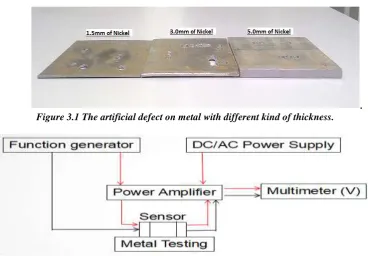
In this research, Titanium (Ti) and Nickel (Ni) with the dimension of 100mm x 100mm will be tested for imperfections that cover three (3) various thickness (1.5, 3 and 5mm) of the metal. Each metal has been made the same diameter and depth of defect. The diameter of imperfection is 7mm,14mm and 21mm in each of metals. Figure 3.1 shows the artificial defect and different type of thickness on the Nickel (Ni) metal.
The function generator will be connected with the exciter coil with frequency signal range between 250kHz to 3.5MHz. The pulsed excitation causes a rapid change in the surrounding magnetic field, this in turn induces eddy currents in the test piece being assessed. The block diagram of the testing instrument is shown in figure 3.2.
. Figure 3.1 The artificial defect on metal with different kind of thickness.
Figure 3.2 The block diagram of testing instrument.
EXPERIMENTAL RESULT
The result for this experiment in metal testing instrument for imperfection metal by using eddy current method. Sample of Ti and Ni of the thickness (1.5mm, 3mm and 5mm) had been drilled with different of width on the surface (7mm, 14mm and 21mm). The frequency used was between 250kHz– 3.5MHz and then the output signals were plotted in a graph to compare the differences of imperfection. Mengbao Fan proposed that the suitable frequency range about 50kHz to 6MHz.15
Results for Nondestructive Test of Metal Imperfection of Titanium (Ti) Metal.
[Alias* 5(4): April, 2018] ISSN 2349-4506
Impact Factor: 3.799
G
lobal
J
ournal of
E
ngineering
S
cience and
R
esearch
M
anagement
Figure 4.1 The output voltage imperfection of Ti (1.5mm).
Figure 4.2 The output voltage imperfection of Ti (3mm). Figure 4.3 The output voltage imperfection of Ti (5mm).
[Alias* 5(4): April, 2018] ISSN 2349-4506
Impact Factor: 3.799
G
lobal
J
ournal of
E
ngineering
S
cience and
R
esearch
M
anagement
Figure 4.4 The output signal on the frequency of 2.5MHz. Figure 4.5 The output signal on the frequency of 2.83MHz.
Results for Nondestructive Test of Metal Imperfection of Nickel (Ni) Metal.
From Figure 4.6, 4.7 and 4.8 shows that the reading for the metal imperfection experiment with all the three different thickness shows that optimum frequency for the Ni metal is at 2.85MHz.
Figure 4.6 The output voltage imperfection of Ni on 1.5mm.
2 2.5 3 3.5 4
0 1 2 3 4 5 6
O
u
tp
u
t
V
o
ltag
e (
V
)
Thickeness of metal (mm) Thickness Reading of Ti at 2.5MHz
Titanium (Ti) Output Voltage Reading (V) Normal Titanium (Ti) Output Voltage Reading (V) 7 mm Titanium (Ti) Output Voltage Reading (V) 14mm Titanium (Ti) Output Voltage Reading (V) 21mm
5 5.5 6 6.5 7
0 2 4 6
O
u
tp
u
t
V
o
ltag
e (
V
)
Thickeness of metal (mm) Thickness Reading of Ti at 2.83MHz
[Alias* 5(4): April, 2018] ISSN 2349-4506
Impact Factor: 3.799
G
lobal
J
ournal of
E
ngineering
S
cience and
R
esearch
M
anagement
Figure 4.7 The output voltage imperfection of Ni (3mm). Figure 4.8 The output voltage imperfection of Ni (5mm).
Then next was the nondestructive testing for finding the thickness of the Ni metal by using eddy current method. From the Figure 4.9 shows the output signal take on the frequency of 2.5MHz and 4.10 shows the output signals take on the frequency of 2.85MHz as known as the optimisation for the Ni metal for this metal instrument.
Figure 4.9 The output signal on the frequency
5 5.3 5.6 5.9 6.2 6.5
0 2 4 6
O
ut
pu
t
Vo
lt
ag
e (
V)
Thickeness of metal (mm)
Thickness Reading of Ni at 2.85MHz
Nickel (Ni) Output Voltage Reading (V) Normal Nickel (Ni) Output Voltage Reading (V) 7 mm Nickel (Ni) Output Voltage Reading (V) 14mm Nickel (Ni) Output Voltage Reading (V) 21mm 2.3
2.6 2.9 3.2 3.5
0 1 2 3 4 5 6
O
u
tp
u
t
V
o
ltag
e (
V
)
Thickeness of metal (mm)
Thickness Reading of Ni at 2.5MHz
Nickel (Ni) Output Voltage Reading (V) Normal
Nickel (Ni) Output Voltage Reading (V) 7 mm
Nickel (Ni) Output Voltage Reading (V) 14mm
[Alias* 5(4): April, 2018] ISSN 2349-4506
Impact Factor: 3.799
G
lobal
J
ournal of
E
ngineering
S
cience and
R
esearch
M
anagement
defects at a single frequency. We also note that output voltage signals change significantly after reach of the peak, and decrease slightly afterwards also the reading became unstable.
CONCLUSION
As a conclusion, this research has developed and established an optimal frequency in strengthen the metal testing instrument that has been designed by using eddy current method. First is by test the imperfection of the defect on two types of metal by using frequency around 250 kHz to 3.5 MHz which is Titanium (Ti) that was found at 2.83MHz is the optimal frequency and Nickel (Ni) is at 2.85MHz. Secondly, the test of three different types of thickness (1.5mm, 3mm and 5mm) by using Titanium (Ti) and Nickel (Ni) metals also by using frequency around 250 kHz to 3.5 MHz. It was found that the optimal frequency for categorise thickness of the Titanium is at 2.83MHz and Nickel is at 2.85MHz the most obvious output voltage that stated the more thicker the metal the less sensitive of the output voltage reading and it was suitable for this kind of test. It is hope that it will contribute to an improvement of eddy current technique of metal testing and can be used in industrial inspection to avoid accidents and any misfortune.
ACKNOWLEDGMENTS
This work was supported in part by UMSGreat Grant: GUG0018-SG-M1/2016. and SBK Grant:0280-SG-2016.
REFERENCES
1. T. J. Rocha, H. G. Ramos, A. L. Ribeiro, D. J. Pasadas, C. S. Angani. Studies to Optimize the Probe Response for Velocity Induced Eddy Current Testing in Aluminium,Measurement 67, 108-115
(2015).
2. M. Fan, Q. Wang, B. Cao, B. Ye, A. I. Sunny and G. Tian. Frequency Optimization for Enhancement of Surface Defect Classification Using the Eddy Current Technique, 16, 649 (2016).
3. J.García-Martín, J. Gómez-Gil and E. Vázquez-Sánchez. review paper Non-Destructive Techniques Based on Eddy Current Testing, 11, 2525-2565 (2011).
4. G.Betta, L.Ferrigno, M.Laracca, P. Burrascano, M. Ricci and G. Silipigni. An experimental comparison of multi-frequency and chirp excitations for eddy current testing on thin defects, Vol 4, No1, 128–134 (2015).
5. H.T. Zhou, K. Hou, H.L. Pan, J.J. Chen, and Q.M. Wang. Study on the Optimization of Eddy Current Testing Coil and the Defect Detection Sensitivity, 130, 1649-1657(2015).
6. N.Dholu, J. R. Nagel, D. Cohrs and R. K. Rajamani. Eddy Current Separation of Nonferrous Metals Using a Variable-Frequency Electromagnet, 34, 241-247 (2017).
7. S.Tumanski. Induction Coil Sensors – a Review, Meas. Sci. Technol. 18 , R31–R46 (2007). 8. D. Pereira and T. G. R. Clarke. Modeling and Design Optimization of an Eddy Current Sensor for
Superficial and Subsuperficial Crack Detection in Inconel Claddings, IEEE Sensors Journal, Volume: 15, Issue: 2, 1287 - 1292 (2015).
9. S. Tumanski. Induction Coil Sensors – a Review, Meas. Sci. Technol. 18 , R31–R46 (2007). 10. N. Mungkung, K. Chomsuwan, N. Pimpru, and T.Yuji. Optimization Frequency Design of Eddy
Current Testing, ELECTROSCIENCE'07 Proceedings of the 5th conference on Applied electromagnetics, wireless and optical communications, 127-131 (2007).
11. L.Dziczkowski. Effect of Eddy Current Frequency on Measuring Properties of Devices used in Non-Destructive Measurement of Non-Ferromagnetic Metal Plates,Volume 32 Issue 2, 77-84 (2008). 12. R. S. Kushwah. Function Generator, http://ei-notes. blogspot.my/2012/03/function-generator.html,
(2012).
13. A. H. Tirmare, S. R. Mohite, P.S. Mali, Mrs V.A.Suryavanshi. FPGA Based Function Generator,
(2015).
14. FM Yasin, MT Yap, MBI Reaz - Proc. of 5th WSEAS,CMOS instrumentation amplifier with offset cancellation circuitry for biomedical applications,258 (2006).
[Alias* 5(4): April, 2018] ISSN 2349-4506
Impact Factor: 3.799
G
lobal
J
ournal of
E
ngineering
S
cience and
R
esearch
M
anagement
16. N. Mungkung, K. Chomsuwan, N. Pimpru, and T.Yuji. Optimization Frequency Design of Eddy Current Testing, ELECTROSCIENCE'07 Proceedings of the 5th conference on Applied electromagnetics, wireless and optical communications, 127-131 (2007).
17. Z. Sun, D. Cai, C. Zou, W. Zhang and Q. Chen.A Flexible Arrayed Eddy Current Sensor for Inspection of Hollow Axle Inner Surfaces,16, 952 (2016).