A
zero
one
programming
model
for
RNA
structures
with
arc
length
≥
4
G.H.SHIRDEL AND N.KAHKESHANI
Department of Mathematics, Faculty of Basic Sciences, University of Qom, Qom, Iran
(Received August 1, 2012)
A
BSTRACTIn this paper, we consider RNA structures with arc-length4. First, we represent these structures as matrix models and zero-one linearprogramming problems. Then, we obtain an optimal solution for this problemusing an implicit enumeration method. The optimal solution corresponds toan RNA structure with the maximum number of hydrogen bonds.
Keywords: RNA structure,zero-one linear programming problem, additive algorithm.
1.
I
NTRODUCTIONA problem in mathematical biology is enumeration of RNA structures. The RNAhas an important role within cells and also, its functions depend on the structure of theRNA molecules. Hence, understanding of its helical configuration is important. TheRNA molecule is a sequence of four nucleotides A, C, G and U which plays an importantrole in Biological reactions. These nucleotides are connected to each other via hydrogenbonds. The formation of these bonds stabilizes the molecule by lowering its free energy[2]. The RNA structures can be displayed in various ways such as tree, linear encodingof tree, coarse grained representation, homeomorphically irreducible tree and diagram[3, 4]. In this paper, we represent another two models for RNA structures. Accordingto [4], the diagram representation is defined as following:
Let ( , )
n n G
G
n V E
G be a directed graph such that
1, ,
and
(, )|1
. ][n n E i j i j n
V
n
n G
G
n
G V and
n
G
E are called the sets of vertices and arcs, respectively. Each directed graphcan be
hydrogen bonds, respectively. We attribute two parameters to the diagrams: the minimum arc-length, , the minimum stack-length, . In diagram representation, the length of an arc
) ,
(i j is ji and a stack of length is a sequence of the parallel arcs like
))) 1 ( ), 1 ( ( , ), 1 , 1 ( ), ,
((i j i j i j , see Figure 1. We denote the number of RNA structures with 4 and 1 over [n] by S4,1(n).
Figure1. RNA Structure with 4, 2.
The remainder of this paper is organized as follows. In sections 2 and 3, we represent RNA structures with arc-length 4and stack-length 1 as matrix models and zero-one linear programming problems, respectively. Also, we express the results forenumeration of RNA structures. In section 4, we use the additive algorithm for solving linear programming problems with binary variables only [1]. The general notion of the additivealgorithm is based on testing a few number of possible solutions, m
2 (in which m is thenumber of variables), of a problem instead of all solutions. In other words, through thismethod, some of the possible solutions of the problem are left unexamined. Also,the zero-one linear programming problems can be solved using each of the generalinteger programming techniques. Finally, conclusions and future works are discussed insection 5.
2.
M
ATRIXM
ODELSEach RNA structure over [n], Gn, corresponds to a nn matrix. We display this matrix by M(Gn)[mij] such that
Theorem 1. Suppose Gn is an RNA structure with arc-length 4over [n]. Then we have
22 21
12 11
) (
A A
A A G
M n (1)
whereA110(n4)4, A21044, A22 04(n4) and A12is the (n4)(n4)upper triangular
matrix.
. )
, ( 0
) , ( 1
n n
G G ij
E j i if
E j i if m
1 2 3 4 5 6 7 8 9 10 11 12
Proof. For all (i,j), where i j,
n
G E j i, )
( . Therefore,M(Gn) is an upper triangular
matrix. Since Gn is a directed graph with arc length 4, we have(i,j)EGnand mij 0
for all (i,j), where ji3. Therefore, three diagonals above theprincipal diagonal are
zero. Then, the matrixM(Gn) is of the form (1).
We now write the upper triangular matrix A12 as follows:
Theorem 2. S4,1(n)is equal to the number of situations in which the entries aboveand on
the principal diagonal in A12can be equal to 1 such that for each 1in4and 5 jn,
at most one of the entries
mi(i4),,min,mj(j4),,mjn,m1i,,m(n4)i,m1j,,m(n4)j
be 1.
Proof. LetGnis an RNA structure with arc-length 4over [n]. The degree of each vertex
n
G is at most 1. Therefore, each row and column A12 is0 or ek, where1kn4.
Suppose that there exist 1in4 and 5 jnso that mij 1. Then
n
G E j i, )
( . Since
the degree of each vertexGn is at most 1,we have
n
G E h i i
k, ),(, )
( for each kiand hi,
where h j. Similarly, we have
n
G E j k h
j, ),( , )
( for each h jand k j, where ki.
This completes our argument.
3.
Z
ERO-
ONEL
INEARP
ROGRAMMINGP
ROBLEMSHere, we present a zero-one linear programming problem for displaying of RNA structures with arc-length 4 and stack-length 1 .Since each row of the matrixA12is 0 or ek, where
4
1kn , we have the following constraints:
n n
n n
m m m
m m
m
) 4 (
2 26
1 16
15
0 0 0
1 1 1 1 1 ) ( 1 1 1 1 ) ( ) 4 ( ) 5 ( ) 1 )( 5 ( ) 6 ( ) 1 )( 6 ( ) 2 )( 6 ( ) 7 ( ) 3 )( 7 ( 5 59 4 48 3 37 2 27 26 1 17 16 15 n n n n n n n n n n n n n n n n n n n n n x x x x x x x x x x b x x x x x x x x x x x a
Similarly, since each column of matrix A12is 0 or ek, where 1kn4, we have the
following constraints:
1 1 1 1 1 1 1 ) ( ) 4 ( ) 4 )( 8 ( ) 4 ( 2 ) 4 ( 1 ) 5 ( ) 1 )( 5 ( ) 5 )( 9 ( ) 5 ( 2 ) 5 ( 1 ) 6 ( ) 1 )( 6 ( ) 2 )( 6 ( ) 6 )( 10 ( ) 6 ( 2 ) 6 ( 1 8 ) 13 ( 8 ) 12 ( 8 48 38 28 18 7 ) 12 ( 7 ) 11 ( 7 37 27 17 6 ) 11 ( 6 ) 10 ( 6 26 16 5 ) 10 ( 5 59 15 n n n n n n n n n n n n n n n n n n n n n n n n n n n n x x x x x x x x x x x x x x x x x x x x x x x x x x x x x x x x x x x x x e
Based on the following lemma, some of the constraints are extra and they can beomitted.
Lemma 1. Let S
x|Axb,x0
, where A is a mn matrix with rank m and mbR .
Let two constraints
i j k k k i
k b x x x x b
x
x1 and 1 1
belong to the set of constraints Axb. Then the constraintx1xk biis extra.
Proof. Suppose that S be the feasible region after deleting the constraint x1xk bi. Let the constraintx1xk bi isn't extra. ThenSS. Let
S x x, , n)
( 1 and(x1,,xn)S. Therefore,
.
and 1 1
1 xk bi x xk xk xk j bi
x
Introducing the slack variables y0and z0, we have the following constraints in standard form:
.
and 1 1
1 xk z bi x xk xk xk j y bi
x Therefore,
(3)
On the other hand,
, 0 1
x y z
xk k j (4) .
0 1
Since xk1,,xkj,y0and z0. But, this is a contradiction. Then SS.
According to Lemma 1, the constraints (b)and (c)are extra. Therefore, we can delete them. Now, we define the Problem A as follows:
Problem A:
E j i x
n j
x x
n n n n j x
i x
t s
x Max
ij
n
j i
ji j
i ij j
i ij n
i j
ij E j i
ij
) , ( 1
, 0
4 , , 6 , 5 1
, 1 , 2 , 3 1
4 , 3 , 2 , 1 1
. .
4 4
1 4
1 4 ) , (
where E
(i,j)| ji4
.The number of variables and constraints of the Problem A has been presented inTable 1.
Theorem 3. S4,1(n)is equal to the number of feasible solutions of the Problem A. Also,
thenumber of optimal solutions of the Problem A is equal to the number of RNA structures with arc length 4 and maximum number of arcs over [n].
Proof. The Problem A is written on the basis of the matrix model (1). Therefore, Theorem 2 guarantees that S4,1(n) is equal to the number of feasible solutions. Sincethe objective
function is equal to the sum of the variables and the Problem A is themaximization problem, then among the feasible solutions, the optimal solution belongs to the one in which the maximum number of xijvariables would be equal to 1. So, the optimal solution
has maximum number of arcs over [n].
4.
U
SINGA
DDITIVEA
LGORITHM FORS
OLVING THEP
ROBLEMA
1. Its objective function should be in the form of minimization. 2. The coefficients of the objective function should be nonnegative. 3. All the constraints must be of the type.
Table 1.The Number of Variables and Constraints of the Problem A.
n 6 7 8 9 10 11 n12
The number of variables 3 6 10 15 21 28 8n60 The number of
constraints
2 4 6 9 10 11 n
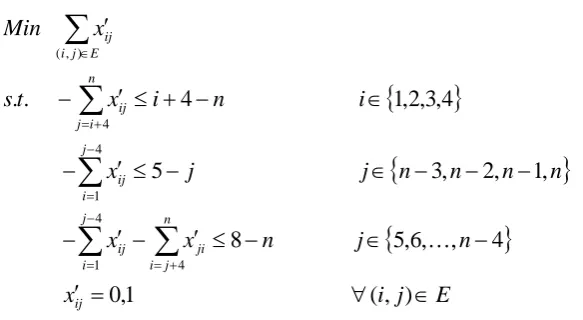
Bysetting xij 1xij, the Problem A is converted into the following problem:
Problem B:
E j i x
n j
n x
x
n n n n j j
x
i n
i x t
s
x Min
ij
n
j i
ji j
i ij j
i ij n
i j
ij E j i
ij
) , ( 1
, 0
4 , , 6 , 5 8
, 1 , 2 , 3 5
4 , 3 , 2 , 1 4
. .
4 4
1 4
1 4 ) , (
Now, we can apply the additive algorithm for solving the Problem B. In Table 2, we list the optimal solutions for n6,,10.
Example 1. For n = 7, the problems A is as follows:
0 , , , , ,
1 1
1 1 .
.
37 27 26 17 16 15
37 27 17
26 16
27 26
17 16 15
37 27 26 17 16 15
x x x x x x
x x x
x x
x x
x x x t
s
x x x x x x z Max
. 3 , 1 ,
0 15 26 37 *
27 17
16 x x x x x z
x
This solution is corresponding to the RNA structure which is shown in Figure 2.
Figure 2. Optimal Structure for n7.
The matrix model of this optimal structure is as follows:
Table2. The Optimal Solutions of the Problem A, for n6,,10.
n Optimal solution Optimal solution
value
6 1, 0
16 26
15 x x
x 2
7 1, 0
27 17 16 37
26
15 x x x x x
x 3 8 0 , 1 38 28 27 18 17 16 48 37 26 15 x x x x x x x x x x 4 9 0 , 0 , 1 49 39 38 29 28 27 26 19 18 17 15 59 48 37 16 x x x x x x x x x x x x x x x 4 10 0 , 0 , 0 , 1 ) 10 ( 5 ) 10 ( 4 ) 10 ( 3 ) 10 ( 2 ) 10 ( 1 59 48 39 37 29 28 26 19 18 17 16 ) 10 ( 6 49 38 27 15 x x x x x x x x x x x x x x x x x x x x x 5 0 0 0 0 0 0 0 0 0 0 0 0 0 0 0 0 0 0 0 0 0 0 0 0 0 0 0 0 1 0 0 0 0 0 0 0 1 0 0 0 0 0 0 0 1 0 0 0 0
1 2 3 4 5 6 7
5.
C
ONCLUSIONPoolsap et al. in [5] represented an integer programming problem for the RNA structures. Their model is complicated with many variables. But, in here, we represented another programming problem for the RNAstructures such that the number of variables is lessthan the number of variables in [5]. The optimal RNA structure obtained by solving this problem is of arc-length 4 and has the maximum number of hydrogen bonds. Inother words, formation of these bonds stabilizes the structure by lowering its free energy over [n].If the enumeration of the feasible solutions of the zero-one linear programming problem is possible, then we are able to enumerate the RNA structures with arc-length 4over
]
[n .also, in this case, the number of optimal solutions will be equal to the number of optimal RNA structures. Therefore, a future work can be the enumeration of the RNA structures using matrix and linear programming models.
R
EFERENCES1. E. Balas, An additive algorithm for solving linear programs with zero-one variables, Operations Research, Vol. 13, No. 4 (1965) 517546.
2. R. T. Batey, R. P. Rambo, J. A. Doudna, Tertiary motifs in RNA structure and folding, Angew. Chem. Int. Ed. 38 (1999) 23262343.
3. I. L. Hofacker, P. schuster, P. F. Stadler, Combinatorics of RNA secondary structures, Discrete Appl. Math. 88 (1998) 207237.
4. E. Y. Jin, C. M. Reidys, Combinatorial design of pseudo knot RNA, Adv. Appl. Math. 42 (2009) 135151.