Evaluation of Cross-Platform Application Development Tools
Sanjay Kumar
Ph.D. Student, Applied Computer Science, Himalayan University, Chimpu, Near Arunachal Pradesh Forest Corporation, Guest House, Gohpur Tinali, Itanagar, Papumpare, Arunachal Pradesh 791111. Email: [email protected]
Article Received: 12 June 2018 Article Accepted: 24 October 2018 Article Published: 30 December 2018
1.INTRODUCTION
The Mobile technologies have become very important part of people’s life. Now a days, people use different- different mobile applications everyday: apps for health, transportation, shopping and many other purposes. Smartphone is as popular as regular mobile phones were five years ago. So many of smartphone and tablet users is increasing, and so is the need for efficient mobile application technologies. Here the tendency has forced companies to develop mobile applications in order to follow current market standards and satisfy customers.
However, there is a number of obstacles that companies need to address. One of these obstacles is development for an increasing number of mobile platforms, for example: An-droid, iOS, BlackBerry, Windows Phone, Windows Mobile and Symbian OS. To develop a different app for each platform is very expensive. So we need cross-platform tools were created for mobile development. A few years ago these tools were not trusted enough to be used in the industry, but nowadays have improved and matured. Many organizations are more often using these tools to decrease the programming time and publish the app for all platforms simultaneously.
For last many years many tools were created to address the difficulty of programming for different mobile platforms and this has created a new dilemma: which tool is right for a given project? It is hard to understand from the tool’s description what kind of project it is most suitable for: games, media applications, etc. In addition, to
standardize the products, create higher quality, have better security and more consistent applications most companies have their own guidelines and principles to be followed in their development process which some of these tools might not comply with.
A B S T R A C T
Cross-platform mobile development is a new area of software engineering that allows the companies to reduce development time and cost. In this paper I have done the surveys of major cross-platform mobile development tools available on the market, which develops a framework for guided choice of such tools, and applies this framework to an actual decision problem from within an authentic industrial case. The main results of the paper’s is a framework for choosing cross-platform development tools, for a specific engineering. The frameworks consists of four evaluation stages and a taxonomy with seven evaluation parameters: tool’s type, license, compatibility, deployment mode, mobile platforms, documentation, and popularity. The case considered, is a large IT solution provider serving a range of manufacturers, design units, and sales organizations within the automotive sector. Our conclusions are that, for this case, the most suitable tools were Sencha Touch, PhoneGap, RhoMobile, Appcelerator Titanium, or Xamarin, with Rho-Mobile as the recommended choice. Availability of the framework improves the quality of decision making in IT solution providers, and thus the qualities and costs of their solutions.
Research question. This study arises the following research question: “the right way for a company to choose the right cross-platform tools with the respect to a particular technical context?” in technical context, Many design guidelines, local development technologies in use, and application domain are meant.
To answer this question, a single-case study was conducted at Volvo IT, a global company supplying “reliable IT solutions to customers across multiple industries”. It is important for Volvo IT to find out which cross-platform tools are currently available on the market and to choose a suitable tool with regards to Volvo Group Architectural Principles. This is why, the objective of this study was to develop a method, useful for practitioners in Volvo IT and other companies with development guidelines to follow.
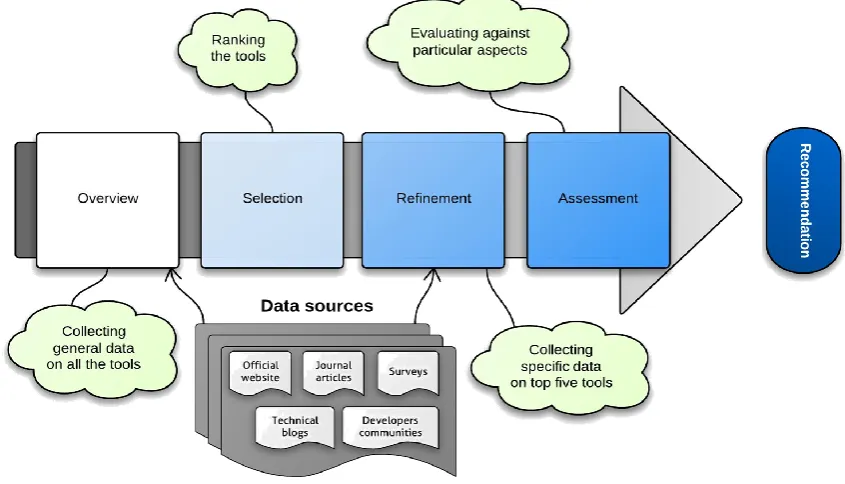
Survey study was used as research strategy. The research process was divided into four steps: overview, selection, refinement and assessment. The overview step included finding suitable cross-platform tools for this research and collecting generic data about each of them. The selection step included ranking the tools with the designed ranking criteria and selecting five tools suitable according to the company’s needs. In the refinement step, specific data was
collected for the five highest ranked tools in the selection step. We have evaluated it on the following step five selected tools with the Volvo IT guidelines and principles. Finally, one of the tools was recommended to the company as the most suitable with the regards to their needs and requirements.
2.THEORETICALFRAMEWORK
Following details gives the terminology used in this study.
2.1. Programming language
A programming language is an artificial language designed to communicate instructions between humans and machines (computers). There are many different types of programming languages and all of them are used in different projects for different kinds of tasks. The examples of programming languages used in mobile applications development are: Java, Objective-C, C++, HTML5, CSS3, and JavaScript.
2.2. Integrated Development Environment (IDE)
Integrated Development Environment is an application which provides different tools and facilities for programmers. Usually, IDE consists of source code editor, debugger, and automation tools. In mobile development, the examples of such IDEs are XCode, Android Studio, Eclipse, and NetBeans.
2.3. Software License
2.4. Mobile operating system (Mobile OS)
The mobile Operating Systems are the platform which operates digital mobile devices e.g. smartphones and tablets. The most obvious mobile platforms are the following:
1. Android. Google Android platform is a Linux-based Mobile OS. This platform is a software package or software stack for mobile devices, containing an operating system, middleware, and main applications.
2. iOS is the operating system originally created by Apple Inc. for the following products: iPhone, iPad and iPod Touch. The iOS license restricts installation of the system to only original Apple Inc. products, so it is impossible to legally install iOS on other devices. Objective-C and C++ programming languages and XCode IDE are used for developing native mobile applications for the iOS platform. 3. Windows Phone. Windows Phone is a mobile Platform created and released by the company. The
native mobile applications for this platform are mainly developed with C# and VB.Net programming languages, with the use of Windows Phone SDK, which contains all the necessary tools needed to develop a native app for Windows Phone OS.
4. Windows Mobile. Windows Mobile is a predecessor of Windows Phone and is incompatible with Windows Phone software or devices. The native applications are developed in Visual Studio IDE with VB.NET and C#.
5. BlackBerry OS. Blackberry platform is an operating system which was created by its company for its’ Blackberry smartphone devices. Most of the native mobile applications are created in Java using. 6. Symbian OS. Symbian OS is a mobile operating system originally designed for Nokia smartphones
and currently supported by Accenture. The applications are developed in C++ with the help of Qt framework.
2.5. Cross-platform mobile development tool
A cross-platform mobile development tool is a type of software (e.g. library, framework, programming language, set of tools, etc) which enables the user to develop an application once and compile it to several mobile operating systems. Using such tools have several benefits:
1. Development time reduction. The fact that the code is written once, but compiles to several mobile operating systems reduces development time.
2. Ease of development. Each mobile platform requires you to use a specific programming language for development. Cross-platform tools, most often, requires one programming language in the development for all the platforms. The tools usually require easy-to-learn web development programming languages: HTML5, CSS3, and JavaScript.
3. Ease of maintenance. It is cheaper and easier to maintain one code base as opposed to maintaining different
4. Even though cross-platform tools have many advantages, there are some known drawbacks of using them as well. For example:
5. Performance. Poor performance in comparison to native applications.
6. Access to native API. Not all the tools have access to all the mobile devices’ functionality, e.g. access to camera, accelerometer, and storage.
7. Reliability. Your project will be dependent on the tool and there is no guarantee that the tool will continue to exist.
8. Up to date. Mobile platforms are changing at a fast pace and it takes cross-platform tools time to support the new features in the new mobile platform.
2.6. Architectural principles and guidelines
Different companies are creating the architectural principles and guidelines which the developers and software architects have to follow. Usually, it is done in order to improve the security and make the project easier to maintain.
3. METHOD
Survey study was chosen to be the research strategy for this thesis. Survey study is defined as follows:
Fig. 1: Research process
Surveys share with their physical counterparts three crucial Characteristics:
3. Empirical research. It involves the idea of getting out of the chair, going out of the office and purposefully seeking the necessary information out there.”
This survey study was mainly a survey of documents”, which means that survey strategy was applied to documents and not to people. In this case, documents consisted of documentation and API from the official websites of the cross-platform tools, previous research papers, articles, and forums’ entries.
The research process consisted of four steps (see Figure 1.):
1. Overview. Creating a list of the most popular tools for this research. 2. Selection. Choosing five tools that suited the company’s needs. 3. Refinement. Expanding knowledge on the five selected tools.
4. Assessment. Evaluating the five selected tools against the company’s specific guidelines and principles.
5. The following sections provide a detailed explanation for each of the research steps.
3.1. Overview
During this first step, general information about cross-platform tools was collected and analyzed. First,”Google” web search engine was used with Cross-platform mobile development tool” as keyword. Tools were chosen and put in a spreadsheet from the first five pages of the search results. These tools were cross checked with the tools that were mentioned in research articles from previous years. In addition to this, information about existing tools was gathered from different developer communities (e.g.”Stack Overflow”).
Initially, there were 24 tools in the list, but some of the tools were removed at this stage due to being outdated (the official website did not exist or had not been updated for years).
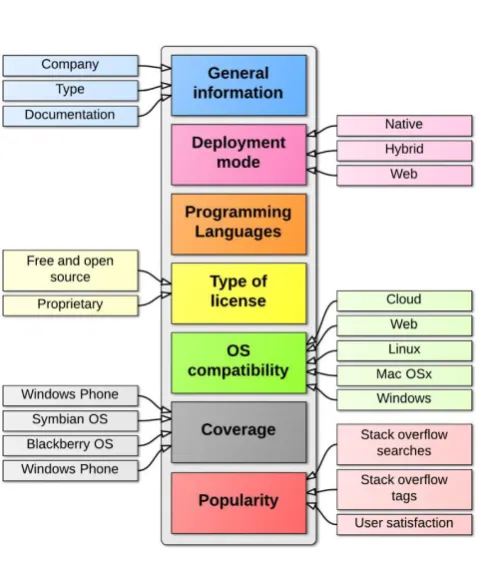
All the data gathered for these tools were stored on a spreadsheets. A representation of these data can be found in the Results section. The gathered data were categorized in a way described below (see Figure 3):
General information. The name of a company or organization that made the tool, information about the documentation quality and the tool’s type were collected. According to Hartmann et al. cross-platform tool can be
of one of the following types:
2. Product. ”Offers a specific functionality or service ready to be used and integrated into a mobile solution. A product is built using a combination of libraries, frameworks and/or platforms but these are not normally visible to the end user.
3. Framework. ”A set of libraries, software components and architecture guidelines that provides the developer with a comprehensive toolkit to build a complete mobile application, from top to bottom. Commonly called full-stack development frameworks; normally more complex to use than a single library.”
4. Library. Library is a” small, self-contained toolkit that offers very specific functionality to the user. Normally used in conjunction with other libraries and tools to make up the full mobile app. Examples include UI widgets and 3D graphics libraries ”
5. Cross-compiling programming language. Cross-compiling programming language is an easy-to-use language with which you can create an application and compile it to several platforms.
Deployment mode. According to Korf and Oksman there are mainly 3 deployment formats of applications that can be created with cross-platform mobile development tools (see Figure 2). They are:
1. Native. Native applications are “specific to a given mobile platform (iOS or Android) using the development tools and language that the respective platform supports (e.g., XCode and Objective-C with iOS, Eclipse and Java with Android).”
2. Hybrid. Hybrid applications” make it possible to embed HTML5 apps inside a thin native container,
combining the best (and worst) elements of native and HTML5 apps.”
3. Web (HTML5). Web mobile application” use standard web technologies typically HTML5, JavaScript and CSS. This write-once-run-anywhere approach to mobile development creates cross-platform mobile applications that work on multiple devices.
Data stating the tool’s ability to deploy in each of these modes was gathered in this sheet. Programming language.
The programming languages that are used for coding with each tool were included in this sheet. Coverage. Coverage sheet contained different mobile OS support.
The data showed if the tool could create apps not only for iOS and Android but for other mobile operating systems as well. OS compatibility. In this sheet the ability to use the tool on different desktop OS (Mac OS, Windows, and Linux) was recorded.
Fig. 2: Deployment formats
Fig. 3: Taxonomy tree
Type of license. Information about the license (Proprietary or Free and Open Source) was stored on this sheet.
3.2. Selection
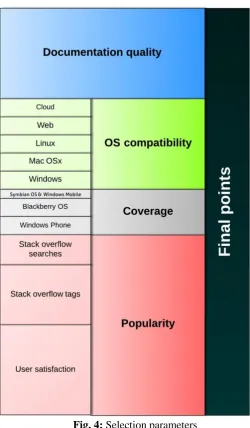
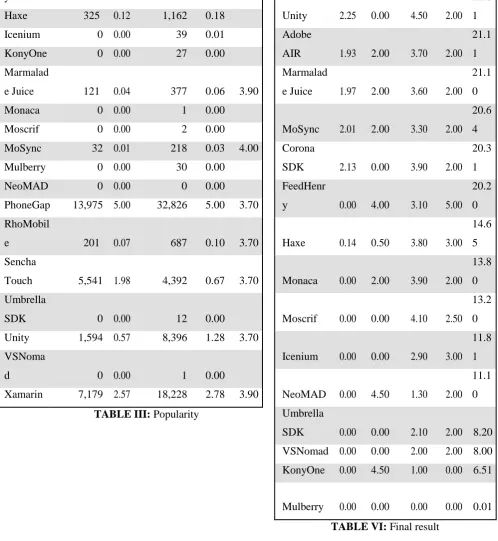
On this step a grading system was introduced. All tools were given a score of 0 to 5 on predefined important parameters (see Figure 4). Then each parameter was given a weight. The total points of each tool were calculated as sum of each score multiplied by its weight: P (Parameter score ⇥ parameter weight)
The parameters, how their points were calculated and their weights were as follows: Popularity. Weight: 4
Number of stack overflow tags and search results were brought to a range of 0 to 5 where 5 was equal to the maximum number between the tools. The survey result was in the range of 0 to 5. The final popularity score was calculates with the following formula:
(tagsnorm ⇥ 2) + (searchesnorm ⇥ 1) + (satisf action ⇥ 3)
6 Coverage. Weight: 1
Windows Phone and BlackBerry each had 2 scores, and Windows Mobile and Symbian each had 1 with the total score of 5. Android and iOS are excluded from the list, as they are supported by all the graded tools.
Documentation quality. Weight: 2
Zero was given to non-existing documentation and five to excellent documentation. OS compatibility. Weight: 2
Each of Windows, Linux, Mac OS, Web IDE, and cloud had 1 score.
Five tools with the highest points were chosen to continue with in the following steps.
3.3. Refinement
On this step, more information about the five chosen tools was collected subjectively. This was done to provide deeper knowledge and detailed specification about benefits and shortcomings of each of them for the company.
3.4. Assessment
Volvo Group IT Governance has established ten architectural principles based on the most important quality attributes for them. When designing and developing a new application, the programmer should always take into considerations each of the principles. In this study, the principles were used to evaluate the most suitable cross-platform mobile development tools for Volvo IT. The description of each principle used is as follows:
1. Conformity to standards. Drive usage of open and industry standards at Volvo.
2. Autonomous and loose coupling, between components and applications. Flexible subsystem and granular component setup, avoiding monoliths.
3. Simplicity in solutions and work methods. Clean solutions from technical, application and user perspective.
4. Strive for usage of existing Volvo services. Whenever possible avoid application specific infrastructure and instead use already existing services at Volvo.
5. Robust solutions. Strive for robust solutions securing uptime.
6. Performance focus from the start. Strive for good performance in solutions from the start. 7. Secure solutions. Strive for secure solutions from the start.
9. Usage of Agile work methods and design principles. Use agile system development and implementation principles.
10. Maintainable solutions. Deliver maintainable solutions to Maintenance.
Fig. 4: Selection parameters
4.RESULTS
This section presents the results of the research and is divided into several subsections with the results of each of the steps in Method section, overview, selection, refinement, and assessment.
4.1. Overview and Selection
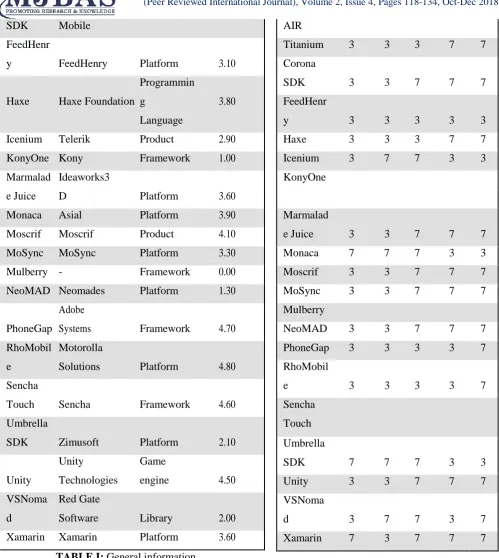
The results of these steps are presented in form of tables, including all the collected data and ranking results for each of the tools. All the tables can be found on page 7. The tables present tools’, general information including the
that relevant data was not found on the tool’s official website. Collected data was analyzed and the final ranking
table was created, where the top-five most suitable cross-platform tools can be found (see Table VI).
4.2. Refinement
According to this study’s result, the top five cross-platform tools currently on the market are: PhoneGap, Titanium,
Rho-Mobile, Sencha Touch, and Xamarin. This subsection gives a detailed description for each of the mentioned tools, in order to widen the company’s knowledge about each of them.
4.2.1. PhoneGap
Is an open-source cross-platform mobile development tool released by Adobe Inc. under Apache 2.0. license in 2008. PhoneGap is one of the most popular tools on the market with large developers community. Applications are developed using HTML5, CSS, and JavaScript. It follows the hybrid model by providing native app wrappers for mobile platforms with an embedded browser which renders the UI and makes the interaction between the mobile device and web application possible. The PhoneGap JavaScript API provides the access to the native functionality (e.g. camera and contacts). The best suited projects for this tool are existing web applications, needed to be converted into a mobile application.
4.2.2. PhoneGap Strengths
PhoneGaps primary strength is that it is very simple. Also any native platform that supports a web view can become a PhoneGap platform, meaning that native extensions can be developed fast. Another strength is the existence of a JavaScript API which provides native functions. HTML, CSS, and JavaScript code can be wrapped in a native app and published. Another strong side of this tool is that the native wrapper source code is provided so it can be changed according to the project’s requirements. Finally, PhoneGap has a strong developer’s community.
4.3. PhoneGap Weaknesses
The user interface quality is the biggest issue of PhoneGap due to the quality of the platform’s rendering engine. Web views on different platforms have some limitations, and this is why the quality of PhoneGap UI is significantly lower than applications with a native UI. In addition to this PhoneGap cannot be extended with native user interface. The last thing to mention is that due to the iOS restrictions, the iOS compass cannot be accessed with PhoneGap, which makes development of some projects impossible.
Name: PhoneGap.
Cross-platform tool type: Framework.
Deployment mode: Hybrid mobile applications.
Mobile Operating Systems: Android, iOS, Windows Phone, BlackBerry, Symbian.
4.4.RhoMobile
Applications are developed mostly in Ruby language using a Model View Controller (MVC) architecture, separating the logic (Ruby) from the UI design (HTML). The apps generated are compiled into Ruby 1.9 bytecode, which is then interpreted by the Ruby Virtual Machine for the target platform. The access to the mobile device’s native API is provided by Rhodes API. JQTouch is supported for creating touchscreen UIs. RhoMobile is targeting enterprise application development and provides several tools for that. Some of the tools are as follows:
1. Rhodes is an open source Ruby-based framework for cross-platform mobile development.
2. RhoSync, working together with RhoConnect, up-dates the device with any changes in the database. 3. RhoConnect provides the connection to the enterprise databases.
4. RhoHub is a cloud based development environment, with Git support, providing the possibility to compile an application for all the different platforms on the cloud, enabling development of iOS applications on a non-Mac OS.
5. RhoGallery is a part of RhoHub, providing an enterprise ”app store” for the company.
6. RhoStudio is an IDE, providing templates, simulators and debugging tools which makes developing applications easier.
4.5.RhoMobile Strengths
MVC architecture support is the main benefit of RhoMobile.
4.6.RhoMobile Weaknesses
Need to know Ruby well to do anything, which is not as popular as other programming languages like JavaScript, Java or PHP. The tool does not generate source code, and only generates native packages.
Name: RhoMobile.
Cross-platform tool type: Platform.
Deployment mode: Hybrid and native mobile applications.
Mobile Operating Systems: Android, iOS, BlackBerry, Windows Phone, Windows Mobile Programming Languages: Ruby for controllers, HTML, JavaScript, and CSS.
License Rhodes is free and open-source (MIT License), but other components need to be purchased. The applications created with the tool can be licensed with any license, however if the created app is using some features (e.g. Barcode extension), the Motorola Solutions Software License has to be applied to it.
Tools Company Type Documentation Adobe
AIR
Adobe
Systems Platform 3.70
Titanium
Appcelerato
r Platform 4.50 Corona Ansca Product 3.90
Tools
Window s
Ma c
Linu x
Clou d
We b OS
x
SDK Mobile FeedHenr
y FeedHenry Platform 3.10
Haxe Haxe Foundation
Programmin
g 3.80
Language
Icenium Telerik Product 2.90 KonyOne Kony Framework 1.00 Marmalad
e Juice
Ideaworks3
D Platform 3.60 Monaca Asial Platform 3.90 Moscrif Moscrif Product 4.10 MoSync MoSync Platform 3.30 Mulberry - Framework 0.00 NeoMAD Neomades Platform 1.30
PhoneGap Adobe
Systems Framework 4.70 RhoMobil
e
Motorolla
Solutions Platform 4.80 Sencha
Touch Sencha Framework 4.60 Umbrella
SDK Zimusoft Platform 2.10
Unity
Unity
Technologies
Game
engine 4.50 VSNoma
d
Red Gate
Software Library 2.00 Xamarin Xamarin Platform 3.60
TABLE I: General information
Tools
Native
apps Hybrid apps Web apps Adobe
AIR 3 3 7
Titanium 3 7 7
AIR
Titanium 3 3 3 7 7 Corona
SDK 3 3 7 7 7
FeedHenr
y 3 3 3 3 3
Haxe 3 3 3 7 7
Icenium 3 7 7 3 3 KonyOne
Marmalad
e Juice 3 3 7 7 7 Monaca 7 7 7 3 3 Moscrif 3 3 7 7 7 MoSync 3 3 7 7 7 Mulberry
NeoMAD 3 3 7 7 7 PhoneGap 3 3 3 3 7 RhoMobil
e 3 3 3 3 7
Sencha Touch
Umbrella
SDK 7 7 7 3 3
Unity 3 3 7 7 7 VSNoma
d 3 7 7 3 7
Xamarin 7 3 7 7 7
TABLE IV: OS compatibility
Corona
SDK 3 7 7
FeedHenr
y 3 3 3
Haxe 3 7 7
Icenium 7 3 7
KonyOne 3 3 7
Marmalad
e Juice 3 3 7
Monaca 3 3 7
Moscrif
MoSync 3 7 7
Mulberry
NeoMAD 3 7 7
PhoneGap 7 3 7
RhoMobil
e 3 7 7
Sencha
Touch 7 3 3
Umbrella
SDK 3 7 7
Unity 3 7 7
VSNomad 7 3 7
Xamarin 3 7 7
TABLE II: Deployment mode
Tools Stack
Tag
s Stack
Searche s
Satis - Overflow 0-5 Overflow 0-5 fac- tags searches tion Adobe
AIR 0 0.00 3,069 0.47 3.70 Titanium 3,184 1.14 6,995 1.07 3.70 Corona
SDK 1,369 0.49 2,526 0.38 3.80 FeedHenr 0 0.00 3 0.00
Corona
SDK 7 7 7 7
FeedHenry 3 3 7 7
Haxe 7 7 3 7
Icenium 7 7 7 7
KonyOne 3 3 7 3
Marmalade
Juice 7 3 7 7
Monaca 3 7 7 7
Moscrif 7 7 7 7
MoSync 3 7 7 7
Mulberry 7 7 7 7
NeoMAD 3 3 7 3
PhoneGap 3 3 7 3 RhoMobile 3 3 7 7 Sencha
Touch 3 3 7 7
Umbrella
SDK 7 7 7 7
Unity 7 7 7 7
VSNomad 7 7 7 7
Xamarin 7 7 7 7
TABLE V: Mobile OS coverage
Tools Popular - Cover - Documenta - SD K To- ity age tion OS tal
PhoneGap 4.35 4.50 4.70 4.00 39.3 0 RhoMobil
e 1.89 4.00 4.80 4.00 29.1 7
Titanium 2.41 4.00 4.50 3.00 28.6 3 Sencha
Touch 2.62 4.00 4.60 0.00 23.6 9
y
Haxe 325 0.12 1,162 0.18 Icenium 0 0.00 39 0.01 KonyOne 0 0.00 27 0.00 Marmalad
e Juice 121 0.04 377 0.06 3.90 Monaca 0 0.00 1 0.00 Moscrif 0 0.00 2 0.00 MoSync 32 0.01 218 0.03 4.00 Mulberry 0 0.00 30 0.00 NeoMAD 0 0.00 0 0.00 PhoneGap 13,975 5.00 32,826 5.00 3.70 RhoMobil
e 201 0.07 687 0.10 3.70 Sencha
Touch 5,541 1.98 4,392 0.67 3.70 Umbrella
SDK 0 0.00 12 0.00 Unity 1,594 0.57 8,396 1.28 3.70 VSNoma
d 0 0.00 1 0.00
Xamarin 7,179 2.57 18,228 2.78 3.90
TABLE III: Popularity
Unity 2.25 0.00 4.50 2.00 22.0 1 Adobe
AIR 1.93 2.00 3.70 2.00 21.1 1 Marmalad
e Juice 1.97 2.00 3.60 2.00 21.1 0
MoSync 2.01 2.00 3.30 2.00 20.6 4 Corona
SDK 2.13 0.00 3.90 2.00 20.3 1 FeedHenr
y 0.00 4.00 3.10 5.00 20.2 0
Haxe 0.14 0.50 3.80 3.00 14.6 5
Monaca 0.00 2.00 3.90 2.00 13.8 0
Moscrif 0.00 0.00 4.10 2.50 13.2 0
Icenium 0.00 0.00 2.90 3.00 11.8 1
NeoMAD 0.00 4.50 1.30 2.00 11.1 0 Umbrella
SDK 0.00 0.00 2.10 2.00 8.20 VSNomad 0.00 0.00 2.00 2.00 8.00 KonyOne 0.00 4.50 1.00 0.00 6.51
Mulberry 0.00 0.00 0.00 0.00 0.01
TABLE VI: Final result
5. DISCUSSION
The results of the research showed that for Volvo IT, the top five cross-platform development tools currently on the market are: PhoneGap, Appcelerator, RhoMobile, Sencha Touch, and Xamarin. However, it was discovered that some of these tools are more suitable for specific types of projects. For example, some PhoneGap reviewers mention that ”Applications that are content heavy, but not really graphically heavy and do not rely heavily on using
consideration that even though, these tools are in the top five list, each of them has some benefits and drawbacks, which should be considered when starting a new project.
In addition, the results of the research were a little different from the results of the similar survey conducted earlier this year by, which means that cross-platform mobile development is a dynamic and fast developing sphere of software engineering, and such researches have to be conducted constantly, in order to provide up-to-date results and observe the changes and tendencies.
Moreover it is important to note that in the developed framework, ”Refinement” and ”Assessment” steps do not include any quantitative analysis or guidelines on how to conduct them, but mostly rely on subjective qualitative analysis based on the data collected from developer communities and user’s blogs. From the point of view of positivism, the only truth is in scientific knowledge, where only the first two steps of the framework, ”Overview” and ”Selection”, fit this idea. However, from the pragmatic point of view, practice is a true knowledge, and the
objective of this research was to create a method, which will be useful for practitioners. These types of methods exhibit a trade-off between rigor and execution cost. However for this study, on a quickly evolving market with new offers every month, it was not considered worthwhile to spend a significant amount of time on ”proving” what option is the best.
6. RECOMMENDATIONS
Based on the research results and authors’ deduction, RhoMobile Suite is recommended to Volvo IT to use as a
cross-platform mobile development tool with the regards to VGAP. The reasons are that RhoMobile Suite: 1. is suitable for enterprise applications
2. supports MVC framework
3. creates applications for all the major mobile OSs
4. consists of several products, supporting the development of enterprise applications in all the different ways 5. creates native applications that support full device features (camera, compass etc.) and can be easily
published on all the app stores
7. LIMITATIONS
There are some limitations and shortcomings to take into Consideration, and they are listed further:
1. Sample size. Twenty of the major cross-platform mobile development tools were evaluated in this research. Due to the fact that the new mobile development tools are being released every day, there are more than a hundred tools on the market and it is almost impossible to include all of them in this research.
2. Tools testing. This research did not include any tools testing or prototype development. And its
3. Grading system. The grading system was created for this study, and the tools were graded subjectively. However, the authors believe that this system worked well in this research, and can be customized in every other case, according to preferences and requirements.
8. VALIDITY OF THE FRAMEWORK
The feedback that was given by Volvo IT stated that the results of this research were different from the results of similar research conducted two years ago. This means that this study brought fresh knowledge with several new cross-platform tools which did not exist then. They also mentioned that copies of this research will be distributed amongst mobile developers and architects within their company to provide them with the latest information on this topic.
However the creditability of the developed framework can be questioned as the findings in ”Refinement” and ”Assessment” steps rely on the honesty of the tool providers and the accuracy of answers in developer communities and blogs. The proposed method can be used without ”Refinement” and ”Assessment” steps, which will improve
the creditability of the framework.
9. CONCLUSION
Cross-platform mobile development is a recent and unexplored area of software engineering. The possibility to develop for mobile platforms at once is a benefit appreciated by most of the mobile application developers. However, due to the variety of cross-platform tools for mobile development, choosing the right tool is not an easy task. Moreover not all companies can use cross-platform tools due to the necessity of following their own guidelines and principles for developing an application.
This research evaluated major cross-platform mobile development tools, taking Volvo Group Architectural Principles (VGAP) into consideration. The main result of the research was a framework for choosing suitable software tools, for a specific engineering context. During the research, general data was collected in order to provide a full picture of what cross-platform mobile development tools are available on the market. More specific data on five highest ranked tools (PhoneGap, RhoMobile, Titanium, Sencha Touch, and Xamarin) was gathered and the five tools were then carefully evaluated against VGAP.
The current state of the cross-platform mobile development tools market is dynamic, which means that the researches similar to this have to be conducted several times a year. The Situation changes every day and there is no guaranty that a similar research conducted six months in the future will have the same results.
and reliable data. Moreover the developed framework can be improved by creating a systematic research guideline for ”Refinement” and ”Assessment” steps. Finally, triangulation can be added to the method in order to increase the validity of ”Recommendations”.
ACKNOWLEDGMENT
We would like to express our sincere gratitude to our super-visor, Dr. KP Yadav, for the continuous support of our study and for his patience, motivation, enthusiasm, and immense knowledge. We would also like to thank our supervisor from Himalayan University Arunachal Pradesh, for his advice, assistance, and for providing us with an exciting research topic. Finally, we wish to thank our parents and families for their support and encouragement throughout this study.
REFERENCES
[1] Y. e. a. Natchetoi, “Service oriented architecture for mobile applications,” in 1st international workshop on Software architectures and mobility/International Conference on Software Engineering, Leipzig, Germany, 2008, pp. 27–32.
[2] C. Teng and R. Helps, “Mobile application development: Essential new directions for it,” in Information Technology: New Generations (ITNG), IEEE, Ed., Las Vegas, NV, April 2010, pp. 471–475. Charland and B. Leroux, “Mobile application development: Web vs. native.” Queue - Data, vol. no. 4, p. 20, 2011.
[3] “Volvo it is a global company, and a part of the volvo group.” [Online]. Available: http://www.volvoit.com/volvoit/global/ en-gb/about us/Pages/aboutus.aspx
[4] J. C. Mitchell, Concepts in Programming Languages. United States of America: Cambridge University Press, 2003.
[5] S. K. Satav, S. K. Satpathy, and K. J. Satao, “Design and implementation of an integrated development environment for multiple languages using c,” International Journal of Advances in Science and
Technology, vol. 2, no. 3, p. 77, March 2011.
[6] “Software licensing.” [Online]. Available: http://its.uncg.edu/Software/ Licensing/
[7] X. Shu, Z. Du, and R. Chen, “Research on mobile location service design based on android,” in Wireless Communications, Networking and Mobile Computing, 2009, pp. 1–4.
[8] G. Hartmann, G. Stead, and A. DeGani, “Cross-platform mobile development,” March 2011. [Online]. Available: http://www.mole-project.net/images/documents/deliverables/ WP4 crossplatform mobile development March2011.pdf
[9] J. Parker, “Pros and cons of cross-platform mobile app development tools,” March 2013. [Online]. Available:http://www.techrepublic.com/blog/app-builder/pros-and-cons-of-cross-platform-mobile-app-de velopment-tools/2379
[10] O. Vogel, I. Arnold, A. Chughtai, and T. Kehrer, Software Architecture A Comprehensive Framework