Copyright © 2013 IJECCE, All right reserved
Solving Benchmark Frequency Assignment Problem of
Helsinki Regions Network by a Novel Nature Inspired
Algorithm
Avtar Singh Buttar, Ashok Kumar Goel, Shakti Kumar
Abstract–The Frequency Assignment Problem is assignment of frequencies or channels to establish link between base station and mobile transmitter in cellular system. To avoid interference, minimum separation between assigned frequencies is required. This problem is NP-hard. Due to limited availability of spectrum and reuse of same frequencies at different geographical locations, an excellent assignment is to be done, which must satisfy electromagnetic constraints with respect to demand in each cell. This paper presents a novel DGWCHD algorithm for frequency assignment problem in cellular radio networks. The objective is to assign the frequency satisfying electromagnetic constraints for given demand with minimum use of frequency bandwidth. The proposed algorithm is based on real wild animal such as dog’s intelligent strategies during chasing and hunting their prey. The proposed algorithm is implemented on benchmark Kunz’s test problems, which are practical FAP problems based on area around 25 regions in Helsinki, Finland. The DGWCHD algorithm has been used for call ordering and FEA strategy for assignment. The performance of the proposed novel DGWCHD algorithm has been compared with other nature inspired techniques. The results obtained are very optimistic and encouraging.
Keywords — Chasing & Hunting, Computational intelligence, Dog Group Wild Chase and Hunt Drive (DGWCHD), Combinatorial Optimization, Frequency Assignment Problem Optimization.
I. I
NTRODUCTIONOver the past years, due to tremendous increase in number of users and their demand for both voice and data services, more and more discrete channels are required to cope with situation. On other hand, available electromagnetic spectrum is limited, the cost of which may be very high. The main problem of planning and operating a mobile communication system is the selection of compatible frequencies to be reused for different channels. The channel plan should utilize the all available frequencies with minimum interference due to co-channel and adjacent channel operation. Various other nets are already present in that area, so the new assignments must be compatible not only with each other but with the old ones as well. The numbers of channels are required to fulfill the demand with minimum span of frequencies. It can be obtained by good assignment. The objective of the work is to utilize minimum span using this computational technique for excellent assignment of channels. There are some good approaches are described in the literature [13]-27].This paper is a step forward in this direction. The remainder of the paper is organized as follows: Section II gives a brief description ofDog’s and their behaviorwhile Section III describes the algorithm based on chasing &
hunting methodology adopted by dogs. Section IV outlines the implementation of algorithm for solving MSFAP benchmark problems. Section V outlines computational experiments undertaken and the results and comparison with other nature inspired algorithms. Finally, the conclusions and future directions are outlined in Section VI.
II. W
ILDD
OGS ANDT
HEIRB
EHAVIORA dog is very active, loyal and sensible animal. There are five main sensing organs gifted to dogs: nose (smell), ears (hearing), tongue (bark), eyes (sight) and skin (touch). The first three senses are highly developed, while others are deficient compared with those of humans [1], [2], [3], [4].
Sense of Smell: Olfaction, the act of smelling, is a dog's primary sense. Dog's sense of smell is by far the most acute and is immeasurably better than that of humans. Humans have about 40 million olfactory receptors only, versus 2 billion for a dog.Dogs have an estimated 125-220 million scent cells and can use each nostril independently and thus, are good at distinguishing one odour from another [4], [5], [6]. They can detect one drop of blood in five quarts of water, drugs, explosives, and scents effectively[3].
Sense of hearing: Dogs have very acute sense of hearing and can hear sounds up to a frequency of 60,000 Hz. A
dog’s ears can move independently from each other, which
gives him greater capability to determine direction and cause of soundthat helps him to pinpoint rapidly the exact location of a sound [8].Dogs can also shut off their inner ear in order to filter out distracting sounds. Additionally, the dogs are able to identify a sound's location much faster and can hear sounds up to four times the distance than humans.
Copyright © 2013 IJECCE, All right reserved of chasers and take their position based on the level of
barking intensity moving around outside the hunting field. Hunters then, assess the health of the prey and run to catch/kill them. Therefore, the dogs have divided their jobs as per their physical capabilities.
III. D
OGG
ROUPW
ILDC
HASE ANDH
UNTD
RIVE(DGWCHD) A
LGORITHMThe design principle of the algorithm is inspired from chasing and hunting strategies of Wild Dogs [25]. The chasers search and drive the prey away from their home and the hunters make use of barking level of the chasers and health of the prey to judge and catch it.
A.
Artificial Hunting field:
Fig.1. Artificial Hunting Field
As shown in Fig. 1, Artificial Chaser Dogs act as agents who move in the field for searching the food target in different directions at random and chase the prey. The hunters stand outside the field, watch the situation, move and trace the area /path based on movement of Chasers and their respective barking level. When the Hunter is confident that the prey’s health is exhausted and can be trapped, it pounces upon the prey and catches it. This process continues until all the prey are hunted or the left over’s have run away successfully for survival.
B. The mathematical model of the algorithm:
The hunting field is divided into many sections, each identified by a mark called node as shown in Figure 1.Artificial Chaser Dog behavior:
The Chasers initially assume that each node is having a prey. The smell of each prey at node j initially taken as S and sij as smell of prey at node j, is inversely
proportional to the distance between j from the Chaser at node i. The barking level of the Chaser when it moves from node i to j is denoted by . Initial value of ‘Health’ of each prey is assumed as H which decreases as the prey is chased and is exhausted due to running away from the chaser. The health of prey at node j, as seen by the chaser at node i is designated as .
The probability, pkof selecting jthnode by the kthChaser
present at node i, is calculated by the probabilistic function given below:
= for i≠j .. (1)
= 0 for i = j
Where k, varies from 1 to nc, (nc is number of Chasers) , : smell of prey at node j, received by the Chaser at node i
, Cumulative Barking level of chaser in the direction of i and j
, Health of prey at node j as seen from node i n, total no. of nodes
α, weight-age of barking level β, weight-age of Smell level γ, weight-age of Health of prey
While chasing, the prey tries to escape by running away. Consequently, it gets exhausted and its health decreases depending upon the distance it has to run. It is assumed that the maximum distance that the prey runs is equal to that of the chaser. The health of the prey when chaser runs through a distance from node i to j is updated based on equation given below:
= -d (i, j) … (2)
Where, d (i, j) is a function of distance from node i to j. The barking level of Chasers along a path from node i to j is updated based on equation 3.
= *ф ……... (3)
Where, Фis reduction/fading factor of barking level. For collective decision barking levels in different directions gives the commutative effect
= …. (4)
Where,
λ : the ratio of lower bound /assumed optimal distance Dkto MDk
Dk : the total distance covered by k th
chaser to chase all prey present.
MDk: the min (Dk) taken as the updated tour length for hunter
nh, : Total no. of hunters
Artificial Hunter Dog behavior:
The Hunters stand outside the field, watch the situation, move and trace the area /path based on movement of Chasers and their respective barking level. When the Hunter is confident that the prey’s health is exhausted and can be trapped, it pounces upon the prey and catches it. Hunting choice path array for a hunter, is calculated using equation (5)
= … (5)
The Hunter updates the Hunted Path Array from the Hunting choice array using equation (6)
……… (6)
where, is the hunting threshold decision value. The Value ‘1’ indicates the path is hunted, and ‘0’ indicates otherwise.
Copyright © 2013 IJECCE, All right reserved
IV. T
HEI
MPLEMENTATION OFA
LGORITHMFOR
S
OLVINGMS-FAP B
ENCHMARKP
ROBLEMSA. Problem Description:
The different classes of constraints: geographical constraints, operational constraints and electromagnetic compatibility constraints. The frequency assignment is not an easy method. Some necessary constraints/requirements are to be satisfied in every method/technique for frequency assignment.
We have selected the Kunz’s test problems which are practical FAP derived from traffic density data of an actual 24X 21 km area around Helsinki, Finland. The final set of test problems is derived from the topographical data of an actual 24 21 km area around Helsinki, Finland, as used by Kunz. These problems are among the most studied FAP instances.
Minimize number of channel /no. of frequencies used for given requirement for a model, while satisfying all requests with no interference is classified as minimum span frequency assignment problem (MSFAP).
Given N : the number of cells
, 1≤ i ≤ N: the number of requested calls (demands) in cell i,
,1≤ i, j≤ N :the frequency separation required between a call in cell i and a call in cell j
Find: , 1≤ i ≤ N , 1≤ k ≤ : the frequency assigned to the call in cell j
such that subject to the separation constraints,
│ - │≥ , for all i;j;k; l
except for i=j and k=l, minimize
Max for all i;k
Demand D: (10 11 9 5 9 4 5 7 4 8 8 9 10 7 7 6 4 5 5 7 6 4 5 7 5)
Table I : Compatibility Separation Matrix [25×25]
B. Dog Wild Chase Hunt Drive Algorithm for
MS-FAP:
The transposition of the original methodology to our problem is obtained in the following way:
The concept of state is associated with that of partial solution, while a move is defined as the order of call. Every chaser dog constructs a solution by examining the demand in each cell and choosing at each move to attend call to the currently examined transmitter according to equation 6 with additional heuristic information multiplier with weight age β+ of compatibility matrix distance as equation 7.
The probability, pkof selecting jthcell by the kthchaser
present at cell i, is calculated by the probabilistic function given below:
= for i≠j
..(7) = 0 for i = j
Where k, varies from 1 to nc, (nc is number of chasers) , smell of prey at node j, received by the chaser at node i , Cumulative Barking level of chaser in the direction of i and j
, Health of prey at node j as seen from node i ci j,Channel separation distance
n, Total no. of nodes
α, weight age of Barking level β, weight age of Smell level
β+, weight age of channel separation distance γ, weight age of Health of prey
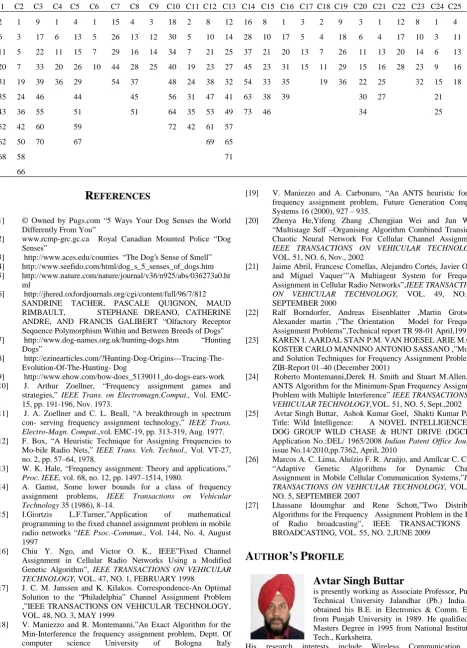
Now new cell is j and chaser proceeds further with the strategy as above for the next moves for assignment till all the requirements are fulfilled. Instead of defining barking and health levels on moves (i, j) as in the original DWCHD model, these are defined them on call order pairs. It gives an indication of how proficient it has been in the past to call order sequence. Once solutions are available, the barking and health update for move will be obtained by substituting within equation (2), (3) and (4). . Hunted call order is done as equation (5) and (6).For assignment, FEA strategy [10] ,[11] used as sequential assignment technique as shown in Fig.2.The algorithm is repeated for all hunters till all the calls are hunted and optimal solution is found.
C. The proposed algorithm for FAP is described as follows:
Procedure DGWCHD ( ) begin
/* initialization */
get-a- instance (xy),(C), (D);
dij:= ;
co := call -ordering for- call list ( ); Fassigned:= frequencies assigned table [];
Smin:= find minimum spectrum for- call list (co); /*starting first LOOP, at this level each loop is called an iteration */
while (all preys are chased and hunted or terminating condition reached)
Copyright © 2013 IJECCE, All right reserved /* select first prey i present on node randomly */
/* put i in co */
Loop /* at this level each loop is called a step */ select a prey pi from node ni i := 1, n; /* using probabilistic function*/
select next prey pj from node nj j = 1, n-1;
=
for i≠j ……..( 7)
= 0 for i = j
=
-= ;
= *ф;
= ;
/* put j in co */ end;
/*find prey order co with Smin.*/
/*prepare result as co and starting FEA technique to find FA and Smin. */
FA:=Actual frequency assignment to call list (xo) fmin= Cmax* (Dmax-1)+1;
fmax:=assign frequency to call list (xo) for
xi:= select first element of call order co(i)
cn:=cell number= co(i)
F1:=first frequency assigned to x1
FA1cn=1
/* next step to assign frequency to next call xjin call order
*/
fk:=another frequency assigned to xj
fk=FA1cn+Cij;
/*check possibility of assignment and find compatible available frequency*/
/*repeat same step until call order and all assignment completed*/
ftr=10*optimal/ Smin; for
= - i= pi,j= pj;
= ;
end; ftr/100; for
= ;
end
/* Phase 2: hunting by hunters */ begin
for for
= ; i= pi,j= pj;
end; end;
/* prepare hunting array */ begin
/*end of while */; end;
co; FA Smin;
Fig.2. Dog Group Wild Chase Hunt Drive Algorithm with FEA Strategy
Table No. 2: Various parameters of algorithm are taken for the problem with demand vector D Instance
Name
α β β+ γ H S ф λ No. of chasers
used nc
No. of hunters used nh
KUNZ4 0.275 2 -5 1 100 100 0.70 1 73/MDk 50 1
V. C
OMPUTATIONALR
ESULTS& D
ISCUSSIONS:
Cell number is mentioned horizontally (Ci) and channel number (assigned) vertically. It has been implemented on PC employing Intel Core i5-560M processor with 4GB RAM and using MATLAB version 2012a software and various parameters of algorithm are taken for the problem as shown in Table 2. Only one iteration is required find solution shown in Table 3 of difficult KUNZ4 problem. As shown in Table 3, the frequency assignment of 73 channels (optimum value) is obtained. The proposed algorithm finds the solution of this problem in 166 milliseconds, for call ordering 81 milliseconds and 85 milliseconds for assignment using FEA strategy. So, the proposed algorithm is proved its ability to solve assignment problem and its further usefulness.
VI. C
ONCLUSIONCopyright © 2013 IJECCE, All right reserved Table 3: Simulation Results for Helsinki FAP
C1 C2 C3 C4 C5 C6 C7 C8 C9 C10 C11 C12 C13 C14 C15 C16 C17 C18 C19 C20 C21 C22 C23 C24 C25
2 1 9 1 4 1 15 4 3 18 2 8 12 16 8 1 3 2 9 3 1 12 8 1 4
6 3 17 6 13 5 26 13 12 30 5 10 14 28 10 17 5 4 18 6 4 17 10 3 11
11 5 22 11 15 7 29 16 14 34 7 21 25 37 21 20 13 7 26 11 13 20 14 6 13
20 7 33 20 26 10 44 28 25 40 19 23 27 45 23 31 15 11 29 15 16 28 23 9 16
31 19 39 36 29 54 37 48 24 38 32 54 33 35 19 36 22 25 32 15 18
35 24 46 44 45 56 31 47 41 63 38 39 30 27 21
43 36 55 51 51 64 35 53 49 73 46 34 25
52 42 60 59 72 42 61 57
62 50 70 67 69 65
68 58 71
66
R
EFERENCES[1] © Owned by Pugs.com “5 Ways Your Dog Senses the World Differently From You”
[2] www.rcmp-grc.gc.ca Royal Canadian Mounted Police “Dog Senses”
[3] http://www.aces.edu/counties “The Dog's Sense of Smell” [4] http://www.seefido.com/html/dog_s_5_senses_of_dogs.htm [5] http://www.nature.com/nature/journal/v36/n925/abs/036273a0.ht
ml
[6] http://jhered.oxfordjournals.org/cgi/content/full/96/7/812 SANDRINE TACHER, PASCALE QUIGNON, MAUD RIMBAULT, STEPHANE DREANO, CATHERINE ANDRE, AND FRANCIS GALIBERT “Olfactory Receptor Sequence Polymorphism Within and Between Breeds of Dogs" [7] http://www.dog-names.org.uk/hunting-dogs.htm “Hunting
Dogs”
[8] http://ezinearticles.com/?Hunting-Dog-Origins---Tracing-The-Evolution-Of-The-Hunting- Dog
[9] http://www.ehow.com/how-does_5139011_do-dogs-ears-work [10] J. Arthur Zoellner, “Frequency assignment games and
strategies,” IEEE Trans. on Electromagn.Compat., Vol. EMC-15, pp. 191-196, Nov. 1973.
[11] J. A. Zoellner and C. L. Beall, “A breakthrough in spectrum con- serving frequency assignment technology,” IEEE Trans. Electro-Magn. Compat.,vol. EMC-19, pp. 313-319, Aug. 1977. [12] F. Box, “A Heuristic Technique for Assigning Frequencies to
Mo-bile Radio Nets,”IEEE Trans. Veh. Technol., Vol. VT-27, no. 2, pp. 57–64, 1978.
[13] W. K. Hale, “Frequency assignment: Theory and applications,” Proc. IEEE, vol. 68, no. 12, pp. 1497–1514, 1980.
[14] A. Gamst, Some lower bounds for a class of frequency assignment problems, IEEE Transactions on Vehicular Technology 35 (1986), 8–14.
[15] I.Giortzis L.F.Turner,”Application of mathematical programming to the fixed channel assignment problem in mobile radio networks “IEE Psoc.-Commun., Vol. 144, No. 4, August 1997
[16] Chiu Y. Ngo, and Victor O. K., IEEE”Fixed Channel Assignment in Cellular Radio Networks Using a Modified Genetic Algorithm”, IEEE TRANSACTIONS ON VEHICULAR TECHNOLOGY, VOL. 47, NO. 1, FEBRUARY 1998
[17] J. C. M. Janssen and K. Kilakos. Correspondence-An Optimal Solution to the “Philadelphia” Channel Assignment Problem ,”IEEE TRANSACTIONS ON VEHICULAR TECHNOLOGY, VOL. 48, NO. 3, MAY 1999
[18] V. Maniezzo and R. Montemanni,”An Exact Algorithm for the Min-Interference the frequency assignment problem, Deptt. Of computer science University of Bologna Italy web:www.csr.unbino.it/~maniezzo
[19] V. Maniezzo and A. Carbonaro, “An ANTS heuristic for the frequency assignment problem, Future Generation Computer Systems 16 (2000), 927–935.
[20] Zhenya He,Yifeng Zhang ,Chengjian Wei and Jun Wang “Multistage Self –Organising Algorithm Combined Transiently Chaotic Neural Network For Cellular Channel Assignment” IEEE TRANSACTIONS ON VEHICULAR TECHNOLOGY, VOL. 51, NO. 6, Nov., 2002
[21] Jaime Abril, Francesc Comellas, Alejandro Cortés, Javier Ozón, and Miguel Vaquer’”A Multiagent System for Frequency Assignment in Cellular Radio Networks”,IEEE TRANSACTIONS ON VEHICULAR TECHNOLOGY, VOL. 49, NO. 5, SEPTEMBER 2000
[22] Ralf Borndorfer, Andreas Eisenblatter ,Martin Grotschel, Alexander martin ,”The Orientation Model for Frequency Assignment Problems”,Technical report TR 98-01 April,1998. [23] KAREN I. AARDAL STAN P.M. VAN HOESEL ARIE M.C.A.
KOSTER CARLO MANNINO ANTONIO SASSANO ,”Models and Solution Techniques for Frequency Assignment Problems”, ZIB-Report 01–40 (December 2001)
[24] Roberto Montemanni,Derek H. Smith and Stuart M.Allen,”An ANTS Algorithm for the Minimum-Span Frequency Assignment Problem with Multiple Interference”IEEE TRANSACTIONS ON VEHICULAR TECHNOLOGY,VOL. 51, NO. 5, Sept.,2002 [25] Avtar Singh Buttar, Ashok Kumar Goel, Shakti Kumar Patent
Title: Wild Intelligence: A NOVEL INTELLIGENCE AS DOG GROUP WILD CHASE & HUNT DRIVE (DGCHD), Application No.:DEL/ 1965/2008 Indian Patent Office Journal, issue No.14/2010,pp.7362, April, 2010
[26] Marcos A. C. Lima, Aluízio F. R. Araújo, and Amílcar C. César, “Adaptive Genetic Algorithms for Dynamic Channel Assignment in Mobile CellularCommunication Systems,”IEEE TRANSACTIONS ON VEHICULAR TECHNOLOGY, VOL. 56, NO. 5, SEPTEMBER 2007
[27] Lhassane Idoumghar and Rene Schott,”Two Distributed Algorithms for the Frequency Assignment Problem in the Field of Radio broadcasting”, IEEE TRANSACTIONS ON BROADCASTING, VOL. 55, NO. 2,JUNE 2009
A
UTHOR’
SP
ROFILEAvtar Singh Buttar
is presently working as Associate Professor, Punjab Technical University Jalandhar (Pb.) India. He obtained his B.E. in Electronics & Comm. Engg. from Punjab University in 1989. He qualified his Masters Degree in 1995 from National Institute of Tech., Kurkshetra.
Copyright © 2013 IJECCE, All right reserved
Ashok Kumar Goel
is presently working as Director, Maharaja Agrasen University, Baddi (HP) India. He obtained B.E. in Electronics & Comm. Engg. from Thapar Institute of Engg. & Tech., Patiala in 1985. He qualified his M.Tech. and Ph.D. in Computer Sc. & Engg. from Thapar University, Patiala in 1992 and 2007 respectively. His research interests include Soft Computing and Artificial Intelligence.