Performance Analysis of Dynamic Source
Routing Protocol under Different Node
Placement Models in Manets
Molli Srinivasa Rao
#1,
Dr.
S.Pallam Shetty, Ph.D
*2#1
Research scholar, Computer Science & Systems Engineering, Andhra University, Visakhapatnam, A.P., India *2Professor, Computer Science & Systems Engineering, Andhra University, Visakhapatnam, A.P., India
ABSTRACT- Mobile Ad-hoc Network (MANET) is a group of wireless mobile nodes dynamically forming an ad hoc network without the help of any laid down infrastructure or centralized administration. The mobility of nodes in MANETs results in regular changes of network topology and establishing routes in MANETs is a challenging task. Routing protocols in MANET helps node to transmit and receive packets. In this paper, we investigate the impact of three node placement models namely Random, Grid and Circular on the performance metrics of DSR routing protocol using Opnet 14.5 simulator.
Keywords - MANET, DSR, Random, Grid, Circular.
I. INTRODUCTION
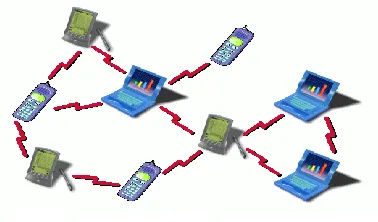
Ad hoc network is a wireless network, which does not have a centralized and fixed infrastructure. MANET [11] is referred to as a wireless ad hoc network in which nodes are free to move arbitrarily and mobile nodes can send and receive the traffic. Also, mobile nodes can behave like routers by forwarding the neighbors traffic to the target node as the routers are multi-hop devices. MANET does not require base stations of wired infrastructure. The mobile nodes in wireless network has wireless interface to communicate with each other because it is a self-organized network. These networks are created by mobile nodes without any fixed infrastructure and central management [1]. The mobile nodes have transmitters and receivers with smart antennas, which enable the mobile nodes to communicate with each others. The topology of the network changes from time to time by arriving in and out of the mobile nodes in the network. In the beginning, MANET was designed for battlefield purpose but now the MANET is employed in many areas such as in disaster-hit areas, data collection in some area, in rescue missions, virtual classes and conferences. By uprising the network, combined with the node mobility the challenges of self-configuration of the network become more evident
Figure 1: MANET
II. RELATED WORK
Dr.S.P.Setty et al. [17] evaluated the performance of DSR under different placement models using QualNet version 5.0 and they concluded that DSR achieved better performance in uniform environment.
shyed Basha shaik et al., [4] evaluated the performance of DSR, AODV, and ANODR routing protocol under grid placement models for different network sizes using QualNet 5.0.2 simulator and concluded that DSR performs well in terms of throughput and packet delivery ratio for all network sizes.
III. ROUTING PROTOCOLS
broadcast; it means the source node sends data packets to all the near and far nodes in the network.
Figure 2. Categorization of Ad Hoc Routing Protocols
A. Proactive Routing Protocols
One of the main characteristics of the Proactive Routing Protocols is that it builds and maintains the information (routing information) to every node in a network whether the route is needed for the sending of traffic or not. Proactive routing protocols [7] continuously sends control messages, even when there is not the flow of data that’s why proactive routing protocols are not bandwidth efficient routing protocols in Mobile Ad hoc Networks (MANETs). These protocols have benefits and drawbacks as well. The main benefit [15] of such type of protocol is that the node can easily get the routing information and a session can easily be established. The drawbacks are that it is not a bandwidth efficient routing protocol; even it will send control messages when there is no flow of data. The other drawbacks can be that for maintenance the nodes will hold too much of data and also restructure process is very slow if a failure occurs in any link
B. Reactive Routing Protocols
When needed to send packets only it began to prepare to send the routing table. When a wireless node needs to send data to another node, the source client node will call a path discovery process [7], and stored in the registers of this path. The path is not valid until the expiration or the occurrence of conditions of the agreement with the first phase of a ratio of such agreements in each node. A smaller amount of data needed, and don’t need to save the entire network environment and the routing information. The main benefit of this agreement is that the use of a lower bandwidth, but the disadvantage is that not every wireless node that sends packets can always quickly
find the path. The path discovery [15] procedure can cause delays and the average delay time is longer
C. Hybrid Routing Protocols
It is an improvement of the proactive and reactive routing protocols, or the combination of other systems, such as global positioning system (GPS) and other equipment, participate in the study of mechanisms to facilitate the routing of the quick search, and data transmission. However, there are already more than 13 kinds of the above routing protocol have been proposed, following the more representative for several separate presentations, and to compare their individual differences lie.
IV. Dynamic Source Routing Protocol (DSR)
The key feature of DSR [1], [2], [3] is the use of source routing. The source knows the complete hop-by-hop route to the target node. These routes are stored in a route cache [12]. The data packets carry the source route in the packet header [5]. It is an on-demand [10] routing protocol and composed of two parts:
A. Route Discovery
B. Route Maintenance.
A. Route Discovery
When a node in the ad hoc network seeking to send a data packet to a target node for which route is not known, it uses a route discovery mechanism to find a route. Route discovery uses simple flooding technique in the network with route request [10] (RREQ) packets. Each node receiving an RREQ rebroadcasts it further unless it is the destination or it has a route to the target node in its route cache. Such a node replies to the RREQ with a route reply (RREP) packet that is routed back to the initiator. RREQ and RREP packets are also source routed. The RREQ builds up the path traversed so far. The RREP routes itself back to the originator by traversing this path backward, the route carried back by the RREP packet is cached at the initiator for future use.
B. Route Maintenance
V. Node Placement Models
Various architectures and node placement models [8] have been developed for Mobile ad hoc networks. We focus on three node placement models for MANET environments in Opnet [13], [14] simulator random node placement, grid node placement, and circular node placement.
A. Random Node placement Model
Random node placement [8], [17] means setting positions of wireless mobile nodes randomly and independently in the target area. Random node placement method is fast in practice though costs a relatively larger number of nodes to achieve the same node placement goal. When practical application scenarios are considered, random node placement is a feasible and practical method, and sometimes it is the only feasible strategy. In this node placement, as shown in Figure 2 each mobile node has the equal probability of being placed at any point inside a given target field. Consequently, the nodes are scattered on locations which are not known with certainty. For example, such a node placement can result from throwing mobile nodes from an airplane.
Figure 3.Random Node Placement
B. Grid Node Placement Model
In Grid Node placement model [4], [8] the mobile nodes are placed as shown in the Fig 4. Node placement starts at 0, 0 and the nodes are placed in a grid format with each node a GRID-UNIT away from its neighbor. GRID-UNIT must be specified numerically, with the unit in meters or degrees, depending on the value of COORDINATE-SYSTEM.
Figure 4. Grid Node Placement
C. Circular Node Placement Model
In circular node placement model, the mobile nodes are placed in a Circular manner.
Figure 5. Circular Node Placement
VI. EXPERIMENTATION
A. OPNET Simulator
We are using the Optimized Network Engineering Tool [5], [6] (OPNET v14.5) for simulation of networks which is one of the most powerful simulation tools regarding wireless communications. OPNET is a research-oriented network simulation tools which provides a development environment for modeling and simulation of deployed wired as well as wireless networks and also provide multiple solutions for managing networks and applications e.g. network operation, planning, research and development (R&D), network engineering and performance management. OPNET 14.5[13] is designed for modeling communication devices, technologies, protocols and to simulate the performance of these technologies. The user can create customized models and simulate various network scenarios [14]. It is possible to simulate various wireless communication technologies such as MANET, 802.11, 3G/4G, WiMAX, Bluetooth, ZigBee using OPNET tool.
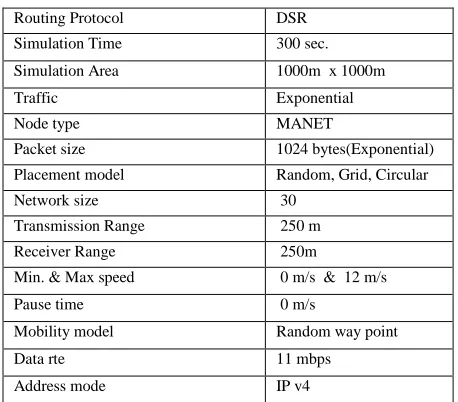
B. SIMULATION SETUP
Table: 1 Simulation parameter values
Routing Protocol DSR
Simulation Time 300 sec.
Simulation Area 1000m x 1000m
Traffic Exponential
Node type MANET
Packet size 1024 bytes(Exponential)
Placement model Random, Grid, Circular
Network size 30
Transmission Range 250 m
Receiver Range 250m
Min. & Max speed 0 m/s & 12 m/s
Pause time 0 m/s
Mobility model Random way point
Data rte 11 mbps
Address mode IP v4
VII. Experimentation Results and Graphical Analysis
A. Throughput: Throughput can be defined as the ratio of the total amount of data reaches a destination from the source. The time it takes by the destination to receive the last message is called as throughput. It is express as bytes or bits per seconds (byte/sec or bit/sec). A throughput with a higher value is more often an absolute choice in every network.
Figure 6. Variation of throughput with different Node placement models.
Table 2: Throughput for different node placement models
Node placement model Throughput (bits/sec)
Random 24,251.03
Grid 19,803.81
Circular 21,140.17
Figure 6 & Table 2 show that the Throughput is Maximum for Random node placement model, minimum for Grid node placement model and moderate for Circular node placement model.
B. Total packets salvaged: When an intermediate node receives a data packet, but however, the next hop along the path of the source route is broken (no acknowledgements received), the intermediate node salvages the packet by rerouting it along a different route to the destination if an alternate route exists in the node's route cache. It represents the total number of packets salvaged by all nodes in the network.
Figure 7. Variation of Packet salvaged with different node placement models.
Table 3: Total Packets Salvaged for different node placement models
Node placement model
Total packets salvaged(Packets)
Random 2.000
Grid 0.000
Circular 1.524
Figure 7 & Table 3 show that the Total Packets salvaged is maximum for Random node placement model, minimum for Grid node placement model and moderate for Circular node placement model.
C. Total replies sent from destination: Once the
destination node receives a route request, it sends a route reply to the source of the request with the entire route discovered. This statistic represents the total number of route reply packets sent from all nodes in the network if they are destinations of route requests.
0.00 5,000.00 10,000.00 15,000.00 20,000.00 25,000.00
Random Grid Circular
T H R O U G H P U T
Node placement models Throughput(bits/sec)
0.000 0.500 1.000 1.500 2.000
Random Grid Circular T
o t a l
P a c k e t s
s a l v a g e d
Node placement models
Figure 8. Total replies sent from destination with different node placement models.
Table 4: Total replies sent from destination for different node placement models
Node placement model Total replies sent from destination
Random 203.00
Grid 140.00
Circular 98.00
Figure 8 & Table 4 Show that the Total replies send from destination is Maximum for Random node placement model than with Grid and Circular node placement models.
VIII. CONCLUSION AND FUTURE SCOPE From the above results, among all node placement models the Random node placement model performs well in terms of Throughput, Packets salvaged and total replies sent from destination for DSR routing protocol. Our future research work will be extended with different network sizes, mobility and pause times.
REFERENCES
[1] D.A.Maltz, D.B.Johnson, “Dynamic Source Routing in Ad hoc Networks”, mobile computing, kulwer Academic publishers,pp.153-181,1996.
[2] D.maltz, Yih-Chun Hu, and David B. Johnson ,“ The Dynamic Source Routing Protocol for Mobile Ad hoc Networks”, http://www.ietf.org/internet-drafts/draft-ietf-manet-dsr-10.txt,IETF Internet draft,19 July 2004.
[3] Y.C.Hu, D.maltz, J. Broch, G.Jetcheva and D.Johnson, “ The Dynamic Source Routing Protocol for Mobile Ad hoc Networks”, Internet –draft, draft-ietf-manet-dsr-05.txt.
[4] Syed Basha shaik and Prof.S.P.Setty, “Performance comparison of AODV,DSR and ANODR for Grid placement model”, International Journal of Computer Applications, Volume 11-No.12(0975-8887),December 2010.
[5] Parulpreet Singh, Ekta Barkhodia, Gurleen Kaur Walia,
Routing Protocol Through Use of OPNET Simulator”,
International Journal Of Distributed And Parallel Systems (IJDPS) Vol.3, No.3, May 2012
[6] FAN Ya-qin et.all, “OPNET-based network of MANET routing protocols DSR Computer Simulation”, 2010 WASE
Internation Conference on Information Engineering
[7] Azzedine Bouke et.all , Routing protocols in ad hoc networks: A survey 55 (2011) 3032–3080
[8] Prof.S.P.Setty, “Performance evaluation of DSR in various placement environments” IJCA special issue on Mobile Ad
hoc Networks,MANETs,2010.
[9] Dr.S.P.Setty et. al, “Performance evaluation of AODV in different environments”, International Journal of Engineering Science and technology,vol.2(7), 2976-2981,2010.
[10] Junaid Arshad Mohammad Ajmal Azad “Performance Evaluation of Secure on-Demand Routing Protocols for Mobile Ad-hoc Networks” 15th IEEE International Conference
on Network Protocols, Beijing, China. 2007.
[11] Saleh Ali K.Al-Omari ,and Putra Sumari, “An over view of mobile ad hoc networks for the existing protocols and applications”. International journal on applications of graph
theory on wireless ad hoc networks and sensor networks (Graph-Hoc) vol.2, No.1, March 2010.(central management) [12] D.Maltz, and D Johnson 1996. “Dynamic Source routing
protocol in Ad Hoc Network” .T.Imielinki and H.Korth, (Eds).
Mobile Computing Ch. 5, Kluwer. [13] OPNET Technologies, http://www.opnet.com
[14] Singh, Ekta Barkhodia, Gurleen Kaur Walia, “Evaluation of various Traffic loads in MANET with DSR routing protocol through use of OPNET Simulator”, International Journal of Distributed and Parallel Systems (IJDPS) Vol.3, No.3, May 2012
[15] David B. Johnson, David A. Maltz, and Josh Broch, “The Dynamic Source Routing Protocol for Multi-Hop Wireless Ad Hoc Networks”, in Ad Hoc Networking, Editor: Charles E.Perkins, Addison-Wesley, Chapter 5, 2001 , pp. 139-172. [16] Charu Sharma, Jaspreet Kaur, “Simulative Analysis Of AODV
Routing Protocol Of MANET Using OPNET Modeler 14.0”, IRJET, Pages 140-143, Vol 2,Issue 3,2015.
[17] K.Narasimha raju and Dr.S.P.Setty, “Performance evaluation of AODV and DSR in Feasible and random placement models”, International Journal of computer science and mobile
computing, IJCSMC,Vol. 3,Issue.7, July 2014,pg.487-498. 0.00
50.00 100.00 150.00 200.00 250.00
Total replies sent
from destination