Int. J. Adv. Res. Sci. Technol. Volume 4, Issue 8, 2015, pp.506-510.
International Journal of Advanced Research in
Science and Technology
journal homepage: www.ijarst.com
ISSN 2319 – 1783 (Print)
ISSN 2320 – 1126 (Online)
Study of the effect of saliva on the static surface tension of water and some soft
drinks using capillary rise method.
J B Yerima*, E I Emmanuel, Simon Solomon and Dikko A. B.
Department of Physics, Modibbo Adama University of Technology, P M B 2076 Yola, Adamawa State Nigeria. *Corresponding Author’s E-mail: [email protected]
A R T I C L E I N F O A B S T R A C T
Article history:
Received Accepted Available online
16 Sep. 2015 01 Nov. 2015 31 Dec. 2015
The effect of saliva on the surface tension of water, Schweppes, Coca-Cola, Fanta and sprite has been measured at 22.50C using capillary rise method. The results show that saliva decreases the surface tension of these liquids with water having the largest % decrease (60.4%) and Fanta the least (29.1%). This implies that when saliva breaks the surface tension of water, the increase in the surface area of the water which fastens digestion is greater than those of the soft drinks. Consequently, water-saliva mixture creates a better medium for digestion and transport of food in the mouth than the soft drinks. It is ascertained that even though water is tasteless and gives lesser comfort and satisfaction to consumers than soft drinks, it still remains the best medium for digestion of food in the mouth.
© 2015 International Journal of Advanced Research in Science and Technology (IJARST).
All rights reserved.
Keywords:
Saliva,
Surface tension, Liquid,
Capillary rise, Digestion.
PAPER-QR CODE
Citation: J B Yerima. et al. Study of the effect of saliva on the static surface tension of water and some soft drinks using capillary rise method,Int. J. Adv. Res. Sci. Technol. Volume 4, Issue 8, 2015, pp.506-510.
Introduction:
In mechanics, liquids occupy a rather peculiar place in the trinity of solid, liquid and gas. Liquids are bodies which have definite volume but do not have elasticity of form or shear modulus. They are distinguished for their strong molecular forces and as a result, low compressibility. The low compressibility of liquids is explained by the fact that a small reduction in the already intermolecular distances causes large intermolecular forces of repulsion. A liquid can easily be identified by the aid of the naked eyes by looking at its colour or smelling its odour using the nose without undergoing laboratory experiment. In the laboratory, liquids of like colour or odour are usually distinguished by studying their properties such as surface tension (Yerima and Ahams, 2011; Yerima and Emmanuel, 2013), activation energy (Yerima et al, 2012), viscosity and density (Yerima et al, 2012), dielectric constant (Yerima et al, 2014) to mention but a few. The molecules of liquids like those of solids are in direct contact but never for a period of time are in the same locations. The molecular units of solids maintain the same average positions unlike those of liquids which are continually jumping and sliding to new ones making
liquids move like gases. This makes the liquid phase a better medium for rapid chemical change that requires intimate contact between the agents undergoing reaction but these agents along with the reaction products must be free to move away to allow new contacts and further reaction to take place. Fluids (liquids and gases) are mobile, that is, they have the ability to move round, change their shape to conform to that of a container, to flow in response to a pressure gradient, and to be displaced by other objects. A liquid differs from a gas because it occupies a fixed volume with the consequence that a liquid possesses a definite surface. The surface is as a result of large density (refractive index) difference between a liquid and the space (air) above it that we can see the surface at all due to the effects of reflection and refraction that occur when light passes across the boundary between two phases differing in density or refractive index.
Int. J. Adv. Res. Sci. Technol. Volume 4, Issue 8, 2015, pp.506-510.
however, and a molecule that finds itself in such a location is attracted to its neighbor below and to either side but there is no attraction operating in the 180o solid angle above the surface. As a consequence, a molecule at the surface will tend to be drawn into the bulk of the liquid. Conversely, work must be done in order to move a molecule within a liquid to its surface. Clearly there must always be some molecules at the surface, but the smaller the surface area, the lower the potential energy. Thus intermolecular attractive forces act to minimize the surface area of a liquid. The geometric shape that has the smallest ratio of surface area to volume is the sphere, so very small quantities of liquids tend to form spherical drops. As the drops get bigger, their weight deforms them into typical tear shape. The imbalance of forces near the upper surface of a liquid has the effect of an elastic film stretched across the surface. Water striders and other insects take advantage of this when they walk across a pond. Surface tension and viscosity are not directly related. Viscosity depends on intermolecular forces within the liquid whereas surface tension arises from the difference in the magnitudes of these forces within the liquid and at the surface. Surface tension always decreases with temperature as the thermal motions reduce the effect of intermolecular attractions. This is one reason why washing with warm water is more effective, the lower surface tension allows water to move readily penetrate a fabric. It is well known that surface tension has many more applications in various aspects of everyday life such as respiration in embryo, digestion of food in the mouth and stomach, design of rain coats and umbrellas, rise of kerosene in the wicks of stoves for cooking and bush lamps for lighting to mention but a few. The applications of surface tension vary from people to people and from place to place. It has been observed that people in Adamawa state in Nigeria consume a lot of water and soft drinks because of the temperate nature of the region. As a result, through personal communications with the consumers of these liquids, some of them said they take them to refresh, satisfy, comfort, please and enjoy themselves especially during their leisure times and after meals. In addition, others said, they take these liquids because of their taste, odor and because they aid digestion making the digestive tract constipation free. It is against this background that in this paper, we have investigated the effect of saliva on the surface tension of these liquids in the mouth. We observed that saliva lowers the surface tensions of these liquids in the mouth with varying degree of lowering being highest for water and least for fanta. We concluded that the higher the degree of lowering of surface tension, the better the liquid, a digestive medium.
Theory of Capillary Rise:
Let us consider a fine capillary tube of uniform radius r with one end dipped in a liquid that wets the walls of the tube. Because of surface tension which acts along the inner circumference of the liquid, the liquid will rise in the capillary tube. The liquid keeps on rising
until the upward force F1 due to surface tension is
balanced by the downward force F2 due to the weight of
liquid.
Since the force due to surface tension is acting at contact angle , the upward force F1 is given by
(Sharma and Sharma, 1999)
where r is the radius of the capillary tube for liquid which wets the wall of the capillary tube.
If the liquid rises to a height h in the tube above the level of the liquid outside, the downward
force F2 is given by
where p is the density of the liquid and g is the gravitational acceleration. At equilibrium, the two forces are equal F1 = F2. Thus
3
But in practice, for most liquids, the contact angle is small, i.e. 1. Thus, equation (3) reduces to
4
Since the surface of the liquid is not perfectly flat it curves up or down at the wall to form a meniscus. The material in this region also contributes to the force of gravity, so one often finds a correction to equation (4) to yield (Yerima and Ahams, 2011)
Comparing equations (4) and (5) yields the correction factor f as
(
) 6
Similarly, comparing equations (3) and (5) yields
and equation (6) becomes
In particular, where r = 0.50 mm and h in mm, equation (7) becomes
( )
(
) 8
Thus equations (5) and (8) can be used to calculate surface tension and contact angle θ respectively.
Methodology:
Int. J. Adv. Res. Sci. Technol. Volume 4, Issue 8, 2015, pp.506-510. et al, 2012). In this paper, the surface tensions of water
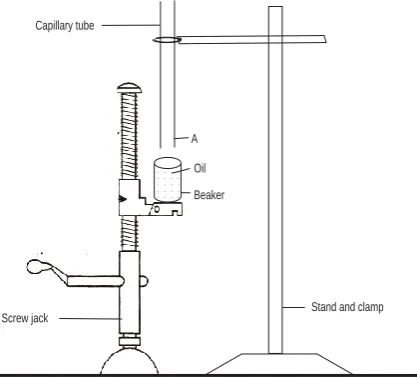
and four soft drinks selected at random and their mixtures with saliva were measured at room temperature of 22.5 oC using the capillary rise technique (Fig. 1).
- - - - - - - - - - - - - - - -
-A
Beaker Oil
Screw jack Stand and clamp Capillary tube
Fig. 1: Schematic diagram for measuring surface tension
The soft drinks used in this work were bought in bottles from Jimeta modern market Yola, Nigeria. A
fixed volume of liquid at known temperature was poured into a beaker and placed on a flat adjustable table directly under a capillary tube of radius, 510-4 m suspended vertically by means of retort stand and clamp. The table was gently adjusted in a way that the beaker of water on it moved upward until the level of water in the beaker coincided exactly with a mark A made on the length of the capillary tube. At this juncture, the height of water, h in the capillary tube due to surface tension was measured using a travelling microscope. The temperature of the water in the beaker was noted at the beginning and end of the experiment and the average recorded. This procedure was repeated for each sample of the liquids. The mass m of a fixed volume v of sample liquid in density bottle was measured using a very sensitive balance and the density ρ=m/v was calculated. The outer diameter, d of the capillary tube was measured in two positions using a travelling microscope and hence its mean radius, r calculated from r = d/2. Using the measured values of h and the calculated values of ρ and r, the surface tension
( ) for a liquid at a given temperature was computed, where g = 9.81 m/s. The contact angle was calculated using the relation (
)
( ), where is the correction factor.
Results and Discussions:
Table: 1. Surface tension of water and soft drinks and their mixtures with saliva at 22.5 oC
Liquid/Mixture h (mm) M (g) ρ(g/cm3) γ (mN/m) PH θo Δγ (%) ΔPH (%)
Water 19.7 42.2 1.055 50.92 7.8 7.4
60.43 5.1 Water + Saliva 8.0 46.3 1.028 20.15 7.4 11.6
Coca-Cola 13.9 42.8 1.070 36.44 4.3 8.8
44.07 11.6 Coca-Cola+ Saliva 8.0 46.8 1.040 20.38 3.8 11.6
Fanta 16.8 43.5 1.088 44.78 3.5 8.0
29.14 8.6 Fanta + Saliva 12.3 47.4 1.053 31.73 3.2 9.4
Sprite 17.0 45.4 1.135 47.27 4.1 8.0
31.84 26.8 Sprite + Saliva 12.0 49.3 1.096 32.22 3.0 13.4
Schweppes 18.9 43.9 1.097 50.80 2.2 7.6
48.53 22.7 Schweppes + Saliva 10.0 48.0 1.067 26.14 1.7 10.4
In Table 1, the meaning of symbols are: h is the height, M is mass, ρ is the density, γ is surface tension, Δγ is change in γ, PH is H+ concentration, ΔPH change
in PH and θ is the contact angle of liquid/mixture. The results in Table 1 show that 5 ml of saliva mixed with 40 ml of each of the liquid samples decreases the height of the capillary rise/surface tension, density and PH of the liquids as opposed to contact angle. It is known that every liquid surface always tend to acquire minimum surface area due to surface tension thereby hindering the liquid to spread out with ease. Consequently, small surface area of the liquid is not good environment for digestion of food in the liquid state. When the surface tension is reduced or broken, the liquid spread out
providing larger surface area a good environment for digestion of food. For example, saliva has been found to decrease surface tension of water and soft drinks. This implies that when saliva mixes with these liquids in the mouth, it decreases their surface tension thereby increasing their surface areas which aid digestion to be faster in the mouth.
Int. J. Adv. Res. Sci. Technol. Volume 4, Issue 8, 2015, pp.506-510.
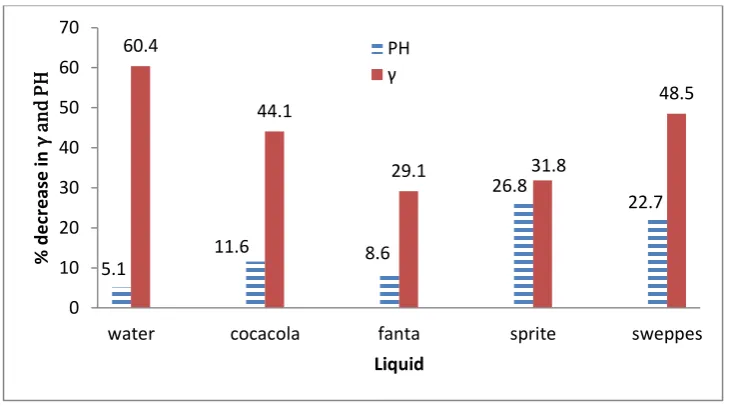
Fanta respectively are 60.4%, 48.5%, 44.1%, 31.8% and 29.4%. This implies that the higher the percentage decrease in surface tension of liquid due to Saliva, the greater the increase in surface area of the liquid and hence the better is the liquid mixture with saliva as a digester. Therefore, in this light, water-saliva mixture has the highest digestive effect and Fanta-saliva mixture
has the least. Arranging the liquids in ascending order of digestive effect in the mouth we have water, Schweppes, Coca-Cola, sprite and Fanta. In terms of contact angle, the reverse is the case since decrease in surface tension of the liquids due to saliva increases the contact angle.
Fig. 2: Percentage decrease in surface tension and PH of liquids
In Table 1, the percentage decrease in PH of these liquids due to saliva may be attributed to the presence of enzymes in the saliva. In Fig.2, the % decrease in descending order of PH of sprite, Fanta, Schweppes, Coca-Cola and water respectively are 26.8%, 22.7%, 11.6%, 8.6% and 5.1% are different from that of surface tension. On the other hand, the decrease in PH of these liquids due to saliva is also important because PH plays a crucial role in a normal functional digestive tract. It has been found that in the mouth PH is typically about 6.8 a very week acid. Most digestive enzymes are sensitive to PH and would not function in a low PH environment like the mouth. The role PH acidic or base plays can be better explained in the light of chemistry. There seems no clear correlation between PH and surface tension as well as their percentage decrease. The reason may be that because PH is a chemical property while surface tension is a physical property of liquid.
Conclusion:
The study of the effect of saliva on the surface tension of water, four soft drinks (Schweppes, Coca-Cola, Fanta and sprite) and their mixtures with saliva using capillary rise method has been carried out. The PH of the liquids and their mixtures with saliva was also measured using PH meter. The results show that saliva decreases both the PH and surface tension of these liquids but no definite correlation between PH and surface tension. The absence of standard correlation between PH and surface tension may be attributed to the fact that PH is chemical property while surface tension is physical property of the liquids. It has been observed
that saliva reduces or breaks the surface tension of these liquids by creating larger surface area thereby paving more room for digestion to take place in the mouth. It has been found that water-saliva mixture is the best medium for digestion and transport of food in the mouth and Fanta-saliva mixture the least. In case of soft drinks, Schweppes-saliva mixture appears to be the best medium and sprite-saliva mixture the least. The reason for Schweppes to be the best among the soft drinks may be due to the presence of phosphate acid which gives it low PH. Generally, the decrease in the surface tensions of soft drinks is less than that of water because they contain extra carbonated water sugar which enzymes of the saliva has to break during digestion process in the mouth.
References:
1.Addison C C (1945) The measurement of surface and interfacial tensions at fresh Surfaces by vibrating jet method. Philosophical mag. 36, 253, 73
2.Bendure R L (1971) Dynamic surface tension determination with the maximum bubble Pressure method, Colloid and interface Sci., 35, 2, 238
3.Bogaert R and Joos P (1979) Dynamic surface tensions of sodium myristate solutions. Phys. Chem... 83, 17, 224 4.Rakshit P C (1997) Physical chemistry, 4th edition,
Calcutta 4th reprint, P M Bagchi, Modern book agency private limited, 88
5.Sharma K K and Sharma L K (1999) A textbook of physical chemistry, Vikas Publishing House, New Delhi, India, 151
6.Yerima J B (2005) A review of thermodynamics of viscous flow of some Nigerian vegetable Oils. The Nigerian academic forum Akwa, Nigeria, 8, 1, 29-34
5.1
11.6 8.6
26.8
22.7 60.4
44.1
29.1 31.8
48.5
0 10 20 30 40 50 60 70
water cocacola fanta sprite sweppes
%
d
e
cr
e
ase
in
γ
an
d
PH
Int. J. Adv. Res. Sci. Technol. Volume 4, Issue 8, 2015, pp.506-510. 7.Yerima J B and Ahams S T (2011) Economic importance
of some Nigerian household Commercial detergents in washing process using surface tension capillary rise method. Adamawa State University, Journal of Scientific Research. 1, 1, 224
8.Yerima J B, J SMadugu, S K Singh and S T Ahams (2012) Investigation of the reliability of activation energy in the stability of viscosity-temperature model. Adamawa state University, Journal of scientific research,
2, 2, 102-108