Copyright © 2012 IJECCE, All right reserved
Simulation Based: Study and Analysis of Routing
Protocol in Vehicular Ad-hoc Network Environment
Mrs. Vaishali D. Khairnar Research Scholar CSE
Institute of Technology, Nirma University–Ahmedabad, India Associate Professor & HOD (IT Dept.)
Terna Engineering College–Mumbai, India Email:[email protected]
Dr. S. N. PradhanProfessor CSE, Institute of Technology Nirma University–Ahmedabad, India
Email:[email protected]
Abstract - A Vehicular Ad hoc Network (VANET) consists
of vehicles which communicate with each other and exchange data via wireless communication links available between the vehicles which are in communication ranges of vehicles to improve the road safety in city. The communication between vehicles is used to provide road safety, comfort and entertainment. The performance of communication depends on how better routing takes place in the network. Routing data between the source and destination vehicle depends on the routing protocols being used in vehicular ad-hoc network. In this simulation based study we investigated about different ad hoc routing protocols for vehicular ad-hoc network (VANET). The main goal of our study was to identify which ad hoc routing protocol has better performance in highly mobile environment of vehicular ad-hoc network. We have measured the performance of routing protocols using 802.11p in vehicular ad-hoc network in which we considered the scenario of city (i.e. Route between Nerul and Vashi) where we have take 1200 different types of vehicles and checked their performance. Routing protocols are selected after the literature review. The selected protocols are then evaluated through simulation under 802.11p in terms of performance metrics (i.e PDR & E2E delay).
Key Word - PDR, V2V, VANET, E2E delay etc.
I. I
NTRODUCTIONAs the sharp increase of vehicles on roads in the recent years, driving has not stopped from being more challenging and dangerous [1]. Roads are saturated, safety distance and reasonable speeds are hardly respected, and drivers often lack enough attention. Without a clear signal of improvement in the near future, leading car manufacturers decided to jointly work with national government agencies to develop solutions aimed at helping drivers on the roads by anticipating hazardous events or avoiding bad traffic areas. One of the outcomes has been a novel type of wireless access called Wireless Access for Vehicular Environment (WAVE) dedicated to vehicle-to-vehicle and vehicle-to-roadside communications. While the major objective has clearly been to improve the overall safety of vehicular traffic, promising traffic management solutions [1-2].
Equipped with WAVE communication devices, cars units form a highly dynamic network called a Vehicular Ad Hoc Network (VANET), which is a special kind of Mobile Ad-Hoc Networks (MANETs). While safety applications mostly need local broadcast connectivity, developed for intelligent transportation systems (ITS) would benefit from unicast communication over a
multi-hop connectivity. Moreover, it is conceivable that applications that deliver contents and disseminate useful information can flourish with the support of multi-hop connectivity in VANETs. Although number of routing protocols has been developed in MANETs, all do not apply well to VANETs. VANETs represent a particularly challenging class of MANETs. They are distributed, self-organizing communication networks formed by moving vehicles, and are thus characterized by very high node mobility and limited degrees of freedom in mobility patterns [3-5].
II. O
VERVIEW OFIEEE 802.11P P
ROTOCOLIEEE 802.11p is applied in the VANET – it is more expensive but able to send data over medium distances and to distribute the information in geographical regions via multi-hop communication fig.1.
IEEE 802.11p is a draft amendment to the IEEE 802.11 standard dedicated to vehicular environments. It is derived from IEEE 802.11a standard, but PHY and MAC layers are modified to support low-latency communication among vehicles. IEEE 802.11p operates at a frequency band specifically allocated for road safety, such as 5.850– 5.925 GHz (75 MHZ) in the US and 5.875–5.90 GHz (30 MHz) in Europe with possible future extension, defines data rates from 3 to 27 MHz for 10 MHz channels (optionally 6 to 54 MHz for 20 MHz channels), OFDM modulation and maximum power levels of 44.8dBm. The basic MAC is the same as the well known IEEE 802.11 Distributed Coordination Function (DCF). It adopts concepts from Enhanced Distributed Channel Access (EDCA) of 802.11e, like Access Category (AC) and Arbitrary Inter-Frame Space (AIFS), in order to differentiate priorities among applications.
IEEE 802.11p is designed as a multi-channel scheme, where nodes can switch between channels (US) or transceive on multiple channels simultaneously (dual transceiver in Europe). For advanced networking algorithms, we use standard-compatible extensions to control radio parameters (transmit power and others) on a per-packet basis [13-16].
Copyright © 2012 IJECCE, All right reserved
III. R
OUTINGP
ROTOCOLS INV
EHICULARA
D-H
OCN
ETWORKSF
ORM
ESSAGES
CATTERINGMovements of vehicles are described in the form of distinct clusters, which is also an observable scene. Therefore, V2V communication within a single group of vehicles depends on the range of wireless coverage being used; commonly deal with physical aspects of the networks. When it comes to the internetworking, more generic - inter-cluster communication, where source vehicle from a group is unreachable in contact with destination vehicle from other (could be same) group creates the communication discontinuity. To overcome the problem like these terminations, various routing protocols are employed for continuous V2V communication manageability purposes. Hence, the concept of hopping where destinations achieved by mean of relaying on other intermediate node is used specifically.
The various experimentations done have identified that the popular Mobile ad-hoc network (MANET) routing protocol AODV is not much suitable for Vehicular ad-hoc network (VANET) environment. Therefore they have proposed its modified version considering its core parameter- direction - as a focal point for route discovery and named it as DAODV. This proposed algorithm via theoretical simulation results has shown the reduction of overall overhead of route discovery than AODV in comparison of highly performance measures. The results like recovery from broken links and route expiration time are improved with respect to number of hops, nodes, and speed with the projected version. The logical aspect of the intended protocol is only positive while focusing on a particular mobility model for example, Manhattan, in this case. Whereas, there are diversified models available depending on their mobility constrains which need to be plotted for generic acceptance of DAODV.
An application oriented study done by NEC Europe researchers for analyzing the networks mobility and their deployable ability approaches in VANET environment. The convergence of IP mobility and Network mobility within VANET is clearly highlighted with the term “VANEMO”. It differentiates the related applications of VANETs by mean of “safety” and “non-safety” grouping with classifications into economical and functional performances, and deploy ability requirements. The two main approaches of connectivity i.e. MANET-centric and NEMO-centric are discussed. With previous approach (which agrees the scope), mobile nodes communicate with each other by utilizing MANET layer for ad hoc routing protocols towards NEMO for high end (infrastructure) connectivity. The latter approach is directly connecting the physical layer of nodes with the NEMO layer. This difference is required to maintain the connectivity tasks of safety (reliable) and non-safety (general ad hoc) applications within different mobility scenarios. Similarly, the application aspect of public safety issues in transportation system and how to mitigate the cases of accident (through chain collision) cases by using vehicle to vehicle communication paradigm are discussed. The major concepts discussed are of Cooperative Collision
Avoidance (CCA) with the help of Wireless Collision Warning Messages (W-CWM) concept. After analyzing various levels of connections establishment through MAC level and respective scheduling protocols, a conclusive remark for broadcast oriented approach with data packet forwarding on geographical and temporal context being preferred. In regard of safety application known doubts, such preferable measures are required for possible connectivity but these may be exposed to security concerns. The given pseudo code with plotted graphs show impressive outputs, whether applicable for an unpredicted case is not identified. The analysis of routing protocols analyzes two location-based routing protocols. The scope of this work is limited to SIFT (Simple Forwarding over Trajectory), and DREAM (Distance Routing Effect Algorithm for Mobility) routing mechanisms. To make a realistic approach like most of the VANET researchers prefer, a real mobility model already discussed which is used for carrying a comparative simulation study. According to similar author’s view point, routing schemes for actual ad hoc networks (MANET) are not suitable for vehicular ad hoc networks (VANET). Hence the location-based schemes like SIFT and DREAM are more appropriate for such scenarios for enhanced efficiency. Further within these schemes certain issues like low-connectivity zone, spatial-awareness, and other are discussed and studied through simulations. At the end of conclusive remark, SIFT wins the game for efficiently resolving these issues. In addition, the considerations of routing in large scale are further studied.
With the help of all these major interrelated sections of mobility and routing explored in this literature review, a formal methodology be derived to consider the overall aspects of mobility and reliability with different VANET routing schemes in a pragmatic simulation environment with the help of NS2. Depending on this study, there are various routing protocols which are proposed with their suitability in MANET and VANET perspectives. After careful consideration, following are some chosen ones for the selected of city and expressway density levels of this study:
DSDV: Destination-Sequence Distance-Vector is a table driven routing protocol where every node maintains a table of information (which updates periodically or when change occurred in the network) of presence of every other node within the network. Any change in network is broadcasted to every node of the network.
AODV: Ad hoc On-demand Distance Vector an improved version of DSDV, as its name suggest, establishes the route only when demanded or required for the transmission of data. By this mean, it only updates the relevant neighboring node(s) instead of broadcasting every node of the network i.e. it does not make source routing to the entire node for the entire network.
Copyright © 2012 IJECCE, All right reserved DSR: Dynamic Source Routing, maintains the source
routing, in which, every neighbor maintains the entire network route from source to the destination [6-12].
IV. I
MPLEMENTATIONM
ETHODOLOGYVehicular Ad Hoc Network (VANET) and its related research studies are still in progression phases. The limited practical deployable options under different projects are purely simulation based before their actual implementations in the real scenarios. The list of all projects along with some related developments could be found in (VANET Projects). For this purpose, we adopted methodology for the results of this research work is based on SUMO (the helping tool for traffic mobility patterns generation for network simulator is used) and NS-2.34 simulation near to the real time packages using 802.11p protocol as shown in fig.2.
Fig.2. Flow Methodology
V. O
BSERVATIONSThe main observation factors are related with the calculations of particular routing metrics. They identify
the accumulated results from the output trace files which are generated by the simulator upon their specified inputs from mobility and traffic files. There are various routing metrics devised in different literatures to signify the importance and measuring purposes of numerous routing protocols. Realistic Traces, complete surveys along with the taxonomy of these metrics with their particular classifications. The two highly discussed metrics which are very useful in differentiating the performing trends of routing; and specially picked by similar assessments of such protocols while analyzing ns-2 traces are used for results generation in this research project. They are “Packet Delivery Ratio / Packet Delivery Fraction” and “Average End-to-End Delay”.
Packet Delivery Ratio (PDR): It is the fraction of packets generated by received packets. That is, the ratios of packets received at the destination to those of the packets generated by the source. As of relative amount, the usual calculation of this system of measurement is in percentage (%) form. Higher the percentage, more privileged is the routing protocol.
Average End-to-End Delay (E2E Delay): It is the calculation of typical time taken by packet (in average packets) to cover its journey from the source end to the destination end. In other words, it covers all of the potential delays such as route discovery, buffering processes, various in-between queuing stays, etc, during the entire trip of transmission of the packet. The classical unit of this metric is millisecond (ms). For this metric, lower the time taken, more privileged the routing protocol is considered.
VI. S
IMULATIONR
EULTSThe navi-mumbai city model is considering the road patterns according to real scenarios. The specified regions are from the Google Maps which are transferred as input to SUMO (traffic Simulator) and then through TraNS interface the input is given to Network Simulator as shown in fig.3
Fig.3.
To study and analyze the selected routing protocol behavior while disseminating data between inter-vehicle communications, an approach of density formulation among traffic flow is used. For this reason, navi-mumbai city scene is further sub-classified on the basis of their participating vehicles in a low, medium, and high density phases.
Copyright © 2012 IJECCE, All right reserved
Variable Value
Simulation Time 1000 s
Routing Protocols AODV, AOMDV, DSR, DSDV No. of Vehicles 11, 60, 1218
MAC Layer 802.11p Traffic Type UDP
Navi-Mumbai City Low Density
AODV AOMD
V
DSR DSDV
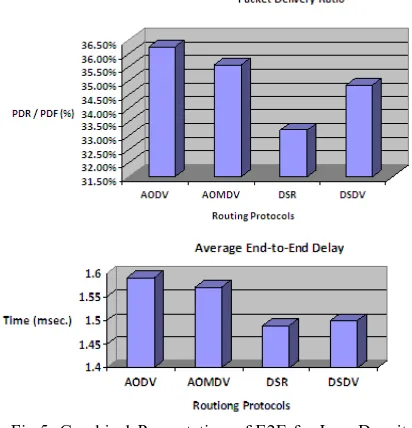
PDR / PDF 36.24 % 35.58 % 33.20 % 34.85 % E-2-E Delay 1.59 ms 1.57 ms 1.49ms 1.50 ms
Navi-Mumbai City Low Density
AODV AOMDV DSR DSDV Packet Loss (%) 56.97% 63.34 % 1.26 % 64.86 % NRL (%) 0.09 % 0.46 % 0.11 % 0.00 % Packets
Dropped
3756 4176 2653 4345
Packets Send 6593 6593 4864 6593
Packets Received
2389 2293 1761 2232
Routing Packets
215 1060 192 0
Average Throughput (Kbps)
326.37 313.26 324.98 305.13
Start Time (secs)
10.01 10.01 10.01 10.01
Stop Time (secs)
40.00 40.00 32.21 39.98 navi-mumbai city model, the common variables defined are shown in Table 1 below:
Table 1: Common variables in navi-mumbai city model
6.1 Low Density Model
Simulation Parameters: The low density model along with previous common parameters comprises of 11 vehicles nodes. These nodes are deployed and arranged according to the provided patterns of mobility traces with a maximum of 8 intercommunication connections.
Simulation Results: The analyzed results from the particular trace file of the navi-mumbai city low density Vehicular Ad-hoc Network scenario are assessed on the basis of two metrics of routing protocol i.e.“PDR / PDF” and“Average E2E Delay”. The outputs of their numerical calculations are placed in Table 2.
Table 2. Analyzed data of Navi-Mumbai city low density
Fig.4. Graphical Presentation of PDR for Low Density Model in Navi-Mumbai City
Fig.5. Graphical Presentation of E2E for Low Density Model in Navi-Mumbai City
Fig.6. Graphical Presentation of Data Delivery Status for Low Density Model in Navi-Mumbai City
Fig.7. Graphical Presentation of Total Packet Loss for Low Density Model in Navi-Mumbai City
Fig.8. Graphical Presentation of Throughput Vs Routing Protocol for Low Density Model in Navi-Mumbai City 6.2 Medium Density Model
Copyright © 2012 IJECCE, All right reserved Navi-Mumbai City Medium Density
AODV AOMDV DSR DSDV
PDR / PDF
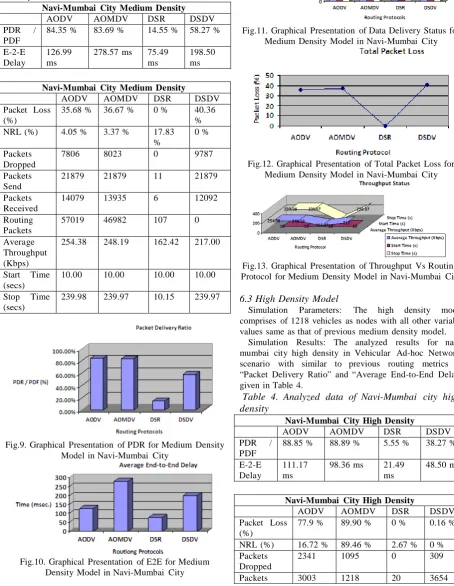
84.35 % 83.69 % 14.55 % 58.27 %
E-2-E Delay
126.99 ms
278.57 ms 75.49 ms
198.50 ms
Navi-Mumbai City High Density
AODV AOMDV DSR DSDV
PDR / PDF
88.85 % 88.89 % 5.55 % 38.27 %
E-2-E Delay
111.17 ms
98.36 ms 21.49 ms
48.50 ms
Navi-Mumbai City High Density
AODV AOMDV DSR DSDV
Packet Loss (%)
77.9 % 89.90 % 0 % 0.16 %
NRL (%) 16.72 % 89.46 % 2.67 % 0 % Packets
Dropped
2341 1095 0 309
Packets 3003 1218 20 3654
Simulation Results: The analyzed numerical results for navi-mumbai city medium density for Vehicular Ad-hoc Network scenario from the generated trace files for individual routing protocols are given in Table 3 (below). Table 3. Analyzed data of Navi-Mumbai city medium density
Navi-Mumbai City Medium Density
AODV AOMDV DSR DSDV
Packet Loss (%)
35.68 % 36.67 % 0 % 40.36 % NRL (%) 4.05 % 3.37 % 17.83
%
0 %
Packets Dropped
7806 8023 0 9787
Packets Send
21879 21879 11 21879
Packets Received
14079 13935 6 12092
Routing Packets
57019 46982 107 0
Average Throughput (Kbps)
254.38 248.19 162.42 217.00
Start Time (secs)
10.00 10.00 10.00 10.00
Stop Time (secs)
239.98 239.97 10.15 239.97
Fig.9. Graphical Presentation of PDR for Medium Density Model in Navi-Mumbai City
Fig.10. Graphical Presentation of E2E for Medium Density Model in Navi-Mumbai City
Fig.11. Graphical Presentation of Data Delivery Status for Medium Density Model in Navi-Mumbai City
Fig.12. Graphical Presentation of Total Packet Loss for Medium Density Model in Navi-Mumbai City
Fig.13. Graphical Presentation of Throughput Vs Routing Protocol for Medium Density Model in Navi-Mumbai City
6.3 High Density Model
Simulation Parameters: The high density model comprises of 1218 vehicles as nodes with all other variable values same as that of previous medium density model.
Simulation Results: The analyzed results for navi-mumbai city high density in Vehicular Ad-hoc Networks scenario with similar to previous routing metrics of “Packet Delivery Ratio” and“Average End-to-End Delay” given in Table 4.
Copyright © 2012 IJECCE, All right reserved Send
Packets Received
160 125 18 404
Routing Packets
2676 1180 150 0
Average Throughput (Kbps)
5.95 324.40 2.12 16.55
Start Time (secs)
10.00 10.00 10.00 10.00
Stop Time (secs)
125.70 11.58 8.50 126.30
Fig.18. Graphical Presentation of Throughput Vs Routing Protocol for High Density Model in Navi-Mumbai City
VII. C
ONCLUSIONFig.14. Graphical Presentation of PDR for High Density Model in Navi-Mumbai City
Fig.15. Graphical Presentation of E2E for High Density Model in Navi-Mumbai City
Fig.16. Graphical Presentation of Data Delivery Status for High Density Model in Navi-Mumbai City
Fig.17. Graphical Presentation of Total Packet Loss for High Density Model in Navi-Mumbai City
In this report I would like to conclude that I have taken the real city scenario and tried to run 1200 vehicles in an hour and 20,000 to 22,000 in a day and check the results using simulators. We have used different simulators to obtain the results and send the data between inter-vehicle properly according to the incident occurred on road which helps in avoiding accidents and traffic jam and also we have tried to analysis the best routing protocol which will help us to send our data and give better performance. So the results obtain DSR routing protocol using DSRC/IEEE 802.11p gives use better performance results to send our own message according to the event occurred. We have also checked the results on national highway where in a day 24,000 vehicles pass through the express highway and V2V communication using DSRC/IEEE 802.11p and also using DSR routing protocol gives better performance results as compared to other routing protocols. In future we may increase the strength of vehicles in city and on national/express highway and check the results and also provide other information to the vehicle operators (i.e. nearest petrol pumps, hotels etc.)
A
CKNOWLEDGMENTI like to thank all my family, friends, relative and colleagues who helped me to complete my work and also helped me to publish this paper.
R
EFERENCES[1] K.C.Lee, U.Lee,“Survey of Routing Protocols in Vehicular Ad-hoc Networks”2010.
[2] J.M.Shaikh,“A Comparative Analysis of Routing Protocols in VANET Environment using Realistic Vehicular Traces”. June 2010.
[3] Lee, K., Le, M., Haerri J., and Gerla, M. (2008), “Louvre: Landmark overlays for urban vehicular routing environments,” Proceedings of IEEE WiVeC, 2008.
[4] Lee U., Cheung R., Gerla, M., “Emerging Vehicular Applications,”Chapter 9 of Vehicular Networks: From Theory to Practice, Chapman & Hall/Crc Computer and Information Science Series, March 17, 2009.
[5] Mehran A. et al. (2004), “A review of routing protocols for mobile ad hoc networks,”in Ad Hoc Networks, Vol.2 pp.1-22, 2004.
[6] Djenouri, D., W. Soualhi, VANET's Mobility Models and Overtaking: An Overview, 3rd International Conference on Information and Communication Technologies: From Theory to Applications, ICTTA 2008.
Copyright © 2012 IJECCE, All right reserved [8] Biswas, S., R. Tatchikou, "Vehicle-to-vehicle wireless
communication protocols for enhancing highway traffic safety," Communications Magazine, IEEE 44(1): 74-82.
[9] Rainer, B., A Survey on Routing Metrics, TIK Report 262, Computer Engineering and Networks Laboratory, ETH-Zentrum, Switzerland, February 10, 2007.
[10] Perkins, C., Belding, E., and Das, S. 2003, Ad hoc On-Demand Distance Vector (AODV) Routing. Request for Comments: 3561.
[11] Mahesh, K. and R. Samir, Ad hoc on-demand multipath distance vector routing, Computer Science Department, University of California, Los Angeles, CA 90095-1596, U.S.A.
[12] Garcia de la Fuente, M. and H. Labiod, Performance analysis of position-based routing approaches in VANETS, 9th IFIP International Conference on Mobile Wireless Communications Networks
[13] Car-to-Car Communication Consortium, “C2C-CC Manifesto, Version 1.1,”August 2007, http://www.car-to-car.org. [14] US Vehicle Safety Communications (VSC) Consortium, ,”
http://www-nrd.nhtsa.dot.gov/pdf/nrd-12/CAMP3/pages/VSCC.htm.
[15] “Vehicle Infrastructure Integration (VII),” http://www.its.dot.gov/vii/.
[16] IEEE,“Wireless Access in Vehicular Environments (WAVE). IEEE 802.11p Draft Version 4.0.,”March 2008
AUTHOR’SPROFILE
Mrs. Vaishali D. Khairnar
She has completed B.E. in Computer from North Maharashtra University, M.E. in Information Technology from Mumbai University and Pursuing Ph.D in Computer Engineering from Institute of Technology-Nirma University, Ahmedabad India under the guidance of Dr. S. N. Pradhan. Total academic experience 13 years. She has also worked with Symbiosis Institute of Technology-Pune, India as HOD (IT/CS Dept.) and currently associated with Terna Engineering College - Mumbai University, India as Associate Professor and HOD of Information Technology. Her area of interest are Networking, Wireless Technology, Mobile Computing, MANET and VANET etc. Total 12 paper published in National/ International Conference and Journal.
Dr Shrikant N. Pradhan
Dr. S. N.Pradhan is Ph.D in Computer Science. He worked as a Scientist at PRL, Ahmedabad, India for 25 years. He is associated with academic fiels since last 10 years. His area of interest are Embedded System, Image Processing, Signal Processing, Networking, Ad-hoc Senor Network and