S O F T W A R E R E V I E W
Open Access
Bio-samtools: Ruby bindings for SAMtools, a
library for accessing BAM files containing
high-throughput sequence alignments
Ricardo H Ramirez-Gonzalez
1, Raoul Bonnal
2, Mario Caccamo
1and Daniel MacLean
3*Abstract
Background: The SAMtools utilities comprise a very useful and widely used suite of software for manipulating files and alignments in the SAM and BAM format, used in a wide range of genetic analyses. The SAMtools utilities are implemented in C and provide an API for programmatic access, to help make this functionality available to
programmers wishing to develop in the high level Ruby language we have developed bio-samtools, a Ruby binding to the SAMtools library.
Results: The utility of SAMtools is encapsulated in 3 main classes, Bio::DB::Sam, representing the alignment files and providing access to the data in them, Bio::DB::Alignment, representing the individual read alignments inside the files and Bio::DB::Pileup, representing the summarised nucleotides of reads over a single point in the nucleotide sequence to which the reads are aligned.
Conclusions: Bio-samtools is a flexible and easy to use interface that programmers of many levels of experience can use to access information in the popular and common SAM/BAM format.
Keywords: Next-generation sequencing, DNA, High, Throughput, Ruby, Bio, SAM, BAM
Background
High-throughput DNA sequencing in the biological sci-ences has made it possible for researchers to obtain many millions of sequence reads in single, low-cost experi-ments. These sequence reads are typically very short compared to the parent genome (reads will usually be in the range of 36 - 200 nucleotides long while genomes are many millions of nucleotides long) and very redun-dant; many reads may have the same sequence. One widespread use for these sequences is in detecting small differences in the genome sequence of the sample donor, which is achieved by using computational methods to align each short sequence read against a long, reference genome sequence then examining the derived alignments and determining positions at which there are differences. Many programs have been created for alignment includ-ing BWA [1], Bowtie [2], SOAP [3], NOVOALIGN [4]
*Correspondence: [email protected]
3The Sainsbury Laboratory, Norwich Research Park, Colney Lane, Norwich, NR4 7UH, UK
Full list of author information is available at the end of the article
and BFAST [5], each implementing different algorithms optimised to address different issues with the alignment problem. Most high-throughput alignment programs pro-duce a standard output file in Sequence Alignment/Map format (SAM) [6], a tab-delimited text-based format for describing alignments. The SAMtools utilities comprise a very useful and widely used suite of software for manipu-lating files and alignments in the SAM format. The large SAM files can be converted to the binary equivalent BAM files a compressed and indexed variant for random access, which vastly facilitates genetic analyses that rely on high-throughput alignment. The SAMtools utilities are imple-mented in C and provide an API for programmatic access, for which there are multiple language bindings, notably in Perl [7], Python [8] and Java [9]. Here we describe the Ruby language binding to the SAMtools library, devel-oped for our own work and distributed as a BioRuby plug-in [10].
Implementation
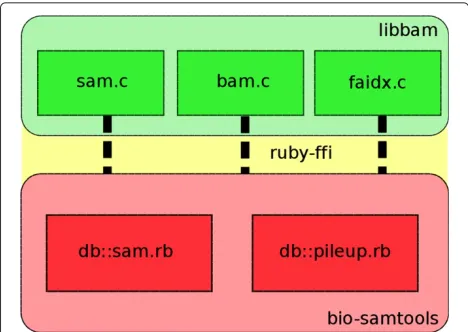
The bio-samtools package is a wrapper around libbam.so (for Linux) and libbam.1.dylib (for Mac OS X), the core shared object library from the SAMtools package. To make it possible for the C functions in libbam to be called from within Ruby code we have used the Ruby Foreign Function Interface (FFI) [11] package as a bridge between the two languages. The flexible FFI package can pro-gramatically load dynamic libraries and bind functions without the need to make changes to Ruby itself or to recompile any extensions, so our package can easily run on standard Ruby interpreters without installation and compilation issues beyond that of the normal Ruby gem installation. Importantly, FFI also has useful methods for managing memory, pointers, structs and binary fields are converted to Ruby boolean variables. A further advantage of using FFI is that the binding is compatible with both the standard Ruby interpreter Matz’s Ruby Interpreter (MRI) and the alternative Java implementation of the Ruby lan-guage (JRUBY). By wrapping SAMtools in this way the scientist may use the high level easily learned and fast to develop with Ruby that facilitates quick development rather than the native C of SAMtools. bio-samtools hides the low-level API completely making bio-samtools a use-ful and easily used tool for working with Next-Generation Sequencing data in BAM files. Each .c library from the SAMtools API is represented by a separate Ruby module mapping the C functions (Figure 1), which are unified in the class Sam.
Bio::DB::Sam
The main object representing the SAM/BAM file is a Bio::DB::Sam object. Objects of class Sam, have several attributes and methods, summarised in Table 1. Most of the attributes relate to the alignment file type and
Figure 1bio-samtools and its relationship to the underlying libbam.Green boxes indicate C source code in libbam, red boxes indicate Ruby files that interact the Ruby FFI represented in yellow.
the location of the BAM file in the file system. The BAM file itself is not held in the object or Ruby mem-ory, rather the Ruby wrapping is used to access the information via the C API. The methods of the Sam object can be divided into utility methods that affect the BAM files, (#sort and #merge), retrieval meth-ods that return objects of other classes representing individual read alignments (#fetch, #fetch with function) and summary methods (#average coverage, #chromo-some coverage and #mpileup,#index stats).
Bio::DB::Alignment
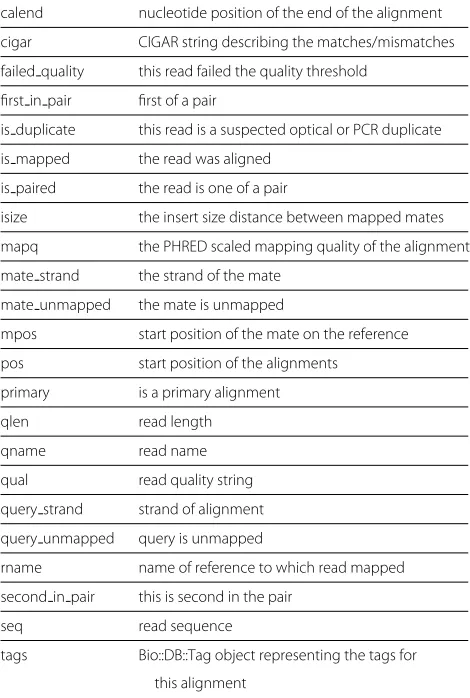
The fetch and fetch with function method of the Bio::DB::Sam object return individual alignments one at a time from an iterator. The individual alignments represent a single read and its mapping to the refer-ence and are Bio::DB::Alignment objects, whose attributes are described in Table 2. These attributes are derived directly from the SAM format definition [6]. The fetch with function method is distinct from fetch in that it allows the user to pass a Ruby Proc object or a block. These are functionally equivalent to closures in other languages and provide advantages in terms of encapsu-lation and often speed compared to the standard block based equivalent, advanced Ruby programmers are likely to appreciate this feature.
Bio::DB::Pileup
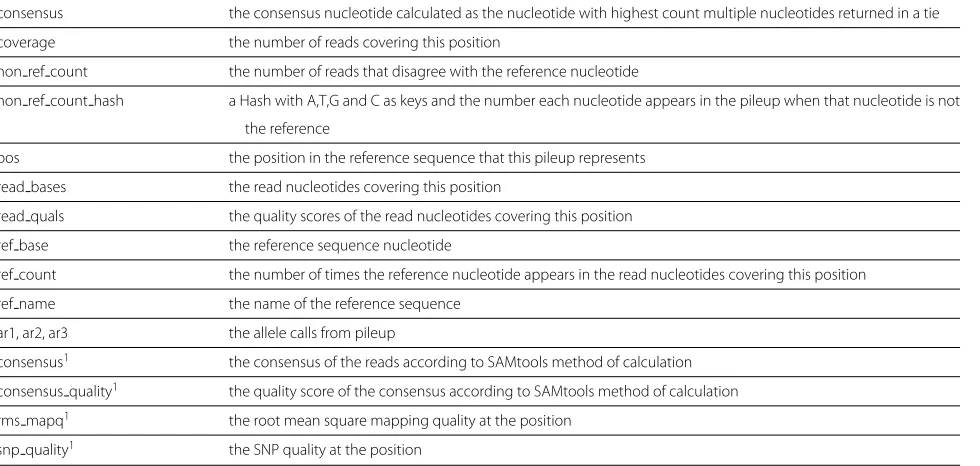
The pileup format is a straightforward way of structuring alignments over single positions for the easy identification of genetic polymorphisms, the format has a long history and has been in use in SAMtools for a while. The orig-inal ’pileup’ function has recently been deprecated and removed in favour of ’mpileup’. The output from mpileup is exactly equivalent to the pileup command called with-out the -c flag set, that is to say the six column format. The class Pileup can parse the old ten column pileup for-mat if an instance is created manually by passing it a raw line from the pileup file. Calling the mpileup method of a SAM object results in the return of a stream of Pileup [12] objects, which have the attributes and methods listed in Table 3. Some of the attributes are related to the ten column format only. Notably, SAMtools will calculate a consensus base call if asked to return a ten column pileup file, so the Pileup class will use SAMtools consensus call if it is available, otherwise it will call a consensus based on a simple majority count.
Results and discussion
Using bio-samtools: a brief tutorial
Table 1 Attributes and methods of the Bio::DB::Sam object
binary denotes whether this is a binary file
compressed denotes whether this file is compressed
fasta path path to the reference FASTA file
sam path to the associated BAM file
chromosome coverage return Ruby Array of coverage over a region
fetch fetch alignment in a region from a bam file, returning a Ruby Array object
fetch reference fetch regions of the reference file returning a String object of the relevant sequence
fetch with function fetch all alignments in a region passing in a Ruby Proc object as a callback, returning an iterator
index stats get information about reference and number of mapped reads
merge merge two or more bam files
mpileup an iterator that returns Pileup objects representing the reads over a single position
sort sort the BAM file
files samtools/doc/tutorial.html and bioruby-samtools/doc/tutorial.pdf. The location of the bio-samtools installation folder can be found by typing ’gem which bio-samtools’ at the command-line.
Table 2 Attributes of the Bio::DB::Alignment object
calend nucleotide position of the end of the alignment
cigar CIGAR string describing the matches/mismatches
failed quality this read failed the quality threshold
first in pair first of a pair
is duplicate this read is a suspected optical or PCR duplicate
is mapped the read was aligned
is paired the read is one of a pair
isize the insert size distance between mapped mates
mapq the PHRED scaled mapping quality of the alignment
mate strand the strand of the mate
mate unmapped the mate is unmapped
mpos start position of the mate on the reference
pos start position of the alignments
primary is a primary alignment
qlen read length
qname read name
qual read quality string
query strand strand of alignment
query unmapped query is unmapped
rname name of reference to which read mapped
second in pair this is second in the pair
seq read sequence
tags Bio::DB::Tag object representing the tags for
this alignment
Installation
bio-samtools is easily installed from a machine with an internet connection and a Ruby installation with the straightforward Gem invocation ’gem install bio-samtools’. bio-samtools automatically downloads the original lib-bam C source code and compiles it for Linux or OSX as appropriate. The new version of the library is kept locally to the bio-samtools code to avoid conflicts with other installations of the library.
Loading a BAM file
A SAM object represents the alignments in the BAM file, and is very straightforward to create, you will need a sorted BAM file, to access the alignments and a reference sequence in FASTA format to use the reference sequence. The object can be created and opened as follows:
require ’bio-samtools’
bam = Bio::DB::Sam.new(:bam=>"my sorted.bam", :fasta=>’ref.fasta’)
bam.open bam.close
Opening the file needs only to be done once for multiple operations on it, access to the alignments is random so you don’t need to loop over all the entries in the file, as you would with a manual SAM file parse.
Getting summary information
Table 3 Attributes and methods of the Bio::DB::Pileup object
consensus the consensus nucleotide calculated as the nucleotide with highest count multiple nucleotides returned in a tie
coverage the number of reads covering this position
non ref count the number of reads that disagree with the reference nucleotide
non ref count hash a Hash with A,T,G and C as keys and the number each nucleotide appears in the pileup when that nucleotide is not
the reference
pos the position in the reference sequence that this pileup represents
read bases the read nucleotides covering this position
read quals the quality scores of the read nucleotides covering this position
ref base the reference sequence nucleotide
ref count the number of times the reference nucleotide appears in the read nucleotides covering this position
ref name the name of the reference sequence
ar1, ar2, ar3 the allele calls from pileup
consensus1 the consensus of the reads according to SAMtools method of calculation
consensus quality1 the quality score of the consensus according to SAMtools method of calculation
rms mapq1 the root mean square mapping quality at the position
snp quality1 the SNP quality at the position
1ten column format only.
sam.index stats
# returns { "chr 1" =>{:length=>69930, :mapped reads=>1000, :unmapped reads=>0}, }
Retrieving reference sequence
Retrieving the reference can only be done if the reference has been loaded, which isn’t done automatically in order to save memory. Reference need only be loaded once, and is accessed using reference name, start, end in 1-based co-ordinates. A standard Ruby String object is returned. In this example a 500 nucleotide region from the start of the sequence is returned.
bam.load reference
seq = bam.fetch reference("Chr1", 1, 500)
Retrieving alignments in a region
Alignments in a region of interest can be obtained one at a time by giving the region to the fetch() function.
bam.fetch("Chr1", 3000, 4000).each do | alignment |
puts alignment.qname #do something with the alignment object
end
Get a summary of coverage in a region
It is easy to get the total depth of reads at a given position, the chromosome coverage function is used. This differs
from the previous functions in that a start position and length (rather than end position) are passed to the func-tion. An array of coverages is returned, eg [26,26,27 ... ]. The first position in the array gives the depth of coverage at the given start position in the genome, the last position in the array gives the depth of coverage at the given start position plus the length given.
coverages = bam.chromosome coverage ("Chr1", 3000, 1000)
Similarly, average (arithmetic mean) of coverage can be retrieved, also with start and length parameters
av cov = bam.average coverage("Chr1", 3000, 1000)
Getting pileup information
Pileup format represents the coverage of reads over a sin-gle base in the reference. Getting a Pileup over a region is very easy. Note that this is done with mpileup and NOT the now deprecated and removed from SAMTools pileup function. Calling the mpileup method creates an iterator that yields a Pileup object for each base.
bam.mpileup do |pileup| puts pileup.consensus end
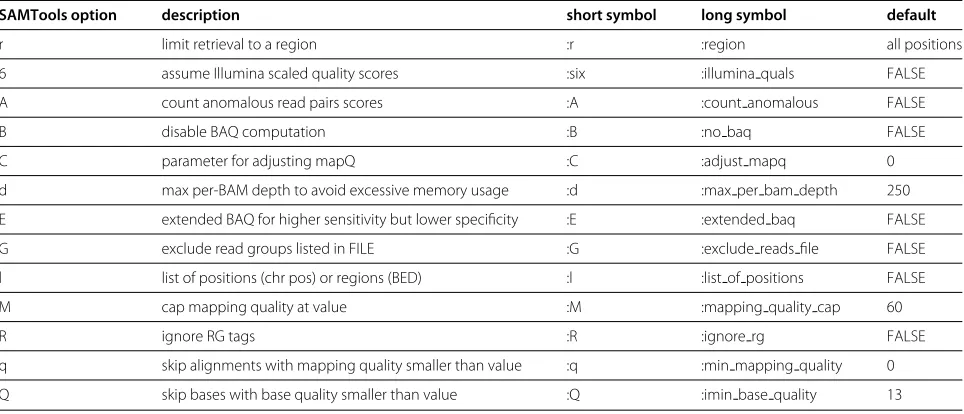
Table 4 SAMtools options recognised by the Bio::DB:Sam#mpileup method and the symbols used to invoke them
SAMTools option description short symbol long symbol default
r limit retrieval to a region :r :region all positions
6 assume Illumina scaled quality scores :six :illumina quals FALSE
A count anomalous read pairs scores :A :count anomalous FALSE
B disable BAQ computation :B :no baq FALSE
C parameter for adjusting mapQ :C :adjust mapq 0
d max per-BAM depth to avoid excessive memory usage :d :max per bam depth 250
E extended BAQ for higher sensitivity but lower specificity :E :extended baq FALSE
G exclude read groups listed in FILE :G :exclude reads file FALSE
l list of positions (chr pos) or regions (BED) :l :list of positions FALSE
M cap mapping quality at value :M :mapping quality cap 60
R ignore RG tags :R :ignore rg FALSE
q skip alignments with mapping quality smaller than value :q :min mapping quality 0
Q skip bases with base quality smaller than value :Q :imin base quality 13
region is specified by :r and a minimum per base quality score is specified by :Q.
bam.mpileup(:r => "Chr1:1000-2000", :Q => 50) do |pileup|
puts pileup.coverage end
Not all the options SAMTools allows you to pass to mpileup are supported, those that cause mpileup to return Binary Variant Call Format (BCF) [13] are ignored. Specif-ically these are g,u,e,h,I,L,o,p. Table 4 lists the SAMTools flags supported and the symbols you can use to call them in the mpileup command.
Conclusions
Ruby is an easily written and understood high-level lan-guage, ideal for beginners or those wishing to develop analysis scripts and prototype applications in short time-frames. A major advantage of scripting in Ruby for biolo-gists is the BioRuby project that provides a lot of classes and functionality for dealing with common biological data types and file formats. bio-samtools is a BioRuby plugin which extends the original BioRuby framework by pro-viding a useful and flexible interface for Ruby coders who wish to have programmatical access to the data in BAM and SAM files without losing performance, the C API is very much quicker than a pure Ruby implementation would be and wrapping it provides the best of both lan-guages. The interface we provide gives access to all the API components of the SAMtools core library libbam.so and extends with some useful high level methods. The open class system of Ruby means that the SAM class which encapsulates the functionality of SAMtools can eas-ily be extended at run-time by the user. These features
together mean that bio-samtools can be an extremely useful tool for scientists wishing to examine the results of next-generation sequencing alignments.
Availability and requirements Project name:bio-samtools
Project home page: http://rubygems.org/gems/bio-samtools
Operating systems:Linux and Mac OS X Programming language:Ruby
Other requirements:none License:as BioRuby
Any restrictions to use by non-academics:none
Competing interests
The authors declare that they have no competing interests.
Authors’ contributions
RRG wrote the binding, tests, co-wrote the documentation and co-wrote the manuscript, RB created and organised the Gem and contributed to the binding and tests and co-wrote the manuscript and DM conceived of the binding, contributed to the binding and tests, tested the implementations with sample data and co-wrote the manuscript. RRG and RB contributed equally to this work. All authors read and approved the final manuscript.
Acknowledgements
RHRG and MC are supported by the BBSRC and DM is supported by The Gatsby Charitable Foundation. RHRG and RB contributed equally to this work.
Author details
1The Genome Analysis Centre, Norwich Research Park, Colney Lane, Norwich, NR4 7UH, UK.2Istituto Nazionale Genetica Molecolare, Via F. Sforza 28, Milan 20122, Italy.3The Sainsbury Laboratory, Norwich Research Park, Colney Lane, Norwich, NR4 7UH, UK.
Received: 26 April 2012 Accepted: 26 April 2012 Published: 28 May 2012
References
2. Langmead B, Trapnell C, Pop M, Salzberg SL:Ultrafast and
memory-efficient alignment of short DNA sequences to the human genome.Genome Biol2009,10(3):R25. [http://genomebiology.com/ content/10/3/R25]
3. Li R, Li Y, Kristiansen K, Wang J:SOAP: short oligonucleotide alignment program.Bioinformatics2008,24(5):713–4.
4. Novocraft.[http://www.novocraft.com]
5. Homer N, Merriman B, Nelson SF:BFAST: an alignment tool for large scale genome resequencing.PLoS ONE2009,4(11):e7767. 6. Li H, Handsaker B, Wysoker A, Fennell T, Ruan J, Homer N, Marth G,
Abecasis G, Durbin R, Subgroup GPDP:The Sequence Alignment/Map format and SAMtools.Bioinformatics2009,25(16):2078–9. [http:// bioinformatics.oxfordjournals.org/cgi/content/full/25/16/2078] 7. Bio-SamTools.[http://search.cpan.org/lds/Bio-SamTools/] 8. pysam.[http://code.google.com/p/pysam/]
9. Picard.[http://picard.sourceforge.net/index.shtml] 10. BioRuby plugins.[http://bioruby.open-bio.org/wiki/Plugins] 11. Ruby Foreign Function Interface.[https://github.com/ffi/ffi/wiki] 12. Pileup Format.[http://samtools.sourceforge.net/pileup.shtml] 13. Variant Call Format.[http://www.1000genomes.org/node/101]
doi:10.1186/1751-0473-7-6
Cite this article as:Ramirez-Gonzalezet al.:Bio-samtools: Ruby bindings for SAMtools, a library for accessing BAM files containing high-throughput sequence alignments.Source Code for Biology and Medicine20127:6.
Submit your next manuscript to BioMed Central and take full advantage of:
• Convenient online submission
• Thorough peer review
• No space constraints or color figure charges
• Immediate publication on acceptance
• Inclusion in PubMed, CAS, Scopus and Google Scholar
• Research which is freely available for redistribution