The Influence of Artificial Intelligence on the Future of Work
Amer Sa’ad Khushman
Southampton Business School, Dept. of Strategy, Innovation and Entrepreneurship, University of Southampton
I. Introduction
Industrial revolutions have been characterized historically by changes in the automation level of functions originally done by human labor, and converting such functions to machine functions
replacing laborers’ jobs. This happened in the first industrial
revolution when the production line concept replaced a lot of human jobs through automated manufacturing, but at the same time led to the creation plenty of new jobs in the engineering,
mechanical, trading, sales and management fields. It actually
reduced the proportion of manual jobs, but at the same time led to a new horizons in the labor market, and the support functions required to enable the economy to respond to challenges of the industrial revolution (Xu, et al., 2018).
Artificial Intelligence (AI) is considered as the fourth industrial
revolution that has started to make a new changes to job functions through intelligent automation of business processes, and replacement of human functions through automated functions doing the job in a more accurate and timely manner (Weforum,
2019). In recent years, the progress of artificial intelligence has
made people think seriously about automated systems and how AI will impact industries and businesses in terms of jobs in the long term. However,some researcher emphasise how AI disrupts people’s work. On the other hand, researchers are seeing that AI and human resource could combine to create a super human machine and how AI will invent new jobs and empower some existing ones such as Trainers and Explainers.
There is some of the problems that leaders in business field
will meet in the course of development i.e. the weaknesses of knowledge in AI technology that people know and how,etc.Also, deployment of AI technology in the job place is considered a dramatical change in the work environment, that most probably will
face fierce resistance, something which would require a different
type of change management program that counts for building the knowledge about AI technology and its impact at work.In nutshell, some studies bringout the fact that what and how AI will do for future jobs but they did not explore in depth the most prominent issues to be addressed, which is the threat of replacement, and its effect on unemployment rate. At the same time,some otherarticles do not explore the need to create the familiarity and acceptance of the new technology by the existing staff.
The core idea of thispaperis that AI will invent new jobs as well as empower humans to better performance,and it goes even further to argue that human resources will combine/collaborate with AI to translate into super intelligent human-machine resources.
Furthermore, it will focus on discussing how the augmentation
of AI by human contributions could increase efficiency in the
work place.
II. Methodology
In this study the researcher used as secondrydata such as; available literature that has been reviewed and analyzed for understanding the concept.
III. Discussion on the Role of Artificial Intelligence on the Future of Work
Artificial Intelligence (AI) is a term referring to a new era of
automated technology that can think, learn and develop over time. The fact that such technology can think and learn, makes it different from all other past technologies (Marr, 2018).
Dirican (2015) argues that the features of such technology are such as seriously to threaten workers as jobs are replaced by machines. Machines are invading more jobs as long as they “learn” and can act more accurately. Especially at dangerous jobs which have
parameters are defined by high degrees of certainty. Ford (2015)
suggests that AI systems would perform better in jobs that rely on interpretation of data and images such as radiologists, analysts, and entry level jobs.
The digital age is creating jobs that did not exist in the past(Dirican, 2015).Take for example marketing jobs: social media and the internet lead to the creation of many administrative, design, programming, and creative jobs.According to Schwab (2016)the AI age, makes it easier for entrepreneurs to start a new business since production costs are less with the automation of processes, and access to the market is much eased by the existence of the internet and social media.
The uncertainty of decision making happen when there is a lack of information about the concequences which can make the
interpreting process for a situation more difficult. Jarrahi (2018)
agrees that and addresses that AI can help human decision in predictive analytics. He add that they can generate new ideas through probability approach, and identify relationships among many factors, which enables human decision makers to be more effectively collect and act upon new sets of information. The prevailing fact in such a technology revolution is that jobs are shifting from routine, parameterised jobs into jobs that need creativity, and the thinking methodology that a machine would not be able to perform alone(Poola, 2017). The same applies to jobs at the top level, where there is a need for evaluation and Abstract
This paper addresses a trend in strategy and innovation management and discussesissues related to The tnfluence of Artificial Intelligence (AI) on the future of work.The overall idea of the paper is that AI will invent new jobs as well as empower humans to better performance.The researcher go even further to argue that human resources will combine/collaborate with AI to translate into super intelligent human-machine resources, which means rather than replace human labour, artificial Intelligence can work in synergy with humans to yield a better output. Furthermore, it will focus on discussing how the augmentation of AI by human contributions could increase efficiency in the work place.
Keywords
judgment in decision making. Such jobs take into consideration different factors affecting the business. The argument leads one to think about integration of AI capability and human intelligence to optimise the workplace making it valid to ask the question “Can
artificial intelligence (AI) and humans work together?”
A. The effect of replacement of Jobs by AI
Replacing the human function with machines is not a new idea. Historically, the industrial revolution, which dates from 1760 was
a turning point in the concept of machine efficiency and the ability
of machines to produce with more accuracy, consistency and in larger quantities (Mokyr, 2001). But despite the introduction of very advanced production technology and the increase in capacity and accuracy of such technologies over the past few decades, humans did not feel any real challenge in respect of major functions such as decision making.
At first glance, AI introduces unlimited visions of technology
managing aspects of life that do not stop at increasing production aspects of a factory or automating a service but touches the most valued and unique aspects of being human (Boden, 1998(.Post-Industrial economies are now witnessing the second wave of machines, but this time, machines have taken a more sophisticated and advanced level. More than being just machines for production, these smart technologies are equipped with the capacity to adapt and improve as they utilise the information they gather through the process.
Unlike its predecessors, AI is developing to become a dynamic system, learning, adapting and acquiring data to produce its outputs.Robotics is just one aspect of the whole AI spectrum.
Artificial intelligence represents a diverse set of tools, algorithms and techniques (Jarrahi, 2018). The Digital Age is now driven by
AI and in order to thrive in this digital ecosystem, businesses need to harness the power of AI.
B. Countervailing Effects
Even with the presence of the Displacement Effect in automated functions that does not mean there will be reductions in the overall demand for labor. Historically, there have been many periods where automated systems were accompanied by growth in the demand for labor(Acemoglu and Restrepo, 2018).This section offers two reasons why automation is going to create increase the demand for labor.
1. The productivity effect: when there is a reduction of cost in some tasks, the automation system will directly increase the demand
for work in non-automated works (Autor, 2015). Specifically,
automation leads to the replacement of capital for work because capital will do some of the tasks more cheaply than labor used to do.
Bessen (2015) argues that the adoption of the ATM machines in the banking system, led to cut the cost of functions performed by the expensive human tellers, but at the same time demand for tellers increased as the lower cost of operations led banks to be able to expand and open new branches. As a result, that increased the demand for bank tellers who specialise and who were able to introduce more personalised services and perform cross-selling functions in an effective manner.
2.Reinstatement effects: as they are known in the case of automation, have some negative effects i.e. displacement effects. Nevertheless, simultaneously, with intensive automation, a new jobs emerge, industries, tasks and activities (Acemoglu and Restrepo, 2018).
(Accenture,2017;Acemoglu and Restrepo, 2018), identified three
new types of jobs in the future of work for companies that are using AI technologies as a part of their process. These jobs are: Explainers, Sustainers, and Trainers. “Explainer” is the person who will need to interpret the output of AI system; “Sustainer” whooptimise the effectiveness of the system and monitor the performance of the system; the “Trainer” who will be feeding the AI systems’ capacity for judgment.
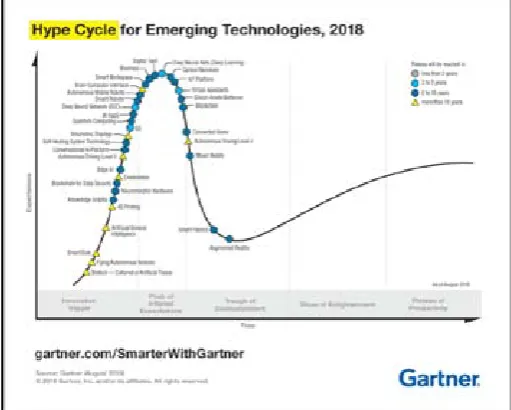
Gartner Research Company (2018) introduced Hype Cycle for Emerging Technologies as shown in Figure (1) that explain businesses and industries are continuing to face the rapid changes with technology and innovations, and that will profoundly impact on the way they deal with the labors, customer, and partners. All the trends that exposed by the emerging technology have the potential to disturb businesses and industries; therefore, it must be actively monitored and controlled by the executive teams.
Fig. 1: Hype Cycle for emerging technologies (Gartner, 2018)
Generally, organisational strategies and plans are focusing on automation, robots and AI. These technologies contribute effectively in reducing unskilled or repetitive jobs, digitisation of work to render remaining employees more effective and AI to provide more reliable and productive (Holford, 2019).
C. When the AI falls short of expectations
Given the envisioned sophistication and advanced capability of AI, expectations of performance are high. However, there have been several cases when AI fell short (Peng, 2018(.
In most Chinese cities, AI is used to address jaywalking incidents. In one occasion, AI “falsely recognised” a photo of Chinese billionaire Mingzhu Dong on an advertisement on a passing bus as “jaywalker”. It went viral in China and the blunder caused
Ningbo police officials to issue a public apology(Peng, 2018).
Self-driving cars seemed to be becoming the future of the automotive industry until an accident occurred in Tempe, Arizona. An Uber self-driving SUV hit and killed a female pedestrian. The car was in autonomous mode, with a human safety driver at the wheel. From the investigation, it turned out that the self-driving software decided to override Volvo’s default emergency braking system. In the light of this tragedy, road tests of self-driving cars have been suspended all throughout North America (The Guardian, 2018).
IBM’s flagship AI project, Watson, has been applied in a broad
turned out that doctors and healthcare professionals complained that it gave the wrong recommendations which could have led to severe and fatal consequences to patients(Peng, 2018).
Tesla, a company known for its technological innovations, was not spared AI errors. Elon Musk intended to build a factory of the future, it call as “Alien Dreadnought”. This new manufacturing facility in Fremont, California was designed to be fully automated, with zero human employees. Musk hoped that with the implementation of AI technology, the factory would increase the production and manufacturing of Model 3 electric cars to achieve 5,000 units on
a weekly basis and meet the increasing demand. The result? The
factory only produced 2,000 cars per week. It was way below expectation. It did not even meet half of the demand. Musk found out that instead of speeding up the production, the AI technology slowed down the process (Wilson and Daugherty, 2018). In the wake of the AI failure, Tesla decided to shut down the production plant and address the bottlenecks. One of the company’s solutions was to hire additional workers, human employees to assess the process, and train and retrain the robots and make necessary adjustments. In Musk’s words, “Yes, excessive
automation at Tesla was a mistake. To be precise, my mistake. Humans are underrated”(Miller, 2019).
Based on above cases and the failuers of the AI, companies should build up relation and integration between the unique features of human skills, in addition to the unique features of AI, which together will consist an integrated capital that could drive a business prospect and ability to grow.
Its worth mentioning that, the near future will present more progress in terms of the AI development, which will enhance the performane of businesses and industries in the world.
D. Aspects of work processes where AI struggle
Like any other innovation, AI is a work-in-progress. These blunders, gaps and errors are opportunities to discover where AI struggles and implement patches to update and upgrade AI systems and algorithms.Following these AI failures, researchers found that there are three primary aspects of work processes where AI often struggles – innovation, creativity and decision making.
Boden (1998) discussed that creativity is inherently with the human, a “fundamental feature of human intelligence”. She argued that creativity is not a special “faculty” or a special kind
of ability confined to a specific group of humans. It is a general
feature of the human intelligence. Any human being, regardless of their cognitive capabilities, has the ability to show creativity. He noted that AI can model one aspect of human creativity, one that focuses on cognitive dimension. However, other aspects of human creativity, for example ones that involves cultural context and personality factors, is something AI struggles to emulate.
Human creativity is not a linear process. Boden (1998) identified
three types of human creativity: combinational, exploratory and
transformational. The first type, combinational creativity, utilises
patterns, analogies, imagery, structural mapping to come up with a novel idea. The exploratory aspect of creativity requires a kind of curiosity that is often associated with curiousness and some concept of the if-then relationship. This second type is the creativity modeled by most AI system.
Finally, transformational creativity is an occurrence of an idea or
a structure that has not been there in the first place. Combinational
and transformational creativity are both challenges for AI developers.
Jarrahi (2018) further added another aspect where AI struggles
in decision-making. He identified three challenges – uncertainty,
complexity, and equivocality.The author argued that decision-making requires not only information gathering and processing. It requires imagination, sensitivity, creativity, and intuition. As opposed to AI which can do complex analyses through algorithms, intuitive intelligence helps a person “analyse alternatives with a deeper reception”. Analytical methods in decision making depend on depth of information. On the other hand, an individual relies on known practices, experiences and judgment when using intuitive approaches.In terms of complexity, AI has some advantages. With
so much information out there, it will be difficult to sort and
identify the most important ones. The power of AI algorithms
allow for speedy, accurate and efficient crunching of big data and
generating reports that will help decision-makers identify areas of potential growth and improvements within the organization. In most cases, the ability of AI to work through a vast domain of information is highly impressive, e.g. Analysing a person’s information, such as credit information, and linking it to personal information available through social media accounts, pricing advertisements for digital marketing.In this realm, AI has exceeded expectations because it can utilise raw data from smaller data
sets and expand to larger data sets and come up with profiles,
reports and analytics. But still the challenge for AI when it
comes to decision-making is overcoming equivocality. Jarrahi
(2018) described equivocality as the incompatible “interests of stakeholders, customers, and policy makers”.
An organisation is made up of various stakeholders, internal and external. These entities have simultaneous but divergent ideas,
concepts, and intentions. Given this equivocality aspect, Jarrahi
(2018) noted that this can transform the act of decision making from “an impartial, objective process into an inherently subjective
and political process that attempts to fulfill the conflicting needs
and objectives of multiple parties” something which AI will fall to meet.Equivocality is driven by a person’s character, beliefs,
culture, and preferences. This aspect becomes a difficulty for AI
because it is void of personality.
E. How AI will affect working environment?
The development and utilisation of AI has generated debate and the results of studies often tipped to opposite ends of two extremes – one of fear that AI will replace human labor, thereby creating fear of job loss and unemployment and another a reassurance that there will be little change in the overall employment. The reality is that neither of these two extremes are likely to happen (British Academy and The Royal Academy, 2018).
Several studies have come up with a consensus that AI will have “disruptive effect on work”(British Academy and The
Royal Academy, 2018). AI will affect employment. Jobs will be lost. However, new jobs will be created. Job descriptions will
change. Nevertheless, there will be skills training to match jobs and people.
as long as the intelligence in the machine is based on algorithms that would only be able to deal with expected events more than the unexpected events or the changes in the environment, it is very important to consider the collaboration and merger of AI and human intelligence to optimise work outcomes.
While AI is dramatically changing and shaping the business landscape and human capital, some important considerations should be further discussed and established:
Developing workers’ education and skills in technology to
•
become ‘digital citizens’.
Understanding the changing in nature of working life where
•
the 4th industry revolution contributes effectively in this
change, for example, with respect to income security and the sharing economy, and in undertaking potential biases from algorithmic systems at work.
Filling the needs for re-training for displaced workers through
•
new methods to training and development.
Presenting processes to share the benefits of AI across •
societies, including by supporting economic growth.
IV. Conclusion
Businesses wholly run by AI look far-fetched following current trends and technology. It could be a reality, but we are far from there yet. Businesses who have tried it, found out the hard way
some truths and implications. It brought more financial loss than benefits, not to mention fatalities and other untoward outcomes.
Automation is not always the solution. Augmented intelligence and assisted intelligence remain viable options in order to utilise AI’s potential even if we do not understand its full potential which maybe be many decades into the future. Instead of AI replacing humans, AI works best as a tool to expand the realm of human abilities and potential.
Creativity and decision-making are aspects of the work process
that are difficult to automate. They require human intervention and
the nuances of human psychology. Businesses thrive on innovation and novelty. AI can help in identifying areas where businesses can
expand and grow. However, the final decision to enter a new market
or to start a new business requires more than just a feasibility study run by algorithms. This type of decision making requires the intuitive intelligence of top and senior management.
Finally, through machines, humans can achieve more than they can on their own, at the same time, machines depend on humans to improve. If done correctly, it becomes a symbiotic relationship. AI is here to stay. It is an integral part of modern life and a much-needed route by which businesses can move forward.
References
[1]. Accenture(2017) Process Reimagined. [Online] Available at: https://www.accenture.com/_acnmedia/PDF-76/Accenture-Process-Reimagined.pdf(Accessed: 2 April 2019). Acemoglu, D., and Restrepo, P. (2018)
[2]. Artificial Intelligence,
Automation and Work. Cambridge: MIT Department of Economics Working Paper No. 18-01. [Online] Available at: https://ssrn.com/abstract=3098384(Accessed: 5 April 2019).
Autor, D.(2015) ‘Why Are There Still So Many Jobs? The
[3].
History and Future of Workplace Automation’, Journal of
Economic Perspectives, 29(3), pp. 3-30.
Bessen, J. (2015) ‘Toil and Technology’,
[4]. Finance and
Development, 52(1), pp. 16–19.
Boden, M. (1998) ‘Creativity and artificial intelligence’,
[5].
Artificial Intelligence, 103, pp. 347-356.
British Academy and The Royal Academy (2018)
[6]. The
impact of artificial intelligence on work.An evidence
synthesis on implications, report study. [Online] Available at: https://royalsociety.org/~/media/policy/projects/ai-and-work/evidence-synthesis-the-impact-of-AI-on-work. PDF(Accessed: 25 April 2019).
Dirican, C. (2015) ‘The impacts of robotics, artificial
[7].
intelligence on business and economics’, Procedia: Social and Behavioral Sciences, 195, pp. 564–573.
Ford, M. (2015).
[8]. Rise of the robots : technology and the threat of a jobless future. United States of America: Basic Books.
Gartner (2018)
[9]. 5 Trends Emerge in the Gartner Hype Cycle for Emerging Technologies, 2018. [Online] Available at: https://www.gartner.com/smarterwithgartner/5-trends- emerge-in-gartner-hype-cycle-for-emerging-technologies-2018/(Accessed: 28 March 2019).
Holford, W. (2019) ‘The future of human creative knowledge [10].
work within the digital economy’, Futures, 105, pp. 143-154.
Jarrahi, M.(2018) ‘Artificial intelligence and the future
[11].
of work: Human-AI symbiosis in organizational decision making’, Business Horizons, 61, pp. 577-586.
Marr, B. (2018)
[12]. The Key Definitions Of Artificial Intelligence (AI) That Explain Its Importance. [Online] Available at:
https://www.forbes.com/sites/bernardmarr/2018/02/14/the-
key-definitions-of-artificial-intelligence-ai-that-explain-its-importance/#465b2da4f5d8(Accessed: 28 March 2019).
Mokyr, J. (2001) ‘The rise and fall of the factory system:
[13].
technology, firms, and households since the industrial
revolution’, Carnegie-Rochester Conference Series on Public Policy, 55(1), pp. 1-45.
Poola, I. (2017) ‘How Artificial Intelligence in Impacting
[14].
Real Life Every day’, International Journal of Advance Research and Development, 2(10), pp. 96-100.
Schwab, K. (2016).
[15]. The Fourth Industrial Revolution. Geneva: World Economic Forum.
Peng, T. (2018)
[16]. 2018 in Review: 10 AI Failures. [Online] Available at: https://syncedreview.com/2018/12/10/2018-in-review-10-ai-failures/(Accessed: 21/4/2019).
Peng, T. (2018)
[17]. Global Survey of Autonomous Vehicle Regulations. [Online] Available at: https://medium.com/ syncedreview/global-survey-of-autonomous-vehicle-regulations-6b8608f205f9(Accessed: 26 April 2019). Miller, R. (2017)
[18]. Artificial intelligence is not as smart as you (or Elon Musk) think. [Online] Available at: https://
techcrunch.com/2017/07/25/artificial-intelligence-is-not-as-smart-as-you-or-elon-musk-think/(Accessed: 15 April 2019).
The Guardian (2018)
[19]. Self-driving Uber kills Arizona woman in first fatal crash involving pedestrian. [Online] Available at: https://www.theguardian.com/technology/2018/ mar/19/uber-self-driving-car-kills-woman-arizona-tempe(Accessed: 1 April 2019).
Wilson, J., and Daugherty, P.(2018)
[20]. Why Even AI-Powered
Factories Will Have Jobs for Humans. [Online] Available at Harvard Business Review: https://hbr.org/2018/08/ why-even-ai-powered-factories-will-have-jobs-for-humans(Accessed:17 March 2019).
Xu, M., David, J., and Kim, S. (2018) ‘The Fourth Industrial
Revolution: Opportunities and Challenges’, International
Journal of Financial Research, 9(2), pp. 90-95. Weforum.com (2019)