The Thirty-Third AAAI Conference on Artificial Intelligence (AAAI-19)
Improving Neural Question Generation Using Answer Separation
Yanghoon Kim,
1,2Hwanhee Lee,
1Joongbo Shin,
1Kyomin Jung
1,2 1Seoul National University, Seoul, Korea2Automation and Systems Research Institute, Seoul National University, Seoul, Korea
{ad26kr,wanted1007,jbshin,kjung}@snu.ac.kr
Abstract
Neural question generation (NQG) is the task of generating a question from a given passage with deep neural networks. Previous NQG models suffer from a problem that a signif-icant proportion of the generated questions include words in the question target, resulting in the generation of unin-tended questions. In this paper, we propose answer-separated seq2seq, which better utilizes the information from both the passage and the target answer. By replacing the target an-swer in the original passage with a special token, our model learns to identify which interrogative word should be used. We also propose a new module termed keyword-net, which helps the model better capture the key information in the tar-get answer and generate an appropriate question. Experimen-tal results demonstrate that our answer separation method sig-nificantly reduces the number of improper questions which include answers. Consequently, our model significantly out-performs previous state-of-the-art NQG models.
Introduction
Neural question generation (NQG) is the task of generat-ing questions from a given passage with deep neural net-works. One of its key applications is to generate questions for educational materials (Heilman and Smith 2010). It is also used as a way to improve question answering (QA) sys-tems (Duan et al. 2017; Tang et al. 2017; 2018) or to engage chatbots to start and continue a conversation (Mostafazadeh et al. 2016).
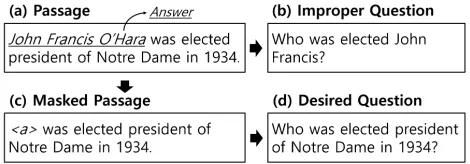
Automatic question generation (QG) from a passage is a challenging task due to the unstructured nature of textual data. One of major issues in NQG is how to take the ques-tion target, referred to as the target answer, in the passage. Specifying the question target is necessary for generating natural questions because there could be multiple target an-swers in the passage as in the following example. In Figure 1(a), the passage “John Francis O’Hara was elected presi-dent of Notre Dame in 1934.” has various candidates to be asked such as the person “John Francis O’Hara”, the loca-tion “Notre Dame”, and the number “1934.” Without taking the target answer as an additional input, existing NQG mod-els such as (Du, Shao, and Cardie 2017) tend to generate
Copyright c2019, Association for the Advancement of Artificial Intelligence (www.aaai.org). All rights reserved.
Figure 1: An example of overall idea for QG in this paper. Generated questions from existing NQG models tend to in-clude words from the answer, resulting in the generation of improper questions. Replacing the answer into a special to-ken effectively prevents the answer words from appearing in the question, resulting in the generation of desired questions.
questions without specific target. This is a fundamental lim-itation due to the fact that recent NQG systems mostly rely on RNN sequence-to-sequence model (Sutskever, Vinyals, and Le 2014; Bahdanau, Cho, and Bengio 2015), and RNNs do not have the ability to model high-level variability (Ser-ban et al. 2017).
To overcome this limitation, most recent NQG models in-corporated the target answer information by using the an-swer position feature (Zhou et al. 2017; Song et al. 2018). However, these approaches have a critical issue that a sig-nificant proportion of the generated questions include words in the target answer. For example, Figure 1(b) shows the im-properly generated question “Who was elected John Fran-cis?”1which exposes some words in the answer. This
prob-lem results from the tendency of the sequence-to-sequence model to include all information from the passage (Am-playo, Lim, and Hwang 2018). It becomes severer with the recent trend that NQG models use the copy mechanism (Gulcehre et al. 2016) to encourage that many words in the original passage appear in the question.
This study focuses on resolving this problem by separat-ing the target answer from the original passage. For example, the masked passage “<a>was elected president of Notre Dame in 1934.” in Figure 1(c) still contains enough informa-tion to generate the desired quesinforma-tion in Figure 1(d), because
1
the term “president” is mostly about someone’s position. In-terestingly, even though a target answer is replaced with a special token<a>in a passage, we can infer the interroga-tive word through contextual information from the remain-ing part of the passage. Therefore we expect that separatremain-ing a target answer will prevent the answer inclusion problem.
In this paper, we develop a novel architecture named answer-separated seq2seqwhich treats the passage and the target answer separately for better utilization of the infor-mation from both sides. The first step in our NQG model is an answer masking. Literally, we replace the target an-swer with the mask token<a>, and keep the corresponding target answer apart. The masked passage is encoded by an RNN encoder inside of our model. This approach to sepa-rate the target answer from the passage helps our model to identify the question type related to the target answer be-cause the model learns to capture the position and contex-tual information of the target answer with the help of the token<a>. Furthermore, we propose a new module called keyword-netas a part of answer-separated seq2seq, which extracts key information from the target answer kept apart before. The keyword-net makes our NQG model be consis-tently aware of the target answer, supplementing the infor-mation deficiency caused by answer separation. This mod-ule is inspired by how people keep the target answer in mind when they ask questions. Lastly, we adopt a retrieval-style word generator proposed by (Ma et al. 2018) which better captures the word semantics during the generation process.
When we evaluate our answer-separated seq2seq on the SQuAD dataset (Rajpurkar et al. 2016)), our model outper-forms previous state-or-the-art NQG models by a consider-able margin. We empirically demonstrate the impact of the answer separation in following three ways: the rare appear-ance of the target answer in the generated questions, the bet-ter prediction of inbet-terrogative words, and the higher atten-tion weights of the<a>token to interrogative words. Fur-thermore, trained with the only questions generated by our model, a machine comprehension system achieves a compa-rable results.
Related Work
Recently, there have been several NQG models which are end-to-end trainable from (passage,question,answer) triplets written in natural language. (Du, Shao, and Cardie 2017) first dealt with end-to-end learning with regard to the question generation problem using a sequence-to-sequence model with an attention mechanism, achieving better perfor-mance than rule-based question generation methods in both automatic and human evaluations. However, their model did not take the target answer into account, resulting in genera-tion of the quesgenera-tions which were full of randomness.
To generate more plausible questions, (Zhou et al. 2017) utilized answer positions to make the model aware of the tar-get answer and used NER tags and POS tags as additional features. (Song et al. 2018) utilized the multi-perspective context matching algorithm of (Wang, Hamza, and Florian 2017) to employ the interaction between the target answer and the passage for collecting the relevant contextual infor-mation. Both works employed a copy mechanism (Gulcehre
et al. 2016) to reflect the phenomenon by which many of the words in the original passage are copied to the gener-ated question. However, none of them dealt with the issue of many of generated questions including target answers, and the copy mechanism could intensify this problem. To tackle this problem, this paper focuses on developing an NQG model that utilizes the target answer as a separated knowledge.
Additionally, there have been several works which uti-lize question generation to improve the question answering system. (Duan et al. 2017) crawled an external QA dataset and generated questions from it through their retrieval-based and generation-based question generation methods. With the generated questions as additional data for training the QA system, they demonstrated that their question generation model helps to improve QA systems. More recently,(Tang et al. 2018) presented a joint training algorithm that improves both the question answering system and the question gener-ation model.
To the best of our knowledge, none of the previous works has focused on the issue that a significant proportion of gen-erated questions include words in the target answers.
Task Definition
Given a passage Xp = (xp
1, ..., xpn) and a target answer
Xa = (xa1, ..., xam)as input, the NQG model aims to
gen-erate a question Y = (y1, ..., yT) asking about the target
answerXa in the passageXp. The NQG task is defined as finding the bestY that maximizes the conditional likelihood given theXpand theXa:
Y = argmax Y
P(Y|Xp, Xa) (1)
= argmax Y
T X
t=1
P(yt|Xp, Xa, y<t) (2)
Base Model: Encoder-Decoder with Attention
Following previous works, we base our model on the RNN encoder-decoder architecture (Sutskever, Vinyals, and Le 2014), which is an RNN-based sequence-to-sequence learn-ing model. It generates a task-specific sequential output from a given sequential input and is widely adopted in se-quence generation tasks such as neural machine translation (Sutskever, Vinyals, and Le 2014; Bahdanau, Cho, and Ben-gio 2015), text summarization (Nallapati et al. 2016) and di-alogue model (Serban et al. 2016; 2017). In neural question generation, the model takes a passage Xp as an input and
outputs a questionY which is relevant to the input passage
Xp. Note that the base model does not take the target answer
as the input.
Figure 2: Overall architecture of our model
In general, attention mechanism (Bahdanau, Cho, and Bengio 2015), which functions as visual attention mech-anisms found in human, is combined with the encoder-decoder model. The mechanism alleviates the bottleneck that the decoder only relies on a fixed-size vector to gen-erate sequences. With the attention mechanism, the decoder is able to pay attention to the most relevant parts of the given input sequence while generating an output sequence. In the following section, we describe the structure of the encoder-decoder with attention in details.
Encoder The encoder is used to extract contextual fea-tures from the given input passageXp. We use an one-layer
bi-directional LSTM as the encoder. A bi-directional LSTM consists of a forward LSTM and a backward LSTM:
→
hpi =−−−−→LST M(xpi,
→
hpi−1) (3)
←
hpi =←−−−−LST M(xpi,
←
hpi+1) (4)
hpi = [
→
hpi;
←
hpi] (5)
For each time stepi, forward hidden state
→
hpi and back-ward hidden state
←
hpi are concatenated to form a hidden state of bi-LSTM.
Decoder Given the extracted features from the encoder, the decoder generates the corresponding questionY. We uti-lize a one-layer uni-directional LSTM with attention:
st=LST M(yt−1, st−1, ct) (6)
P(yt|y<t, Xp) =Sof tmax(Wost) (7)
For each time step t, the output token of previous time stepyt−1, the hidden state of previous time stepst−1 and
the context vector of current timectare passed through the
decoder LSTM to compute the decoder hidden state of cur-rent time step st. Each hidden state of decoderst is then
linearly projected with a trainable weight matrix Wo and
passed through a softmax layer to compute the probability of outputyt. The context vectorctis used to reflect the most
relevant feature from the input passageXpwhile generating
the current question tokenyt. In Eq. (8), the alignment score
etiis computed as the matching score betweenst−1andhpi,
whereWc andUc are trainable weight matrices andv> is
a trainable vector. As in Eq. (9), the alignment weightαti
is computed with normalization and we take the weighted average ofhpi as context vector:
eti=v>tanh(Wcst−1+Uchpi) (8)
αti=
exp(eti) Pn
k=1exp(etk)
(9)
ct= n X
i=1
αtihpi (10)
Answer-Separated Seq2seq
Previous encoder-decoder based neural question generation models take the whole passage Xp as an input. However, RNN encoders tend to pass all of the information in the passage to the decoder, causing a serious issue: the gener-ated question often includes the target answerXa.
There-fore, we propose answer-separated seq2seq which treats the target answer and the passage separately for better uti-lization of the information from both sides. With a simple pre-processing of data, we separate the target answer from the input passage. Encoded with two individual encoders of answer-separated seq2seq, contextual feature of the passage and the target answer are passed to the decoder. We further propose keyword-net as another part of answer-separated seq2seq, which is used to extract the key information from target answer. In every decoding step, the decoder utilizes both the contextual feature of the passage from the atten-tion mechanism and the keyword feature of the target answer from the keyword-net to generate a question that is related to the target answer in the passage. Furthermore, we adopt a re-trieval style word generator by (Ma et al. 2018) as the output layer of the decoder to better capture the word semantics.
Different from the general RNN encoder-decoder, our answer-separated seq2seq consists of :
• Two encoders each to extract contextual feature from the passageXpand the target answerXa.
In the following section, we give a detailed description on how answer-separated seq2seq works. An overview of our answer-separated seq2seq is shown in Figure 2.
Encoder
Answer-separated seq2seq contains two individual encoders each for encoding the passageXpand the target answerXa.
Similar to the base model, we use two one-layer bi-LSTMs as encoders.
Answer-Separated Passage Encoder Rather than feed-ing the passage encoder with additional features to empha-size the answer position, we first extract the target answer inside the passage and simply replace the corresponding tar-get answer with a special<a>token as in Figure 1(c). In this way, the model learns to capture the position and con-textual information of the target answer, knowing which part of the passage should be focused by the generated question. As a result, the probability that the generated question in-cludes the target answer is reduced. This has a direct effect of preventing generation of questions irrelevant to the given target answer. We use the same one-layer bi-LSTMs as in Eq. (1) and Eq. (2).
Answer encoder We use another one-layer bi-LSTM to encode the target answer Xa. In the last time step of the answer encoder, the hidden state of each LSTM is concate-nated to form the final hidden statehaf inal, which represents the overall feature of the answerXa:
→
haj = −−−−→
LST M(xaj, →
haj−1) (11)
←
haj =←−−−−LST M(xaj,
←
haj+1) (12)
s0=haf inal= [ →
ham;
←
ham] (13)
Answer-Separated Decoder
To exploit sufficient information from both the passage and the target answer, we design the answer-separated decoder. Based on LSTM, answer-separated decoder employs fea-tures of the passage and the target answer in the following three ways.
Decoder Initialization We initialize the decoder state with the final answer vectorha
f inal.
Incorporating the Key Feature of the Answer We ex-tract the key information in the target answer to disam-biguate the question target. For example, given a passage “Steve Jobs is the founder of Apple” and the target answer “founder of Apple”, we want to generate a question like “Who is Steve Jobs?”. Then “founder” in “founder of Ap-ple” is a keyword which defines the representative charac-teristic of the whole answer. In every decoding step, we use an attention-based module, termedkeyword-net, to extract the key information from the target answer. For each layer of the keyword-net, a normalized matching score between out-put vector of last layerolt−1and answer hidden statesha
j is
computed. We then take the weighted average overhaj as the
extracted keyword featureoltin current layerl. We initialize
o0
twith context vectorctof current decoding step. Following
equations describe the mechanism of keyword-net:
o0t=ct (14)
pltj =Sof tmax((o l−1
t )>h a
j) (15)
olt=X j
pltjhaj (16)
st=LST M(yt−1, st−1, ct, oLt) (17)
Retrieval Style Word Generator Based on the current decoder structure, we further adopt an architecture which can generate words by querying distributed word representa-tion, with the purpose of capturing the semantic information of the according words.
(Ma et al. 2018) proposed a retrieval style word genera-tion layer which can remedy a shortcoming of the sequence-to-sequence model that sequence-sequence-to-sequence model has tendency to memorize the sequence pattern rather than re-flecting word meanings. They made use of word embeddings to tackle the problem. Their word generator produces words by querying the distributed word representations, hoping to capture the meaning of used words. We then borrow the idea behind this novel word generator to replace the existing out-put layer in our decoder.
The queryqtis computed as a combination of the decoder
hidden statestand the context vectorct. By queryingqtto
each of the word embeddingek, we can compute the
rele-vance score betweenqtandek whereWa is a trainable
pa-rameter matrix. Then the normalized value of score function denotes the generation probability of each word. Since the original output layer takes the most of model parameters, we can dramatically reduce the parameter size and the time of model convergence by using this word retrieval layer:
qt= tanh(Wq[st;ct]) (18)
score(qt, ek) =q>i Waek (19)
p(yt) =Sof tmax(score(qt, ek)) (20)
Experimental Settings
In this section, we first introduce the dataset we conduct ex-periments on. Then we give a detailed description of hyper-parameter settings of our model. Lastly, several evaluation methods mainly used to assess the quality of generated ques-tions are introduced.
Dataset
Model Split-1 Split-2
BLEU METEOR ROUGE-L BLEU
(Du, Shao, and Cardie 2017) 12.28 16.62 39.75 -(Song et al. 2018) 13.98 18.77 42.72 13.91
(Zhou et al. 2017) - - - 13.29
ASs2s-ASdec 12.30±0.26 16.70±0.22 40.32±0.26 12.25±0.24 ASs2s-keyword 13.95±0.29 19.34±0.24 40.60±0.25 13.86±0.30 ASs2s-<a> 14.37±0.28 18.95±0.24 42.06±0.27 14.05±0.30 ASs2s 16.20±0.32 19.92±0.20 43.96±0.25 16.17±0.35
Table 1: Evaluation of our model and previous NQG models with three metrics: BLEU-4, METEOR and ROUGE-L.
Zhou et al. 2017) re-divided them into train/dev/test splits, and extracted passages from the paragraph that contains the target answer, each of which we call data split-1 and data split-2 in the following lines. For the data split-1, since (Du, Shao, and Cardie 2017) does not include the target answers, (Song et al. 2018) extracted them from each passage to make (passage,question,answer) triplets. As a result, data split-1 and data split-2 contains 70,484/10,570/11,877 triplets and 86,635/8,965/8,964 triplets respectively. We tokenize both data splits with Stanford CoreNLP (Manning et al. 2014) and then lower-case them.
Implementation Details
We implement our models in Tensorflow 1.4 and train the model with a single GTX 1080 Ti. The hyperparameters of our proposed model are described as follows.
Our model consists of two one-layer encoders each for encoding passages and target answers, and a one-layer de-coder to generate questions. The number of hidden units in both encoders and the decoder are 350. For both encoder and decoder, we use 34k most frequent words appeared in training corpus, replacing the rest with the <UNK> to-ken. We use 300-dimensional pre-trained GloVe (Penning-ton, Socher, and Manning 2014) embeddings trained on 6 billion-token corpus for initialization and freeze it when training. Weight normalization is applied to the attention module and dropout with Pdrop = 0.4 is applied for both
RNNs and the attention module. The layer size of keyword-net is set as 4.
Training and Inference During training, we optimize the cross-entropy loss function with the gradient descent algo-rithm using Adam (Kingma and Ba 2014) optimizer, with an initial learning rate of 0.001. The mini-batch size for each update is set as 128 and the model is trained for up to 17 epochs.
When testing, we conduct beam search with beam width 10 and length penalty weight 2.1. Decoding stops when the generated token is <EOS>. The Performances of all our models are reported as mean and standard derivation values (Mean±Std).
Named Entity Replacement To further improve the model performance, we pre-process the data with a very sim-ple technique. Since most named entities do not appear
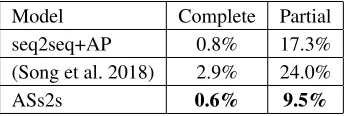
of-Model Complete Partial seq2seq+AP 0.8% 17.3% (Song et al. 2018) 2.9% 24.0%
ASs2s 0.6% 9.5%
Table 2: Percentage of complete/partial inclusion of the tar-get answer in generated questions.
ten, by replacing those named entities with representative tokens, we can not only reduce unknown words but also capture the grammatical structure. We look for the named entity tags for tokens in the given passage and replace each of them with the corresponding tag. We make sure that the same entity is assigned the same tag. NER tags are ex-tracted with named entity tagger in Stanford CoreNLP. For those passages that have different named entities with the same tag, we distinguish them with different subscripts such as P erson1, P erson2. We store a matching table between
named entities and tags, which is used to post-process the generated questions.
Evaluation Methods
Following (Zhou et al. 2017; Song et al. 2018), we compare the performance of NQG models with 3 evaluation metrics: BLEU-4, Meteor and RougeL, which are standard
evalua-tion metrics of machine translaevalua-tion and text summarizaevalua-tion. We use the evaluation package published by (Chen et al. 2015).
BLEU-4 BLEU-4 measures the quality of the candidate by counting the matching 4-grams in the candidate to the 4-grams in the reference text.
Meteor Meteor compares the candidate with the reference in terms of exact, stem, synonym, and paraphrase matches between words and phrases.
RougeL RougeL assesses the candidate based on longest
Model Question type
what how when which where who why yes/no seq2seq+AP 77.3% 56.2% 19.4% 3.4% 12.1% 36.7% 23.7% 5.3% ASs2s 82.0% 74.1% 43.3% 6.1% 46.3% 67.8% 28.5% 6.2%
Table 3: Recall of interrogative word prediction.
Results
Performance Comparison
We compare our model with previous state-of-the-art NQG models. Since there exists two different data splits pro-cessed by (Du, Shao, and Cardie 2017; Zhou et al. 2017), we conduct experiments on both data splits. To figure out the effect of each module, we also conduct ablation tests against some key modules: ASs2s denotes the com-plete answer-separated seq2seq model.ASs2s-<a>is the answer-separated seq2seq without replacing the target an-swer in the original passage.ASs2s-keywordis the answer-separated seq2seq without keyword-net.ASs2s-ASdecis the answer-separated seq2seq without the answer-separated de-coder but with a general LSTM dede-coder.
As shown in Table 1, ASs2s outperforms all of the pre-vious NQG models on both data splits by a great margin, showing that separate utilization of target answer informa-tion plays an important role in generating the intended ques-tions. With the help of answer-separated decoder,
ASs2s-<a>still outperforms the previous NQG models except for ROUGE-L on data split-1. However, there is a considerable decrease in all metrics compared to the complete model. This results from the fact that answer separation prevents generated question from including the answer. Similarly, ASs2s-keyword has a big drop in performance and this veri-fies that the keyword-net has actual impact on improving the performance. ASs2s-ASdec has greater decrease in all met-rics compared to the ASs2s. This is a very natural result be-cause without the answer-separated decoder, the model has to generate questions by only relying on context around the target answer position without knowledge of the target an-swer.
Impact of Answer Separation
Answer separation helps the model generate the right ques-tion for the given target answer. Since the base model does not utilize the target answer information, we further define seq2seq+AP(Answer Position)as base model with answer position feature (Zhou et al. 2017) for comparison. We show the benefits of answer-separated seq2seq in three aspects.
Answer Copying Frequency If a NQG model captures the question target well, the generated question will rarely include the target answer. We verify the assumption by com-puting the percentage of generated questions including tar-get answers. Since (Du, Shao, and Cardie 2017) ignores the target answer, we choose seq2seq+AP to represent (Du, Shao, and Cardie 2017) with answer position feature. Fur-ther, we choose the previous state-of-the-art (Song et al.
2018) for comparison because both (Zhou et al. 2017) and (Song et al. 2018) use the copy mechanism.
As shown in Table 2, the percentage that the target an-swers are either completely or partially included in the gen-erated questions is significantly lower in our model. We also figure out an interesting observation: even though (Song et al. 2018) is the previous state-of-the-art NQG model, it gen-erates more irrelevant questions to the target answer when compared to seq2seq+AP. This observation indicates the negative effect of copy mechanism that the target answer in-side the passage is unintentionally copied to the generated question.
Interrogative Word Prediction To figure out the effect of answer-separated seq2seq on question type prediction, we compare the recall of each interrogative word predic-tion between the generated quespredic-tions of answer-separated seq2seq and seq2seq+AP. We group questions into 8 cate-gories: “what”, “how”, “when”, “which”, “where”, “who”, “why” and “yes/no”. As shown in Table 3, answer-separated seq2seq has better recall score over seq2seq+AP in all categories. Especially, the recall of question types “how”, “when”, “where” and “who” improved in big magnitude. Both model’s recall of question type “what” is very high because “what” takes up more than half of the whole train-ing set (55.4%). Both model’s recall of type “which” is very low. This may result from the fact that some combinations like “which year” and “which person” may be generated as “where” and “who” respectively. For question types “why” and “yes/no” which only take up 1.5% and 1.2% of the train-ing set respectively, both models did not perform well due to the small amount of data.
Attention from <a> We verify the effect of replacing answer with <a>by comparing attention matrices. Given the passage “john francis o’hara was elected president of notre dame in 1934.” and the target answer “john francis o’hara”, following Figure 3(a) and Figure 3(c) show the at-tention matrices produced by our answer-separated seq2seq and seq2seq+AP respectively.
Figure 3: (a) and (b) show attention matrices of our model given a passage with two different target answers. (c) shows an attention matrix of seq2seq+AP given the same passage and the target answer as (a).
tends to utilize more information from the word embeddings rather than answer position features, since the word embed-ding has far more information than answer position features.
Question Generation for Machine Comprehension
By training a machine comprehension system on the syn-thetic data generated by our model, we verify that our model has an enough ability to generate natural and fluent ques-tions. By changing the position of the<a>token, we can easily produce various questions with our model. Figure 3(a) and Figure 3(b) shows one example where we use our model to generate two different questions corresponding to differ-ent target answers from the same input passage.
We experiment with QANet (Yu et al. 2018) on SQuAD dataset to verify whether the generated questions from our model are valid or not. Since most of the answers correspond to named entities, we use words and phrases that are named entities from training part of data split-1 as target answers. Then, we pair those answers with corresponding passages. We also make sure that selected answers are not overlapped with answers in the original SQuAD dataset because our NQG model is trained with the target answer provided with SQuAD dataset. If answers are overlapped, our model may generates exact the same questions as the golden questions. then we pair those answers with corresponding passages.
To organize the dataset in the same way as SQuAD dataset, (paragraph,question,answer position) triplets, we trace the passage in data split-1 in the original paragraph and re-compute the answer position as well. We finally make a synthetic data with about 50k questions and train the ma-chine comprehension system only with our synthetic data.
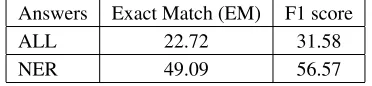
As shown in Table 4, the machine comprehension sys-tem achieves EM/F1 score of 22.72/31.58 in public SQuAD dev set. This result is far below the result 68.78/78.56 of the case when the model is trained with the original training set. However, considering our synthetic data only consists of target answers with single named entity, we further check EM/F1 score of partial dev set that only has a single named entity as the answer. We find that in the 10k dev set, about 40 percent of the data has an answer with a single named
en-Answers Exact Match (EM) F1 score
ALL 22.72 31.58
NER 49.09 56.57
Table 4: Performance of the machine comprehension system which is trained only with synthetic data generated by our NQG model.
tity and the machine comprehension system achieves EM/F1 score of 49.09/56.57 with those parts of the data. Since the SQuAD dataset is a human-made dataset, this result suffi-ciently shows that our answer-separated seq2seq can gener-ate valid questions that can be acceptable both by human and machine comprehension systems.
Conclusion
In this paper, we investigate the advantages of answer sepa-ration in neural question genesepa-ration. We observe that exist-ing NQG models suffer from a serious problem: a significant proportion of generated questions include words in the tion target, resulting in the generation of unintended ques-tions. To overcome this problem, we introduce a novel NQG architecture that treats the passage and the target answer sep-arately to better utilize the information from the both sides. Experimental results show that our model has a strong abil-ity to generate the right question for the target answer in the passage. As a result, it yields a substantial improvement over previous state-of-the-art models.
Acknowledgments
References
Amplayo, R. K.; Lim, S.; and Hwang, S.-w. 2018. En-tity commonsense representation for neural abstractive sum-marization. InProceedings of the 2018 Conference of the North American Chapter of the Association for Computa-tional Linguistics: Human Language Technologies, Volume 1 (Long Papers), volume 1, 697–707.
Bahdanau, D.; Cho, K.; and Bengio, Y. 2015. Neural ma-chine translation by jointly learning to align and translate. InProceedings of the International Conference on Learning Representations.
Chen, X.; Fang, H.; Lin, T.-Y.; Vedantam, R.; Gupta, S.; Doll´ar, P.; and Zitnick, C. L. 2015. Microsoft coco cap-tions: Data collection and evaluation server. arXiv preprint arXiv:1504.00325.
Du, X.; Shao, J.; and Cardie, C. 2017. Learning to ask: Neu-ral question generation for reading comprehension. In Pro-ceedings of the 55th Annual Meeting of the Association for Computational Linguistics (Volume 1: Long Papers), vol-ume 1, 1342–1352.
Duan, N.; Tang, D.; Chen, P.; and Zhou, M. 2017. Ques-tion generaQues-tion for quesQues-tion answering. InProceedings of the 2017 Conference on Empirical Methods in Natural Lan-guage Processing, 866–874.
Gulcehre, C.; Ahn, S.; Nallapati, R.; Zhou, B.; and Bengio, Y. 2016. Pointing the unknown words. InProceedings of the 54th Annual Meeting of the Association for Computational Linguistics (Volume 1: Long Papers), volume 1, 140–149. Heilman, M., and Smith, N. A. 2010. Good question! sta-tistical ranking for question generation. In Human Lan-guage Technologies: The 2010 Annual Conference of the North American Chapter of the Association for Computa-tional Linguistics, 609–617. Association for Computational Linguistics.
Kingma, D. P., and Ba, J. 2014. Adam: A method for stochastic optimization.arXiv preprint arXiv:1412.6980. Ma, S.; Sun, X.; Li, W.; Li, S.; Li, W.; and Ren, X. 2018. Query and output: Generating words by querying distributed word representations for paraphrase generation. In Proceed-ings of the 2018 Conference of the North American Chapter of the Association for Computational Linguistics: Human Language Technologies, Volume 1 (Long Papers), volume 1, 196–206.
Manning, C.; Surdeanu, M.; Bauer, J.; Finkel, J.; Bethard, S.; and McClosky, D. 2014. The stanford corenlp natural language processing toolkit. In Proceedings of 52nd an-nual meeting of the association for computational linguis-tics: system demonstrations, 55–60.
Mostafazadeh, N.; Misra, I.; Devlin, J.; Mitchell, M.; He, X.; and Vanderwende, L. 2016. Generating natural questions about an image. InProceedings of the 54th Annual Meeting of the Association for Computational Linguistics (Volume 1: Long Papers), volume 1, 1802–1813.
Nallapati, R.; Zhou, B.; dos Santos, C.; Gulcehre, C.; and Xiang, B. 2016. Abstractive text summarization using sequence-to-sequence rnns and beyond. InProceedings of
The 20th SIGNLL Conference on Computational Natural Language Learning, 280–290.
Pennington, J.; Socher, R.; and Manning, C. 2014. Glove: Global vectors for word representation. InProceedings of the 2014 conference on empirical methods in natural lan-guage processing (EMNLP), 1532–1543.
Rajpurkar, P.; Zhang, J.; Lopyrev, K.; and Liang, P. 2016. Squad: 100,000+ questions for machine comprehension of text. InProceedings of the 2016 Conference on Empirical Methods in Natural Language Processing, 2383–2392. Serban, I. V.; Sordoni, A.; Bengio, Y.; Courville, A. C.; and Pineau, J. 2016. Building end-to-end dialogue systems us-ing generative hierarchical neural network models. InAAAI, volume 16, 3776–3784.
Serban, I. V.; Sordoni, A.; Lowe, R.; Charlin, L.; Pineau, J.; Courville, A. C.; and Bengio, Y. 2017. A hierarchical latent variable encoder-decoder model for generating dialogues. In
AAAI, 3295–3301.
Song, L.; Wang, Z.; Hamza, W.; Zhang, Y.; and Gildea, D. 2018. Leveraging context information for natural question generation. In Proceedings of the 2018 Conference of the North American Chapter of the Association for Computa-tional Linguistics: Human Language Technologies, Volume 2 (Short Papers), volume 2, 569–574.
Sutskever, I.; Vinyals, O.; and Le, Q. V. 2014. Sequence to sequence learning with neural networks. InAdvances in neural information processing systems, 3104–3112. Tang, D.; Duan, N.; Qin, T.; Yan, Z.; and Zhou, M. 2017. Question answering and question generation as dual tasks.
arXiv preprint arXiv:1706.02027.
Tang, D.; Duan, N.; Yan, Z.; Zhang, Z.; Sun, Y.; Liu, S.; Lv, Y.; and Zhou, M. 2018. Learning to collaborate for question answering and asking. InProceedings of the 2018 Confer-ence of the North American Chapter of the Association for Computational Linguistics: Human Language Technologies, Volume 1 (Long Papers), volume 1, 1564–1574.
Wang, Z.; Hamza, W.; and Florian, R. 2017. Bilateral multi-perspective matching for natural language sentences. In Pro-ceedings of the 26th International Joint Conference on Arti-ficial Intelligence, 4144–4150. AAAI Press.
Yu, A. W.; Dohan, D.; Luong, M.-T.; Zhao, R.; Chen, K.; Norouzi, M.; and Le, Q. V. 2018. Qanet: Combining local convolution with global self-attention for reading compre-hension. InProceedings of the International Conference on Learning Representations.