The Journal of Social Sciences Research
ISSN(e): 2411-9458, ISSN(p): 2413-6670
Vol. 5, Issue. 11, pp: 1614-1619, 2019 URL: https://arpgweb.com/journal/journal/7 DOI: https://doi.org/10.32861/jssr.511.1614.1619
Academic Research Publishing Group
Original Research Open Access
The Intellectualisation of the Malay Language in Interreligious Dialogue
Munif Zarirruddin Fikri Nordin
School of Languages, Civilisation and Philosophy, Universiti Utara Malaysia, Malaysia
Fellow, King Abdullah Bin Abdulaziz International Centre for Interreligious and Intercultural Dialogue (KAICIID), Vienna, Austria
Abstract
The Malay language is the national language of Malaysia’s multireligious and multiracial society. Due to a close association between Islam and Malay, the Muslim hegemony controls the religious truth of the meaning and interpretation in the Malay language. However, to enhance the role of the Malay language to be an inclusive religious language, it is important to intellectualise the language through interreligious dialogue in Malaysia. The study aims at (1) analysing the needs of the intellectualisation of the Malay language as a religious language in Malaysian interreligious dialogue, and (2) explaining the process of the intellectualisation of the Malay language in Malaysian interreligious dialogue. The main approaches of the study are Syed Hussein Alatas (1977) idea of intellectualism in the sociology of development and Asmah Haji Omar (1993) suggestion of intellectualisation in language planning. There are two types of data. Firstly, the news on interreligious dialogue in Berita Harian, an online Malay newspaper. Secondly, the answers given by four sociolinguists in their interviews covering questions on the needs and the process of the intellectualisation of the Malay language. The intellectualisation of the Malay language refers to the ability of the language to express intellectually the religious messages of all religions in Malaysia, which can be done through two different ways: linguistic and non-linguistic perspectives. The findings suggest that the intellectualisation of the Malay language as a religious language in Malaysian interreligious dialogue has strong potential for strengthening mutual understanding, respect and tolerance among the followers of different religions who participate in the dialogue.
Keywords: Religious discourse analysis; Sociology of language and religion. CC BY: Creative Commons Attribution License 4.0
Disclaimer
The article has been supported for publication as a part of the KAICIID Fellows Programme, which aims to provide opportunities for individuals to engage in research and scholarship in interreligious dialogue and related areas as part of their professional development and learning. The work undertaken has been conducted by external actors. The views, opinions, findings, and conclusions or recommendations expressed in the article are strictly those of the author(s) and do not necessarily reflect the views of the International Dialogue Centre (KAICIID) or its Member States. The International Dialogue Centre (KAICIID) does not guarantee the accuracy of the data included in this article and, further, neither the International Dialogue Centre (KAICIID) nor its Member States will accept any liability in connection with these data.
1. Introduction
In Malaysia, the Malay language, as a religious language, linguistically relates to religious meaning and interpretation, which are dominated by Muslims. The Muslim hegemony controls the religious truth of the meaning and interpretation in the Malay language. From the perspective of traditionalist Muslims, as Islam is the religion of the Federation, it is above all other religions.
Although Muslims are the majority in Malaysia, their hegemony in controlling the religious truth of the meaning and interpretation in the Malay language needs to be examined through Article 152 (National Language and Other Languages) of the Federal Constitution because it states that the national language is the Malay language. This means that all activities, including the religious activities of all religions, conducted in the Malay language fulfil the spirit of Malaysia as a nation state.
Therefore, in order to enhance the role of the Malay language from an exclusive religious language to an inclusive religious language, it is important to intellectualise the language through interreligious dialogue in the name of intellectual tradition, academic freedom and academic culture in Malaysia.
The study aims at (1) analysing the needs of the intellectualisation of the Malay language as a religious language in Malaysian interreligious dialogue, and (2) explaining the process of theintellectualisation of the Malay language in Malaysian interreligious dialogue.
2. The Intellectualisation of the Malay Language
Liddicoat and Bryant (2002), stress that the intellectualisation of a language is a current issue in language
The thematisation of topics at the highest levels of discourse in academia is called intellectualisation, for the language then becomes used, not only in everyday conversational discourse in the community, but as a means of learning subject matter especially at the highest levels of intellectual application and displaced discourse about abstract (concrete) realities (Gonzalez, 2002).
The intellectualisation of the Malay language means the ability of the language to express intellectually the religious messages of all religions in Malaysia by taking into consideration the role of English as a religious language for all religions, all over the world. Through the activities in interreligious dialogue, the intellectualisation of the language has strong potential for strengthening mutual understanding, respect and tolerance among the followers of different religions who participate in the dialogue.
Who intellectualises language? They are intellectuals who create for a class, or people, a coherent and reasoned account of the world; they are crucial in relation to the emergence of a new culture, representing the world-view of an emerging class or people (Mkandawire, 2005).
Language is the normal medium of transferring knowledge and skills in all educational levels. A successful and effective acquisition of knowledge and skills can take place only if effective communication via a language medium has taken place (Chumbow, 2005).
3. Interreligious Dialogue in Malaysia
Malaysia, being a multiethnic and multireligious country, has not been spared from the inter-religious tensions due to various reasons. Over the years, there have been several controversies which should have served as wake-up calls on the need for urgent intervention to address the animosity in our local interreligious relations (Ahmad and
Wan, 2012).
Among them is the issue related to the purported questioning of the freedom of religion of Malaysians in a string of controversial cases such as that involving the religious status of the late M. Moorthy before his untimely death in 2005 and the apostasy case of Lina Joy in 2006, which provided another example concerning the freedom of religion of an individual (Ahmad and Wan, 2012). These controversies underline the issue of one’s religious freedom in
Malaysia, especially when it comes to the Malays and Islam.
In reality, interreligious dialogue in Malaysia can be traced back to the year 1956 when Persatuan Hidup Murni (The Pure Life Society), a Hindu charitable body, pursued the establishment of a global interfaith cooperation council based in Malaysia. In its early stage, this council was known as World Council for Inter-Faith Cooperation
(Mustafa and Jaffary, 2013). In 1963, it developed and operated under the new name of Pertubuhan Antara Agama
Malaysia (Interfaith Association of Malaysia) until 1986 when it became known as Inter-Faith Spiritual Fellowship (INSAF). It has operated under this name ever since. Members of INSAF come from various religious backgrounds, including Islam. They are largely professionals who share a common view of the universality of God and the shared humanity of all people (Muhammad Abu Bakar, 1987).
Azizan (2008), views that, from the 1970s till the time of writing, a number of strategies were planned and
executed by some government agencies and NGOs to ensure that racial and religious harmony was achieved in society. For example, in 1983, non-Muslim religious leaders, primarily religious officials from the four main religions, came to a consensus and formed the Malaysian Consultative Council of Buddhism, Christianity, Hinduism, Sikhism and Taoism (MCCBCHST). The Council has expressed concern about the Islamisation policy of the government as well as other human rights and social issues. The Council acts as a watchdog organization monitoring enactments and policies that affect the religious life of minority religious groups in the country (Azizan,
2008).
In April 2002, the Human Rights Commission (Suhakam) initiated an interfaith dialogue aimed at promoting better understanding and respect among the country’s different religious groups. The interfaith dialogue included representatives from the Malaysian Islamic Development Department, the Malaysian Ulama’ Association, and the MCCBCHST. On 14th December 2004, the government established the Select Committee on National Service and Unity to discuss issues pertaining to unity between the races and national integration. This committee, comprised of 11 members from the various races and political parties, was headed by the Minister in the Prime Minister’s
Department, in charge of national unity, the Honourable Maximus Ongkili (Azizan, 2008).
In 2010, the Interfaith Relations Working Committee was established under the purview of the National Unity and Integration Department. Upon approval from the Cabinet, it was renamed as Committee to Promote Inter-Religious Understanding and Harmony. It comprises representation fromthe Department of Islamic Development, the Institute of Islamic Understanding, and the MCCBCHST. The committee was a framework for managing religious and cultural polarities. The idea was to involve religious leaders, leaders of NGOs as well as the relevant government departments such as JAKIM and the Unity Department. The involvement of any active politicians was prohibited (Azizan, 2008).
4. Theoretical Framework and Methodology
The theoretical framework of the study mainly covers the sociolinguistic and intellectualism aspects, which are language planning and intellectualisation. The main approaches are Syed Hussein Alatas (1977) idea of intellectualism in the sociology of development and Asmah Haji Omar (1993) suggestion of intellectualisation in language planning.
Syed Hussein Alatas (1977), stresses that mismanagement and incompetence in developing nations are the result
of the ineffectiveness of their intellectuals. This stems from low language ability, which, in turn, causes the low level of recognising and solving problems, learning what is required and learning the art of learning. His approach will be used in analysing the needs of the intellectualisation of the Malay language.
Asmah Haji Omar (1993), highlights that intellectualisation is a standardisation and rationalisation of language
in language planning. It is about the accuracy of a language in expressing complex and interconnected ideas towards a scientific and theoretic language; and also about the elaboration and expansion of a language through its vocabulary and grammar structure. Her approach will be applied in explaining the process of the intellectualisation of the Malay language.
The data relate to the use of the Malay language as a religious language within four important religions in Malaysia, namely Islam, Buddhism, Christianity and Hinduism, in their interreligious dialogue.
There are two types of data. Firstly, the news on interreligious dialogue in Berita Harian, an online Malay newspaper. Secondly, the answers given by four sociolinguists in their interviews covering questions on the needs and the processof the intellectualisation of the Malay language.
The news is identified by searching the phrase “dialog antara agama” (interreligious dialogue) on the Berita Harian website. There are seven accessible titles on its website within the period 2015-2019, as shown in Table 1. The news about interreligious dialogue, with the purpose of highlighting religion as an effective platform for creating harmony and peace in the country, is in line with Berita Harian’s ideology and vision in promoting interreligious dialogue.
Table-1. News about Interreligious Dialogue (IRD) in Berita Harian from 2015-2019
Date Title
1. 28 May 2019 Pendidikan toleransi agama benteng ekstremisme belia
(Religious tolerance education a bulwark against youth extremism) 2. 6 Mac 2019 Perbanyakkan dialog antara agama, elak cetus ketidakharmonian
(Increase interreligious dialogue, avoid conflict) 3. 15 December
2018
Kepelbagaian agama, budaya perlu dihormati
(Religious diversity, culture should be respected)
4. 1 July 2017 Keagamaan, kerohanian penting bagi identiti negara – PM
(Religion, spirituality essential to the nation's identity – PM) 5. 9 May 2017 Hubungan diplomatik Malaysia, Holy See galak pemahaman agama
(Malaysian diplomatic relations, the Holy See encourage religious understanding)
6. 9 August 2015 Dialog PERKASA-CPHM perkembangan positif – Shamsul Amri
(PERKASA-CPHM dialogue is a positive development - Shamsul Amri) 7. 4 February 2015 Pergiat dialog keharmonian, tangani konflik kaum dan agama – Rais
(Take up the dialogue of harmony, manage racial and religious conflicts – Rais)
5. The Needs of the Intellectualisation of the Malay Language in Interreligious
Dialogue
The Malay language is an intellectual language. The influence of Islam in the classical period (the 14th century – the 18th century), transition period (the 19th century) and modern period (the 20th century – now) has revolutionised the Malay language to become one of the languages of Islam through rationalism and intellectualism (Al-Attas and
Syed, 1972).
Generally, as with any language, the Malay language develops as its users develop in society. There are four reasons why the Malay language needs to be intellectualised in the religious context, including the interreligious dialogue:
a. Expression of a high level of religious thought;
b. Understanding and explaining religious concepts, such as metaphysics, ethics, etc.; c. Strengthening the belief and faith;
d. Representing the identity of the assimilated Malaysians.
Table-2. The Needs of Intellectualisation and IRD in Berita Harian
Title Reason Function
1. Toleransi agama, ekstremisme
(Religious tolerance, extremism)
Religious thought
Understanding and explaining religious concepts
Strengthening the belief and faith
Content and tool
2. Dialog antara agama, ketidakharmonian
(Interreligious dialogue, conflict)
Religious thought
Strengthening the belief and faith
Content and tool
3. Kepelbagaian agama, budaya
(Religious diversity, culture)
Religious thought
Understanding and explaining religious concepts
Strengthening the belief and faith
Content and tool
4. Keagamaan, kerohanian, identiti negara
(Religion, spirituality, nation's identity)
Religious thought
Understanding and explaining religious concepts
Strengthening the belief and faith Representing the identity of the Malaysians
Content and tool
5. Hubungan diplomatik,
pemahaman agama
(Diplomatic relations, religious understanding)
Religious thought
Understanding and explaining religious concepts
Strengthening the belief and faith, Representing the identity of the Malaysians
Content and tool
6. Dialog PERKASA-CPHM
(PERKASA-CPHM dialogue)
Religious thought Content and tool
7. Dialog keharmonian, konflik kaum dan agama
(Dialogue of harmony, racial and religious conflicts)
Religious thought
Strengthening the belief and faith
Content and tool
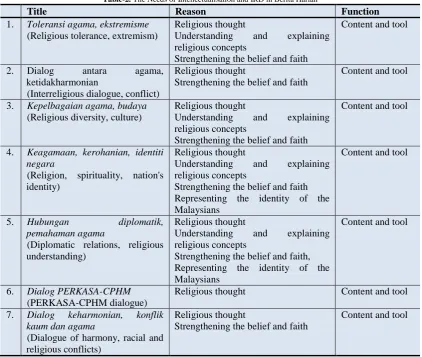
This finding shows that the expression of high level religious thought, in particular theology, eschatology, can only be accomplished through an intellectual language, which is a language with an intellectual value of religious knowledge. Every single example in Table 2 has religious thought. It means that the thought cannot be easily delivered without an intellectual language or a high level of language ability.
In example 1, religious tolerance is a religious thought. The thought is not only knowledge, but also an intellectual value about religion. In examples 2, 6 and 7, the word dialogue means that dialogue has a religious value, and the value must be expressed through interreligious dialogue.
To understand and explain religious concepts, such as metaphysics, ethics, etc., intellectual language is a substance. It relates to religious belief and faith accordingly, which need to be strengthened intellectually, covering all aspects from the concept to its practice.
Spirituality, in example 4, and religious understanding, in example 5, cannot be understood easily without clear and accurate explanations. Thus, an intellectual language is a language that has the capacity to explain religious concepts clearly and accurately.
Thirdly, having an intellectual language will strengthen the belief and faith because every religious principle can be examined and understood clearly through the language. In examples 1-5 and 7, language plays its role in strengthening the belief that religious tolerance, harmony, diversity and spirituality are important basic elements in real life. It is through such belief that it influences what people think and practise.
Fourthly, the identity of the assimilated Malaysians is represented by the ability of the Malay language to express intellectual thought in any religious context (Asmah Haji Omar, 2019; Norhashimah, 2019; Normaliza
Abdul Rahim, 2019; Rahim, 2019). In example 4, as interreligious dialogue is a nation’s identity, it requires a
language that intellectually enables people to accommodate, acculturate and assimilate into a culture.
6. The Processes of the Intellectualisation of the Malay Language in
Interreligious Dialogue
Table-3. The Processes of Intellectualisation and IRD in Berita Harian
Title Linguistics Non-Linguistics
1. Pendidikan toleransi agama benteng ekstremisme belia
(Religious tolerance education a bulwark against youth extremism)
Education
Teaching and learning
Academic writing Debate
Forum
Cultural activities 2. Perbanyakkan dialog antara agama, elak
cetus ketidakharmonian
(Increase interreligious dialogue, avoid conflict)
Education
Teaching and learning Administration
Dialogue Discussion Forum
3. Kepelbagaian agama, budaya perlu dihormati
(Religious diversity, culture should be respected)
Education
Teaching and learning Administration
Dialogue Discussion Forum
Cultural activities 4. Keagamaan, kerohanian penting bagi
identiti negara – PM
(Religion, spirituality essential to the nation's identity – PM)
Education
Teaching and learning
Dialogue Discussion Forum
5. Hubungan diplomatik Malaysia, Holy See galak pemahaman agama
(Malaysian diplomatic relations, the Holy See encourage religious understanding)
Education
Teaching and learning Administration Legal system
Dialogue Discussion Forum
6. Dialog PERKASA-CPHM perkembangan positif – Shamsul Amri
(PERKASA-CPHM dialogue is a positive development - Shamsul Amri)
Education
Teaching and learning Administration
Dialogue Discussion Forum
7. Pergiat dialog keharmonian, tangani konflik kaum dan agama – Rais
(Take up the dialogue of harmony, manage racial and religious conflicts – Rais)
Education
Teaching and learning Administration
Dialogue Discussion Forum
Linguistically, an intellectual language is a well-planned and well-structured language at national and international levels. It is a language with a clear policy or a number of policies (Norhashimah, 2019; Normaliza
Abdul Rahim, 2019; Rahim, 2019) at the national level. Subsequently, it can be intellectualised in many forms
including education, teaching, learning, administration, and the legal system. These forms are connected and complement each other.
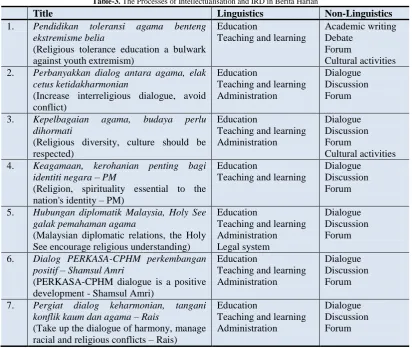
In Table 3, all the examples linguistically exhibit the importance of education, teaching, and learning in the
process of the intellectualisation of the Malay language in the interreligious context. The Malay language used in the teaching and learning activities in all educational institutions must be of a high level. In example 5, administration and the legal system are involved in a context in which interreligious dialogue must be held intellectually in the Malay language, in particular, for the purpose of managing religious issues. In other words, as linguistic domains, administration and the legal system impose on the Malay language users the need to use a high level of the language.
From the non-linguistic perspective, generally, intellectualisation needs no specific language plan because it is a natural process (Asmah Haji Omar, 2019). As shown in Table 3, intellectualisation exists along with all kinds of language use, particularly in academic or high order thinking skills activities, including academic writing, debate, forum, business and cultural activities, etc. For example, the Malay language thrives on religion(s) and vice versa, as long as people practise their beliefs and faiths.
Naturally, the more they want to broaden their religious understanding, the more they use the Malay language. Historically, before language planning was introduced in Malaysia, the Malay language developed as its users used it consistently from one generation to another.
7. Conclusion
The intellectualisation of the Malay language means the ability of the language to intellectually express the religious messages of all religions in Malaysia by taking into consideration the role of English as a religious language of all religions, all over the world. Through the activities in interreligious dialogue, the intellectualisation of the Malay language has strong potential for strengthening mutual understanding, respect and tolerance among the followers of different religions who participate in the dialogue. Thus, interreligious dialogue in Malaysia could be managed systematically and effectively by taking into consideration Malaysia’s cultural and national identity.
This can be done through two different perspectives, namely, the linguistic and non-linguistic perspectives. The linguistic perspective centres on locating the intellectualisation of the Malay language in language planning or a language policy that Malaysia has been implementing since its independence. The non-linguistic perspective involves leaving the intellectualisation of the language to a natural process, which exists alongside any kind of language use, particularly in academic or high order thinking skill activities.
References
Ahmad, M. I. and Wan, K. M. (2012). Themes and issues in research on interfaith and inter-religious dialogue in Malaysia. Advances in Natural and Applied Sciences, 6(6): 1001-10.
Al-Attas and Syed, N. (1972). Islam dalam sejarah dan kebudayaan Melayu. Penerbit Universiti Kebangsaan Malaysia: Kuala Lumpur.
Asmah Haji Omar (1993). Perancangan bahasa dengan rujukan khusus kepada perancangan bahasa Melayu. 3rd edn: Dewan Bahasa dan Pustaka: Kuala Lumpur.
Asmah Haji Omar (2019). Interview on 8 July, at Section 17. Petaling Jaya: Selangor.
Azizan, B. (2008). Peranan dialog peradaban dalam wacana, tamadun Malaysia. Jurnal Peradaban, 1: 25-41. Chumbow, B. S., 2005. "The language question and national development in Africa. In Mkandawire, T. ." In African
intellectuals: Rethinking politics, language, gender and development. London: Zed Books.
Gonzalez, A. (2002). Language planning and intellectualisation. Current Issues in Language Planning, 3(1): 5-27. Liddicoat, A. J. and Bryant, P. (2002). Intellectualisation: A current issue in language planning. Current Issues in
Language Planning, 3(1): 1-4.
Mkandawire, T., 2005. "Introduction. In Mkandawire, T." In African intellectuals: Rethinking politics, language, gender and development. London: Zed Books.
Muhammad Abu Bakar (1987). Penghayatan sebuah ideal. Dewan Bahasa dan Pustaka: Kuala Lumpur.
Mustafa, K. A. M. and Jaffary, A. (2013). Dialog antara agama di Malaysia: Perkembangan daripada tahun 1956-2010. Ulum Islamiyyah Journal, 11: 49-64.
Norhashimah, J. (2019). Interview on 9 July. National University of Malaysia: Bangi, Selangor. Normaliza Abdul Rahim (2019). Interview on 2. Putra University of Malaysia: Serdang, Selangor. Rahim, A. (2019). Interview on 29. National University of Malaysia: Bangi, Selangor.