The Thirty-Third AAAI Conference on Artificial Intelligence (AAAI-19)
Hyperbolic Heterogeneous Information Network Embedding
Xiao Wang, Yiding Zhang, Chuan Shi
∗School of Computer Science, Beijing University of Posts and Telecommunications
{xiaowang, zyd, shichuan}@bupt.edu.cn
Abstract
Heterogeneous information network (HIN) embedding, aim-ing to project HIN into a low-dimensional space, has at-tracted considerable research attention. Most of the exit-ing HIN embeddexit-ing methods focus on preservexit-ing the inher-ent network structure and semantic correlations in Euclidean spaces. However, one fundamental problem is that whether the Euclidean spaces are the appropriate or intrinsic isomet-ric spaces of HIN? Recent researches argue that the complex network may have the hyperbolic geometry underneath, be-cause the underlying hyperbolic geometry can naturally re-flect some properties of complex network, e.g., hierarchical and power-law structure. In this paper, we make the first ef-fort toward HIN embedding in hyperbolic spaces. We ana-lyze the structures of two real-world HINs and discover some properties, e.g., the power-law distribution, also exist in HIN. Therefore, we propose a novel hyperbolic heterogeneous in-formation network embedding model. Specifically, to capture the structure and semantic relations between nodes, we em-ploy the meta-path guided random walk to sample the se-quences for each node. Then we exploit the distance in hy-perbolic spaces as the proximity measurement. The hyper-bolic distance is able to meet the triangle inequality and well preserve the transitivity in HIN. Our model enables the nodes and their neighborhoods have small hyperbolic distances. We further derive the effective optimization strategy to update the hyperbolic embeddings iteratively. The experimental results, in comparison with the state-of-the-art, demonstrate that our proposed model not only has superior performance on net-work reconstruction and link prediction tasks but also shows its ability of capture hierarchy structure in HIN via visualiza-tion.
Introduction
Heterogeneous information networks (HINs) are networks that consist of multiple types of nodes and edges. Modeling data in the real world as HINs can capture rich data seman-tics. For example, the bibliographic network can be mod-eled as an HIN with three types of nodes: Author, paper, and venue (Fu, Lee, and Lei 2017). Further, the relations between nodes, such as author-paper (write), paper-venue (publish), have different types of edges. Recently, HIN em-bedding, aims at learning the node representations in the
∗
Corresponding author, Chuan Shi, [email protected]. Copyright c2019, Association for the Advancement of Artificial Intelligence (www.aaai.org). All rights reserved.
low-dimensional spaces while preserving the structure and semantic information, has received increasing research at-tention. Benefited from HIN embedding, a variety of HIN based applications, e.g, recommendation (Shi et al. 2018; Hu et al. 2018) and link prediction (Chen et al. 2018), can be conducted and improved in the low-dimensional space.
So far, a number of HIN embedding methods have been proposed. Loosely speaking, there are the works based on random walk (Dong, Chawla, and Swami 2017; Fu, Lee, and Lei 2017), network partition based methods (Tang, Qu, and Mei 2015; Xu et al. 2017), and deep neural network based HIN embedding (Chang et al. 2015; Wang et al. 2018). In essence, because the structure and semantics are the two most important information in an HIN, most of them fo-cus on how to effectively preserve the HIN structures and semantics in the low-dimensional spaces. However, another fundamental problem is that what are the appropriate or in-trinsic underlying isometric spaces of HIN? Because the Eu-clidean spaces are the natural generalization of our intuition-friendly, and visual three-dimensional space, they have be-come the primary choice for the current HIN embedding methods. While more and more researches demonstrate that many types of complex data, e.g., social network, actually exhibit a highly non-Euclidean latent anatomy (Bronstein et al. 2017). This motivates us to rethink that whether the current chosen low-dimensional spaces for HIN embedding, i.e., Euclidean spaces, are optimal and are there other feasi-ble non-Euclidean spaces?
Recently, hyperbolic spaces have gained momentum in the context of network science. Hyperbolic spaces are spaces of constant negative curvature (Cannon et al. 1997). A supe-riority of hyperbolic spaces is that they expand faster that Euclidean spaces (Nickel and Kiela 2017). For instance, considering a circle and a disk in a 2-dimensional hyper-bolic space with constant curvature K = −1, the length of the circle and the area of the disk of hyperbolic radius
r are given as2πsinhrand2π(coshr−1), respectively, and both of them grow aserwithr. In a 2-dimensional
Eu-clidean space, the length of a circle and the area of a disk of Euclidean radius r are given as2πr andπr2, growing
hyper-bolic spaces underlies complex network and find that data with power-law structure is suitable to be modeled in hy-perbolic spaces. Because of these properties of hyhy-perbolic spaces, some works begin to study the hyperbolic embed-dings of different data. For instance, (Dhingra et al. 2018) embeds text in hyperbolic spaces. (Nickel and Kiela 2017) and (Ganea, Becigneul, and Hofmann 2018) learn the em-beddings of homogeneous networks.
In this paper, we propose a novel hyperbolic hetero-geneous information network embedding model (HHNE) which is able to preserve the structure and semantic informa-tion in hyperbolic spaces. We leverage the meta-path guided random walk to generate heterogeneous neighborhoods for each node to capture the structure and semantic relations in HIN. Then the proximity between nodes is measured by the distance in hyperbolic spaces. As the distance is defined in metric spaces, the proximity between nodes meets the tri-angle inequality and can well preserve the transitivity in HIN. Our model is able to maximize the proximity between the neighborhood nodes while minimizing the proximity be-tween the negative sampled nodes. We further derive the ef-fective optimization strategy to optimize hyperbolic embed-dings iteratively.
We highlight the main contributions as follows:
• To our best knowledge, we are the first to study the prob-lem of HIN embedding in hyperbolic spaces.
• We propose a novel HIN embedding model, named HHNE, to preserve the HIN structure and semantic cor-relations in hyperbolic spaces based on the meta-path guided random walk.
• We conduct extensive experiments to evaluate the perfor-mance of HHNE in terms of representation capacity and generalization ability on two real-world datasets. The re-sults show the superiority of HHNE by comparing with the state-of-the-art techniques.
Related Work
Network Embedding
Recently, a significant amount of progress has been made toward network embedding (Cui et al. 2018). For instance, inspired by language modeling technique, DeepWalk (Per-ozzi, Al-Rfou, and Skiena 2014) regards the node sequences generated from random walks as “sentences”, and nodes as “words”, and then maximizes the co-occurrence probability among nodes. LINE (Tang et al. 2015) is able to efficiently learn the node embeddings while preserving both of the first-order and second-first-order structures. Node2vec (Grover and Leskovec 2016) is generalized from DeepWalk. It designs a parameterized random walk procedure to learn a mapping of nodes that maximizes the likelihood of preserving net-work neighborhoods of nodes. SDNE (Wang, Cui, and Zhu 2016) uses autoencoder to capture local and global network structures to learn user representation. Most of network em-bedding methods embed network into low-dimensional Eu-clidean spaces, while some researchers begin to embed net-work into low-dimensional hyperbolic spaces. (Nickel and Kiela 2017) embeds network into hyperbolic spaces to learn
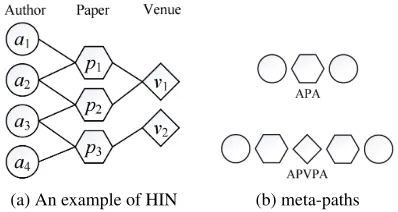
(a) An example of HIN (b) meta-paths
Figure 1: An illustrative example of a heterogeneous infor-mation network (DBLP) and meta-paths.
hierarchical feature representations of network. (Ganea, Be-cigneul, and Hofmann 2018) embeds the directed acyclic graphs into hyperbolic spaces to learn their hierarchical fea-ture representations. However, these methods only focus on learning the representation of nodes in homogeneous net-works and do not consider the heterogeneity of complex in-formation network.
Heterogeneous Information Network Embedding
Recently, some methods have been proposed representation learning methods for HIN. Metapath2vec (Dong, Chawla, and Swami 2017) formalizes meta-paths based random walks to obtain heterogeneous neighborhoods of a node and leverages Skip-gram model to learn the network structure. HIN2vec (Fu, Lee, and Lei 2017) carries out multiple pre-diction tasks jointly to learn the presentation of nodes and meta-paths. PTE (Tang, Qu, and Mei 2015) partitions an HIN into a set of edgewise bipartite networks and then learn the feature representation jointly by using LINE. EOE (Xu et al. 2017) aims to embed the coupled HIN, which consists of two different but related homogeneous networks. It mod-els each homogeneous network by using the same function as LINE. HNE (Chang et al. 2015) transfers different ob-jects in HIN to unified feature representations and considers contents and topological structures in networks jointly for creating the embedding. SHINE (Wang et al. 2018) utilizes multiple deep autoencoders to extract users’ highly nonlin-ear representations while preserving the structure of original networks.
To sum up, all the above mentioned HIN embedding models project HIN into low-dimensional Euclidean spaces. Nevertheless, whether the Euclidean space is the most ap-propriate one is still an open question.
Preliminaries
Definitions in HIN
Definition 1. Heterogeneous Information Network (HIN)
(Shi et al. 2017). An HIN is defined as a graph G = (V, E, T, φ, ψ), in whichV andEare the sets of nodes and edges. Each node v ∈ V and each edgee ∈ E are asso-ciated with their mapping functionsφ(v) : V → TV and
ψ(e) :E →TErespectively.TV andTEdenote the sets of
Table 1: Statistics of datasets
DBLP # A # P # V # P-A # P-V 14475 14376 20 41794 14376
MovieLens # A # M # D # M-A # M-D 11718 9160 3510 64051 9160
Definition 2. Meta-path. Given an HIN G = (V, E, T, φ, ψ), a meta-path P is a sequence of node types tv1, tv2, . . . , tvn connected by edge types
te1, te2, . . . , ten−1:P = tv1
te1 −−→ tv2
te2
−−→ . . . −t−−−en−→1 tvn.
A meta-path instance consists of specific nodes and edges,
e.g.,a1
write
−−−→p1
publish
−−−−−→v1.
For example, Figure 1(a) shows an academic network with authors (A), papers (P), venues (V) as nodes, wherein edges indicate thewrite(A-P),publish(P-V). The examples of meta-paths are shown in Figure 1(b). The meta-paths con-tain rich semantic information, such as coauthor(A-P-A),
authors attending the same venue(A-P-V-P-A).
Definition 3. Heterogeneous Information Network Em-bedding. Given an HING = (V, E, T, φ, ψ), HIN embed-ding aims to project nodes into a latent low-dimensional representation space while preserving the original network structure and semantic correlations.
Relation Distribution in HIN
In order to find out whether there is some underlying correla-tions between HIN and hyperbolic spaces, we analyze some meta-paths in two real-world HINs. The basic statistics of the two HINs are shown in Table 1.
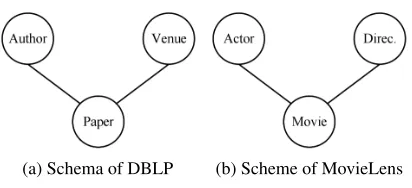
• DBLPis a bibliographic dataset in computer science. We use a subject of DBLP, i.e., DBLP-4-Area taken of (Sun et al. 2011) which contains three types of nodes, i.e., author (A), paper (P), venue (V) and two types of edges, i.e., author-paper (write), paper-venue (publish). The schema of DBLP network is shown in Figure 2(a).
• MovieLens1 contains knowledge about movies
(Canta-dor, Brusilovsky, and Kuflik 2011). We extract a subset of from MovieLens, which contains three types of nodes, i.e., actor (A), movie (M), director (D) and two types of edges, i.e., actor-movie (act in), director-movie (direct). The schema of MovieLens is shown in Figure 2(b).
As mentioned before, data with power-law structure can be naturally modeled in hyperbolic spaces. Therefore, we use two real-world HINs to check whether the power-law dis-tribution of nodes also exists with different meta-paths. We calculate the distribution of nodes as follows: given a meta-path P and a node v, we first calculate how many meta-path instances can be composed started withvfollowingP, and then calculate how many nodes have the same results. The two results are plotted as the horizontal axis and verti-cal axis, respectively. For DBLP dataset, we show the distri-bution of paper-author (A-P-A) relation and author-paper-venue (A-P-V) relation in Figure 3(a) and Figure 3(b),
1
https://grouplens.org/datasets/hetrec-2011/
(a) Schema of DBLP (b) Scheme of MovieLens
Figure 2: Schemas of two HINs.
respectively. For MovieLens dataset, we show the distribu-tion of actor-movie-director (A-M-D) reladistribu-tion in Figure 3(c). We can see these distribution presents the power-law dis-tribution. This fact implies that hyperbolic spaces may be the alternative spaces for embedding HINs. Please note that there exist a lot of meta-paths in an HIN, it makes sense that the nodes with some specific meta-paths may not al-ways have power-law distribution, but as can be seen in the following experiments, the results are still very competitive. More fine-grained analysis on the meta-paths will leave for the future work.
Embedding HIN in Hyperbolic Spaces
Hyperbolic Geometry and Embedding
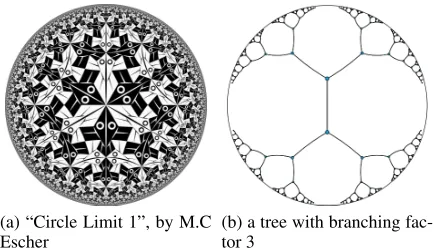
Hyperbolic geometry is a non-Euclidean geometry which is obtained by replacing Euclid’s fifth geometric postulate (the parallel postulate). Hyperbolic geometry studies the spaces of constant negative curvature. A key property of hyperbolic spaces His that they expand faster than Euclidean spaces because Euclidean spacesRexpand polynomially while hy-perbolic spacesHexpand exponentially. Specifically, each tile in Figure 4(a) (Tay, Tuan, and Hui 2018) is of the equal area in hyperbolic space but diminishes towards zero in Eu-clidean space towards the boundary. Because of this prop-erty, hyperbolic spaces can be thought of as a continuous version of trees. Specifically, as show in Figure 4(b) (Nickel and Kiela 2017), consider a tree with branching factorb, the number of nodes at level l or no more thanl hops from the root are (b+ 1)bl−1 and [(b+ 1)bl −2]/(b −1)
re-spectively. The number of nodes grows exponentially with their distance to the root of the tree, which is similar to hy-perbolic spaces as they expand exponentially. In hyhy-perbolic spaces, the data with tree structure can be embedded into 2-dimensional hyperbolic spaces naturally. Given a node at level l, the node can be placed on a sphere in hyperbolic spaces with distancedH∝lto the origin of the sphere, and
(a) Author-Paper-Author in DBLP (b) Author-Paper-Venue in DBLP (c) Actor-Movie-Director in MovieLens
Figure 3: The distribution of some relations in two datasets.
(a) “Circle Limit 1”, by M.C Escher
(b) a tree with branching fac-tor 3
Figure 4: Two examples of Poincar´e disk model of hyper-bolic spaces.
Hyperbolic spaces cannot be isometrically embedded into Euclidean spaces, so they are difficult to envisage (Kri-oukov et al. 2010). Fortunately, there exist many equivalent models of hyperbolic spaces such as Poincar´e disk (ball) model, Poincar´e half-plane model, Beltrami-Klein model, hyperboloid model (Cannon et al. 1997). As Poincar´e ball model is well-suited for gradient-based optimization, our work makes use of Poincar´e ball model. LetDd = {x ∈
Rd : kxk < 1} be theopend-dimensional unit ball. The Poincar´e ball model is defined by the manifoldDdequipped
with the following Riemannian metric tensorgD
x:
gD
x =λ
2
xgE whereλx:=
2
1− kxk2, (1)
wherex ∈ Dd,gE = Idenotes the Euclidean metric ten-sor. It is worth noting that the Poincar´e model is conformal, meaning that Euclidean angles between hyperbolic lines in the model are equal to their hyperbolic angles that makes it suitable for gradient-based method.
The HHNE Model
We aim to learn the representation of nodes to preserve the structure and semantic correlations in hyperbolic spaces. Given an HING= (V, E, T, φ, ψ)with|TV|>1, we are
in-terested in learning the embeddingsΘ ={θi}| V|
i=1, θi∈Dd. We preserve the structure by facilitating the proximity be-tween the node v ∈ V and its neighborhoodsct ∈ Ct(v)
with typet. We use meta-path guided random walks (Dong, Chawla, and Swami 2017) to obtain heterogeneous neigh-borhoods of a node. In meta-path guided random walks, the nodes sequences are restrained by the node types which are defined by meta-paths. Specifically, given a meta-path
P =tv1
te1 −−→tv2
te2
−−→. . . −t−−−en−→1 tvn,the transition
proba-bility at stepiis defined as follows:
p(vi+1|vtivi,P)=
( 1
|Ntvi
+1(v i tvi)|
(vi+1, vi
tvi)∈E, φ(vi+1)=tvi+1
0 otherwise,
(2) wherevi
tvi is nodev ∈ V with type tvi, andNtvi+1(v
i tvi)
denotes thetvi+1type of neighborhood of nodev
i tvi.
The meta-path guided random walk strategy ensures that the semantic relationships between different types of nodes can be properly incorporated into HHNE.
In order to preserve the proximity between nodes and its neighborhoods in hyperbolic spaces, we use distances in Poincar´e ball model to measure their proximity. Given nodes embeddingsθi, θj ∈Dd, the distance in Poincar´e ball is given by:
dD(θi, θj) = cosh−1
1 + 2 kθi−θjk
2
(1− kθik2)(1− kθjk2)
.
(3) It is worth noting that as the Poincar´e ball model is defined in metric spaces, the distance in Poincar´e ball meet the trian-gle inequality and can well preserve the transitivity in HIN. Then, we use a probability to measure the nodectis a
neigh-borhood of nodevas following:
p(v|ct; Θ) =σ[−dD(θv, θct)],
whereσ(x) = 1
1+exp(−x). Then the object of our model is
to maximize the probability as following:
arg max
Θ X
v∈V
X
ct∈Ct(v)
logp(v|ct; Θ). (4)
v, we want to maximize the proximity betweenv and its neighborhood ct while minimize the proximity betweenv
and its negative sampled node n. Therefore, the objective function Eq. 4 can be rewritten as following:
L(Θ) = logσ[−dD(θct, θv)]
+
M
X
m=1
Enm∼P(n){logσ[dD(θct, θnm)]},
(5)
where P(n) is the pre-defined distribution from which a negative nodenm is drew from forM times. Our method
builds the node frequency distribution by draw nodes regard-less of their types.
Optimization
As the parameters of the model live in a Poincar´e ball which has a Riemannian manifold structure, the back-propagated gradient is a Riemannian gradient. It means that the Eu-clidean gradient based optimization, such as θi ← θi +
η∇E
θiL(Θ), makes no sense as an operation in the Poincar´e
ball, because the addition operation is not defined in this manifold. Instead, we can optimize Eq. 5 via a Riemannian stochastic gradient descent (RSGD) optimization method (Bonnabel and others 2013). In particular, letTθiD
ddenote
the tangent space of a node embedding θi ∈ Dd, and we can compute the Riemannian gradient∇R
θiL(Θ)∈ TθiD
dof
L(Θ). Using RSGD, parameter updates to maximize Eq. 5 are in the form:
θi←expθi(η∇
R
θiL(Θ)), (6)
whereexpθi(·)is exponential map in the Poincar´e ball. In Euclidean spaces , the exponential map is familiar with us: Given a node embeddingθi ∈Dd,s=η∇RθiL(Θ), the
ex-ponential map is given byexpθi(s) =θi+s. In our model,
the exponential map is given by (Ganea, Becigneul, and Hof-mann 2018):
expθ i(s) =
λθi
cosh(λθiksk) +hθi,
s
kskisinh(λθiksk)
1 + (λθi−1) cosh(λθiksk) +λθihθi,
s
kskisinh(λθiksk)
θi
+
1
ksksinh(λθiksk) 1 + (λθi−1) cosh(λθiksk) +λθihθi,
s
kskisinh(λθiksk)
s.
(7)
As the Poincar´e ball model is a conformal model of hyper-bolic spaces, i.e.,gD
x =λ2xgE, the Riemannian gradient∇R
is obtained by rescaling the Euclidean gradient∇E by the
inverse of the metric tensor, i.e.,g1D
x
:
∇RθiL=
1
λθi 2
∇EθiL. (8)
Furthermore, the gradients of Eq. 5 can be derived as fol-lows:
∂L
∂θum
= 4
αpγ2−1[Iv[u
m]−σ(−d
D(θct, θum))]
· θ
ct
βm
−kθctk 2−2hθ
ct, θumi+ 1
β2
m
θum
,
(9)
∂L
∂θct
= M X m=0 4 βm p
γ2−1[Iv[u
m]−σ(−d
D(θct, θum))]
·
θum
α −
kθumk2−2hθc
t, θumi+ 1
α2 θct
,
(10)
where α = 1 − kθctk 2, β
m = 1− kθumk2,γ = 1 + 2
αβkθct−θumk
2and whenm= 0,u0 =v.
Iv[u]is an
in-dicator function to indicate whetheruisv. Then, our model can be update by using Eq. 9-10 iteratively.
Complexity Analysis
The overall complexity of HHNE isO(τ·l·k·n·d· |V|), whereτ is the number of random walks,l is the length of random walks,kis the neighborhood size,nis the number of negative sampling,dis the embedding dimension,|V|is the number of nodes in the network.
Experiments
Experiments Setup
Datasets The datasets have been introduced in the Prelim-inaries.
Baselines We compare our method with the following state-of-the-art methods: (1) the homogeneous network em-bedding methods, i.e., DeepWalk (Perozzi, Al-Rfou, and Skiena 2014), LINE (Tang et al. 2015) and node2vec (Grover and Leskovec 2016); (2) the heterogeneous in-formation network embedding methods, i.e., metapath2vec (Dong, Chawla, and Swami 2017); (3) Moreover, the hy-perbolic homogeneous network embedding methods, i.e., Poincar´eEmb (Nickel and Kiela 2017).
Paremeter Settings For random walk based methods DeepWalk, node2vec, metapath2vec and HHNE, we set neighborhood size as 5, walk length as 80, walks per node as 40. For LINE, metapath2vec, Poincar´eEmb and HHNE, we set the number of negative samples as 10. For methods based on meta-path guided random walks, we use “APA” for relation “P-A” in network reconstruction and link prediction experiments in DBLP; “APVPA” for relation “P-V” in above experiments in DBLP; “AMDMA” for all relation in above experiments in MovieLens. In visualization experiment, in order to focus on analyzing the relation of “A” and “P”, we use “APA”.
Experimental Results
Table 2: AUC scores for network reconstruction
Dataset Edge Dimension Deepwalk LINE(1st) LINE(2nd) node2vec metapath2vec Poincar´eEmb HHNE
DBLP P-A
2 0.6933 0.5286 0.6740 0.7107 0.6686 0.8251 0.9835 5 0.8034 0.5397 0.7379 0.8162 0.8261 0.8769 0.9838 10 0.9324 0.6740 0.7541 0.9418 0.9202 0.8921 0.9887 15 0.9666 0.7220 0.7868 0.9719 0.9500 0.8989 0.9898 20 0.9722 0.7457 0.7600 0.9809 0.9623 0.9024 0.9913 25 0.9794 0.7668 0.7621 0.9881 0.9690 0.9034 0.9930
P-V
2 0.7324 0.5182 0.6242 0.7595 0.7286 0.5718 0.8449 5 0.7906 0.5500 0.6349 0.8019 0.9072 0.5529 0.9984 10 0.8813 0.7070 0.6333 0.8922 0.9691 0.6271 0.9985 15 0.9353 0.7295 0.6343 0.9382 0.9840 0.6446 0.9985 20 0.9505 0.7369 0.6444 0.9524 0.9879 0.6600 0.9985 25 0.9558 0.7436 0.6440 0.9596 0.9899 0.6760 0.9985
MoiveLens M-A
2 0.6320 0.5424 0.6378 0.6402 0.6404 0.5231 0.8832 5 0.6763 0.5675 0.7047 0.6774 0.6578 0.5317 0.9168 10 0.7610 0.6202 0.7739 0.7653 0.7231 0.5404 0.9211 15 0.8244 0.6593 0.7955 0.8304 0.7793 0.5479 0.9221 20 0.8666 0.6925 0.8065 0.8742 0.8189 0.5522 0.9239 25 0.8963 0.7251 0.8123 0.9035 0.8483 0.5545 0.9233
M-D
2 0.6626 0.5386 0.6016 0.6707 0.6589 0.6213 0.9952 5 0.7263 0.5839 0.6521 0.7283 0.7230 0.7266 0.9968 10 0.8246 0.6114 0.6969 0.8308 0.8063 0.7397 0.9975 15 0.8784 0.6421 0.7112 0.8867 0.8455 0.7378 0.9972 20 0.9117 0.6748 0.7503 0.9186 0.8656 0.7423 0.9982 25 0.9345 0.7012 0.7642 0.9402 0.8800 0.7437 0.9992
and Poincar´eEmb. Finally, we use the AUC (Fawcett 2006) to evaluate the performance of each embedding method. For example, for link type “write”, we calculate all pairs of authors and papers in DBLP and compute the proximity for each pair. Then using the links between authors and papers in real DBLP network as ground-truth, we compute the AUC value for each embedding method.
The results are shown in Table 2. As we can see, HHNE consistently performs the best in all the tested HINs. The re-sults demonstrate that our proposed method can effectively preserve the original network structure and reconstruct the network, especially on the reconstruction of P-V and M-D edges. Also, please note that our method can achieve very promising results when the embedding dimension is very small. This suggests that regarding hyperbolic spaces under-lying HIN is reasonable and hyperbolic spaces have strong ability of modeling network when the dimension of spaces is small.
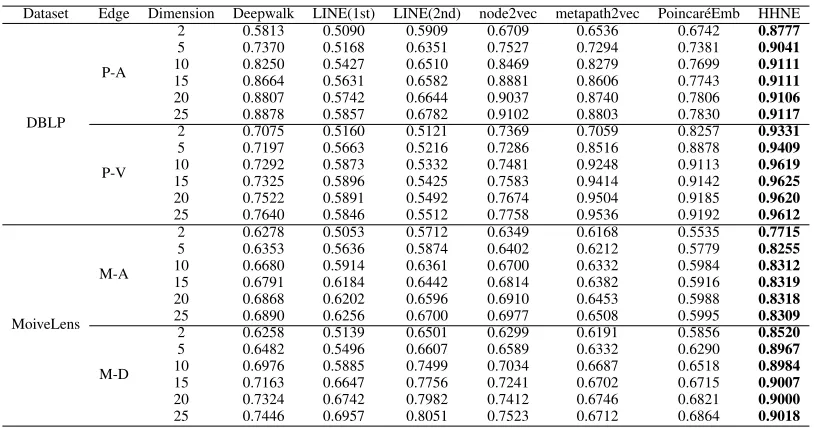
Link Prediction Link prediction aims to infer the un-known links in an HIN given the observed HIN structure, which can be used to test the generalization performance of a network embedding method. We set our experiments sim-ilar to (Xu et al. 2017). For each type of edge, we remove 20% of edges randomly from the network while ensuring that the rest network structure is still connected. To generate negative samples, we randomly sample an equal number of node pairs from the network which have no edge connecting them. We split the chosen edges and negative samples into validation and test. In our experiments, we train the embed-dings on the residual network, and use the validation data to tune the model parameters. We calculate proximity of all pair of nodes in the test. We still use AUC as the evaluation metric.
From the results in Table 3, HHNE outperforms the base-lines upon all the dimensionality, especially in the low
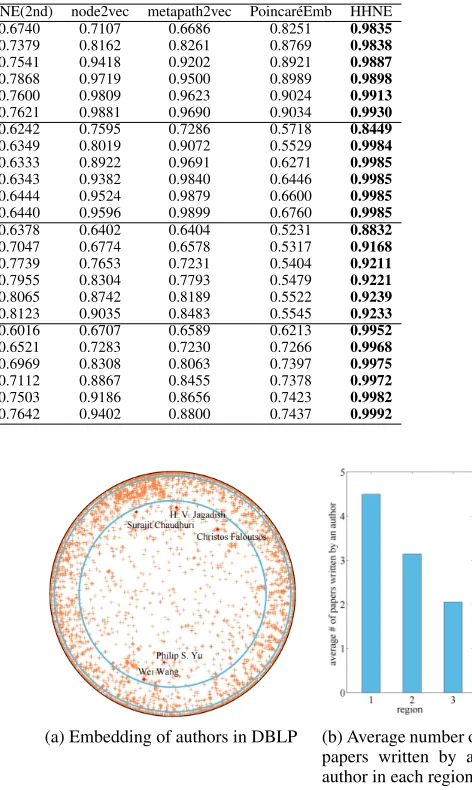
di-(a) Embedding of authors in DBLP (b) Average number of papers written by an author in each region
Figure 5: Visualization analysis of authors in DBLP dataset.
mensionality. The results can demonstrate the generalization ability of HHNE. In DBLP dataset, the results of HHNE in 10 dimensionality exceed all the baselines in higher dimen-sionality results. In MovieLens dataset, HHNE with only 2 dimensionality surpasses baselines in all dimensionality. Be-sides, both of LINE(1st) and Poincar´eEmb preserve proxim-ities of node pairs linked by an edge, while LINE(1st) embed network into Euclidean spaces and Poincar´e embed network into Hyperbolic spaces. Poincar´eEmb performs better than LINE(1st) in most cases, especially in dimensionality lower than 10, suggesting the superiority of embedding network into hyperbolic spaces. But because HHNE can preserve high-order network structure and handle different types of nodes in HIN, HHNE is more effective than Poincar´eEmb.
Table 3: AUC scores for link prediction
Dataset Edge Dimension Deepwalk LINE(1st) LINE(2nd) node2vec metapath2vec Poincar´eEmb HHNE
DBLP P-A
2 0.5813 0.5090 0.5909 0.6709 0.6536 0.6742 0.8777 5 0.7370 0.5168 0.6351 0.7527 0.7294 0.7381 0.9041 10 0.8250 0.5427 0.6510 0.8469 0.8279 0.7699 0.9111 15 0.8664 0.5631 0.6582 0.8881 0.8606 0.7743 0.9111 20 0.8807 0.5742 0.6644 0.9037 0.8740 0.7806 0.9106 25 0.8878 0.5857 0.6782 0.9102 0.8803 0.7830 0.9117
P-V
2 0.7075 0.5160 0.5121 0.7369 0.7059 0.8257 0.9331 5 0.7197 0.5663 0.5216 0.7286 0.8516 0.8878 0.9409 10 0.7292 0.5873 0.5332 0.7481 0.9248 0.9113 0.9619 15 0.7325 0.5896 0.5425 0.7583 0.9414 0.9142 0.9625 20 0.7522 0.5891 0.5492 0.7674 0.9504 0.9185 0.9620 25 0.7640 0.5846 0.5512 0.7758 0.9536 0.9192 0.9612
MoiveLens M-A
2 0.6278 0.5053 0.5712 0.6349 0.6168 0.5535 0.7715 5 0.6353 0.5636 0.5874 0.6402 0.6212 0.5779 0.8255 10 0.6680 0.5914 0.6361 0.6700 0.6332 0.5984 0.8312 15 0.6791 0.6184 0.6442 0.6814 0.6382 0.5916 0.8319 20 0.6868 0.6202 0.6596 0.6910 0.6453 0.5988 0.8318 25 0.6890 0.6256 0.6700 0.6977 0.6508 0.5995 0.8309
M-D
2 0.6258 0.5139 0.6501 0.6299 0.6191 0.5856 0.8520 5 0.6482 0.5496 0.6607 0.6589 0.6332 0.6290 0.8967 10 0.6976 0.5885 0.7499 0.7034 0.6687 0.6518 0.8984 15 0.7163 0.6647 0.7756 0.7241 0.6702 0.6715 0.9007 20 0.7324 0.6742 0.7982 0.7412 0.6746 0.6821 0.9000 25 0.7446 0.6957 0.8051 0.7523 0.6712 0.6864 0.9018
dataset in Figure 5(a). Each dot in Figure 5(a) represents an author’s position in two-dimensional Poincar´e ball (disk). The distances between nodes and origin of the disk can re-flect the latent hierarchy of authors. In general, authors have high latent hierarchy if their distances to the origin are small. The distances between nodes and origin are defined as norms in Poincar´e disk. The norm can be computed by:
kxkD:=dD(0, x).
We split the authors in Poincar´e disk into 3 regions by their norms. As the maximum norm of authors is slightly smaller than 6 in Figure 5(a), we split the authors who have norm between 0 and 2 into region 1, norm between 2 and 4 into region 2, norm between 4 and 6 into region 3. Therefore, the authors in region 1 have the highest hierarchy while the authors in region 3 have the lowest hierarchy. We mark the two boundaries of three regions by blue lines in Figure 5(a). In order to evaluate the influence of authors quantitatively, we calculate the average number of papers written by an au-thor in each region. The results are shown in Figure 5(b). We can see that the average number of papers written by an author in a region decreases from region 1 to region 3. More-over, we find that some high-impact researchers in computer science (i.e., Christos Faloutsos in Carnegie Mellon Univer-sity, H. V. Jagadish in University of Michigan, Philip S. Yu in University of Illinois at Chicago, Surajit Chaudhuri in Mi-crosoft Research, Wei Wang in University of California, Los Angeles), marked by red dot, are also in the region 1. These results demonstrate that the learned hyperbolic embeddings can reflect the latent hierarchy in HIN.
Parameters Sensitivity Due to the page limitation, we take the DBLP dataset as an example to conduct the param-eter sensitivity analysis. In all paramparam-eters sensitivity exper-iments, we set dimensional as 5. Except for the parameter being tested, all other parameters are set as default. As can
(a) # of walks per node (b) walk length
(c) # of negative sampling (d) neighborhood size
Figure 6: Parameter sensitivity in network reconstruction
be seen in Figure 6(a) and 6(b), the performance is relatively stable with respect to the number of walks per node and the walk length. Figure 6(c) suggests the negative size is rele-vant to the reconstruction. An appropriate negative size can make HHNE achieve better results. Figure 6(d) shows too large neighborhood size could make the results descent, so a smaller neighborhood size actually produces better embed-dings for network reconstruction.
Conclusion
of neighborhoods for a given node. We exploit the distance in hyperbolic spaces as the proximity measurements, which meets the triangle inequality and can well preserve the tran-sitivity in HIN. To update the hyperbolic embeddings, we use a stochastic Riemannian optimization method. Exten-sive experiments demonstrate that HHNE is outperformed than some state-of-the-art network embedding methods, es-pecially the dimension of embedding spaces is small and verify HHNE can discover the latent hierarchy in HIN.
Acknowledgement
This work is supported in part by the National Natural Science Foundation of China (No. 61772082, 61702296, 61806020, 61375058), the National Key Research and De-velopment Program of China (2017YFB0803304), the Bei-jing Municipal Natural Science Foundation (4182043), and the CCF-Tencent Open Fund.
References
Bonnabel, S., et al. 2013. Stochastic gradient descent on riemannian manifolds. IEEE Trans. Automat. Contr.
58(9):2217–2229.
Bronstein, M. M.; Bruna, J.; LeCun, Y.; Szlam, A.; and Van-dergheynst, P. 2017. Geometric deep learning: going beyond euclidean data.IEEE Signal Processing Magazine34(4):18– 42.
Cannon, J. W.; Floyd, W. J.; Kenyon, R.; Parry, W. R.; et al. 1997. Hyperbolic geometry. Flavors of geometry31:59– 115.
Cantador, I.; Brusilovsky, P.; and Kuflik, T. 2011. 2nd workshop on information heterogeneity and fusion in rec-ommender systems (hetrec 2011). InRecSys.
Chang, S.; Han, W.; Tang, J.; Qi, G.-J.; Aggarwal, C. C.; and Huang, T. S. 2015. Heterogeneous network embedding via deep architectures. InSIGKDD, 119–128.
Chen, H.; Yin, H.; Wang, W.; Wang, H.; Nguyen, Q. V. H.; and Li, X. 2018. Pme: Projected metric embedding on het-erogeneous networks for link prediction. InSIGKDD, 1177– 1186.
Cui, P.; Wang, X.; Pei, J.; and Zhu, W. 2018. A survey on network embedding. IEEE Transactions on Knowledge and Data Engineering.
Dhingra, B.; Shallue, C.; Norouzi, M.; Dai, A.; and Dahl, G. 2018. Embedding text in hyperbolic spaces. InTextGraphs, 59–69.
Dong, Y.; Chawla, N. V.; and Swami, A. 2017. metap-ath2vec: Scalable representation learning for heterogeneous networks. InSIGKDD, 135–144.
Fawcett, T. 2006. An introduction to roc analysis. Pattern recognition letters27(8):861–874.
Fu, T.-y.; Lee, W.-C.; and Lei, Z. 2017. Hin2vec: Explore meta-paths in heterogeneous information networks for rep-resentation learning. InCIKM, 1797–1806.
Ganea, O.; Becigneul, G.; and Hofmann, T. 2018. Hyper-bolic entailment cones for learning hierarchical embeddings. InICML, 1646–1655.
Grover, A., and Leskovec, J. 2016. node2vec: Scalable fea-ture learning for networks. InSIGKDD, 855–864.
Hu, B.; Shi, C.; Zhao, W. X.; and Yu, P. S. 2018. Leveraging meta-path based context for top-n recommendation with a neural co-attention model. InSIGKDD, 1531–1540. Huang, Z., and Mamoulis, N. 2017. Heterogeneous infor-mation network embedding for meta path based proximity.
arXiv preprint arXiv:1701.05291.
Krioukov, D.; Papadopoulos, F.; Kitsak, M.; Vahdat, A.; and Bogun´a, M. 2010. Hyperbolic geometry of complex net-works. Physical Review E82(3):036106.
Mikolov, T.; Sutskever, I.; Chen, K.; Corrado, G. S.; and Dean, J. 2013. Distributed representations of words and phrases and their compositionality. InNIPS, 3111–3119. Nickel, M., and Kiela, D. 2017. Poincar´e embeddings for learning hierarchical representations. InNIPS, 6338–6347. Perozzi, B.; Al-Rfou, R.; and Skiena, S. 2014. Deepwalk: Online learning of social representations. InSIGKDD, 701– 710.
Shi, C.; Li, Y.; Zhang, J.; Sun, Y.; and Philip, S. Y. 2017. A survey of heterogeneous information network analysis.
IEEE Transactions on Knowledge and Data Engineering
29(1):17–37.
Shi, C.; Hu, B.; Zhao, X.; and Yu, P. 2018. Heterogeneous information network embedding for recommendation.IEEE Transactions on Knowledge and Data Engineering. Sun, Y.; Han, J.; Yan, X.; Yu, P. S.; and Wu, T. 2011. Path-sim: Meta path-based top-k similarity search in heteroge-neous information networks. InVLDB, 992–1003.
Tang, J.; Qu, M.; Wang, M.; Zhang, M.; Yan, J.; and Mei, Q. 2015. Line: Large-scale information network embedding. In
WWW, 1067–1077.
Tang, J.; Qu, M.; and Mei, Q. 2015. Pte: Predictive text em-bedding through large-scale heterogeneous text networks. In
SIGKDD, 1165–1174.
Tay, Y.; Tuan, L. A.; and Hui, S. C. 2018. Hyperbolic rep-resentation learning for fast and efficient neural question an-swering. InWSDM, 583–591.
Wang, H.; Zhang, F.; Hou, M.; Xie, X.; Guo, M.; and Liu, Q. 2018. Shine: signed heterogeneous information network embedding for sentiment link prediction. InWSDM, 592– 600.
Wang, D.; Cui, P.; and Zhu, W. 2016. Structural deep net-work embedding. InSIGKDD, 1225–1234.