MURDOCH RESEARCH REPOSITORY
Studio learning of requirements: towards aligning teaching to
practitioner needs
Author(s):
Armarego, Jocelyn ; Minor, Oliver
Year:
2005
Source:
REET'05 (1st International Workshop on RE Education and
Training), Paris, 29 Aug 2005.
Official URL:
This is the author’s final version of the work, as accepted for publication following
peer review but without the publishers’ layout or pagination.
Studio Learning of Requirements: towards Aligning Teaching to Practitioner
Needs
Jocelyn Armarego
Murdoch University, Western Australia
[email protected]
Oliver Minor
University of Koblenz-Landau, Germany
[email protected]
Abstract
Research endeavours in software development have found that failures and deficiencies of software systems are often rooted in the requirements activities undertaken. One possible cause is the appropriateness of the education of those engaged with the requirements component of software development. This education is largely based on model curricula used as guidelines for a traditional learning environment. A small study was undertaken to compare the RE components of selected model curricula to the opinions of a small but representative group of practitioners in the local context. The results were matched to studies undertaken elsewhere, and confirm that practitioners see shortcomings in formal education, particularly with respect to more generic skills such as communication, team skills and affective attributes of novice REs. These practitioner expectations are being used to validate changes made to the learning of RE at this University, and to trigger further changes in order to align learning with practitioner needs.
1. Introduction
Requirements Engineering (RE) as a fundamental discipline within the development of systems and software has been widely recognised as crucial. As early as 1976 Bell and Thayer [1] observed that inadequate, inconsistent, incomplete, or ambiguous requirements have a critical impact on the quality of the resulting software.
Surveys and studies continue to underline the pivotal character of RE, draw attention to the variety of challenges to be met and also reveal opportunities to improve the RE process. To tackle these challenges and make use of the opportunities, novice Requirements Engineers should be equipped with appropriate skills and knowledge. The model curricula (for the purpose
of this paper we look at Information Systems (IS), Computer Science (CS) and Software Engineering (SE) [2-4]) indicate that a graduate within the broad IT discipline should emerge from formal education with knowledge of the basic requirements processes, generally at a competency level equivalent to ‘application’ in Bloom’s [5] taxonomy.
However, Conn [6] reports that it is a surprise to graduates that requirements is a major cause for software deficiencies. Therefore, while the relevant Bodies of Knowledge (BOK)s and model curricula may address those elements of discipline content
required to undertake RE, what is lacking is an appreciation of the importance of the Requirements Engineer in the context of practice.
A small study was undertaken in the local software development environment [7] and the results matched with studies undertaken elsewhere. The aim was to test practitioner perspective of the usefulness of RE content knowledge included in tertiary education programs for the practicalities of being a professional RE. The results are being used to validate changes instituted in the way RE is learnt at Murdoch University and to trigger further changes, in an attempt to align learning with practitioner needs.
2. Teaching Requirements Engineering
Over 35 years ago, those involved in the development of software agreed that one mechanism for dealing with intrinsic difficulties (eg complexity, visibility, and changeability [8]) of developing software was to embed its production within an applied science environment. Royce [9] was the first to note explicitly that an engineering approach was required, in the expectation that adhering to a defined, repeatable process would enhance software quality.
1. Engineering is the systematic application of scientific knowledge…. Software engineering is that form of engineering that applies the principles of computer science and mathematics to achieving cost-effective solutions to software problems. SEI software engineering definition [10]
2. The application of a systematic, disciplined, quantifiable approach to the development, operation, and maintenance of software. IEEE Standard. 610-1990 [11]
and, with the adoption of the term Requirements Engineering, may be considered to underlie this discipline as well.
Increasingly, approaches to educating software developers model scientific and engineering methodologies, with their focus on process and repeatability. In general this education is based on a normative professional education curriculum [12], in which students first study basic science, then the relevant applied science, so that learning may be viewed as a progression to expertise through task analysis, strategy selection, try-out and repetition.
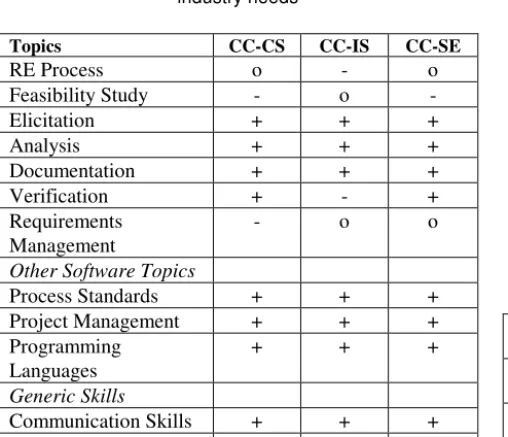
A comparison of the major model curricula undertaken as part of Minor’s study of RE practitioners shows that, in general terms, the base case of RE knowledge identified in practitioner studies is covered in models used in university courses. Table 1 provides a summary of this comparison.
Table 1: Minor - curricula match to perceived industryneeds
Legend:
+ complete coverage; o partial coverage; - minimal or no coverage
Minor notes, however, that the studies only examine the general importance of specific topics as perceived by different stakeholders. The collation of these studies provides insights, as different approaches are taken in gaining this knowledge from different target groups.
3. Practitioner expectations
A closer look reveals the depth of the mismatch between practitioner needs and formal education in software development in general.
3.1. Practitioners of Information Systems
Summarising his work of the previous eight years on the knowledge requirements and professional development of young IS workers Lee [13] found that
• significant gaps exist between what industry expects IS workers to know and what universities teach IS students
• the knowledge and skills required change, so that that the ability to learn quickly on the job was critical to IS workers. This study identifies a wider range of non-technical skills, such as business functional knowledge, interpersonal and management skills, and technology management skills as important to IS professionals
• IS workers need not have a technology-relevant degree
• they also draw heavily from a `bipolar' knowledge structure - most current technical knowledge and localised team-centric project work, but are unable to exploit tacit organisational knowledge outside their specific project.
In a later work Lee expand his discussion of the gap he perceives between the academic preparation offered by universities and what industry demands [14]. The results of this study, of transition to workplace, are summarised in Table 2.
Table 2: Lee - comparison of IS formal education and industry requirements
IS education characteristics Industry characteristics
structured learning
environment independent and self-motivated learning workers tend to be more task
than relationship oriented workers must interact closely and build relationships with colleagues
Lee found that one of the ‘reality shock’ involved in the socialisation of new graduates to work was the onus
Topics CC-CS CC-IS CC-SE
RE Process o - o
Feasibility Study - o - Elicitation + + +
Analysis + + +
Documentation + + + Verification + - + Requirements
Management - o o
Other Software Topics
Process Standards + + + Project Management + + + Programming
Languages + + +
Generic Skills
of teaching themselves what they needed to know in order to perform the task successfully.
He concludes:
...educators should also help students to develop their initiatives and abilities to deal with ill-structured problems. This would require approaches which emphasize independent learning and collaborative teamwork.
[14] p. 135 Noll and Wilikens [15] verify these results in IS. They identified the need for IS workers to comprehend business functions as well as know how to develop technical solutions, with importance given to teamwork, communication and organisational skills.
Similar issues arise throughout studies of IS - a long term shift from programming and other technical subjects to business analysis and people-oriented skills - a change in emphasis to both generic attributes and managerial knowledge.
2.2. Practitioners of CS and Engineering
Fewer studies address the skills and knowledge needed in Computer Science and Software Engineering. Lethbridge [16] examined industry perception in a comprehensive study: his aim was to gain a practitioner ranking of the usefulness of specific topics compiled from the curricula of (emerging) software and computer engineering and computer science programmes, the influence of these on respondents' career and how much they had learned formally compared to what was required as a professional.
Although he found few surprises in the data: software topics are clearly learned far more by the CS/SE graduates, while the engineers learn more about traditional engineering topics, it is interesting to note that engineers have more background in entrepreneurship and also ethics and professionalism than computer scientists.
An indication of differing educational focus is provided by pronounced bi-polar distribution in his data: Leadership and Negotiation ranked third and fourth for industrial knowledge, while Technical Writing, and Analysis & Design Methods rank as having the 5th and 6th most pronounced bi-polar distribution in education [17].
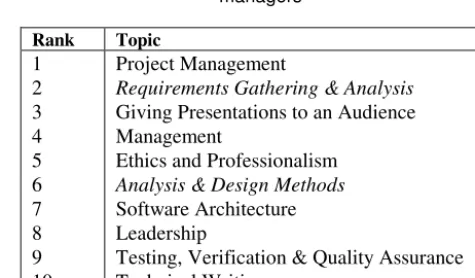
Of the long list of topics that managers consider more important than developers at large, the high ranking of both RE related topics and more generic skills is significant (see Table 3).
Unfortunately, many of these appear to have been learnt on the job (eg Requirements Gathering &
Analysis ranks 6th for mostly learnt on the job, and 4th for very high on the job learning). This topic is also highlighted as having a lag in training (inadequate knowledge based on importance), with a 60% lag between formal education and overall importance (see Table 4). At least in this case it can be seen that teaching does not reflect the needs of the practice.
Table 3: Lethbridge rankings - most important for managers
Rank Topic
1 2 3 4 5 6 7 8 9 10
Project Management
Requirements Gathering & Analysis
Giving Presentations to an Audience Management
Ethics and Professionalism
Analysis & Design Methods
Software Architecture Leadership
Testing, Verification & Quality Assurance Technical Writing
Table 4: Lethbridge Rankings - lag between formal learning and importance
Rank Topic % lag
1 2 3 4
5 6 7 8 9 10
Negotiation
Configuration & Release Management Leadership
Maintenance, Re-engineering & Reverse Engineering
HCI/ User Interfaces Software Reliability & Fault Tolerance
Ethics and Professionalism Project Management Management
Requirements Gathering & Analysis
84 83 73 72
67 64 63 63 61 60
Lee also looked at the long-term professional development of young engineers as technologists, in studies reported in the late 1980s and early 1990s. Starting from the premise that the primary focus of university education and industrial work requirements were different (conceptual understanding versus accomplishment of specific tasks [18]) these studies explored on-the-job learning and information seeking behaviours and found no correlation between academic achievement and job performance. Instead, what was found to have significance was:
• approach to information seeking in order to keep up with the relevant changes in knowledge and information requirements
• the success of the transition from an academic environment and the formation of social ties with veteran colleagues.
These results indicate that the effective preparation of young technology workers involves far more than just a fixed set of academic subjects.
2.3. The Australian perspective
Other research looks at the situation in an Australian context. Again, these tend to be generic, rather than specific to RE, but are useful in the context of software development.
Snoke and Underwood [19]’s study sampled a wide cross section of the IS academics in Australia, including representatives from all universities offering an undergraduate degree in IS or with a major in IS as of July 1998. It showed that personal and group attributes are consistently more highly valued than technical knowledge competencies.
Table 5: Turner rankings – lag between student and employer perceptions of importance
Attribute Respondent Mean
Rank
Accept direction Student
Employer 66.2 96.3 Acquire new skills Student
Employer 71.3 86.6 Work as part of a team
Student Employer 72.7 83.9 Think creatively Student
Employer 73.5 80.8 Work independently
Student Employer 74.2 80.9 Information seeking skills
Student Employer 73.4 82.5 Problem definition skills
Student Employer 74.1 81.0 Problem solving skills Student
Employer 72.7 82.4
The aim of the Turner [20] 1999 study was to achieve a better fit between university study and the professional practice of IS. They based their survey on topics commonly found in undergraduate university curricula, focusing on intellectual skills and personal attributes desired by employers. As Table 5 shows,
they also found that employers lay heavier emphasis on personal attributes than specific academic skills.
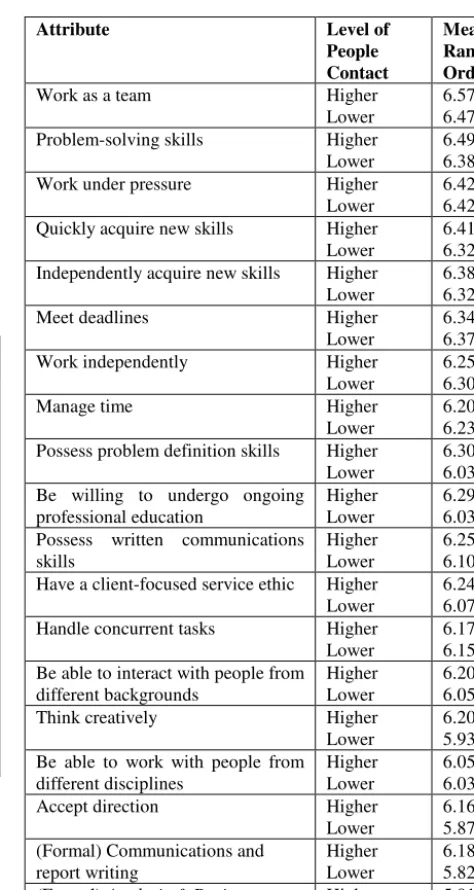
During 2001 a follow-up survey to explore the ‘other skills’ aspect of IS curriculum was conducted [21]. Table 6 shows that, in general, both respondents with high and low levels of people contact rate soft skills higher than ‘hard’ academic skills (eg practitioners with higher levels of people contact rate working as a team at 6.57 while those with lower levels of people contact rate the same attribute at 6.47).
Table 6: Turner rankings – comparative rating of skills by IS practitioners
Attribute Level of
People Contact
Mean Rank Order
Work as a team Higher
Lower 6.57 6.47 Problem-solving skills Higher
Lower 6.49 6.38 Work under pressure Higher
Lower 6.42 6.42 Quickly acquire new skills Higher
Lower 6.41 6.32 Independently acquire new skills Higher
Lower 6.38 6.32 Meet deadlines
Higher Lower 6.34 6.37 Work independently
Higher Lower 6.25 6.30
Manage time Higher
Lower 6.20 6.23 Possess problem definition skills Higher
Lower 6.30 6.03 Be willing to undergo ongoing
professional education Higher Lower 6.29 6.03 Possess written communications
skills Higher Lower 6.25 6.10 Have a client-focused service ethic Higher
Lower 6.24 6.07 Handle concurrent tasks Higher
Lower 6.17 6.15 Be able to interact with people from
different backgrounds Higher Lower 6.20 6.05 Think creatively Higher
Lower 6.20 5.93 Be able to work with people from
different disciplines Higher Lower 6.05 6.03 Accept direction Higher
Lower 6.16 5.87 (Formal) Communications and
report writing Higher Lower 6.18 5.82 (Formal) Analysis & Design Higher
Lower 5.91 5.82
Even though it is ranked below all but seven (of 24) of the soft skills, Analysis & Design rated as one of the highest-ranking academic skill. This confirms the perception of the high importance of RE topics noted in northern hemisphere studies. It can also be argued that several of the soft skills rated above Analysis & Design
are in fact integral to it (such as problem definition skills and thinking creatively).
Scott and Yates [22] report on the experience with Engineering graduates as one of the parallel series being undertaken in various professions across Australia and New Zealand. The study sought to identify:
• the capabilities which are seen to be most important for successful professional practice in Engineering during the first few years after graduation
• the extent to which the universities at which the participating graduates had studied focused on these capabilities.
Respondents noted that learning profession-specific content provides the ‘scaffold’ for the important task of career-long professional learning: the skills to undertake this are of great importance, with the ability to know when and when not to deploy technical expertise, and how to continuously update it, the keys to successful professional practice. The supervisors in the study acknowledged that a high level of technical expertise is necessary but not sufficient for successful practice, giving emphasis to the individual's ability to diagnose what is really causing a problem and to testing solutions in action.
This study, and a parallel study reporting on IT graduates, emphasises the interrelationship between capabilities identified by respondents
when the unexpected occurs, what is most telling is being able to tolerate the uncertainty and ambiguity of the situation, having well developed reciprocal networks upon which to call to identify potentially relevant solutions, being able to ‘read’ the total technical and social components of a troubling situation, and then being able to apply a high level of appropriate technical skill in partnership with other team members to resolve the situation
[23] p 6
2.3. Practitioner views of RE
Few studies have examined practitioner views of the relevance of education in RE in the same way. However, we can come to the conclusion, albeit indirectly through both anecdotal evidence and the results of studies regarding software development
failures, that the same flaws exist. Nikula [24], for example, conclude that general knowledge of RE in industry may be seen to be ‘quite weak’.
Of most significance, Macaulay and Mylopoulos [25] undertook a brief study of practitioner REs during 1995 in order to elicit industry requirements of formal RE education. There were no surprises in the list of technical knowledge expected of a graduate. However, asked what additional training would be given to a graduate, a number of respondents expressed doubts as to whether this was a job for a new graduate, who would take 12 to 18 months to be able to be ‘effective in the job’ [25]. Nevertheless, training would include interpersonal communication skills, shadowing experienced analysts and involvement in difficult projects.
3. The affective nature of RE
Industry is seen to require a broad perspective on RE from formal education. While the base case of RE content knowledge assumed by practitioners is covered in models used in university courses, concern is expressed that a standard university lecture cannot achieve all that industry requires [25].
Minor's interviewees unanimously noted that it was
very rare that newly hired graduates are involved in requirements activities. He states:
The interviewees mention that almost exclusively more senior people do requirements activities. Some interviewees argue that experience is necessary. One interviewee expects credibility and presence from somebody doing requirements activities. These characteristics are considered to be reserved to people more mature than most graduates are. In businesses where requirements activities do not involve direct contact with customers the argument is that people must have insight and knowledge about the existing software, which is described as experience.
[7] p 83 This confirms, in our local environment, the results of Macaulay and Mylopoulos’ international study, in which some respondents even expressed doubts about RE being a suitable topic for university courses. They state that efficient software development activities “require a certain level of knowledge and maturity which can only be gained through experience in dealing with practical problems”[25].
the common industry belief that most of the books and classes that teach it are impractical [27].
What is also interesting is that Minor's interviewees added another category to the more generic abilities identified in the studies cited above. His respondents emphasised Personality (confident and faithful, strong work ethic, be proactive or self-started, inquisitive nature, have the ability to ask people questions and accept to appear stupid, perseverance, be teachable and willing to learn) as well as Interpersonal skills and
Management (of self(personal work organisation) and of large amounts of information) as mandatory skills. While we address the latter two items in the learning model we apply at this University, (and, in fact, they cover some of the attributes noted as exit criteria in tertiary education), addressing the Personality of students may prove a more difficult task.
Nevertheless, the work of Lee (specifically [14]) suggests there is an underlying ‘socialisation’ requirement for a graduate to achieve ‘working professional’ status, while personal qualities identified by Macaulay and Mylopoulos for an RE include:
make himself or herself understood, listen, stay calm and assured under fire, quickly assimilate information, talent for sorting and analysing information, write clear, well structured documents, make presentations, chair meetings, run a group. Also patience, perseverance, be able to live comfortably in a constant state of ambiguity, both independence and team working skills, negotiation skills, flexibility, open-mindedness, sense of humour; Good interpersonal skills, analytical, logical and open-minded.
[25] p 347 In summary then, industry requires personable professionals who integrate into the organisational structure, and, rather than cope specifically with today's perceived problems, have models, skills and analytical techniques that allow them to learn, evaluate and apply appropriate emerging technologies in a collaborative environment. The implications of this include initiative, ability to deal with complexity and ill-structure and organisational (self, task and information) skills.
4. Addressing practitioner needs
Attempts to address practitioner concerns through interventions in the learning environment have taken several forms. In general, however, these have been attempted within the framework of a traditional learning environment.
4.1. Traditional learning
Approaches to training REs based on traditional learning models tend to emphasise technical knowledge, and focus largely on notations and prescribed processes. This is at odds with the inherent characteristics associated with real requirements problems, where [28]:
• complexity is added to rather than reduced with increased understanding of the initial problem
• metacognitive strategies are fundamental to the process
• problem-solving needs a rich background of knowledge and intuition to operate effectively
• a breadth of experience is necessary so that similarities and differences with past strategies are used to deal with new situations.
The addition of either a capstone project or an industry-based placement, typically towards the completion of the qualification, has been seen to address general practitioner concerns, though not specifically those of RE practitioners. They are seen to provide opportunities for both authentic and experiential learning.
While accepted as valuable, this approach is flawed in several respects:
• the opportunity (project or placement) is presented as an aid to content learning rather than a substitute
• it focuses on know-how which will allow students to gain competence to practice within given frameworks (but not necessarily outside of them, therefore limiting adaptability)
• students are expected to transfer skills acquired to the world of work, but without them necessarily being rooted in metacognitive evaluation and professional judgement
(based on Savin-Baden [29]). In other words, while project or placements are of value, they are still presented as neat cases in which knowledge gained formally can be applied and do little to model encountering ill-structured problems in organisational contexts.
cases, is reduced to assignment hopping with ‘just-in-time’ and ‘just-enough’ learning to fulfill the assessment tasks.
4.2. Aligning learning with RE characteristics
The nature of the RE (opportunistic, exploratory, creative, emergent [28, 31-33]) implies a need to transcend traditional education and focus on flexibility, productive thinking and creativity-enhancing activities, so that while students learn to use past experience on a general level, they are also able to deal with each new problem situation in its own terms. Gott et al [34] posit that this adaptive/generative capability suggests the performer not only knows the procedural steps for problem solving (ie, applying knowledge) but
understands when to deploy them and why they work. The implication of this is effort spent on higher, (metacognitive) learning skills, including abstraction and reflection.
In attacking the normative professional education curriculum, Schön looked to an alternative epistemology of practice “in which the knowledge inherent in practice is understood as artful doing”[35]. For Schön, practitioners have their own ‘esoteric’ knowledge codes woven right into their practices. They apply tacit knowledge-in-action, and when their messy problems do not yield to it, they ‘reflect-in-action,’ and in the languages specific to their practices. Even when they do stop to reflect on action, they think in the language of practice, not the language of science. For Schön the ideal site of education for reflective practice is the Design Studio. Under the close supervision of a master practitioner serving as coach the novice learns the vocabularies of the professional practice in the course of learning its ‘operational moves’. In making the moves, talking about them and even talking about their talk about them (meta-reflection), the novice and master “negotiate the ladder of reflection” [36].
Schön’s view of professional practice as design has three implications:
• it is learnable but not didactically or discursively teachable: it can be learned only in and through practical operations
• it is holistic: its parts cannot be learned in isolation. It must be learned as a whole because all components of a situation have meaning
• it depends upon the ability to recognise desirable and undesirable qualities of the discovered world. But novice students do not possess this ability, and it cannot be conveyed to them by verbal descriptions, only in the operational context of the task.
One example of learning environments that embraces
these ideas is Problem-based Learning (PBL). It integrates the learning of content and skills in a collaborative environment, and emphasises ''learning to learn'' by placing great responsibility for learning on the learner [37]. It has been argued [38, 39] that:
• learning based around constructivist principles is likely to be more suitable in domains involving ill-structured problems
• appropriate learning in ill-structured domains and/or dealing with ill-structured problems should itself be problem-based
• problem-based learning best provides an effective environment for future professionals who need to access knowledge across a range of disciplines. As an ideology, PBL is rooted in the experiential learning tradition advocated by Schön and others, but with a number of different forms according to the nature of the field and goals of the learning situation: Schön’s Design Studios exemplify Savin-Baden [29]’s PBL model for professional action as summarised in Table 7.
Table 7: Savin-Baden – PBL Model II
knowledge practical and performative learning outcome focussed acquisition of
skills and knowledge for the workplace
problem
scenario focussed on real-life situations that require an effective practical solution
students pragmatists inducted into professional cultures who can undertake practical action
facilitator a demonstrator of skills and guide to best practice
assessment testing of skills and competencies for the work place supported by a body of knowledge
As an educational strategy PBL requires three components to be differentiated [40]:
• an integrated curriculum organised around real-world problems rather than disciplines and with an emphasis on cognitive skills
• small groups, tutorial instruction and active learning conditions to facilitate problem-based learning
Through its emphasis on problem and student-centredness, PBL is seen to [29]:
• acknowledge the base of student experience
• emphasise student responsibility for learning
• cross boundaries between disciplines
• intertwine theory with practice
• focus on the process of knowledge acquisition rather than the products of that process
• change staff roles from instructor to facilitator
• focus on communication and interpersonal skills so that students understand that to relate their knowledge, skills beyond their area of technical expertise are required.
Its supporters claim PBL results in increased motivation for learning, better integration of knowledge across disciplines and greater commitment to continued professional learning [39]. As well as offering the flexibility to cater for a variety of learning styles, the emphasis moves from dealing with content and information in abstract ways to using information in ways that reflect how learners might use it in real life [41]. Theories of expertise also advocate a focus on the solution of authentic problems as a context for learning [42].
Thus a PBL approach which integrates Schön’s ideas on Studio learning goes some way to providing students with a solid foundation in subject matter while at the same time exposing them to real-world characteristics.
4.3. Applying PBL to RE learning
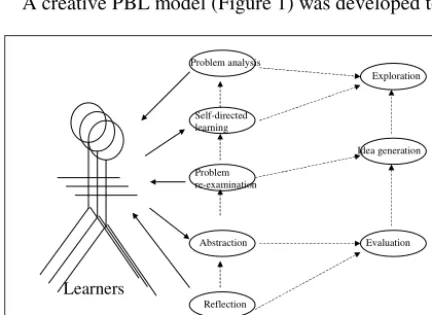
A creative PBL model (Figure 1) was developed to
Figure 1: the Creative PBL Model
address the characteristics of RE as a domain, and to provide a learning environment that enhances the opportunity for creative and divergent thinking. There
is evidence that students who have been taught to explore different ways to define problems (the prime objective of RE) engage in more creative problem solving over the longer term [43], addressing flexibility and adaptability issues raised by practitioners.
Evidence from qualitative and quantitative evaluations1 of this environment [45] indicates that,
while some deep learning is exhibited, students are still ‘hedging their bets’ by focusing some of their learning strategies on learning for reproduction. This suggests that further work is required in building an appropriate learning environment that provides students with the ability to transcend imposed frameworks, whether those of disciplinary boundaries or of personal stance.
Within our SE programme, Savin-Badin [29]’s Model IV may provide a more appropriate framework. As Table 8 summarises, in this model students are encouraged to develop an autonomous position as individuals within the group, and as a group, and implies an evaluation of one’s own stance and an openness towards the stance of others. Students take a critical position towards knowledge, themselves and their peers and elect to use the group to resolve dilemmas. A learning environment based on this model enables students to deal with problems within a metacognitive-rich framework that makes complexity apparent and lets students deal with it explicitly.
Table 8: Savin-Badin - Model IV PBL for transdisciplinary learning
knowledge the examining and testing out of given knowledge and frameworks learning critical thought and decentring
oneself from disciplines in order to understand them
problem
scenario characterised by resolving and managing dilemmas students independent thinkers who take up a
critical stance towards learning facilitator an orchestrator of opportunities for
learning (in its widest sense)
assessment opportunity to demonstrate an integrated understanding of skills and personal and propositional knowledge across disciplines.
1quantitative – based on assessment components and the reduced Approaches to Study Inventory confirmed by Richardson [44]’s work to possess adequate internal consistency and test-retest reliability;
qualitative – based on surveys, interviews and personal journals Problem analysis
Self-directed learning
Problem re-examination
Abstraction
Reflection
Evaluation
Learners
Exploration
4.4. Extending PBL to engineering
While applying the creative PBL model has had some measure of success, at least in terms of learning outcomes in RE, one issue to be addressed is that innovation introduced into one course may be undermined if traditional approaches are maintained elsewhere in the students’ programme – so that benefits may only be apparent or are enhanced if it is introduced across the entire curriculum.
During 2004 a complete restructure of the final two years of all undergraduate engineering programmes (including that in SE) was undertaken to introduce an integrated PBL-based Studio environment. Extensive evaluation of the applicability of this approach is currently being undertaken. In the meanwhile, a brief review of feedback on the Studio learning orientation programme suggests long-term benefits will be realised.
Already comments from students highlight the value of interdisciplinary teams, and an acknowledgement of
the need to work in the context of the problem in order to resolve tensions experienced during the project.
5. Conclusion
Addressing the requirements of industry in terms of formal education cannot be considered in case-by-case isolation. The need to engage with complexity, the holistic nature of the domain and the focus on higher learning outcomes imply a commensurate need in teachers to apply to the learning environment the principles they are advocating in their students, namely flexibility, adaptability and creativity. Only through approaches that focus on independent learning and soft skills can students enter industry with the ability to engage in the career-long professional learning required to succeed in professional practice.
6. References
[1] T. E. Bell and T. A. Thayer, "Software Requirements: Are they really a problem?," presented at 2nd International Conference on Software Engineering, San Francisco, 1976, 61-68.
[2] "Computing Curricula 2001: Computer Science -- final report," G. Engel and E. Roberts, Eds.: Joint Task Force on Computing Curricula, ACM and IEEE Computer Society, 2001.
[3] "Computing Curricula -- Software Engineering Volume: Public Draft 3.1," J. L. Diaz-Herrera and T. B. Hilburn, Eds.: Joint Task Force on Computing Curricula, ACM and IEEE Computer Society, 2004.
[4] "IS 2002: model curriculum and guidelines for
undergraduate degree programs in Information Systems," J. T. Gorgone, G. B. Davis, J. S. Valacich, H. Topi, D. Feinstein, and H. E. Longnecker, Eds. Atlanta: Association for Information Systems, 2002.
[5] B. S. Bloom, Taxonomy of Educational Objectives: the classification of educational goals Handbook 1: cognitive domain. New York: David Mackay, 1956.
[6] R. Conn, "Developing Software Engineers at the C-130J Software Factory," IEEE Software, 2002.
[7] O. Minor, "Theory and Practice in Requirements Engineering: an investigation of curricula and industry needs." Koblenz (Germany): University of Koblenz-Landau, 2004.
[8] F. P. Brooks, "No silver bullet - essence and accidents of software engineering," presented at Proceedings of Information Processing 86: the IFIP 10th World Conference, Amsterdam, 1986, 1069-1076.
[9] W. W. Royce, "Managing the development of large software systems: concepts and techniques," presented at IEEE WESCON, 1970, 1-9.
[10] G. Ford, " SEI Report on Undergraduate Engineering Education, Undergraduate Software Engineering Education," Software Engineering Institute/Carnegie Mellon University, Pittsburgh (PA) CMU/SEI-90-TR-003, 1990.
[11] IEEE, IEEE Standard Glossary of Software Engineering Terminology, IEEE Std. 610-1990, IEEE Standards Software Engineering, Volume 1: The Institute of Electrical and Electronics Engineers, 1999.
[12] L. J. Waks, "Donald Schon's Philosophy of Design and Design Education," International Journal of Technology and Design Education, vol. 11, pp. 37-51, 2001. [13] D. M. S. Lee, "Information seeking and knowledge
acquisition behaviors of young information systems workers: preliminary analysis," presented at 1999 Americas Conference on Information Systems, 1999, 856-858.
[14] D. M. S. Lee, "Organizational entry and transition from academic study: examining a critical step in the
professional development of young IS workers," in
Strategies for Managing IS/IT Personnel, M. Igbaria and C. Shayo, Eds. Hershey (PA): Idea Group, 2004, pp. 113-141.
[15] C. L. Noll and M. Wilikens, "Critical skills of IS professionals: a model for curriculum development,"
Journal of Information Technology Education, vol. 1, pp. 143-154, 2002.
[16] T. C. Lethbridge, "What knowledge is important to a software professional?," IEEE Computer, vol. 33, pp. 44-50, 2000.
Ottowa, Ottowa (Canada), Computer Science Technical Report TR-99-05, 1999.
[18] D. M. S. Lee, "Educating engineers in the era of computers-integrated operations," Engineering Education, vol. 79, pp. 31-35, 1989.
[19] R. Snoke and A. Underwood, "Generic attributes of IS graduates - a Queensland study," presented at Proceedings of the 10th Australasian Conference on Information Systems, Wellington (NZ), 1999, 817-823. [20] R. Turner and G. Lowry, "Educating Information
Systems professionals: towards a rapprochement between new graduates and employers," presented at Proceedings of the 10th Australasian Conference on Information Systems, Wellington (NZ), 1999, 1049-1058.
[21] R. Turner and G. Lowry, "Education for a technology-based profession: softening the Information Systems curriculum," in Current Issues in IT Education, T. McGill, Ed. Hershey (PA): IRM Press, 2003, pp. 153-172. [22] G. Scott and W. Yates, "Using successful graduates to
improve the quality of undergraduate engineering programs," European Journal of Engineering Education, vol. 27, pp. 60-67, 2002.
[23] G. Scott and D. Wilson, "Tracking and profiling successful IT graduates: an exploratory study," presented at Proceedings of the 13th Australasian Conference on Information Systems, 2002,
[24] U. Nikula, J. Sajaniemi, and H. Kälviäinen, "A state-of-the-practice survey on Requirements Engineering in small- and medium-sized enterprises," Telecom Business Research Center,Lappeenranta University of Technology, Lappeenranta (Finland) Research Report 1, 2000. [25] L. Macauley and J. Mylopoulos, "Requirements
Engineering: an educational dilemma," Automated Software Engineering, vol. 4, pp. 343-351, 1995. [26] P. N. Robillard, "The role of knowledge in software
development," Communications of the ACM, vol. 42, pp. 87-92, 1999.
[27] J. Bach, "SE education: we're on our own," IEEE Software, vol. 14, pp. 26,28, 1997.
[28] J. Bubenko, "Challenges in Requirements Engineering: keynote address," presented at RE'95: Second IEEE International Symposium on Requirements Engineering, York (UK), 1995,
[29] M. Savin-Baden, Problem-based Learning in Higher Education: untold stories. Buckingham (UK): Society for Research into Higher Education and Open University Press, 2000.
[30] A. Patel, Kinshuk, and D. Russell, "Intelligent tutoring tools for cognitive skill acquisition in life long learning,"
Educational Technology & Society, vol. 3, pp. 32-40, 2000.
[31] R. Guindon, "The process of knowledge discovery in system design," in Designing and Using Human-Computer Interfaces and Knowledge Based Systems, G. Salvendy and M. J. Smith, Eds. Amsterdam: Elsevier, 1989, pp. 727-734. [32] N. Maiden and A. Gizikis, "Where do requirements
come from?," IEEE Software, vol. 18, pp. 10-12, 2001. [33] L. Nguyen and P. A. Swatman, "Complementary Use of
ad hoc and post hoc Design Rationale for Creating and Organising Process Knowledge," presented at Proceedings
of the Hawaii International Conference on System Sciences HICSS-33, Maui (Hawaii), 2000,
[34] S. P. Gott, E. P. Hall, R. A. Pokorny, E. Dibble, and R. Glaser, "A naturalistic study of transfer: adaptive expertise in technical domains," in Transfer on Trial: intelligence, cognition and instruction, D. K. Detterman and R. J. Sternberg, Eds. Norwood (NJ): Ablex, 1993, pp. 258-288. [35] D. A. Schön, The Reflective Practitioner: How
Professionals Think in Action. New York: Basic Books, 1983.
[36] D. A. Schön, Educating the Reflective Practitioner: Towards a New Design for Teaching in the Professions. San Fransisco: Jossey-Bass Inc, 1987.
[37] B. G. Wilson and P. Cole, "Cognitive teaching models," in Handbook of Research for Educational
Communications and Technology, D. H. Jonassen, Ed. New York: Simon & Schuster Macmillan, 1996, pp. 601-621.
[38] R. J. Spiro, P. J. Feltovich, M. Jacobson, and R. Coulson, "Cognitive flexibility, constructivism and hypertext: random access instruction for advanced knowledge acquisition in ill-structured domains,"
Educational Technology, vol. 31, pp. 24-33, 1991. [39] D. Boud, "Problem-based learning in perspective," in
Problem-based Learning in Education for the Professions, D. Boud, Ed. Sydney: Higher Education Research Society of Australasia, 1985, pp. 13-18.
[40] H. J. Walton and M. B. Mathews, "Essentials of problem-based learning," Medical Education, vol. 23, pp. 542-548, 1989.
[41] R. Oliver and C. McLoughlin, "Using web and problem-based learning environments to support the development of key skills," presented at Responding to Diversity:
Proceedings of ASCILITE '99, Brisbane, 1999, [42] H. L. Dreyfus and S. E. Dreyfus, Mind over Machine.
New York: Free Press, 1986.
[43] J. M. Baer, "Long term effects of creativity training with middle-school students," Journal of Adolescence, vol. 8, pp. 183-193, 1988.
[44] J. T. E. Richardson, "Reliability and replicability of the Approaches to Studying questionnaire," Studies in Higher Education, vol. 15, pp. 155-168, 1990.