196
Copyright © 2018. IJEMR. All Rights Reserved.
Volume-8, Issue-2, April 2018
International Journal of Engineering and Management Research
Page Number: 196-208
DOI:
doi.org/10.31033/ijemr.v8i02.11785
Performance Measurement of Military Supply Chains
Sanjay Sethi1 and Sunil Sharma2
1Doctoral student, FMS, Delhi University, INDIA
2 Faculty of Management Studies Delhi University, INDIA
1Corresponding Author: [email protected]
ABSTRACT
Defence is the largest item of physical expenditure in the Union budget presented by the Government of India every year. A substantial portion of the budget is allocated for equipping the army, a task which is performed by a very complex and extended supply chain. Therefore, it is essential that the performance of the military’s supply chain is measured and monitored, so that the nation derives value from the expenditure made on the supply chain. Moreover, the effectiveness of the supply chain provides the defence forces competitive advantage, and thus its performance has a direct bearing on the country’s security. The wars in future are more likely to be a competition between the rival supply chains.
Development of a suitable framework for measuring the performance of any extended supply chain is a challenging task. The challenge arises from the very design and nature of the supply chain construct. The entities which constitute the supply chain invariably have varied goals and objectives, and therefore more than often, they indulge in adversarial practices and operate in an environment of mutual distrust. The paper dwells upon the conceptual development of an ideal performance measurement framework for the military supply chain. It compares the military and commercial supply chains, and discusses some of the principal performance measurement frameworks, like the Balanced scorecard, Supply Chain Operations Reference model amongst others used by the commercial supply chains. It also discusses the endeavours made towards supply chain performance evaluation by some of the modern militaries to include that of the United States, United Kingdom, and Australia. It also briefly covers the Indian approach to evaluation of supply chain performance. The paper brings out the relevance of the subject, challenges there in, and its importance to the country’s armed forces.
Keywords––– Supply Chain Performance, SCOR, Performance Measurement Framework, Supply Chain Management, Balanced Scorecard, Military, Army, Supply Chain
I.
INTRODUCTION
Development of a suitable framework for
measuring the performance of a supply chain is a challenging task. The challenge arises from the very design and nature of the supply chain construct. The entities which constitute the supply chain invariably have varied goals and objectives, and therefore more than often, they indulge in adversarial practices and operate in an environment of mutual distrust. The managers controlling these entities rarely look beyond their respective spans of control and achieving inter-organisation co-ordination and optimisation is hardly a priority. Identification of the right metrics for measurement of supply chain performance in such an operating environment is a formidable task. Assuming, that the decision makers arrive at an agreed set of metrics to measure supply chain performance, their implementation across the supply chain is an even bigger challenge, given the diverse nature of information systems which are used by the entities constituting the supply chain. Improving supply chain performance through well-conceived performance measurement systems has therefore been a subject of intense research in the recent times. Given the diverse nature, design, objectives, and strategies adopted by the commercial supply chains, expectation of a generic model would have been misplaced. Numerous models and frameworks have evolved in the last three decades to measure and improve supply chain performance.
Supply Chain Management, itself, has
197
Copyright © 2018. IJEMR. All Rights Reserved.
(Gansler & Luby Jr, 2004). The maturing of SupplyChain Management has led to a titanic increase in commercial supply chain standards. Order to receipt times have not only become absolutely predictable but shrunk to as low as two days or even less. In India, in Dec 2013, Amazon and Flipkart promised delivery within a day (The Economic Times, 2013). In April 2014, Flipkart improved the standard to same day delivery (The Hindu, 2014). Such world class standards can be sustained only by continuous monitoring of the supply chain’s performance.
The commercial sector, primarily for gaining competitive advantage, has been in a continuous process of rapidly adopting modern, information technology based supply chain systems. However, the shift to such systems has been very slow in the public sector (Gansler & Luby Jr, 2004). More importantly, the government supply chains urgently need to improve performance and transform into efficient and cost effective organizations, not only because they absorb colossal public funds, but for the reason that they contribute to the nation’s capability and power. The military supply chains are very complex, mammoth, and extremely costly and their performance directly impacts the military’s operational capability. Performance measurement of the military supply chain therefore assumes utmost significance. The present paper attempts to discuss the following:
The concept of Supply Chain performance
measurement.
The various frameworks/models that are used to
measure supply chain performance.
Difference between military and commercial
supply chains.
Performance measures adopted by the modern
militaries.
II. LITERATURE REVIEW
Supply Chain
Christopher (2006) has defined supply chain as ‘the network of organizations that are involved, through upstream and downstream linkages, in the different processes and activities that produce value in the form of products and services delivered to the ultimate consumer’. It has also been defined as ‘a set of three or more entities (organizations or individuals) directly involved in the upstream and downstream flows of products, services, finances, and/or information from a source to a customer’ (Mentzer, et al., 2001). Within this definition there exists three degrees of supply chain complexity, which are a direct supply chain, an extended supply chain, and an ultimate supply chain.
Supply Chain Management
Supply Chain Management is defined as ‘the systemic, strategic coordination of the traditional business functions and the tactics across these business functions within a particular company and across businesses within the supply chain, for the purposes of improving the long-term performance of the individual
companies and the supply chain as a whole’ (Mentzer, et al., 2001).
Various other definitions of Supply Chain Management are available in literature. The Logistics Management Institute succinctly defines Supply Chain Management as the management of all processes or functions to satisfy a customer. As per the Council of Supply Chain Management Professionals, the term ‘Supply Chain Management encompasses the planning and management of all activities involved in sourcing
and procurement, conversion, and all logistics
management activities. Importantly, it also includes coordination and collaboration with the channel partners, which can be suppliers, intermediaries, third party service providers, and customers (CSCMP, 2013).
Activities in Supply Chain Management
Rom a purely functional perspective, Supply Chain Management has also been viewed as a series of activities that aim to implement a shared management objectives. The activity set includes the following aspects (Mentzer, et al., 2001):
Integrated behaviour.
Common goals that focus on serving
customers.
Sharing of information amongst supply
chain entities.
Sharing of risks and rewards amongst
entities that constitute the supply chain.
Cooperation.
Building and maintaining long-term
relationships.
Process integration.
Supply Chain Management despite the meteoric rise it has already witnessed, will continue to grow in importance. Globalization, free trade, and increased outsourcing have all contributed significantly to an enhanced interest in the subject. McKinsey & Company have estimated, that by the year 2020, as much as 80 percent of the global output will be manufactured in a country other than where it is consumed. Major challenges that are likely to confront Supply Chain Management have been identified by Ballou (2007). Some of these challenges are still very relevant. Supply Chain Management has to concurrently arrive at strategies that maximise revenue, and at the same time reduces input cost. Though, it is relatively easy to recognise the boundary-spanning gains that accrue from Supply Chain Management, the real challenge lies in their realisation. To capitalise the advantages of Supply Chain Management, the entities that comprise the supply chain have to build trust amongst themselves and
formulate policies that promote cooperation,
coordination, and collaboration. Sharing of information is the bedrock on which cooperation and collaboration can be built upon. However, achieving this shall be a challenge given the natural instincts of organisations to protecting own turfs. Most managers also have a
challenge in distinguishing compromise with
198
Copyright © 2018. IJEMR. All Rights Reserved.
relevant or productive in the long term, and hence theremay be short term relations amongst entities. Building trust and relationships in such a dynamically changing external environment is going to be the key in exploiting benefits of Supply Chain Management.
III. SUPPLY CHAIN PERFORMANCE
Measurement
Lord Kelvin once said, ‘if you cannot measure it, it does not exist’ (Lebas, 1995). Measurement has been described as ‘complex, frustrating, difficult, challenging, important, abused and misused’. The Representational Theory of Measurement is presently
the dominant measurement theory. It defines
measurement as a process of assigning numbers to attributes or characteristics of entities or events in a manner that the relevant qualitative empirical relations among these attributes or characteristics are represented by these numbers as well as by important properties of the number system (Boumans, 2007). Bertrand Russell saw measurement as the correlation, with numbers, of entities which are not numbers. Lebas (1995) says that
measurement is central to management, and
management cannot exist without measurement.
Performance Measurement
Performance relates to the future, and has little to do with the past accomplishments of an organisation. Performance is about realisation of defined objectives of a firm as per conceived timelines within the organisational constraints. Performance has also been defined as ‘the potential for future successful implementation of actions in order to reach objectives and targets’ (Lebas, 1995). Performance measurement has also been defined as the process of quantifying the efficiency and effectiveness of action (Neely, Gregory, & Platts, 1995). Shephard & Gunter (2006) have stated that effectiveness is the extent to which a customer’s requirements are met, and on the other hand efficiency measures how economically a firm’s resources are utilised when providing a pre-defined service level to customers.
Selection of right performance measures is the most critical aspect in design of performance measurement systems. Performance measure is a metric used to quantify the efficiency and/or effectiveness of an action. Gunaskaran, Patel, & McGaughey (2004) have observed that organisations often find it difficult to identify metrics that can measure the efficiency and effectiveness of an integrated supply chain. Practitioners should be aware of the measures that they should use to analyse the performance of supply chain. However, the choice of performance measures differs from context to
context. The mix of the measures that are used is contingent on the nature and design of the supply chain. The importance assigned to agility, adaptability, and alignment would greatly influence the choice of performance measures. Researchers have designed sets of performance measures which evaluate the supply chain performance in many different ways. Gopal & Thakkar (2012) have compiled these as under: Qualitative or quantitative (Beamon, 1999 and Chan, 2003).
Cost and non-cost (Gunasekaran, Patel, & Tirtioglu, 2001).
Quality, cost, delivery and flexibility
(Schonsleben, 2004).
Cost, quality, resource utilization, flexibility, visibility, trust and innovativeness (Chan, 2003).
Resources, outputs and flexibility (Beamon,
1999).
Supply chain collaboration efficiency;
coordination efficiency and configuration (Hieber, 2002).
Input, output and composite measures (Chan &
Qi, 2003).
Strategic, operational or tactical levels
(Gunasekaran, Patel, & Tirtioglu, 2001).
Modelling the metrics of lean, agile and leagile
supply chains (Agarwal, Shankar, & Tiwari, 2006).
Scorecard approach (Brewer & Speh, 2000).
Tangible/intangible (Saad & Patel, 2006).
Supply chain operations reference (SCOR)
model.
Sustainability (Clift, 2003).
Financial/non-financial (Gunasekaran, Patel, & Tirtioglu, 2001 and Gunaskaran, Patel, & McGaughey, 2004).
Performance Measurement System
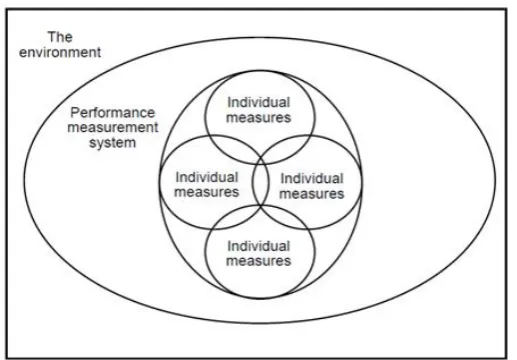
A performance measurement system (depicted in Figure 2) is defined as the set of metrics used to quantify both the efficiency and effectiveness of actions (Neely, Gregory, & Platts,1995).
Performance measurement systems are therefore viewed at three levels. First, at the level of individual measures, second as a set of measures collectively, and thirdly in relation to the operating environment. The framework as depicted in Figure 1 cannot function in an isolated environment. It needs to be supported by a
management information system that facilitates
199
Copyright © 2018. IJEMR. All Rights Reserved.
Figure 1 – Performance Measurement Framework (Neely, Gregory, & Platts, 1995)The characteristics required for putting together a modern performance measurement systems available in the recent literature have been summarized by Gomes, Yasin, & Lisboa (2004) and Neely in Business Performance Measurement: Theory and Practice (2002). The important characteristics that emerge are:
The performance measures need to be selected on the basis of the organisation’s objectives. Their choice should be based on factors which dictate an organisation’s success, and the measures should be such that they help in fulfilling customer needs.
The performance measures should be so chosen
that they provide a balanced profile of the supply chain as an entity. They should be able to present a comprehensive snapshot of the organisation, which should include financial as well as non-financial measures, internal and external measures, and reflect both efficiency and effectiveness of the supply chain.
The utility of performance measures is reflected
in the business results, and future business results in turn would dictate the choice of measures. Therefore, they can’t be static, and must change dynamically.
The performance measurement framework
should provide a snapshot of the complete supply chain’s performance. Therefore, it is essential that the performance measures are integrated across the hierarchy as well as functions of the organisation.
The performance measurement framework
should include measures that cover all functional areas of performance that contribute to organisations success.
The reward system in the organisation should be aligned to the performance measurement framework.
Challenges in Supply Chain Performance
Management
Neely & Bourne (2000) have reserached and identified causes behind failure of performance
measurement initialtives. They have concluded that the principal cause for failure of said initiatives is poor design of performance measurement systems. Managers often use measures which have no correlation to the organisation’s success. What is measured and monitored has therefore no impact on the entity’s performance. There are others, who choose measures which cannot be measured objectively. Implementation of such systems is therefore not feasible.
Nudurupati, Bititci, Kumar, & Chan (2010) have also researched the causes that lead to failure of performance measurement frameworks:
Few performance management systems have an
integrated management information system infrastructure. In absence of a dedicated management information system, collation of
data, and its subsequent analysis and
interpretation becomes a huge challenge in terms of time and effort.
Historical measures are of little use as they contain antiquated and irrelevant information. Performance management systems need to be current, and sensitive to changes in the external and internal operating environment.
A manually compiled performance
measurement framework with a large number of performance measures is difficult to maintain and seldom yields value.
Difficult to calculate and poorly implemented measures yield inappropriate and inaccurate outputs, and are a major cause of failure of the performance management systems.
Resistance to performance management
systems is present across all levels of the
organisation, and in case the senior
200
Copyright © 2018. IJEMR. All Rights Reserved.
IV. PERFORMANCE MEASUREMENT
FRAMEWORKS/MODELS
Evolution of Performance Measurement Frameworks
The accounting systems evolved to form early performance measurement frameworks (Kurien & Qureshi, 2011). Ghalayini & Noble, 1996 identified two distinct phases of the evolution. The first phase covers nearly a century, comencing from the late nineteenth century till the late twentieth century, and was characterised by its cost accounting approach. The shortcomings of the cost accounting based performance measurement systems were highlighted in the late seventies, and a need for change was felt. The dissatisfaction with the backward looking performance measures led to the development of balanced frameworks. These frameworks were multi-dimensional and they attempted to look at various facets of performance, including non-financial aspects. These system were not only historic but also future looking (Bourne, Mills, Wilcox, Neely, & Platts, 2000). The mid eighties was a critical turning point in the evolution history of performance measurement systems and it also marked the beginning of the second phase (Gomes, Yasin, & Lisboa, 2004).
Thomas Johnson and Robert Kaplan critically analysed and detailed the deficiencies in the traditional
cost accounting based performance measurement systems (Johnson & Kaplan, 1987). They were critcal of the use of financial performance measures which do not provide a succint overview of modern organisation, and do not in any manner reflect its ability to satisfy customers, and the internal health of the organisation to handle competition. Most researchers agree that the financial performance measures provide only a historical view, and therefore encourage policies that are good for short term. These measures gave no indication of the future performance (Neely, 2002). The second phase witnessed mixing of financial and non-financial measures, and alignment of performance measurement systems to overall business startegy. This led to
development of integrated multi-dimensional
performance measurement systems.
The second phase of evolution of Performance Measurement Systems saw development of a number of different frameworks/models as detailed in Table 1. The following important/popular ones amongst those quoted above are discussed in succeeding paragraphs:
Balanced Score Card and variants there to.
Framework based on Supply Chain Operations
Reference model and variants there to.
Framework based on levels – strategic,
operational and tactical.
The Performance Prism.
Table 1 – Frameworks for Performance Measurement (Gopal & Thakkar, 2012 and Neely, 2002)
Balanced Score Card
Robert Kaplan and David Norton from the Harvard Business School were the first to present the Balanced Scorecard in an article titled ‘The Balanced Scorecard – Measures that Drive Performance’ in
January-February 1992. The balanced scorecard
addressed four different perspectives, and hence provided a comprehensive picture to the business managers. The balance scorecard provided answers to the following:
How do our customers see us?
What must we excel at?
How do we continue to improve and create
value?
How do we look to shareholders?
201
Copyright © 2018. IJEMR. All Rights Reserved.
Figure 2 - The Balanced Scorecard Links Performance Measures (Kaplan & Norton, 1992)The term ‘balanced scorecard’ reflected the balance between short-and long-term objectives, financial and non-financial measures, lagging and leading indicators, and the external and internal performance perspectives. The balanced scorecard was successfully implemented in a large number of transformational projects. It was used as a tool to align organisations performance to management’s strategy (Hepworth, 1998). The popularity of the framework can be gauged by the fact by the end of the nineteenth century as many as 40 to 60 per cent of large firms in the United States should have adopted the balanced scorecard (Neely & Bourne, 2000).
Researchers have modified the balanced scorecard in many different ways. Sharma & Bhagwat (2007) developed an integrated approach by concurrent use of balanced scorecard and analytical hierarchy process (AHP) for evaluating the performance of supply chains.
Supply Chain Operations Reference (Scor) Model
A consortium of 69 forward thinking
organizations representing a variety of industry segments founded Supply Chain Council (SCC) in 1996 to address Supply Chain Management from a global and a cross industry perspective (Stephens, 2001). The SCC developed, established and maintains the world’s most widely accepted framework for evaluating and comparing supply chain activities and their performance - the SCOR model. The SCOR framework is one of the most efficient, standardised, and consitent framework for evaluating the performance of supply chains. It can be
used within an organisation, and also to compare performance of two different organisations.
The SCOR model is used by a multitude of organizations across the globe and has been adapted to suit business peculiarities. The performance in SCOR is evaluated by use of two elements - Performance Attributes and Metrics.
Performance Attribute. Performance attribute is a set of related metrics which reflect a particular aspect of the management’s strategy. The attribute itself cannot be measured. It is measured through a set of metrics. Reliability or responsiveness are examples of performance attribute.
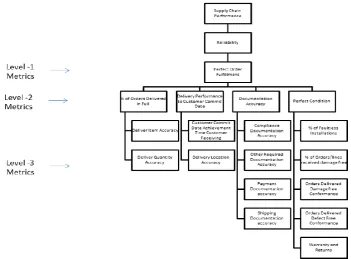
Performance Metrics. The metrics are defined to measure the ability of an organisation to achieve success in various performance attributes. Perfect Order Fulfilment will therefore be a metrics to achieve responsiveness.
202
Copyright © 2018. IJEMR. All Rights Reserved.
Figure 3 – Performance Attributes and the Level-1 Metrics (Adapted from SCOR Model)Figure 4 – Metrics for Perfect Order Fulfillment (Adapted from SCOR Model)
Frameworks Based on Levels
Gunasekaran, Patel, & Tirtioglu (2001) classified metrics into strategic, tactical and operational levels. This was done for ease of assignment of metrics at the appropriate level. For example, the total cycle time, is assigned at the strategic level and can be used and managed by the top management. The metrics are also differentiated as financial and non-financial. In some cases, a metric is classified as both financial and non-financial. For example, the buyer-supplier relationship can be quantified in terms of financial performance achieved, such as cost savings, and in terms of tangible and intangible benefits, like improved quality, flexibility and deliverability. Further, Gunaskaran, Patel, & McGaughey (2004) have also presented a framework where in the metrics have been identified for major supply chain activities/processes as per the SCOR model (plan, source, make/assemble and deliver) and also
classified as per strategic, tactical and operational level to clarify the appropriate level of management authority responsible for performance.
Performance Prism
The Performance Prism is a second generation measurement framework proposed by Andy Neely and Chris Adam, and it is designed to facilitate selection of the right performance measures. The Performance Prism consists of five interrelated facets (see Figure 7). These facets help in defining a comprehensive set of measures by addressing the following questions:
Stakeholder satisfaction – identify the
key-stakeholders, and their specific wants and needs?
203
Copyright © 2018. IJEMR. All Rights Reserved.
Processes – what critical processes do we need
to operate and enhance these processes?
Capabilities – what capabilities do we need to operate and enhance these processes?
Stakeholder contribution – what contributions do we require from our stakeholders if we are to maintain and develop these capabilities?
Figure 5- Performance Prism delivering stakeholder value (Neely, 2002)
The organisation’s results are a function of determinants which are the other facets of the prism. At the organisational level, it provides a succinct overview of its performance. To an extent it is similar to the balanced scorecard, but includes more details than the balanced scorecard. The comprehensiveness of the framework helps in identifying gaps in measurement (Neely, 2002)
V. MILITARY VERSUS COMMERCIAL
SUPPLY CHAINS
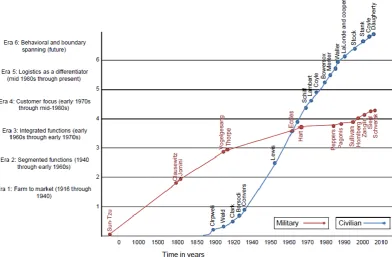
Comparison of the evolution of military and business supply chains is interesting. The military supply chains enjoyed a definite advantage over the civilian supply chains on account of early adoption of technology. The pressures of performance led to adoption of efficient and effective processes. However, post second world war the civilian supply chain management made huge advances and surpassed the military logistics (Figure 6 refers) (Rutner, Aviles, & Cox, 2012).
204
Copyright © 2018. IJEMR. All Rights Reserved.
Therefore, the current reality is that the military’sacross the world stand to gain from knowledge diffusion and by implementing practices which can reduce the gap between thetwo competing but distinct supply chains. Military and commercial supply chains differ on many accounts. A few palpable differences are appended in the succeeding paragraphs.
Size and Complexity
The military supply chains are enormous in terms of reach, size, and complexity. The United States Department of Defence supply chain includes over 30,000 specific ‘customers’ (military units), 22 maintenance and repair echelons, 14 national inventory control points, 22 regional/international distribution depots, over 80 major air and sea transport ports, 5 million consumable and repairable items procured from more than 100,000 suppliers, and over 2000 legacy systems. The Department of Defence material enterprise – global in scope, enormous in scale, unsurpassed in complexity, and employs more than 1 million personnel – is the largest supply chain in the world (Parlier, 2011). Similarly, the Indian military supply chain is fed by 39 ordnance factories and 9 defence public sector undertakings whose annual sales in 2011 amounted to INR 410 billion. They form the world’s largest government controlled defence production organisation and employ over 200,000 employees. In terms of sheer magnitude, the military supply chain are bigger than their commercial counterparts and the same poses natural challenges in exercising systemic coordination and collaboration.
The military itself is the customer of its supply chain is another fact that makes military supply chains different from the commercial supply chains. The military uses product delivered by its very own supply chain, expects its supply chain to maintain and service the product during its life-cycle, and finally returns the used product at end of fair life. Supply chain complexity also has another dimension. The military supply chain has not only a forward pipeline pushing (or pulling) items, but it also has reverse and lateral linkages.
Mission Critical Requirements
Soldier is a demanding customer who needs products like ammunition, food, water, medicine and fuel. The requirements of the soldier are mission critical. Their non-availability can by no means be compared with non-availability of items on a shelf in a departmental stores. If a departmental store runs out of inventory for an item, it has time to react. The loss on account of missed sales opportunity cannot be compared to that what can happen on a battle field. ‘Soldiers can be killed if they run out of fuel in their tanks or ammo’, says William Pagonis, a retired Lieutenant General who oversaw logistics in the Persian Gulf War. To meet these mission critical requirements all governments make available sufficient funds. The Indian finance minister in the 2013-14 budget speech said ‘I propose to increase
the allocation for Defence to Rupees 203,672
crore…assure.... the House that constraints will not come in the way of providing any additional requirement
for the security of the nation’. These two facts together imply that for military supply chains, the stock-out costs are exponentially high, and they face relatively lesser resource constraints. This results in an organisational culture where it is considered better to buy more items than what you need, than to manage with just the right amount of inventory. The culture prevents use of effective inventory management techniques used by the commercial supply chains that lead to lower levels of inventory (GAO/HR-95-5, 1995).
Efficiency versus Responsiveness
The traditional supply chains focus primarily on efficiency. Their prime concern is to reduce operating costs by reducing input costs, maintaining lower levels of inventory, and by maximising capacity utilisation. Military supply chains on the other hand accord higher priority to responsiveness in comparison to efficiency. They are concerned about building surge capabilities to meet any possible contingencies. The militaries expect their supply chain to facilitate deployment in remote localities and be able to quickly respond to the demands of operating environment irrespective of the geography (Wang, 2006). The high degree of unpredictability when coupled with mission criticality results in enhancing the adverse effects of organisation culture discussed in the previous paragraph.
Spare Parts Challenge
Meeting the demands for spare parts of weapons and equipment of the military is another formidable challenge. The military equipment is mostly non-civil end use, and is highly specialised. The range of equipment in service is often limited, and commercial
suppliers are mostly the original equipment
manufacturers. In many cases, equipment overhaul is the only method for meeting the future requirements (Wang, 2006). In case of imported equipment this challenge is even tougher. Most of the imported equipment is that which have been phased out in the country of origin. Therefore, the importing nations resort to life time buys which need to be based on accurate forecasts. The problem is further compounded due to the small population of main equipment and extremely large service life spans of main equipment which create maintenance and up-gradation challenges (MIG-21 FL was decommissioned after being in service for 50 years and the T-72 tank is only 44 years young).
Systemic Inefficiencies
Critics have proclaimed public organisations to be inefficient, and ineffective. They are often large in size, governed by a bureaucratic hierarchy, insensitive to the wants and needs of the end customer. Many researchers have commented adversely on the ability of government
organisations to meet organisational objectives
205
Copyright © 2018. IJEMR. All Rights Reserved.
of the Australian, United States and British defenceforces are detailed in the succeeding paragraphs.
The Australian National Audit Office (ANAO) undertook a performance audit of the country’s Department of Defence and presented a report titled ‘Performance Management of the Defence Inventory’ to the Parliament in October 1997. The ANAO observed that the level of operating stocks was far too high, which as per the audit report, was a reflection of ‘Just in Case’ culture. Scant attention is paid to the overall management of the performance and costs of the supply chain, including inventory carrying costs. Defence managers are not provided with adequate information or incentives to ensure that their decisions are based upon considerations of efficiency and effectiveness of the total supply chain. Considerable one-off savings and annual savings could be accrued through adoption of commercial management practices such as Vendor-held stock. Similarly, the ANAO noted that the Defence would benefit from focusing on the analysis and management of each component of procurement lead times. Though there have been a few worthwhile but isolated attempts to improve the management practices applied to the defence supply chain, a cultural change is needed to bring the defence practices closer to those identified as best practice.
In January 1990, the United States General Accounting Office (GAO) started a drive to review and report on federal government program areas that were considered ‘high risk’. The GAO identified areas that are especially vulnerable to waste, fraud, abuse, and
mismanagement. Inventory management of the
Department of Defence (DoD) was then identified as high risk, and interestingly the categorisation continues as on date (the nomenclature has since changed to Supply Chain Management). The very fact that the US DoD has not been able to get rid of the audit’s observations in entirety for more than two decades is a testimony of the magnitude of complexities involved in the issue at hand. The GAO’s initial report in 1993 on Defence Inventory Management (GAO/HR-93-12) identified the problem area as that the defence bought more than it needs and failed to apply standards of economy or efficiency to the purchase, maintenance, and distribution of its inventories. The DoD not only wasted billions of dollars on excess supplies, but burdened itself with the need to maintain them, and failed to acquire the tools or expertise to manage them effectively.
The National Audit Office (NAO) of United Kingdom on 28 Jun 2012 presented a report titled ‘Managing the Defence Inventory’. The NAO in its report observed that the Department holds £4.2 billion of inventory that has not moved in over two years and a further £2.4 billion of holdings sufficient to cover five years of use. Moreover, it spent £1.5 billion in 2009-10 and 2010-11 on consumable inventory that it has not used. Holding inventory that may not be used imposes a cost on the Department. The estimated costs of storing and managing inventory were at least £277 million in 2010-11. Further, there is an opportunity cost for the
Department, if it stores inventory that will never be used. The Department’s logistics strategy does not discourage over-ordering and therefore risks increase in inventory levels despite actions to reduce levels of unnecessary inventory. The Department has set few efficiency targets that encourage buying and holding of inventory in the right quantities. In line with the strategy, targets are focused on ensuring that there is sufficient inventory to meet requirements, rather than minimising over-ordering or managing inventory already being stored. No incentives exist for procurement agencies to consider the full impact of their decision-making. Reduction in order quantity as well as inventory holding costs are not rewarded in any manner. The department is neither aware of the complete costs associated with the inventory held under its management nor does it use these costs while taking inventory related decisions.
Decisions related to inventories procurement,
maintenance, stocking, and disposal should factor in the costs involved. This would only be possible if the management of inventory, at all levels, is done by qualified personnel who are trained in the field. The NAO in its report observe that 20 percent posts are vacant, and almost 13 percent of the staff do not have the requisite qualifications.
VI. PERFORMANCE MEASUREMENT
FRAMEWORKS ADAPTED BY THE
MILITARIES
The militaries across the globe in the recent past have begun to face increased oversight of the government, coupled with resource constraints arising out of budgetary cuts. There is an increased realisation that the military supply chains need to incorporate commercial best practices with a view to enhance efficiency and effectiveness. Some of the modern militaries have also adopted second generation performance measurement frameworks. Three of them are detailed below
The Australian Defence Forces
The Australian Defence Forces traditionally focus on the measurement of results or the lagging and quantitative performance measurements in the defence supply chain. The ANAO post review suggested a shift in approach and recommended development of metrics for process assessment in order to influence those results. The analysis of existing performance measures revealed the following (ANAO, 1997):
Just 7.0% of the measures related to
organisational learning and growth.
Lack of adequate measures that help in
sustaining and maintaining innovation, and improving the learning curve.
Although over half of the measures overall
were assessed as falling into the internal business process domain, 72 per cent of these measured the results of those processes.
Only 28 per cent of measures focused on
206
Copyright © 2018. IJEMR. All Rights Reserved.
The ANAO recommended implementation of theBalanced Scorecard a schematic diagram of which is
depicted in Figure 7.
Figure 7 - Balanced Scorecard as recommended by the ANAO
The UK Defence Balanced Score Card
The UK Ministry of Defence uses the Defence Balanced Scorecard to manage its performance against the objectives contained in five year defence plans. The UK Defence Board reviews performance against the scorecard objectives every quarter alongside details of the emerging financial position. The scorecard facilitates the Defence Board in evaluating its supply chain’s performance and also helps to identify areas of concern which require attention (Defence Plan 2008-2012, 2008). However, the need for development of an effective performance measurement framework remains unfulfilled, as is evident from the minutes of the Thirty-second session report of Committee of Public Accounts, House of Commons, UK. ‘… we need to reduce the current inventory levels (disposing of unwanted inventory); improve Ministry of Defence’s Inventory Management capability; establish the right skills, putting in place coherent Inventory Management, commercial and finance processes; and ensuring these processes are supported by an appropriate organisation, quality data,
strong governance and effective performance
measures..’ (Ministry of Defence: Managing the defence inventory, 2013).
The US Logistic Strategy Plan
The DoD in its Logistic Strategy Plan has described two analytical models that help promote process standardization, facilitate process integration, and define the enterprise framework.
SCOR Model. SCOR provides a unique
framework that links business processes, metrics, best practices, and technology features into a unified structure to improve effectiveness of supply chain management. The Department uses SCOR processes as a
framework for developing, improving, and conducting material management activities.
Joint Supply Chain Architecture (JSCA).
JSCA is a Department of Defence wide SCOR-based process model that clearly defines supply chain configuration elements and links them to driving precise and reliable outcomes. The JSCA fosters a common understanding among stakeholders of supply chain objectives, terminology, and performance measures and provides a mechanism to improve unity of effort. However, the GAO in its review in 2012 stated that the department does not have a comprehensive set of performance measures which can evaluate the efficiency and effectiveness of its extended supply chain. The Office of the Secretary of Defence is involved in an effort to identify suitable metrics to monitor the supply chain performance across the length and breadth of the enterprise. The metrics together will yield a performance measurement framework which shall guide the management in shaping its supply chain strategy. Performance attributes of responsiveness, reliability, total costs, accuracy in forecasting, and readiness are being considered by the department for making the framework (GAO, 2013).
The Indian Model
207
Copyright © 2018. IJEMR. All Rights Reserved.
government define targets against objectives andmonitor their performance on an annual basis. At the heart of the PMES lies a document called the Results-Framework Document (RFD). The RFD includes DDP’s main objectives for the year, actions proposed to achieve
these objectives, and metrics to determine progress made in implementing these actions (Performance Monitoring and Evaluation System for Government Departments). The format of the RFD is depicted at Table 2.
Table 2 -– Format for RFD (PMES for Government Department, Cabinet Secretariat, Government of India)
The last section of the RFD contains broad outcomes and the expected impact the Department has at the national level. This section essentially captures the very purpose for which the organisation exists and is included to keep reminding the Department the purpose of its existence and also the rationale for undertaking the RFD exercise.
The performance of the distribution chain which is entirely owned by the Services is monitored by a variety of mechanisms. The administrative and technical inspection of logistic echelons is conducted on a periodic basis. Administrative inspections are carried out by the local formation commanders and they focus on issues pertaining to human resource development, security, firefighting etc., while the technical inspections focus on the functional aspects. The central and regional depots of the army also record the efficiency of their functional processes against established benchmarks by compiling statistical summaries.
VII. FINDINGS
We live in the era of ‘supply chain competition’ (Christopher, 2006). In this era, efficient and effective management of the supply chain provides the ultimate competitive advantage. This can be achieved through systemic coordination, collaboration, building of relationship and trust amongst business partners. Measuring the performance of supply chain has therefore attracted serious attention. The performance measurement revolution that started in late twentieth century, with the dissatisfaction of traditional accounting based performance measurement systems, and has matured to yield a variety of frameworks for supply chain performance measurement (Nudurupati, Bititci, Kumar, & Chan, 2010). It is the identification of right performance measures and the implementation of
performance measurement framework which poses the biggest challenge in the field. The military supply chains across the globe owing to their current state, and design, urgently need to implement supply chain performance measurement systems. The modern defence forces across the globe have experimented with commercial performance measurement frame works which include the Balanced Scorecard and the SCOR model. However, identification of the right supply chain metrics which provide a succinct, enterprise wide picture of the entire military supply chain remains a work in progress. Given the resources committed in the military supply chains and their impact on national security, the subject deserves attention and future research.
208
Copyright © 2018. IJEMR. All Rights Reserved.
to strategy and realising the ultimate aim of maximisingcustomer satisfaction at the lowest cost.
VIII. CONCLUSION
In the modern world, competition is not between organisations, but amongst supply chains. Supply Chain Management and the performance of supply chains with a view to obtain competitive advantage thus assume greater significance (Trkman, McCormack, Oliveira, & Ladeira, 2010). The analogy can be extended to the military and it can be said that in conflicts which occur in future, what will matter most, apart from the quality of the fighting formations, is the quality of the supply chains that support them and hence the need for developing a framework which objectively measures the effectiveness and efficiency of the military supply chain. In contemporary times, overlooking of this aspect would amount to yielding of competitive advantage to the adversary.
The military establishments therefore need to design and adopt a supply chain performance framework which addresses the military supply chain in its entirety and is balanced in its approach. The SCOR model and the Balanced Scorecard can be effectively customised to meet the peculiar requirements of the military supply chain. Above all, the framework should also lead to enhanced co-ordination, collaboration and building of trust amongst the various entities that link together to constitute the military supply chain.
REFERENCES
[1] Agarwal, A., Shankar, R., & Tiwari, M. (2006). Modeling the metrics of lean, agileand leagile supply chain: an ANP based approach. Europen Journal of
Operational Research, 173(1), 211-225.
[2] Melnyk, S. A., Stewart, D. M., & Swink, M. (2004). Metrics and performance measurement in operations
management: Dealing with the metrics maze. Journal of
Operations Management, 22(3), 209–217.
[3] Ballou, R. H. (2007). The evolution and future of
logistics and supply chain management. European
Business Review, 19(4), 332-348.
[4] Beamon, B. (1999). Measuring supply chain performance. International Journal Operations &
Production Management, 19(3-4), 275-292.
[5] Beamon, B. M. (1998). Supply chain design and analysis: Models and methods. International Journal of
Production Economics, 55(3), 281–294.
[6] Bourne, M., Mills, J., Wilcox, M., Neely, A., & Platts, K. (2000). Designing, implementing and updating
performance measurement systems. International
Journal of Operations & Production Management, 20(7), 754-771.
[7] Brewer, P., & Speh, T. (2000). Using the balanced scorecard to measure supply chain performance. Journal
of Business Logistics,21(1), 75-93.
[8] Chan, F. (2003). Performance measurement in a
supply chain. International Journal of Advanced
Manufacturing Technology, 21(1), 534-548.
[9] Bititci, U. S., Carrie, A. S., & McDevitt, L. (1997). Integrated performance measurement systems: A
development guide. International Journal of Operations
& Production Management, 17(5), 522–534.
[10] Clift, R. (2003). Metrics for supply chain
sustainability. Clean Technologies and Environmental
Policies, 5(3-4), 240-7.
[11] Gansler, J. S., & Luby Jr, R. E. (2004).
Transforming Government Supply Chain Management.
Maryland: Rowman & Littlefield Publishers, Inc. [12] Ghalayini, A. M., & Noble, J. S. (1996). The
changing basis of performance measurement.
International Journal of Operations & Production
Management, 16(8) , 63-80.
[13] Baumol WJ. (2002). The free-market innovation machine: analyzing the growth miracle of capitalism
woodstock. Oxon: Princeton University Press.
[14] Gopal, P. R., & Thakkar, J. (2012). A review on supply chain performance measures and metrics:
2000-2011. International Journal of Productivity and
Performance Management, 61(5), 518-547.
[15] Gunasekaran, A., Patel, C., & Tirtioglu, E. (2001). Performance measures and metrics in a supply chain environment. International Journal of Operations &
Production Management, 21(1/2), 71-87.
[16] Gunaskaran, A., Patel, C., & McGaughey, R. (2004). A framework for sipply chain performance
measurement. International Journal of Production
Economics, 87(3), 333-347.
[17] Halachmi, A. (2005). Performance measurement is the only way of managing performance. International Journal of Productivity and Performance Management, 54(7), 502-514.
[18] Hepworth, P. (1998). Weighing it up – a literature
review for the balanced scorescard. Journal of
Management Development, 17(8), 559-563.
[19] Johnson, H., & Kaplan, R. (1987). Relevance lost:
The rise and fall of management accounting. Boaston:
Harvard Business School Press.
[20] Kurien, G., & Qureshi, M. (2011). Study of performance measurement practices in supply chain
management. International Journal of Business,
Management and Social Science, 2(4), 19-34.
[21] Neely, A. (2002). Business performance
measurement: theory and practice. Cambridge:
Cambridge University Press.
[22] Parlier, G. H. (2011). Transforming U.S army
supply chains. New York: Business Expert Press.
[23] Rutner, S. M., Aviles, M., & Cox, S. (2012). Logistics evolution: a comparison of military and commercial logistics thought. The International Journal
of Logistics Management, 23(1), 96-118.
[24] Wang, M. Y. (2006). Factory to foxhole: Improving
the army's supply chain. Sanat Monica, CA: Rand