The Thirty-Third AAAI Conference on Artificial Intelligence (AAAI-19)
Mixture of Expert/Imitator Networks:
Scalable Semi-Supervised Learning Framework
Shun Kiyono,
1Jun Suzuki,
1,2Kentaro Inui
1,2 1Tohoku University,2RIKEN Center for Advanced Intelligence Project{kiyono, jun.suzuki, inui}@ecei.tohoku.ac.jp
Abstract
The current success of deep neural networks (DNNs) in an increasingly broad range of tasks involving artificial intelli-gence strongly depends on the quality and quantity of labeled training data. In general, the scarcity of labeled data, which is often observed in many natural language processing tasks, is one of the most important issues to be addressed. Semi-supervised learning (SSL) is a promising approach to over-coming this issue by incorporating a large amount of unla-beled data. In this paper, we propose a novel scalable method of SSL for text classification tasks. The unique property of our method, Mixture of Expert/Imitator Networks, is that im-itator networks learn to “imitate” the estimated label distri-bution of the expert network over the unlabeled data, which potentially contributes a set of features for the classification. Our experiments demonstrate that the proposed method con-sistently improves the performance of several types of base-line DNNs. We also demonstrate that our method has the
more data, better performanceproperty with promising scal-ability to the amount of unlabeled data.
1
Introduction
It is commonly acknowledged that deep neural networks (DNNs) can achieve excellent performance in many tasks across numerous research fields, such as image classifica-tion (He et al. 2016), speech recogniclassifica-tion (Amodei et al. 2016), and machine translation (Wu et al. 2016). Recent progress in these tasks has been primarily driven by the fol-lowing two factors: (1) A large amount of labeled training data exists. For example, ImageNet (Deng et al. 2009), one of the major datasets for image classification, consists of ap-proximately 14 million labeled images. (2) DNNs have the property of achieving better performance when trained on a larger amount of labeled training data, namely, themore data, better performanceproperty.
However, collecting a sufficient amount of labeled train-ing data is not always easy for many actual applications. We refer to this issue as the labeled data scarcity issue. This issue is particularly crucial in the field of natural language processing (NLP), where only a few thousand or even a few hundred labeled data are available for most tasks. This is
Copyright c2019, Association for the Advancement of Artificial Intelligence (www.aaai.org). All rights reserved.
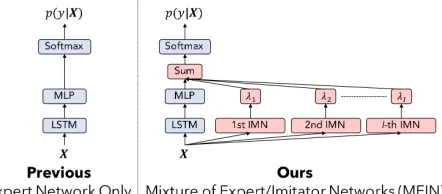
Figure 1: Overview of our framework: the Mixture of Ex-pert/Imitator Networks (MEIN)
because, in typical NLP tasks, creating the labeled data of-ten requires the professional supervision of several highly skilled annotators. As a result, the cost of data creation is high relative to the amount of data.
Unlike labeled data, unlabeled data for NLP tasks is es-sentially a collection of raw texts; thus, an enormous amount of unlabeled data can be obtained from the Internet, such as through the Common Crawl website1, at a relatively low cost. With this background, semi-supervised learning (SSL), which leverages unlabeled data in addition to labeled train-ing data for traintrain-ing the parameters of DNNs, is one of the promising approaches to practically addressing the la-beled data scarcity issue in NLP. In fact, some intensive studies have recently been undertaken with the aim of de-veloping SSL methods for DNNs and have shown promis-ing results (Mikolov et al. 2013; Dai and Le 2015; Miy-ato, Dai, and Goodfellow 2017; Clark, Luong, and Le 2018; Peters et al. 2018).
In this paper, we also follow this line of research topic, i.e., discussing SSL suitable for NLP. Our interest lies in themore data, better performanceproperty of the SSL ap-proach over the unlabeled data, which has been implic-itly demonstrated in several previous studies (Pennington, Socher, and Manning 2014; Peters et al. 2018). In order to take advantage of the huge amount of unlabeled data and improve performance, we need an SSL approach that scales with the amount of unlabeled data. However, the scal-ability of an SSL approach has not yet been widely
dis-1
cussed, since the primary focus of many of the recent stud-ies on SSL in DNNs has been on improving the perfor-mance. For example, several studies have utilized unlabeled data as additional training data, which essentially increases the computational cost of (often complex) DNNs (Miyato, Dai, and Goodfellow 2017; Clark, Luong, and Le 2018; Sato et al. 2018). Another SSL approach is to (pre-)train a gigantic bidirectional language model (Peters et al. 2018). Nevertheless, it has been reported that the training of such a network requires 3 weeks using 32 GPUs (Jozefowicz et al. 2016). By developing a scalable SSL method, we hope to broaden the usefulness and applicability of DNNs since, as mentioned above, the amount of unlabeled data can be easily increased.
In this paper, we propose a novel scalable method of SSL, which we refer to as the Mixture of Expert/Imitator Net-works (MEIN). Figure 1 gives an overview of the MEIN framework, which consists of an expert network (EXN) and at least one imitator network (IMN). To ensure scalability, we design each IMN to be computationally simpler than the EXN. Moreover, we use unlabeled data exclusively for training each IMN; we train the IMN so that itimitatesthe label estimation of the EXN over the unlabeled data. The basic idea underlying the IMN is that we force it to perform the imitation with only a limited view of the given input. In this way, the IMN effectively learns a set of features, which potentially contributes to the EXN. Intuitively, our method can be interpreted as a variant of several training techniques of DNNs, such as the mixture-of-experts (Jacobs et al. 1991; Shazeer et al. 2017), knowledge distillation (Ba and Caruana 2014; Hinton, Vinyals, and Dean 2015), and ensemble tech-niques.
We conduct experiments on well-studied text classifica-tion datasets to evaluate the effectiveness of the proposed method. We demonstrate that the MEIN framework consis-tently improves the performance for three distinct settings of the EXN. We also demonstrate that our method has themore data, better performanceproperty with promising scalabil-ity to the amount of unlabeled data. In addition, a current popular SSL approach in NLP is to pre-train the language model and then apply it to downstream tasks (Mikolov et al. 2013; Dai and Le 2015; McCann et al. 2017; Peters et al. 2017; 2018). We empirically prove in our experiments that MEIN can be easily combined with this approach to further improve the performance of DNNs.
2
Related Work
There have been several previous studies in which SSL has been applied to text classification tasks. A common ap-proach is to utilize unlabeled data as additional training data of the DNN. Studies employing this approach mainly focused on developing a means of effectively acquiring a teaching signal from the unlabeled data. For example, in vir-tual adversarial training (VAT) (Miyato, Dai, and Goodfel-low 2017) the perturbation is computed from unlabeled data to make the baseline DNN more robust against noise. Sato et al. (2018) proposed an extension of VAT that generates a more interpretable perturbation. In addition, cross-view training (CVT) (Clark, Luong, and Le 2018) considers the
auxiliary loss by making a prediction from an unlabeled in-put with a restricted view. On the other hand, in our MEIN framework, we do not use unlabeled data as additional train-ing data for the baseline DNN. Instead, we use the unlabeled data to train the IMNs to imitate the baseline DNN. The ad-vantage of such usage is that one can choose an arbitrary architecture for the IMNs. In this study, we design the IMN to be computationally simpler than the baseline DNN to en-sure better scalability with the amount of unlabeled data (Ta-ble 4).
The idea of ourexpert-imitatorapproach originated from the SSL framework proposed by Suzuki and Isozaki (2008). They incorporated several simple generative models as a set of additional features for a supervised linear conditional ran-dom field classifier. Our EXN and IMN can be regarded as their linear classifier and the generative models, respec-tively. In addition, they empirically demonstrated that the performance has a linear relationship with the logarithm of the unlabeled data size. We empirically demonstrate that the proposed method also exhibits similar behavior (Figure 3), namely, increasing the amount of unlabeled data reduces the error rate of the EXN.
One of the major SSL approaches in NLP is to train a language model over unlabeled data. The pre-trained weights have many uses, such as parameter initial-ization (Dai and Le 2015) and as a source of additional features (McCann et al. 2017; Peters et al. 2017; 2018), in downstream tasks. For example, Peters et al. (2018) have recently trained a bi-directional LSTM language model us-ing the One Billion Word Benchmark dataset (Chelba et al. 2014). They utilized the hidden state of the LSTM as contex-tualized embedding, calledELMoembedding, and achieved state-of-the-art results in many downstream tasks. In our experiment, we empirically demonstrate that the proposed MEIN is complementary to the pre-trained language model approach. Specifically, we show that by combining the two approaches, we can further improve the performance of the baseline DNN.
3
Task Description and Notation Rules
This section gives a formal definition of the text classifica-tion task discussed in this paper. LetV represent the vocab-ulary of the input sentences. xt ∈ {0,1}|V| denotes the
one-hot vector of the t-th token (word) in the input sen-tence, where|V|represents the number of tokens inV. Here, we introduce the short notation form(xt)Tt=1 to represent a sequence of vectors for simplicity, that is, (xt)Tt=1 = (x1, . . . ,xT). Suppose we have an input sentence that
con-sists ofTtokens. For a succinct notation, we introduceXto represent a sequence of one-hot vectors that corresponds to the tokens in the input sentence, namely,X = (xt)Tt=1.Y denotes a set of output classes. Lety ∈ {1, . . . ,|Y|}be an integer that represents the output class ID. In addition, we defineXa:bas the subsequence ofXfrom indexato index
b, namely,Xa:b = (xa,xa+1. . . ,xb)and1 ≤a≤b≤T.
classifica-tion tasks modeled by DNNs, we aim to maximize the (con-ditional) probability p(y|X) over a given set of labeled training data (X, y) ∈ Ds by using DNNs. In the
semi-supervised training, the objective of maximizing the proba-bility is identical but we also use a set of unlabeled training dataX∈ Du.
4
Baseline Network: LSTM with MLP
In this section, we briefly describe a baseline DNN for text classification. Among the many choices, we select the LSTM-based text classification modeldescribed by Miyato, Dai, and Goodfellow (2017) as our baseline DNN architec-ture since they achieved the current best results on several well-studied text classification benchmark datasets. The net-work consists of the LSTM (Hochreiter and Schmidhuber 1997) cell and a multi layer perceptron (MLP).First, the LSTM cell calculates a hidden state sequence (ht)Tt=1, where ht ∈ RH for all t and H is the size of the hidden state, asht = LSTM(Ext,ht−1). Here,E ∈ RD×|V|is the word embedding matrix,D denotes the size of the word embedding, andh0is a zero vector.
Then theT-th hidden statehT is passed through the MLP,
which consists of a single fully connected layer with ReLU nonlinearity (Glorot, Bordes, and Bengio 2011), to compute the final hidden states∈ RM. Specifically,sis computed as s = ReLU(WhhT +bh), where Wh ∈ RM×H is a trainable parameter matrix and bh ∈ RM is a bias term. Here, M denotes the size of the final hidden state of the MLP.
Finally, the baseline DNN estimates the conditional prob-ability from the final hidden statesas follows:
zy=wy>s+by, (1)
p(y|X,Θ) =P exp(zy)
y0∈Yexp(zy0)
, (2)
wherewy ∈RMis the weight vector of classyandbyis the
scalar bias term of classy. Also,Θdenotes all the trainable parameters of the baseline DNN.
For the training process of the parameters in the baseline DNN Θ, we seek the (sub-)optimal parameters that mini-mize the (empirical) negative log-likelihood for the given labeled training dataDs, which can be written as the
follow-ing optimization problem:
Θ0 = arg min
Θ
Ls(Θ|Ds) , (3)
Ls(Θ|Ds) =−
1
|Ds|
X
(X,y)∈Ds
log p(y|X,Θ), (4)
whereΘ0 represents the set of obtained parameters in the baseline DNN, by solving the above minimization problem. Practically, we apply a variant of a stochastic gradient de-scent algorithm such as Adam (Kingma and Ba 2015).
5
Proposed Model: Mixture of
Expert/Imitator Networks (MEIN)
Figure 1 gives an overview of the proposed method, which we refer to as MEIN. MEIN consists of an expert network(EXN) and a set of imitator networks (IMNs). Once trained, the EXN and the set of IMNs jointly predict the label of a given inputX. Figure 1 shows the baseline DNN (LSTM with MLP) as an example of the EXN. Note that MEIN can adopt an arbitrary classification network as the EXN.
5.1
Basic Idea
A brief description of MEIN is as follows: (1) The EXN is trained using labeled training data. Thus, the EXN is ex-pected to be very accurate over inputs that are similar to the labeled training data. (2) IMNs (we basically assume that we have more than one IMN) are trained to imitate the EXN. To accomplish this, we train each IMN to minimize the Kullback–Leibler (KL) divergence between estimations of label distributions of the EXN and the IMNs over the un-labeled data. (3) Our final classification network is a mixture of the EXN and IMN(s). Here, we fine-tune the EXN using the labeled training data jointly with the estimations of all the IMNs.
The basic idea underlying MEIN is that we force each IMN to imitate estimated label distributions with only a lim-ited view of the given input. Specifically, we adopt a slid-ing window to divide the input into several fragments of n-grams. Given a large amount of unlabeled data and the esti-mation by the EXN, the IMN learns to represent the label “tendency” of each fragment in the form of a label distri-bution (i.e., certain n-grams are more likely to have posi-tive/negative labels than others). Our assumption here is that this tendency can potentially contribute a set of features for the classification. Thus, after training the IMNs, we jointly optimize the EXN and the weight of each feature. Here, MEIN may control the contribution of each feature by up-dating the corresponding weight.
Intuitively, our MEIN approach can be interpreted as a variant of several successful machine learning techniques for DNNs. For example, MEIN shares the core concept with the mixture-of-experts technique (MoE) (Jacobs et al. 1991; Shazeer et al. 2017). The difference is that MoE considers a mixture of several EXNs, whereas MEIN generates a mix-ture from a single EXN and a set of IMNs. In addition, one can interpret MEIN as a variant of the ensemble, bagging, voting, or boosting technique since the EXN and the IMNs jointly make a prediction. Moreover, we train each IMN by minimizing the KL-divergence between the EXN and the IMN through unlabeled data. This process can be seen as a form of “knowledge distillation” (Ba and Caruana 2014; Hinton, Vinyals, and Dean 2015). We utilize these method-ologies and formulate the framework as described below.
5.2
Network Architecture
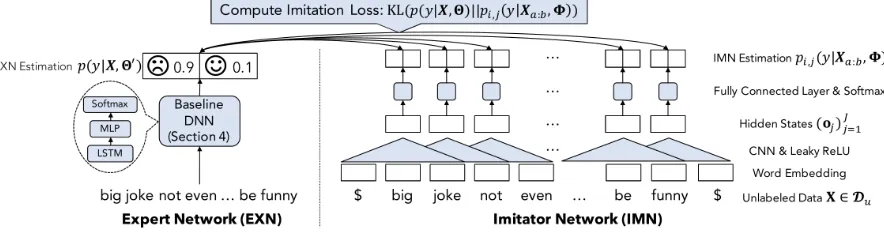
(condi-Figure 2: Overview of the 1st IMN (c1= 1). The IMN must predict the label estimation of the EXN from a limited amount of information. $ denotes a special token used to pad the input (a zero vector).
tional) probability:
p(y|X,Θ,Φ,Λ) = exp(z
0
y)
P
y0∈Yexp(zy00)
, (5)
where zy0 =zy+ I
X
i=1
σ(λi)αi[y]. (6)
λiis a scalar parameter that controls the contribution of logit
αiof thei-th IMN andΛis defined asΛ={λ1, . . . , λI}.
Here, logit αi represents an estimated label distribution,
which we assume to be a feature. Note that the first term of Equation 6 is the baseline DNN logitzy = wy>s+by
(Equation 1). In addition, if we setσ(λi) = 0for alli, then
Equation 5 becomes identical to Equation 2 regardless of the value ofΦ.
ci denotes the window size of the i-th IMN. Given an
inputX and thei-th IMN, we createJ inputs with a slid-ing window of sizeci. Then the IMN predicts the EXN for
each input and generatesJpredictions as a result. We com-pute thei-th imitator logitαiby taking the average of these
predictions. Specifically,αiis defined as
αi= log
1
J
J
X
j=1
pi,j(y|Xa:b,Φ)
, (7)
where a=j−ci and b=j+ci.
Here,ais a scalar index that represents the beginning of the window. Similarly,brepresents the last index of the window.
5.3
Definition of IMNs
Note that the architecture of the IMN used to model Equa-tion 7 is essentially arbitrary. In this research, we adopt a single-layer CNN for modelingpi,j(y|Xa:b,Φ). This is
be-cause a CNN has high computational efficiency (Gehring et al. 2017), which is essential for our primary focus: scalabil-ity with the amount of unlabeled data.
Figure 2 gives an overview of the architecture of the IMN. First, the IMN takes a sequence of word embeddings of in-put X and computes a sequence of hidden states (oj)Jj=1 by applying aone-dimensional convolution(Kalchbrenner, Grefenstette, and Blunsom 2014) and leaky ReLU nonlin-earity (Maas, Hannun, and Ng 2013). We ensure thatJ is
Algorithm 1:Training framework of MEIN Data:Labeled dataDsand unlabeled dataDu
Result:Trained set of parametersΘb,Φb,Λb
1 Θ0←arg min
Θ
{Ls(Θ|Ds)} .Train EXN (Equation 3)
2 Φb ←arg min Φ
{Lu(Φ|Θ0,Du)} .Train IMN(s) (Equation 11)
3 Θb,Λb ←arg min Θ,Λ
{L0s(Θ,Λ|Φb,Ds)} .Train EXN (Equation 13)
always equal to T. To achieve this, we pad the beginning and the end of the inputX with zero vectors0∈R|V0|×c
i, where|V0|denotes the vocabulary size of the IMN.
As explained in Section 5.2, each IMN has a predeter-mined and fixed window sizeci. One can choose an arbitrary
window size for thei-th IMN. Here, we defineciasci =i
for simplicity. For example, as shown in Figure 2, the 1st IMN (i= 1) has a window size ofc1 = 1. Such a network imitates the estimation of the EXN from three consecutive tokens.
Then thei-th IMN estimates the probabilitypi,j(y|X,Φ)
from each hidden stateojas
pi,j(y|Xa:b,Φ) =
exp(w0>
i,yoj+b0i,y)
P
y0∈Yexp(wi,y0>0oj+b0i,y0)
, (8)
wherewi,y0 ∈RN is the weight vector of thei-th IMN and b0i,y is the scalar bias term of classy.N denotes the CNN kernel size.
5.4
Training Framework
First, we define theimitation lossof each IMN as the KL-divergence between the estimations of the label distributions of the EXN and the IMN given (unlabeled) dataX, namely, KL(p(y|X,Θ)||pi,j(y|Xa:b,Φ)). Note that this imitation
loss is defined for an input with the sliding windowXa:b.
Thus, this definition effectively accomplishes the concept, i.e., the IMN making a predictionpi,j(y|Xa:b,Φ)from only
a limited view of the given inputXa:b.
IMNs as biases of the network. Therefore, we jointly solve the following two minimization problems for the parameter estimation of MEIN:
b
Θ,Λb = arg min Θ,Λ
{L0s(Θ,Λ|Φb,Ds)} (9)
b
Φ= arg min
Φ
{Lu(Φ|Θ0,Du)}. (10)
As described in Equations 9 and 10, we update the differ-ent sets of parameters depending on the labeled/unlabeled training data. Specifically, we use the labeled training data (X, y) ∈ Dsto update the set of parameters in the EXN,
Θ, and the set of mixture parameters of the IMNs,Λ. In ad-dition, we use the unlabeled training dataX∈ Duto update
the parameters of the IMNs,Φ.
To ensure an efficient training procedure, the training framework of MEIN consists of three consecutive steps (Al-gorithm 1). First, we perform standard supervised learn-ing to obtainΘ0 using labeled training data while keeping
λi = −∞unchanged for alli during the training process
to ensure thatσ(λi) = 0in Equation 6. Note that this
opti-mization step is essentially equivalent to that of the baseline DNN (Equation 4).
Second, we estimate the set of IMN parameters Φ by solving the minimization problem in Equation 10 with the following loss function:
Lu(Φ|Θ0,Du) =
1
|Du|
X
X∈Du
I
X
i=1
J
X
j=1
KL(p||pi,j), (11)
KL(p||pi,j) =−
X
y∈Y
p(y|X,Θ0) log pi,j(y|Xa:b,Φ)
+const, (12)
where KL(p||pi,j)is a shorthand notation of the imitation
loss KL(p(y|X,Θ)||pi,j(y|Xa:b,Φ))andconst is a
con-stant term that is independent ofΦ.
Finally, we estimateΘandΛby solving the minimization problem in Equation 9 with the following loss function:
L0s(Θ,Λ|Φb,Ds) =−
1
|Ds|
X
(X,y)∈Ds
logp(y|X,Θ,Φb,Λ)
.
(13)
6
Experiments
To investigate the effectiveness of MEIN, we conducted ex-periments on two text classification tasks: (1) a sentiment classification (SEC) task and (2) a category classification (CAC) task.
6.1
Datasets
For SEC, we selected the following widely used bench-mark datasets: IMDB (Maas et al. 2011), Elec (Johnson and Zhang 2015), and Rotten Tomatoes (Rotten) (Pang and Lee 2005). For the Rotten dataset, we used the Amazon Reviews dataset (McAuley and Leskovec 2013) as unla-beled data, following previous studies (Dai and Le 2015; Miyato, Dai, and Goodfellow 2017; Sato et al. 2018). For
Task Dataset Classes Train Dev Test Unlabeled
SEC
Elec 2 22,500 2,500 25,000 200,000 IMDB 2 21,246 3,754 25,000 50,000 Rotten 2 8,636 960 1,066 7,911,684 CAC RCV1 55 14,007 1,557 49,838 668,640
Table 1: Summary of datasets. Each value represents the number of instances contained in each dataset.
CAC, we used the RCV1 dataset (Lewis et al. 2004). Table 1 summarizes the characteristics of each dataset2.
6.2
Baseline DNNs
In order to investigate the effectiveness of the MEIN frame-work, we combined the IMN with following three distinct EXNs and evaluated their performance:
• LSTM: This is the baseline DNN (LSTM with MLP) de-scribed in Section 4.
• LM-LSTM: Following Dai and Le (2015), we initialized the embedding layer and the LSTM with a pre-trained RNN-based language model (LM) (Bengio et al. 2003). We trained the language model using the labeled training data and unlabeled data of each dataset. Several previous studies have adopted this network as a baseline (Miyato, Dai, and Goodfellow 2017; Sato et al. 2018).
• ADV-LM-LSTM: Adversarial training (ADV) (Good-fellow, Shlens, and Szegedy 2015) adds small perturba-tions to the input and makes the network robust against noise. Miyato, Dai, and Goodfellow (2017) applied ADV to LM-LSTM for a text classification. We used the reim-plementation of their network.
Note that these three EXNs have an identical network ar-chitecture, as described in Section 4. The only difference is in the initialization or optimization strategy of the network parameters.
To the best of our knowledge, ADV-LM-LSTM provides a performance competitive with the current best result for the configuration of supervised learning (using labeled train-ing data only).
Thus, if the IMN can improve the performance of a strong baseline, the results will strongly indicate the effectiveness of our method.
6.3
Network Configurations
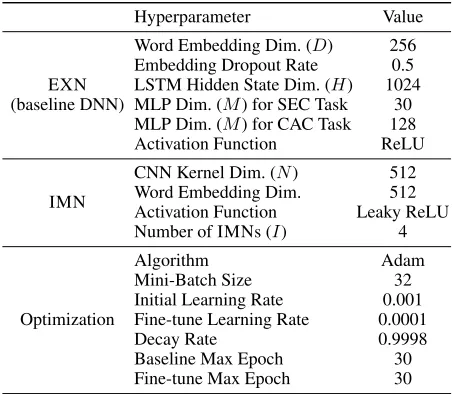
Table 2 summarizes the hyperparameters and network con-figurations of our experiments. We carefully selected the set-tings commonly used in the previous studies (Dai and Le 2015; Miyato, Dai, and Goodfellow 2017; Sato et al. 2018). We used a different set of vocabulary for the EXN and the IMNs. We created the EXN vocabularyVby following the previous studies (Dai and Le 2015; Miyato, Dai, and Good-fellow 2017; Sato et al. 2018), i.e., we removed the tokens
2
Hyperparameter Value
EXN (baseline DNN)
Word Embedding Dim. (D) 256 Embedding Dropout Rate 0.5 LSTM Hidden State Dim. (H) 1024 MLP Dim. (M) for SEC Task 30 MLP Dim. (M) for CAC Task 128 Activation Function ReLU
IMN
CNN Kernel Dim. (N) 512 Word Embedding Dim. 512 Activation Function Leaky ReLU Number of IMNs (I) 4
Optimization
Algorithm Adam
Mini-Batch Size 32 Initial Learning Rate 0.001 Fine-tune Learning Rate 0.0001 Decay Rate 0.9998 Baseline Max Epoch 30 Fine-tune Max Epoch 30
Table 2: Summary of hyperparameters
that appear only once in the whole dataset. We created the IMN vocabularyV0by byte pair encoding (BPE) (Sennrich, Haddow, and Birch 2016)3. The BPE merge operations are jointly learned from the labeled training data and unlabeled data of each dataset. We set the number of BPE merge oper-ations to 20,000.
6.4
Results
Table 3 summarizes the results on all benchmark datasets, where the evaluation metric is the error rate. Therefore, a lower value indicates better performance. Here, all the re-ported results arethe average of five distinct trialsusing five different random seeds. Moreover, for each trial, we au-tomatically selected the best network in terms of the perfor-mance on the validation set among the networks obtained at every epoch. For comparison, we also performed experi-ments on training baseline DNNs (LSTM, LM-LSTM, and ADV-LM-LSTM) with incorporating random vectors as the replacement of IMNs, which is denoted as “+IMN (Ran-dom)”. Moreover, we present the published results of VAT-LM-LSTM (Miyato, Dai, and Goodfellow 2017) and iVAT-LSTM (Sato et al. 2018) in the bottom three rows of Ta-ble 3, which are the current state-of-the-art networks that adopt unlabeled data. For VAT-LM-LSTM, we also report the result of the reimplemented network, denoted as “VAT-LM-LSTM (rerun)”. As shown in Table 3, incorporating the IMNs consistently improved the performance of all baseline DNNs across all benchmark datasets. Note that the source of these improvements is not the extra set of parametersΛbut the outputs of the IMNs. We can confirm this fact by com-paring the results of IMNs, “+IMN”, with those of random vectors, “+IMN (Random)”, since the difference between these two settings is the incorporation of IMNs or random vectors.
3
We used sentencepiece (Kudo and Richardson 2018) (https: //github.com/google/sentencepiece) for the BPE operations.
Method Elec IMDB Rotten RCV1
LSTM 10.09 10.98 26.47 14.14
LSTM+IMN (Random)† 9.87 10.75 27.27 14.04
LSTM+IMN† 8.83 10.04 24.93 12.31
LM-LSTM† 5.72 7.25 16.80 8.37
LM-LSTM+IMN (Random)† 5.71 7.01 16.78 7.83
LM-LSTM+IMN† 5.48 6.51 15.91 7.53
ADV-LM-LSTM† 5.38 6.58 15.73 7.89
ADV-LM-LSTM+IMN (Random)† 5.34 6.27 15.11 7.78
ADV-LM-LSTM+IMN† 5.14* 6.07* 13.98 7.51*
VAT-LM-LSTM (rerun)† 5.47 6.20 18.50 8.44
VAT-LM-LSTM (Miyato 2017)† 5.54 5.91 19.1 7.05
VAT-LM-LSTM (Sato 2018)† 5.66 5.69 14.26 11.80
iVAT-LSTM (Sato 2018)† 5.18 5.66 14.12 11.68
Table 3: Test performance (error rate (%)) on each dataset. A lower error rate indicates better performance.Models using the unlabeled data are marked with†. Results marked with∗are statistically significant compared with ADV-LM-LSTM.Miyato 2017: the result reported by Miyato, Dai, and Goodfellow (2017). Sato 2018: the result reported by Sato et al. (2018).
The most noteworthy observation about MEIN is that the amount of the improvement upon incorporating the IMN is nearly consistent, regardless of the performance of the base EXN. For example, Table 3 shows that the IMN reduced the error rates of LSTM, LM-LSTM, and ADV-LM-LSTM by 1.54%, 0.89%, and 1.22%, respectively, for the Rotten dataset. From these observations, the IMN has the potential to further improve the performance of much stronger EXNs developed in the future.
We also remark that our best configuration, ADV-LM-LSTM+IMN, outperformed VAT-LM-LSTM (rerun) on all datasets4. In addition, the best configuration outper-formed the current best published results on the Elec and Rotten datasets, establishing new state-of-the-art results.
As a comparison with the current strongest SSL method, we combined the IMN with the current state-of-the-art VAT method, namely, VAT-LM-LSTM+IMN. In the Elec dataset, the IMN improved the error rate from 5.47% to 5.16%. This result indicates that the IMN and VAT have a complementary relationship. Note that utilizing VAT is chal-lenging in terms of the scalability with the amount of unla-beled data. However, if sufficient computing resources exist, then VAT and the IMN can be used together to achieve even
4The performance of our VAT-LM-LSTM (rerun) is lower
(a) Elec (b) RCV1
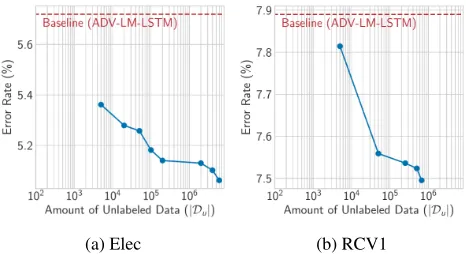
Figure 3: Error rate (%) at different amounts of unlabeled data. The x-axis is in log-scale. A lower error rate in-dicates better performance. The dashed horizontal line represents the performance of the base EXN (ADV-LM-LSTM).
higher performance.
7
Analysis
7.1
More Data, Better Performance Property
We investigated whether the MEIN framework has themore data, better performance property for unlabeled data. Ide-ally, MEIN should achieve better performance by increas-ing the amount of unlabeled data. Thus, we evaluated the performance while changing the amount of unlabeled data used to train the IMN.
We selected the Elec and RCV1 datasets as the focus of this analysis. We created the following subsamples of the unlabeled data for each dataset:{5K, 20K, 50K, 100K, Full Data}for Elec and{5K, 50K, 250K, 500K, Full Data}
for RCV1. In addition, for the Elec dataset, we sampled extra unlabeled data from the electronics section of the Amazon Reviews dataset (McAuley and Leskovec 2013) and constructed{2M, 4M, 6M}unlabeled data5. For each (sub)sample, we trained ADV-LM-LSTM+IMN as ex-plained in Section 6.
Figures 3a and 3b demonstrate that increasing the amount of unlabeled data improved the performance of the EXN. It is noteworthy that in Figure 3a, ADV-LM-LSTM+IMN trained with 6M data achieved an error rate of 5.06%, out-performing the best result in Table 3 (5.14%). These results explicitly demonstrate the more data, better performance property of the MEIN framework. We also report that the training process on the largest amount of unlabeled data (6M) only took approximately a day.
7.2
Scalability with Amount of Unlabeled Data
The primary focus of the MEIN framework is its scalability with the amount of unlabeled data. Thus, in this section, we compare the computational speed of the IMNs with that of
5
We discarded instances from the unlabeled data when the non stop-words overlap with instances in the Elec test set. Thus, the unlabeled data and the Elec test set had no instances in common.
Method Tokens/sec Relative Speed
LM-LSTM 41,914
-ADV-LM-LSTM 13,791 0.33x
VAT-LM-LSTM 9,602 0.23x
IMN (ci= 1) 555,613 13.26x
IMN (ci= 1,2) 236,065 5.63x
IMN (ci= 1,2,3) 122,076 2.91x
IMN (ci= 1,2,3,4) 75,393 1.80x
Table 4: Number of tokens processed per second during the training
the base EXN. We also compare the IMNs with the state-of-the-art SSL method, VAT-LM-LSTM, and discuss their scalability. Here, we focus on the computation in the train-ing phase of the network, where the network processes both forward and backward computations.
We measured the number of tokens that each network pro-cesses per second. We used identical hardware for each mea-surement, namely, a single NVIDIA Tesla V100 GPU. We used the cuDNN implementation for the LSTM cell since it is highly optimized and substantially faster than the naive implementation (Bradbury et al. 2017).
Table 4 summarizes the results. The table shows that even the slowest IMN (ci = 1,2,3,4) was 1.8 times faster than
the optimized cuDNN LSTM network and eight times faster than VAT-LM-LSTM. This indicates that it is possible to use an even larger amount of unlabeled data in a practical time to further improve the performance of the EXN. In ad-dition, note that each IMN can be trained inparallel. Thus, if multiple GPUs are available, the training can be carried out much faster than reported in Table 4.
7.3
Effect of Window Size of the IMN
In this section, we investigate the effectiveness of combin-ing IMNs with different window sizescion the final
perfor-mance of the EXN. Figure 4 summarizes the results across all datasets. The figure shows that integrating an IMN with a greater window size consistently reduced the error rate, and the IMN with the greatest window size (D:ci = 1,2,3,4)
achieved the best performance. This observation implies that the context, which is captured by a greater window size, con-tributes to the performance.
8
Discussion
8.1
Variations of the IMN
In this section, we discuss two possible variations of the IMN to better understand its effectiveness in the MEIN framework.
Figure 4: Effect of the IMN with different window sizesci
on the final error rate (%) of ADV-LM-LSTM.A lower er-ror rate indicates better performance. Base: EXN (ADV-LM-LSTM) without the IMN,A:ci = 1,B:ci = 1,2,C:
ci = 1,2,3,D:ci= 1,2,3,4.
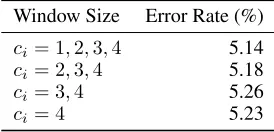
Window Size Error Rate (%)
ci = 1,2,3,4 5.14
ci = 2,3,4 5.18
ci = 3,4 5.26
ci = 4 5.23
Table 5: Effect of removing IMNs with smaller window sizes on the error rate (%) of ADV-LM-LSTM on the Elec dataset.A lower error rate indicates better performance.
a configuration, i.e.,ci= 1,2,3,4,5, and found that the
hy-pothesis is valid. For example, the error rates of ADV-LM-LSTM+IMN (ci = 1,2,3,4,5) were 5.12% and 6.00% for
Elec and IMDB, respectively, which are better than the val-ues reported in Table 3.
However, we found that a large window size has a ma-jor drawback; the training of IMNs becomes significantly slower. This undesirable property must be avoided as our primary focus is the scalability with the amount of unlabeled data. Thus, we do not report these values as the main results of the experiment in Table 3.
Removing IMNs with Smaller Window Sizes We also investigated the effectiveness of utilizing IMNs with smaller window size in addition to the larger window sizes. Table 5 gives the results of this investigation, and we can see that combining IMNs with smaller window sizes works better than incorporating a single IMN with the greatest window size.
8.2
Stronger Baseline DNN
In this section, we discuss the results of two attempts to im-prove the performance of baseline DNNs.
Increasing Number of Parameters The most straight-forward means of improving the performance of baseline DNNs is to increase the number of parameters. Thus, we doubled the word embedding dimension and trained ADV-LM-LSTM, namely, the ADV-LM-LSTM-Large model. This model has approximately the same number of parame-ters as the ADV-LM-LSTM+IMN. However, the perfor-mance did not improve from that of the original ADV-LM-LSTM. Specifically, the error rate degraded by 0.08 points for the IMDB dataset and was unchanged for the Elec dataset.
Combining ELMo ELMo (Peters et al. 2018) is one of the strongest SSL approaches in the research field. Thus, we conducted an experiment with a baseline that utilizes ELMo. Specifically, we combined LSTM with the ELMo embed-dings, namely, ELMO-LSTM6. The error rate of this net-work on the IMDB test set was8.67%, which is worse than that of LM-LSTM reported in Table 3. This result suggests that, at least in this task setting, pre-training the RNN lan-guage model for initialization is more effective than using the ELMo embeddings.
9
Conclusion
In this paper, we proposed a novel method for SSL, which we named Mixture of Expert/Imitator Networks (MEIN). The MEIN framework consists of a baseline DNN, i.e., an EXN, and several auxiliary networks, IMNs. The unique property of our method is that the IMNs learn to “imitate” the estimated label distribution of the EXN over the unla-beled data with only a limited view of the given input. In this way, the IMNs effectively learn a set of features that potentially contributes to improving the classification per-formance of the EXN.
Experiments on text classification datasets demonstrated that the MEIN framework consistently improved the per-formance of three distinct settings of the EXN. We also trained the IMNs with extra large-scale unlabeled data and achieved a new state-of-the-art result. This result indicates that our method has themore data, better performance prop-erty. Furthermore, our method operates eight times faster than the current strongest SSL method (VAT), and thus, it has promising scalability to the amount of unlabeled data.
References
Amodei, D.; Ananthanarayanan, S.; Anubhai, R.; Bai, J.; Battenberg, E.; Case, C.; Casper, J.; Catanzaro, B.; Cheng, Q.; Chen, G.; et al. 2016. Deep Speech 2: End-to-End Speech Recognition in English and Mandarin. In ICML, 173–182.
Ba, J., and Caruana, R. 2014. Do Deep Nets Really Need to be Deep? InNIPS, 2654–2662.
Bengio, Y.; Ducharme, R.; Vincent, P.; and Jauvin, C. 2003. A Neural Probabilistic Language Model. JMLR 3(Feb):1137–1155.
6
Bradbury, J.; Merity, S.; Xiong, C.; and Socher, R. 2017. Quasi-Recurrent Neural Networks. InICLR.
Chelba, C.; Mikolov, T.; Schuster, M.; Ge, Q.; Brants, T.; Koehn, P.; and Robinson, T. 2014. One Billion Word Bench-mark for Measuring Progress in Statistical Language Mod-eling. InINTERSPEECH, 2635–2639.
Clark, K.; Luong, T.; and Le, Q. V. 2018. Cross-View Train-ing for Semi-Supervised LearnTrain-ing. InICLR.
Dai, A. M., and Le, Q. V. 2015. Semi-supervised Sequence Learning. InNIPS, 3079–3087.
Deng, J.; Dong, W.; Socher, R.; Li, L.-J.; Li, K.; and Fei-Fei, L. 2009. ImageNet: A Large-Scale Hierarchical Image Database. InCVPR, 248–255.
Gardner, M.; Grus, J.; Neumann, M.; Tafjord, O.; Dasigi, P.; Liu, N. F.; Peters, M.; Schmitz, M.; and Zettlemoyer, L. S. 2017. AllenNLP: A Deep Semantic Natural Language Pro-cessing Platform.
Gehring, J.; Auli, M.; Grangier, D.; Yarats, D.; and Dauphin, Y. N. 2017. Convolutional Sequence to Sequence Learning. InICML, 1243–1252.
Glorot, X.; Bordes, A.; and Bengio, Y. 2011. Deep Sparse Rectifier Neural Networks. InAISTATS, 315–323.
Goodfellow, I. J.; Shlens, J.; and Szegedy, C. 2015. Explain-ing and HarnessExplain-ing Adversarial Examples. InICLR.
He, K.; Zhang, X.; Ren, S.; and Sun, J. 2016. Deep Residual Learning for Image Recognition. InCVPR, 770–778.
Hinton, G.; Vinyals, O.; and Dean, J. 2015. Distilling the Knowledge in a Neural Network. InNIPS Deep Learning and Representation Learning Workshop.
Hochreiter, S., and Schmidhuber, J. 1997. Long Short-Term Memory. Neural Computation9(8):1735–1780.
Jacobs, R. A.; Jordan, M. I.; Nowlan, S. J.; and Hinton, G. E. 1991. Adaptive Mixtures of Local Experts.Neural Compu-tation3(1):79–87.
Johnson, R., and Zhang, T. 2015. Semi-supervised Convolu-tional Neural Networks for Text Categorization via Region Embedding. InNIPS, 919–927.
Jozefowicz, R.; Vinyals, O.; Schuster, M.; Shazeer, N.; and Wu, Y. 2016. Exploring the Limits of Language Modeling. arXiv preprint arXiv:1602.02410.
Kalchbrenner, N.; Grefenstette, E.; and Blunsom, P. 2014. A Convolutional Neural Network for Modelling Sentences. InACL, 655–665.
Kingma, D., and Ba, J. 2015. Adam: A Method for Stochas-tic Optimization. InICLR.
Kudo, T., and Richardson, J. 2018. SentencePiece: A sim-ple and language independent subword tokenizer and detok-enizer for Neural Text Processing. InEMNLP, 66–71.
Lehmann, J.; Isele, R.; Jakob, M.; Jentzsch, A.; Kontokostas, D.; Mendes, P. N.; Hellmann, S.; Morsey, M.; Van Kleef, P.; Auer, S.; et al. 2015. DBpedia–a large-scale, multilingual knowledge base extracted from Wikipedia. Semantic Web 6(2):167–195.
Lewis, D. D.; Yang, Y.; Rose, T. G.; and Li, F. 2004. RCV1: A New Benchmark Collection for Text Categorization Re-search. JMLR5:361–397.
Maas, A. L.; Daly, R. E.; Pham, P. T.; Huang, D.; Ng, A. Y.; and Potts, C. 2011. Learning Word Vectors for Sentiment Analysis. InACL, 142–150.
Maas, A. L.; Hannun, A. Y.; and Ng, A. Y. 2013. Rectifier Nonlinearities Improve Neural Network Acoustic Models. In ICML Workshop on Deep Learning for Audio, Speech, and Language Processing.
McAuley, J., and Leskovec, J. 2013. Hidden Factors and Hidden Topics: Understanding Rating Dimensions with Re-view Text. InRecSys, 165–172.
McCann, B.; Bradbury, J.; Xiong, C.; and Socher, R. 2017. Learned in Translation: Contextualized Word Vectors. In NIPS, 6294–6305.
Mikolov, T.; Sutskever, I.; Chen, K.; Corrado, G. S.; and Dean, J. 2013. Distributed Representations of Words and Phrases and their Compositionality. InNIPS, 3111–3119. Miyato, T.; Dai, A. M.; and Goodfellow, I. 2017. Adversar-ial Training Methods For Semi-Supervised Text Classifica-tion. InICLR.
Pang, B., and Lee, L. 2005. Seeing Stars: Exploiting Class Relationships for Sentiment Categorization with Respect to Rating Scales. InACL, 115–124.
Pennington, J.; Socher, R.; and Manning, C. 2014. GloVe: Global Vectors for Word Representation. InEMNLP, 1532– 1543.
Peters, M.; Ammar, W.; Bhagavatula, C.; and Power, R. 2017. Semi-supervised Sequence Tagging with Bidirec-tional Language Models. InACL, 1756–1765.
Peters, M.; Neumann, M.; Iyyer, M.; Gardner, M.; Clark, C.; Lee, K.; and Zettlemoyer, L. 2018. Deep Contextualized Word Representations. InNAACL, 2227–2237.
Sato, M.; Suzuki, J.; Shindo, H.; and Matsumoto, Y. 2018. Interpretable Adversarial Perturbation in Input Embedding Space for Text. InIJCAI, 4323–4330.
Sennrich, R.; Haddow, B.; and Birch, A. 2016. Neural Ma-chine Translation of Rare Words with Subword Units. In ACL, 1715–1725.
Shazeer, N.; Mirhoseini, A.; Maziarz, K.; Davis, A.; Le, Q.; Hinton, G.; and Dean, J. 2017. Outrageously Large Neural Networks: The Sparsely-Gated Mixture-of-Experts Layer. InICLR.
Suzuki, J., and Isozaki, H. 2008. Semi-Supervised Sequen-tial Labeling and Segmentation Using Giga-Word Scale Un-labeled Data. InACL, 665–673.