The Thirty-Third AAAI Conference on Artificial Intelligence (AAAI-19)
Character
n
-Gram Embeddings to Improve RNN Language Models
Sho Takase,
†∗Jun Suzuki,
†‡Masaaki Nagata
††NTT Communication Science Laboratories ‡Tohoku University
[email protected], [email protected], [email protected]
Abstract
This paper proposes a novel Recurrent Neural Network (RNN) language model that takes advantage of character information. We focus on charactern-grams based on research in the field of word embedding construction (Wieting et al. 2016). Our pro-posed method constructs word embeddings from charactern -gram embeddings and combines them with ordinary word em-beddings. We demonstrate that the proposed method achieves the best perplexities on the language modeling datasets: Penn Treebank, WikiText-2, and WikiText-103. Moreover, we con-duct experiments on application tasks: machine translation and headline generation. The experimental results indicate that our proposed method also positively affects these tasks.
1
Introduction
Neural language models have played a crucial role in re-cent advances of neural network based methods in natural language processing (NLP). For example, neural encoder-decoder models, which are becoming the de facto standard for various natural language generation tasks including ma-chine translation (Sutskever, Vinyals, and Le 2014), summa-rization (Rush, Chopra, and Weston 2015), dialogue (Wen et al. 2015), and caption generation (Vinyals et al. 2015) can be interpreted as conditional neural language models. Moreover, neural language models can be used for rescoring outputs from traditional methods, and they significantly improve the performance of automatic speech recognition (Du et al. 2016). This implies that better neural language models improve the performance of application tasks.
In general, neural language models require word embed-dings as an input (Zaremba, Sutskever, and Vinyals 2014). However, as described by (Verwimp et al. 2017), this ap-proach cannot make use of the internal structure of words although the internal structure is often an effective clue for considering the meaning of a word. For example, we can comprehend that the word ‘causal’ is related to ‘cause’ im-mediately because both words include the same character sequence ‘caus’. Thus, if we incorporate a method that han-dles the internal structure such as character information, we can improve the quality of neural language models and prob-ably make them robust to infrequent words.
∗
Current affiliation: Tokyo Institute of Technology.
Copyright c2019, Association for the Advancement of Artificial Intelligence (www.aaai.org). All rights reserved.
To incorporate the internal structure, (Verwimp et al. 2017) concatenated character embeddings with an input word bedding. They demonstrated that incorporating character em-beddings improved the performance of RNN language mod-els. Moreover, (Kim et al. 2016) and (Jozefowicz et al. 2016) applied Convolutional Neural Networks (CNN) to construct word embeddings from character embeddings.
On the other hand, in the field of word embedding construc-tion, some previous researchers found that charactern-grams are more useful than single characters (Wieting et al. 2016; Bojanowski et al. 2017). In particular, (Wieting et al. 2016) demonstrated that constructing word embeddings from char-actern-gram embeddings outperformed the methods that construct word embeddings from character embeddings by using CNN or a Long Short-Term Memory (LSTM).
Based on their reports, in this paper, we propose a neural language model that utilizes charactern-gram embeddings. Our proposed method encodes charactern-gram embeddings to a word embedding with simplified Multi-dimensional Self-attention (MS) (Shen et al. 2018). We refer to this constructed embedding as charn-MS-vec. The proposed method regards charn-MS-vec as an input in addition to a word embedding. We conduct experiments on the well-known benchmark datasets: Penn Treebank, WikiText-2, and WikiText-103. Our experiments indicate that the proposed method outperforms neural language models trained with well-tuned hyperparam-eters and achieves state-of-the-art scores on each dataset. In addition, we incorporate our proposed method into a standard neural encoder-decoder model and investigate its effect on machine translation and headline generation. We indicate that the proposed method also has a positive effect on such tasks.
2
RNN Language Model
In this study, we focus on RNN language models, which are widely used in the literature. This section briefly overviews the basic RNN language model.
In language modeling, we compute joint probability by using the product of conditional probabilities. Letw1:T be a word sequence with lengthT, namely,w1, ..., wT. We for-mally obtain the joint probability of word sequencew1:T as follows:
p(w1:T) =p(w1)
T−1
Y
t=1
p(w1)is generally assumed to be1 in this literature, i.e.,
p(w1) = 1, and thus we can ignore its calculation1.
To estimate the conditional probability p(wt+1|w1:t), RNN language models encode sequencew1:tinto a fixed-length vector and compute the probability distribution of each word from this fixed-length vector. LetV be the vocabulary size and letPt∈RV be the probability distribution of the
vocabulary at timestept. Moreover, letDhbe the dimension of the hidden state of an RNN and letDebe the dimensions of embedding vectors. Then, RNN language models predict the probability distributionPt+1by the following equation:
Pt+1= softmax(W ht+b), (2)
ht=f(et, ht−1), (3)
et=Ext, (4) whereW ∈RV×Dhis a weight matrix,b∈RV is a bias term,
andE∈RDe×V is a word embedding matrix.x
t∈ {0,1}V andht∈RDh are a one-hot vector of an input wordwtand the hidden state of the RNN at timestept, respectively. We definehtat timestept= 0as a zero vector, that is,h0=0.
Letf(·)represent an abstract function of an RNN, which might be the LSTM, the Quasi-Recurrent Neural Network (QRNN) (Bradbury et al. 2017), or any other RNN variants.
3
Incorporating Character
n
-gram
Embeddings
We incorporate charn-MS-vec, which is an embedding con-structed from charactern-gram embeddings, into RNN lan-guage models since, as discussed earlier, previous studies revealed that we can construct better word embeddings by using charactern-gram embeddings (Wieting et al. 2016; Bojanowski et al. 2017). In particular, we expect charn -MS-vec to help represent infrequent words by taking advantage of the internal structure.
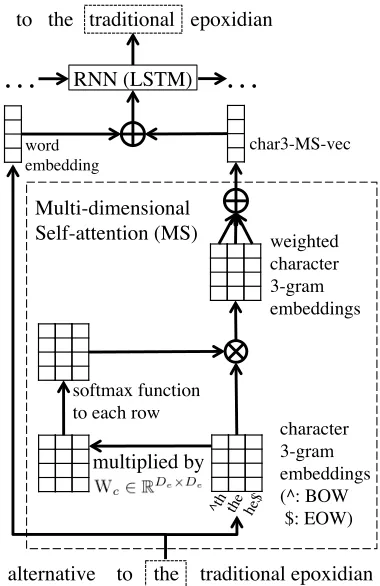
Figure 1 is the overview of the proposed method using character 3-gram embeddings (char3-MS-vec). As illustrated in this figure, our proposed method regards the sum of char3-MS-vec and the standard word embedding as an input of an RNN. In other words, letctbe charn-MS-vec and we replace Equation 4 with the following:
et=Ext+ct. (5)
3.1
Multi-dimensional Self-attention
To computect, we apply an encoder to charactern-gram em-beddings. Previous studies demonstrated that additive com-position, which computes the (weighted) sum of embeddings, is a suitable method for embedding construction (Takase, Okazaki, and Inui 2016; Wieting et al. 2016). Thus, we adopt (simplified) multi-dimensional self-attention (Shen et al. 2018), which computes weights for each dimension of given embeddings and sums up the weighted embeddings (i.e., element-wise weighted sum) as an encoder. Letsibe the charactern-gram embeddings of an input word, letIbe
1
This definition is based on published implementations of previous studies such as https://github.com/wojzaremba/lstm and https://github.com/salesforce/awd-lstm-lm.
Notation
temporal
D
e
W
c
x
1…
d
Multiplied by
Matrix (size = L × d)
x
2x
LSoftmax function to each column
…
…
Weighted vectors
Each column is a distribution by softmax function
alternative to the traditional epoxidian word
embedding
Multiplied by
character 3-gram embeddings (^: BOW $: EOW)
multiplied by
softmax function to each row
weighted character 3-gram embeddings
RNN (LSTM)
…
…
to the traditional epoxidian
char3-MS-vec
Multi-dimensional Self-attention (MS)
Figure 1: Overview of the proposed method. The proposed method computes charn-MS-vec from charactern-gram (3-gram in this figure) embeddings and inputs the sum of it and the standard word embedding into an RNN.
the number of charactern-grams extracted from the word, and letSbe the matrix whosei-th column corresponds tosi, that is,S= [s1, ..., sI]. The multi-dimensional self-attention constructs the word embeddingctby the following equations:
ct= I X
i=1
gisi, (6)
{gi}j ={softmax((WcS)T
j)}i, (7) where means element-wise product of vectors, Wc ∈
RDe×Deis a weight matrix,[·]
jis thej-th column of a given matrix, and {·}j is the j-th element of a given vector. In short, Equation 7 applies the softmax function to each row of
[WcS]and extracts thei-th column asgi.
Let us consider the case where an input word is ‘the’ and we use character 3-gram in Figure 1. We prepare special characters ‘ˆ’ and ‘$’ to represent the beginning and end of the word, respectively. Then, ‘the’ is composed of three character 3-grams: ‘ˆth’, ‘the’, and ‘he$’. We multiply the embeddings of these 3-grams by transformation matrixWcand apply the softmax function to each row2as in Equation 7. As a result
2
PTB WT2 WT103
Vocab 10,000 33,278 267,735
Train 929,590 2,088,628 103,227,021 #Token Valid 73,761 217,646 217,646
Test 82,431 245,569 245,569
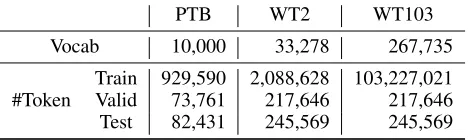
Table 1: Statistics of PTB, WT2, and WT103.
of the softmax, we obtain a matrix that contains weights for each embedding. The size of the computed matrix is identical to the input embedding matrix:De×I. We then compute Equation 6, i.e., the weighted sum of the embeddings, and add the resulting vector to the word embedding of ‘the’. Finally, we input the vector into an RNN to predict the next word.
3.2
Word Tying
(Inan, Khosravi, and Socher 2017) and (Press and Wolf 2017) proposed a word tying method (WT) that shares the word embedding matrix (E in Equation 4) with the weight ma-trix to compute probability distributions (W in Equation 2). They demonstrated that WT significantly improves the per-formance of RNN language models.
In this study, we adopt charn-MS-vec as the weight matrix in language modeling. Concretely, we useE+Cinstead of
Win Equation 2, whereC∈RDe×V contains charn-MS-vec for all words in the vocabulary.
4
Experiments on Language Modeling
We investigate the effect of charn-MS-vec on the word-level language modeling task. In detail, we examine the following four research questions;
1. Can character n-gram embeddings improve the perfor-mance of state-of-the-art RNN language models?
2. Do charactern-gram embeddings have a positive effect on infrequent words?
3. Is multi-dimensional self-attention effective for word em-bedding construction as compared with several other simi-lar conventional methods?
4. How manynshould we use?
4.1
Datasets
We used the standard benchmark datasets for the word-level language modeling: Penn Treebank (PTB) (Marcus, Marcinkiewicz, and Santorini 1993), WikiText-2 (WT2), and WikiText-103 (WT103) (Merity et al. 2017). (Mikolov et al. 2010) and (Merity et al. 2017) published pre-processed PTB3,
WT2, and WT1034. Following the previous studies, we used
these pre-processed datasets for our experiments.
Table 1 describes the statistics of the datasets. Table 1 demonstrates that the vocabulary size of WT103 is too large, and thus it is impractical to compute charn-MS-vec for all
3
http://www.fit.vutbr.cz/˜mikolov/rnnlm/ 4
https://einstein.ai/research/the-wikitext-long-term-dependency-language-modeling-dataset
words at every step. Therefore, we did not useCfor word tying. In other words, we used only word embeddingsEas the weight matrixW in WT103.
4.2
Baseline RNN Language Model
For base RNN language models, we adopted the state-of-the-art LSTM language model (Merity, Keskar, and Socher 2018b) for PTB and WT2, and QRNN for WT103 (Bradbury et al. 2017). (Melis, Dyer, and Blunsom 2018) demonstrated that the standard LSTM trained with appropriate hyperpa-rameters outperformed various architectures such as Recur-rent Highway Networks (RHN) (Zilly et al. 2017). In addi-tion to several regularizaaddi-tions, (Merity, Keskar, and Socher 2018b) introduced Averaged Stochastic Gradient Descent (ASGD) (Polyak and Juditsky 1992) to train the 3-layered LSTM language model. As a result, their ASGD Weight-Dropped LSTM (AWD-LSTM) achieved state-of-the-art re-sults on PTB and WT2. For WT103, (Merity, Keskar, and Socher 2018a) achieved the top score with the 4-layered QRNN. Thus, we used AWD-LSTM for PTB and WT2, and QRNN for WT103 as the base language models, respectively. We used their implementations5for our experiments.
4.3
Results
Table 2 shows perplexities of the baselines and the proposed method. We variednfor charn-MS-vec from 2 to 4. For the baseline, we also applied two word embeddings to investigate the performance in the case where we use more kinds of word embeddings. In detail, we preparedE1, E2 ∈RDe×V and
usedE1+E2instead ofEin Equation 4. Table 2 also shows
the number of charactern-grams in each dataset. This table indicates that charn-MS-vec improved the performance of state-of-the-art models except for char4-MS-vec on WT103. These results indicate that charn-MS-vec can raise the quality of word-level language models. In particular, Table 2 shows that char3-MS-vec achieved the best scores consistently. In contrast, an additional word embedding did not improve the performance. This fact implies that the improvement of charn -MS-vec is caused by using character n-grams. Thus, we answer yes to the first research question.
Table 3 shows the training time spent on each epoch. We calculated it on the NVIDIA Tesla P100. Table 3 indicates that the proposed method requires more computational time than the baseline unfortunately. We leave exploring a faster structure for our future work.
Table 4 shows perplexities on the PTB dataset where the frequency of an input word is lower than 2,000 in the train-ing data. This table indicates that the proposed method can improve the performance even if an input word is infrequent. In other words, charn-MS-vec helps represent the meanings of infrequent words. Therefore, we answer yes to the second research question in the case of our experimental settings.
We explored the effectiveness of multi-dimensional self-attention for word embedding construction. Table 5 shows perplexities of using several encoders on the PTB dataset. As in (Kim et al. 2016), we applied CNN to construct word embeddings (charCNN in Table 5). Moreover, we applied the
5
PTB WT2 WT103
Method #Charn #Params Valid Test #Charn #Params Valid Test #Charn #Params Valid Test
Baseline - 24M 58.88 56.36 - 33M 66.98 64.11 - 153M 31.24 32.19
2 embeds - 28M 58.94 56.56 - 47M 66.71 64.00 - 261M 31.75 32.71
char2-MS-vec 773 25M 57.88 55.91 2,442 35M 65.60 62.96 8,124 158M 31.18 31.92 char3-MS-vec 5,258 26M 57.40 55.56 12,932 39M 65.05 61.95 51,492 175M 30.95 31.81 char4-MS-vec 15,416 31M 57.30 55.64 39,318 49M 64.84 62.19 179,900 226M 31.23 32.21
Table 2: Perplexities on each dataset. We varied thenfor charn-MS-vec from 2 to 4.
Method Seconds / epoch
Baseline 63.78
char2-MS-vec 173.77 char3-MS-vec 171.10 char4-MS-vec 165.46
Table 3: Computational speed of the baseline and proposed method on NVIDIA Tesla P100.
Method Valid Test
Baseline 44.02 41.14
char2-MS-vec 43.21 40.99 char3-MS-vec 42.74 40.50 char4-MS-vec 42.71 40.41
Table 4: Perplexities on the PTB dataset where an input word is infrequent in the training data, which means its frequency is lower than 2,000.
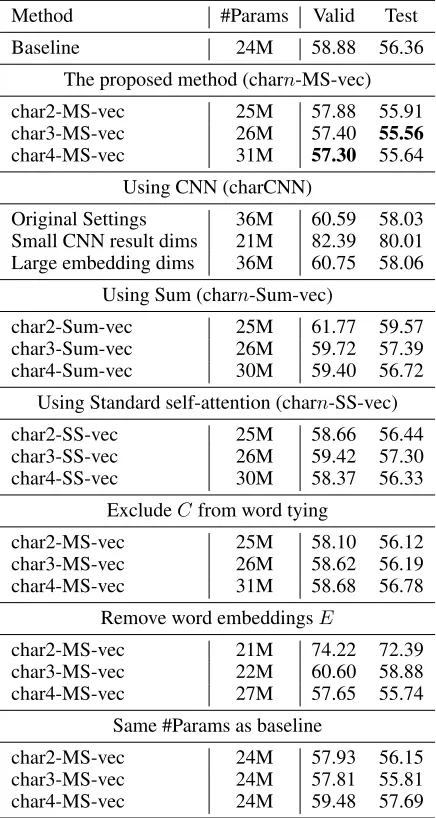
summation and standard self-attention, which computes the scalar value as a weight for a charactern-gram embedding, to construct word embeddings (charn-Sum-vec and charn -SS-vec, respectively). For CNN, we used hyperparameters identical to (Kim et al. 2016) (“Original Settings” in Table 5) but the setting has two differences from other architectures: 1. The dimension of the computed vectors is much larger than the dimension of the baseline word embeddings and 2. The dimension of the input character embeddings is much smaller than the dimension of the baseline word embeddings. There-fore, we added two configurations: assigning the dimension of the computed vectors and input character embeddings a value identical to the baseline word embeddings (in Table 5, “Small CNN result dims” and “Large embedding dims”, respectively).
Table 5 shows that the proposed charn-MS-vec outper-formed charCNN even though the original settings of CNN had much larger parameters. Moreover, we trained char-CNN with two additional settings but char-CNN did not improve the baseline performance. This result implies that charn -MS-vec is better embeddings than ones constructed by applying CNN to character embeddings. Table 5 also indicates that charn-Sum-vec was harmful to the performance. Moreover, charn-SS-vec did not have a positive effect on the baseline. These results answer yes to the third research question; our
Method #Params Valid Test
Baseline 24M 58.88 56.36
The proposed method (charn-MS-vec)
char2-MS-vec 25M 57.88 55.91
char3-MS-vec 26M 57.40 55.56
char4-MS-vec 31M 57.30 55.64
Using CNN (charCNN)
Original Settings 36M 60.59 58.03 Small CNN result dims 21M 82.39 80.01 Large embedding dims 36M 60.75 58.06
Using Sum (charn-Sum-vec)
char2-Sum-vec 25M 61.77 59.57
char3-Sum-vec 26M 59.72 57.39
char4-Sum-vec 30M 59.40 56.72
Using Standard self-attention (charn-SS-vec)
char2-SS-vec 25M 58.66 56.44
char3-SS-vec 26M 59.42 57.30
char4-SS-vec 30M 58.37 56.33
ExcludeCfrom word tying
char2-MS-vec 25M 58.10 56.12
char3-MS-vec 26M 58.62 56.19
char4-MS-vec 31M 58.68 56.78
Remove word embeddingsE
char2-MS-vec 21M 74.22 72.39
char3-MS-vec 22M 60.60 58.88
char4-MS-vec 27M 57.65 55.74
Same #Params as baseline
char2-MS-vec 24M 57.93 56.15
char3-MS-vec 24M 57.81 55.81
char4-MS-vec 24M 59.48 57.69
Table 5: Perplexities of each structure on PTB dataset.
use of multi-dimensional self-attention is more appropriate for constructing word embeddings from charactern-gram embeddings.
Model #Params Valid Test
LSTM (medium) (Zaremba, Sutskever, and Vinyals 2014) 20M 86.2 82.7 LSTM (large) (Zaremba, Sutskever, and Vinyals 2014) 66M 82.2 78.4
Character-Word LSTM (Verwimp et al. 2017) - - 82.04
LSTM-CharCNN-Large (Kim et al. 2016) 19M - 78.9
Variational LSTM (medium) (Gal and Ghahramani 2016) 20M 81.9±0.2 79.7±0.1 Variational LSTM (large) (Gal and Ghahramani 2016) 66M 77.9±0.3 75.2±0.2
Variational RHN (Zilly et al. 2017) 32M 71.2 68.5
Variational RHN + WT (Zilly et al. 2017) 23M 67.9 65.4
Variational RHN + WT + IOG (Takase, Suzuki, and Nagata 2017) 29M 67.0 64.4
Neural Architecture Search (Zoph and Le 2017) 54M - 62.4
LSTM with skip connections (Melis, Dyer, and Blunsom 2018) 24M 60.9 58.3
AWD-LSTM (Merity, Keskar, and Socher 2018b) 24M 60.0 57.3
AWD-LSTM + Fraternal Dropout (Zolna et al. 2018) 24M 58.9 56.8
AWD-LSTM-MoS (Yang et al. 2018) 22M 56.54 54.44
AWD-LSTM-DOC (Takase, Suzuki, and Nagata 2018) 23M 54.12 52.38
Proposed method: AWD-LSTM + char3-MS-vec 26M 57.40 55.56
Proposed method: AWD-LSTM-MoS + char3-MS-vec 23M 56.13 53.98
Proposed method: AWD-LSTM-DOC + char3-MS-vec 24M 53.76 52.34
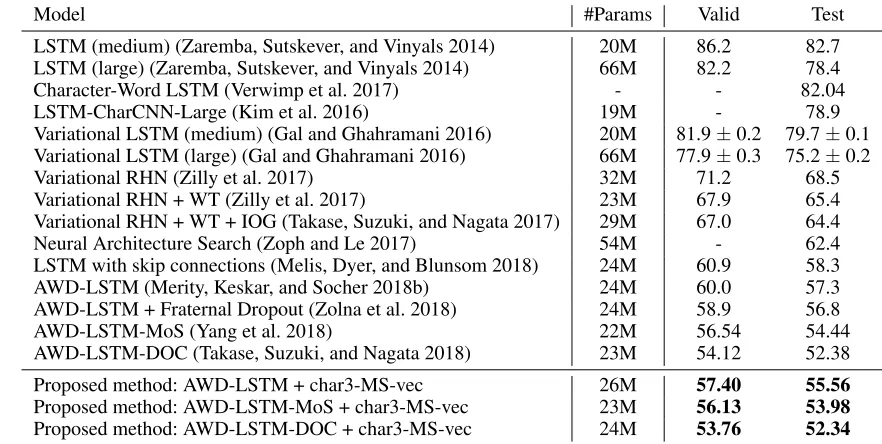
Table 6: Perplexities of the proposed method and as reported in previous studies on the PTB dataset.
Model #Params Valid Test
LSTM (Grave, Joulin, and Usunier 2017) - - 99.3
Variational LSTM + IOG (Takase, Suzuki, and Nagata 2017) 70M 95.9 91.0 Variational LSTM + WT + AL (Inan, Khosravi, and Socher 2017) 28M 91.5 87.0 LSTM with skip connections (Melis, Dyer, and Blunsom 2018) 24M 69.1 65.9
AWD-LSTM (Merity, Keskar, and Socher 2018b) 33M 68.6 65.8
AWD-LSTM + Fraternal Dropout (Zolna et al. 2018) 34M 66.8 64.1
AWD-LSTM-MoS (Yang et al. 2018) 35M 63.88 61.45
AWD-LSTM-DOC (Takase, Suzuki, and Nagata 2018) 37M 60.29 58.03
Proposed method: AWD-LSTM + char3-MS-vec 39M 65.05 61.95
Proposed method: AWD-LSTM-MoS + char3-MS-vec 39M 62.20 59.99 Proposed method: AWD-LSTM-DOC + char3-MS-vec 41M 59.47 57.30
Table 7: Perplexities of the proposed method and as reported in previous studies on the WT2 dataset.
Model #Params Valid Test
LSTM (Grave, Joulin, and Usunier 2017) - - 48.7
GCNN-8 (Dauphin et al. 2016) - - 44.9
GCNN-14 (Dauphin et al. 2016) - - 37.2
QRNN (Merity, Keskar, and Socher 2018a) 153M 32.0 33.0
Proposed method: QRNN + char3-MS-vec 175M 30.95 31.81
Table 8: Perplexities of the proposed method and as reported in previous studies on the WT103 dataset.
fails as the the number of parameters is increased. Thus, we need to assignCto word tying to prevent over-fitting for the PTB dataset. In addition, this result implies that the perfor-mance of WT103 in Table 2 might be raised if we can apply word tying to WT103.
Moreover, to investigate the effect of only charn-MS-vec, we ignoreExtin Equation 5. We refer to this setting as “Re-move word embeddingsE” in Table 5. Table 5 shows
char3-MS-vec is more useful than char4-MS-vec, which is the answer to the fourth research question. We use the com-bination of the char3-MS-vecctand word embeddingExt in the following experiments.
Finally, we compare the proposed method with the pub-lished scores reported in previous studies. Tables 6, 7, and 8, respectively, show perplexities of the proposed method and previous studies on PTB, WT2, and WT1036. Since MoS (Yang et al. 2018) and AWD-LSTM-DOC (Takase, Suzuki, and Nagata 2018) achieved the state-of-the-art scores on PTB and WT2, we combined char3-MS-vec with them. These tables show that the proposed method improved the performance of the base model and outper-formed the state-of-the-art scores on all datasets. In particular, char3-MS-vec improved perplexity by at least 1 point from current best scores on the WT103 dataset.
5
Experiments on Applications
As described in Section 1, neural encoder-decoder models can be interpreted as conditional neural language models. Therefore, to investigate if the proposed method contributes to encoder-decoder models, we conduct experiments on ma-chine translation and headline generation tasks.
5.1
Datasets
For machine translation, we used two kinds of language pairs: English-French and English-German sentences in the IWSLT 2016 dataset7. The dataset contains about 208K
English-French pairs and 189K English-German pairs. We conducted four translation tasks: from English to each language (En-Fr and En-De), and their reverses (Fr-En and De-En).
For headline generation, we used sentence-headline pairs extracted from the annotated English Gigaword cor-pus (Napoles, Gormley, and Van Durme 2012) in the same manner as (Rush, Chopra, and Weston 2015). The training set contains about 3.8M sentence-headline pairs. For evaluation, we exclude the test set constructed by (Rush, Chopra, and Weston 2015) because it contains some invalid instances, as reported in (Zhou et al. 2017). We instead used the test sets constructed by (Zhou et al. 2017) and (Kiyono et al. 2017).
5.2
Experimental Settings
We employed the neural encoder-decoder with attention mechanism described in (Kiyono et al. 2017) as the base model. Its encoder consists of a 2-layer bidirectional LSTM and its decoder consists of a 2-layer LSTM with attention mechanism proposed by (Luong, Pham, and Manning 2015). We refer to this neural encoder-decoder as EncDec. To in-vestigate the effect of the proposed method, we introduced char3-MS-vec into EncDec. Here, we applied char3-MS-vec to both the encoder and decoder. Moreover, we did not apply word tying technique to EncDec because it is default setting in the widely-used encoder-decoder implementation8.
6To compare models trained only on the training data, we ex-cluded methods that use the statistics of the test data (Grave, Joulin, and Usunier 2017; Krause et al. 2017).
7
https://wit3.fbk.eu/ 8
http://opennmt.net/
We set the embedding size and dimension of the LSTM hid-den state to 500 for machine translation and 400 for headline generation. The mini-batch size is 64 for machine translation and 256 for headline generation. For other hyperparameters, we followed the configurations described in (Kiyono et al. 2017). We constructed the vocabulary set by using Byte-Pair-Encoding9(BPE) (Sennrich, Haddow, and Birch 2016)
because BPE is a currently widely-used technique for vocab-ulary construction. We set the number of BPE merge oper-ations to 16K for machine translation and 5K for headline generation.
5.3
Results
Tables 9 and 10 show the results of machine translation and headline generation, respectively. These tables show that EncDec+char3-MS-vec outperformed EncDec in all test data. In other words, these results indicate that our proposed method also has a positive effect on the neural encoder-decoder model. Moreover, it is noteworthy that char3-MS-vec improved the performance of EncDec even though the vocab-ulary set constructed by BPE contains subwords. This implies that charactern-gram embeddings improve the quality of not only word embeddings but also subword embeddings.
In addition to the results of our implementations, the lower portion of Table 10 contains results reported in previous stud-ies. Table 10 shows that EncDec+char3-MS-vec also outper-formed the methods proposed in previous studies. Therefore, EncDec+char3-MS-vec achieved the top scores in the test sets constructed by (Zhou et al. 2017) and (Kiyono et al. 2017) even though it does not have a task-specific architecture such as the selective gate proposed by (Zhou et al. 2017).
In these experiments, we only applied char3-MS-vec to EncDec but (Morishita, Suzuki, and Nagata 2018) indicated that combining multiple kinds of subword units can improve the performance. We will investigate the effect of combining several charactern-gram embeddings in future work.
6
Related Work
RNN Language Model (Mikolov et al. 2010) introduced RNN into language modeling to handle arbitrary-length se-quences in computing conditional probabilityp(wt+1|w1:t). They demonstrated that the RNN language model out-performed the Kneser-Ney smoothed 5-gram language model (Chen and Goodman 1996), which is a sophisticated
n-gram language model.
(Zaremba, Sutskever, and Vinyals 2014) drastically im-proved the performance of language modeling by applying LSTM and the dropout technique (Srivastava et al. 2014). (Zaremba, Sutskever, and Vinyals 2014) applied dropout to all the connections except for recurrent connections but (Gal and Ghahramani 2016) proposed variational inference based dropout to regularize recurrent connections. (Melis, Dyer, and Blunsom 2018) demonstrated that the standard LSTM can achieve superior performance by selecting appropriate hy-perparameters. Finally, (Merity, Keskar, and Socher 2018b) introduced DropConnect (Wan et al. 2013) and averaged SGD (Polyak and Juditsky 1992) into the LSTM language
9
Model En-Fr En-De Fr-En De-En
EncDec 34.37 23.05 34.07 28.18
EncDec+char3-MS-vec 35.48 23.27 34.43 28.86
Table 9: BLEU scores on the IWSLT16 dataset. We report the average score of 3 runs.
Test set by (Zhou et al. 2017) Test set by (Kiyono et al. 2017)
Model ROUGE-1 ROUGE-2 ROUGE-L ROUGE-1 ROUGE-2 ROUGE-L
EncDec 46.77 24.87 43.58 46.78 24.52 43.68
EncDec+char3-MS-vec 47.04 25.09 43.80 46.91 24.61 43.77
ABS (Rush, Chopra, and Weston 2015) 37.41 15.87 34.70 - -
-SEASS (Zhou et al. 2017) 46.86 24.58 43.53 - -
-(Kiyono et al. 2017) 46.34 24.85 43.49 46.41 24.58 43.59
Table 10: ROUGE F1 scores on the headline generation test sets provided by (Zhou et al. 2017) and (Kiyono et al. 2017). The upper part is the results of our implementation and the lower part shows the scores reported in previous studies. In the upper part, we report the average score of 3 runs.
model and achieved state-of-the-art perplexities on PTB and WT2. For WT103, (Merity, Keskar, and Socher 2018a) found that QRNN (Bradbury et al. 2017), which is a faster architec-ture than LSTM, achieved the best perplexity. Our experimen-tal results show that the proposed charn-MS-vec improved the performance of these state-of-the-art language models.
(Yang et al. 2018) explained that the training of RNN lan-guage models can be interpreted as matrix factorization. In addition, to raise an expressive power, they proposed Mix-ture of Softmaxes (MoS) that computes multiple probability distributions from a final RNN layer and combines them with a weighted average. (Takase, Suzuki, and Nagata 2018) proposed Direct Output Connection (DOC) that is a general-ization of MoS. They used middle layers in addition to the final layer to compute probability distributions. These meth-ods (AWD-LSTM-MoS and AWD-LSTM-DOC) achieved the current state-of-the-art perplexities on PTB and WT2. Our proposed method can also be combined with MoS and DOC. In fact, Tables 6 and 7 indicate that the proposed method further improved the performance of them.
(Kim et al. 2016) introduced character information into RNN language models. They applied CNN to character em-beddings for word embedding construction. Their proposed method achieved perplexity competitive with the basic LSTM language model (Zaremba, Sutskever, and Vinyals 2014) even though its parameter size is small. (Jozefowicz et al. 2016) also applied CNN to construct word embeddings from char-acter embeddings. They indicated that CNN also positively affected the LSTM language model in a huge corpus. (Ver-wimp et al. 2017) proposed a method concatenating character embeddings with a word embedding to use character informa-tion. In contrast to these methods, we used charactern-gram embeddings to construct word embeddings. To compare the proposed method to these methods, we combined the CNN proposed by (Kim et al. 2016) with the state-of-the-art LSTM language model (AWD-LSTM) (Merity, Keskar, and Socher 2018b). Our experimental results indicate that the proposed method outperformed the method using character
embed-dings (charCNN in Table 5).
Some previous studies focused on boosting the perfor-mance of language models during testing (Grave, Joulin, and Usunier 2017; Krause et al. 2017). For example, (Krause et al. 2017) proposed dynamic evaluation that updates model parameters based on the given correct sequence during eval-uation. Although these methods might further improve our proposed language model, we omitted these methods since it is unreasonable to obtain correct outputs in applications such as machine translation.
Embedding Construction Previous studies proposed vari-ous methods to construct word embeddings. (Luong, Socher, and Manning 2013) applied Recursive Neural Networks to construct word embeddings from morphemic embeddings. (Ling et al. 2015) applied bidirectional LSTMs to character embeddings for word embedding construction. On the other hand, (Bojanowski et al. 2017) and (Wieting et al. 2016) focused on charactern-gram. They demonstrated that the sum of character n-gram embeddings outperformed ordi-nary word embeddings. In addition, (Wieting et al. 2016) found that the sum of character n-gram embeddings also outperformed word embeddings constructed from character embeddings with CNN and LSTM.
As an encoder, previous studies argued that additive com-position, which computes the (weighted) sum of embed-dings, is a suitable method theoretically (Tian, Okazaki, and Inui 2016) and empirically (Muraoka et al. 2014; Takase, Okazaki, and Inui 2016). In this paper, we used multi-dimensional self-attention to construct word embeddings be-cause it can be interpreted as an element-wise weighted sum. Through experiments, we indicated that multi-dimensional attention is superior to the summation and standard self-attention as an encoder.
7
Conclusion
of word embedding construction (Wieting et al. 2016), we focused on charactern-gram embeddings to construct word embeddings. We used multi-dimensional self-attention (Shen et al. 2018) to encode charactern-gram embeddings. Our proposed charn-MS-vec improved the performance of state-of-the-art RNN language models and achieved the best per-plexities on Penn Treebank, WikiText-2, and WikiText-103. Moreover, we investigated the effect of charn-MS-vec on ap-plication tasks, specifically, machine translation and headline generation. Our experiments show that charn-MS-vec also improved the performance of a neural encoder-decoder on both tasks.
Acknowledgments
This work was supported by JSPS KAKENHI Grant Num-ber JP18K18119. We would like to thank the anonymous reviewers for their helpful suggestions and comments.
References
Bojanowski, P.; Grave, E.; Joulin, A.; and Mikolov, T. 2017. Enriching word vectors with subword information. TACL 5:135–146.
Bradbury, J.; Merity, S.; Xiong, C.; and Socher, R. 2017. Quasi-recurrent neural networks. InProceedings of ICLR. Chen, S. F., and Goodman, J. 1996. An empirical study of smoothing techniques for language modeling. InProceedings of ACL, 310–318.
Dauphin, Y. N.; Fan, A.; Auli, M.; and Grangier, D. 2016. Language modeling with gated convolutional networks. CoRRabs/1612.08083.
Du, J.; Tu, Y.-H.; Sun, L.; Ma, F.; Wang, H.-K.; Pan, J.; Liu, C.; and Lee, C.-H. 2016. The ustc-iflytek system for chime-4 challenge. InProceedings of CHiME-4, 36–38.
Gal, Y., and Ghahramani, Z. 2016. A Theoretically Grounded Application of Dropout in Recurrent Neural Networks. In Proceedings of NIPS.
Grave, E.; Joulin, A.; and Usunier, N. 2017. Improving Neural Language Models with a Continuous Cache. In Pro-ceedings of ICLR.
Inan, H.; Khosravi, K.; and Socher, R. 2017. Tying Word Vec-tors and Word Classifiers: A Loss Framework for Language Modeling. InProceedings of ICLR.
Jozefowicz, R.; Vinyals, O.; Schuster, M.; Shazeer, N.; and Wu, Y. 2016. Exploring the limits of language modeling. Kim, Y.; Jernite, Y.; Sontag, D.; and Rush, A. M. 2016. Character-aware neural language models. InProceedings of AAAI, 2741–2749.
Kiyono, S.; Takase, S.; Suzuki, J.; Okazaki, N.; Inui, K.; and Nagata, M. 2017. Source-side prediction for neural headline generation.CoRR.
Krause, B.; Kahembwe, E.; Murray, I.; and Renals, S. 2017. Dynamic evaluation of neural sequence models. CoRR. Ling, W.; Dyer, C.; Black, A. W.; Trancoso, I.; Fermandez, R.; Amir, S.; Marujo, L.; and Luis, T. 2015. Finding function in form: Compositional character models for open vocabulary word representation. InProceedings of EMNLP, 1520–1530.
Luong, T.; Pham, H.; and Manning, C. D. 2015. Effective approaches to attention-based neural machine translation. In Proceedings of EMNLP, 1412–1421.
Luong, T.; Socher, R.; and Manning, C. 2013. Better word representations with recursive neural networks for morphol-ogy. InProceedings of CoNLL, 104–113.
Marcus, M. P.; Marcinkiewicz, M. A.; and Santorini, B. 1993. Building a Large Annotated Corpus of English: The Penn Treebank.Computational Linguistics19(2):313–330.
Melis, G.; Dyer, C.; and Blunsom, P. 2018. On the state of the art of evaluation in neural language models.Proceedings of ICLR.
Merity, S.; Xiong, C.; Bradbury, J.; and Socher, R. 2017. Pointer Sentinel Mixture Models. InProceedings of ICLR. Merity, S.; Keskar, N. S.; and Socher, R. 2018a. An Analysis of Neural Language Modeling at Multiple Scales. arXiv preprint arXiv:1803.08240.
Merity, S.; Keskar, N. S.; and Socher, R. 2018b. Regularizing and Optimizing LSTM Language Models. InProceedings of ICLR.
Mikolov, T.; Karafi´at, M.; Burget, L.; Cernock´y, J.; and Khu-danpur, S. 2010. Recurrent neural network based language model. InProceedings of INTERSPEECH, 1045–1048. Morishita, M.; Suzuki, J.; and Nagata, M. 2018. Improv-ing neural machine translation by incorporatImprov-ing hierarchical subword features. InProceedings of COLING, 618–629.
Muraoka, M.; Shimaoka, S.; Yamamoto, K.; Watanabe, Y.; Okazaki, N.; and Inui, K. 2014. Finding the best model among representative compositional models. InProceedings of PACLIC, 65–74.
Napoles, C.; Gormley, M.; and Van Durme, B. 2012. Anno-tated gigaword. InProceedings of AKBC-WEKEX, 95–100. Polyak, B. T., and Juditsky, A. B. 1992. Acceleration of Stochastic Approximation by Averaging. SIAM Journal on Control and Optimization30(4):838–855.
Press, O., and Wolf, L. 2017. Using the Output Embedding to Improve Language Models. In Proceedings of EACL, 157–163.
Rush, A. M.; Chopra, S.; and Weston, J. 2015. A Neural Attention Model for Abstractive Sentence Summarization. In Proceedings of EMNLP, 379–389.
Sennrich, R.; Haddow, B.; and Birch, A. 2016. Improving neural machine translation models with monolingual data. In Proceedings of ACL, 86–96.
Shen, T.; Zhou, T.; Long, G.; Jiang, J.; Pan, S.; and Zhang, C. 2018. Disan: Directional self-attention network for rnn/cnn-free language understanding. InProceedings of AAAI. Srivastava, N.; Hinton, G.; Krizhevsky, A.; Sutskever, I.; and Salakhutdinov, R. 2014. Dropout: A simple way to prevent neural networks from overfitting.Journal of Machine Learning Research15(1):1929–1958.
Takase, S.; Okazaki, N.; and Inui, K. 2016. Composing dis-tributed representations of relational patterns. InProceedings of ACL, 2276–2286.
Takase, S.; Suzuki, J.; and Nagata, M. 2017. Input-to-output gate to improve rnn language models. InProceedings of IJCNLP, 43–48.
Takase, S.; Suzuki, J.; and Nagata, M. 2018. Direct output connection for a high-rank language model. InProceedings of EMNLP, 4599–4609.
Tian, R.; Okazaki, N.; and Inui, K. 2016. The mechanism of additive composition.CoRRabs/1511.08407.
Verwimp, L.; Pelemans, J.; Van hamme, H.; and Wambacq, P. 2017. Character-word lstm language models. InProceedings of EACL, 417–427.
Vinyals, O.; Toshev, A.; Bengio, S.; and Erhan, D. 2015. Show and tell: A neural image caption generator. In Proceed-ings of CVPR, 3156–3164.
Wan, L.; Zeiler, M.; Zhang, S.; Cun, Y. L.; and Fergus, R. 2013. Regularization of Neural Networks using DropConnect. InProceedings of ICML, 1058–1066.
Wen, T.-H.; Gasic, M.; Mrkˇsi´c, N.; Su, P.-H.; Vandyke, D.; and Young, S. 2015. Semantically Conditioned LSTM-based Natural Language Generation for Spoken Dialogue Systems. InProceedings of EMNLP, 1711–1721.
Wieting, J.; Bansal, M.; Gimpel, K.; and Livescu, K. 2016. Charagram: Embedding words and sentences via character n-grams. InProceedings of EMNLP, 1504–1515.
Yang, Z.; Dai, Z.; Salakhutdinov, R.; and Cohen, W. W. 2018. Breaking the softmax bottleneck: A high-rank RNN language model. InProceedings of ICLR.
Zaremba, W.; Sutskever, I.; and Vinyals, O. 2014. Recurrent neural network regularization. InProceedings of ICLR. Zhou, Q.; Yang, N.; Wei, F.; and Zhou, M. 2017. Selec-tive encoding for abstracSelec-tive sentence summarization. In Proceedings of ACL, 1095–1104.
Zilly, J. G.; Srivastava, R. K.; Koutn´ık, J.; and Schmidhuber, J. 2017. Recurrent Highway Networks.Proceedings of ICML 4189–4198.
Zolna, K.; Arpit, D.; Suhubdy, D.; and Bengio, Y. 2018. Fraternal dropout. InProceedings of ICLR.