Fall 2018
Continuous Time Control for Bilateral Telemetry Application
Continuous Time Control for Bilateral Telemetry Application
Madhura Kulkarni
Iowa State University, [email protected]
Follow this and additional works at: https://lib.dr.iastate.edu/creativecomponents
Part of the Controls and Control Theory Commons
Recommended Citation Recommended Citation
Kulkarni, Madhura, "Continuous Time Control for Bilateral Telemetry Application" (2018). Creative Components. 76.
https://lib.dr.iastate.edu/creativecomponents/76
by
Madhura Kulkarni
A creative component report submitted to the graduate faculty
in partial fulfillment of the requirements for the degree of
MASTER OF SCIENCE
Major: Electrical Engineering
Program of Study Committee:
Dr. Greg R. Luecke, Major Professor
Iowa State University
Ames, Iowa
2018
DEDICATION
I would like to dedicate this research work to my family for their constant support and
encouragement. I would also like to thank my friends and professors for guiding me through
TABLE OF CONTENTS
LIST OF TABLES . . . v
LIST OF FIGURES . . . vi
ACKNOWLEDGEMENTS . . . x
ABSTRACT . . . xi
CHAPTER 1. OVERVIEW . . . 1
CHAPTER 2. MATHEMATICAL MODELING . . . 3
2.1 Mathematical Model for the Robotic Arm . . . 3
2.2 Calculating the Environmental Stiffness . . . 10
2.2.1 Case 1 : Stylus + inkwell attached to the cantilever beam . . . 15
2.2.2 Case 2: Inkwell attached to the cantilever beam without the Omni stylus 19 2.2.3 Case 3: Inkwell attached to the cantilever beam with the weights placed on top of the inkwell . . . 22
2.3 Calculating the natural frequency and damping ratio . . . 26
CHAPTER 3. CONTROL SYSTEM DESIGN . . . 29
3.0.1 Case 1 : No delay and no dynamics . . . 32
3.0.2 Case 2 : No delay with dynamics . . . 32
3.0.3 Case 3 : With delay and dynamics . . . 33
3.0.4 Case 4: With delay, dynamics and compensation . . . 35
CHAPTER 4. RESULTS . . . 36
4.0.1 Case 1 : No delay, no dynamics . . . 37
4.0.3 Case 3: With delay and dynamics . . . 41
4.0.4 Case 4: With delay, dynamics and compensation . . . 43
CHAPTER 5. CONCLUSION . . . 48
LIST OF TABLES
2.1 Maximum force and displacement values corresponding to various values
LIST OF FIGURES
Figure 1.1 Teleoperation Setup . . . 1
Figure 2.1 Schematic of a DC motor [3] . . . 3
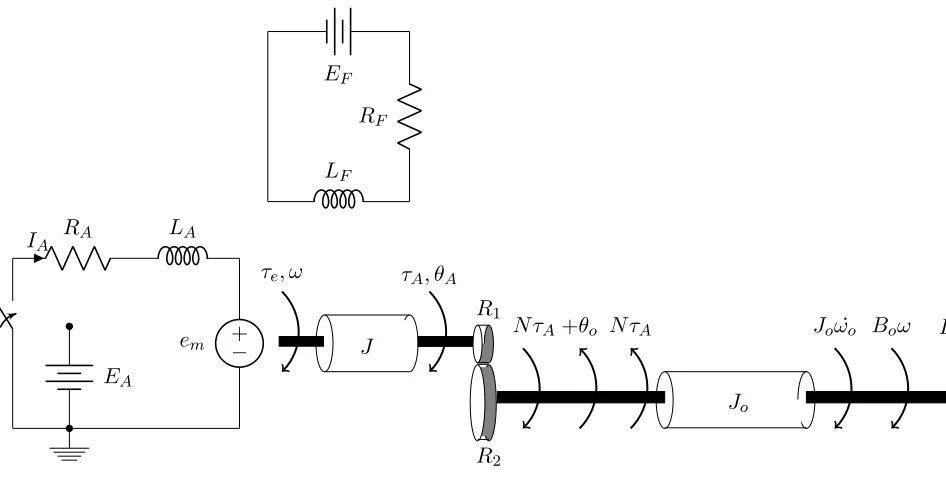
Figure 2.2 Mechanical and Electrical representation of a motor . . . 4
2.3 Spring force experienced by an elastic body when subjected to a load ’P’ [6] . . . 10
Figure 2.4 Relation between force ’P’ and displacement ’u’ for an elastic body [6] 10 Figure 2.5 Interaction of the Slave robot with the Environment . . . 12
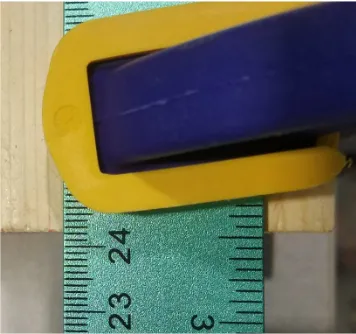
Figure 2.6 Clamping of the steel ruler at 0.247m . . . 12
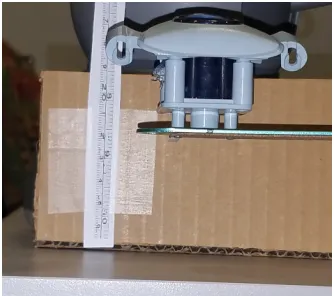
Figure 2.7 Fixing the inkwell on the steel ruler at 0.013m . . . 13
Figure 2.8 Measuring the height of the steel ruler . . . 14
Figure 2.9 Measuring the width of the steel ruler . . . 15
Figure 2.10 With stylus and inkwell connected: original position of the cantilever beam at 0.0212m . . . 16
Figure 2.11 A known weight of 0.077kg is placed underneath the inkwell. The dis-placement observed is 0.0238m . . . 17
Figure 2.12 A steel ball of 0.0952kg is additionally placed on the cantilever beam. The displacement observed is 0.0340m . . . 17
Figure 2.13 Plot of force ’F’ vs displacement ’x’ . . . 18
Figure 2.14 With no stylus attached to the cantilever beam, the displacement ob-served is 0.015m . . . 19
Figure 2.16 Adding another known weight of 0.075kg to the cantilever beam.The
total load on the beam is now 0.152kg . . . 20
Figure 2.17 Placing a steel ball and aluminum disk of 0.0952kg and 0.077kg respec-tively the cantilever beam. The total load on the beam is now 0.1722kg 20 Figure 2.18 Plot of Force ’F’ vs displacement ’x’ for only inkwell placement on the cantilever beam. . . 21
Figure 2.19 With a minimum load from the inkwell, the cantilever beam is placed at 0.017m . . . 22
Figure 2.20 With load of 0.077kg + 0.075kg = 0.152kg placed on top of the inkwell, the cantilever beam is placed at 0.0345m . . . 22
Figure 2.21 For a maximum external load of0.2472kg placed on top of the inkwell, the cantilever beam is placed at 0.0421m . . . 23
Figure 2.22 With the load placed on top of the inkwell the plot for force ’F’ vs displacement ’x’ is observed as above . . . 23
Figure 2.23 For various values of amplitude factor ’a’ the saturation is observed at -4N . . . 25
Figure 2.24 For an input force the spring force exerted by the cantilever beam is observed . . . 25
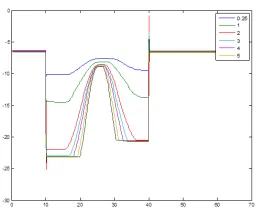
Figure 2.25 Step response of the Phantom Omni for forces in the range from 1N to 4N . . . 26
Figure 2.26 The transient peak data points used to determine the peak overshoot . 27 Figure 2.27 For a step input with reference to theσ - jω axis, the x-axis represents the attenuation σ=ζωn . . . 28
Figure 3.1 A basic block diagram representing the master-slave system . . . 29
Figure 3.2 Modified block diagram representing the master-slave system . . . 30
Figure 3.3 With no delay and dynamics the master-slave system . . . 32
Figure 3.4 No delay with dynamics: master-slave system . . . 33
Figure 3.6 With delay, dynamics and compensation: master-slave system . . . 35
Figure 4.1 Basic block diagram representing the master-slave system . . . 36
Figure 4.2 With no delay and dynamics the master-slave system . . . 37
Figure 4.3 Root locus of the system with no delay and dynamics . . . 38
Figure 4.4 Step response of the system with no delay and dynamics . . . 38
Figure 4.5 No delay with dynamics: master-slave system . . . 39
Figure 4.6 Root locus of the system with dynamics and no delay . . . 39
Figure 4.7 Step response of the system with dynamics and no delay . . . 40
Figure 4.8 With delay and dynamics: master-slave system . . . 41
Figure 4.9 Root locus of the system with delay and dynamics . . . 41
Figure 4.10 Zoomed Root locus of the system with delay and dynamics depicting master and slave system poles . . . 42
Figure 4.11 Step response of the system with delay and dynamics . . . 42
Figure 4.12 With delay, dynamics and compensation: master-slave system . . . 43
Figure 4.13 Ziegler Nichols tuning method : sustained oscillations for a critical gain valueKu = 122 . . . 43
Figure 4.14 Ziegler Nichols tuning method : Measuring the period of sustained os-cillations asTu= 30sec . . . 44
Figure 4.15 Root locus of PD controller designed using Ziegler Nichols tuning method : Kp = 97.6 and Kd= 366 . . . 45
Figure 4.16 Zoomed Root locus of PD controller designed using Ziegler Nichols tun-ing method : Kp = 97.6 and Kd= 366 . . . 45
Figure 4.17 Step response of PD controller designed using Ziegler Nichols tuning method : Kp = 97.6 andKd= 366 . . . 46
Figure 4.18 Root locus of PD controller designed using manual parameters : Kp = 95 andKd= 410 . . . 46
Figure 4.20 Step response of PD controller designed using manual parameters :
ACKNOWLEDGEMENTS
I would like to express my gratitude to Dr. Greg R. Luecke for his constant support
and encouragement. His insights and enthusiasm guided me through the research and the
writing of this report. I would also like to thank Dr. Ratnesh Kumar for helping me build an
ABSTRACT
Time delay or dead time is defined as the response time required for a process/ a device
when an input is applied. Dead time is a phenomena commonly occurring in industrial
pro-cesses, biological systems and engineering applications. Transport lags, communication lags,
computational delays are various types of time delays which inherently cause improper
func-tioning of the system unless compensated for. Bilateral telemetry is one such application which
faces instability in operation when subjected to time delay. The master robot in the virtual
environment is ’motion and force coupled’ with the slave robot in the virtual environment. This
bilateral feedback provides better tracking results as compared to the unilateral scenario at the
cost of introducing a transport lag in the communication channel. The present work focuses
on addressing this time delay using classical control methods to provide for stability in event
CHAPTER 1. OVERVIEW
Teleoperation is defined as the remote control of machines electronically.The arrangement
consists of a master robot placed in the virtual environment and a slave robot in the actual
environment. The force applied by the operator controls the position of the master robot.
This force acts as a position command for the slave robot. The term ’bilateral’ arises due the
position data of the slave robot fedback to the master robot to enhance the performance of the
[image:13.612.115.542.380.433.2]teleoperating system.[1] This setup is shown in Figure 1.1.
Figure 1.1: Teleoperation Setup
Teleoperation has been in use in the nuclear industry to safeguard and reduce human
intervention in the field operating areas. The early applications of bilateral feedback used servo
controllers on both master and slave side to reflect the position of the slave to the master as an
input force is applied.[5] For applications in undersea or outer space areas the large distances
between master and slave robots cause a significant delay in the data transmission. This delay
is due to the transmission losses in the communication channels and impacts the stability of
the system. Passivity and scattering theory have been used in the past to address this issue.[1]
in both unilateral[4] and bilateral operations.[7] The variable signal transmission times of the
Internet have been compensated for using event based approach[2] using the non-time based
references on the slave and the sensor.[11] In this work, we propose the use of classical control
methods in discrete domain to address the stability of the system with time delay. We have
used Internet as a communication medium between the master and slave. The communication
delay is assumed to be constant. The architecture used for such an experiment consists of two
CHAPTER 2. MATHEMATICAL MODELING
2.1 Mathematical Model for the Robotic Arm
Consider a simple master-slave system. We propose the use of two ’Phantom Omni’ robots
manufactured by Sensable Devices. Since both the robots are identical there is zero kinematic
mismatch. Hence, we can represent both the haptic arms as electromechanical motor systems
with voltage as the input and position as the output.
Figure 2.1: Schematic of a DC motor [3]
As shown in the figure 2, a DC motor consists of field wound on an iron core named as
stator. The stator is the stationery part of the motor.The iron cylinder placed in between
the poles of the magnet is the rotating part of the motor which constitutes as the rotor. The
rotating coils wound on the rotor known as armature windings. A commutator consisting of
low resistance carbon brushes are connected to the stator which come into contact with the
rotor on application of a current source. When a current is passed through the rotor, the rotor
For the purpose of modeling we interpret the DC motor as follows:
EA
RA
IA LA
−
+
em
LF
RF
EF
τe, ω
J
τA, θA
R1
R2
N τA+θo N τA
Jo
[image:16.612.91.564.115.360.2]Joω˙o Boω D
Figure 2.2: Mechanical and Electrical representation of a motor
The armature can be represented as a circuit consisting of armature resistance RA,
in-ductance LA, supply voltage EA and induced voltageem. The magnetic field induced can be
represented as a circuit consisting of field resistance RF, inductance LF and a supply voltage
EF. The back emf observed in the motor is represented asKe.[3]
The rotor has a moment of inertia Jm, damping due to back emf of the motor Bm and a
driving torqueτe which constitute the mechanical equation for motor as follows:
Jms2θm+Bmsθm+τA=τe
The electromechanical torque exerted on the rotor is proportional to the current flowing
through it:
For the gear input/output the equation can be written as:
τA
R2
R1
=N τA
∴ R2
R1
=N
The output inertia is given by:
Jos2θo+Bosθo=N τA+D
Combining the above equations:
Jms2θm+Bmsθm+
Jos2θo+Bosθo−D
N =τe
where
θm=N θo
Jms2θm+Bmsθm+
Jos2θo
N +
Bosθo
N −
D N =τe
(JmN2+Jo)sωo+ (BmN2+Bo)ωo =N τe+D
In terms of output shaft:
Jeqsωo+Beqωo=N τe+D
where :
Jeq=JmN2+Jo
For the electrical circuit representation we can write the Kirchoff’s voltage equation as
follows:
LAi(t) +RAi(t) +Keω=Vin
Laplace transform of the above equation gives:
LAsI+RAI+Keω=Vin
which can be written for the current I as follows:
LAsI=Vin−RAI−Keω
− + Vin − + 1 LA
LAsI 1
s
sI I
RA
Keωm
Reducing the loop:
−
+
Vin 1
RA
1
τEs+ 1
I
Keωm
The mechanical equation for the highest order of ω0 is given by:
Jeqsωo =N τe+D−Beqωo
N Km I + + − + 1 Jeq
Jeqsωo 1
s
sωo 1
s
ωo θo
Beq
Beqωo
D
Reducing the loop:
N Km
I + + 1 Beq 1 Jeq Beq
s+ 1
1
s ωo
D
θo
Connecting the two blocks we obtain:
−
+
Vin 1
RA
1
τEs+ 1
Keωm
N Km
I + + 1 Beq 1 Jeq Beq
s+ 1
ωo 1
s
θo
D
If we assume no dependence on motor speed and no disturbance ’D’, the block diagram
becomes:
1
RA
Vin 1
τEs+ 1
N Km
I 1
Beq
1
Jeq
Beq
s+ 1
ωo 1
s
θo
Since RA,N Km and Beq are constants, clubbing them together as a constant ’C’:
C = 1
RA
×N Km× 1
Beq
C
Vin 1
τEs+ 1
1
Jeq
Beq
s+ 1
1
s
ωo θo
The effect of motor inductanceτE is negligible and hence can be ignored for this application.
Thus for modeling purposes, the motor equations can be solely represented using the rotor
moment of inertia ’Jeq’ and the damping due to back emf ’Beq’.
C Jeq
Beq
s+ 1
Vin 1
s
ωo θo
Hence, the complete motor block diagram becomes:
−
+
Vin 1
RA
N Km
I +
+ 1
Jeqs+Beq
1
s
ωo θo
D
N
Ke ω
m
Keωm
For our application, the disturbance ’D’ is in fact operator hand force ’Fhand’. Hence
re-writing the block diagram as follows :
Fhand −
+ 1
Jeqs+Beq
1
s
ωo θo
N2KeKm
RA
Vin
Since, force and voltage are analogous quantities, solving the above block diagram, the
transfer function for the robotic arm with force ’Fhand’ as the input and position ’θo’ as the
output gives :
θo
Fhand
= 1
Jeqs2+Beqs+
N2KmKes
RA
= 1/Beq2
where:
Beq2=Beqs+
N2KmKes
RA
τ = Jeq
2.2 Calculating the Environmental Stiffness
[image:22.612.214.411.125.195.2]P
Figure 2.3: Spring force experienced by an elastic body when subjected to a load ’P’ [6]
For an elastic body, application of an external force causes deformation which is resisted by
the internal forces. For a spring, such an application of force(load) causes deformation in form
of displacement.
This type of force acting on the spring or any elastic body is called as the ’spring force’
which is given by:
P =Ku
where:
P : spring force
K : spring constant
u : displacement due to forceP
[image:22.612.238.388.523.640.2]As the force varies, the displacement produced by the spring varies. This relation remains
linear for a small value of the force and as the value of the force increases, the nonlinearity is
apparent(Figure2.4).
The cantilever beam is one such type of elastic body which has been utilized in our
exper-iment to calculate the environmental stiffness. The environmental stiffness can be considered
as an analogous quantity to the spring constant. For our application, environmental stiffness is
defined as the opposition created by the surrounding which the slave robot has to overcome to
follow the desired trajectory as governed by the master robot. The slave system can be
anal-ogously depicted as a mass-spring system. The spring force generated when the slave robot is
placed in the virtual environment is given as follows:
FE =KE×xslave
Using the equation for spring force of the beam the environmental stiffnessKE is given by:
KE = 3EI
L3
where:
L : length of the beam
E : Young’s modulus of elasticity
I : moment of inertia of the beam
For our experiment, we have represented the cantilever beam with a standard 30 cm ≡
0.3m long steel ruler. The ruler is clamped at one end using a wooden support of 0.04m
thickness. The other end of the ruler consists of a fixed Phantom Omni inkwell of measured
weight 0.025kg. The inkwell is used for fixing the stylus position. The weight of the stylus
is known to be 0.020kg [8]. Thus the total fixed load on the cantilever beam(steel ruler) is
0.045kg. When not in operation, this is the maximum load that the cantilever beam will be
subjected to. During the course of the operation, the total load on the beam depends on the
mass of the stylus and the variable mass of the operator’s arm - whether the arm is outstretched
Figure 2.5: Interaction of the Slave robot with the Environment
Because of the fixed position of the inkwell on the ruler as shown in Figure 2.5, the length
of the beam ’L’ is is calculated as follows:
L = clamping position of the ruler - inkwell position
Figure 2.6: Clamping of the steel ruler at 0.247m
To observe a sufficient amount of spring force, the clamping position of the ruler was
chosen at 0.247m(Figure2.6). The inkwell was placed ≈at 0.013m location(Figure 2.7). This
Figure 2.7: Fixing the inkwell on the steel ruler at 0.013m
Thus, the length of the beam ’L’ is:
L= 0.234m
Since the ruler is made of steel, the Young’s modulus of the ruler is observed as:
E= 69−72×109GP a
The steel ruler can be approximated as a rectangular object. Hence, the moment of inertia
’I’ of the cantilever beam can be determined using the standard inertia equation for a rectangle
given by:
I = bh
3
12
where:
b : base or width of the rectangle
Figure 2.8: Measuring the height of the steel ruler
As shown in Figures 2.8 and 2.9, a vernier calliper was used to measure the beam height
and the beam width.The beam height and the beam width were observed to be 0.0015 meters
and 0.03 meters respectively.
This leads to the moment of inertia being calculated as:
I = bh
3
12 =
0.03×(0.0015)3
12 = 8.449×10 −12m4
While calculating the height of the steel ruler, the following phenomenon was observed:
The etch markings on the steel ruler contributed a significant amount to the measurement of
the height h= 0.0015m. We consider a case where the environmental stiffness KE is assumed
to be 100N/m. Using the values of :
L= 0.234m,E = 69×109GP a,b= 0.03m
we reverse calculate the height of the beam as follows:
h= 3 r
12KL3
3bE
which gives h as:
Figure 2.9: Measuring the width of the steel ruler
This error of one ten-thousandth of an inch is due to the etching material coated on the
steel ruler.
Assuming h= 0.0015m we calculate the environmental stiffness as follows:
KE = 3EI
L3
KE =
3×69×109×8.449×10−12 (0.234)3
which gives the value of environmental stiffness as:
KE ≈136.50N/m
To verify this calculated value, we perform the following experiment:
2.2.1 Case 1 : Stylus + inkwell attached to the cantilever beam
We consider the case where the cantilever beam is subjected to its maximum non operating
load i.e. the inkwell and the stylus are connected. The position at the end of the beam
is measured which is termed as the ’original position’ = 0.015m from the base(Figure 2.10).
Figure 2.10: With stylus and inkwell connected: original position of the cantilever beam at 0.0212m
underneath the inkwell position on the cantilever beam. With each load, the displacement is
measured.
Using the standard spring force equation:
F =Kx
where: F =mg
’m’ : mass of the known weights in kilograms
’g’ : acceleration due to gravity = 9.81m/s2
Plotting a graph of force’F’ vs displacement’x’ we calculate the slope which is in turn our
Figure 2.11: A known weight of 0.077kg is placed underneath the inkwell. The displacement observed is 0.0238m
As shown in Figure 2.11, an aluminum disk of known weight 0.077g causes a displacement
of 0.0238m. The actual displacement is calculated as:
Actual displacement = original position - position due to weights
Thus, the actual displacement observed for a mass of 0.077kg is 0.0026m.
Figure 2.12: A steel ball of 0.0952kg is additionally placed on the cantilever beam. The displacement observed is 0.0340m
As shown in Figure 2.12, with the steel ball placed alongwith the aluminum disk the total
Using these data points i.e. displacement with no load, displacement with 0.077kg load and
displacement with 0.1722kg load we plot the graph of force ’F’ vs displacement ’x’ as shown
in Figure 2.13:
Figure 2.13: Plot of force ’F’ vs displacement ’x’
The slope of the line is calculated using the data tips shown in the plot(Figure2.13).
KE =
(1.688−0.7547) (0.0128−0.0026)
2.2.2 Case 2: Inkwell attached to the cantilever beam without the Omni stylus
Figure 2.14: With no stylus attached to the cantilever beam, the displacement observed is 0.015m
We now consider a case where the stylus is disconnected from the cantilever beam. In such
a case the minimum mass subjected to the cantilever beam is that of the inkwell(0.025g). The
original position for such an arrangement is 0.015m as shown in Figure 2.14.
Now, adding a weight of 0.077kg to the cantilever beam causes a displacement of 0.0288.
[image:31.612.229.396.118.266.2]The actual displacement is thus 0.0288 - 0.015 = 0.0138m(Figure 2.15).
Figure 2.15: Adding a known weight of 0.077kg to the cantilever beam.The beam is now positioned at 0.0288m
Further addition of 75g to the cantilever beam causes the beam location to shift to 0.0308m
Figure 2.16: Adding another known weight of 0.075kg to the cantilever beam.The total load on the beam is now 0.152kg
Figure 2.17: Placing a steel ball and aluminum disk of 0.0952kg and 0.077kg respectively the cantilever beam. The total load on the beam is now 0.1722kg
For a steel ball and an aluminum disk placed on the cantilever beam, the displacement
Using these data points, the plot of force ’F’ vs displacement ’x’ is given by:
Figure 2.18: Plot of Force ’F’ vs displacement ’x’ for only inkwell placement on the cantilever beam.
The data is curve fitted(shown by a red line) to estimate the environmental stiffness as
follows:
KE =
(1.586−1.004) (0.01995−0.01285)
2.2.3 Case 3: Inkwell attached to the cantilever beam with the weights placed on top of the inkwell
We now consider the case where only the inkwell is connected to the cantilever beam and
the weights are placed on top of the inkwell.
Figure 2.19: With a minimum load from the inkwell, the cantilever beam is placed at 0.017m
With no weight attached to the cantilever beam, the only load is that of the inkwell with
measured weight 0.025kg. As shown in Figure2.19 the original position recorded is 0.017m.
Now by placing two aluminum disks of 0.077kg and 0.075kg on top of the inkwell, the total
load to which the cantilever beam is subjected is 0.152kg. The actual displacement observed
is 0.0175m. This is shown in Figure 2.20.
Figure 2.21: For a maximum external load of0.2472kg placed on top of the inkwell, the cantilever beam is placed at 0.0421m
As shown in Figure2.21or a total external load of 0.0952kg(steel ball) + 0.077kg(aluminum
disk 1) + 0.075kg(aluminum disk 2) = 0.2472kg, the actual displacement recorded is 0.0251m.
[image:35.612.213.411.86.236.2]Using this data, the graph of force ’F’ vs displacement ’x’ is plotted as follows:
Figure 2.22: With the load placed on top of the inkwell the plot for force ’F’ vs displacement ’x’ is observed as above
The environmental stiffness is thus calculated as:
KE =
(2.423−1.49) (0.0251−0.0175)
From the above three experiments we observe the environmental stiffness value to be
91.5N/m, 82N/m and 122.76N/m respectively. Accounting for frictional forces and round off
errors we can approximate the environmental stiffness value as an average of the three values
obtained experimentally.
Averaging these values thus yields KE = 98.7N/m which for all practical purposes is
approximated as KE = 100N/m.
Further, to observe the relation between ’force’ and ’displacement’, we consider a one
di-mensional application of the Phantom Omni. We send out a force in negative ’y’ direction to
observe the displacement along the y-axis. With no damping i.e. ζ = 0 the force inputted is a
sinusoidal waveform given by:
Fy =a(1−cos(ωt))
For ω = 0.25 and ω = 0.5, we vary the value of the amplitude factor’a’ from 0.5 to 5.0 in
steps of 0.5. This results in the force valueFy in the range of -1N to -10N.
a Fy(N) Displacementy(m)
[image:36.612.225.403.391.554.2]0.5 –0.99993 -9.73909 1.0 -2 -14.0298 1.5 -2.99963 -17.7762 2.0 -3.99955 -20.3996 2.5 -4.99997 -20.1961 3.0 -5.99926 -19.948 3.5 -6.99048 -19.7449 4.0 -7.99967 -19.5419 4.5 -8.99969 -19.3392 5.0 -9.99985 -19.6352
Figure 2.23: For various values of amplitude factor ’a’ the saturation is observed at -4N
For Fy = -1 to -4N, the relation between displacement in y-direction and Fy is linear.
For a force beyond -4N, there is saturation in the spring force and hence the nonlinearity is
apparent(Figure2.23).
Figure 2.24: For an input force the spring force exerted by the cantilever beam is observed
As can be seen from the Figure 2.24 there is a decrease in the amplitude of the sine wave
observed at the output of the Phantom Omni. This decrease in the amplitude is due to the
[image:37.612.248.385.359.468.2]2.3 Calculating the natural frequency and damping ratio
Figure 2.25: Step response of the Phantom Omni for forces in the range from 1N to 4N
For the one dimensional application of the Phantom Omni, a force in the negative
y-direction ranging from 1N to 4N was inputted to observe the displacement in y-y-direction. This
force was inputted as a step force decreasing in magnitude with every 10 seconds(Figure2.25).
This resulted in a scenario where the Phantom Omni was subjected to disturbances of varied
amplitudes. For every transition, the response of the Omni was observed. This was useful in
determining the transient characteristics of the system.
The main operational device inside the Phantom Omni is a DC motor. Using section 2.1
we can say that the equation governing the robotic arm is a standard second order system.
This allows us to use the standard transient response characteristics associated with a second
order system. The peak overshoot for the system was calculated using the reading in green
Figure 2.26: The transient peak data points used to determine the peak overshoot
Using the data points in Figure 2.26we calculate the peak overshoot ’Mp’ as follows:
Mp =
(−7.507−(−6.324)) (−7.507)
Mp = 0.1575
Using the standard formula:
Mp = exp−ζπ/ √
1−ζ2
×100
the damping ratio was calculated as:
Figure 2.27: For a step input with reference to the σ - jω axis, the x-axis represents the attenuation σ=ζωn
The displacement along the x-axis which is equivalent toζωnor the attenuation was found
out to be 0.3.
ζωn= 0.3
∴ωn= 0.3
ζ = 0.3333rad/sec
Using these values of ωn = 0.3333rad/sec, ζ = 0.9 and KE = 100N/m we have designed
the second order representation for the Phantom Omni.
Since, two Phantom Omnis are utilized to represent the master and slave systems
respec-tively; their architectures are same i.e. they are represented using the same second order
CHAPTER 3. CONTROL SYSTEM DESIGN
With the experimentally calculated values of damping ratio ’ζ’, natural frequency ’ωn’ and
environmental stiffness ’KE’ we now construct a block diagram structure to observe the effects
of various dynamics introduced by the mathematical modeling.
−
+
Fhand C
τ s+ 1
Master system
Fnet 1
s
˙
xmaster
∆T
xmaster 1
KE
ωn2 s2+ 2ζω
ns+ωn2
Slave system xslave KE ∆T Fslave RA
KmN
Control Gain
KmN
RA Vin
Fmaster
Figure 3.1: A basic block diagram representing the master-slave system
Figure3.1shows the basic model of a LTI SISO system with force as the input variable and
position as the output variable.The operator in the virtual environment controls the motion
of the master robot. Hence, the input to the system is the hand force commanded by the
operator. The hand force is variable in nature depending on whether the handle is held firmly
or lightly, whether the arm is bent or outstretched.
The actions performed by the master robot are conveyed using a communication
chan-nel(represented as ∆T) to the slave robot. The slave robot in the actual environment
expe-riences certain oppositions. These oppositions as mentioned in section 2.2 are primarily the
The slave robot tries to imitate the actions of the master robot in the actual environment.
This slave imitation data is fedback to the master robot via a communication channel. The data
contains the current position of the slave robot which is incorporated with the environmental
stiffness ’KE’. Thus, the spring force experienced by the slave robot in the environment forms
the feedback loop.
This feedback spring force is applied to the master robot in terms of voltage. This conversion
of force to voltage is done using a control gain of the form:
Control Gain = RA
KmN
The architecture of the Phantom Omni is such that it allows for an internal adjustment of
voltage to force conversion. Hence, it is no longer impertinent to represent the control gain
and the conversion factor from voltage to force.
Compensating the force to voltage conversion blocks we can form the block diagram as
follows:
−
+
Fhand C
τ s+ 1
Fnet 1
s
˙
xmaster
Master system
∆T
xmaster 1
KE
ωn2 s2+ 2ζω
ns+ωn2 Slave system xslave KE ∆T Fslave Fmaster
Figure 3.2: Modified block diagram representing the master-slave system
The force from the master robot is sent to the slave robot using a communication channel
and vice versa. The communication channel proposed is User Datagram Protocol(UDP). It
is observed that the communication channel creates a delay in the transmission of data from
master robot to the slave robot and vice versa. This communication delay significantly impacts
For the slave system, the standard second order equation has been used as follows:
ωn2 s2+ 2ζω
ns+ωn2
If we represent our slave system as a mass spring damper system, the second order equation
becomes:
1
M s2+Bs+K
E
Thus, the above equations are equivalent and hence we can express mass ’M’, damping ’B’
as follows :
M = KE
ω2
n
B = 2×ζ×ωn×M
In regards to the time constant form used to represent the master system this can be
equivalently written as:
τ = M
B
C= 1
3.0.1 Case 1 : No delay and no dynamics
−
+
Fhand C
τ s+ 1
1 s ˙ x x KE FE
Figure 3.3: With no delay and dynamics the master-slave system
We first consider the ideal case where the system experiences no instability. This consists
of the master system and an accurate execution of the operator’s commands in the actual
environment. The system equation thus becomes:
x Fhand
= C
τ s2+s+CK
E
At steady state the transfer function becomes:
x Fhand(s=0)
= 1
KE
which shows that the system behavior solely depends on the environmental stiffness and
it’s effects on the manipulator behavior. Any instability due to the environment will affect the
stability of the system. It also shows that any amount of operator’s force will include a factor
of the environmental stiffness. For e.g. if we command the Phantom Omni to travel for 1m
withKE = 100N/m the actual travel will be 0.01m.
3.0.2 Case 2 : No delay with dynamics
We now introduce the dynamics caused by the environment and its association with the
slave system. Using the experimental data from section 2.2 we have determined the values
for damping ratio ζ = 0.9, natural frequency ωn = 0.3333 rad/sec and environmental stiffness
Since the environmental stiffness is observed to be varying the damping ratio ζ and natural
frequencyωn add dynamics which can destabilize the system. This is shown in Figure4.6.
−
+
Fhand C
τ s+ 1
1
s
˙
xmaster 1
KE
xmaster ωn2
s2+ 2ζω
ns+ωn2
xslave
KE
FE
Figure 3.4: No delay with dynamics: master-slave system
The transfer function for such a system becomes:
xslave
Fhand
= Cω
2
n (τ s2+s)(s2+ 2ζω
ns+ωn2) + (Cωn2KE) For the steady state condition the transfer function becomes:
xslave
Fhand(s=0)
= 1
KE
This shows that the stability of the system depends on dynamic nature of the environment
of operation.
3.0.3 Case 3 : With delay and dynamics
The delay included in the block diagram is shown as ’∆T’. However, in actual calculations
the delay is represented as ’e−sT’. To express this delay of ’e−sT’ mathematically we use Pade
approximation to represent the Taylor series with an approximate value. In the present work,
we have used the first order Pade approximation to represent the time delay as :
e−sT = −s+a
s+a
Since the time delay model introduces a zero in the right half s-plane, the system is subjected
Figure 4.9.
−
+
Fhand C
τ s+ 1
1
s
˙
xmaster −s+a
s+a
xmaster 1
KE
ω2n s2+ 2ζω
ns+ωn2
xslave
KE −s+a
s+a FE
Figure 3.5: With delay and dynamics: master-slave system
The system transfer function for such a system is calculated to be as follows:
xslave
Fhand
= Cω
2
n(−s+a)(s+a) (τ s+ 1)(s)(s+a)(s2+ 2ζω
ns+ωn2)(s+a) +CKE(−s+a)2ωn2 At steady state :
xslave
Fhand(s=0)
= 1
KE
Thus it can be seen that the effects of the non-minimum phase contribute to the transient
effect of the system. The steady state solely depends on the effects of the environment in which
3.0.4 Case 4: With delay, dynamics and compensation
−
+
Fhand C
τ s+ 1
1
s
˙
xmaster −s+a
s+a
xmaster 1
KE
ω2n s2+ 2ζω
ns+ωn2
xslave
KE −s+a
s+a Kp(s+ac)
[image:47.612.99.583.119.226.2]FE
Figure 3.6: With delay, dynamics and compensation: master-slave system
To compensate for the varying nature of the environmental stiffness and the time delays,
we introduce a PD controller. The controller is designed in association with the slave system
and hence the slave system can be modeled as a position input and position output system.
The PD controller is able to stabilize the system although unstable poles are observed.
The transfer function thus becomes:
xslave
Fhand
= Cω
2
n(−s+a)(s+a) (τ s+ 1)(s)(s+a)2(s2+ 2ζω
ns+ω2n) +CKEωn2(−s+a)2(Kp(s+ac))
At steady state :
xslave
Fhand(s=0)
= 1
KpacKE
Thus the proportional gain and the derivative gain act as a compensation for any instabilities
CHAPTER 4. RESULTS
With reference to the design scenarios discussed in chapter 3, we now use MATLAB to
simulate the results for the closed loop system response.
−
+
Fhand C
τ s+ 1
Fnet 1
s
˙
xmaster
∆T
xmaster 1
KE
ωn2 s2+ 2ζω
ns+ωn2
xslave
KE ∆T
Fslave
Fmaster
Figure 4.1: Basic block diagram representing the master-slave system
With damping ratio ζ = 0.9, natural frequency ωn = 0.3333rad/sec and environmental
stiffness KE = 100N/m, the values of ’C’,’τ’,’M’ and ’B’ are computed as follows:
M = KE
ω2
n
M = 900kg
B = 2×ζ×ωn×M
τ = M
B
τ = 1.6667sec
C= 1
B
C = 0.0019m/N s
Using these values, we compute the transfer functions for each of the cases mentioned in
chapter 3. The root locus technique has been utilized to observe the behavior of the closed
loop system and the impact of delay on such systems. The step response is used to analyze the
accuracy of our design in the event of disturbances due to varying nature of the environment
or the delays in communication channel.
All the results tested so far are for a time delay ofT = 0.0001seconds
4.0.1 Case 1 : No delay, no dynamics
−
+
Fhand C
τ s+ 1
1
s
˙
x x
KE
[image:49.612.211.420.474.563.2]FE
Figure 4.2: With no delay and dynamics the master-slave system
x Fhand
= 0.001852 1.667s2+s+ 0.1852
Figure 4.3: Root locus of the system with no delay and dynamics
The root locus shows a pair of complex conjugate poles in the left half s-plane indicating
that the system is stable.
For a step input the response is recorded as follows:
Figure 4.4: Step response of the system with no delay and dynamics
The step response indicates that the system stabilizes within a settling time of 14.1 seconds
since no delay or dynamics interfere with it’s stability.
This shows that for any given input from the master robot, the slave robot will take 14.1
[image:50.612.153.474.395.558.2]4.0.2 Case 2: No delay, with dynamics
−
+
Fhand C
τ s+ 1
1
s
˙
xmaster 1
KE
xmaster ωn2
s2+ 2ζω
ns+ωn2
xslave
KE
[image:51.612.110.525.119.218.2]FE
Figure 4.5: No delay with dynamics: master-slave system
xslave
Fhand
= 2.058×10 −6
1.667s4+ 2s3+ 0.7852s2+ 0.1111s+ 0.0002058
With the dynamics of the slave + environment system added to the closed loop transfer
function, the root locus now becomes:
Figure 4.6: Root locus of the system with dynamics and no delay
The two complex conjugate poles are due to the slave system while the two single poles :
one at the origin and the other at 1
τ belong to the master system. The pole at the origin and
one of the complex conjugate poles converge to the right half of the s-plane thus marking that
[image:51.612.153.474.396.561.2]Figure 4.7: Step response of the system with dynamics and no delay
Due to the pole at the origin and the complex pole converging in the right half s-plane the
system takes longer time to stabilize (Settling time = 2.09×10³ seconds). This response to a
4.0.3 Case 3: With delay and dynamics
−
+
Fhand C
τ s+ 1
1
s
˙
xmaster −s+a
s+a
xmaster 1
KE
ω2n s2+ 2ζω
ns+ωn2
xslave
KE −s+a
[image:53.612.100.581.119.226.2]s+a FE
Figure 4.8: With delay and dynamics: master-slave system
With delay introduced into the system as a Pade approximation of 1st order, we now
compute the transfer function of the system as follows:
xslave
Fhand
= −2.058×10
−6s2+ 823
1.667s6+ 6.667×10⁴s5+ 6.667×10⁸s4+ 8×10⁸s3+ 3.141×10⁸s2+ 4.444×10⁷s+ 8.23×10⁴
This block diagram shows that there is a proportional gain Kp= 1 present in the system.
The root locus for such a system was observed to be as follows:
[image:53.612.152.475.471.645.2]Figure 4.10: Zoomed Root locus of the system with delay and dynamics depicting master and slave system poles
Due to the Pade approximation, there is an introduction of zero in the right half s-plane.
The pole of the Pade approximation is canceled by another zero created during the formulation
of the transfer function.
Figure 4.11: Step response of the system with delay and dynamics
For a system with time delay, the system settles at 1.17×10³ seconds. This settling time
is less than the one observed in section 4.0.2. It is because the dominant roots belong to the
Pade approximated time delay system and the slave dynamics due to environment have very
[image:54.612.155.474.407.574.2]4.0.4 Case 4: With delay, dynamics and compensation
−
+
Fhand C
τ s+ 1
1
s
˙
xmaster −s+a
s+a
xmaster 1
KE
ω2n s2+ 2ζω
ns+ωn2
xslave
KE −s+a
s+a Kp(s+ac)
[image:55.612.109.580.117.225.2]FE
Figure 4.12: With delay, dynamics and compensation: master-slave system
To tune the PD controller, Ziegler-Nichols method was used. The integral gainKI and the
derivative gain Kd were made zero. The proportional gain Kp was increased to a value such
that sustained oscillations were observed.[9]
Figure 4.13: Ziegler Nichols tuning method : sustained oscillations for a critical gain value
Ku = 122
The sustained oscillations were observed for Kp = 122. This is the critical gain ’Ku’. The
period of oscillation for this critical gain is ’Tu = 30sec’. This is shown in Figures 4.13 and
4.14.
[image:55.612.158.470.379.562.2]Figure 4.14: Ziegler Nichols tuning method : Measuring the period of sustained oscillations as
Tu= 30sec
Kp = 0.8Ku= 97.6
Td=
Tu
8 = 3.75
the PD controller equation becomes :
C(s) =Kp(1 +Tds)
C(s) = 97.6(1 + 3.75s)
C(s) = 97.6 + 366s
which becomes:
xslave
Fhand
= −2.058×10
−6s2+ 823
1.667s6+ 6.667×10⁴s5+ 6.667×10⁸s4+ 8×10⁸s3+ 3.141×10⁸s2+ 7.457×10⁷s+ 8.033×10⁶
[image:57.612.149.474.182.351.2]Using this controller, the root locus becomes :
Figure 4.15: Root locus of PD controller designed using Ziegler Nichols tuning method : Kp = 97.6 andKd= 366
[image:57.612.150.477.446.613.2]Figure 4.17: Step response of PD controller designed using Ziegler Nichols tuning method :
Kp = 97.6 andKd= 366
The step response is observed in Figure4.17. This shows that even though there are unstable
poles and zeros in the transfer function of the master-slave system, the PD controller is able
to compensate for these instabilities and provide for a settling time of 24.9 seconds.
Further using some manual computation, theKp value was adjusted to 95 and theKdvalue
was changed to 410. This yielded a system with better settling time.
Figure 4.18: Root locus of PD controller designed using manual parameters : Kp = 95 and
[image:58.612.153.472.467.632.2]Figure 4.19: Zoomed Root locus of PD controller designed using manual parameters : Kp= 95 and Kd= 410
The settling time of this system was observed to be 17.3 seconds which is better compared
to that obtained using the Ziegler-Nichols tuning method(Figure 4.20).
Figure 4.20: Step response of PD controller designed using manual parameters : Kp = 95 and
CHAPTER 5. CONCLUSION
In this report we introduce the concept of time delay and it’s implications to various fields
of applications requiring human safety and intervention. We introduced the Phantom Omni
haptic devices as the hardware to design the system identification parameters: damping ratio
’ζ’ and natural frequency of oscillation ’ωn’. We further use the Phantom Omni haptic device
to determine the environmental stiffness value. This forms our system identification process.
Using these parameters has helped us in simplifying the mathematical model for our
master-slave system. Developing the master and slave systems as standard second order systems
has allowed us to use the standard transient response characteristics to the study the system
behavior.
To simplify the analysis, we propose the use of classical control methods to determine the
system stability regions. Using the root locus technique helps us in building an intuition of the
system behavior in event of large time delays. As can be seen, a proportional plus derivative
(PD) controller can provide for a sufficient control during time delayed operation. To enhance
the design further, a lead compensator can be designed to accurately design the location of the
Specifications for the PHANTOM Omni® haptic device
Corporate Headquarters
SensAble Technologies, Inc. 15 Constitution Way Woburn, MA 01801 USA [t] +1-781-937-8315 [f] +1-781-937-8325 email: [email protected] Web: www.sensable.com
© 1993-2008 SensAble Technologies, Inc. All rights reserved. OpenHaptics, PHANTOM, PHANTOM Desktop, PHANTOM Omni, SensAble, and SensAble Technologies, Inc. are trademarks or registered trademarks of SensAble Technologies, Inc. Other brand and product names are trademarks of their respective holders. Product specifications are subject to change without notice. The SensAble Technologies PHANTOM® product line of haptic devices makes it possible for users to touch and manipulate virtual objects. Different PHANTOM devices meet varying needs. The Premium models are high-precision instruments and, within the PHANTOM product line, provide the largest workspaces and highest forces, and some offer 6DOF (6 degrees of freedom) output capabilities. The PHANTOM Omni model is the most cost-effective haptic device available today. Portable design, compact footprint, and IEEE-1394a FireWire® port interface ensure quick installation and ease-of-use.
Model The PHANTOM Omni Device
Force feedback workspace ~6.4 W x 4.8 H x 2.8 D in > 160 W x 120 H x 70 D mm Footprint
Physical area the base of device occupies on the desk
6 5/8 W x 8 D in ~168 W x 203 D mm Weight (device only) 3 lb 15 oz
Range of motion Hand movement pivoting at wrist
Nominal position resolution
> 450 dpi ~ 0.055 mm Backdrive friction <1 oz (0.26 N) Maximum exertable force at nominal
(orthogonal arms) position 0.75 lbf. (3.3 N) Continuous exertable force (24 hrs.) > 0.2 lbf. (0.88 N)
Stiffness
X axis > 7.3 lb/in (1.26 N/mm) Y axis > 13.4 lb/in (2.31 N/mm)
Z axis > 5.9 lb/in (1.02 N/mm) Inertia (apparent mass at tip) ~0.101 lbm. (45 g)
Force feedback x, y, z Position sensing
[Stylus gimbal]
x, y, z (digital encoders)
[Pitch, roll, yaw (± 5% linearity potentiometers)] Interface IEEE-1394 FireWire® port:
6-pin to 6-pin* Supported platforms Intel or AMD-based PCs OpenHaptics® SDK compatibility Yes
Bibliography
[1] Anderson, R. J. and Spong, M. W. (1989). Bilateral control of teleoperators with time
delay. IEEE Transactions on Automatic Control, 34(5):494–501.
[2] Brady, K. and Tarn, T. J. (2001). Internet-based teleoperation. InProceedings 2001 ICRA.
IEEE International Conference on Robotics and Automation (Cat. No.01CH37164),
vol-ume 1, pages 644–649 vol.1.
[3] Close, C. M., Frederick, D. K., and Newell, J. C. (2002). Modeling and analysis of dynamic
systems; 3rd ed. Wiley, New York, NY.
[4] Coristine, M. and Stein, M. R. (2004). Design of a new pumapaint interface and its use
in one year of operation. In Robotics and Automation, 2004. Proceedings. ICRA ’04. 2004
IEEE International Conference on, volume 1, pages 511–516 Vol.1.
[5] GOERTZ, R. C. (1964). Manipulator systems developed at anl. Proceedings, The 12th
Conference on Remote Systems Technology, pages 117–136.
[6] Humar, J. L. (1990). Dynamic of Structures. Prentice-Hall, Inc., Upper Saddle River, NJ,
USA.
[7] Munir, S. and Book, W. J. (2002). Internet-based teleoperation using wave variables with
prediction. IEEE/ASME Transactions on Mechatronics, 7(2):124–133.
[8] Najdovski, Z. and Nahavandi, S. (2008). Extending haptic device capability for 3d virtual
grasping. In Ferre, M., editor, Haptics: Perception, Devices and Scenarios, pages 494–503,
Berlin, Heidelberg. Springer Berlin Heidelberg.
[10] Wikipedia contributors (2004). Zieglernichols method — Wikipedia, the free encyclopedia.
[Online; accessed 22-July-2004].
[11] Xi, N. and Tarn, T. J. (1999). Action synchronization and control of internet based
telerobotic systems. In Proceedings 1999 IEEE International Conference on Robotics and

![Figure 2.3: Spring force experienced by an elastic body when subjected to a load ’P’ [6]](https://thumb-us.123doks.com/thumbv2/123dok_us/8131947.242527/22.612.238.388.523.640/figure-spring-force-experienced-elastic-body-subjected-load.webp)