Available Online At www.ijpret.com
INTERNATIONAL JOURNAL OF PURE AND
APPLIED RESEARCH IN ENGINEERING AND
TECHNOLOGY
A PATH FOR HORIZING YOUR INNOVATIVE WORK
CHANNEL ESTIMATION OF OFDM BASED SYSTEM USING PILOT ASSISTED
NEURAL NETWORKS
POONAM G. CHAUDHARI, PROF. ARCHANA CHARKHAWALA
Faculty, Department of ETC, PCE, Nagpur (MH) -440019, India.
Accepted Date:
27/02/2013
Publish Date:
01/04/2013
Keywords
OFDM,
Channel Estimation.
Artificial Neural
Network, Pilots,
Data symbols,
Bit error rate,
Signal to noise ratio
Corresponding Author
Ms. Poonam G.
Chaudhari
Abstract
This paper uses Artificial Neural Network (ANN) for channel
estimation in OFDM systems over AWGN fading channels. This
technique utilizes the learning property of neural network. By
using this feature, there is no need of any matrix computation
and proposed technique is less complex. This technique is
useful to achieving the high data rate, transmission capability
with high bandwidth, efficiency and its robustness to noise. In
OFDM system, the Channel estimation is an essential problem
so the Pilot-aided channel estimation has been used; a good
choice of the pilot pattern should match the channel behavior
both in time and frequency domains. In this arrangement, the
performance of the channel estimation is analyzed with
estimators based on finding weights and biases of ANN are
carried out through MATLAB Simulation and coding. The
performance of OFDM is evaluated on the basis of Bit Error
Rate (BER). The OFDM with ANN has been shown to perform
Available Online At www.ijpret.com I. INTRODUCTION
OFDM is becoming a very popular
multi-carrier modulation technique for
transmission of signals over wireless
channels. Now OFDM is widely used for
high-speed communications over frequency
selective channels. OFDM divides the high
data rate stream into parallel lower data
rate and hence prolongs the symbol
duration, thus helping to eliminate Inter
Symbol Interference (ISI). It also allows the
bandwidth of subcarriers to overlap without
Inter Carrier Interference (ICI) as long as the
modulated carriers are orthogonal.
Therefore OFDM is considered as an
efficient modulation technique for
broadband access in a very dispersive
environment.
The frequency selective fading, is caused by
multipath could lead to carriers used, being
heavily attenuated due to destructive
interference at the receiver. The result of
this is the carriers being lost in the noise
[1].To increase performance of OFDM
system under frequency selective channels;
the channel estimation is required before
demodulation of OFDM signals [2]. The
channel estimation is a process of
characterizing the effect of the transmission
medium on the input signal.
In OFDM system there are several
techniques for channel estimation
[2-14].Among these techniques; Block type
Pilot based channel estimation technique is
more popular. The Block type Pilot based
estimation techniques can be based on
Least-Square (LS). The LS estimators have
low complexity.
In this paper, we propose an artificial neural
network (ANN) based on channel
estimation technique as an alternative to
Block type pilot based channel estimation
technique for OFDM systems over AWGN
fading channels. The Simulation results
show that ANN based on channel estimator
gives better results as compared to Block
type pilot based channel estimator and
without ANN for OFDM systems over the
AWGN fading channel.
II. FEED FORWARD ANN
Artificial Neural Network (ANN) is an
interconnected group of artificial neurons.
Available Online At www.ijpret.com
model for information processing. In Feed
Forward ANN a multilayer perceptron is
used. For feed forward as the structure is
parallel, the input/output relationship is
given by the equation as:
Y= Ф (W*X+b)
where X is a N by 1 vector of inputs, W is an
M by N vector of weights, b is an M by 1
vector of biases, and Y is the M by 1 vector
of outputs. The operator Ф(o) is the
element-by-element activation function for
each neuron. The architecture for Feed
Forward ANN is as given bellow:
Fig 1 – Architecture of Feed Forward ANN
In fig, neural network with 5 inputs and 3
neurons in hidden layer and 2 outputs.
The Normal ANN used usually uses Back
propagation algorithm in feed forward
networks as learning algorithm to update
weights and biases of the network when
inputs are applied to the network. The Back
propagation has a tendency to stick at local
minima or maxima. Also the performance
evaluated for the system under
consideration show delayed convergence.
III. SYSTEM DIAGRAM
A. System with Channel Estimation using
ANN
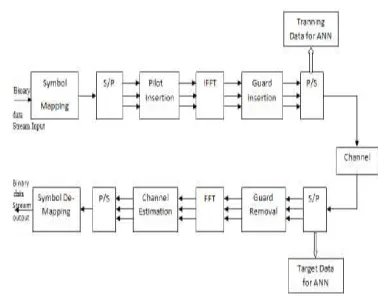
Figure 2 – Channel Estimation using ANN
The proposed system uses ANN with 4
pilots and 48 data symbols. The pilots were
separated into real and imaginary part and
then given as input to ANN. The total inputs
to ANN were 8 (4 real and 4 imaginary). The
outputs of the ANN were again 8 (4 real and
4 imaginary). Single hidden layer was used
with 12 Neurons. The transfer functions
used were log sigmoid to first 2 layers and
linear to the output layer. The number of
Available Online At www.ijpret.com
were taken in the range [0 1] with offset of
0.125.
For training the ANN these pilots with 1e-06
imaginary part were simulated for signal to
ratio from o dB to 10 dB. The received pilots
were then stored and given as input to ANN
separated into real and imaginary part.
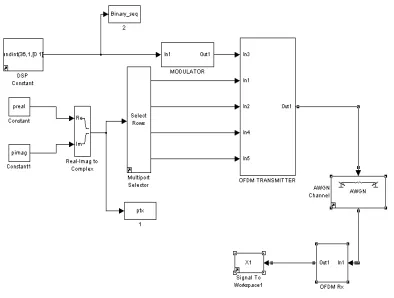
The model used for training data is shown
below,
Figure 3 – Simulink model for data pilots for
training ANN
The system parameters used were,
Table 1 – System parameters
Modulation BPSK
OFDM 64
Pilots 4
Data Symbols 48
Code rate ¾
Frame Period 4e-04
Channel AWGN
The total pilots transmitted were – 09.
[0 0.125 0.250 0.375 0.50 0.625 0.750 0.875
1].
Each pilot was simulated over SNR = 0 to 10
that is 11 times and the total period over
which the system was simulated was 4e-04
that is for every pilot number of target
pilots received was 5. The total combination
for pilots used in 4 places was 24.
Therefore total input to ANN training was
9*24*11=2376.
B. The System for channel Estimation
using ANN
The figure 3 shows the actual model for
802.11a WLAN system using the ANN block
to channel estimation. The ANN used in the
system was trained offline using MATLAB
Available Online At www.ijpret.com
Targets and the received pilots were used
as the inputs to the ANN. The ANN used has
3 layers excluding inputs and outputs [8 12
8].
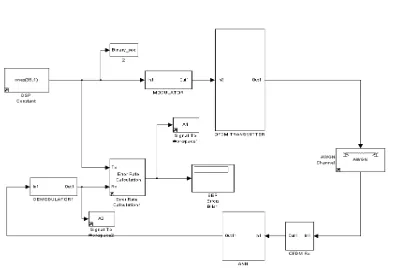
Figure 4 - System showing ANN block for
Channel Estimate
The main problem was to estimate the data
symbols. After OFDM demodulation the
pilots were grounded. The ANN was trained
for 4+4=8 inputs (4 real and 4 imaginary).
The training was done in such a manner
that all 24 combinations for 4 pilots were
considered and the system was simulated.
The 48 data symbols were broken into
group of four and 12 such block of ANN
were utilized for estimating the data
symbols. After estimation all the real and
imaginary part was again combined and
vertically concatenated to form 48 symbols
and then fed to the receiver part of the
system.
Transfer functions – [logsig logsig purelin]
IV. RESULTS
The graph shows the performance of the
system without estimating the channel
parameters.
Figure 5 – Performance of BPSK-OFDM
without channel estimation.
Figure 6 – Performances of BPSK-OFDM
with and without channel estimation using
ANN (Normal
Available Online At www.ijpret.com
Figure 7 - Performances of BPSK-OFDM
with channel estimation using ANN
Figure 8 - Training for Neural Network
V. CONCLUSION
The performance of ANN for channel
estimation for the OFDM based 802.11a
WLAN using BPSK modulation with a code
rate of ¾ was superior as compared to
estimation by channel impulse response.
Also the ANN showed early convergence
and low BER for high noise.
REFERENCES
1. Datacomm research company St. Louis,
missouri USA, “Using MIMO-OFDM
Technology To Boost Wireless LAN
Performance Today”, White paper , June
2005.
2. Kamran Arshad, “Channel Estimation In
OFDM Systems ” , MS thesis , Department
Of Electrical Engineering , King Fahd
University Of Petroleum And Minerals,
Dhahran , Saudi Arabia , August 2002 .
3. HELMUT BOLCSKEI, “Principles of MIMO
OFDM Wireless Systems”, Communication
Technology Laboratory, Swiss Federal
Institute of Technology (ETH) , http: //www.
nari.ee.ethz.ch / commth / pubs /p / c r c03,
last access ed:October 2007.
4. Rohde, Schwarz, “Introduction to MIMO
Systems”, Application Not e: 1MA102, http:
//www. rohde- schwa rz.com last accessed:
November 2007.
5. A. Meyer , T. Peter , S. Haene , P. Lue thi ,
“Channel Estimation for MIMO-OFDM”,
Semester Thesis , Integrated Systems
Laboratory, Swiss Federal Institute of
technology Zurich, February 2006.
PIO LTS
PIO LTS
PIO LTS
Available Online At www.ijpret.com
6. Parisi, R.; Di Claudio, E.D.; Orlandi , G. ;
Rao , B. D , “Fast adaptive digital
equalization by recurrent neural networks”,
IEEE Transact ions on Signal Processing,
Vol.45, No. 11 , pp . 2731-2739, November
1997.
7. Eliod. Diclaudio, Rafaela Parisi, Gianni or
landi, “Neural Sequence Detector For Digital
Equalization”,www.eurasip.org/content/eus
ipco/2000/sessions/thupm/or2/cr1213.pdf,
Last accessed: November 2007.
8. G. Liodakis, d. Arvanitis, and Io.
Vardiambasis: “Neural l Network – based
Digital Receiver for Radio Communications”,
WSEAS TRANSACTIONS on SYSTEMS,
Volume 3, Issue 10, ISSN: 1109-2777,
December 2004.
9. Quazim. Rahman, m. Ibnkahla, m.
Bayoumi, “Neural Network Based Channel
Estimation and Performance valuation of a
Time Varying Multipath Satellite Channel”,
Proceedings of the IEEE 3rd Annual
Communication Networks and Services
Research Conference, pp. 7 4 – 79, May
2005.
10.F. Balazs, S. Imre: “Modified Radial Basis
Network Based Blind Channel Estimation”,
FESB-Split, SoftCOM2004, ISBN 953-6114-
69-0, pp. 4 49 -452, October 2004.
11.Rose Trepkowski’s, “Channel Estimation
Strategies for Coded MIMO Systems”, MS
thesis, Virginia Polytechnic Institute and
State University, Blacksburg -Virginia , June
2004.
12.Cebrail Çiflikli · A. Tuncay Öz¸sahin · A.
Çagrı Yapici, Artificial Neural Network
Channel Estimation Based on
Levenberg-Marquardt for OFDM Systems, Wireless
Pers Commun (2009) 51:221–229 DOI
10.1007/s11277-008-9639-2.
13.Colieri, S., Ergen, M., Puri, A., & Bahai,
A. (2002). A study of channel estimation in
OFDM systems. In Proceedings of the IEEE
56th Vehicular Technology Conference, 24–
28 September 2002 (Vol. 2,pp. 894–898).
14.Edfors, O., Sandell, M., Wilson, S. K., &
Borjesson, P. O. (1998). OFDM channel
estimation by singular value decomposition.
IEEE Transactions of Communications, 46,
Available Online At www.ijpret.com
15.Tolochko, I., & Faulkner, M. (2002). Real
time LMMSE channel estimation for
wireless OFDM systems with transmitter
diversity. In Proceedings of the 56th IEEE
VTC, Vancouver, Canada (pp. 1555–1559).
16.Gacanin, H., Takaoka, S., & Adachi, F.
(2005). Pilot-assisted channel estimation for
OFDM/TDM with frequency-domain
equalization. In Vehicular Technology
Conference, 25–28 September 2005, USA.
17.Colieri, S., Ergen, M., Puri, A., & Bahai,
A. (2002). Channel estimation techniques
based on pilot arrangement in OFDM
systems. IEEE Transactions on Broadcasting,
48(3), 223–229.
18.Doukopoulos, X. G., & Moustakides, G.
V. (2004). Adaptive algorithms for blind
channel estimation in OFDM systems. In
2004 IEEE International Conference on
Communications, 20–24 June 2004 (Vol. 4,
pp. 2377–2381).
19.Roy, S., & Li, C. (2002). A subspace blind
channel estimation method for OFDM
systems without cyclic prefix. IEEE
Transactions on Wireless Communications,
1, 572–579.
20.Patra, J. C., Pal, R. N., Baliarsingh, R., &
Panda, G. (1999). Nonlinear channel
equalization for QAM signal constellation
using artificial neural networks.IEEE
Transactions on Systems, Man, and
Cybernetics,29(2), 254–262.