Organized by C.O.E.T, Akola, ISTE, New Delhi & IWWA. Available Online at www.ijpret.com162
INTERNATIONAL JOURNAL OF PURE AND
APPLIED RESEARCH IN ENGINEERING AND
TECHNOLOGY
A PATH FOR HORIZING YOUR INNOVATIVE WORK
ANALYSIS OF RCC BEAMS WITH WEB OPENING THROUGH EXPERIMENTAL,
COMPUTER SIMULATION AND ANALYTICAL APPROACH
DR. R. N. KHAPRE, DR. V. A. DAKWALE
Civil Engineering Department, Shri Ramdeobaba College of Engineering & Management, Ramdeo Tekdi, Katol Road, Gitti Khadan, Nagpur 440013, Maharashtra, INDIA
Accepted Date: 07/09/2016; Published Date: 24/09/2016
Abstract: This article presents analysis of RCC beam with web opening. The analysis of behavior of beam with web opening was done by experimental investigation, Computer simulation and analytical method. Beam sample with web openings were casted and test were carried out for finding maximum deflection. Computer simulation was also carried out using ANSYS software to obtain detailed solution. Further, analytical approach was used to compare the results obtained from computer simulation and experimental findings. The results thus obtained were compared and conclusions were drawn.
Keywords: RCC beam, Web opening, ANSYS.
.
Corresponding Author:DR. R. N. KHAPRE
Co Author: DR. V. A. DAKWALE
Access Online On:
www.ijpret.com
How to Cite This Article:
R. N. Khapre, IJPRET, 2016; Volume 5 (2): 162-168
PAPER-QR CODE
SPECIAL ISSUE FOR
INTERNATIONAL CONFERENCE ON
Organized by C.O.E.T, Akola, ISTE, New Delhi & IWWA. Available Online at www.ijpret.com163
INTRODUCTION
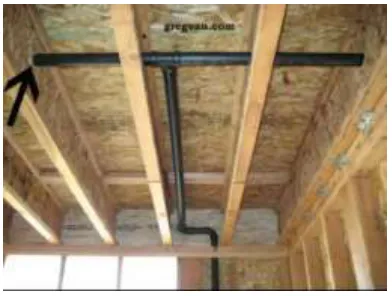
Beam is the prime load carrying member in the frame of a structure. RCC buildings are popular in India and thus beams are casted in concrete with steel reinforcement. Beam is designed for a combination of several loads and its depth increases as the load increases. Increase in the depth of beam results into reduction of clear head room below. It is observed that, the service cables, conduits and pipes run through the bottom of the beam further reducing the clear head room. Figure 1 shows a typical view where electrical cables and water pipe lines can be seen. This problem can be eliminated by providing openings in the beam web. Openings allow all service cables to pass through without any bends as shown in Figure 2.
Figure 1: Service cables and pipes under beams
Figure 2: Pipes through web of beams
In past the behaviour of beams with web opening made of homogeneous materials like steel or timber were studied. In RCC beams, compressive stresses are taken by concrete and tensile stresses are taken by steel reinforcement, hence provision of web opening alters the stress distribution pattern tremendously around the web opening. Thus the provision of opening in the web of beam affects strength of the beam. Present article investigates the behavior of RCC beam with web openings by experimental, simulation and analytical approach.
Organized by C.O.E.T, Akola, ISTE, New Delhi & IWWA. Available Online at www.ijpret.com164
reinforcing bars in computer simulation and reports that strength of beam reduces with inclusion of opening in beam. Khapre and Pachpor [4] have conducted study on investigation of RCC beam with web opening using finite element method. Their study shows that circular opening are more suitable as compared to rectangular opening.
Study on wooden beams with opening was presented by Danielsson [5] in 2009. This study shows experimental investigation as well as analytical approach to understand behavior of wooden beams with circular and square opening.
Effect of web opening in steel beams was also report by few researchers. Study by Chung KF and other [6, 7, 8] shows finite element analysis of I sections with web opening. These articles report effect of web opening on stiffness, shear and flexure failure. Pachpor and others [9, 10] also carried out investigation on steel with openings of different shapes using ANSYS and its comparison with Eurocode 3 [11], AISC steel design guide 2 [12] and British code BS 5950 [13] was presented by Pachpor [14].
This article aims at performing detailed investigation of RCC beam with web opening through experimental investigation, computer simulation using finite element method based software, and analytical solution.
2. Methodology
The investigation of RCC beams with web opening is carried out using three different methods i.e. experimental, analytical and through computer simulation. In the first method, RCC beam was casted and tested with two point loading system for flexural strength and displacement. In the second method, finite element model was prepared in ANSYS software considering identical geometric and material properties that of casted beam. Computer simulation was carried out and detailed results are obtained in from of strains, stresses and reactive force. In the last method, an attempt was made to obtain the analytical solution.
2.1. Experimental Investigation
RCC beam with following specification was casted Material Properties
Concrete Grade - M 35
Cement - OPC 53 Grade
Steel - Fe250.
Organized by C.O.E.T, Akola, ISTE, New Delhi & IWWA. Available Online at www.ijpret.com165
Web opening - PVC pipe
Small aggregate - fine sand
Large aggregate - 10-20 mm Geometric Properties
Shape of the opening- Circular
Size of beam - 150 x 150 x 750mm
Location of web opening across length - at centre i.e. 350 mm from both ends
Location of web opening across depth - at center i.e. 75 mm from top/bottom
Size of opening - 50 mm in diameter Reinforcement details
2 Numbers 8 mm diameter bars at bottom
2 Numbers 8 mm diameter bars at top
Clear cover is taken 35 mm
8 mm diameter stirrups at spacing 200 mm c/c
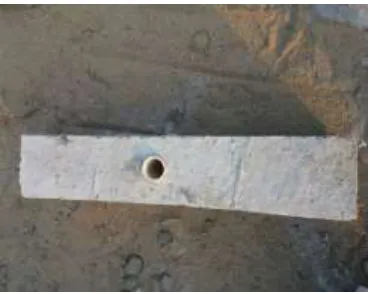
Figure 3: RCC beam Sample with web opening
Figure 3 shows casted beam sample with circular web opening. After 28 days immersion curing, testing was carried out in UTM of capacity 400 kN. The rate of loading applied on beam was 40 kg/mm2/min. Two point loading system was adopted for experimental investigation. Beam was
Organized by C.O.E.T, Akola, ISTE, New Delhi & IWWA. Available Online at www.ijpret.com166
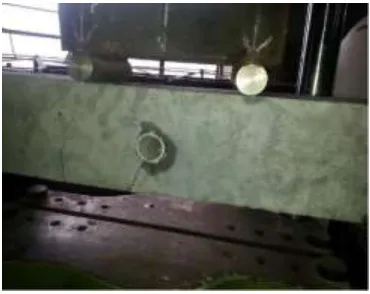
Figure 4: Load displacement curve Figure 5: Testing of RCC Beam sample
Two point loads at a distance of 200 mm were applied as shown in Fig. 4. The load displacement curve was obtained as shown in Fig. 5. It was found that the beam failed at displacement of 7.1 mm and the corresponding ultimate load was reported as 68.40kN. Figure 5 also shows the failure pattern of RCC beam sample.
2.2. Computer Simulation
In order to obtain detailed solution, computer simulation using ANSYS was carried out. Initially three dimensional solid model was prepared using ANSYS Design Modeller as shown in Fig. 5 All dimensions are taken exactly same as beam that was actually tested experimentally. Computer simulation was carried out using Simulation feature of ANSYS for two point loading system. Figure 6 shows finite element model used by ANSYS for simulation. Actual material properties (as mentioned above) were assigned to the appropriate portion the finite element model. The loads are applied in form of Displacement Load of 7.1 mm that was same as the displacement where the beam failed in experimental investigation. The reactive load for 7.1 mm displacement was measured and it was found that the value of load was 63.65 kN.
Organized by C.O.E.T, Akola, ISTE, New Delhi & IWWA. Available Online at www.ijpret.com167
2.3. Analytical
After experimental investigation and computer simulation, an attempt was made to find the analytical solution of the problem. The analytical solution couldn’t be obtained as there was no direct method available to analyze beam with web opening. However, equation for solid beam was available to compute the deflection under two point loads. The equation is as follows
EI PL 192
2
… (1)
Using the material properties and geometric properties mentioned above, the load was computed using the equation (1) for deflection of 7.1 mm. it was found that the load value was 77.95 kN corresponding to 7.1 mm deflection.
2.4. Comparison of Results
Following table shows the comparison of ultimate load obtained using three different methods. It was observed that for displacement of 7.1 mm, the value of ultimate load was found to be least for computer simulation and highest for analytical solution.
Displacement Experimental Simulation Analytical
7.1 mm 68.40 kN 63.65 kN 77.95 kN
3. Results and Conclusions
After analyzing the RCC beam with web opening using three different methods, the ultimate load obtained experimentally and by computer simulation was found to be similar. The difference between experimental value of ultimate load and ultimate load obtained from computer simulation is 6.94%. Analytical solution shows higher value of ultimate load (12.25%) as it was computed using equation that is used form solid beam. With the introduction of web opening in the RCC beam, load carrying capacity of the beam will be reduced. Hence the difference in value of ultimate load is acceptable.
4. Acknowledgement
Organized by C.O.E.T, Akola, ISTE, New Delhi & IWWA. Available Online at www.ijpret.com168
5. REFERENCES
1. Mansur M. Design of reinforced concrete beams with web openings. 6th Asia-Pacific Structural Engineering and Construction Conf. Malaysia (APSEC Kuala Lumpur, Malaysia), 2006; 104-120.
2. Hee Chang Eun, Yound Ho Lee, Heon Soo Chung, Keun Hyeok Yang. On the shear strength of reinforced concrete deep beam with web opening. The Structural Design of Tall and Special Buildings 2006; 15-4:445-466.
3. Geetha L, Neethu U, Hegde M. Performance of reinforced concrete beams with openings of different size, shape and locations. Recent Trends in Engineering & Technology Conf. India (ICRTET, India), 2013; 10-17.
4. Khapre RN, Pachpor PD. Effect of Reinforcement on Flexural Behavior of RCC Beam with Opening. 3rd International Conference on Civil Engineering (ICCEN 2014), Mauritius, 29-30 November 2014.
5. Danielsson H. The strength of glulam beams with holes a probabilistic fracture mechanics method and experimental tests. Dissertation. Department of Construction Science, Lund University, Sweden: 2009.
6. Chung KF, Liu TCH, Ko ACH. Investigation of vierendeel mechanism in steel beams with circular web openings. Journal of Constructional Steel Research 2001; 57-5:467-490.
7. Chung KF, Lawson RM. Simplified design of composite beams with large web openings to Eurocode 4. Journal of Constructional Steel Research 2001; 57(2):135-164.
8. Chung KF, Liu CH, Ko ACH. Steel beams with large web openings of various shapes and sizes: an empirical design method using a generalised moment-shear interaction curve. Journal of Constructional Steel Research 2003; 59-9:1177-1200.
9. Bedi K, Pachpor P. Comparison of deflection in beam with web opening of different shapes. Int. J. Research in Engineering, Science & Technology 2011; 1:1-5.
10. Pachpor P, Gupta L, Deshpande N, Bedi K. Parametric study of castellated beam. Advance Material Research 2010; 163-167:842-845.
11. EN 1993 Eurocode 3. Design of Steel Structure. National Application Document, UK, 1993. 12. Darwin D. Steel and composite beams with openings. Steel Design Guide Series 2. American Institute of Steel Construction, University of Kansas, USA, 2003.
13. BS 5950. Structural use of steel work in building. British Standard Institution, 2000.