Available Online at www.ijpret.com 723
INTERNATIONAL JOURNAL OF PURE AND
APPLIED RESEARCH IN ENGINEERING AND
TECHNOLOGY
A PATH FOR HORIZING YOUR INNOVATIVE WORK
USING EMBEDDED WEB TECHNOLOGY DEVELOPING TRAFFIC MANAGEMENT
SYSTEM
PROF. APARNA S. DHONE, PROF. SARITA C. SAKURE, PROF. PRITI JASUD Computer Tech. Dept, KDK Engg. College, Nagpur
Accepted Date: 05/03/2015; Published Date: 01/05/2015
\
Abstract: Rising traffic congestion is an inescapable condition in large and growing metropolitan areas across the world. So it is very essential to resolve this congestion problem and design intelligent system to monitor traffic flow and reduce accidents. In this paper we exploit technology to design an intelligent Traffic Management System (TMS). The system is based on utilizing Embedded Web Servers (EWS) technology to design a web-based TMS. The EWS located at each intersection uses IP technology for communicating remotely with a Central Traffic Management Unit (CTMU) located at the traffic department authority. The system is aimed at improving the traditional traffic monitoring system by incorporating better management and monitoring schemes as well as providing road users with real time information.
Keywords: Embedded system, Flash ROM, TCP/ IP, Web browser, Embedded Web Servers, microcontrollers.
Corresponding Author: PROF. APARNA S. DHONE
Access Online On:
www.ijpret.com
How to Cite This Article:
Available Online at www.ijpret.com 724 INTRODUCTION
One major factor that affects the traffic flow is the management of the traffic at road intersections.
Figure 1, Traffic Congestion
Traffic congestion is a condition on road networks that occurs as use increases, and is characterized by slower speeds, longer trip times, and increased vehicular queuing. The most common example is the physical use of roads by vehicles. When traffic demand is great enough that the interaction between vehicles slows the speed of the traffic stream, this results in some congestion.
Available Online at www.ijpret.com 725 II. RELATED WORK
1. Traffic research still cannot fully predict under which conditions a "traffic jam" (as opposed to heavy, but smoothly flowing traffic) may suddenly occur. It has been found that individual incidents (such as accidents or even a single car braking heavily in a previously smooth flow) may cause ripple effects (a cascading failure) which then spread out and create a sustained traffic jam when, otherwise, normal flow might have continued for some time longer.
2. Some traffic engineers have attempted to apply the rules of fluid dynamics to traffic flow, likening it to the flow of a fluid in a pipe. Congestion simulations and real-time observations have shown that in heavy but free flowing traffic, jams can arise spontaneously, triggered by minor events ("butterfly effects"), such as an abrupt steering maneuver by a single motorist. Traffic scientists liken such a situation to the sudden freezing of super cooled fluid.
3. However, unlike a fluid, traffic flow is often affected by signals or other events at junctions that periodically affect the smooth flow of traffic. Alternative mathematical theories exist, such as Boris Kerner's three-phase traffic theory (see also spatiotemporal reconstruction of traffic congestion).
4. Because of the poor correlation of theoretical models to actual observed traffic flows, transportation planners and highway engineers attempt to forecast traffic flow using empirical models. Their working traffic models typically use a combination of macro-, micro- and macroscopic features, and may add matrix entropy effects, by "platooning" groups of vehicles and by randomizing the flow patterns within individual segments of the network. These models are then typically calibrated by measuring actual traffic flows on the links in the network, and the baseline flows are adjusted accordingly
5. A team of MIT mathematicians has developed a model that describes the formation of "phantom jams," in which small disturbances (a driver hitting the brake too hard, or getting too close to another car) in heavy traffic can become amplified into a full-blown, self-sustaining traffic jam. Key to the study is the realization that the mathematics of such jams, which the researchers call "jamitons," are strikingly similar to the equations that describe detonation waves produced by explosions.
III. INTELLIGENT SYSTEM
Available Online at www.ijpret.com 726 networks .The systems in which information and communication technologies are applied in the field of road transport, including infrastructure, vehicles and users, and in traffic management and mobility management, as well as for interfaces with other modes of transport. In the developing world, the migration from rural to urbanized habitats has progressed differently. Many areas of the developing world have urbanized without significant motorization and the formation of suburbs.
Figure 2, Web-Based Traffic Management System
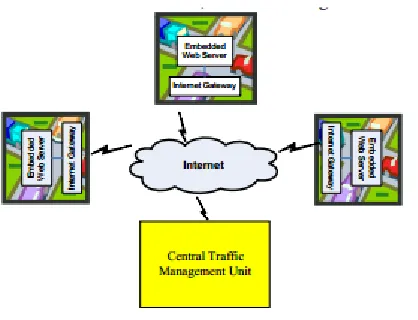
In this paper system consist of a master unit and a number of slave nodes sparsely located at different geographical sites and interconnected together through the internet. The master unit is the Central Traffic Management Unit (CTMU) used to remotely monitor and control the different nodes using the internet as the communication backbone, as shown in figure 2.
An embedded web server is a HTTP protocol stack that is limited to handling HTTP requests. In contrast, an embedded application server is a software framework dedicated to the efficient execution of programs, routines, or scripts for supporting the construction of various applications. An application server also contains a web server. Thus, one may consider a web server a subset of an application server. While a web server mainly deals with sending HTML for display in a web browser, an application server provides access to server side logic (server applications) for use by client application programs.
Available Online at www.ijpret.com 727 These extensions typically limit the GUI designer and make it time consuming and difficult to design GUI applications.
Figure 3, Embedded Web Application Server.
The above diagram shows the Barracuda Embedded Web/Application Server and the major plugins such as the LSP plugin. The diagram is interactive, and more information appears when you move your mouse over the diagram
A. III. INTELLIGENT TRANSPORT APPLICATIONS
1) 1 Emergency Vehicle Notification Systems
The in-vehicle eCall is an emergency call generated either manually by the vehicle occupants or automatically via activation of vehicle sensors after an accident. When activated, the in-vehicle eCall device will establish an emergency call carrying both voice and data directly to the nearest emergency point. The voice call enables the vehicle occupant to communicate with the trained eCall operator. At the same time, a minimum set of data will be sent to the eCall operator receiving the voice call.
2) Automatic road enforcement
Available Online at www.ijpret.com 728 A traffic enforcement camera system, consisting of a camera and a vehicle-monitoring device, is used to detect and identify vehicles disobeying a speed limit or some other road legal requirement and automatically ticket offenders based on the license plate number. Traffic tickets are sent by mail.
2. Variable Speed Limits
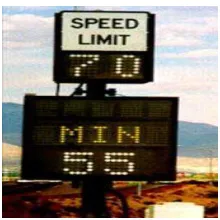
Figure 5, Example variable speed limit sign in the United States.
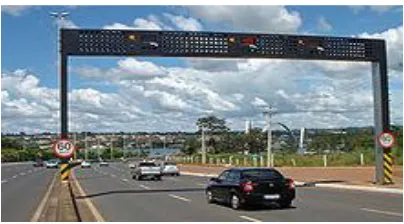
Recently some jurisdictions have begun experimenting with variable speed limits that change with road congestion and other factors. Typically such speed limits only change to decline during poor conditions, rather than being improved in good ones.
3. Bluetooth Detection
Bluetooth is an accurate and inexpensive way to measure travel time and make origin and destination analysis. Bluetooth is a wireless standard used to communicate between electronic devices like mobile phones, smart phones, headsets, navigation systems, computers etc. Bluetooth road sensors are able to detect Bluetooth MAC addresses from Bluetooth devices in passing vehicles. If these sensors are interconnected they are able to calculate travel time and provide data for origin and destination matrices. Accurate measurement points with absolute confirmation to provide to the second travel times.
Since Bluetooth devices become more prevalent on board vehicles and with more portable electronics broadcasting, the amount of data collected over time becomes more accurate and valuable for travel time and estimation purposes.
IV. EMBEDDED WEB SERVER
Available Online at www.ijpret.com 729 standards, and their control panel utility is accessible from any Web browser on any hardware platform.
An embedded Web server is like a mini Web site, except that it is not on the Web. However, some Web servers may be accessed remotely via the Internet. Incorporating an embedded web server is a remarkably powerful mechanism for easily implementing a variety of key features and functions in your device.
A user sitting at any standard browser sees a web enabled device as a web site. The device presents itself and its state graphically and responds to buttons, hot links, and the entire array of familiar browser controls. The potential for this kind of interface is essentially unlimited.
Although the word "server" is often associated with things that are heavyweight, web servers can actually be implemented efficiently and in a small footprint.
V. PROPOSED WORK
The intelligent traffic control and monitoring system proposed in this paper consists of a master unit and a number of slave units sparsely located at different geographical sites and interconnected together through the internet. The master node is the used for remote monitoring and controlling the different nodes using the internet technology .Master unit is called as Central Traffic Management Unit (CTMU).
In this CTMU acts as the client node while each node act as a server in a client-server mode.
In figure 6, traffic monitoring system consists of the data acquisition equipment (for multiple devices), remote monitoring host and the local Web server. The embedded remote monitoring system completes the data collection in the embedded platform and then provides the data to remote host through the TCP/IP protocol from Web server. It creates a condition to realize unattended management.
Available Online at www.ijpret.com 730 Similarly, the selected node’s EWS sends or receives the desired information using HTTP, and the TCP/IP stack manages the entire communication. The embedded web server at the selected node will send its status as dynamic contents inserted into the HTML file, hence generating a Dynamic HTML file, which will be translated to a web page by the CTMU WEB browser.
VI. CONCLUSION
Traffic Problem begins when more vehicles try to use a road than the road can move. This can occur when vehicles cannot exit quickly enough to make way for others. To solve this , paper proposed Central Traffic Management has the unique ability and expertise to offer clients a totally integrated package of road management services. Interfaced with the traffic signals and used to monitors and control its operation. The managers can manage and monitor situations of traffic through the Internet by using web browsers.
VII. REFERENCES
1. Igor Klimchynski, “Extensible Embedded Web Server Architecture for Internet-Based Data Acquisition and Control,” IEEE Sensors Journal, Vol. 6, No. 3, June 2006.
2. Jen-Hao Teng; Chin-Yuan Tseng; Yu-Hung Chen, “Integration of networked embedded systems into power equipment remote control and monitoring,” 2004 IEEE Region 10 Conference, TENCON 2004. Volume C, Issue 3, 21-24 Nov. 2004, pp. 566 – 569.
3. Lakshmi Sangeetha, A. and Balaji Ganesh, A., “An embedded based digital controller for thermal process,” Sensors & Transducers Journal, Vol. 87, Issue 1, January 2008, pp. 46–51.
4. Jen-Hao Teng; Chin-Yuan Tseng; Yu-Hung Chen, “Integration of networked embedded systems into power equipment remote control and monitoring,” 2004 IEEE Region 10 Conference, TENCON 2004. Volume C, Issue 3, 21-24 Nov. 2004, pp. 566 – 569.
5. Sing Y., Sinem C., Baris D., Sumitra G., Chin-Woo T., Pravin V., “Traffic measurement and vehicle classification with a single magnetic sensor”, Journal of the Transportation Research Board, February, 2006.
6. Malik T., Yi Sh., Hongchi Sh., “Adaptive Traffic Light Control with Wireless Sensor Networks”, Research paper, Indian institute of science, IEEE, pp. 187 –191, 2007.
Available Online at www.ijpret.com 731 8. Manohar B., Mehrdad R., Ishu P., Nilesh P., Joe G., Nigamanth S., “A Sensor Network System for Measuring Traffic in Short-Term Construction Work Zones”, Research paper, Springer-Verlag Berlin Heidelberg, pp. 216 –230, 2009.