ISSN:2278 7496
VALIDATED RP HPLC METHOD DEVELOPMENT FOR THE ESTIMATION
OF LOSARTAN POTASSIUM IN MARKETED FORMULATION
Amit Kumar Jain*1 B.K. Dubey1, Amit Joshi1, Salaj Khare1, Rajesh Bhardwaj1, Prabhat Jain2 1Technocrats Institute of Technology Pharmacy Education and Research, Bhopal (M.P.), India. 2Scan Research Laboratory, Indrapuri, Bhopal, India.
*Corresponding Author’s E mail: [email protected]
Received 15 July 2018 Revised 19 July 2018; Accepted 20 July 2018, Available online 15 October 2018
ABSTRACT
A simple, reliable, rapid, precise, sensitive and validated RP-HPLC method has been developed to determine Losartan in pharmaceutical dosage form. Chromatographic separation achieved isocratically Thermo C₁ ₈ column (4.6 x 250mm, 5μ particle size) as the stationary phase with a flow rate of 1.0 ml/min and using a UV detector to monitor the eluate at 286 nm. The mobile phase consisted of Methanol: Acetonitrile (10:90v/v) enabled separation of the drug. Parameters such as linearity, precision, accuracy, recovery, specificity and robustness are studied as reported in the ICH guidelines. The retention times for Losartan was found to be 3.305±0.5 min. Linearity for Losartan was in the range of 5-25μg/ml. The mean recoveries obtained for Losartan was 100.22% and RSD was less than 2. The correlation coefficients for all components are close to 1. Developed method was found to be accurate, precise, selective and rapid for estimation of Losartan in pharmaceutical dosage form.
Keywords: Losartan, RP-HPLC, Validation.
INTRODUCTION
Losartan potassium is chemically
2-butyl-4-chloro-1-[p-(o-1H-tetrazol-5-yl-phenyl)benzyl]-imidazole-5-methanol monopotassium salt (Fig. 1) 1,2. It is an angiotensin II receptor blocker and chemically is used
as an antihypertensive agent 3. Losartan has been demonstrated to be superior to previous peptide receptor
antagonists and angiotensin converting enzyme (ACE) inhibitors because of its enhanced specificity,
selectivity, and tolerability 4. Several analyticalmethods have been applied to the analysis of Losartan
potassium in pharmaceutical products that make use of high performance thin layer chromatography
(HPTLC) 5,6, capillary electrophoresis (CE), capillary electrochromatography (CEC) [7], and
spectrophotometry 8–10. The literature reportsmany analyticalmethods for the quantitation of Losartan in
tablets using HPLC 11–15.
Fig. 1: Chemical structures of Losartan Potassium EXPERIMENTAL
Instrumentation
A high performance liquid chromatographic system from Waters comprising of manual injector, waters
715 pump for constant flow and constant pressure delivery and U.V. vis. Detector connected to software
data Ace for controlling the instrumentation as well as processing the data generated was used.
Reagents and chemicals
Losartan potassium was obtained as pure samples from Micro labs Ltd. Bangalore, India. Methanol and
acetonitrile were of HPLC grade supplied by Merck Ltd., India. Triple distilled water was generated in
house. Tablet, Cozaar 50 mg was purchased from local market.
Chromatographic condition
The isocratic mobile phase consisted of methanol–acetonitrile 10:90 v/v, flowing through the column at
a constant flow rate of 1 ml/min. A Thermo (C‐ 18) Column (5 μm, 250mm x 4.60mm) was used as the
stationary phase. Considering the chromatographic parameter, sensitivity and selectivity of method for
losartan, 286 nm was selected as the detection wavelength for UV.vis detector.
Standard preparation
Standard stock solution: Standard stock solutions of 1000 μg/ml of losartan was prepared in mixture of
methanol: acetonitrile (50:50 %v/v) respectively.
Working standard solution: Working standard solutions were prepared by taking dilutions ranging from
5-25 μg/ml for losartan.
Sample preparation
Twenty tablets of Cozaar containing losartan 50mg was weighed and crushed to fine powder. Powder
equivalent to 50 mg of losartan was weighed and dissolved in 100 ml of diluent, sonicated for 10 min
and filtered through whatmann filter paper No. 42, finally different concentrations of tablet sample were
prepared by serial dilution technique.
RESULTS AND DISCUSSION Chromatography
Initially reverse phase LC separation was tried to develop using methanol and water (80:20) as mobile
mobile phase was also investigated to optimize the separation of losartan. To improve the tailing factor,
the pH of mobile phase becomes important factor. At pH 6.4 the signal to noise ratio for losartan is less
and RT was also 12.5 min. Thereafter, methanol– acetonitrile in the ratio of 10:90 v/v was selected to
improve resolution and the tailing for losartan was reduced considerably and brought close to 1. To
analyze losartan various wavelengths from 230nm to 260nm were tried for detection. Therefore 286 nm
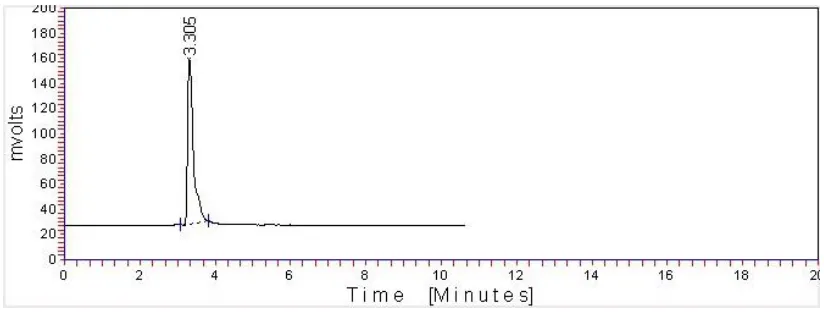
was found to be suitable. The peak shapes of losartan was symmetrical and the asymmetry factor was
lesser than 2.0. [Fig.2].
Fig. 2: Representative chromatogram of Losartan Potassium System suitability
System suitability parameters such as number of theoretical plates, HETP and peak tailing were determined. The results obtained are shown in Table‐1. The number of theoretical plates for losartan
3176.
Table 1: Result of system suitability
Serial No. Parameters Losartan
1 No. of Theoretical plates 3176
2 HETP 0.079
3 Tailing factor 1.8
Linearity
Losartan showed a linearity of response between 5-25 μg/ml. The linearity was represented by a linear
regression equation as follows.
Accuracy
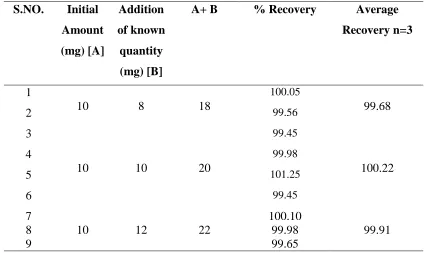
Recovery studies were performed to validate the accuracy of developed method by adding a definite
concentration of standard drug in to preanalyzed sample solution. These results are summarized in
Table‐2.
Table 2: Results of recovery experiments
S.NO. Initial Amount (mg) [A] Addition of known quantity (mg) [B]
A+ B % Recovery Average Recovery n=3
1
10 8 18
100.05
99.68
2 99.56
3 99.45
4
10 10 20
99.98
100.22
5 101.25
6 99.45
7
10 12 22
100.10
99.91
8 99.98
9 99.65
Precision:
Repeatability: Five dilutions in three replicates were analyzed in same day for repeatability and results were found within acceptable limits (RSD ‹ 2) as shown in Table‐3.
Intermediate precision: Five dilutions in three replicates were analyzed on two different days and by two analysts for day to day and analyst to analyst variation. All Results were fall within
acceptable limits (RSD ‹ 2) as shown in Table‐3.
Table 3: Results of precision
Serial No.
Validation Parameter % Mean*
S.D. % R.S.D.
1 Repeatability 100.1 0.51 0.50
2 Intermediate precision Day to Day
98.33 0.398 0.405
3 Intermediate precision Analyst to Analyst
* Mean of fifteen determinations (3 replicates at 5 concentration level)
Robustness
As per ICH norms, small, but deliberate variations, by altering the pH or concentration of the mobile
phase were made to check the method’s capacity to remain unaffected. The change was made in the ratio
of mobile phase, instead of Methanol: acetonitrile (10:90v/v), Methanol: Methanol: acetonitrile (15:85v/v), was used as a Mobile Phase. Results of analysis were summarized in Table‐4.
Table 4 : Results of robustness
Serial No. Validation Parameter % Mean* S.D. % R.S.D.
1 Robustness 99.8 0.26 0.26
* Mean of six determinations
Stability of sample solution
The sample solution injected after 12 hr did not show any appreciable change.
Tablet analysis
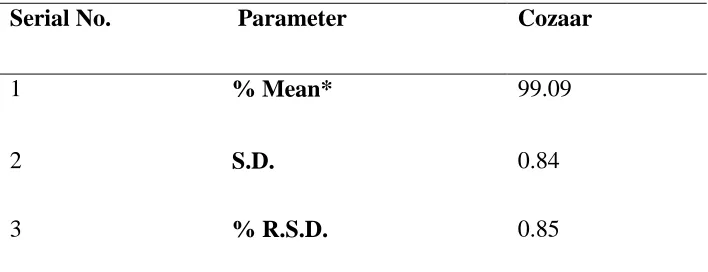
Content of losartan found in the tablets by the proposed method are shown in Table‐5. The low values of
R.S.D. indicate that the method is precise and accurate.
Table 5: Results of the HPLC analysis for tablets Serial No. Parameter Cozaar
1 % Mean* 99.09
2 S.D. 0.84
3 % R.S.D. 0.85
* Mean of fifteen determinations (3 replicates at 5 concentration level)
CONCLUSION
RP‐HPLC method was developed and validated for estimation of losartan in tablet dosage form. Proposed
method is fast, accurate, precise and sensitive hence it can be employed for routine estimation and quality
REFERENCE
1. Indian Pharmacopoeia Commission, Indian pharmacopoeia, GAZIABAD, 2007, 701-3.
2. The United States Pharmacopoeia Drug Information, vol. 1, The United States Pharmacopoeia
Convention, Rockville,Md,USA, 18th edition, 1998.
3. Wankhede SB, Raka KC, Wadkar SB and Chitlange SS. Spectrophotometric and HPLC methods
for simultaneous estimation of amlodipine besilate, losartan potassium and hydrochlorothiazide
in tablets. Indian Journal of Pharmaceutical Sciences. 2010; 72(1): 136–140.
4. Pitt B, Segal R, Martinez FA. Randomised trial of losartan versus captopril in patients over 65
with heart failure(Evaluation of Losartan in the Elderly Study, ELITE). Lancet. 1997; 349(9054):
747–752.
5. McCarthy KE, Wang Q, Tsai EW, Gilbert RE, Ip DP and Brooks MA. Determination of losartan
and its degradates in COZAAR tablets by reversed-phase high-performance thinlayer
chromatography. Journal of Pharmaceutical and Biomedical Analysis. 1998; 17(4): 671–677.
6. Sathe SR and Bari SB. Simultaneous analysis of losartan potassium, atenolol, and
hydrochlorothiazide in bulk and in tablets by high-performance thin-layer chromatography with
UV absorption densitometry. Acta Chromatographica. 2007; 19: 270–278.
7. Quaglia MG, Donati E, Carlucci G, Mazzeo P and Fanali S. Determination of losartan and
hydrochlorothiazide in tablets by CE and CEC. Journal of Pharmaceutical and Biomedical
Analysis. 2002; 29(6): 981–987.
8. Lastra OC, Lemus IG, S´anchez HJ and P´erez RF. Development and validation of
anUVderivative spectrophotometric determination of Losartan potassium in tablets. Journal of
Pharmaceutical and Biomedical Analysis. 2003; 33(2): 175–180.
9. RM. Maggio, P. M. Castellano, and T. S. Kaufman, “A multivariate approach for the
simultaneous determination of losartan potassium and hydrochlorothiazide in a combined
pharmaceutical tablet formulation. Analytical and Bioanalytical Chemistry. 2008; 391(8): 2949–
2955.
10.Prabhakar AH and Giridhar R. A rapid colorimetric method for the determination of Losartan
potassium in bulk and in synthetic mixture for solid dosage form. Journal of Pharmaceutical and
Biomedical Analysis. 2002; 27(6): 861–866.
11.Hertzog DL, McCafferty JF, Fang X, Tyrrell RJ and Reed RA. Development and validation of a
hydrochlorothiazide, and their degradation products. Journal of Pharmaceutical and Biomedical
Analysis. 2002; 30(3): 747–760.
12.Erk N. Analysis of binary mixtures of losartan potassium and hydrochlorothiazide by using high
performance liquid chromatography, ratio derivative spectrophotometric and compensation
technique. Journal of Pharmaceutical and Biomedical Analysis. 2001; 24(4): 603–611.
13.Carlucci G, Palumbo G, Mazzeo P and Quaglia G. Simultaneous determination of losartan and
hydrochlorothiazide in tablets by high-performance liquid chromatography. Journal of
Pharmaceutical and Biomedical Analysis. 2000; 23(1): 185– 189.
14.Williams RC, Alasandro MS, Fasone VL, Boucher RJ and Edwards JF. Comparison of liquid
chromatography, capillary electrophoresis and super-critical fluid chromatography in the
determination of Losartan Potassium drug substance in Cozaar tablets. Journal of Pharmaceutical
and Biomedical Analysis. 1996; 14(11): 1539–1546.
15.Ozkan SA, Akay C, Cevheroglu S and Senturk Z. Rapid and accurate simultaneous determination
of fosinopril sodium and hydrochlorothiazide in tablets by HPLC. Journal of Liquid