PROBLEMATIC OF THE EARLY INTRODUCTION OF FOOD IN INFANTS IN
DEVELOPING COUNTRIES: CASE OF A SUB-DISTRICT OF ABIDJAN (IVORY
COAST)
Abo K. J. Mouroufie1*, Egnon K. V. Kouakou1,4, Siaky M. Kamara3,4, Carène M. S. Konan2,4, Kouamé G. M. Bouafou5, Amenan Clementine Kouakou2, Séraphin Kati-Coulibaly1
1
Laboratory of Nutrition and Pharmacology, Faculty of Biosciences, University Felix Houphouet-Boigny, Abidjan, Ivory Coast 22 B.P. 582 Abidjan 22, Ivory Coast.
2
Nangui Abrogoua University Training and Research Unit in Food Science and Technology (UFR-STA) Laboratory of Food Biotechnology and Microbiology. 02 BP 801 Abidjan 02, Côte d’Ivoire.
3
Institute of Anthropological Sciences of Development (ISAD), University Félix Houphouet-Boigny (UFHB), Abidjan, 22 B.P. 582 Abidjan 22, Ivory Coast.
4
National Nutrition Program, Ivory Coast. 18 BP 976 Abidjan 18. 5
Natural Sciences, Normal Superior School, Abidjan, Ivory Coast. 08 B.P. 10 Abidjan 08.
Received date: 19 September 2018 Revised date: 10 October 2018 Accepted date: 30 October 2018
1-INTRODUCTION
Africa remains one of the regions of the world where breastfeeding is the most widespread and lasts the longest (Perez-Escamilla, 1993). There are, however,
inappropriate practices in the management of
breastfeeding. In addition, complementary foods are introduced before the age of (6) six months. The World Health Organization (WHO) advocates exclusive breastfeeding for up to 6 months and continued until the age of 2 (WHO / UNICEF, 2003). Indeed, exclusive breastfeeding reduces the risk of chronic diseases
(diabetes, obesity ...) pathology and improves cognitive development of the child (Kramer et al., 2008).
Like other developing countries, respect for exclusive breastfeeding practices and the age of dietary diversification have not always been respected by mothers. In Côte d'Ivoire, despite advances, 77% of mothers do not practice exclusive breastfeeding for the first six months of life (MICS, 2016). Although breastfeeding is a customary rule in Côte d'Ivoire, the rate of exclusive breastfeeding remains low (EDSCI 2016, PNN 2016). And one in three (30%) children are stunted (UNICEF, 2016).
Original Article www.wjahr.com
Volume: 2. Issue: 6. Page N. 62-66
Year: 2018
WORLD JOURNAL OF ADVANCE
HEALTHCARE RESEARCH
Corresponding author:Abo K. J. Mouroufie
Laboratory of Nutrition and Pharmacology, Faculty of Biosciences, University Felix Houphouet-Boigny, Abidjan, Ivory Coast 22 B.P. 582 Abidjan 22, Ivory Coast.
ABSTRACT
The purpose of this work is to determine the influence of the early introduction of food to instead of in infants in Anono a sub-district of Abidjan Cocody. To do so, a cross-sectional and descriptive study was carried out in Cocody (Anono), a sub-district of Abidjan Côte d'Ivoire. It was conducted from early March to the end of July 2018. During this case study 960 children underwent a nutritional assessment. The data were collected using a sample questionnaire form for nutritional assessment including a SECA brand baby weigh scale, and a mother-child health record. The results of this study show that food is introduced early in the diet of all infants aged 0 to 6 months. Of these children, more than 61% received foods at an early age of 4-5 months. The introduced foods are Anagobaka at 41.27%, 24.16% for industrial flours, 20% for local flours and 9.57% for water and 5% for fruit juices. It is the housewives and traders with 36.25% and 26.04% respectively were those who mostly introduced food early. The reasons given for this tendency are the unavailability of the mother (68.02%), the insufficiency of breast milk (22.36%), the problem of constipation (6.57%) and finally the problem of lactation (3, 05%). Early introduction of food to the baby, before the age of (6) six months, could cause a disturbance of the gut microbiota which leads creates a factor favoring malnutrition. In addition, rising of awareness should be conducted on the appropriate period to introduce food and what type of such food for infants in Côte d'Ivoire.
In fact, according to the WHO, dietary diversification must start at 6 months of age (WHO, 2001, Kramer et al., 2004). Early diversification may increase the risk of subsequent allergic manifestations (Greer et al., 2008) and nutritional deficits by reducing milk consumption. In addition, early weaning leads to protein-energy malnutrition in infants. This situation influences the growth of young children, and poses a real public health problem in Côte d'Ivoire. It is in this contest that the present study is conducted to evaluate the impact of the introduction of foods in infants from 0 to 6 months.
2- MATERIALS AND METHODOLOGIES
2.1-Materials
The materials used are: - A baby scale (500g); - A SECA brand balance; - A horizontal height (cm); - A Shakir Band (MUAC);
- Information sheet (Questionnaire).
2.2-Methodologies
A descriptive cross-sectional study was conducted over a period of six (6) months (From March to July 2018). In this study 960 mother-child couples were recruited to the Immunization-Nutrition Service at a community health center in Abidjan Cocody (Ivory Coast) (Egnon et al., 2017). Questions were asked to mothers about the function of the mother, the sex of the child, the period of introduction of food other than breast milk and the type of food.
2.2.1-Data processing
The data from this study were processed with Excel version 2010.
3. RESULTS
3.1-Distribution of mothers by function
The housewives (36.25%) introduces the food at an early stage and secondly by the tradesmen (26.04%).
Figure 1: Distribution of mothers by function.
3.2-Distribution of children by sex In this study, 56.46% of children are girls.
Figure 2: Distribution of children by sex.
3.3-Distribution of children according to the period of introduction of food
The results of this study showed that all infants received either the drink or the food from 0 to 6 months early. 0 to 2 months (3%), 2 to 3 months (5%), 3 to 4 months 9.07%), 4 to 5 months 61% and finally 5 to 6 months (21.05%).
Figure 3: Distribution by food introduction period.
3.3-Distribution of children by type of food introduced before six (6) months.
Anagobaka was the most introduced food at 41.27%, followed by industrial flours with 24.16%.
3.5-Distribution by reason of introduction of food other than breast milk before the age of six (6) months
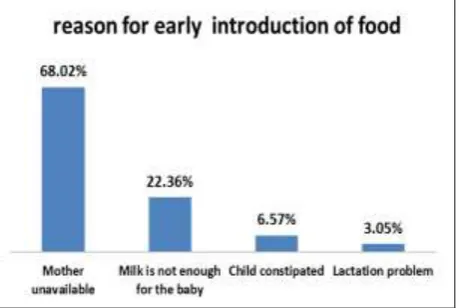
Several reasons motivate the introduction of food before the age of six (6) months, between and others the mother is unavailable (68.02%), the milk is not enough for the baby is 22.36%, the infant is constipated (6, 57%) and finally the problem of lactation at 3.05%.
Figure 5: Distribution by reason of early introduction of food.
4. DISCUSSION
The recommendations of WHO and UNICEF advocate exclusive breastfeeding for up to six (6) months (WHO and UNICEF, 2003). This recommendation is not always respected. In this study, housewives and shopkeepers are the most represented with respectively 36.25% and 26.04%. Our results are a big difference from those of Azagoh-K et al (2013) with an early weaning rate of 87%. On the other hand, our results differ somewhat from those of the countries of the world according to a round table "Breastfeeding". The XIV national public health days 13-14 September 2006 Oriental Palace-Tunis hotel where early weaning before 3 months concerns 25% of Algerian infants and 8.3% of Yemeni infants. In Libya, 50% of infants under 4 months of age are already weaned.
In addition, it has been shown that studies of feeding patterns during the first year of life in Africa, Asia and South America indicate that "98%, 96% and 90% of newborns, respectively, are partially breastfed. During this period; however, the duration of exclusive breastfeeding is usually short "(Breastfeeding Info, 1998, No. 002). These results reveal that breastfeeding, which is a departure for life, encounters in this locality, with many difficulties related to cultural taboos, lack of education and education, and socio-economic aspects (Dakpo et al. al., 2015).
The present study indicates that the household-trade pairing represents more than half of the mothers who introduced the most foods early in infants aged between 4 and 5 months. Commerce, whatever its level, deprives anyone who uses it of time to devote it to other concerns.
Thus, traders sometimes give the infant to close relatives or neighbors for child care care Dakpo et al., (2013). It is in this process that food supplements are sometimes administered to infants to meet their dietary needs. Our results are consistent with those of Dakpo et al., (2013) who found that housewives use feed supplements in infant feeding, followed by nanny nurses. Providing infants under six months of other fluids and / or food products in addition to breast milk is widespread in Côte d'Ivoire (ESDI, 2016).
The results of the present study all infants received early either drink or food from 0 to 6 months.
From 0 to 2 months (3%), 2 to 3 months (5%), 3 to 4 months 9.07%), 4 to 5 months 61% and finally 5 to 6 months (21.05%). These results are consistent with those of Nlend et al (1997). According to them, weaning begins early putting the child in potential contact with water not always clean to the drink. In fact, during this study, it was found that early weaning reduces the practice of breastfeeding. The same findings were made by Aké-Tano et al (2014).
This early introduction of complementary foods may have an adverse effect on the nutritional status of children, leading to malnutrition. In addition, the introduction of solid foods early can lead to nutritional deficiencies Crochet et al (Crochet et al., 2018). In the Morgaye (2009) study, it was also shown that most mothers introduced food before 6 months. In addition, the introduction of foods early influences the gut microbiota of the child (Betoko, 2013) and may cause growth retardation in infants. If the early introduction of fruit is related to constipation those of the porridge is attributed to the impression of a lack of satiety of the child by the mothers.
According to Egnon et al. (2017b) Socio-economic status is a risk factor that can influence early childhood growth. Social classes or relatively low standard of living are more vulnerable to the introduction of food before age (6) six months.
In this study, the results show that more than 61% of children received food early. This is not consistent with the recommendation of the World Health Organization (WHO) to introduce solid foods from six months of the child (WHO, UNICEF, 2003).
These results are contrary to those of Kanté (2009), where rice was the most introduced cereal (74.1%) in children from 0 to 6 months. The consumption of so-called early weaning meal by children in this study could be one of the potential causes of nutritional deficiencies in infants in Côte d'Ivoire. In this study more than 41% consume Anagobaka. According to Egnon et al (2016a) the biochemical assays of Anagobaka weaning flour showed a huge nutritional imbalance. Indeed, they revealed in an animal experiment that the consumption of Anagobaka resulted in a loss of -0.97g / day of body weight and a low digestibility in animals.
The introduction of these foods could explain the low consumption of breast milk because of its low digestibility. This could influence the child's growth in relation to his age and weight. In addition, local flours such as millet, maize, soybean, rice and anagobaka contain negligible amounts of protein with a high carbohydrate value. Organs such as the liver, heart and kidneys may therefore suffer from a pathology or disruption of their nutritional metabolism leading to malnutrition (Egnon et al., 2016a).
The addition of water or any other liquid such as flour meal can also cause a decrease in the production of breast milk which will then cause the baby to breastfeed less often. This form of malnutrition is no doubt responsible, directly or indirectly, for the growing number of annual deaths of children under five worldwide. These deaths are often associated with inappropriate feeding practices that occur in the first year of life. In addition, the consumption of solid foods leads to changes in the gut microbiota in children, whose composition will gradually be closer to that of adults (Palmer, 2007).
The imbalance of the intestinal microbiota through early feeding may affect energy metabolism, weight gain, and long-term health (Backhed 2004, Turnbaugh 2006, Larsen 2010).
Less than 35% of infants worldwide receive exclusive breastfeeding for the first four months, complementary feeding often starts too early or too late and foods are often nutritionally inadequate and unsafe (WHO and UNICEF, 2003).
Factors that favored early weaning were the
unavailability (return to work) of mothers (68.02%), inadequate breast milk (22.36%), and the problem of constipation (6.57%). and finally the problem of lactation (3.05%). In addition, in this study, some mothers said that the duration of breastfeeding could damage the breasts. Indeed, these results are substantially opposite to those of Azagoh-K et al (2013) who mentioned factors favoring the precocity of weaning. These factors were mothers' refusal to breastfeed (28.7%) followed by work demands (24.1%) and a new pregnancy (19.5%). These factors may explain the lack of awareness of the
importance of duration of breastfeeding. The results of this study show that the ratio of girls to boys is 1.3. This result is contrary to the configuration of the girl-boy ratio of the population of our country. This finding could favor the intergenerational cycle of malnutrition.
5-CONCLUSION
The result of this study showed that early introduction of food is common in infants under 6 months of age. The risk factors associated with this early introduction are multiple and go beyond the health sector, ranging from the function of breastfeeding mothers to the type of feed introduced. Often foods are given to young children because of the problem of satiety, lactation, constipation and unavailable mother. In this study the early introduction of food was made mostly in girls as boys.
Early weaning may, however, pose a risk to infant health because it increases the risk of diarrhea and other infectious diseases. This undoubtedly demonstrates that the population still needs to be sensitized on the period of introduction of food and its consequences on the health of the young child. In sum, this study shows that the improvement of infant nutrition would be a necessary condition for the reduction of chronic malnutrition, stunting in Côte d'Ivoire.
REFERENCES
1. Aké-Tano, O., Ekou F, Yao EK, Ekissi OT, Kpebo
D, Sand P, Aka BS, Gbané M, Dagnan NS. feeding practices of children from 0 to 2 years followed in a health facility in Abidjan. Rev int sc med, 2014; 16(1): 89-93.
2. Azagoh-K, R., Enoh Js, Niangue B, Cisse L, Oulai Sm, Andoh J. Knowledge and practices of mothers from 6 to 18 months of age related to the conduct of weaning: case of the general hospital from Marcory. Mali Medical Journal, 2013; 4.
3. Coulibaly, A., Aké-Tano O, Benié-Bi V J., Traoré Y., Dagnan NS. Socioprofessional factors and practice of exclusive breastfeeding by primiparous women in Abidjan (Côte d'Ivoire) Public Health, 2014; 4(26): 555-562.
4. Betoko, A S. Early feeding: its determinants, its influence on postnatal growth and food consumption at 3 years. Human medicine and pathology. Thesis of Paris Sud University - Paris XI, 2013; 244.
5. Backhed, F., Ding H, Wang T, Hooper LV, Koh
GY, Nagy A, et al. The gut microbiota as an environmental factor that regulates fat storage. Proc Natl Acad Sci U S A, 2004; 101: 15718-23.
6. Castetbon, K., N. Duport, Hercberg S.
Epidemiological Bases for Monitoring Breastfeeding in France. Rev Epidemiol Public Health, 2004; 52(5): 475-80.
7. Dakpo, C.P., Messan F., A. Nakou, A. Mikode,
the commune of Dangbo in Benin. University of Abomey-Calavi - Benin, 2013.
8. Dewey, K.G. "Nutrition, growth, and
complementary feeding of the infant breast." Pediatr Clin North Am, 2001; 48(1): 87-104.
9. Demographic and Health Survey and Multiple
Indicators Côte d'Ivoire 2016 (EDSMICS, 2016). 10. Forestell CA, Mennella, JA. Early Determinants of
Fruit and Vegetable Acceptance. Pediatrics, 2007; 120: 1247-54.
11. Greer US, Sicherer SH., Burks, A. Effects of early nutritional interventions on the development of atopic diseases in infants and children: the role of maternal dietary restriction, breastfeeding, timing of
introduction of complementary foods, and
hydrolyzed formulas. Pediatrics, 2008; 121(1): 183-91.
12. Kanté, L. Assessment of the nutritional status of children from 2 to 59 months hospitalized in the pediatric ward of Gabriel Toure University Hospital. About 116 cases. Thesis of the Faculty of Medicine, Pharmacy and Odontostomatology of Mali, 2000; 82.
13. Kouakou, E K V., Bouafou K G M, Meité A.,
Kouamé K G., Kati-Coulibaly S. Commercial weaning flour Anagobaka: what pathological risks in the growing rat diet? International Journal of Biological and Chemical Sciences, 2016; 10(1).
14. Kouakou, E V., Siaky M. Kamara, Zannou-Tchoko,
V., Meité, A., Kouamé, Bouafou, GM, Niaba, K., Djetouan, J M., Kati-Coulibaly S, Neglected Growth Retardation in Children Aged 6-59 months in developing Countries: Case of a Sub-neighborhood of Abidjan Cocody - Ange (Ivory Coast). Science Journal of Public Health, 2017; 5(5-1): 8-12.
15. Kouakou Egnon K. V., Bouafou Kouamé G. M,
Meité Alassane, Kouamé K. Gustave, Kati-Coulibaly Séraphin, Nutritional Effects of Weaning Flour 'Anagobaka' on Young Rats Wistar, Science Journal of Public Health. Special Issue: Addiction and Substance Abuse, 2016; 4(5-1): 12-16.
16. Kramer, MS., Aboud, F., Mironova, E., Vanilovich,
I., Platt, RW., Matush, L. Breastfeeding and Child Cognitive Development: New evidence from a large randomized trial. Arch Gen Psychiatry, 2008; 65(5): 578-84.
17. Koletzko, B. Early nutrition and its later
consequences: new opportunities. Adv Exp Med Biol, 2005; 569: 1-12.
18. Larsen, N., Vogensen, FK., Van den Berg, FWJ.,
Nielsen, DS., Andreasen, AS., Pedersen BK. Gut Microbiota in Human Adults with Type 2 Diabetes Differs from NonDiabetic Adults. PLoS One, 2010; 5: e9085.
19. Morgaye, A B. Evaluation of the nutritional status of
children aged 6 to 24 months seen in pediatric consultation at the National Reference General Hospital of N'Djamena (Chad). FMPOS Thesis of Medicine, 2009; 118.
20. Nlend, A., Wamba, G., Same Eboko, C. Infant
feeding from 0 to 36 months in Cameroonian urban areas. Med Afr Black, 1997; 44(1): 47-51.
21. Perez-Escsuiilla R. Update on the breastfeeding
situation in Africa. Nutl: Res., 1993; 13: 597-609. 22. WHO. Global Strategy for Infant and Young Child
Feeding - Optimal duration of exclusive
breastfeeding. WHO A54 / INF DOC / 4, 2001; 1-5.
23. WHO, UNICEF. Global Strategy for Infant and
Young Child Feeding, 2003; 30.
24. Palmer, C., Bik EM, DiGiulio DB., Relman DA.,
Brown PO. Development of the Human Infant Intestinal Microbiota. PLoS Biol, 2007; 5: e177.
25. Turnbaugh, PJ., Ley RE., Mahowald, MA., Magrini,