*Address for correspondence
K.V.N.R.Aishwarya* D/O K.N.V.S.Satyanarayana, Dno: 44-11- 37,Bose Statue Street, Annapurnammapeta, Rajahmundry-533101,
East Godavari District,AndhraPradesh.
E-mail: [email protected] Phone Number: 9949736626
Research Article
PREPARATION, CHARACTERIZATION AND EVALUATION OF
PGS-PVP-AEROSIL CO-PROCESSED EXCIPIENT AS DIRECTLY COMPRESSIBLE VEHICLE
IN TABLETS FORMULATION
K.V.N.R.Aishwarya *, K.V.Ratnam
Aditya Pharmacy College, AdityaNagar, ADB Road, Surampalem-533437, Andhra Pradesh, India.
A RT I C L E I N F O A B S T R AC T
Key words:
Co-processing, Direct compression, directly compressible vehicles, Tablets, Aceclofenac,
Sulphamethoxazole.
An efficient platform for the manipulation of excipient functionality is provided by co-processing two or more existing excipients. Co-processing is based on the novel concept of two or more excipients interacting at the sub particle level, the objective of which is to provide a synergy of functionality improvements as well as masking the undesirable properties of individual excipients. The objective of the present study is to prepare and characterize pregelatinised starchpolyvinyl pyrrolidone K30 -Aerosil (PGS-PVP--Aerosil) co-processed excipient and to evaluate its application as directly compressible vehicle in tablet formulations. PGS-PEG-Aerosil co-processed Excipient was prepared by gelatinizing rice starch in the presence of PEG 1500 and Aerosil and drying the resulting mass and was characterized by determining melting point, solubility, swelling index in water, PH and micromeritic characters namely particle size, bulk density, tapped density, angle of repose and compressibility index and evaluated for its application as directly compressible vehicle in tablet formula-tions. The new co-processed excipient prepared was crystalline, discrete, fine and free flowing powder. It is insoluble in water and aqueosus buffers of pH 1.2, 4.5 and 7.4 and in several organic solvents. It exhibited high swelling (284%) in water. The new excipient developed (PGS- PVP-Aerosil) exhibited excellent flow properties alone and as blends with selected drugs. Tablets of i) Aceclofenac and ii) Sulpha-methoxazole prepared employing PGS-PVP-Aerosil co-processsed excipient alone as directly compressible vehicle were found to be soft and fragile. Blend of PGS-PVP-Aerosil co-processed excipient exhibited good flow characteristics. Tablets of i) Aceclofenac and ii)Sulphamethoxazole prepared by direct compression method em-ploying blend PGS- PVP-Aerosil as directly compressible vehicle was found to be of good quality with regard to drug content, hardness, friability, disintegration time and dissolution rate. All the tablets disintegrated rapidly within 60-80 sec and gave rapid dissolution of the contained drug fulfilling the official dissolution rate test specification prescribed in each case. Thus PGS-PGVP-Aerosil co-processed excipi-ent developed was found to be a promising directly compressible vehicle for the preparation of compressed tablets with fast dissolution characteristics.
INTRODUCTION
Direct compression is the preferred method for the preparation of tablets [1].
It offers several advantages[2-3] .Notable among
them are (i) It is economical compared to wet granulation since it requires fewer unit operations (ii) More suitable for moisture and heat sensitive APIs since it eliminates wetting and drying steps (iii) Changes in dissolution profile are less likely to occur in tablets made by direct compression method on storage than in those made from granu-lations[4].This is extremely important because the official compendium now requires dissolution
specifications in most solid dosage forms[5].
Disin-tegration or dissolution is the rate-limiting step in
Journal of Global Trends in Pharmaceutical Sciences
3214 absorption in the case of tablets of poorly soluble API prepared by wet granulation. The tablets pre-pared by direct compression disintegrate into API particles instead of granules that directly come into contact with dissolution fluid and exhibits compar-atively faster dissolution. The direct compression process is mainly influenced by the properties of the excipients. The physico mechanical properties of excipients that ensure a robust and successful process are good flowability, good compressibil-ity, low or no moisture sensitivcompressibil-ity, low lubricant sensitivity, and good machine ability even in high
–speed tableting machinery with reduced dwell
times [6]. The majority of the excipients that are currently available fail to live up to these function-ality requirements, thus creating the opportunity for the development of new high-functionality excipients. An efficient platform for the manipula-tion of excipient funcmanipula-tionality is provided by co-processing two or more existing excipients. Co-processing is based on the novel concept of two or more excipients interacting at the sub particle lev-el, the objective of which is to provide a synergy of functionality improvements as well as masking the undesirable properties of individual excipients
[7]
. The availability of a large number of excipients for co-processing ensures numerous possibilities to produce tailor-made “designer excipients” to a d-dress specific functionality requirements. Co-processed excipients are prepared by incorporating one excipient into the particle structure of another excipient using processes such as co-drying. Co-processing of excipients in the pharmaceutical
industry can be dated back to the late 1980’s with
the introduction of co-processed microcrystalline
cellulose and calcium carbonate[8], followed by
Cellactose (Meggle Corp.,Wasserburg, Germany) in 1990, which is a co-processed combination of cellulose and lactose. A similar principle was ap-plied in developing silicified microcrystalline cel-lulose (SPVP), which is the most widely used co-processed excipient[9].The major objective of the present study is to prepare and characterize prege-latinized starch-poly vinyl pyrrolidone (PGS-PVP) co-processed excipient and to evaluate its applica-tion as directly compressible vehicle in tablet for-mulations. PGS-PVP co- processed excipeint was prepared by gelatinizing potato starch in the pres-ence of PVP and drying the resulting mass.
Materials &Methods:
Aceclofenac and sulphamethoxazole were gift samples from M/s Natco Pharma Ltd., Potato starch from SDFCL. Mumbai., Poly vinyl Pyrroli-done K-30 from Sigma Chemicals. Mumbai., Lac-tose, methanol, chloroform,di chloromethane from Qualigens., Talc, magnesium stearate were
pro-cured from LOBA CHEME Mumbai., All other materials used were of Pharmacopoeial grade.
Methods:
Preparation of PGS-PVP-Aerosil Coprocessed Excipient:
Potato starch (49 parts) and PVP K-30 (1 part) and Aerosil (0.4 parts) were dispersed in 20 parts of water to form smooth slurry. Purified water (40 parts) was taken in a separate beaker and heated to boiling. Starch-PVP-Aerosil slurry was added to boiling water while stirring. Stirring and heating was continued for 15 to 20 minutes to form a thick mass. To the massformed, acetone (40 parts) was added and mixed thoroughly to remove the water in the product formed. The product formed was collected by filtration and further dried at 800C until dry. The dried product was grinded and sized to obtain -72+100 mesh sized particles.
Characterization of New Co-Processed Excipient Prepared:
The new co-processed excipient prepared was evaluated for the following:
Solubility: Solubility of PGS-PVP-Aerosil copro-cessed excipient was tested in water, aqueous buffers of pH 1.2, 4.5, and 7.4 and organic sol-vents such as alcohol, dichloromethane, chloro-form, acetone and petroleum ether.
pH: The pH of 1% w/v slurry was measured.
Melting Point: Melting point was determined by using melting point apparatus (Digimelt).
Swelling Index [10]: The new excipient pre-pared(500 mg) was added to 10 ml of water and light liquid paraffin taken in two different graduat-ed test tubes and mixgraduat-ed. The dispersions in the tubes were allowed to stand for 24 h. The volume of the sediment in the tubes was recorded. The swelling index of the material was calculated as follows.
Moisture Absorption: The hygroscopic nature of the new excipient prepared was evaluated by mois-ture absorption studies in a closed desiccator at 84% relative humidity and room temperature.
Particle Size: Particle size analysis was done by sieving using standard sieves.
Angle of Repose [12]: Angle of repose was meas-ured by fixed funnel method.
Compressibility Index [13]: Compressibility index (CI) was determined by measuring the initial vol-ume (V0) and final volume (V) after hundred
tap-ings of a sample of the product in a measuring cylinder. CI was calculated using the equation
Compressibility index (CI) = [(V0–V)/V0)]×100
Estimation of Aceclofenac:
An UV spectrophotometric method based on the measurement of absorbance at 274 nm in phos-phate buffer of pH 7.4 was used for the estimation of aceclofenac. The method was validated for line-arity, accuracy, precision and interference. The
method obeyed Beer’s law in the concentration
range of 1-10 µg/ml. when a standard drug solu-tion was repeatedly assayed (n=6), the relative error and coefficient of variance were found to be 1.76 % and 0.18 % respectively. No interference by excipients used in the study was observed.
Estimation of Sulphamethoxazole:
An UV spectrophotometric method based on the measurement of absorbance at 276 nm in 0.1 N Hcl was used for the estimation of Sulphamethox-azole. The method was validated for linearity, accuracy, precision and interference. The method
obeyed Beer’s law in the concentration range of 1
-10 µg/ml. when a standard drug solution was re-peatedly assayed(n=6), the relative error and coef-ficient of variance were found to be 1.87 % and 0.45 % respectively. No interference by excipients used in the study was observed.
Preparation of Tablets by Direct Compression Method:
Tablets of (i) Aceclofenac (100 mg) and (ii) Sul-phamethoxazole (100 mg) were prepared by direct compression method as per the formulae given in the Table 2 employing PGS-PVP-Aerosil co-processed excipient as directly compressible vehi-cle. All the materials required as per the formula were blended in a closed polyethylene bag. The blends were directly compressed into tablets on a 10-station tablet punching machine (Rimek) to a hardness of 3-4 kg/cm2 using 12 mm flat punches.
Evaluation of Tablets:
All the tablets prepared were evaluated for content of active ingredient, hardness, friability, disinte-gration time and dissolution rate. Hardness of tab-lets was tested using Monsanto hardness tester.
Friability of the tablets was determined in a Roche Friabilator. Disintegration time was determined in single unit disintegration test apparatus (Make paramount) using water as a test fluid.
Estimation of Drug Content in the Tablets[14]:
From each batch of tablets prepared 10 tablets were accurately weighed and powdered. Tablet powder equivalent to 50 mg of drug was taken for assay into a 100 ml conical flask and extracted with 3×20 ml quantities of methanol. The meth-anolic extracts were filtered and collected into a 100 ml volumetric flask and the volume was then made upto 100 ml with methanol. The solution was then suitably diluted with phosphate buffer 7.4 in case of aceclofenac and with 0.1 N HCl of in the case of sulphamethoxazole. The absorbance of the solutions was measured at 276 nm and 274 nm respectively in the case of aceclofenac and sul-phamethoxazole . Drug content of the tablets was calculated using the standard calibration curve in each case.
Dissolution Rate study [15]:
Dissolution rate of the tablets prepared was studied employing USP 8 station dissolution rate test ap-paratus (M/s Labindia Disso 8000) with a paddle stirrer at 50 rpm.Phosphate buffer of pH 7.4 (900ml), and 0.1N HCl (900ml) were used as dissolution fluids for aceclofenac and sulphameth-oxazole respectively. One tablet was used in each test. At a temperature, 37±100C was maintained throughout. Samples of dissolution medium (5ml) were withdrawn through a filter (0.45 µ) at differ-ent time intervals and assayed for for aceclofenac at 276 nm and at 274 nm for sulphamethoxazole. All the dissolution experiments were conducted in triplicate (n=3).
RESULTS AND DISCUSSION
Directly compressible vehicles can be prepared by
various methods [1-3]. Co- processing is the one of
3216 determining various physical and micromeritic
properties[16]. The PGS-PVP co-processed
excipi-ent prepared was found to be crystalline, discrete and free flowing powder. It could be ground to various particle sizes by grinding in a dry mortar.
Particles of size -72+100 mesh (179.5 μm) were
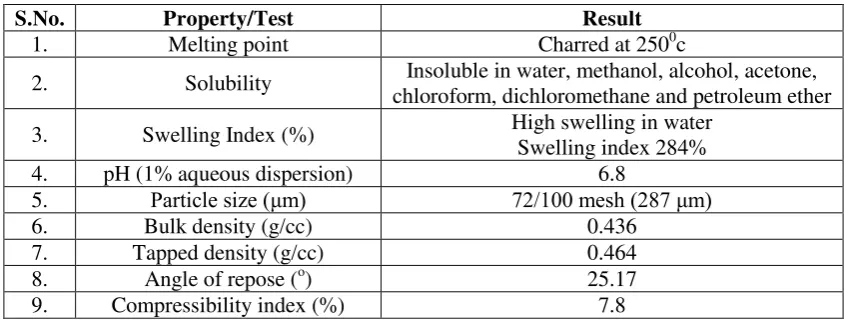
collected and used for further studies. The physical and micromeritic properties of PGS-PVP co-processed excipient prepared are summarized in
Table – 1. The PGS-PVP co-processed excipient
prepared was charred at 2500C.It is insoluble in water and aqueous fluids of pH 1.2, 4.5 and 7.4 and also in several organic solvents such as alco-hol, methanol, dichloromethane, acetone, chloro-form and petroleum ether. It exhibited high swell-ing in water and the swellswell-ing index was found to be 284 %.
The flow properties of the PGS-PVP co-processed excipient prepareprepared were deter-mined by measuring bulk density, angle of repose and compressibility index. The results given in Table 4 indicated that the excipient prepared has excellent flow properties. Directly compressible vehicles should be free flowing.Flowability is re-quired in order ensure homogeneous and rapid flow of powder for uniform die filling. During the short dwell-time (milliseconds), the required amount of powder blend should be transferred into die cavities with reproducibility of ± 5%. As the PGS-PVP co-processed excipient possesses excel-lent flow properties, it is considered as a promising directly compressible vehicle for direct compres-sion of tablets. Blends of PGS-PVP co-processed excipient and selected drugs (sulphamethoxazole, paracetamol and aceclofenac) also exhibited excel-lent to good flow properties. The estimated bulk density values of PGS-PVP co-processed excipient would also contribute to its good flow.
Evaluation of PGS-PVP co-processed excipient as directly compressible vehicle:
To evaluate the PGS-PVP co-processed excip-ient as directly compressible vehicle (DCV), tab-lets of (i) sulphamethoxazole (ii) paracetamol and (iii) aceclofenac were prepared by direct compres-sion method employing PGS-PVP co-processed excipient as DCV at strength of 60% in the formu-la. The tablets were prepared as per the formulae given Table 5. All the tablets prepared were evalu-ated for content of active ingredient, hardness, friability, and disintegration time and dissolution rate. The results are given in Table 6. Hardness of the tablets was in the range 4.0 - 5.0 Kg/sq.cm. Weight loss in the friability test was in the range 1.45 – 2.10%.The drug content of the tablets was
within 100 ± 3% of the labelled claim. All the tablets formulated disintegrating rapidly within 3.5 min. As such all the tablets prepared employing the PGS-PVP co-processed excipient were of good quality with regard to drug content ,hardness, fria-bility and disintegration time. .With all the three drugs,the tablets prepared gave rapid dissolution of the contained drug. The dissolution was complete (100 %) within 20 min and fulfilled the official (IP/USP) dissolution rate test specification pre-scribed in each case. The dissolution parameters are summarized in table – 4.
CONCLUSIONS:
1. The new co-processed excipient prepared
was crystalline, discrete, fine and free flowing powder.
2. It is insoluble in water and aqueous buff-ers of pH 1.2, 4.5 and 7.4 and in several organic solvents.
3. It exhibited high swelling (284%) in
wa-ter.
4. The new excipient developed (PGS-
PVP-Aerosil) exhibited excellent flow proper-ties with selected drugs.
5. Tablets of i) Aceclofenac and ii)
Sulpha-methoxazole prepared employing PGS-PVP-Aerosil coprocesssed excipient alone as directly compressible vehicle were found to be soft and fragile.
6. Blends of PGS-PVP-Aerosil co-processed
co-processed excipient exhibited good flow characteristics.
7. Tablets of i) Aceclofenac and
ii)Sulphamethoxazole prepared by direct compression method employing PGS-PVP-Aerosil coprocessed excipient as di-rectly compressible vehicle were found to be of good quality with regard to drug content, hardness, friability, disintegration time and dissolution rate.
8. All the tablets disintegrated rapidly within
Table 1: Physical and Micromeritic Properties of PGS-PVP-Aerosil Co-processed Excipient
Table 2: Formulae of Tablets Prepared By Direct Compression Method Employing PGS –
PVP – Aerosil Co-processed Excipient
Ingredient (mg/tablet)
Tablet Formulation
Sulphamethoxazole Aceclofenac
Sulphamethoxazole 100 -
Aceclofenac - 100
PGS-PVP
Co-processed excipient (72/100 mesh) 264 264
Lactose 58.4 58.4
Talc 8.8 8.8
Magnesium stearate 8.8 8.8
Tablet weight
(mg) 440 440
Table 3: Physical Properties of Various Tablets Prepared by Direct Compression
Method Employing PGS –PVP-Aerosil Co-processed Excipient
Formulation Hardness
(kg/sq.cm)
Friability (% weight loss)
Disintegration time(min-sec)
Drug content (mg/tablet)
Aceclofenac tablets 4.0 0.72 1-20 98.5
Sulphamethoxazole tablets 4.5 0.93 1-00 101.6
Table 4: Dissolution Parameters of Tablets Prepared by Direct Compression Method Employing PGS-PVP-Aerosil Co-processed Excipient
Tablet
Formulation DE30 (%) K1×10
2
(min-1) PD10 (%) T50 (min)
Aceclofenac tablets 55.45 0.046 55.62 10
Sulphamethoxazole tablets 72.74 0.069 100 9
S.No. Property/Test Result
1. Melting point Charred at 2500c
2. Solubility Insoluble in water, methanol, alcohol, acetone,
chloroform, dichloromethane and petroleum ether
3. Swelling Index (%) High swelling in water
Swelling index 284%
4. pH (1% aqueous dispersion) 6.8
5. Particle size (μm) 72/100 mesh (287 μm)
6. Bulk density (g/cc) 0.436
7. Tapped density (g/cc) 0.464
8. Angle of repose (o) 25.17
3218
Fig 1: Zero order plot for Aceclofenac and Sulphamethoxazole tablets Employing PGS- PVP-Aerosil Co-processed Excipient
Fig 2: First order plot for Aceclofenac and Sulphamethoxazole tablets Employing PGS-PVP-Aerosil Co-processed Excipient
REFERENCES:
1. Shangraw RF, Direct Compression
Tablet-ing, Encyclopedia of Pharmaceutical
Technology.Vol(4), 2nded.Newyork: Marcel
Dekker, USA, 1988,pp.85-160.
2. Armstrong NA, Selection of excipients for
direct compression tablet formulation.
Pharm.Technol.Eur.1989; 24-30.
3. JivrajM,Martini LG, Thomson CM, An
Overview of the Different Excipients Useful for the Direct Compression of Tablets, PSTT.2000;3:58-63.
4. Rubinstein MH, Tablets Pharmaceutics: The
Science of Dosage of Form, Churchill, UK, Isted, 1998, pp.304-321.
5. Banker UV, Role of Ingredients and
Excipi-ents in Developing Pharmaceuticals., Manuf. Chem.1994;65:32-34.
6. N.A.Armstrong and L.P.Palfrey, The Effect
of Machine Speed on the Consolidation of Four Directly Compressible Tablet Diluents ,J.Pharm. Pharmacol.41, 149-151(1989).
7. D.Reimerdes, The Near Future of Tablet
Ex-cipients ,Manufacturing Chemist, 64(7),14-15(1993)
8. K.M.Dev et al., Coprocessed
Microcrystal-line Cellulose and Calcium Carbonate and Its Preparation. US Patent No.4,744,987 to FMC Corporation (Philadelphia,PA) 1988.
9. G.K.Bolhius and Z.T.Chowhan, Materials
for Direct Compaction. In Pharmaceutical
Powder Compaction Technology,
G.Alderborn and C.Nystron, Eds.(Marcel Dekker Inc., New York, NY, 1996), pp.419-500.
10. K.P.R.Chowdary and Sunil Kumar:
Formu-lation development of selected drugs by di-rect compression method. IJPRD, 2011; Vol 3(6): 273-279.
11. Martin A: Physical Pharmacy. Lippincott
Williams &Wilkins. Baltimore, 2001:423-454.
12. Cooper J, Gunn C: Powder flow and
com-paction. Tutorial Pharmacy. CBS Publica-tions, New Delhi, India, 1986: 211-233.
13. Aulton ME, Wells TI: Pharmaceutics; The
science of dosage form design. Churchill Livingstone, London, England, Edition 2, 1988: 89-90.
14. Jivraj M, Martini LG, Thomson CM, an
Overview of the Different Excipients Useful for the Direct Compression of Tablets, PSTT.2000; 3:58-63.
15. Rubinstein MH, Tablets Pharmaceutics: The
Science of Dosage of Form, Churchill, UK, Isted, 1998, pp.304-321.
0 20 40 60 80 100 120
0 50 100
P
er
ce
nt
di
ssolve
d
Time (min)
ACECLOFEN AC
0 0.5 1 1.5 2 2.5
0 100
log p
er
ce
n
t
u
n
d
iss
olved
Tiime(min)
Aceclofenac