Available Online at www.ijpret.com 322
INTERNATIONAL JOURNAL OF PURE AND
APPLIED RESEARCH IN ENGINEERING AND
TECHNOLOGY
A PATH FOR HORIZING YOUR INNOVATIVE WORK
COMPARITIVE STUDY OF EFFECT OF WASTE MATERIALS ON EXPANCIVE
SOIL
PAYAL D. LUNGE, PRAGATI A.DMAKE Dept. of civil engg, D.R.G.I.O.T.& R Amt
Accepted Date: 15/03/2016; Published Date: 01/05/2016
\
Abstract:
Expansive soils are soils that expand when water is added, and shrink when theydry out. This continuous change in soil volume can cause homes built on this soil to move
unevenly and crack. Each year in the United States, expansive soils cause $2.3 billion in
damage to houses, other buildings, roads, pipelines, and other structures. This is more than
twice the damage from floods, hurricanes, tornadoes, and earthquakes combined.
Corresponding Author: MS. PAYAL D. LUNGE
Access Online On:
www.ijpret.com
How to Cite This Article:
Available Online at www.ijpret.com 323 INTRODUCTION
Expansive soils are soils that expand when water is added, and shrink when they dry out. This continuous change in soil volume can cause homes built on this soil to move unevenly and crack. Each year in the United States, expansive soils cause $2.3 billion in damage to houses, other buildings, roads, pipelines, and other structures. This is more than twice the damage from floods, hurricanes, tornadoes, and earthquakes combined.
In Amravati region, black cotton soil is widely present. Black cotton soil is also called as Expansive soil.
Expansive soils owe their characteristics to the presence of swelling clay minerals. As they get wet, the clay minerals absorb water molecules and expand; conversely, as they dry they shrink, leaving large voids in the soil. Swelling clays can control the behavior of virtually any type of soil if the percentage of clay is more than about 5 percent by weight. Soils with steatite clay minerals, such as montmorillonite, exhibit the most profound swelling properties.
Causes of failure:
1. As water from irrigation or rainfall migrates underneath the home’s foundation, the soil
around the edge of the foundation expands, pushing up on the edges of the foundation. This condition, called edge-lift, can cause cracking in the drywall and in the foundation itself.
2. Tree planted near homes can cause long term damage to the foundation. As the trees age and their roots grow beneath the foundation, the roots extract the moisture from the soil, causing it to dry out and shrink. This shrinking can result in increased settlement of the structure many years after the original construction.
Control measures:
1 Geosynthetic materials can be used for reinforcement of expansive soil.
2 Use of waste materials for stabilise the expansive soil.
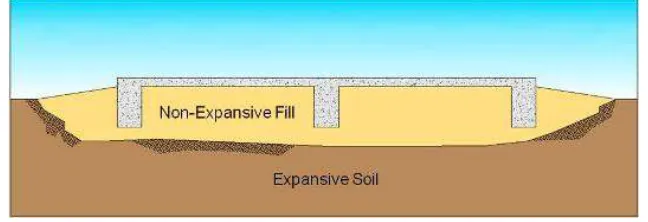
3 Replace the expansive soil by different soil.
4 There are aqlso Expansive soil chemical treatment available which are designed to alter the clay minerlogy and reduce the expansion poetntial.
Available Online at www.ijpret.com 324 properties of the subgrade soil. One such subgrade soil often encountered is the black cotton (BC) soil. Instead of weak soil, improved soil with waste materials in the pavement layers can be a substitute in the economic view.
The effect of use of waste material available in Amravati region such as Marble waste, coir
fibres, iron oxide, wheat husk etc. Marble is a non-foliated metamorphic rock composed of
recrystallized carbonate minerals, most commonly calcite or dolomite. Coir is a natural fiber
extracted from the husk of coconut made of cellulose. The coir fiber is relatively waterproof,
and is one of the few natural fibers resistant to damage by saltwater. Iron oxides and oxide-hydroxides are widespread in nature, play an important role in many geological and biological processes. Wheat husk is a lignocelluloses waste product which is about 15–20% of wheat and
some extents of wheat husk use cattle food and fuel.
Figure 1.1.1.: Photo-view and mechanism of expansive soil
Necessity :
Soil stabilisation reffers to the process of changing soil properties to improve strenth and durability. It is an important to road construction and maintenance. It is important that soil stabilisation is performed to eliminate the risk of environmental concern. Although all roads need to be repaired and construction boosts the economy they can both harm the environment. Both of these processes be stopped, therefore there has to be a way to control the damage to the environment. It protects against errosion in many different places.
Available Online at www.ijpret.com 325 engineering properties of black cotton soil such as index properties, compaction properties and C.B.R. value etc.
Figure 1.2.1.: Veiw after soil stabilisation
Objectives:
Determination of comapction properties of various percentage of marble waste.
Detremination of comapction properties of various percentage of wheat husk.
Determination of comapction properties of various percentage of coir fibres.
Detremination of campaction properties of various percentage of iron oxide.
Determination of compaction properties of various percentage of composite of all waste material.
Comparison of C.B.R. values between original soil sample and sample using waste material.
Theme :
The theme of the project is to utilised the waste material such as Marble waste, coir fibres, iron oxide, wheat husk produce widely in Amravati region. In this project we compared the results obtained from the compaction properties and C.B.R. values between original soil sample and sample using waste material. Based on it, the conclusions will be made for effective, economical and ecofriendly method of soil stabilization.
Mainly the project is consist of five chapters namely Introduction, Literature Review, Methodology, Result and Discussion and Refferences.
Available Online at www.ijpret.com 326 have been discussed. Also, Necessity, Objectives, Organization, and theme of the project have been given.
The SECOND CHAPTER deals with the Literature Review of various studies given by the various authors. In this chapter author’s effective study and their conclusions have been discussed from which the refference are taken for the effective study of materials.
The THIRD CHAPTER deals with the methodology of the project which includes the result of properties of original soil sample such as consistency limits, specific gravity, M.D.D. and O.M.C. The compaction properties of soil using marble dust, iron oxide, wheat husk and coir fibre on various percentages are given. The effective results have been shown.