S O F T W A R E
Open Access
LotuS: an efficient and user-friendly OTU
processing pipeline
Falk Hildebrand
1,2,3, Raul Tadeo
1,2,6,7, Anita Yvonne Voigt
3,4, Peer Bork
3,5and Jeroen Raes
1,2,6,7*A correction to this article has been published: http://www.microbiomejournal.com/content/2/1/37
Abstract
Background:16S ribosomal DNA (rDNA) amplicon sequencing is frequently used to analyse the structure of
bacterial communities from oceans to the human microbiota. However, computational power is still a major bottleneck in the analysis of continuously enlarging metagenomic data sets. Analysis is further complicated by the technical complexity of current bioinformatics tools.
Results:Here we present the less operational taxonomic units scripts (LotuS), a fast and user-friendly open-source tool to calculate denoised, chimera-checked, operational taxonomic units (OTUs). These are the basis to generate taxonomic abundance tables and phylogenetic trees from multiplexed, next-generation sequencing data (454, illumina MiSeq and HiSeq). LotuS is outstanding in its execution speed, as it can process 16S rDNA data up to two orders of magnitude faster than other existing pipelines. This is partly due to an included stand-alone fast simultaneous demultiplexer and quality filter C++ program, simple demultiplexer (sdm), which comes packaged with LotuS. Additionally, we sequenced two MiSeq runs with the intent to validate future pipelines by sequencing 40 technical replicates; these are made available in this work.
Conclusion:We show that LotuS analyses microbial 16S data with comparable or even better results than existing
pipelines, requiring a fraction of the execution time and providing state-of-the-art denoising and phylogenetic reconstruction. LotuS is available through the following URL: http://psbweb05.psb.ugent.be/lotus.
Keywords:OTU, 16S rDNA gene, Pipeline, Metagenomics, Demultiplexing
Background
Next generation sequencing platforms are reducing the cost of collecting metagenomic data from large environ-mental and clinical microbial ecosystems. With 16S rDNA amplicon sequencing becoming a mainstream approach in these research areas, there is a need to optimize computer resources to handle this data.
Although online services exist to process 16S rDNA data such as the Ribosomal Database Project (RDP) pipe-line [1] or the PyroTagger pipepipe-line [2], a single HiSeq run can yield up to 6 × 10⁹ sequences1, which challenges uploading capabilities. Large initiatives, like the Human Microbiome Project (HMP), have used the 16S pipelines
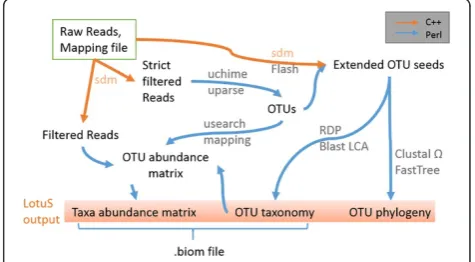
Quantitative Insights Into Microbial Ecology (QIIME) [3] and mothur [4], applications that can be installed and run locally. mothur follows the philosophy of incorporating all tools in one software package, while QIIME (partly) relies on 3rd party software. Both pipelines present a complete package with tools to interpret the community composition, but more work-intensive components like denoising and sequence clustering are designed for cluster environments. We developed less OTU scripts (LotuS) as an open-source pipeline in Perl and C++, which clusters operational taxonomic units (OTUs), generates taxonomic-level abun-dance matrices and a phylogenetic tree of the OTUs dir-ectly from non-demultiplexed sequencing files (Figure 1). Currently, 454, HiSeq and MiSeq technologies are supported. Two popular proprietary programs, UPARSE [5] and RDP classifier [6], were incorporated to cluster OTUs, remove se-quencing noise and chimeric sequences and classify OTUs taxonomically. Alternatively, OTU seed sequences can be * Correspondence:[email protected]
1
Department of Structural Biology, Vlaams Instituut voor Biotechnologie (VIB), Pleinlaan 2, Brussels 1050, Belgium
2
Department of Bioscience Engineering, Vrije Universiteit Brussel, Pleinlaan 2, Brussels 1050, Belgium
Full list of author information is available at the end of the article
classified by BLAST lowest common ancestor (LCA) com-parison to either greengenes [7] or SILVA 16S rDNA data-bases [8]. LotuS installation does not require root access or changes in system paths and is automatically performed with a script that can additionally also update LotuS to newer versions. This script downloads, installs and config-ures all proprietary software and databases as well as con-figuring LotuS to these, with the exception of UPARSE, which requires user registration. Tutorials about LotuS usage and subsequent R numerical analysis are provided on the LotuS webpage (http://psbweb05.psb.ugent.be/lotus/).
Implementation Sequence filtering
Sequences are filtered with a novel C++ program bundled with the pipeline, sdm, that has evolved over the course of this project from a simple demultiplexer to a general pur-pose sequence file formatting, quality filtering/adjustment and OTU sequence (“Seed”) picking tool, optimized for speed and a high recovery rate of sequences. Further bene-fits of this program include the simultaneous sorting of in-put sequences into“high-” and“mid-” quality sequences, dependent on the overall quality and length. These two se-quence bins will be important in the further LotuS work-flow: the high quality sequences are used in the sensitive OTU clustering process, reducing the number of spurious OTU’s caused by sequencing errors and not biological di-versity. Both, high- and mid-quality sequences are used to count the occurrence of OTU’s in single samples, with the intent that mid-quality sequences, which are mapping to an established OTU, will not confound overall diversity measures but add to the count of given biological entities present in a sample.
Default sdm options for 454 and MiSeq sequences are provided with LotuS; these can be modified to filter input sequences after average quality, accumulated error over the sequence, quality in a freely definable window and re-move 5′low-quality bases filtered for these criteria. Fur-thermore, sequences are filtered for min/max length, ambiguous nucleotides, max barcode and primer errors, polynucleotide runs, and trimmed for adapter sequences, if present. sdm/LotuS accepts fasta + quality, fastq and gzipped versions of these as input. Furthermore, sdm can be used on non-demultiplexed sequences to do a quality filtering of sequences, e.g. prior to assembly [9,10].
OTU clustering
Filtered sequences are clustered into OTUs with UPARSE. UPARSE is implemented as described by [5], with the exception that the“-cluster_OTUs”command is executed with the additional parameters -uparse_maxhot 62 -uparse_maxdrop 12 that increase the number of po-tential best hits that are explicitly aligned. This makes the overall clustering slightly slower, but in our experience, it
results into more consistent OTUs on MiSeq datasets in case studies, thereby reducing the total number of OTUs. Also, we noticed that default UPARSE can propose a minor fraction of OTUs that are overlapping with other OTUs (mapped within the desired OTU sequence similar-ity, e.g. 97%, to existing OTUs). OTU abundance is esti-mated by mapping mid- and high-quality filtered input sequences onto the newly created OTUs.
Seed extension
The OTU sequence, here termed OTU seed sequence, should fulfil the following criteria to represent the OTU for sequence matching, taxonomic annotation and tree re-construction: it should be as long as possible, be close to the median of all amplicons clustered to the OTU (repre-senting the centre of the OTU) and contain the least amount of sequencing errors. One common practice is to use a consensus sequence of all amplicons clustered to an OTU, also used by UPARSE. However, a consensus se-quence could be the average of two or more strains that constitute the OTU and the UPARSE denoising algorithm is critically dependent on sequences pruned to a reduced length (typically 250bp for 454 sequencing). To resolve this, sdm searches within all high quality input sequences for a sequence matching the above criteria, in a process we call “Seed extension”. In brief, all input sequences are aligned with the consensus OTU sequence using usearch [11]. From these, sdm selects iteratively the hit being clos-est to the OTU median, having the highclos-est overall mean accumulated error and the longest overall sequence length, with low-quality 5′nucleotides being removed. In the case of paired MiSeq or HiSeq sequences, the highest-quality pair is selected and these are then merged using flash [12].
Taxonomic annotation of OTUs
a taxonomic assignment is accepted if >90% of references are the same taxa, modifiable with the LotuS parameter “-LCA_frac”. If a reference has no taxonomic information for a given level (and taxonomic assignments were consist-ent thus far), it is discarded. In an extreme example, this can lead to species-level taxonomic assignments even if only one reference is assigned to species level but all other references have no taxonomic information.
Furthermore, the sequence similarity of the best hit is used to delimit the taxonomic depth of an assignment. Even if the best hit has a known species name, if the identity of the OTU to the reference is 96%, the taxonomy will only be used up to genus level, as a best reference at a 96% thresh-old could indicate that this OTU is not represented by a ref-erence species in the database. The default parameters are to limit species at 97%, genus at 95%, family at 93%, class at 91%, order at 88% and phylum at 78% sequence similarity, though users can change these parameters as the established 16S rRNA gene taxonomy does strictly speaking not follow consistent cutoffs for different taxonomic levels [15,16].
Multiple alignment and phylogenetic reconstruction The calculation of a phylogenetic tree of the extended OTU seed sequences is an optional step. The phylogenetic tree can be used to fulfil requirements for calculating diversity indices such as Faith’s phylogenetic diversity [17] or be-tween sample UniFrac distances [18]. For this step, the se-quences are aligned with Clustal Ω [19] with default parameters for nucleotide alignments. From the aligned se-quences, a phylogenetic tree is reconstructed using the gamma model of sequence evolution (options“-nt -gamma -no2nd -fastest -spr 4”) in FastTree2 [20], as recommended by its author (http://www.microbesonline.org/fasttree/) and is saved in Phylip format.
LotuS Output
LotuS saves the output in the specified output folder in a structure that can be directly integrated into specialized analytical packages of statistical software packages. OTU abundance matrix, the phylogeny for each OTU, a phylo-genetic tree and a .biom formatted OTU matrix are stored in this folder. Three subfolders contain a) the run logs and processing reports, b) copies of configuration files and c) higher level taxa abundance matrices.
Results and discussion
We used a simulation of 1000 greengenes [7] 16S se-quences, truncated and randomly mutated (see Additional file 1), to validate the LCA algorithm and research the in-fluence of read length on taxonomic classification. This showed that longer reads are assigned with a higher confi-dence in RDP (Additional file 3a) and the fraction of 16S reads that remains unclassified using our LCA algorithm significantly decreases with longer read length, when using
a reference database from which the 1,000 simulated reads were removed (Additional file 3b). With reads≥250 bp, our simulation converged to 100% precision and specificity (Additional file 4a,b). To simulate a rare situation where no close relatives are present in the reference database, we used the LCA algorithm only on database hits that had <97% identity to the target read. Here the fraction of taxo-nomic assignments is in general lower and no species-level assignments were made, as expected given default param-eters (Additional file 3c). Precision and specificity of as-signments were lowered, and here, the longer read lengths were especially important (Additional file 4c,d).
Read quality is decreasing with increasing read length in 454 and illumina sequencing [5], and UPARSE im-proves OTU clustering by using only the high-quality 5′ DNA. The here proposed OTU seed extension is im-portant for taxonomic classification and tree building, especially for badly characterized species. It takes advan-tage of the improved, fast OTU clustering, while using long, high-quality reads for taxonomic annotations and multiple sequence alignments.
We tested the validity and performance of LotuS on cecal gut samples from five different mice strains [21]. It consists of two 454 GS FLX runs and a total of 393,070 reads, the expected read length is 400-500 nucleotides. We used five methods (described in Additional file 1) to calculate OTU abundance matrices: LotuS using RDP taxonomy (LR),
LotuS using BLAST taxonomy (LB), QIIMEde novoOTU
creation (QDN), QIIME with reference-based OTUs (QRE) and mothur (MOT). LotuS was run in 454 mode:
lotus.pl -i [path to fasta/qual] -o [output dir] -m [mapping file] -s [sdm option file]
74 samples were demultiplexed, each sample containing 4699 ± 742 reads. 43,555 reads were rejected due to the low quality filtering criteria. Median OTU seed length was 513 nucleotides for LotuS with a median quality of 37.2. For QDN, OTU seed sequences are slightly longer (527 bp), because the longest available sequence with no quality
clippings and filtering is used. In mothur, this was 248 bp, because only high-quality and informative sequence parts were retained, similar to the 250 bp cutoff used by LotuS to cluster OTUs. OTU and taxon-read abundance matri-ces from these three pipelines were promatri-cessed in the R
stat-istical computer language. In general, the sample
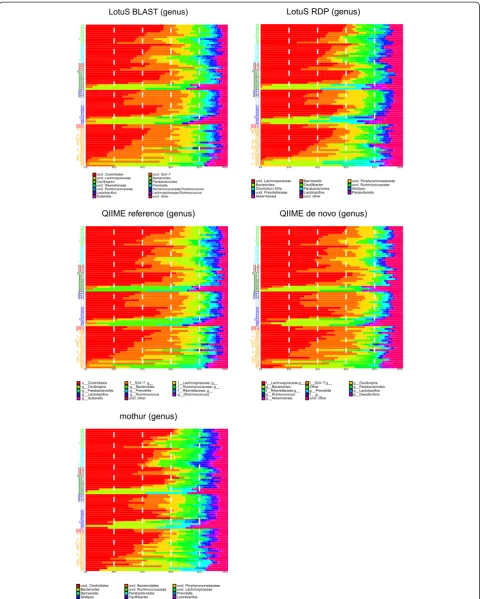
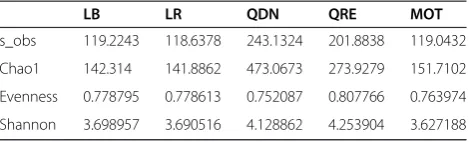
composition is very consistent between the five methods (Figure 2), when taking into consideration differences in taxonomy due to the database/assignment algorithm, that were different in all three pipelines. To measure how well the sample relationships are maintained if different pipeline versions are used, the correlations between Bray-Curtis (BC) and weighted UniFrac (wUF) inter-sample distances were compared in an approach similar to the Mantel test [22] (Additional file 5: Table S1 and Additional file 6: Table S2). The average correlation was 0.993 ± 0.005, 0.988 ± 0.001 and 0.958 ± 0.02, on OTU BC, wUF and genus BC distances, respectively.. Both LotuS-derived wUF were closer to those of mothur than QRE or QDN; they were also closer to QRE than QDN, where the guide tree is based on the greengenes phylogenetic tree, indicating that ourde novoconstructed guide tree is similar to the green-genes one. OTU diversity varied strongly between methods [5]: QDN and QRE clustered most OTUs (6,148 and 1,467), followed by mothur (913) and LotuS (369) (Table 1). When rarefying samples to 2,000 reads, the average OTU number across all samples was similar between LotuS and mothur, with 119 and 118 OTUs/sample. QIIME-derived data had higher sample diversity, with 243 and 201 rarefied OTUs in QDN and QRE, respectively. The total number of reads in the abundance matrices differs only slightly be-tween pipelines (345,801 ± 9,622).
The number of unassigned taxa at a given taxonomic level is usually lowest in QRE and highest in QDN. QRE does not use a LCA algorithm to exclude cross hits and this is obvious at genus level where only 54.7% of taxa are undefined, which is lower than LB (65.9% of genera unassigned, Additional file 2). QRE is by default exclud-ing sequences that do not match a reference with <97% and the unassigned taxa are thus from the greengenes taxonomic assignment. From the known genera, 55% are shared between all methods, and this applies for 71% of families (Additional file 7). Execution times are the most outstanding difference between tested pipelines (Table 2). The same dataset was processed with all pipelines using the same 2.7 GHz Intel Core i7 MacBook (1 core). De-fault LotuS was 25 to 200 times faster than the other pipelines and demultiplexing and quality filtering with sdm was 4–6 times faster than these processes in other pipelines. However, when matching reads to a reference database, LotuS is limited by the speed of BLAST+.
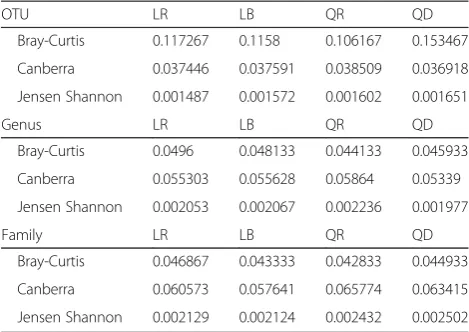
One of the main problems in testing the validity of metagenomic processing is that the real taxonomic com-position of a metagenomic sample is unknown or only available for artificial datasets [23], and thus, the abso-lute error due to bioinformatics processing is hard to es-timate. Here we sequenced 40 technical replicates in two separate MiSeq runs to circumvent this problem, as we can determine a relative error between replicates that could be attributed to a pipeline. In this dataset, LotuS recovered 28,789,221 reads from the two MiSeq runs, 19% or 10% more reads than QRE or QDN, respectively. The average sample richness at 15,000 rarefied se-quences was highest in QDN (1,333 ± 393.5) followed by LotuS (720.5 ± 186) and closed-reference OTU picking QRE (469.6 ± 146). This could be related to QRE being too stringent as not all OTUs might be present in refer-ence database and QDN being too lenient. Comparing the reproducibility of technical replicates between the two MiSeq runs, we used Canberra, Bray-Curtis and Jensen-Shannon distances between technical replicates. The mean of these was measured for each pipeline vari-ant and on OTU, genus and family level. Overall, no consistent trend was detected for one pipeline recover-ing more reproducible compositions that any other
Table 1 Richness comparisons between pipelines
LB LR QDN QRE MOT
s_obs 119.2243 118.6378 243.1324 201.8838 119.0432
Chao1 142.314 141.8862 473.0673 273.9279 151.7102
Evenness 0.778795 0.778613 0.752087 0.807766 0.763974
Shannon 3.698957 3.690516 4.128862 4.253904 3.627188
Average diversity and richness estimates for the five methods to derive an OTU matrix, rarefied to 2,000 reads per samples.LBLotuS BLAST,LRLotuS RDP,QDNQIIMEde novoOTU creation,QREQIIME reference OTU picking,
MOTmothur.
Table 2 Computational efficiency
Dataset Time (s) Lotus_RDP Lotus_BLAST QIIME DN QIIME Ref mothur
2 × 454 Demultiplexing/quality filtering 37 37 160 160 235
2 × 454 Full run 177 7,317 4,325 17,081 39,660
2 × MiSeq Demultiplexing/quality filtering 820 820 3,495 3,495 *
2 × MiSeq Full run 8,856 23,761 69,696 56,916 *
(Table 3). Comparing the reproducibility of richness, LotuS OTU matrices (identical between LR and LB) had an average richness difference of 5.7 ± 5.9%, lower com-pared to QRE (7.5 ± 6%, p= 0.0065 compared to LotuS) and QDN (6.4 ± 6.3%, p= 0.17 compared to LotuS), thus richness was more stable with LotuS among technical replicates. Runtime was again fastest in LotuS (Table 2), though differences in execution time were not as ex-treme as observed for the 454 dataset with LR being ~8 times faster than Qiime.
Conclusions
The novel LotuS pipeline is able to handle small to very large 16S datasets on a personal computer and effort-lessly integrate multiple sequencing runs. Computational efficiency is very high due to a selection of state-of-the-art proprietary software like UPARSE for denoising and sequence clustering and sdm for demultiplexing and se-quence filtering. Comparison to other pipelines suggests a high similarity in higher taxonomic composition to exist-ing tools, but on OTU level, the de-novo-called OTU shows an increased richness compared to closed-reference OTU calling and less richness than non-denoisedde novo OTU calling, as expected. This pipeline has the advantage of state-of-the-art, flowgram-independent denoising and long, high-quality OTU sequences from the OTU seed ex-tension step used for phylogenetic tree construction and taxonomic annotation.
Endnote 1
http://www.illumina.com/systems/hiseq_comparison.ilmn
Availability and requirements Project name:LotuS, sdm.
Project home page:http://psbweb05.psb.ugent.be/lotus
Operating system(s):Linux, Mac Programming language:Perl, C++
Other requirements: proprietary software, downloaded by autoinstaller, UPARSE
License:GNU GPL
Any restrictions to use by non-academics: licence needed.
Additional files
Additional file 1:Supplementary methods.Supplementary methods including the following sections: sample collection and 16S rRNA sequencing, 16S read simulation, comparison of pipelines and commands used to run mothur and QIIME on sample datasets.
Additional file 2:Dependency of precision and specificity of BLAST-based LCA from best hit subset.The reference database sequences included for LCA evaluation are dependent on % identity to best hit; by default all reference sequences that have an identity≤1.5% of the best found hit are included (red line). Specificity and precision are dependent on this parameter and the default 1.5% is a trade-off between a high precision and a high specificity.
Additional file 3:Classification performance is dependent on 16S read length.16S reads (1,000) of different length were simulated from the greengenes database (Additional file 1). a) RDP average classification confidence on six taxonomic levels that is increasing constantly with increasing read length. b) Similarly, the fraction of simulated reads that were not assigned to a taxon, using our LCA algorithm, was constantly decreasing with read length.
Additional file 4:Precision and specificity of Blast based LCA is dependent on sequence length.Using the same dataset as in Additional file 3, we measured precision (a,c) and specificity (b,d) of the taxonomic assignments. These are increasing to 100% on all taxonomic levels at higher read length, when using the full greengenes database with the exclusion of the queried sequence (a,b). When simulating that sequence related to the test sequence (≥97% identity) are absent from the database (c,d), the importance of long reads becomes more apparent. Species data is not shown in (c), as species level was not assigned and therefore the specificity was 100% in (d).TPtrue positive,
FPfalse positive,TNtrue negative.
Additional file 5: Table S1.Comparison of compositional similarity. Additional file 6: Table S2.Comparison of compositional and phylogenetic similarity.
Additional file 7:Taxa stability across pipelines.a) The 454 datasets was analyzed in respect to taxonomic stability across the 5 pipeline versions. a) The percentage of OTU’s from different pipeline versions, which could not be assigned the respective taxonomic level. As expected, this is increasing towards the more specific levels. b) The fraction of Taxa that are present in only 1,2,3,4 or all 5 of the pipelines.
Abbreviations
sdm:simple demultiplexer;LotuS: less OTU scripts;OTU: operational taxonomic unit;rDNA: ribosomal DNA.
Competing interests
The authors declare that they have no competing interests.
Authors’contributions
FH designed and implemented the pipeline. Pipeline validity was tested by FH and RT. Samples for the MiSeq runs were collected, extracted and sequenced by AYV. FH, RT, AYV, PB and JR wrote the manuscript. All authors read and approved the final manuscript.
Table 3 Compositional similarity of technical replicates
OTU LR LB QR QD
Bray-Curtis 0.117267 0.1158 0.106167 0.153467
Canberra 0.037446 0.037591 0.038509 0.036918
Jensen Shannon 0.001487 0.001572 0.001602 0.001651
Genus LR LB QR QD
Bray-Curtis 0.0496 0.048133 0.044133 0.045933
Canberra 0.055303 0.055628 0.05864 0.05339
Jensen Shannon 0.002053 0.002067 0.002236 0.001977
Family LR LB QR QD
Bray-Curtis 0.046867 0.043333 0.042833 0.044933
Canberra 0.060573 0.057641 0.065774 0.063415
Jensen Shannon 0.002129 0.002124 0.002432 0.002502
Acknowledgements
We thank Robert Edgar for essential help during LotuS pipeline conception, as well as Matthew Hayward, Sara Viera-Silva and Samuel Chaffron for constructive comments during LotuS development.
This study received funding through Fund for Scientific Research - Flanders (FWO), the Brussels Institute for Research and Innovation, the EU Framework 7 programme (MetaCardis project), the CancerBiome project (European Research Council project reference 268985), VIB, the REGA institute, KU Leuven and EMBL.
Author details
1
Department of Structural Biology, Vlaams Instituut voor Biotechnologie (VIB), Pleinlaan 2, Brussels 1050, Belgium.2Department of Bioscience Engineering, Vrije Universiteit Brussel, Pleinlaan 2, Brussels 1050, Belgium.3Structural & Computational Biology Unit, European Molecular Biology Laboratory (EMBL), Meyerhofstrasse 1, Heidelberg 69117, Germany.4Molecular Medicine Partnership Unit (MMPU), University of Heidelberg and European Molecular Biology Laboratory, Heidelberg, Germany.5Max Delbrück Centre for Molecular Medicine, Robert-Rössle-Str. 10, Berlin 13125, Germany. 6
Department of Microbiology and Immunology, REGA institute, KU Leuven, Herestraat 49, Leuven 3000, Belgium.7VIB Center for the Biology of Disease, Herestraat 49, Leuven 3000, Belgium.
Received: 1 April 2014 Accepted: 23 August 2014 Published: 30 September 2014
References
1. Cole JR, Wang Q, Cardenas E, Fish J, Chai B, Farris RJ, Kulam-Syed-Mohideen AS, McGarrell DM, Marsh T, Garrity GM, Tiedje JM:The Ribosomal Database Project: improved alignments and new tools for rRNA analysis.
Nucleic Acids Res2009,37(Database issue):D141–D145.
2. Kunin V, Hugenholtz P:PyroTagger: a fast, accurate pipeline for analysis of rRNA amplicon pyrosequence data.Open J2010, Article 1, 1–8. 3. Caporaso JG, Kuczynski J, Stombaugh J, Bittinger K, Bushman FD, Costello
EK, Fierer N, Peña AG, Goodrich JK, Gordon JI, Huttley GA, Kelley ST, Knights D, Koenig JE, Ley RE, Lozupone CA, McDonald D, Muegge BD, Pirrung M, Reeder J, Sevinsky JR, Turnbaugh PJ, Walters WA, Widmann J, Yatsunenko T, Zaneveld J, Knight R, Pena AG:QIIME allows analysis of high-throughput community sequencing data.Nat Methods2010,7:335–336.
4. Schloss PD, Westcott SL, Ryabin T, Hall JR, Hartmann M, Hollister EB, Lesniewski RA, Oakley BB, Parks DH, Robinson CJ, Sahl JW, Stres B, Thallinger GG, Van Horn DJ, Weber CF:Introducing mothur: open-source,
platform-independent, community-supported software for describing and comparing microbial communities.Appl Environ Microbiol2009, 75:7537–7541.
5. Edgar RC:UPARSE: highly accurate OTU sequences from microbial amplicon reads.Nat Methods2013,10:996–998.
6. Wang Q, Garrity GM, Tiedje JM, Cole JR:Naive Bayesian classifier for rapid assignment of rRNA sequences into the new bacterial taxonomy.
Appl Env Microbiol2007,73:5261–5267.
7. McDonald D, Price MN, Goodrich J, Nawrocki EP, DeSantis TZ, Probst A, Andersen GL, Knight R, Hugenholtz P:An improved greengenes taxonomy with explicit ranks for ecological and evolutionary analyses of bacteria and archaea.ISME J2012,6:610–618.
8. Quast C, Pruesse E, Yilmaz P, Gerken J, Schweer T, Yarza P, Peplies J, Glöckner FO:The SILVA ribosomal RNA gene database project: improved data processing and web-based tools.Nucleic Acids Res2013,
41(Database issue):D590–D596.
9. Ye L, Matthijs S, Bodilis J, Hildebrand F, Raes J, Cornelis P:Analysis of the draft genome of Pseudomonas fluorescens ATCC17400 indicates a capacity to take up iron from a wide range of sources, including different exogenous pyoverdines.Biometals2014,27:633–644.
10. Dingemans J, Ye L, Hildebrand F, Tontodonati F, Craggs M, Bilocq F, De Vos D, Crabbé A, Van Houdt R, Malfroot A, Cornelis P:The deletion of TonB-dependent receptor genes is part of the genome reduction process that occurs during adaptation of Pseudomonas aeruginosa to the cystic fibrosis lung.Pathog Dis2014,71(1):26–38.
11. Edgar RC:Search and clustering orders of magnitude faster than BLAST.
Bioinformatics2010,26:2460–2461.
12. MagočT, Salzberg SL:FLASH: fast length adjustment of short reads to improve genome assemblies.Bioinformatics2011,27:2957–2963.
13. Altschul SF, Gish W, Miller W, Myers EW, Lipman DJ:Basic local alignment search tool.J Mol Biol1990,215:403–410.
14. Pruesse E, Quast C, Knittel K, Fuchs BM, Ludwig W, Peplies J, Glöckner FO: SILVA: a comprehensive online resource for quality checked and aligned ribosomal RNA sequence data compatible with ARB.Nucleic Acids Res
2007,35:7188–7196.
15. Luo C, Rodriguez-R LM, Konstantinidis KT:MyTaxa: an advanced taxonomic classifier for genomic and metagenomic sequences.Nucleic Acids Res
2014,14:1–12.
16. Schloss PD, Westcott SL:Assessing and improving methods used in operational taxonomic unit-based approaches for 16S rRNA gene sequence analysis.Appl Environ Microbiol2011,77:3219–3226.
17. Faith DP:Conservation evaluation and phylogenetic diversity.Biol Conserv
1992,61(1):1–10.
18. Lozupone C, Knight R:UniFrac: a new phylogenetic method for comparing microbial communities.Appl Environ Microbiol2005, 71:8228–8235.
19. Sievers F, Wilm A, Dineen D, Gibson TJ, Karplus K, Li W, Lopez R, McWilliam H, Remmert M, Söding J, Thompson JD, Higgins DG:Fast, scalable generation of high-quality protein multiple sequence alignments using Clustal Omega.Mol Syst Biol2011,7:539.
20. Price MN, Dehal PS, Arkin AP:FastTree 2—approximately maximum-likelihood trees for large alignments.PLoS One2010, 5:e9490.
21. Hildebrand F, Nguyen ATL, Brinkman B, Yunta RG, Cauwe B, Vandenabeele P, Liston A, Raes J:Inflammation-associated enterotypes, host genotype, cage and inter-individual effects drive gut microbiota variation in common laboratory mice.Genome Biol2013,14:R4.
22. Mantel N:The detection of disease clustering and a generalized regression approach.Cancer Res1967,27:209–220.
23. Haas BJ, Gevers D, Earl AM, Feldgarden M, Ward DV, Giannoukos G, Ciulla D, Tabbaa D, Highlander SK, Sodergren E, Methé B, DeSantis TZ, Petrosino JF, Knight R, Birren BW:Chimeric 16S rRNA sequence formation and detection in Sanger and 454-pyrosequenced PCR amplicons.Genome Res
2011,21:494–504.
doi:10.1186/2049-2618-2-30
Cite this article as:Hildebrandet al.:LotuS: an efficient and user-friendly OTU processing pipeline.Microbiome20142:30.
Submit your next manuscript to BioMed Central and take full advantage of:
• Convenient online submission
• Thorough peer review
• No space constraints or color figure charges
• Immediate publication on acceptance
• Inclusion in PubMed, CAS, Scopus and Google Scholar
• Research which is freely available for redistribution