R E S E A R C H
Open Access
Postural orientation and equilibrium
processes associated with increased
postural sway in autism spectrum disorder
(ASD)
Zheng Wang
1,2*, Rami R. Hallac
3, Kaitlin C. Conroy
4, Stormi P. White
4, Alex A. Kane
3, Amy L. Collinsworth
3,
John A. Sweeney
5and Matthew W. Mosconi
1,2Abstract
Background:Increased postural sway has been repeatedly documented in children with autism spectrum disorder (ASD). Characterizing the control processes underlying this deficit, including postural orientation and equilibrium, may provide key insights into neurophysiological mechanisms associated with ASD. Postural orientation refers to children’s ability to actively align their trunk and head with respect to their base of support, while postural equilibrium is an active process whereby children coordinate ankle dorsi-/plantar-flexion and hip abduction/ adduction movements to stabilize their upper body. Dynamic engagement of each of these control processes is important for maintaining postural stability, though neither postural orientation nor equilibrium has been studied in ASD. Methods:Twenty-two children with ASD and 21 age and performance IQ-matched typically developing (TD) controls completed three standing tests. During static stance, participants were instructed to stand as still as possible. During dynamic stances, participants swayed at a comfortable speed and magnitude in either anterior-posterior (AP) or mediolateral (ML) directions. The center of pressure (COP) standard deviation and trajectory length were examined to determine if children with ASD showed increased postural sway. Postural orientation was assessed using a novel virtual time-to-contact (VTC) approach that characterized spatiotemporal dimensions of children’s postural sway (i.e., body alignment) relative to their postural limitation boundary, defined as the maximum extent to which each child could sway in each direction. Postural equilibrium was quantified by evaluating the amount of shared or mutual information of COP time series measured along the AP and ML directions.
Results:Consistent with prior studies, children with ASD showed increased postural sway during both static and dynamic stances relative to TD children. In regard to postural orientation processes, children with ASD demonstrated reduced spatial perception of their postural limitation boundary towards target directions and reduced time to correct this error during dynamic postural sways but not during static stance. Regarding postural equilibrium, they showed a compromised ability to decouple ankle dorsi-/plantar-flexion and hip abduction/adduction processes during dynamic stances.
(Continued on next page)
* Correspondence:[email protected]
1Schiefelbusch Institute for Life Span Studies and Clinical Child Psychology Program, University of Kansas, 1000 Sunnyside Ave., Suite 2004, Lawrence, KS 66045, USA
2Kansas Center for Autism Research and Training (KCART), University of Kansas Medical School, Overland Park, KS 66213, USA
Full list of author information is available at the end of the article
(Continued from previous page)
Conclusions:These results suggest that deficits in both postural orientation and equilibrium processes contribute to reduced postural stability in ASD. Specifically, increased postural sway in ASD appears to reflect patients’impaired perception of their body movement relative to their own postural limitation boundary as well as a reduced ability to decouple distinct ankle and hip movements to align their body during standing. Our findings that deficits in postural orientation and equilibrium are more pronounced during dynamic compared to static stances suggests that the
increased demands of everyday activities in which children must dynamically shift their COP involve more severe postural control deficits in ASD relative to static stance conditions that often are studied. Systematic assessment of dynamic postural control processes in ASD may provide important insights into new treatment targets and neurodevelopmental mechanisms.
Keywords:Autism spectrum disorder, Postural orientation, Postural equilibrium, Static and dynamic stances, Virtual time-to-contact, Mutual information
Background
Sensorimotor deficits are common in children with autism spectrum disorder (ASD) [1, 2]. Gross motor activities, in-cluding walking, jumping, and running, appear to be dis-rupted in ASD across development [3–5]. Postural control is a fundamental gross motor skill critical for stabilizing trunk orientation and executing upper and lower limb movements [6–8]. Reduced postural stability has been re-peatedly demonstrated in ASD, and it appears to interfere with the development of fine motor skills [9, 10] and patients’ability to coordinate behavior during social in-teractions [2, 11]. The control mechanisms underlying increased postural sway in ASD have not been estab-lished. The present study aimed to determine the con-trol processes contributing to increased postural sway in ASD in order to identify new targets for treatments aimed at increasing postural stability in affected chil-dren and to better understand neurodevelopmental mechanisms associated with atypical sensorimotor be-haviors in ASD.
The primary control processes used to actively support postural stability include both postural orientation and equilibrium [12–14]. Postural orientation involves active alignment of the trunk and head with respect to support surfaces, which is a process relying on multi-sensory pro-cessing, reweighting and integration. Previous studies have indicated that reductions in postural stability among chil-dren with ASD are more severe under conditions in which sensory information is occluded or degraded [4, 6, 15–18] suggesting that postural orientation processes may be disrupted in affected children. Studies of postural stability under different sensory conditions provide only indirect measurements of postural orientation processes, however, as they do not specify spatial or temporal characteristics of children’sway relative to their support surface. A virtual time-to-contact (VTC) approach has been used repeatedly in motor control and biomechanical studies to provide more direct measurements of postural orientation [19–23]. This approach quantifies the relationship in both spatial
(VTC (ω)Spatial) and temporal (VTC (τ)Temporal) domains
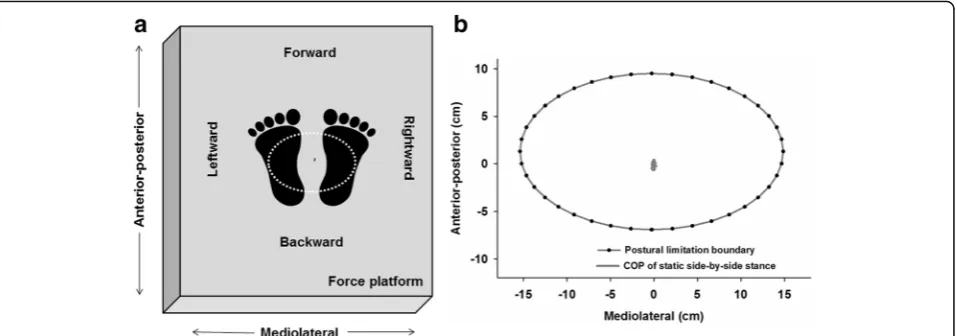
between children’postural sway relative to their own pos-tural limitation boundary—i.e., the maximum extent to which children’s center of pressure (COP) can travel with-out their losing balance [12, 21, 23] (Fig. 1).
To maintain stability, children must instantaneously per-ceive spatial information regarding their postural sway rela-tive to their own postural limitation boundary and then adjust their sway promptly to avoid moving closer to their boundary and losing balance [12, 19–23]. Multiple prior studies have shown that interpreting postural sway infor-mation is confounded if it is not measured in the context of an individual’s postural limitation boundary [21–23]. For example, patients with Parkinson’s disease show reduced COP variability in both anterior-posterior (AP) and medio-lateral (ML) directions during static stance, but they also have smaller postural limitation boundaries rendering a less stable posture as their COP range of motion relative to their boundaries is significantly greater compared to healthy adults [20]. VTC measurements thus provide quantitative spatial and temporal information regarding the active orientation processes children use to align their body sway during stance.
Postural equilibrium involves the coordination of joint movements to stabilize body motion during both static and self-initiated dynamic stances. Postural sway in the AP dir-ection (COPAP) is predominantly controlled by anti-gravity
torques generated from the dorsi-/plantar-flexion of the ankle joints while ML sway (COPML) is controlled by hip
when postural control systems are compromised [27] or under challenging conditions [26]. On the contrary, during self-initiated dynamic stances in which participants’sway is targeted in one direction (i.e., either the AP or ML direc-tion), a reduction in shared information is expected. For example, the ideal COP movement during intentional AP sway would be a straight line moving along the target dir-ection without any lateral deviation indicating a minimum involvement of hip abduction/adduction or sideways body weight shifting. No known studies have examined the de-pendency of ankle and hip coordination in children with ASD.
The majority of postural control studies in ASD have examined static stances in which children attempt to minimize movement of their COP while standing still [4, 8, 15–18, 28]. These studies have documented in-creases in sway and sway variability that are associated with worse clinical symptoms [29, 30]. However, dynamic stances or self-initiated postural sways in a specific direc-tion that more closely resemble the majority of activities performed during everyday life have received less empirical attention. During a test of gait initiation (i.e., taking a step forward), Fournier et al. [28] observed reduced COP shifts to the side in children with ASD suggesting that postural control deficits contributing to reduced postural stability in ASD may be different during more dynamic stance condi-tions compared to static stances. The present study exam-ined postural orientation and equilibrium in children with ASD during static stance and dynamic postural sways in both AP and ML directions. We also assessed the extent to which static and dynamic postural deficits were associated with clinical symptoms in ASD.
Our study had three aims: (1) to quantify the extent to which children with ASD showed increased postural sway
during static and dynamic stances, (2) to quantify postural orientation processes in ASD by characterizing spatial and temporal dimensions of their postural sway relative to their own postural limitation boundary, and (3) to quantify pos-tural equilibrium processes in ASD by determining the amount of shared COPAPand COPML information during
quiet and dynamic standing postures. For aim 1, we hypoth-esized that, consistent with prior studies, children with ASD would show increased COP standard deviation and trajec-tory length as compared with typically developing (TD) chil-dren. We also predicted that elevations in COP variability and trajectory length in ASD would be more severe during the more challenging dynamic stances compared to static stance. For aim 2, we applied the VTC approach to test the hypotheses that children with ASD would show a compro-mised ability to actively acquire spatial information regard-ing the direction of their body sway, and reduced time to correct their movement prior to approaching their postural limitation boundary. For aim 3, we predicted that children with ASD would show increased COPAPand COPML
de-pendency as compared to TD children during static stance and that this deficit would be more severe during dynamic stances due to the increased demands on equilibrium pro-cesses. Based on prior studies showing that motor impair-ments may be associated with core symptoms of ASD [2, 7, 11, 29, 30], we also hypothesized that postural sway deficits in children with ASD would be related to the severity of their ASD symptoms, including clinically rated social-communication abnormalities and repetitive behaviors.
Methods
Participants
Twenty-two children with ASD and 21 age, height, weight, sex, and performance IQ-matched TD children completed
tests of static and dynamic stances (Table 1). IQ was assessed using the Wechsler Abbreviated Scales of Intelligence [31] for all participants except for one younger participant who completed the Wechsler Preschool and Pri-mary Scale of Intelligence—Fourth Edition [32]. Children with ASD were recruited through community advertise-ments and local clinical programs. The diagnosis of ASD was established with the Autism Diagnostic Inventory-Revised (ADI-R) [33], the Autism Diagnostic Observation Schedule—II (ADOS-II) [34], and expert clinical opinion based on DSM-V criteria. Potential patients were excluded if they had any known genetic condition associated with ASD. TD participants were recruited from the community and were required to have a score of 8 or lower on the Social Communication Questionnaire (SCQ) [35]. Potential TD participants were excluded for current or past psychiatric or neurological disorders; family history of ASD in first-, second-, or third-degree relatives; or a history in first-degree relatives of a developmental or learning disorder, psychosis, or obsessive compulsive disorder based on a brief screening interview.
No participants were taking medications known to affect motor performance at the time of testing, including anti-psychotics, stimulants, or anticonvulsants [36]. Four chil-dren with ASD were taking antidepressant medications and two were taking antihypertensive medications at the time of testing. No participant had a history of head injury, birth asphyxia, or non-febrile seizure. Participants 18 years of age or older provided written consent and minors pro-vided assent in addition to written consent from their legal guardian. Study procedures were approved by the local In-stitutional Review Board.
Apparatus and procedures
Postural testing was conducted for children with ASD ei-ther during children’s first visit after the completion of their clinical assessment or during a second visit that was no later than three weeks from their clinical evaluation. Postural testing consisted of four experimental conditions lasting 30–40 min in total. All testing was completed with participants standing with bare feet shoulder width apart on an AMTI (American Mechanical Technology, Inc., Watertown, MA) AccuGait strain gauge force platform (size 49.78 × 49.78 cm; sampling rate of 1000 Hz).
Prior to testing, each participant’s postural limitation boundary was determined based on the maximum extent to which he/she could lean in each of four directions: for-ward, backfor-ward, leftfor-ward, and rightward. During the pos-tural limitation boundary trial, participants stood with their feet side-by-side shoulder width apart, kept their arms fixed at their sides, and slowly leaned as far as pos-sible in each of the four directions without raising their feet. Participants maintained an inclined posture while leaning for 2 s. An experimenter always observed partici-pants’behavioral performance and COP pattern online to ensure that they had reached their maximum extent. Par-ticipants who swayed further than their reported extent while maintaining their maximum extent for 2 s were asked to repeat the trial as done in prior studies [21, 23].
Prior to the testing trial, the examiner modeled the task by leaning as far as possible in each of the four directions. Participants then were guided through the postural limita-tion trials by the examiner, who used the following in-structions:“For the next part, you will lean your body as far as possible without raising your feet from the ground. Now, slowly lean your body forward, hold, come back to the center. Slowly lean your body backward, hold, etc.”for each of the directions. Each individual’s postural limitation boundary then was modeled as an ellipse based on the in-dividual’s COP maximum for each direction as well as the force platform coordinates (Figs. 1 and 2a). Participants’ foot position during the postural limitation boundary trials was outlined on a tracing paper placed on top of the force platform, and children then aligned their feet with the tracings during the remaining trials so that their foot loca-tion remained constant throughout testing.
Following postural limitation boundary trials, participants completed tests of both static and dynamic stances. During the static stance test, participants were instructed to stand as still as possible on the force platform with their arms resting at their sides for three 30 s trials. During dynamic stance tests, participants completed two different self-initiated postural sways—AP and ML—each of which in-cluded three 30-s trials. For each dynamic stance condition, participants were instructed to sway continuously along the target direction at a comfortable speed and magnitude with-out raising their toes or heels. All trials were followed by
Table 1Demographic characteristics [mean (SD)] of children with ASD and typically developing (TD) children
ASD (n= 22) TD (n= 21) t p
Age (years) 12.72 (3.64) 11.67 (4.53) 0.719 0.401
Range 7–18 years 4–18 years
Height (cm) 154.3 (24.45) 142.90 (23.09) 2.493 0.122
Weight (kg) 55.00 (27.54) 41.77 (20.88) 3.123 0.085
% malea 86.4% 85.7% 0.004 0.951
FSIQb 98.68 (17.15) 108.05 (14.29) 3.766 0.059
Range 70–131 80–141
PIQ 103.45 (16.74) 104.24 (12.69) 0.030 0.864
Range 72–132 80–129
VIQ 94.50 (18.01) 109.81 (15.26) 9.006 0.005**
Range 64–129 85–129
FSIQfull-scale IQ,PIQperformance IQ,VIQverbal IQ Statistical significance at **α= 0.01
a
Chi-square (χ2
) statistics
b
a
b
c
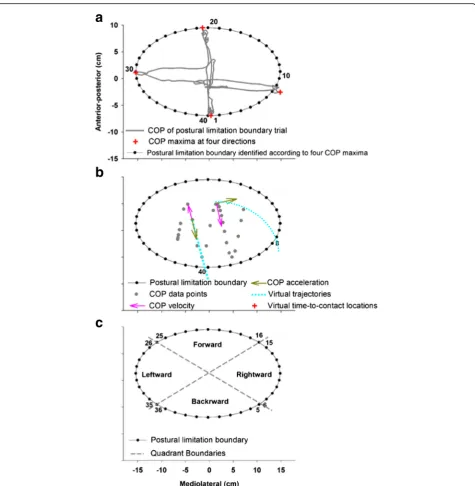
Fig. 2aThe same 12-year-old TD participant’s COP time series recorded from the postural limitation boundary trial during which the participant slowly leaned forward, backward, and to each side. The maximum postural sway (red crosses) in each direction was used to model the postural limitation boundary (solid black line), which was then divided into 40 equal-sized segments (black dots, each with 9° expansion) identified in a counter-clockwise manner to quantify the spatial orientation of his VTC (ω)Spatialand VTC (τ)Temporalminima measurements.bSchematic representation of
linear and nonlinear COP virtual trajectories (light blue dotted lines). The COP time series (gray dotted line) was amplified for demonstration purpose. The virtual trajectories were determined based on the velocity and acceleration of each COP data point (gray dot). The virtual trajectory has a parabolic shape if the COP data point’s initial velocity and acceleration are not co-linear (e.g., shown here intersecting with the postural limitation boundary at segment 8). The virtual trajectory is linear if the COP data point’s initial velocity and acceleration are in the same direction and either the velocity or acceleration vector is zero (e.g., shown here intersecting with the postural limitation boundary at segment 40).cSchematic of four quadrants defined for statistical analyses of VTC (ω)Spatialand VTC (τ)Temporalminima.Numerical labelsrepresent the postural limitation boundary segments that were used to define quadrant in each
30 s of rest with 1 min of rest between different stance con-ditions. Nine postural standing trials (3 conditions × 3 trials) and one postural limitation boundary trial were examined during the test. Order of administration of the static and dy-namic stance tests and the two directions of the dydy-namic stance test were counterbalanced across participants.
Data processing
The initial and final 5 s of force and moment data col-lected from the force platform was removed from analyses in order to limit variable effects related to initiating pos-tural stance and fatigue at the end of trials. The remaining 20 s of the force and moment time series was processed and analyzed in Matlab 2015b (MathWorks, Inc., Natick, MA). All kinetic data were down sampled to 100 Hz and low pass filtered using a fourth-order double pass Butter-worth filter with a cutoff frequency of 6 Hz. The COP time series for both the postural limitation boundary trial and the standing tests were derived from force and mo-ment data using the following formulas [37]:
COPAP ¼−ðMML−FAP⋅dzÞ Fz
COPML¼ðMAP−FML⋅dzÞ Fz
ð1Þ
whereFandMrepresent ground reaction force and
mo-ment, respectively, in either the AP or ML direction;Fz
represents the vertical ground reaction force; anddz
rep-resents the offset of the force platform sensor located 7.9 mm underneath the surface of the platform.
Data analysis
To quantify participants’ postural stability, we examined the standard deviation of each participant’s COP time series in both AP (COPAP) and ML (COPML) directions, as
well as the COP trajectory length during each trial of the static and dynamic stance tests. The COP trajectory length is estimated as the sum of the distances between consecu-tive points on the COP path [37]. During the dynamic stance trials, participants’natural postural sway frequency of each trial was measured using the 20-s COP time series along the target direction (i.e., COPAP was used for
dy-namic AP sway and COPMLwas used for ML sway). Due
to the inherent trending of the COP data, a local maxima and minima algorithm [38] was applied to detect each sway cycle with the criteria that the range of COP move-ment in each direction should be >50% of the global COP range of motion of the trial. The natural sway frequency along the target direction then was calculated as follows:
Freq¼ðNmax20s=2Þ ð2Þ
whereNmaxstands for the number of local COP maxima
detected. Due to the fact that each postural sway cycle
includes two Nmax, natural sway frequency was
calcu-lated as (Nmax/2) divided by 20 s. Sway frequency was
not assessed during static stance trials. All dependent variables were averaged across three trials of each condi-tion prior to between-group comparisons.
Virtual time-to-contact
To measure postural orientation processes, both VTC (ω)Spatial and VTC (τ)Temporal time series were calculated
for each trial of the static and dynamic stances. The basic assumption underlying the VTC approach is that partici-pants evaluate the spatial and temporal characteristics of their body movement relative to their postural limitation boundary, and then they use this information to adjust their COP movement away from their postural limitation boundary [12, 19–23]. VTC (ω)Spatialquantifies the specific
location at which individuals’ postural sway will collide with their postural limitation boundary under the assump-tion that it continues to travel along its original trajectory given its current velocity and acceleration. To determine VTC (ω)Spatial, we divided each individual’s postural
limita-tion boundary into 40 equal-sized segments, each with 9° expansion, labeled from 1 to 40 in a counter-clockwise manner (Fig. 2a). The numeric label of the boundary seg-ment associated with the first crossing point of the COP trajectory was assigned as VTC (ω)Spatial. Therefore, VTC
(ω)Spatialcontains a time series of discrete boundary
seg-ment labels ranging from 1 to 40. The percentage distribu-tion of VTC (ω)Spatialat each postural limitation boundary
segment relative to the total segments was examined. The distribution of VTC (ω)Spatial increases along directions
that would potentially challenge participants’stability sug-gesting that children try to perceive sufficient spatial infor-mation regarding their body movement towards these “dangerous”directions and continuously use this informa-tion to evaluate their postural stability.
VTC (τ)Temporal quantifies the time it would take for
the individuals’sway to collide with their postural limita-tion boundary if it continued to travel along the current trajectory at the current rate. VTC (τ)Temporal estimates
the time limit for individuals to adjust their postural sway so that their COP movement does not reach their postural limitation boundary. An increased VTC (τ) Tem-poralindicates an increased amount of time for children to
refine their postural movement and ensure that they do not reach their postural limitation boundary, whereas a re-duced VTC (τ)Temporalindicates that they have a reduced
time to make this adjustment. The VTC (τ)Temporal was
calculated for each instantaneously measured COP data point by defining the current moment (ti) and estimating
Briefly, the resultant force and acceleration!að Þti were as-sumed to be constant while the COP data point moved along its virtual trajectory from its initial position !rð Þti with its instantaneous initial velocity!vð Þti until it was es-timated to collide with the postural limitation boundary. The following formulas were used to calculate VTC (τ)Temporal:
xið Þ ¼τ rxð Þ þti vxð Þti ⋅τþaxð Þti ⋅τ
2
2 ð3Þ
and
yið Þ ¼τ ryð Þ þti vyð Þti ⋅τþayð Þti ⋅τ
2
2 ð4Þ
where [xi(τ), yi(τ)] represents the physical contact
loca-tion of VTC (ω)Spatial at the postural limitation
bound-ary,rx(ti) and ry(ti) are components of the instantaneous
initial position vector,vx(ti) and vy(ti) are components of
the instantaneous initial velocity vector, and ax(ti) and
ay(ti) are components of the instantaneous initial
accel-eration vector in the AP and ML directions.
As Fig. 2b shows, the virtual trajectory is parabolic if the initial velocity and acceleration vectors of a COP data point are not co-linear. In this scenario, the COP data point would have multiple contacts with the pos-tural limitation boundary at different locations. When this occurred, the minimum positive time parameter as-sociated with the first boundary crossing (i.e., VTC (ω)Spatial) point was assigned as VTC (τ)Temporal. In
con-trast, the virtual trajectory is linear if a COP data point’s initial velocity and acceleration vectors have the same direction or if either of them equals zero. If both initial velocity and acceleration vectors are equal to zero, the virtual trajectory is a stationary point and VTC (τ) Tem-poralis infinite because this specific COP data point will
never contact the postural limitation boundary. VTC (τ)Temporal, therefore, ranges from 0 to infinity with 0
representing a COP data point that is in contact with the postural limitation boundary and infinity represent-ing a COP data point that will never reach the postural limitation boundary given its current location, velocity, and acceleration. The minimum value of VTC (τ)Temporal
was calculated in this study as it is more informative than the maximum value [23].
Mutual information
To examine postural equilibrium processes, the amount of mutual information shared between COPAP and COPML
sway was quantified. Mutual information is a measure of the dependency of two time series useful for determining the degree to which a joint distribution of p(COPAP, COPML)
covaries with the products of the factored marginal
distributionsp(COPAP)p(COPML). Mutual information was
calculated using the following formula [39]:
MIðCOPAP; COPMLÞ ¼ Z
COPML
Z
COPAP
pðCOPAP; COPMLÞ
log2 pðCOPAP; COPMLÞ
pðCOPAPÞpðCOPMLÞ
dCOPAPdCOPML
ð5Þ
wherep(COPAP, COPML) stands for the joint probability
density function of COPAP and COPML, and p(COPAP)
andp(COPML) are the marginal probability density
func-tions of COPAP and COPML, respectively. The unit of
mutual information is bit. Higher mutual information
represents more shared information across COPAP and
COPML time series. Given previous literature suggesting
that COPAP primarily is controlled by the ankle dorsi-/
plantar-flexion while COPML is associated with hip
ab-duction/adduction [24–26], our mutual information
ana-lyses allowed us to determine the extent to which distinct ankle and hip joint movements could be applied independently during standing.
Clinical measures
The ADI-R and ADOS-II were used to examine the sever-ity of ASD symptoms for each participant and determine the extent to which postural control deficits were associ-ated with core symptoms. The ADI-R is a semi-structured interview conducted with parents/caregivers of children with ASD assessing early development and both past and current levels of social interaction and communication abilities as well as the presence of restricted and repetitive behaviors [33]. The ADOS-II consists of a series of struc-tured and semi-strucstruc-tured tasks designed to elicit social interaction and communication behaviors that are im-paired in ASD [34]. For both the ADI-R and ADOS-II, higher scores reflect more severe behavioral abnormalities in a given domain. We examined scores from the social, communication, and restricted-repetitive behavior algo-rithms of the ADI-R and the social-affective and restricted-repetitive behavior algorithms of the ADOS-II.
Statistical analyses
included as a within-subject factor and group was entered as a between-subject factor. Natural postural sway fre-quency was compared across groups during AP and ML dy-namic sways only using a 2 (stance condition) × 2 (group) fixed effects repeated-measure ANOVA.
In order to quantify between-group differences on VTC (τ)Temporalminima and VTC (ω)Spatialrelative to each
indi-vidual’s postural limitation boundary, four equally spaced quadrants were defined (Fig. 2c): forward (segments 16 to 25), backward (segments 36 to 5), leftward (segments 26 to 35), and rightward (segments 6 to 15). A series of 4 (quad-rants) × 2 (group) fixed-effects ANOVAs were conducted on VTC (τ)Temporalminima and VTC (ω)Spatialfor each task
condition independently. For all analyses, results were interpreted as significant ifp< 0.05. Where Mauchly’s test indicated a violation of sphericity, the Greenhouse-Geisser correction was used to provide a conservative estimate of main and interaction effects. The normal distribution of all dependent measurements as well as homogeneity of vari-ance between groups were examined, where no variable has shown violation of these assumptions.
Pearson correlation coefficients were used to examine the relationships between standing parameters found to be different between groups and age, IQs, and clinical rat-ings of ASD severity. In order to account for the large number of correlations performed for each group, a more conservative cutoff was used and results were interpreted to be significant if alpha values were less than 0.01 and correlation coefficient (r) was greater than 0.5.
Results
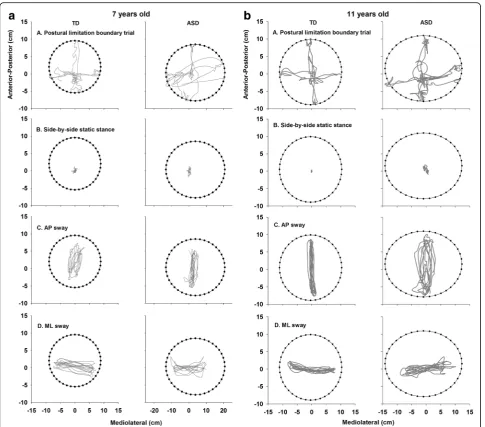
Figure 3 shows traces of the COP time series for one 7-and one 11-year-old representative control (left column) and each of their age-matched peer with ASD (right col-umn) during the postural limitation boundary (A), static stance (B) AP sway (C) and ML sway (D) trials. Both the 7-and 11-year-old children with ASD showed increased COP variability relative to TD controls across all conditions. During static stance, increased COP variability of children with ASD was observed along both the AP and ML direc-tions. During dynamic stances, the representative partici-pants with ASD displayed greater COP variability than the TD children along the directions orthogonal to the targets.
COP standard deviation was greater for the dynamic stances compared to static stance (stance condition main effect: F2, 78= 295.193,p= 0.000). COP standard deviation
was greater in the AP than ML direction during static stance, whereas it was greater in the target directions dur-ing dynamic stances (condition × direction interaction ef-fect: F1.195, 46.618= 360.747, p= 0.000). Children with ASD
showed increased within trial COP standard deviation com-pared to TD controls across all conditions and directions of postural sway (group main effect:F1, 39= 15.347,p= 0.000).
This difference was more severe for the dynamic stances
compared to static stance (stance condition × direction × group interaction: F2, 78= 3.198, p= 0.046). During
static stance, children with ASD showed more severe elevations compared to TD children in COPAPstandard
de-viation relative to COPML standard deviation [ASD-TD
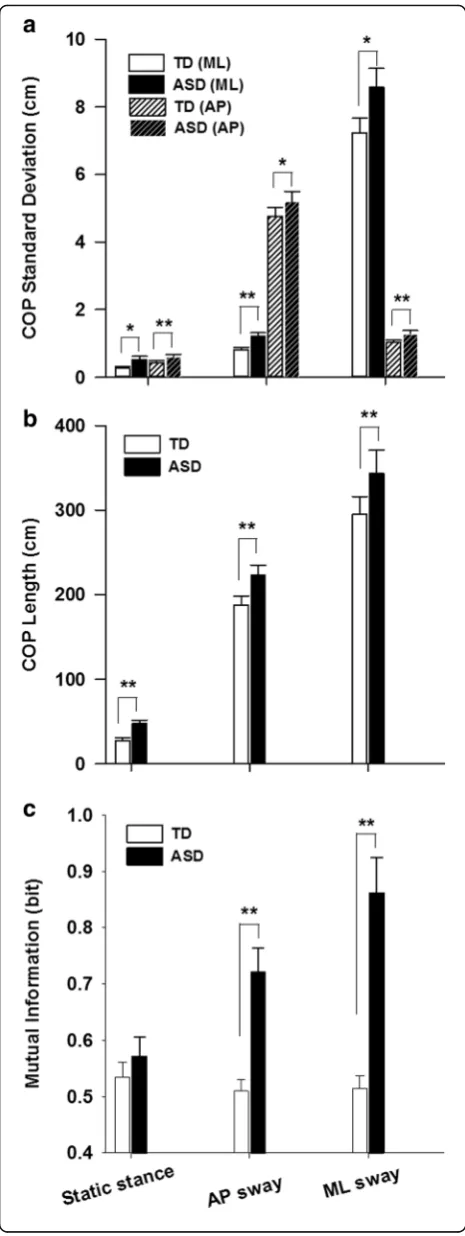
(AP) = 0.237 cm, SE = 0.084 cm,p= 0.007; ASD-TD (ML) = 0.271 cm, SE = 0.112 cm, p= 0.020]. During dynamic stances, children with ASD showed larger differences rela-tive to TD controls in COP standard deviation orthogonal to the target directions as opposed to along the target direc-tions [AP sway: ASD-TD (AP) = 1.022 cm, SE = 0.495 cm, p= 0.046; ASD-TD (ML) = 0.464 cm, SE = 0.141 cm, p= 0.002; ML sway: ASD-TD (AP) = 0.303 cm, SE = 0.104 cm, p= 0.006; ASD-TD (ML) = 1.700 cm, SE = 0.691 cm, p= 0.019] (Fig. 4a).
COP trajectory length was greater for the dynamic stances compared to static stance, and for the dynamic ML sway condition compared to the AP sway condition (stance condition main effect: F1.325, 51.672= 184.571,
p= 0.000). Children with ASD showed greater COP tra-jectory length compared to TD children across all postural conditions (group main effect: F1, 39= 8.706, p= 0.005).
There was no significant stance condition × group inter-action identified (F1.325, 51.672= 1.272,p= 0.286) (Fig. 4b).
Natural postural sway frequency was similar across the two dynamic stance conditions (condition main effect:F1, 40= 0.655,p= 0.423). No between-group differences were
observed in terms of sway frequency (group main effect: F1, 40= 1.482, p= 0.231; ASD = 0.320 Hz, SE = 0.019 Hz;
TD = 0.354Hz, SE = 0.020 Hz) Additional file 2.
Virtual time-to-contact
The postural limitation boundary area was similar for children with ASD and TD controls (t41= 0.482,p= 0.632;
ASD = 326.233 cm2, SE = 28.367 cm2; TD = 308.372 cm2, SE = 23.521 cm2) indicating that between-group differences in VTC (ω)Spatialand VTC (τ)Temporalminima were not due
to differences in the extent to which children with ASD and TDs could lean in any direction.
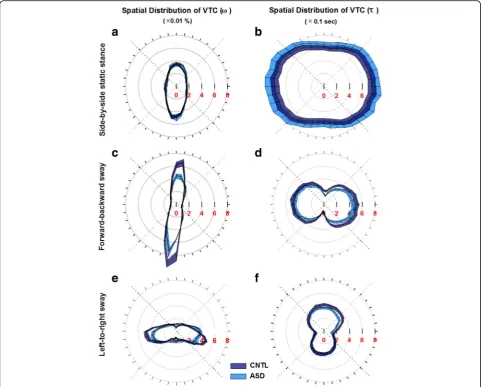
During static stance, both groups showed increased VTC (ω)Spatialdistribution in the forward and backward
quadrants compared to the leftward and rightward quad-rants (quadrant main effect: F3, 164= 186.107, p= 0.000;
forward = 29%, SE = 0.6%; backward = 35%, SE = 0.6%; left-ward = 18%, SE = 0.6%; and rightleft-ward = 18%, SE = 0.6%) (Fig. 5a). There was no difference in VTC (ω)Spatial for
children with ASD and TD controls during static stance (group main effect:F1, 164= 0.016,p= 0.899) at any
quad-rants (quadrant × group interaction effect: F3, 164= 1.142,
p= 0.334). VTC (τ)Temporal minima were greater
lat-erally compared with the backward quadrant for both groups (quadrant main effect: F3, 164= 4.101, p= 0.008;
showed increased VTC (τ)Temporal minima during static
stance relative to TD controls (group main effect:F1, 164=
5.936,p= 0.016; ASD-TD = 0.088 s, SE = 0.036 s) (Fig. 5b). During dynamic AP sway, VTC (ω)Spatial showed
greater distribution in forward and backward quadrants compared to leftward and rightward quadrants (quad-rant main effect: F3, 160= 637.329, p= 0.000; forward =
32%, SE = 0.6%; backward = 38%, SE = 0.6%; leftward = 10%, SE = 0.6%; rightward = 10%, SE = 0.6%). Children with ASD showed a significant reduction of VTC
(ω)Spatialdistribution compared with TD controls (group
main effect: F1, 160= 19.354, p= 0.000; ASD-TD =−2.5%,
SE = 0.6%) with the effect more pronounced in forward and backward relative to leftward and rightward directions (quadrant × group interaction effect: F3, 160= 6.238, p=
0.000; forward, ASD-TD =−5.2%, SE = 1%; backward, ASD-TD =−4.7%, SE = 1.0%; leftward, ASD-TD = 0.8%, SE = 1.0%; and rightward, ASD-TD = 0.6%, SE = 1.0%) (Fig. 5c). For VTC (τ)Temporal minima, both groups showed
reduc-tions along the target direcreduc-tions relative to the orthogonal
directions (quadrant main effect:F3, 160= 45.482,p= 0.000;
forward = 0.290 s, SE = 0.016 s; backward = 0.258 s, SE = 0.016 s; leftward = 0.458 s, SE = 0.016 s; and rightward = 0.461 s, SE = 0.016 s). In contrast to findings from the static stance condition, children with ASD showed a VTC (τ)Temporal minima reduction compared with TD
con-trols (group main effect: F1, 160= 13.268, p= 0.000;
ASD-TD =−0.058 s, SE = 0.016 s) suggesting that af-fected children showed a reduced amount of time to correct their postural sway before it reached their pos-tural limitation boundary (Fig. 5d).
During dynamic ML sway, VTC (ω)Spatialshowed greater
distribution along the leftward and rightward relative to forward and backward quadrants (quadrant main effect:F3, 164= 174.356, p= 0.000; forward = 11.8%, SE = 0.7%;
back-ward = 16.6%, SE = 0.7%; leftback-ward = 30.1%, SE = 0.7%; and rightward = 30.1%, SE = 0.7%). VTC (ω)Spatial distribution
was significantly reduced in the leftward quadrant for chil-dren with ASD compared to TD chilchil-dren (quadrant × group interaction effect:F3, 164= 5.304,p= 0.002; leftward,
ASD-TD =−5.1%, SE = 1.4%) (Fig. 5e). Both groups showed decreased VTC (τ)Temporalminima along the target
direc-tions relative to orthogonal direcdirec-tions (quadrant main ef-fect: F3, 164= 48.825, p= 0.000; forward = 0.380 s, SE =
0.012 s; backward = 0.332 s, SE = 0.012 s; leftward = 0.211 s, SE = 0.012 s; and rightward = 0.212 s, SE = 0.012 s). Children with ASD showed a significant VTC (τ)Temporalminima
re-duction compared with TD controls (group main effect:F1, 164= 5.488, p= 0.020; ASD-TD =−0.029 s, SE = 0.012 s)
(Fig. 5f).
Mutual information
Mutual information was greater for ML sway compared to other conditions (stance condition main effect: F2, 80=
8.544,p= 0.000). Children with ASD showed increased levels of mutual information compared to TD children (group main effect:F1, 40= 24.253,p= 0.000), especially
during dynamic stances (stance condition × group inter-action effect: F2, 80= 10.755, p= 0.000; AP sway:
ASD-TD = 0.212 bit, SE = 0.048 bit, p= 0.000; ML sway: ASD-TD = 0.335 bit, SE = 0.069 bit,p= 0.000). Children with ASD showed increased mutual information during ML sway compared to both AP sway and static stance (ML sway–AP sway = 0.140 bit, SE = 0.044 bit, p= 0.009; ML sway–static stance = 0.290 bit, SE = 0.053 bit,p= 0.000; AP sway–static stance = 0.150 bit, SE = 0.039 bit, p= 0.001) whereas TD children showed similar levels of mutual infor-mation across all task conditions (Fig. 4c).
Fig. 4aCOPAPand COPMLstandard deviation.bCOP trajectory length.
cMutual information shared between COPAPand COPMLare shown as a
Demographic and clinical correlations
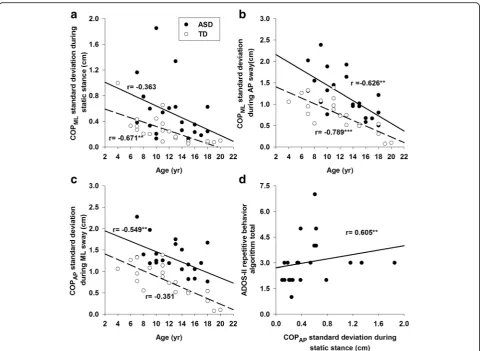
None of the postural measurements were associated with IQ scores (i.e., verbal, performance or full-scale IQ) for ei-ther group (Table 2). For TD children, increased age was associated with lower COPMLstandard deviation and COP
trajectory length during static stance (Fig. 6a). Increased age of TD children was also associated with reductions of COPML standard deviation and mutual information
during dynamic AP sway (Fig. 6b). For children with ASD, increased age was associated with reduced COP standard deviation in directions orthogonal to the tar-get during dynamic stances (Fig. 6b, c). The strength of age and postural control associations did not differ be-tween groups (p> .05). Increased COPAPstandard
devi-ation during static stance was associated with higher
clinical ratings of restricted-repetitive behaviors on the ADOS-II for children with ASD (Fig. 6d).
Discussion
To our knowledge, this is the first study to examine pos-tural orientation and equilibrium deficits underlying in-creased postural sway in children with ASD. Unlike the majority of prior studies, we also assessed children’s postural stability during static stance and dynamic stances that more closely resemble the dynamic aspects of everyday activities, including walking and reaching for objects while standing. We utilized both traditional measures of postural control, including COP standard deviation and trajectory length, and novel measures of postural orientation (VTC spatial and VTC temporal) and equilibrium control processes (mutual
Fig. 5Spatial distribution of VTC (ω)Spatial(panelsa,c,e) and VTC (τ)Temporalminima (panelsb,d,f) (mean ± SE) as a function of task condition (side-by-side
static stance: panelsaandb; forward-backward sway: panelscandd; left-to-right sway: panelseandf).Redindices on theleft columnrepresent the percentage distribution (×0.01%) of VTC (ω)Spatialat each postural limitation boundary segment.Redindices on theright columnrepresent the temporal
dis-tribution (×0.1 s) of VTC (τ)Temporalminima at each postural limitation boundary segment.Gray dotted linesrepresent quadrant boundaries we defined for
information) that have been well validated in motor control and biomechanical fields, but never applied to studies of ASD. There are three key findings from this study. First, children with ASD showed increased COP trajectory length and standard deviation during all standing conditions rela-tive to TD controls, but elevations in COP standard devi-ation shown by children with ASD were more severe during dynamic stances. Second, children with ASD displayed greater VTC (τ)Temporalminima during static stance. In the
context of their increased COP variability, this suggests that children with ASD compensate for their postural instability by allowing themselves more time to correct their postural sway before it reaches the postural limitation boundary. In contrast, children with ASD were not able to show this same compensatory process during dynamic stances. They also showed significant VTC (ω)Spatialreductions indicating that
their ability to acquire spatial information regarding their sway is impaired during dynamic but not static stances.
Third, increased mutual information of COPAPand COP
ML-time series was observed during dynamic stances in chil-dren with ASD suggesting a compromised ability to decouple distinct joint movements when attempting to sway in one direction. Taken together, these results suggest that both postural orientation and equilibrium control pro-cesses are disrupted in ASD, but the manifestations of these disruptions vary across different standing conditions.
Increased postural sway in ASD during static and dynamic stances
Our findings are consistent with prior studies show-ing increased COP standard deviation and trajectory length in children with ASD during static stance, but extend these results to indicate that increases in COP variability become more severe when children with ASD attempt to sway along specified directions. Dur-ing dynamic stances, gravitational torque increases
Table 2Correlation coefficients between postural measurements and demographic, cognitive and ASD clinical ratings
TD (n= 21) Age FSIQ PIQ VIQ
SS_COPML −0.671** −0.118 −0.245 −0.108
SS_COPAP −0.480 −0.123 −0.167 −0.137
AP_COPML −0.789*** −0.069 −0.247 0.063
AP_COPAP −0.057 −0.080 −0.068 −0.050
ML-COPML 0.395 0.140 0.257 0.104
ML_COPAP −0.351 0.176 0.054 0.279
AP_MI −0.666** −0.309 −0.324 −0.290
ML_MI −0.211 −0.134 −0.116 −0.114
SS_Length −0.704*** −0.135 −0.155 −0.171
AP_Length 0.008 0.216 −0.045 0.299
ML_Length 0.203 0.286 0.171 0.394
ASD (n= 22) Age FSIQ PIQ VIQ ADI-R Social ADI-R Comm ADI-R RRB ADOS RRB
SS_COPML −0.363 −0.063 −0.089 −0.044 0.066 −0.070 −0.093 0.211
SS_COPAP −0.286 −0.250 −0.360 −0.125 0.085 0.114 −0.288 0.605**
AP_COPML −0.626** 0.141 0.110 0.149 0.092 −0.038 −0.094 0.138
AP_COPAP 0.504 0.085 0.066 0.072 0.183 −0.019 0.211 −0.133
ML-COPML 0.298 −0.184 −0.250 −0.111 0.090 −0.050 0.070 0.347
ML_COPAP −0.549** 0.164 0.055 0.237 −0.060 −0.088 −0.063 0.266
AP_MI 0.212 −0.026 −0.154 0.088 0.457 0.299 0.305 −0.172
ML_MI −0.328 −0.026 −0.183 0.122 0.130 −0.083 −0.049 0.241
SS_Length −0.265 −0.125 −0.387 −0.102 0.218 −0.024 −0.151 0.206
AP_Length −0.297 0.196 0.235 0.126 −0.087 −0.528 −0.057 0.170
ML_Length −0.498 −0.117 −0.158 −0.050 −0.034 −0.519 −0.310 0.311
SS_ COPMLCOPMLstandard deviation of static stance,SS_ COPAPCOPAPstandard deviation of static stance,AP_ COPMLCOPMLstandard deviation of dynamic AP
sway,AP_ COPAPCOPAPstandard deviation of dynamic AP sway,ML_ COPMLCOPMLstandard deviation of dynamic ML sway,ML_ COPAPCOPAPstandard deviation
of dynamic ML sway,AP_MImutual information of dynamic AP sway,ML_MImutual information of dynamic ML sway,SS_LengthCOP trajectory length of static stance,AP_LengthCOP trajectory length of dynamic AP sway,ML_LengthCOP trajectory length of dynamic ML sway,FSIQfull scale IQ,PIQperformance IQ,VIQ verbal IQ,ADI-R SocialADI-R social algorithm total,ADI-R CommADI-R verbal communication algorithm total,ADI-R RRBADI-R restricted and repetitive behavior al-gorithm total,ADOS-RRBADOS-II restricted and repetitive behavior algorithm total
relative to static stance due to increases in postural sway magnitude, velocity, and acceleration [24, 25, 40]. The goal of dynamic stances is distinct from static stance in that participants introduce internal pertur-bations to their postural control system by moving themselves along a target direction and then reac-tively refine their postural sway velocity and acceler-ation to avoid contact with their postural limitacceler-ation boundary. The task becomes more difficult as chil-dren approach their postural limitation boundary be-cause the direction of sway acceleration must be reversed and velocity must subsequently return to zero prior to the individual’s COP colliding with the boundary [25, 40]. The increased demands on control processes used to maintain stability despite constant and intentional movement appear to contribute to postural deficits in children with ASD that are more severe than the static stance conditions that have been studied previously.
Altered postural orientation in ASD during static and dynamic stances
To assess the control processes contributing to increased postural sway variability in ASD, we examined participants’ COP time series relative to their postural limitation bound-ary. During standing, the postural limitation boundary serves as an internal representation of the maximum extent to which an individual may sway without losing balance [12–14]. In our study of static stance, we did not see any difference in VTC (ω)Spatialbetween groups suggesting that
children with ASD have a relatively spared ability to acquire postural sway spatial information relative to their limitation boundary (Fig. 5a). In order to ensure that one’s postural sway does not collide with or move beyond the postural limitation boundary, individuals maintain a“safety margin” from the postural limitation boundary [12, 20]. The safety margin can be preserved by consistently perceiving spatial information of the postural limitation boundary regarding directions to which postural stability may be reduced [23].
Fig. 6Relationship between postural performance and key demographic and clinical characteristics of participants.aIncreased age was associated with a COPMLstandard deviation reduction in TD children during static stance.bIncreased age was associated with COPMLstandard deviation
reductions of both groups during dynamic AP sway.cIncreased age was associated with a COPAPstandard deviation reduction in children with ASD
during dynamic ML sway.dIncreased ADOS-II ratings of restricted, repetitive behavior algorithm total was associated with increased COPAPstandard
Our finding that children with ASD utilize spatial informa-tion similar to controls indicates that their ability to pre-serve a safety margin by dynamically processing spatial information during static stance is intact. The safety margin also can be maintained by reducing the magnitude of pos-tural sway [12–14] and/or increasing the time it will take for the COP to reach the postural limitation boundary (i.e., VTC (τ)Temporalminima) [21–23]. VTC (τ)Temporalminima
was increased in children with ASD compared to TD con-trols during static stance suggesting that, in the context of increased postural instability, they may utilize a compensa-tory process that affords them more time to direct their body movement away from their postural limitation bound-ary despite increased sway and sway variability (Fig. 5b).
During dynamic stances, children with ASD showed re-duced VTC (ω)Spatialalong the target directions compared to
TD children indicating that they acquired less spatial infor-mation along directions that would potentially induce pos-tural instability (Fig. 5c, e). Children with ASD also showed a decreased VTC (τ)Temporalminima suggesting that they have
a reduced amount of time to adjust their postural sway away from their postural limitation boundary (Fig. 5d, f). These findings contrast with our results from the static stance con-dition and suggest that when children with ASD are required to dynamically adjust the velocity and acceleration of their postural sway, they are not able to invoke the same compen-satory mechanisms as they do when attempting to stand still. Therefore, our results identify an atypical pattern of postural orientation in ASD that is exacerbated by increased task de-mands, and which may be more evident during everyday ac-tivities involving dynamic shifting of children’s COP (e.g., mediolateral trunk sway during walking, rhythmical arm reaching from one location to the other, rocking in a chair). These findings suggest that studies examining sensorimotor behaviors in ASD may be more informative for treatment development efforts if they focus on dynamic activities simi-lar to those postural activities executed in the context of daily living rather than static postural control tasks that emphasize reducing movement while standing still.
Children with ASD and controls showed postural limita-tion boundaries that were similar in size suggesting that all confounding variables that could possibly affect partici-pants’boundary are well controlled (Table 1). It remains possible that postural limitation boundaries may vary in size in ASD when age and key physical characteristics of height and weight are not controlled. By matching groups on these variables in our study, differences in VTC mea-surements reported among children with ASD can be seen as being more directly reflective of postural orientation deficits rather than differences in physical characteristics.
Altered postural equilibrium in ASD across dynamic stances
We also found that children with ASD show significant in-creases in mutual information during dynamic stances
implicating deficits in postural equilibrium process (Fig. 4c). Mutual information typically is reduced during dynamic stances compared to static stance as postural sway is con-strained within one dimension and one type of joint move-ment is emphasized over another [41]. In contrast, we found that children with ASD showed increased levels of shared information between ankle and hip movement dur-ing dynamic compared to static stances. These finddur-ings sug-gest that failures to decouple ankle dorsi-/plantar-flexion and hip abduction/adduction may contribute to postural disruptions during dynamic stances in ASD. Increased de-pendency of COPAPand COPMLin ASD may reflect a
re-duced ability to evoke distinct motor control processes and move towards the target without generating unwanted body movements in orthogonal directions [26, 27].
Alternatively, increased mutual information may suggest a compensatory process that allows children with ASD to increase their body sway generally and actively engage mul-tiple control mechanisms in order to decrease the likeli-hood that they will lose balance if depending on only one joint action. While this strategy may assist children in real-izing the task goal, it also inevitably disrupts their balance as increased variability along directions orthogonal to the target has been shown to compromise an individual’s abil-ities to maintain stability [42] and realize task goals that in-volve intentional sway, such as reaching for an object [43].
Postural stability, developmental and clinical features in ASD
Our findings that COP trajectory length and variability de-crease with age in TD children but not children with ASD are consistent with those reported by Minshew et al. [4] who showed that postural stability in children with ASD failed to reach adult levels during development. Children with ASD showed reductions in orthogonal COP variabil-ity with age indicating that the abilvariabil-ity to independently ac-tivate ankle or hip mechanisms during dynamic stances may develop along a delayed timeline, but that equilib-rium control processes may continue to mature through-out childhood (Fig. 6b, c). Longitudinal studies assessing postural orientation and equilibrium during dynamic standing activities are needed to characterize the timing and nature of these deficits across the lifespan in ASD.
repetitive behaviors in ASD as they both commonly present negative correlations with children’s development and cognitive abilities [45], further studies are needed to systematically examine mechanisms underlying this inter-esting relationship.
Study limitations and future directions
While the present study documents multiple novel find-ings useful for developing more mechanistic models of postural control deficits in ASD, our results must be con-sidered in the context of multiple limitations. First, we in-cluded children across a broad age range (4–18 years) in order to better characterize postural control processes across childhood in ASD. Still, denser sampling of individ-ual periods of development and longitudinal follow-up studies are needed to map trajectories of postural control development and their relation to clinical symptoms in ASD. Second, we also chose to match our groups on per-formance as opposed to verbal IQ as we and others have done previously [46–49]. This allowed us to maximize the generalizability of our findings by including children whose verbal ability may be below average despite average non-verbal abilities as is common in ASD [50]. Third, some of the participants with ASD in our sample may have comor-bid conditions that are common in this disorder (e.g., ADHD, depression). Systematic study of the relationships between these comorbid conditions and postural control in ASD is needed. Last, while the VTC measurement ap-proaches used here have been well validated in prior stud-ies of aging [23], mild traumatic brain injury [22], ankle instability [19], and Parkinson disease [20], these ap-proaches may have limitations when studied with children with ASD. We controlled for multiple variables that may confound these measurements (e.g., height, weight, age, verbal ability), but it remains possible that performance for some children with ASD or TD children may have been disrupted by factors such as reduced attention, motivation, or understanding of the task. Larger studies assessing the extent to which attention, verbal abilities, and age are re-lated to VTC measurements are warranted.
Conclusions
Our results demonstrate that postural orientation and equi-librium deficits contribute to reduced postural stability in children with ASD during both static and dynamic stances. Studies of more naturalistic dynamic standing activities in ASD are needed to better define how deficits in orientation and equilibrium control processes affect sensorimotor behav-iors performed during daily living. An emerging literature has indicated that early motor developmental abnormalities are among the earliest signs of ASD [2, 11] and, combined with our findings that postural control impairments are asso-ciated with age and clinically rated restricted and repetitive behaviors in ASD, these results suggest that studies of the
development of postural control in ASD may provide im-portant insights into neurodevelopmental mechanisms that cause ASD and the emergence of sensorimotor and other core symptoms during childhood.
Additional files
Additional file 1:Supplemental information on virtual time-to-contact (VTC) calculations. (DOCX 112 kb)
Additional file 2:Supplemental information on COP based measurements. (DOCX 124 kb)
Abbreviation
ADI-R:Autism Diagnostic Inventory-Revised; ADOS-II: Autism Diagnostic Observation Schedule-II; AP: posterior direction; AP sway: anterior-posterior postural sway (dynamic condition); ASD: autism spectrum disorder; ML: mediolateral direction; ML sway: mediolateral postural sway (dynamic condition); TD children: typically developing children
Acknowledgements
This study was supported by NIMH K23 Research Career Development Award (MH092696) and the Kansas Center for Autism Research and Training (KCART) Research Investment Council Strategic Initiative Grant to Dr. Mosconi and the NICHD U54 Kansas Intellectual and Developmental Disabilities Research Center Award (PI: Dr. John Colombo; HD090216-01).
Availability of data and materials
Select data will be shared in the National Database for Autism Research (NDAR) according to agreements with NIH for the PI’s K23 award. We also would be open to share de-identified data based upon requests made to the first and last author of the paper.
Authors’contributions
ZW is responsible for the conception and design of the research; KCC, MWM, and SPW performed the ADI-R, ADOS-II, and IQ diagnostic tests for children with ASD and TD controls; and AAK provided the lab space and equipment for testing. ALC, KCC, RH, and ZW performed the experiments; ZW wrote the Matlab scoring program and scored the raw data; ZW performed the statis-tical analyses; JAS, AAK, MWM, and ZW interpreted the experimental results; ZW prepared the figures and drafted the manuscript; each author edited the manuscript; and MWM and ZW revised the manuscript. All authors have ap-proved the final version of the manuscript.
Competing interests
The authors declare no existing conflicts of interest, financial, or otherwise except Dr. Sweeney who consulted to Takeda, Roche, and Lilly unrelated to this work.
Ethics approval and consent to participate
All study procedures were approved by the Institutional Review Board of UT Southwestern Medical Center and Children’s Hospital of Dallas. Participants 18 years of age or older provided written consent and minors provided assent in addition to written consent from their legal guardian.
Glossary Force
Force is a push or pull on an object. If the net force on an object is not zero, then the object accelerates (or changes its velocity). Force is a vector and has both magnitude and direction. Force recorded from a force platform includes measurements in three dimensions, including anterior-posterior, mediolateral, and vertical directions. Force along the vertical direction is typically referred to the ground reaction force. Moment
The moment is the turning effect produced by a net force perpendicular to the point of rotation.
COP
(i.e., feet) in contact with the ground. It has been used as an indirect measure of individuals’postural sway. The COP can be derived from the force and moment data collected from a force platform (Formular1).
COPAP
Center of pressure time series in the anterior-posterior direction COPML
Center of pressure time series in the mediolateral direction VTC
Virtual time-to-contact, a measurement quantifies the spatiotemporal relation of an individual’s postural sway to his/her own postural limita-tion boundary
VTC (ω)Spatial
Spatial virtual time-to-contact, a resultant variable from the VTC meas-urement characterizing the spatial relation of an individual’s postural sway to his/her own postural sway boundary
VTC (τ)Temporal
Temporal virtual time-to-contact, a resultant variable from the VTC measurement characterizing the temporal relation of an individual’s postural sway to his/her own postural sway boundary
Mutual information
In probability and information theory, the mutual information of two random variables measures their mutual dependency quantifiing the amount of information obtained about one random variable through the other
Author details
1
Schiefelbusch Institute for Life Span Studies and Clinical Child Psychology Program, University of Kansas, 1000 Sunnyside Ave., Suite 2004, Lawrence, KS 66045, USA.2Kansas Center for Autism Research and Training (KCART), University of Kansas Medical School, Overland Park, KS 66213, USA. 3
Analytical Imaging and Modeling Center, Children’s Medical Center, Dallas, TX 75235, USA.4Center for Autism and Developmental Disabilities, University of Texas Southwestern Medical Center, Dallas, TX 75390, USA.5Department of Psychiatry and Behavioral Neuroscience, University of Cincinnati College of Medicine, Cincinnati, OH 45219, USA.
Received: 17 May 2016 Accepted: 8 November 2016
References
1. Mosconi MW, Wang Z, Schmitt LM, et al. The role of cerebellar circuitry alternations in the pathophysiology of autism spectrum disorders. Front Neurosci. 2015a;9: 296.
2. Hannant P, Tavassoli T, Cassidy S. The role of sensorimotor difficulties in autism spectrum conditions. Front Neurol. 2016;7:124.
3. Travers BG, Bigler ED, Duffield TC, et al. Longitudinal development of manual motor ability in autism spectrum disorder from childhood to mid-adulthood relates to adaptive daily living skills. Dev Sci. 2016:1-15. 4. Minshew NJ, Sung K, Jones BL, et al. Underdevelopment of the postural
control system in autism. Neurology. 2007;63:2056–61.
5. Ming X, Brimacombe M, Wagner GC. Prevalence of motor impairment in autism spectrum disorders. Brain Dev. 2007;29:565–70.
6. Kohen-Raz R, Volkmar FR, Cohen DJ. Postural control in children with autism. J Autism Dev Disord. 1992;22:419–32.
7. Cook JL, Blakemore SJ, Press C. Atypical basic movement kinematics in autism spectrum conditions. Brain. 2013;136:2816–24.
8. Morris SL, Foster CJ, Parsons R, et al. Differences in the use of vision and proprioception for postural control in autism spectrum disorder. J Neurosci. 2015;307:273–80.
9. Loh A, Soman T, Brian J, et al. Stereotyped motor behaviors associated with autism in high-risk infants: a pilot videotape analysis of a sibling sample. J Autism Dev Disord. 2007;37:25–36.
10. Hilton CL, Zhang Y, Whilte MR, et al. Motor impairment in sibling pairs concordant and discordant for autism spectrum disorders. Autism. 2011;16:430–41.
11. Cook J. From movement kinematics to social cognition: the case of autism. Philos Trans R Soc Lond B Biol Sci. 2016;371:20150372.
12. Riccio GE. Information in movement variability about the qualitative dynamics of posture and orientation. In: Newell KM, Corcos DM, editors.
Variability and motor control. University of Illinois at Urbana-Champaign: Human Kinetics; 1993:317-39.
13. Massion J. Postural control system. Curr Opin Neurobiol. 1994;4:877–87. 14. Horak FB. Postural orientation and equilibrium: what do we need to know
about neural control of balance to prevent falls? Age Ageing. 2006;35:ii7–ii11. 15. Gepner B, Mestre DR. Brief report: postural reactive to fast visual motion
differentiates autistic from children with asperger syndrome. J Autism Dev Disord. 2002;32:231–8.
16. Molloy CA, Dietrich KN, Bhattacharya A. Postural stability in children with autism spectrum disorder. J Autism Dev Disord. 2003;33:643–53. 17. Chang CH, Wade MG, Stoffregen TA, et al. Visual tasks and postural sway in
children with and without autism spectrum disorders. Res Dev Disabil. 2010;31:1536–42.
18. Doumas M, McKenna R, Murphy B. Postural control deficits in autism spectrum disorder: the role of sensory integration. J Autism Dev Disord. 2016;46(3):853-61.
19. Hertel J, Olmsted-Kramer LC. Deficits in time-to-boundary measures of postural control with chronic ankle instability. Gait Posture. 2007;25:33–9. 20. Mancini M, Rocchi L, Horak FB, et al. Effects of Parkinson’s disease and
levodopa on functional limits of stability. Clin Biomech. 2008;23:450–58. 21. Slobounov S, Cao C, Sebastianelli W, et al. Residual deficits from concussion
as revealed by virtual time-to-contact measures of postural stability. Clin Neurophysiol. 2008;119:281–9.
22. Slobounov S, Cao C, Jaiswal N, et al. Neural basis of postural instability identified by VTC and EEG. Exp Brain Res. 2009;199:1–16.
23. Kilby MC, Slobounov SM, Newell KM. Postural instability detection: aging and the complexity of spatial-temporal distributional patterns for virtually contacting the stability boundary in human stance. PLoS One. 2014;9: e108905.
24. Riach CL, Starkes JL. Velocity of center of pressure excursions as an indicator of postural control system in children. Gait Posture. 1994;2:167–72. 25. Winter DA, Prince F, Frank JS, et al. Unified theory regarding A/P and M/L
balance in quiet stance. J Neurophysiol. 1996;75:2334–43.
26. Wang Z, Newell KM. Inter-foot coordination dynamics of quiet standing postures. Neurosci Biobehav Rev. 2014;47:194–202.
27. Rosenblum M, Firsov GI, Kuuz R, et al. Human postural control: force plate experiments and modelling. In: Kantz H, Kurths J, Mayer-Kress G, editors. Nonlinear analysis of physiological data. Berlin: Springer; 1998. p. 283–306. 28. Fournier KA, Kimberg CI, Radonovich KJ, Tillman MD, Chow JW, Lewis MH, et al. Decreased static and dynamic postural control in children with autism spectrum disorders. Gait Posture. 2010;32:6–9.
29. Travers BG, Powell PS, Klinger LG, et al. Motor difficulties in autism spectrum disorder: linking symptom severity and postural stability. J Autism Dev Disord. 2013;43:1568–83.
30. Radonovich KJ, Fournier KA, Hass CJ. Relationship between postural control and restricted, repetitive behaviors in autism spectrum disorders. Front Integr Neurosci. 2013;7:28.
31. Wechsler D. Wechsler Abbreviated Scale of Intelligence: Psychological Corporation. 1999.
32. Wechsler D. Wechsler Abbreviated Scale of Intelligence—second edition—(WASI-II). San Antonio, TX: Pearson Education; 2011.
33. Lord C, Rutter M, Le Couteur A. Autism diagnostic interview-revised: a revised version of a diagnostic interview for caregivers of individuals with possible pervasive developmental disorders. J Autism Dev Disord. 1994;24:659–85. 34. Rutter M, DiLavore PC, Risi S, et al. Autism Diagnostic Observation Schedule:
ADOS-2. Torrance, CA: Western Psychological Services; 2012. 35. Berument SK, Rutter M, Lord C, et al. Autism screening questionnaire:
diagnostic validity. Br J Psychiatry. 1999;175:444–51.
36. Reilly JL, Lencer R, Bishop JR, et al. Pharmacological treatment effects on eye movement control. Brain Cogn. 2008;68:415–35.
37. Prieto TE, Myklebust JB, Hoffmann RG, et al. Measures of postural steadiness: differences between healthy young and elderly adults. IEEE Trans Biomed Eng. 1996;43:956–66.
38. Billauer E. Peakdet: Peak detection using MATLAB. Retrieved http://www.billauer.co.il/peakdet.html. 2015.
39. Coombs CH, Dawes RM, Tversky A. Mathematical psychology: an elementary introduction. Prentice-Hall: Englewood Cliffs, New Jersey; 1970.
40. Pai YC, Patton JL. Center of mass velocity-position predictions for balance control. J Biomech. 1997;30:347–54.
42. Hsu WL, Scholz JP, Schoner G, et al. Control and estimation of posture during quiet stance depends on multijoint coordination. J Neurophysiol. 2007;97:3024–35.
43. Ma S, Feldman AG. Two functionally different synergies during arm reaching movements involving the trunk. J Neurophysiol. 1995;73:2120–2. 44. Bodfish JW, Parker DE, Lewis MH, et al. Stereotypy and motor control:
differences in the postural stability dynamics of persons with stereotyped and dyskinetic movement disorders. Am J Ment Retard. 2001;106:123–34. 45. Graham SA, Abbott AE, Nair A, Lincoln AJ, Muller RA, Goble DJ. The
influence of task difficulty and participant age on balance control in ASD. J Autism Dev Disord. 2015;45:1419–27.
46. Schmitt LM, Cook EH, Sweeney JA, et al. Saccadic eye movement abnormalities in autism spectrum disorder indicate dysfunctions in cerebellum and brainstem. Mol Autism. 2014;5:47.
47. Mosconi MW, Mohanty S, Greene RK, et al. Feedforward and feedback motor control abnormalities implicate cerebellar dysfunctions in autism spectrum disorder. J Neurosci. 2015;35:2015–25.
48. Wang Z, Magnon GC, White SP, et al. Individuals with autism spectrum disorder show abnormalities during initial and subsequent phases of precision gripping. J Neurophysiol. 2015;113:1989–2001.
49. Neely KA, Mohanty S, Schmitt LM, Wang Z, Sweeney JA, Mosconi MW. MotorMemory Deficits Contribute to Motor Impairments in Autism Spectrum Disorder. J Autism Dev Disord. 2016;1-10.
50. Shah A, Frith U. Why do autistic individuals show superior performance on the block design task? J Child Psychol Psychiat. 1993;34:1351–64.
• We accept pre-submission inquiries
• Our selector tool helps you to find the most relevant journal • We provide round the clock customer support
• Convenient online submission • Thorough peer review
• Inclusion in PubMed and all major indexing services • Maximum visibility for your research
Submit your manuscript at www.biomedcentral.com/submit
![Table 1 Demographic characteristics [mean (SD)] of childrenwith ASD and typically developing (TD) children](https://thumb-us.123doks.com/thumbv2/123dok_us/9011656.1894071/4.595.56.290.530.699/table-demographic-characteristics-mean-childrenwith-typically-developing-children.webp)