A NEW ILP MODEL FOR IDENTICAL PARALLEL-MACHINE
SCHEDULING WITH FAMILY SETUP TIMES MINIMIZING THE
TOTAL WEIGHTED FLOW TIME BY A GENETIC ALGORITHM
R. Tavakkoli-Moghaddam*
Department of Industrial Engineering, Faculty of Engineering University of Tehran, P. O. Box 11365/4563, Tehran, Iran
E. Mehdizadeh
Department of Industrial Engineering, Qazvin Branch Islamic Azad University, Qazvin, Iran
*Corresponding Author
(Received: November 21, 2006 – Accepted in Revised Form: May 31, 2007)
Abstract This paper presents a novel, integer-linear programming (ILP) model for an identical parallel-machine scheduling problem with family setup times that minimizes the total weighted flow time (TWFT). Some researchers have addressed parallel-machine scheduling problems in the literature over the last three decades. However, the existing studies have been limited to the research of independent jobs, and most classical optimization methods are focused on parallel-machine scheduling problems without considering setup times and relationship between jobs. This problem is shown to be NP-hard one in the strong sense. Obtaining an optimal solution for this type of complex, large-sized problems in reasonable computational time is extremely difficult. A meta-heuristic method, based on genetic algorithms, is thus proposed and applied to the given problem in order to obtain a good and near-optimal solution, especially for large sizes. Further, the efficiency of the proposed algorithm, based on various test problems, is compared with the Lingo 8.0 software.
Keywords Parallel Machine Scheduling, ILP Model, Family Setup Times, Total Weighted Flow
Time, Genetic Algorithm
ﻩﺪﻴﮑﭼ
ﻪﻣﺎﻧﺮﺑ ﻝﺪﻣ ﮏﻳ ﻪﻟﺎﻘﻣ ﻦﻳﺍ ﺭﺩ
ﻂﻠﺘـﺨﻣ ﻱﺰـﻳﺭ )
ﺢﻴﺤـﺻ ﺩﺪـﻋ
ﻲـﻄﺧ (
ﺴـﻣ ﯼﺍﺮـﺑ ﺪـﻳﺪﺟ ﺎ
ﻱﺪـﻨﺒﻧﺎﻣﺯ ﻪﻟ
ﻦﻴﺷﺎﻣ
ﻥﺎﻣﺯ ﻦﺘﻓﺮﮔ ﺮﻈﻧ ﺭﺩ ﺎﺑ ﻥﺎﺴﮑﻳ ﻱﺯﺍﻮﻣ ﻱﺎﻫ ﻩﺩﺎﻣﺁ ﻱﺎﻫ
ﻱﺯﺎﺳ ﺎﻫﺭﺎﮐ ﻩﺩﺍﻮﻧﺎﺧ ﻥﺎـﻣﺯ ﻞﮐ ﻥﺩﻮﻤﻧ ﻞﻗﺍﺪﺣ ﺭﻮﻈﻨﻣ ﻪﺑ
ﻲﻣ ﯽﻧﺯﻭ ﺖﺧﺎﺳ ﻥﺎﻳﺮﺟ
ﺩﺩﺮﮔ . ﻝﺎﺳ ﺭﺩ
ﻦﻴﺷﺎﻣ ﻱﺪﻨﺒﻧﺎﻣﺯ ﻞﺋﺎﺴﻣ ﺮﻴﺧﺍ ﻱﺎﻫ
ﻣ ﻱﺎﻫ ﺩﺭﻮـﻣ ﻱﺩﺎﻳﺯ ﻦﻴﻘﻘﺤﻣ ﻂﺳﻮﺗ ﻱﺯﺍﻮ
ﺵﻭﺭ ﺐـﻠﻏﺍ ﻭ ﻩﺩﻮـﺑ ﻞﻘﺘﺴﻣ ﻱﺎﻫﺭﺎﮐ ﻪﺑ ﺩﻭﺪﺤﻣ ﺩﻮﺟﻮﻣ ﺕﺎﻘﻴﻘﺤﺗ ﺎﻣﺍ ،ﺖﺳﺍ ﻪﺘﻓﺮﮔ ﺭﺍﺮﻗ ﻪﻌﻟﺎﻄﻣ
ﻪـﻨﻴﻬﺑ ﻱﺎـﻫ
ﻱﺯﺎـﺳ
ﻦﻴﺷﺎﻣ ﻞﺋﺎﺴﻣ ﻱﻭﺭ ﻝﻭﺍﺪﺘﻣ
ﻥﺎﻣﺯ ﻦﺘﻓﺮﮔﺮﻈﻧ ﺭﺩ ﻥﻭﺪﺑ ﻱﺯﺍﻮﻣ ﻱﺎﻫ
ﻩﺩﺎﻣﺁ ﻱﺎﻫ ﺰـﮐﺮﻤﺘﻣ ﺎـﻫﺭﺎﮐ ﻦﻴـﺑ ﻁﺎـﺒﺗﺭﺍ ﻭ ﻱﺯﺎـﺳ
ﻲﻣ ﺪﻨﺷﺎﺑ .
ﺣ ﻱﺍﺮﺑ ﻪﻨﻴﻬﺑ ﺏﺍﻮﺟ ﻥﺩﺭﻭﺁ ﺖﺳﺪﺑ ﯽﺗﺎﺒـﺳﺎﺤﻣ ﻥﺎـﻣﺯ ﺭﺩ ﮒﺭﺰـﺑ ﺱﺎـﻴﻘﻣ ﺎـﺑ ﻭ ﻩﺪﻴﭽﻴﭘ ﻞﺋﺎﺴﻣ ﻉﻮﻧ ﻦﻳﺍ ﻞ
ﻲﻣ ﻞﮑﺸﻣ ﺭﺎﻴﺴﺑ ﻝﻮﻘﻌﻣ ﺪﺷﺎﺑ
.
ﺍﺮـﻓ ﻢﺘﻳﺭﻮـﮕﻟﺍ ﮏـﻳ ﻪﺋﺍﺭﺍ ،ﺮﻈﻧ ﺩﺭﻮﻣ ﻪﻠﺌﺴﻣ ﻞﺣ ﻱﺍﺮﺑ ﻦﻳﺍﺮﺑﺎﻨﺑ ﺱﺎـﺳﺍ ﺮـﺑ ﻱﺭﺎـﻜﺘﺑﺍ
ﺩﺎﻬﻨﺸـﻴﭘ ،ﮒﺭﺰـﺑ ﻩﺯﺍﺪﻧﺍ ﺎﺑ ﻞﺋﺎﺴﻣ ﻱﺍﺮﺑ ًﺎﺻﻮﺼﺨﻣ ،ﻪﻨﻴﻬﺑ ﮏﻳﺩﺰﻧ ﻭ ﺐﺳﺎﻨﻣ ﺏﺍﻮﺟ ﻪﺑ ﻲﺑﺎﻴﺘﺳﺩ ﻱﺍﺮﺑ ﮏﻴﺘﻧﮊ ﻢﺘﻳﺭﻮﮕﻟﺍ ﻲﻣ ﺩﺩﺮﮔ . ﻪﺨﺴﻧ ﻮﮕﻨﻴﻟ ﺭﺍﺰﻓﺍ ﻡﺮﻧ ﺎﺑ ﻪﻧﻮﻤﻧ ﻪﻠﺌﺴﻣ ﺪﻨﭼ ﺱﺎﺳﺍ ﺮﺑ ﯼﺩﺎﻬﻨﺸﻴﭘ ﻢﺘﻳﺭﻮﮕﻟﺍ ﯽﻳﺍﺭﺎﮐ ،ﻩﻭﻼﻌﺑ ۸
ﻪﺴـﻳﺎﻘﻣ ﺩﺭﻮﻣ
ﻲﻣ ﺭﺍﺮﻗ ﺩﺮﻴﮔ .
1. INTRODUCTION
A machine scheduling problem is an extended field of research in various applications. The main elements of machine scheduling problems are machine configuration, job characteristics, and objective function. The machine configuration can
issues are dealt with this scheduling as follows:
• What machine to be allocated to which jobs?
• How to order the jobs in an appropriate processing sequence?
• How to rationalize the reasonableness of the schedule?
The main criteria measures can also be classified to three distinct groups as follows [2]:
1. Completion-time-based measures. 2. Due-date-based measures.
3. Idleness-penalty-based measures.
1.1. Minimum Weighted Flow Time
Problem
The minimum weighted flow time problem belongs to the first above-mentioned group.Let Wj denotes the weight associated with
job
j
. This problem finds an optimal non-preemptive job schedule by minimizing the weighted flow time as follows:∑
== n
i j
j j
s f s w c
Min ( )
s refers to a given schedule and f(s) is the corresponding objective function value.
General assumptions are listed below [3]:
• Each job can be processed only by one operation.
• No job can be processed on more than one machine simultaneously.
• Any machine can process any job.
• No machine may process more than one job at a time.
• Machines never break down and are available during the scheduling period.
• Job processing times are independent of the scheduling.
• Number of jobs is fixed.
• Number of machines is fixed.
• Processing time of jobs on machine is given and fixed.
In the other hands, scheduling problems in practice often require a trade-off between the system
efficiency and timely completion of individual orders. A major reason for this is that there are typically efficiencies associated with processing similar parts together. This exerts pressure for scheduling long runs of similar jobs at the expense of some delays in other jobs.
1.2. Literature Review
Many researchers studied parallel-machine scheduling problems in past. Cheng and Sin [4] surveyed a parallel-machine scheduling problem and Allahverdi et al. [5] investigated a comprehensive review of setup-time (or setup-time) research for scheduling problems classifying into batch, non-batch, sequence-independent, and sequence-dependent setup. Potts and Kovalyov [6] reviewed the literature on family scheduling models with single-machine, shop problems, and parallel machine. Research on family scheduling models is relatively new in the literature, and most of this work has been focused on single machine models [7]. Brono et al. [8] proved that even a two-machine system for finding the weighted sum of flow times with an unequally weighted set of jobs is NP-hardness. This is true even when the problem is simplified by assuming no family setup times [9], or assigning weight 1 for each job [10].problem and identified characteristics of problems, in which each algorithm is best suited. However, they did not develop an algorithm to be directly implemented in practice. They believed that most real-world problems are much more complicated than the model under consideration, and hoped to take a step towards effective and practical solutions methods for more complex and more widely applicable models of scheduling problems in industries.
Nessah et al. [15] presented an identical parallel-machine scheduling problem with sequence-dependent setup times and release dates to minimize the total completion time. They proved a condition for local optimality as a priority rule, and defined a dominant subset based on this condition. They also proposed heuristic algorithms based on this condition to build a schedule belonging to a subset, and then developed the lower bound computed in a polynomial time. They constructed a branch-and-bound (B/B) algorithm in such way that the heuristic, lower bound, and dominance properties were incorporated. Monch et al. [16] attempted to minimize the total weighted tardiness on parallel batch machines with incompatible job families and unequal ready times of jobs. They proposed two approaches and applied genetic algorithm (GA) in both approaches. Leung et al. [17] analyzed efficient heuristics for the scheduling orders for multiple product types to minimize the total weighted completion time without release dates.
Zhu and Heady [18] introduced a mixed integer programming formulation to minimize the earliness and tardiness of all jobs for a scheduling problem with a non-uniform parallel machine and setup consideration. Omar and Teo [19] studied on minimizing the sum of earliness/tardiness in the presence of setups. They developed a mixed-integer programming formulation model to deal with such a scheduling problem. Biskup and Cheng [20] focused on two objectives, namely small deviations from a common due date and short flow times. Therefore, they proposed a model to minimize the earliness, tardiness, and completion time penalties. Caoa et al. [21] developed a combinatorial optimization model and a heuristic algorithm to obtain the optimal or near-optimal solutions based on a tabu search (TS) mechanism on parallel machines scheduling problems by minimizing the
sum of machine holding costs and job tardiness costs. Balakrishnan et al. [22] presented a compact mathematical model and described computational experience by using their model to solve small-sized problems. Dunstall et al. [23] proposed a B/B algorithm for lower bounds for the problem of minimizing the weighted flow time on a single machine with family set-up times and static job availability.
Thus, as the case of many NP-hard problems, research on efficient heuristics capable of high quality solutions is warranted. Meta-heuristic methods can be developed to solve such hard problems. Park et al. [24] applied a neural network approach for scheduling jobs on parallel machines. Wardono and Fathi [2] developed a tabu search algorithm for the problem of scheduling N jobs on parallel machines in L successive stages with limited buffer capacities between stages. Ramachandra and Elmaghraby [14] proposed a genetic algorithm (GA) procedure to find a sequence of precedence-related jobs on two machines that minimizes the weighted completion time. Li and Cheng [25] considered the job scheduling problem in identical parallel-machine systems with an objective of minimizing the maximum weighted absolute lateness as follows: there are a set of jobs associated with known processing time s and weights, several parallel and identical machines, and a common due date that is not too early to constrain the scheduling decision. The objective is to find an optimal job schedule so as to minimize the maximum weighted absolute lateness.Further, Cheng and Gen [26] have applied genetic algorithms to the above problem. Kim et al. [27] proposed a simulated annealing (SA) method for unrelated parallel-machine scheduling problems with setup times.
the total flow time on parallel machines. Kang and Ng [31] presented a fully polynomial-time approximation scheme for the parallel-machine scheduling with deteriorating jobs.
The purpose of this paper is to develop a combinatorial optimization model and describe a meta-heuristic algorithm in order to schedule job families on parallel machines by minimizing the total weighted flow time, in which the weight of a job is the cost rate for delaying its completion [7]. Job families reflect the efficiencies associated with processing similar jobs together. The setup may reflect the need to change a tool or clean the machine. A machine must be set up when switching from one family to others. There is no setup time between two jobs from the same family. The rest of this paper is given bellow. In Section 2, details of the given problem and the optimization model are presented. Section 3 presents a description and design of the proposed genetic algorithm. In Section 4, several small-sized instances are solved by a combinatorial model with the Lingo 8.0 software to demonstrate the nature of the problem and the features of the model. In Section 5, various test problems are presented and solved by the proposed genetic algorithm. Computational results obtained by the proposed algorithm show its effectiveness of finding optimal or near-optimal solutions, especially for larger-sized problems. Future research in this area and conclusions are presented in Section 6.
2. PROBLEM FORMULATION
The objective of the problem is to schedule identical parallel machines by minimizing the total weighted flow time. All jobs are available at time zero with known integer-processing times, setup times, and weights. Each job is related to a family, in which a setup time is required between two jobs from deferent families, and the family setup time is independent of the preceding family. A setup is also required prior to the processing of the first job on a machine. This is typical of environment when scheduling at the beginning of a new shift after machine down time. For a given schedule, the weighted flow time of a particular job is the product of its weight and job completion time, and
the total weighted flow time of a schedule is the sum of weighted flow time over all jobs.
2.1. Definition of Parameters
Following Parameters are used in the proposed model:i
,j
Job indices where job 0 is a dummy job which is always at the first position on a machine (i, j = 0, 1, …, n)
k Machine index (k = 1, 2, …, m)
f
,g
Family indicesn Number of jobs
m Number of identical parallel machines o Number of families, (
o
≤
n
)M
A large positive numberif
P
Processing time of jobi
from family of (f
= 1, 2, …, o)f
S
Setup time of familyf
if
W
Weight of jobi
from familyf
ifjg
γ
= 1, iff
≠
g
; and = 0, otherwise2.2. Definition of Decision Variable
if
C
Completion time of job i from familyf
ifk
Y
= 1, if jobi
from familyf
is assigned to machinek; and = 0, otherwise.ifjgk
X
= 1, if jobj
from familyg
immediately follows jobi
from familyf
on machinek ; and = 0, otherwise.
ifk
X
0 = 1, if job i from familyf
on machine k is the first in the queue; and = 0, otherwise.2.3. Proposed Model
The proposedmathematical model is as follows:
1
M in ;n if if
i
T W FT C W =
=
∑
(1)s.t.
1
1 , m
if k k
Y i f
=
= ∀
if f ifk if ifk
C
≥
S Y
+
P Y
∀
i f k
, ,
(3)); 1
( ifjgk
ifjg jg jg if
jg C P S M X
C ≥ + +
γ
− −, , , , , ; ; i j f m g k i j f g
∀ ≠ ≠ (4)
0 1
1 , ,
n m
if jgk
i k
j i
X f j g
= = ≠
= ∀
∑ ∑
(5)0
, , ,
n
if jgk jgk
i j i
X
Y
f
j g k
= ≠
=
∀
∑
(6)1
, , ,
n
ifjgk ifk j
j i
X
Y
i f g k
= ≠
≤
∀
∑
(7)0 1
1
,
n ifk i
X
f k
=
≤
∀
∑
(8)0
,
,
0,1 ;
0
ifk ifjgk ifk i
Y
X
X
=
C
≥
, , , ,
i j f g k
∀
(9)Equation 1 represents the objective function minimizing the total weighted flow time. Equation 2 states each job from each family must be assigned to exactly one machine. Equation 3 ensures that completion time of a job from a family must be later or equal to its processing time and setup time. Equation 4 guarantees that the completion time of a job must be later or equal to the completion time of its direct predecessor job in the sequence, and its processing and setup time (if setup is necessary). This constraint becomes redundant if jobs i and j are assigned to different machines. Equation 5 ensures that a job must be processed at one and only one position on a machine. Equation 6 states that job j should immediately follow other job on machine k if it is placed on this machine. Equation 7 states that if job i, i ≠ 0, is processed on machine k, it will be immediately followed by at most one another job on this machine. Equation 8 enforces that only at most one job immediately follows the dummy job 0 on each machine. Equation 9 states the properties of the decision variables.
3. THE PROPOSED GENETIC ALGORITHM
3.1. Structure of Genetic Algorithm
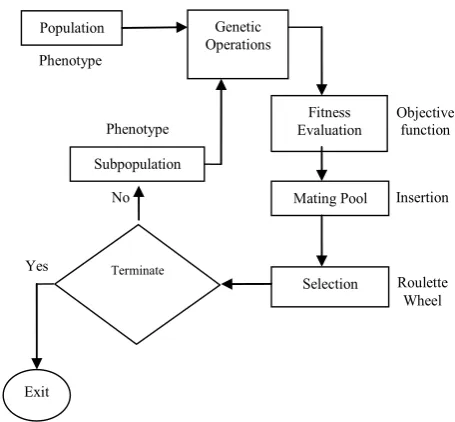
Genetic algorithm (GA) was first introduced by John Holland in the 1970s. It is a search technique based on the concept of the natural selection and evolution. The usual form of GA was described by Goldberg [32]. GA is a stochastic search technique based on the mechanism of the natural selection and natural genetics. Genetic algorithm, differing from conventional search techniques, it starts with an initial set of random solutions called a population. Each individual in the population is referred to a chromosome, representing a solution to the problem at hand. A chromosome is a string of symbols. Chromosomes evolve through successive iterations, namely generations. During each generation, chromosomes are evaluated by using some measures of fitness. To create the next generation, new chromosomes, referred to offspring, are formed by either 1 merging two chromosomes from the current generation by usinga crossover operator, or 2 modifying a
chromosome by using a mutation operator. A new generation is formed by 1 selecting, according to the fitness value, some of parents and offspring, and 2 rejecting others so as to keep the population size constant. After several generations, the algorithm converges to the best chromosome, which hopefully represents the optimal or sub-optimal solution to the given problem [32].
Usually, initialization is assumed to be random. There are only two types of operators in genetic algorithms:
• Genetic operations: crossover, mutation
• Evolution operations: selection
Population Genetic Operations
Fitness Evaluation
Mating Pool
Selection
Exit
Subpopulation
Terminate No Phenotype
Insertion
Roulette Wheel Phenotype
Yes
Objective function
Figure 1. Structure of the proposed GA.
Machine 2 (j1, k1)
Machine 1 (j2, k3) (j1, k2)
Figure 2. Schedule for three-jobs, two-families and two
machines.
structure, it is necessary that the initial population of schedules be a diverse representative of the search space. The structure of GA is illustrated in Figure 1.
3.2. Application of GA to the Given
Problem
3.2.1. Chromosome representation
There are two essential issues to be dealt with all types of multiple machine scheduling problems [32]:• Partition of jobs to machines.
• Sequence jobs for each machine.
Also, each job (e.g., k) belongs to a family (e.g., j) as shown with (j, k). An extended permutation representation is proposed to encode these things into a chromosome. Where (j, k) represent all possible permutation of (j, k) (or sequence of (j, k)) and asterisks * designate the partition of (j, k) to machines. Each * in a chromosome is a gene of it. Let us consider a simple example with three jobs, two families and two machines subject to k1 and k2
belong to j1 and k3 belong to j2. Suppose there is a
schedule shown in Figure 2.
The chromosome can be represented as follows: [(j2, k3) (j1, k2) * (j1, k1)]
In general, for an n-job, f-family and m-machine problem, a legal chromosome contains n symbols of (j, k) and m-1 partitioning symbols resulting in the total size of (n + m-1).
3.2.2. Generation of the initial population
Initial population is randomly generated.3.2.3. Evaluation a
simple way to determine the fitness value for each chromosome is to use the inverse of total weighted flow time. Let TWFTkdenote the total weighted flow time for the kth
chromosome. The fitness value (
eval
(
v
k)
) is then calculated as follows:k k
TWFT
v
eval
(
)
=
1
Where,
∑
== n
i j
j
k WFT
TWFT
WFTj is weighted flow time for the jth job that is
computed as follows:
WFTj = (Completion time of jth job) * (weight of jth
job)
3.2.4. Selection
The
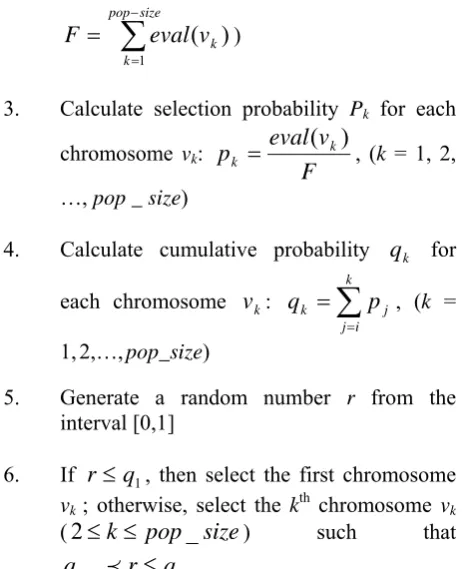
purpose of the parent selection in GA is to offer additional reproductive chances to those population members that are the fittest. One common technique used in the proposed GA is the roulette wheel selection. The roulette wheel can be constructed as follows: 1. Calculate the fitness value eval(vk) for eachchromosome vk (k = 1,2,…,pop_size)
∑
− == pop size
k
k
v eval F
1
) ( )
3. Calculate selection probability Pk for each
chromosome vk:
F v eval
pk k
) (
= , (k = 1, 2, …, pop _ size)
4. Calculate cumulative probability
q
k for each chromosomev
k:∑
=
= k
i j
j
k p
q , (k =
1, 2,…,pop_size)
5. Generate a random number r from the interval [0,1]
6. If r≤q1, then select the first chromosome vk ; otherwise, select the kth chromosome vk
(
2
≤ ≤
k
pop size
_
) such thatk
k
r
q
q
−1p
≤
.3.2.5. The genetic operators
Crossover is the main genetic operator. It generates offspring by combining both chromosomes’ features. To a great extend, the performance of genetic algorithms depends on the type of the crossover operator used. The crossover rate is defined as the ratio of the number of offspring produced in each generation to the population size [32]. There are several types of crossover operators. In this study, we use the order crossover (OX) operator.Order Crossover (OX)
The OX works as follows:• Select a substring from one parent at random.
• Produce a proto-child by copying the substring into the corresponding positions.
• Delete the jobs which are already in the substring from the second parent. The resulted sequence of jobs contains the jobs that the proto-child needs.
• Place the jobs into the unfixed positions of the proto-child from left to right according to the order of the sequence to produce an offspring.
The procedure is illustrated in Figure 3. By the OX procedure, we can produce two offspring in per iteration but the proposed crossover takes two parents and creates a single offspring.
Mutation is a background operator which produces spontaneous random changes in various chromosomes. The mutation rate is defined as the percentage of the total number of gene in the population. During past years several mutation operators have been proposed such as inversion, insertion, displacement, reciprocal exchange mutation [32]. The reciprocal exchange mutation (swapping mutation) is used here, in which we select two random positions and then swap their genes.
Swapping Mutation
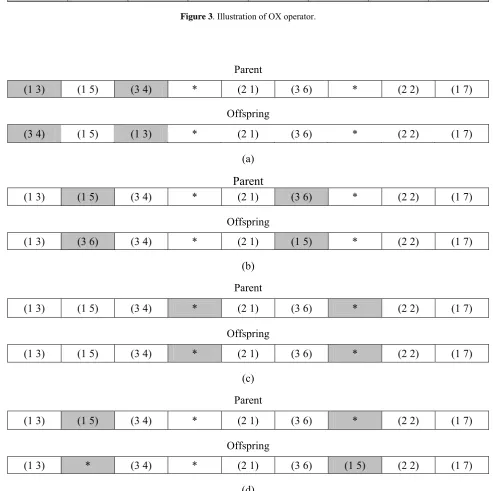
The randomly swapped genes may be either job or asterisk. The different combinations of job and asterisk result in four basic types of mutation.1. If both genes are job, two cases may occur: One case is that two selected jobs are processed by the same machine. In this case, the mutation alters the job order for the machine as shown in Figure 4(a)
2. Another case is that two jobs are processed by different machines. In this case, the mutation alters both job order and job partition to machines for the chromosome as shown in Figure 4(b).
3. If both genes are asterisk, the mutation performs a trivial operation as shown in Figure 4(c).
4. If one gene is asterisk and another is job, the mutation alters both job order and job partition to machines for the chromosome as shown in Figure 4(d).
The last one is the only genetic operation, which can alter the position of asterisks.
4. ILLUSTRATED EXAMPLES
Parent1
(1 3) (1 5) (3 4) * (2 1) (3 6) (2 2) (1 7)
Offspring
(3 6) (1 5) (3 4) * (2 1) (1 3) (2 2) (1 7)
Parent2
(3 6) (1 5) * (3 4) (1 3) (2 1) (2 2) (1 7)
Figure 3. Illustration of OX operator.
Parent
(1 3) (1 5) (3 4) * (2 1) (3 6) * (2 2) (1 7)
Offspring
(3 4) (1 5) (1 3) * (2 1) (3 6) * (2 2) (1 7)
(a)
Parent
(1 3) (1 5) (3 4) * (2 1) (3 6) * (2 2) (1 7)
Offspring
(1 3) (3 6) (3 4) * (2 1) (1 5) * (2 2) (1 7)
(b) Parent
(1 3) (1 5) (3 4) * (2 1) (3 6) * (2 2) (1 7)
Offspring
(1 3) (1 5) (3 4) * (2 1) (3 6) * (2 2) (1 7)
(c) Parent
(1 3) (1 5) (3 4) * (2 1) (3 6) * (2 2) (1 7)
Offspring
(1 3) * (3 4) * (2 1) (3 6) (1 5) (2 2) (1 7)
(d)
Figure 4. (a) Swap two jobs within on machine; (b) Swap two jobs within different machine;
Example 4.1.
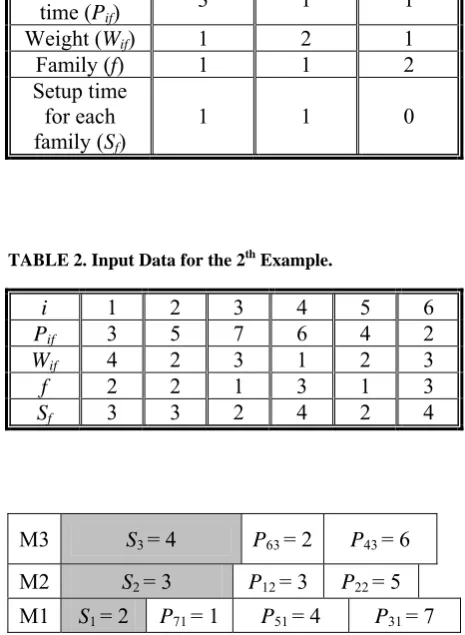
First, we consider a simple example of a three-job, family, and two-machine problem given in Webster and Azizoglu [7]. The primary information is summarized in Table 1.The globally optimal solution is found at iteration 514 with the best objective function 10, in which the associated sequence is given bellow: M1: (1 2)
M2: (2 3) → (1 1)
Example 4.2.
For the second example, we consider an identical parallel-machine scheduling problem with seven jobs, three families, and three machines. The other associated information is given in Table 2.The globally optimal solution is found at iteration 165723with the best objective function 147, and the associated Gantt chart for the best one is depicted in Figure 5. A comparison of these two examples also reveals the complexity of the problem.
5. COMPUTATIONAL RESULTS AND PERFORMANCE EVALUATION
Most real-world problems are more complicated than the previous examples. The proposed genetic algorithm can be used for more complex and widely applicable models of scheduling problems in industries.
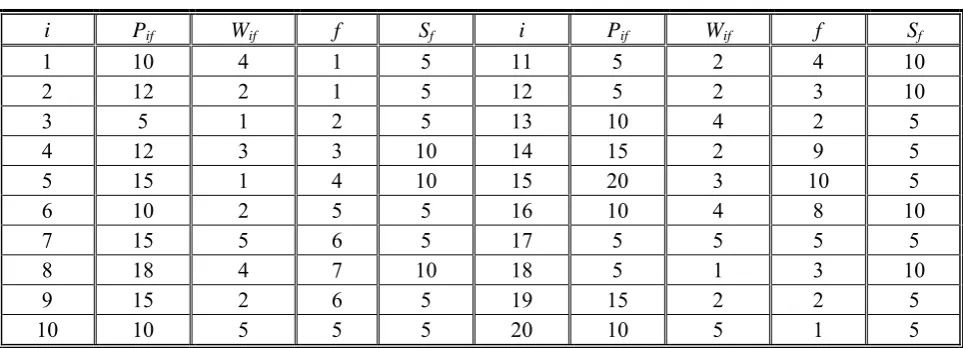
The genetic algorithm is first used to solve the same two small-sized test problems as presented in Section 4. The related genetic solutions are compared with the optimal solutions obtained by the Lingo 8.0 software package. It is then used to solve one medium-sized problem to schedule 20 jobs from 10 families on five machines with various Pc and Pm.
Example 5.1. For example 4.1, the genetic parameters are set as follows: pop-size = 5, max-gen = 1, Pc = [0.3-0.8], and Pm = [0.1-0.6]. We run the proposed GA about 50 times and obtain an optimal schedule in any effort in first time. There are two distinct optimal schedules in the proposed GA (e.g., jobs (1,2) and (1,1) on one machine, and job (2,3) on the other machine, or alternatively,
jobs (2,3) and (1,1) on one machine, and job (1,2) on the other machine). The associated computational results are presented in Table 3.
TABLE 1. Input Data.
JOB (I) 1 2 3 Processing
time (Pif)
3 1 1
Weight (Wif) 1 2 1
Family (f) 1 1 2
Setup time for each family (Sf)
1 1 0
TABLE 2. Input Data for the 2th Example.
i 1 2 3 4 5 6
Pif 3 5 7 6 4 2
Wif 4 2 3 1 2 3
f 2 2 1 3 1 3
Sf 3 3 2 4 2 4
M3 S3 = 4 P63 = 2 P43 = 6
M2 S2 = 3 P12 = 3 P22 = 5
M1 S1 = 2 P71 = 1 P51 = 4 P31 = 7
Figure 5. Gantt chart for best schedule for the 2nd example.
TABLE 3. Comparison of GA with DP and ILP Methods.
Method Machine Schedule TWFT
MI (1 2)
DP
M2 (2 3) → (1 1) 10
M1 (1 2)
ILP
M2 (2 3) → (1 1) 10
M1 (1 2)
GA
Example 5.2.
For example 4.2, the genetic parameters are set as follows: pop_size = 20, max_gen = 150, Pc = 0.3, Pm = 0.1. We run the genetic algorithm 10 times. The computational results obtained are summarized in Table 4.Example 5.3
. Table 5 shows an identical parallel-machine problem with 20 jobs, 10 families, 5 machines and other information generated at random.In this section, to compare various
P
c and Pm,we choose the appropriate crossover rate and mutation rate for parallel machines with family setup times. Other parameters are tuned up as follows: pop_size = 10, max_gen = 20. We run the genetic algorithm 15 times. The associated computational results are summarized in Table 6. As discussed above, the genetic search method is guided by the ‘tuning’ of three parameters, namely population size, crossover rate (Pc), and
mutation rate (Pm). We choose these parameters
empirically within the ranges as shown in Table 7. In Table 8 we compare the performance of the proposed GA with the Lingo 8 software in terms of computational times. The proposed GA has better
solution than the Lingo software. Further, when the number of jobs increases, we can see that the computational time increases exponentially because of the NP-hard nature of the given problem.
6. CONCLUSION
The
parallel-machine scheduling problem is an extended field of study in various applications. This type of problem is one of classical machine scheduling problems. This problem with family setup times is considered in the parallel machines problem, and shown to be NP-hardness in strong sense. We presented a new integer-linear programming (ILP) model of the foregoing problem. Further, we proposed a genetic algorithm (GA) that minimizes the total weighted flow time of jobs on identical parallel machines with family setup times. Some properties and solution methods for a generalized model consisting of job due dates and penalties for completing both early and tardy jobs can be used in further research.TABLE 4. Result of Example with Seven Jobs
Total run Best one Worst one Average
10 147 178 169.2
TABLE 5. Information for Example 5.3.
i Pif Wif f Sf i Pif Wif f Sf
7. REFERENCES
1. Ahn, B. H. and Hyun, J. H., “Single facility multi-class job scheduling”, Computers and Operations Research,
Vol. 17, (1990), 265-72.
2. Wardono, B. and Fathi, Y., “A tabu search algorithm for the multi-stage parallel machine problem with limited buffer capacities”, European Journal of Operational Research, Vol. 155, (2004), 380-401.
3. Bjorndal, M, Caprara, A., Cowling, P., Croce, P.
TABLE 6. The Comparison Various Mutation and Crossover Rates.
No. of Job Machine No. of Family No. of Pc Pm
TWFT of
Best One Average
20 5 10 0.2 0.1 2758 3087
20 5 10 0.3 0.1 2755 3158
20 5 10 0.5 0.1 2570 2960
20 5 10 0.7 0.1 2760 3397
20 5 10 .3 0.2 2491 3085
20 5 10 0.5 0.2 2608 3151
20 5 10 0.7 0.2 2671 3253
20 5 10 0.3 0.4 2659 3036
20 5 10 0.3 0.6 2498 3008
20 5 10 0.5 0.7 2813 3171
TABLE 7. Basic Setting for GA Parameters.
Parameters Range
Pop-size 5 - 50
Max-gen 20 - 100
Pc 0.2 - 0.5
Pm 0.05 - 0.2
TABLE 8. Comparison of the Proposed GA and Lingo 8.
Lingo GA No. of
Job
No. of Machine
No. of
Family OFV Time
(sec) OFV
Time (sec)
3 2 2 10 < 1 10 < 1
5 2 2 46 1 46 < 1
7 3 3 147 40 147 5
10 3 3 77 4906 77 20
Lourence, H., Malucelli, F., Orman, A., Pisinger, D., Rego, C. and Salazar, J., “Some thoughts on combinatorial optimization”, European Journal of Operational Research, Vol. 83, (1990), 253-270.
4. Cheng, T. and Sin, C., “A state-of-the-art review of parallel-machine scheduling research”, European Journal of Operational Research, Vol. 47, (1990),
271-292.
5. Allahverdi, A., Ng, C. T., Cheng, T. C. E. and Kovalyov, M. Y., “A survey of scheduling problems with setup times or costs”, European Journal of Operational Research, to appear in, (2007), DOI: 10.1016/j.ejor., (2006).06.060.
6. Potts, C. N. and Kovalyov, M. Y., “Scheduling with batching: A review”, European Journal of Operational Research, Vol. 120, (2000), 228-249.
7. Webster, S. and Azizoglu, M., “Dynamic programming algorithms for scheduling parallel machines with family setup times”, Computers and Operations Research,
Vol. 28, (2001), 127-137.
8. Bruno, L, Coofman, J. and Sethi, R., “Scheduling independent tasks reduce mean finishing time”,
Communications on ACM, Vol. 17, (1974), 382-387.
9. Garey, M. R. and Johnson, D. S., “Computers and intractability: a guide to the theory of NP-completeness”, San Francisco, CA: Freeman, (1979). 10. Webster, S. T., “The complexity of scheduling job
families about a common due date”, Operations Research Letters, Vol. 20, (1997), 65-74.
11. Bruno, J. and Sethi, R., “Task sequencing in a batch environment with setup times”, Foundations of Control Engineering, Vol. 3, (1978), 105-117.
12. Mason, A. J. and Anderson, E. J., “Minimizing flow time on a single machine with job classes and setup times”, Naval Research Logistics, Vol. 38, (1991), 333-350.
13. Monma, C. L. and Potts, C. N., “On the complexity of scheduling with batch setup times”, Operations Research, Vol. 37, (1989), 798-804.
14. Ramachandra, G. and Elmaghraby, S. E., “Sequencing precedence-related jobs on two machines to minimize the weighted completion time”, Int. J. Production Economics, Vol. 100, (2006), 44-58.
15. Nessah, R., Chu, C. and Yalaoui, F., “An exact method for
∑ = ∑
=
n 1 i Ci) / i r , sds / m P ( n 1 i or i C / i r , sds / m p
problem”, Computers and Operations Research, Vol.
34, (2007), 2840-2848.
16. Monch, L., Balasubramanian, H., Fowler, W. J. and Pfund, E. M., “Heuristic scheduling of jobs on parallel batch machines with incompatible job families and unequal ready times”, Computers and Operations Research, Vol. 32, (2005), 2731-2750.
17. Leung, J. Y. - T., Li, H. and Pinedo, M. L., “Scheduling orders for multiple product types to minimize total
weighted completion time”, Discrete Applied
Mathematics, Vol. 155, (2007), 945-970.
18. Zhu, Z. and Heady, R. B., “Minimizing the sum of earliness/tardiness in multi machine scheduling with sequence dependant setups on uniform parallel
machines”, Computer and Industrial Engineering, Vol.
38, (2000), 297-305.
19. Omar, M. K. and Teo, S. C., “Minimizing the sum of earliness/tardiness in identical parallel machines schedule with incompatible job families: An improved
MIP approach”, Applied Mathematics and
Computation, Vol. 181, (2006), 1008-1017.
20. Biskup, D. and Cheng, T. C. E., “Multiple-machine scheduling with earliness, tardiness and completion time penalties”, Computer and Operations Research, Vol. 26, (1999), 45-57
21. Caoa, D., Chen, M. and Wan, G., “Parallel machine selection and job scheduling to minimize machine cost and job tardiness”, Computers and Operations Research, Vol. 32, (2005), 1995-2012.
22. Balakrishnan, N., Kanet, J. and Sridharan, S. V., “Early/tardy scheduling with sequence dependent setups
on uniform parallel machines”, Computer and
Operations Research, Vol. 26, (1999), 127-141.
23. Dunstall, S., Wirth, A. and Baker, K., “Lower bounds and algorithms for flow time minimization on a single machine with set-up times”, Journal of Scheduling,
Vol. 3, (2000) 51-69.
24. Park, Y., Kim, S. and Lee, Y. - H., “Scheduling jobs on parallel machines applying neural network and heuristic rules”, Computers and Industrial Engineering, Vol.
38, (2000), 189-202.
25. Li, C. and Cheng, T., “The parallel machine min-max weighted absolute lateness scheduling problem”, Naval Research Logistics, Vol. 41, (1993), 33-46.
26. Cheng, R. and Gen, M., “MinMax earliness/tardiness scheduling in identical parallel machine system using
genetic algorithm”, Computer and Industrial
Engineering, Vol. 29, No. 1-4, (1995), 513-517.
27. Kim, D. - W., Kim, K. - H. Wooseung, Jang, F. and Chen, F., “Unrelated parallel machine scheduling with setup times using simulated annealing”, Robotics and Computer Integrated Manufacturing, Vol. 18, (2002),
223–231.
28. Tavakkoli-Moghaddam, R., Jolai, F., Khodadadeghan, Y. and Haghnevis, M., “A mathematical model of a multi-criteria parallel machine scheduling problem: a
genetic algorithm”, International Journal of
Engineering, Transactions A: Basic, Vol. 19, No. 1,
(2006), 79-86.
29. Melve, S. and Uzsoy, R., “A genetic algorithm for minimizing maximum lateness on parallel identical batch processing machines with dynamic job arrivals and incompatible job families”, Computers and Operations Research, Vol. 34, (2007), 3016-3028.
30. Gen, M. and Cheng, R., “Genetic algorithms and engineering design”, John Wiley and Sons, New York, (1997).
31. Leonardi, S. and Raz, D., “Approximating total flow time on parallel machines”, Journal of Computer and System Science, Vol. 73, (2007), 875-891.