VOLUME NO. 4 (2014), ISSUE NO. 05 (MAY) ISSN 2231-5756
A Monthly Double-Blind Peer Reviewed (Refereed/Juried) Open Access International e-Journal - Included in the International Serial Directories
Indexed & Listed at:
Ulrich's Periodicals Directory ©, ProQuest, U.S.A., EBSCO Publishing, U.S.A., Cabell’s Directories of Publishing Opportunities, U.S.A., Open J-Gage, India [link of the same is duly available at Inflibnet of University Grants Commission (U.G.C.)],
VOLUME NO. 4 (2014), ISSUE NO. 05 (MAY) ISSN 2231-5756
INTERNATIONAL JOURNAL OF RESEARCH IN COMMERCE, IT & MANAGEMENT
CONTENTS
Sr.
No.
TITLE & NAME OF THE AUTHOR (S)
Page
No.
1
.
AN EXPLORATORY STUDY OF THE POTENTIAL OF ‘KatSRS SYSTEM’ AS AN
EDUCATIONAL TECHONOLOGY IN FACILITATING LEARNERS’ ENGAGEMENT AND
FEEDBACK: A CASE STUDY OF BOTHO UNIVERSITY
WILLIAM NKOMO, BONOLO E. SAMSON-ZULU & RODRECK CHIRAU
1
2
.
MEASURES FOR ACTIVITY BASED COSTING SUCCESS: A REVIEW
SHAFEQ HAMOUD M. AL-SAIDI & H. NANJE GOWDA
10
3
.
ICT & WOMEN
S. S. PATHAK & SHUBHADA GALA
13
4
.
A STUDY ON LABOUR WELFARE MEASURES WITH REFERENCE TO TEXTILE
INDUSTRIES
DR. P. GURUSAMY, J. PRINCY & P.MANOCHITHRA
16
5
.
AN ANALYSIS AND EVALUATION OF A UNIVERSITY’s E-COMMERCE READINESS: A
CASE STUDY OF BOTHO UNIVERSITY
TERESSA TJWAKINNA CHIKOHORA & RODRECK CHIRAU
21
6
.
SUSTAINABILITY OF THE WASTE MANAGEMENT PRACTICES IN TOURIST
DESTINATIONS OF NAGALAND: A CRITICAL REVIEW
AIENLA & DR. T. R. SARMA
28
7
.
DETERMINANTS OF INTERNAL BRANDING FOR CUSTOMER-ORIENTATION
JASMINE SIMI
33
8
.
A CONCEPTUAL STUDY ON RETAIL BANKING
BHARAT N BASRANI & CHANDRESH B. MEHTA
38
9
.
IMPACT OF CELEBRITY ENDORSEMENT ON CONSUMER’S BUYING BEHAVIOUR
SUPREET KAUR
42
10
.
A STUDY ON THE FACTORS INFLUENCING CUSTOMER’s CHOICE OF RETAIL STORES
ANUPAMA SUNDAR D
46
11
.
GLOBALISATION, SEX INDUSTRY AND SEX MYTH: A COMPARATIVE STUDY OF SEX
MYTH AMONG ADULT MEN AND WOMEN IN CHHATTISGARH & WEST BENGAL
SIDDHARTHA CHATTERJEE & BIBHAS RANA
51
12
.
APPLICATION OF RESTRICTED LEAST SQUARES TO ECONOMETRIC DATA
IBRAHEEM, A. G, ADEMUYIWA, J. A & ADETUNJI, A. A
55
13
.
EFFECTIVENESS OF INTERNAL CONTROL SYSTEM OF ETHIOPIAN PUBLIC
UNIVERSITIES: THE CASE OF JIMMA UNIVERSITY
KENENISA LEMIE & MATEWOS KEBEDE
59
14
.
THE IMPACT OF CORPORATE SOCIAL RESPONSIBILITY - INITIATIVES ON
CONSUMER PSYCHOLOGY
PURTI BATRA
66
15
.
INVESTIGATION OF CUSTOMERS’ PRODUCT AWARENESS AND TRANSACTION GAP
IN LIFE INSURANCE CORPORATION OF INDIA
PARTHA SARATHI CHOUDHURI
69
VOLUME NO. 4 (2014), ISSUE NO. 05 (MAY) ISSN 2231-5756
INTERNATIONAL JOURNAL OF RESEARCH IN COMMERCE, IT & MANAGEMENT
CHIEF PATRON
PROF. K. K. AGGARWAL
Chairman, Malaviya National Institute of Technology, Jaipur
(An institute of National Importance & fully funded by Ministry of Human Resource Development, Government of India)
Chancellor, K. R. Mangalam University, Gurgaon
Chancellor, Lingaya’s University, Faridabad
Founder Vice-Chancellor (1998-2008), Guru Gobind Singh Indraprastha University, Delhi
Ex. Pro Vice-Chancellor, Guru Jambheshwar University, Hisar
FOUNDER PATRON
LATE SH. RAM BHAJAN AGGARWAL
Former State Minister for Home & Tourism, Government of Haryana
Former Vice-President, Dadri Education Society, Charkhi Dadri
Former President, Chinar Syntex Ltd. (Textile Mills), Bhiwani
CO-ORDINATOR
AMITA
Faculty, Government M. S., Mohali
ADVISORS
DR. PRIYA RANJAN TRIVEDI
Chancellor, The Global Open University, Nagaland
PROF. M. S. SENAM RAJU
Director A. C. D., School of Management Studies, I.G.N.O.U., New Delhi
PROF. M. N. SHARMA
Chairman, M.B.A., Haryana College of Technology & Management, Kaithal
PROF. S. L. MAHANDRU
Principal (Retd.), Maharaja Agrasen College, Jagadhri
EDITOR
PROF. R. K. SHARMA
Professor, Bharti Vidyapeeth University Institute of Management & Research, New Delhi
CO-EDITOR
DR. BHAVET
Faculty, Shree Ram Institute of Business & Management, Urjani
EDITORIAL ADVISORY BOARD
DR. RAJESH MODI
Faculty, Yanbu Industrial College, Kingdom of Saudi Arabia
PROF. SANJIV MITTAL
University School of Management Studies, Guru Gobind Singh I. P. University, Delhi
PROF. ANIL K. SAINI
VOLUME NO. 4 (2014), ISSUE NO. 05 (MAY) ISSN 2231-5756
INTERNATIONAL JOURNAL OF RESEARCH IN COMMERCE, IT & MANAGEMENT
DR. SAMBHAVNA
Faculty, I.I.T.M., Delhi
DR. MOHENDER KUMAR GUPTA
Associate Professor, P. J. L. N. Government College, Faridabad
DR. SHIVAKUMAR DEENE
Asst. Professor, Dept. of Commerce, School of Business Studies, Central University of Karnataka, Gulbarga
ASSOCIATE EDITORS
PROF. NAWAB ALI KHAN
Department of Commerce, Aligarh Muslim University, Aligarh, U.P.
PROF. ABHAY BANSAL
Head, Department of Information Technology, Amity School of Engineering & Technology, Amity
University, Noida
PROF. A. SURYANARAYANA
Department of Business Management, Osmania University, Hyderabad
DR. SAMBHAV GARG
Faculty, Shree Ram Institute of Business & Management, Urjani
PROF. V. SELVAM
SSL, VIT University, Vellore
DR. PARDEEP AHLAWAT
Associate Professor, Institute of Management Studies & Research, Maharshi Dayanand University, Rohtak
DR. S. TABASSUM SULTANA
Associate Professor, Department of Business Management, Matrusri Institute of P.G. Studies, Hyderabad
SURJEET SINGH
Asst. Professor, Department of Computer Science, G. M. N. (P.G.) College, Ambala Cantt.
TECHNICAL ADVISOR
AMITA
Faculty, Government M. S., Mohali
FINANCIAL ADVISORS
DICKIN GOYAL
Advocate & Tax Adviser, Panchkula
NEENA
Investment Consultant, Chambaghat, Solan, Himachal Pradesh
LEGAL ADVISORS
JITENDER S. CHAHAL
Advocate, Punjab & Haryana High Court, Chandigarh U.T.
CHANDER BHUSHAN SHARMA
Advocate & Consultant, District Courts, Yamunanagar at Jagadhri
SUPERINTENDENT
VOLUME NO. 4 (2014), ISSUE NO. 05 (MAY) ISSN 2231-5756
INTERNATIONAL JOURNAL OF RESEARCH IN COMMERCE, IT & MANAGEMENT
CALL FOR MANUSCRIPTS
We invite unpublished novel, original, empirical and high quality research work pertaining to recent developments & practices in the areas of Computer Science & Applications; Commerce; Business; Finance; Marketing; Human Resource Management; General Management; Banking; Economics; Tourism Administration & Management; Education; Law; Library & Information Science; Defence & Strategic Studies; Electronic Science; Corporate Governance; Industrial Relations; and emerging paradigms in allied subjects like Accounting; Accounting Information Systems; Accounting Theory & Practice; Auditing; Behavioral Accounting; Behavioral Economics; Corporate Finance; Cost Accounting; Econometrics; Economic Development; Economic History; Financial Institutions & Markets; Financial Services; Fiscal Policy; Government & Non Profit Accounting; Industrial Organization; International Economics & Trade; International Finance; Macro Economics; Micro Economics; Rural Economics; Co-operation; Demography: Development Planning; Development Studies; Applied Economics; Development Economics; Business Economics; Monetary Policy; Public Policy Economics; Real Estate; Regional Economics; Political Science; Continuing Education; Labour Welfare; Philosophy; Psychology; Sociology; Tax Accounting; Advertising & Promotion Management; Management Information Systems (MIS); Business Law; Public Responsibility & Ethics; Communication; Direct Marketing; E-Commerce; Global Business; Health Care Administration; Labour Relations & Human Resource Management; Marketing Research; Marketing Theory & Applications; Non-Profit Organizations; Office Administration/Management; Operations Research/Statistics; Organizational Behavior & Theory; Organizational Development; Production/Operations; International Relations; Human Rights & Duties; Public Administration; Population Studies; Purchasing/Materials Management; Retailing; Sales/Selling; Services; Small Business Entrepreneurship; Strategic Management Policy; Technology/Innovation; Tourism & Hospitality; Transportation Distribution; Algorithms; Artificial Intelligence; Compilers & Translation; Computer Aided Design (CAD); Computer Aided Manufacturing; Computer Graphics; Computer Organization & Architecture; Database Structures & Systems; Discrete Structures; Internet; Management Information Systems; Modeling & Simulation; Neural Systems/Neural Networks; Numerical Analysis/Scientific Computing; Object Oriented Programming; Operating Systems; Programming Languages; Robotics; Symbolic & Formal Logic; Web Design and emerging paradigms in allied subjects.
Anybody can submit the soft copy of unpublished novel; original; empirical and high quality research work/manuscriptanytime in M.S. Word format
after preparing the same as per our GUIDELINES FOR SUBMISSION; at our email address i.e. [email protected] or online by clicking the link online submission as given on our website (FOR ONLINE SUBMISSION, CLICK HERE).
GUIDELINES FOR SUBMISSION OF MANUSCRIPT
1. COVERING LETTER FOR SUBMISSION:
DATED: _____________ THE EDITOR
IJRCM
Subject: SUBMISSION OF MANUSCRIPT IN THE AREA OF.
(e.g. Finance/Marketing/HRM/General Management/Economics/Psychology/Law/Computer/IT/Engineering/Mathematics/other, please specify)
DEAR SIR/MADAM
Please find my submission of manuscript entitled ‘___________________________________________’ for possible publication in your journals.
I hereby affirm that the contents of this manuscript are original. Furthermore, it has neither been published elsewhere in any language fully or partly, nor is it under review for publication elsewhere.
I affirm that all the author (s) have seen and agreed to the submitted version of the manuscript and their inclusion of name (s) as co-author (s).
Also, if my/our manuscript is accepted, I/We agree to comply with the formalities as given on the website of the journal & you are free to publish our contribution in any of your journals.
NAME OF CORRESPONDING AUTHOR: Designation:
Affiliation with full address, contact numbers & Pin Code: Residential address with Pin Code:
Mobile Number (s): Landline Number (s): E-mail Address: Alternate E-mail Address:
NOTES:
a) The whole manuscript is required to be in ONE MS WORD FILE only (pdf. version is liable to be rejected without any consideration), which will start from
the covering letter, inside the manuscript.
b) The sender is required to mentionthe following in the SUBJECT COLUMN of the mail:
New Manuscript for Review in the area of (Finance/Marketing/HRM/General Management/Economics/Psychology/Law/Computer/IT/ Engineering/Mathematics/other, please specify)
c) There is no need to give any text in the body of mail, except the cases where the author wishes to give any specific message w.r.t. to the manuscript. d) The total size of the file containing the manuscript is required to be below 500 KB.
e) Abstract alone will not be considered for review, and the author is required to submit the complete manuscript in the first instance.
f) The journal gives acknowledgement w.r.t. the receipt of every email and in case of non-receipt of acknowledgment from the journal, w.r.t. the submission
of manuscript, within two days of submission, the corresponding author is required to demand for the same by sending separate mail to the journal.
2. MANUSCRIPT TITLE: The title of the paper should be in a 12 point Calibri Font. It should be bold typed, centered and fully capitalised.
3. AUTHOR NAME (S) & AFFILIATIONS: The author (s) full name, designation, affiliation (s), address, mobile/landline numbers, and email/alternate email address should be in italic & 11-point Calibri Font. It must be centered underneath the title.
VOLUME NO. 4 (2014), ISSUE NO. 05 (MAY) ISSN 2231-5756
INTERNATIONAL JOURNAL OF RESEARCH IN COMMERCE, IT & MANAGEMENT
5. KEYWORDS: Abstract must be followed by a list of keywords, subject to the maximum of five. These should be arranged in alphabetic order separated bycommas and full stops at the end.
6. MANUSCRIPT: Manuscript must be in BRITISH ENGLISH prepared on a standard A4 size PORTRAIT SETTING PAPER. It must be prepared on a single space and single column with 1” margin set for top, bottom, left and right. It should be typed in 8 point Calibri Font with page numbers at the bottom and centre of every page. It should be free from grammatical, spelling and punctuation errors and must be thoroughly edited.
7. HEADINGS: All the headings should be in a 10 point Calibri Font. These must be bold-faced, aligned left and fully capitalised. Leave a blank line before each heading.
8. SUB-HEADINGS: All the sub-headings should be in a 8 point Calibri Font. These must be bold-faced, aligned left and fully capitalised.
9. MAIN TEXT: The main text should follow the following sequence:
INTRODUCTION REVIEW OF LITERATURE
NEED/IMPORTANCE OF THE STUDY STATEMENT OF THE PROBLEM OBJECTIVES
HYPOTHESES
RESEARCH METHODOLOGY RESULTS & DISCUSSION FINDINGS
RECOMMENDATIONS/SUGGESTIONS CONCLUSIONS
SCOPE FOR FURTHER RESEARCH ACKNOWLEDGMENTS REFERENCES APPENDIX/ANNEXURE
It should be in a 8 point Calibri Font, single spaced and justified. The manuscript should preferably not exceed 5000 WORDS.
10. FIGURES &TABLES: These should be simple, crystal clear, centered, separately numbered & self explained, and titles must be above the table/figure. Sources of data should be mentioned below the table/figure. It should be ensured that the tables/figures are referred to from the main text.
11. EQUATIONS:These should be consecutively numbered in parentheses, horizontally centered with equation number placed at the right.
12. REFERENCES: The list of all references should be alphabetically arranged. The author (s) should mention only the actually utilised references in the preparation of manuscript and they are supposed to follow Harvard Style of Referencing. The author (s) are supposed to follow the references as per the following:
•
All works cited in the text (including sources for tables and figures) should be listed alphabetically.•
Use (ed.) for one editor, and (ed.s) for multiple editors.•
When listing two or more works by one author, use --- (20xx), such as after Kohl (1997), use --- (2001), etc, in chronologically ascending order.•
Indicate (opening and closing) page numbers for articles in journals and for chapters in books.•
The title of books and journals should be in italics. Double quotation marks are used for titles of journal articles, book chapters, dissertations, reports, workingpapers, unpublished material, etc.
•
For titles in a language other than English, provide an English translation in parentheses.•
The location of endnotes within the text should be indicated by superscript numbers.PLEASE USE THE FOLLOWING FOR STYLE AND PUNCTUATION IN REFERENCES: BOOKS
•
Bowersox, Donald J., Closs, David J., (1996), "Logistical Management." Tata McGraw, Hill, New Delhi.•
Hunker, H.L. and A.J. Wright (1963), "Factors of Industrial Location in Ohio" Ohio State University, Nigeria. CONTRIBUTIONS TO BOOKS•
Sharma T., Kwatra, G. (2008) Effectiveness of Social Advertising: A Study of Selected Campaigns, Corporate Social Responsibility, Edited by David Crowther &Nicholas Capaldi, Ashgate Research Companion to Corporate Social Responsibility, Chapter 15, pp 287-303. JOURNAL AND OTHER ARTICLES
•
Schemenner, R.W., Huber, J.C. and Cook, R.L. (1987), "Geographic Differences and the Location of New Manufacturing Facilities," Journal of Urban Economics,Vol. 21, No. 1, pp. 83-104. CONFERENCE PAPERS
•
Garg, Sambhav (2011): "Business Ethics" Paper presented at the Annual International Conference for the All India Management Association, New Delhi, India,19–22 June.
UNPUBLISHED DISSERTATIONS AND THESES
•
Kumar S. (2011): "Customer Value: A Comparative Study of Rural and Urban Customers," Thesis, Kurukshetra University, Kurukshetra.ONLINE RESOURCES
•
Always indicate the date that the source was accessed, as online resources are frequently updated or removed. WEBSITESVOLUME NO. 4 (2014), ISSUE NO. 05 (MAY) ISSN 2231-5756
INTERNATIONAL JOURNAL OF RESEARCH IN COMMERCE, IT & MANAGEMENT
AN EXPLORATORY STUDY OF THE POTENTIAL OF ‘KatSRS SYSTEM’ AS AN EDUCATIONAL TECHONOLOGY
IN FACILITATING LEARNERS’ ENGAGEMENT AND FEEDBACK: A CASE STUDY OF BOTHO UNIVERSITY
WILLIAM NKOMO
TEAM LEADER (SOFTWARE ENGINEERING)
FACULTY OF COMPUTING
BOTHO UNIVERSITY
FRANCISTOWN
BONOLO E. SAMSON-ZULU
LECTURER
FACULTY OF COMPUTING
BOTHO UNIVERSITY
FRANCISTOWN
RODRECK CHIRAU
TEAM LEADER
FACULTY OF BUSINESS MANAGEMENT
BOTHO UNIVERSITY
FRANCISTOWN
ABSTRACT
Learners’ engagement is the main key to achieving better teaching and learning. In recent years, a variety of educational technologies have been used to motivate learners to participate in learning. Amongst these tools, students’ responses have proved to be very useful. The trend has been to equip students with clickers and simple cellular phones to cast votes and send their anonymous responses to the receiver. In contrast, Katlego Students’ Response System is an intranet system that captures students’ responses via the desktop and laptop computers to the main server. The purpose of the present study is to investigate the potential of the Katlego Students’ Response System as an online educational technology to facilitate classroom engagement and feedback in teaching/learning. The study group consists of students from the Computing Science department at Botho University (N=80). In the study an experimental design was used over six weeks. Data was collected using Katlego Student Response System, feedback/evaluation forms and oral interviews. The findings of the study revealed that the Katlego Student Response System is more effective in increasing learners’ engagement and experience. However, acquisition and setting of the appropriate equipment, software and sufficient network bandwidth remains a challenge since Botswana is a developing country.
KEYWORDS
KatSRS, educational technology, feedback 360d, students’ response system.
INTRODUCTION
igh levels of learners’ involvement during a learning session are not easy to achieve or ascertain in a classroom. Furthermore, real-time feedback may be one of the difficult components to access from students especially if a class consists of varied learners with different backgrounds and learning efficacies (Dunn and Dunn, 1992; Dyson, 2008). In any classroom setting, students’ ability to listen and understand and students’ capability to provide real-time feedback are valuable parameters in measuring success in learning and teaching. The rationale behind these metrics is to identify means by which a teacher can assist students on time to facilitate successful and progressive learning. Real-time feedback provided by students during a lecture is also central in assisting the teacher in measuring how effective is the teaching approach used. The research seeks to evaluate how Katlego Student Response System (KatSRS) a component of Katlego Feedback 360d can be embraced as an online tool for evaluating learning and teaching in class before, during and after the lecture. This would not only assist in encouraging learners’ engagement in class but, also it would be used as a tool to assist the lecturer in gauging success in his/her teaching approach.
BACKGROUND
Many students at Botho University face problems of making meaningful contribution to the discussions during lectures due to a number of factors. The factors contributing to loss of students participation in class include (a) fear of being embarrassed if their contribution is incorrect or trivial, (b) expectation by some students to be quite while the lecturer talks (Caldwell, 2007; Dyson, 2008), (c) loss of opportunity by some students because vocal students always dominate all discussions in class (Sellahewa, 2011) and (d) language barrier (Turugare et al., 2012). These problems present challenges to learning/teaching because learners’ engagement is a vital component that teachers can use to assess an effective learning process.
In the months of July to September 2012, Botho University lecturers (Francistown) conducted peer assessment to investigate challenges faced by both students and lecturers in teaching and learning. The motive for this exercise was to try and mitigate any issues arising from limited resources or to determine better strategies for handling classroom by lecturers. Some of the challenges uncovered include:
• STUDENT INTERACTION
It was discovered that participation is not evenly distributed among students. This observation concurs with Horowitz (2006) investigation on the role played by SRS systems on influencing learners’ engagement in class. According to Prof. Harold Horowitz in Horowitz (2006), ten to twenty percent of the students in class dominate the discussion and these students are the ones who ask questions, offer unsolicited comments and they always volunteer to provide answers posed by the teacher.
• AVAILABILITY OF TIME
During a normal lecture, time available does not allow all key points to be covered if the lecturer encourages learners’ questions and comments as part of the learning process.
• TIME MANAGEMENT VERSUS ATTENTIVENESS
Peer observations carried out noted some problems when it comes to time allocation and student alertness and attentiveness. Duson Benjamin, Tumkaya and Songul (2012) and Harold Horowitz the director of the IBM Corporate Education Centre have conducted the same investigations and reported that there is a significant dichotomy between efficient time allocation and student attentiveness (Horowitz, 2006).
VOLUME NO. 4 (2014), ISSUE NO. 05 (MAY) ISSN 2231-5756
INTERNATIONAL JOURNAL OF RESEARCH IN COMMERCE, IT & MANAGEMENT
The challenges outlined above point to the need for a more effective learning-teaching environment to encourage learners’ engagement in class (Houghton, 2004). This paper attempts to establish how effective the KatSRS system is, in facilitating and improving learners’ engagement.
REVIEW OF LITERATURE
The most dominant delivery methods at higher-education Institutions remain lectures and lectorials (Caldwell, 2007). According to Habeshaw and Biggs (1992),
the lecturing methods involve a large span of uninterrupted discourse from a lecturer with no discussion between learners and no learners’ activities other than listening and note-taking if not “face-booking” at the back of a classroom. The description of the lecture method given above reflects that despite its long dominancy as a delivery method, it has failed to get learners’ full engagement and attention in class. Botho University is not an exception; it has been observed that students start losing attention the moment they are not encouraged to take part in some form of activity or group discussions. Basically, lecturing has proved to be amongst some ineffective methods of delivery especially if not coupled with some intentional interventions (interactive windows) that could make teaching-learning livelier (Knight and Wood, 2005).
Without redesigning approaches to teaching/learning, it has been proved that traditional methods can be improved by introducing regular “interactive windows”
that encourage active learning and hence improve learners’ engagement, (Eric, 2005). Dyson (2008) observed that a teacher can boost students engagement and reflective learning by using a simple “three-one-minute interactive window” strategy that involves the use of three interventions to enable the students to take part in assessing their lecture engagement. The windows are:
• A[“Write one thing you have learnt so far”],
• B[“Write one question you have that has not been answered so far”] and • C [“Short break”].
In this context learners can be engaged by allowing them to reflect on one thing they have learnt and one question that has not been answered so far in every 20 minutes time intervals and then take a rest. This design makes it possible to assess two things: (a) which intervention led to an increase in lecture engagement and (b) whether these effects were limited to a specific time during the lecture. The findings indicate a positive increase in students’ participation in class when such a tool is used (Dyson, 2008).
Sellahewa (2011) introduced a system called EduMECCA which is quite a relevant scenario of some promising Student Response System’s (SRS) tool for use in class. Unlike traditional Electronic Voting systems (EVS) that use clickers and purpose-built-infrastructure, the SRS uses widely available mobile devices and mobile services to collect student responses in a convenient way. According to Sellahewa (2011), Student Response System’s increase participation, helps students understand the lecture and indicate where further effort is required. According to Duman in Dunn and Dunn (1992), careful administering of traditional small-scale interventions is not only useful for improving students’ engagement, but it is a strategy useful for attaining good learners’ motivation, acquisition of content knowledge and internalization of meaning (Duman, 2010). These learning gains can be achieved by encouraging learners to take short breaks, drink water, engage in brief discussions and solve small cross-word puzzles (Duman, 2010; Dyson, 2008).
The advancement of modern Educational Technologies (EDuTech) has seen substantial technologically sophisticated solutions to engage students in learning anonymously (Dyson, 2008). The past two decades have been characterized by spontaneous innovations where Universities and other higher educational institutions employ response systems, clickers or audience response systems (Caldwell, 2007) in assessing lecture engagement. In general, the SRS and EVS systems are introduced in class to address the main challenges of obtaining maximum possible students’ engagement in classrooms where it is difficult to have a meaningful engagement between the teacher and the learners or to gauge the learners’ comprehension due to lack of sound participation by the learners (Knight and Wood, 2005). The problems mentioned above are very prevalent at Botho University.
FEEDBACK 360d AND KatSRS SYSTEM
Feedback 360d system is designed to allow students to give feedback about their faculties and their program of study. The feedback is anonymous so the students are encouraged to write freely. It helps management review the performance of faculties and review program syllabuses and then set up ways to improve that, if needed. The system provides the following functionality:
• Creating batches, programmes, faculties and periods of feedbacks,
• Creating feedbacks (Student feedback, Network laboratory feedback, customer satisfaction feedback, Open University feedbacks), • Generating Login IDs for student to take feedback, this login IDs are one time use,
• Students taking feedbacks, and
• Generating reports of the taken feedbacks.
The online Student Response System (SRS) is developed as part of Botho University Katlego Feedback System project. The Katlego feedback system is used to collect learners’ feedback (quarterly) online for evaluating learning/teaching for a course. Instead of soliciting for feedback at long time intervals, the researchers propose that a component be added to Katlego Feedback system to provide the following functionalities;
Broadcast a multiple choice questions (MCQ) to the students machines(clients), Allow students to submit their answers to the teacher’s machine (server), Facilitate data collection, and active data processing,
Prompt presentation of the collated data to enable real-time feedback to the teacher and students.
The sub-system of the main Katlego Feedback 360d is called Katlego Student Response System (KatSRS) and it enables students to respond to one-minute quizzes or MCQ’s during a lecture. The real-time feedback collected thus enables the teacher to assess students understanding of a topic during a lecture. In the same manner, students can assess their understanding of the concepts being taught and argue their points out during discussion. This will further improve on the teacher’s capability to provide necessary interventions on time if there is need to do so. Unlike traditional EVS that use clickers (Caldwell, 2007), and EduMeCCA. SRS that uses mobile devices and mobile services, KatSRS uses the intranet available in a classroom to collect real-time student responses (Sellahewa, 2011).
THE PURPOSE OF STUDY
The present study investigates the effect of KatSRS in engaging learners during a lecture. That is, the study aims to establish whether KatSRS can improve students’ engagement during learning/teaching sessions. In turn, the study aims to show the effect of students’ real-time feedback in assisting the teacher in assessing whether there is need for any immediate interventions if the majority of students did not understand the concepts. However rather than comparing two different tools in students’ engagement, this investigation focuses on the use of the single KatSRS for this purpose. More importantly, we have sought to check if learners’ engagement and experiences have been increased as compared to when normal forms of teaching/learning are used. We may expect using the KatSRS tool to have a significant effect to learners’ participation than when the traditional discussion methods are used in a lecture. KatSRS is expected to assist the teacher to gauge if the topic taught has been thoroughly understood as soon as possible than waiting for feedback from students during formative assessments conducted after the lecture or several topics of the course have been taught. For this purpose, we formulate the following hypothesis:
• H0: Students’ engagement and experiences would not vary much with the application of KatSRS in active learning/teaching as compared to the traditional discussion methods.
• Using KatSRS would not enhance learners’ participation or impact on their experiences in learning under any context of its application. • The teacher may not get useful feedback from this approach for improving his/her class delivery methods.
VOLUME NO. 4 (2014), ISSUE NO. 05 (MAY) ISSN 2231-5756
INTERNATIONAL JOURNAL OF RESEARCH IN COMMERCE, IT & MANAGEMENT
IMPORTANCE OF THE STUDY
The main premise of the study is to develop and pilot an educational system that will promote active learning and increase students’ participation. The well-planned activities conducted via the students’ response systems are likely to maximise students’ participation and hence cultivate a positive attitude towards school amongst students. The study will also help in increased student-teacher interaction through encouraging students’ responses and justifying their points This will also result in the collection of real-time feedback by the teachers. The students’ response system will enable the teachers to collect real-time feedback and measure the success of learning/teaching during a lecture or soon after a session. Eventually, this practice would equip the modern teachers with the ability of gauging the efficiency of their teaching every time they are in class.
Finally this study will assist in increasing Students’ motivation and retention rates.
STATEMENT OF THE PROBLEM
There are students who find it difficult to engage in class because of shyness, lack of confidence, lose of opportunities because some colleagues are dominating in all learning activities and the general expectation that they need to be quite while the teacher talks. Furthermore, experience tells, collecting real-time feedback is one of the major challenges faced by most teachers when they want to measure the success of learning/teaching.
AIM OF STUDY
The present study aims at investigating and determining the effects of KatSRS (which is a component of Katlego Feedback 360d system) in promoting learners’ engagement in active learning. The study combines literature and analysis of data collected from the participants during the experimental study of the KatSRS and students evaluation of the tool before and after the lecture to arrive at the conclusion.
OBJECTIVES
The main objectives of the present study are to:
• Review related literature in order to establish the current trends and use of SRS systems for engaging students in learning,
• Establish whether KatSRS has an impact on changing learners’ engagement as compared to the experiences of students with other approaches ,
• Determine if there is an improvement in student-to-student or student-to-lecturer interaction when KatSRS is used compared to when traditional approaches are used,
• Determine the most preferred mode of answering or interaction during a normal lecture.
RESEARCH METHODOLOGY
PARTICIPANTS
The study was carried out by the researchers among the first year students in the Computing Department studying computer science at Botho University (Francistown) in the 2011 – 2012 academic years. The sample group was formed considering the continuum behaviours of students ranging from dominant students to very passive students in class. However all participants have the same level of qualification (BTHIT-Honours Diploma in Information Technology and Business Skills) and therefore they have the same experiences in computing. The sample consisted of 80 students, 46(58%) are female and 34(42%) are male. Although there could be some variances in the socio-economic and cultural conditions of the participants, the majority of these participants are Botswana students and hence the prevalent condition is Setswana culture. The experiment was conducted at recap, during class and after class to examine how effective anonymous interactive feedback could improve engagement.
STIMULI AND APPARATUS RESPONSE MCQ
Participants answered Multiple Choice Questions (MCQ) presented on the slides via KatSRS interface on the computer screens. The responses were then submitted online to the server and automatically saved. The responses of type [A, B, C, D, I don’t know], or [True, False, Not sure] were used to enable students to easily pick an answer they considered most appropriate. All participants used college personal computers’ to log onto KatSRS and select appropriate answers. At the end of each interactive window, the researchers collected the learners’ responses from the server and viewed the summaries.
QUESTIONNAIRE
To collect feedback from students regarding the effectiveness of the KatSRS a questionnaire was used. Out of 80 participants 62 responses were collected and analysed. Due to such a small number, the researchers used qualitative feedback as the primary measure of effectiveness. Learners’ feedback was collected in two ways: (a) a survey specific to the use of KatSRS in the Computer Systems Architecture (C1-CSA) and Mathematics for computing courses; (b) learners’ view of the KatSRS system as a tool for collecting feedback at the end the ninth week.
DESIGN
The experiment was conducted by the researchers over 6 weeks (week 3 - 9) of Computer Systems Architecture CSA) and Mathematics for Computing (C1-MAT) courses. Before the first lecture in week 3, all students who took part in the investigation were alerted of the opportunity to take part in an informal assessment of teaching. The participants were also notified that the informed consent for the experiment would be provided in the 4th
week. In the second lecture of week 3, participants were shown how to use KatSRS to respond to a MCQ provided by the teacher on the board. Class sizes varied from 18 – 38 students. During week 9, participants completed the KatSRS evaluation form during lectures to indicate how they feel about the online KatSRS.
During the lecture MCQ
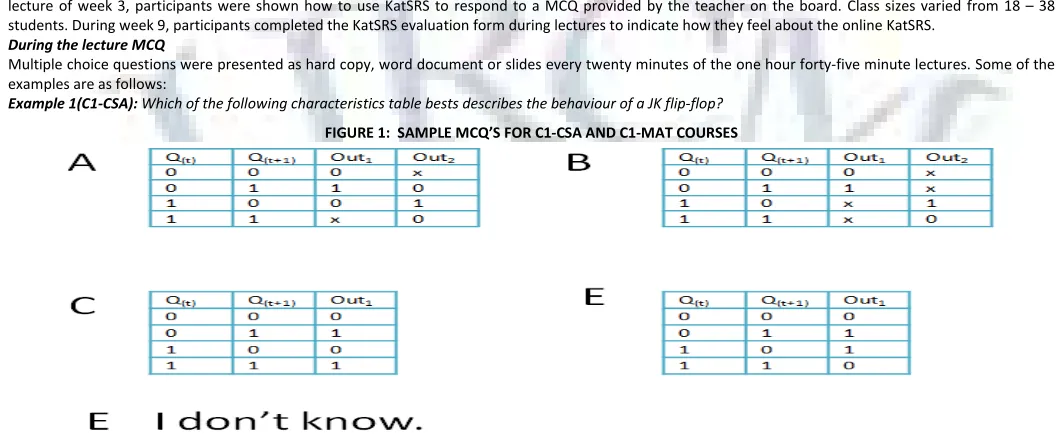
Multiple choice questions were presented as hard copy, word document or slides every twenty minutes of the one hour forty-five minute lectures. Some of the examples are as follows:
Example 1(C1-CSA): Which of the following characteristics table bests describes the behaviour of a JK flip-flop?
VOLUME NO. 4 (2014), ISSUE NO. 05 (MAY) ISSN 2231-5756
INTERNATIONAL JOURNAL OF RESEARCH IN COMMERCE, IT & MANAGEMENT
Example 2(C1-MAT): Which binary number below represents the octal number (632)8;
A. 11000011 B. 111110000
C. 110011010 D. 000111110
E. I don’t know.
Recap MCQ’s
Example 1 (C1-MAT): Let P = {multiples of 3 less than 20} and Q = {even numbers less than 20}. Draw and label a Venn diagram to show the intersection Find P ∩ Q .
Answer:
A. P ∩ Q = {3,6, 9,12, 18} B. P ∩ Q = {6, 12, 18}
C. P ∩ Q = {2,4,6,8,10, 12,14,16, 18} D. I don’t know
Example 2(C1-MAT): Let U = {x : x is an integer, 4 ≤ x ≤ 20}, Q ’ = {5,6,12,14,15,16,18}. Find n(Q)
Answer:
A. 17
B. 10
C. 7
D. I do not know
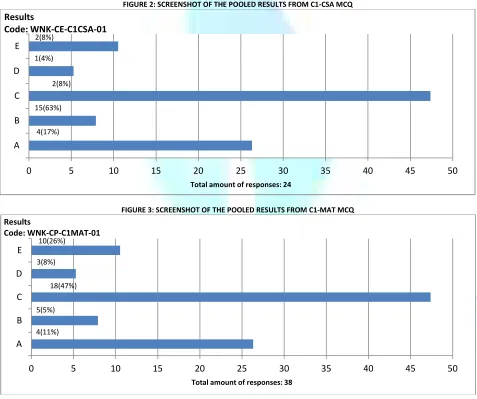
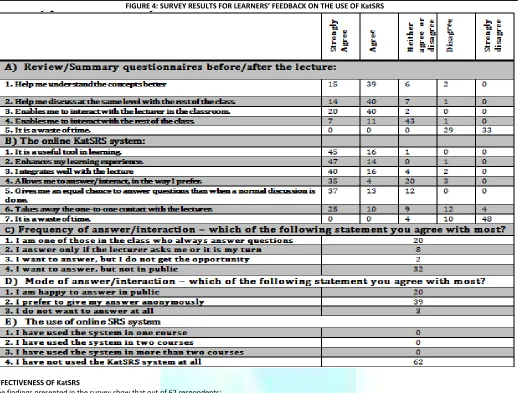
During 4, 5, 6, 7, 8 weeks, students were engaged by asking them to respond to MCQ’s and the results of each question were displayed to the students (see Figure 2 for pooled results of example 1(C1-CSA). In the case of a high number of negative/incorrect responses from students, the topic is discussed immediately.
From the class activities the following results were found pertaining to the examples presented above. The following results are showing how students were responding to the above examples in class. In C1-CSA multiple choice questions all students participated. It does not show only the number of participants but also shows the distribution of the responses pattern as well as the correct answer showing how many actually managed to get it right or wrong.
FIGURE 2: SCREENSHOT OF THE POOLED RESULTS FROM C1-CSA MCQ
FIGURE 3: SCREENSHOT OF THE POOLED RESULTS FROM C1-MAT MCQ
RESULTS & DISCUSSION
The results are presented according to the tools that were employed. The first results are based on the survey of the participant learners followed by the selected interview results.
SURVEY RESULTS FOR LEARNERS’ FEEDBACK ON THE USE OF KATSRS
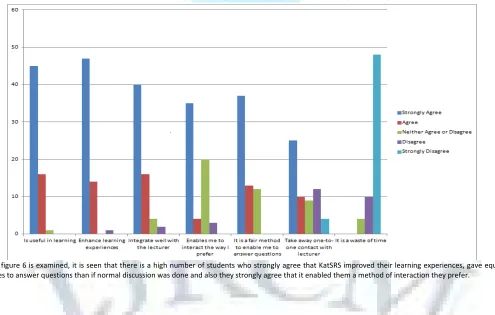
Qualitative feedback was used as the primary measure of effectiveness since the sample group is relatively small and most of the judgment relied on literature. 27 out of 38 students that took the C1-MAT course responded to the survey and 35 out of the 42(both normal and progression classes included) students that took the C1-CSA course responded to the survey. In total, out of eighty students sixty-two (77.5%) responded to the survey. The details of the survey are summarized in Figure 4. The key points in the survey are:
4(17%) 15(63%)
2(8%) 1(4%) 2(8%)
0
5
10
15
20
25
30
35
40
45
50
A
B
C
D
E
Total amount of responses: 24
Results
Code: WNK-CE-C1CSA-01
4(11%) 5(5%)
18(47%) 3(8%)
10(26%)
0
5
10
15
20
25
30
35
40
45
50
A
B
C
D
E
Total amount of responses: 38
Results
VOLUME NO. 4 (2014), ISSUE NO. 05 (MAY) ISSN 2231-5756
INTERNATIONAL JOURNAL OF RESEARCH IN COMMERCE, IT & MANAGEMENT
FIGURE 4: SURVEY RESULTS FOR LEARNERS’ FEEDBACK ON THE USE OF KatSRSEFFECTIVENESS OF KatSRS
The findings presented in the survey show that out of 62 respondents:
1. 33(53%) of the respondents ‘strongly disagree’ with the suggestion that “Review/Summary questionnaires before/after the lecture are a waste of time” and 29(47%) of the respondents “disagree” with the same suggestion that “Review/Summary questionnaires before/after the lecture are a waste of time”. None of the respondents think that the summary questionnaires are a waste of time;
2. 48(77%) of the respondents “strongly disagree.” with the suggestion that KatSRS is a waste of time while 10(16%) “Disagree.” that it is a waste of time; 3. Except for 1(2%) respondent, all respondents “strongly agree” 45(73%) or “agree” 16(25%) with the suggestion that KatSRS “KatSRS is a useful tool in
learning.”;
4. Except for 1(2%) respondent, all respondents either “Strongly agree” 47(75%) or “Agree” 14(23%) with the suggestion that ‘KatSRS enhances their learning experience’ ;
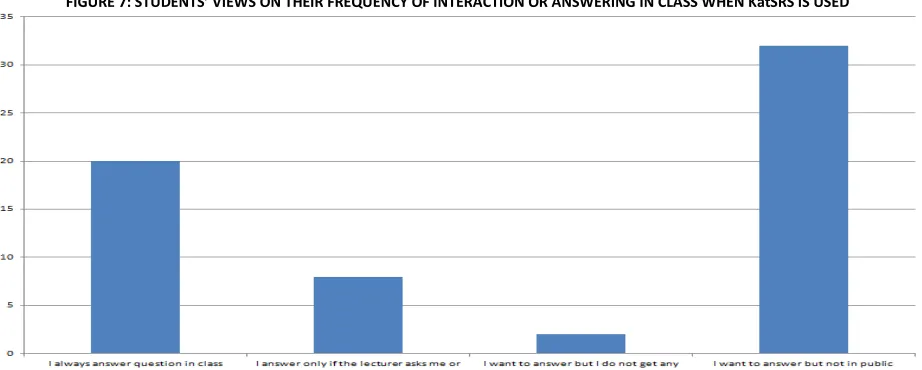
5. 32(52%) of the respondents said “I want to answer but not in public”, 20(32%) said “I am one of those in the class who always answer questions.”, 8(13%) said “I answer only if the lecturer asks me or it is my turn.” and only 2(3%) said “I want to answer, but I do not get the opportunity.”;
6. 39(63%) of the respondents said “I prefer to give my answer anonymously.”, 20(32%) said “I am happy to answer in public.” and only 3(5%) said “I do not want to answer at all.”;
7. All 62 respondents said “I have not used the KatSRS system at all.”
8. Furthermore, the screenshots for the pooled data for KatSRS used show that a hundred percent participation from all students presenting the Mathematics for Computing and Computer Systems Architecture groups. In the formal peer observations conducted in July to September 2012, the situation is different. The statistics show that when the traditional method of lecturing and discussion is used, only ten to twenty percent of the students manage to engage and make meaningful contribution to learning/teaching.
VOLUME NO. 4 (2014), ISSUE NO. 05 (MAY) ISSN 2231-5756
INTERNATIONAL JOURNAL OF RESEARCH IN COMMERCE, IT & MANAGEMENT
FIGURE 5: STUDENTS VIEWS ON THE USE OF KATSRS BEFORE/AFTER THE LECTUREWhen figure 5 is examined, it is seen that most students either “strongly agreed” or “agreed” with the suggestion that KatSRS is a useful tool in enhancing interactions in class and increasing the ability of students’ understanding of concepts. Notably, 47% of the students disagree with the suggestion that the use of KatSRS is a waste of time.
USE OF KatSRS IN LEARNING
FIGURE 6: STUDENTS’ VIEWS ON THE INFLUENCE OF KATSRS IN THEIR LEARNING EXPERIENCES
VOLUME NO. 4 (2014), ISSUE NO. 05 (MAY) ISSN 2231-5756
INTERNATIONAL JOURNAL OF RESEARCH IN COMMERCE, IT & MANAGEMENT
FIGURE 7: STUDENTS’ VIEWS ON THEIR FREQUENCY OF INTERACTION OR ANSWERING IN CLASS WHEN KatSRS IS USEDAs can be seen in figure 7, they are more students 52% who would prefer to remain anonymous and 32% said that they like answering in class. The rest of the students prefer to wait for the lecturer to pick on them or they do not get the opportunity at all. This is an indication that KatSRS would be very effective on getting most students to participate in class since they seem to prefer it that way.
FIGURE 8: STUDENTS’ VIEWS ON THE MODE OF INTERACTION WHEN KatSRS THAN WHEN TRADITIONAL
When figure 8 is examined, it is seen that the majority of the students (63%) prefer to answer anonymously in class, one-third of the students say that they are always answering in class and 3 students would never want to answer questions in public.
The results appear to be similar to the results obtained from the studies which aimed at investigating the effects of the students’ response systems in engaging learners during teaching sessions (Caldwell, 2007; Sellahewa, 2011; Eric, 2005). It was also found that lecturers can benefit from the real-time feedback provided by students to construct on-time-interventional strategies (such as extended tutorials) if the concept is missed by most students during a lecture (Sellahewa, 2011; Eric, 2005).
According to our hypothesis H0, there must be an even or less number of students who advocate for the use of KatSRS compared to those who do not favour its
use. In the same manner, the same participants must have reflected their support for an open discussion mode than anonymity. In the present study, the researchers observed that there are more students who fear or deliberately avoid answering in public and prefer to respond anonymously. Based on the observation made from the survey results, we therefore do not have any evidence to support hypothesis H0.
Hypothesis H1 would be supported if the present study found that a high number of students support the use of KatSRS in active learning and provides them
with equal opportunities to answer questions in class. Furthermore, if a high number of students strongly supported “anonymous” as the preferred mode of answering questions, then this would indicate the need for the KatSRS system and hence, H2 would be supported.
In the present study, the researchers observed also considered the learner’s feedback according to how the KatSRS influences their experiences and enabling interaction with their lecturers and colleagues. It was observed that more than two thirds of the students strongly agree with the suggestion that KatSRS is a useful tool in learning, enhancing their learning experiences and encouraging student-to-lecturer or student-to-student interaction. This finding concurs with the other studies based on clickers, online handheld devices and mobile services (Caldwell, 2007; Sellahewa, 2011). Accordingly we find strong evidence to support
H2.
The pooled results show a hundred percent participation from the students present in the Computer Systems Architecture and Mathematics classes during the administration of KatSRS tool. When the findings of the present study are examined, it is possible to argue that the KatSRS method enabled learners to be free to answer questions anonymously, provided students with equal opportunities for participating in class. In the case, KatSRS availed good conditions for active learning and increased learners’ engagement. Studies by Dyson (2008); Caldwell (2007); Eric (2005) and Horowitz (2006) revealed that learners need to be encouraged by using appropriate interactive tools that protect them against embarrassment or any forms of prejudice or unfair criticism by other learners. This finding concurs with the literature Sellahewa, (2011).
For example, Dyson (2008) contends that asking learners to record their responses during interactive windows anonymously would attract more participation. Also recording these engagements throughout the lecture can act as a form of active and anonymous contribution to learning/teaching.
Furthermore, when the findings of the present study are examined, it is possible to argue that the online KatSRS system promotes lecturer-student and student-student interaction and removes barriers to participation (Horowitz, 2006; Sellahewa, 2011).
VOLUME NO. 4 (2014), ISSUE NO. 05 (MAY) ISSN 2231-5756
INTERNATIONAL JOURNAL OF RESEARCH IN COMMERCE, IT & MANAGEMENT
engagement. Further research is needed on technology’s role in the "classroom of the future" for both industrial and public education. At the other end of the spectrum, research into the learning of non-vocal students would also be valuable.
SELECTION OF STUDENTS’ FEEDBACK
The following is a sample of some comments from the three batches doing Computer architecture and mathematics for computing. The comments were considered reflect students’ feedback (relevant to the use of KatSRS) given as feedback for the course:
BFT12-F-CM022-01: “The introduction of KatSRS could be a very good idea especially to us who do not like to be public. I can contribute in class but now I cannot go in front of other students and show my ignorance.” (C1-CSA- 2012 Normal Entry group).
BFT12-F-CM022-01: “This is a good system it helps us who are shy.”; “I think all lecturers must try this it is friendly...”; “I like it because it made me participate in class.”; “The Katlego student response system (KatSRS) is a very useful tool in gauging the understanding of materials flip flops.”; “It’s my first time to use this, but well I have no problems with it. But me I like the oral discussions in class.” (CSA 2012- Progression group).
CP-MAT-B1: “This system favours students because I know many [colleagues] do not know but they shy to raise their hands and tell the teacher.”; “So with this system, many of us indicated that we do not understand Cartesian product of two sets and the teacher explained again.”; “The KatSRS system was a good way to involve the class”; “I liked the recap questions. I benefited because they reminded me of key points in sets and Boolean algebra.” (Mathematics for Computing, 2012).
FINDINGS
• KatSRS is a useful tool in learning
• KatSRS enhances students’ learning experience
• Most students do not want to answer questions in public/in front of their classmates but would rather remain anonymous during lectures • There is 100% engagement when the teacher uses KatSRS compared to 10-20% participation when traditional methods are used.
LIMITATIONS OF THE METHODOLOGY
The benefits of the KatSRS are apparent but, there are some limitations that were identified in its application. These include the following: • Connectivity and insufficient bandwidth:
Network connectivity may be slow or not sufficient to handle multiple responses at the same time. Reliability problems may frustrate the users (Sellahewa, 2011).
• Administration of the process may be difficult
Presenting questions and collecting the results may consume a lot of time (taking 5 - 10 minutes) (Horowitz, 2006). This becomes more stressing if there is slow network connectivity or other technical issues.
• Preparation
Preparing for a lecture where the KatSRS is used requires more time to plan for appropriate questions: preparation of MCQ questions needs extra effort by the lecturer. According to Caldwell (2007) and Horowitz (2006), there is need for proper planning prior to conducting classes with students’ response systems. For example, MCQ’s to be given to students must be examined to ensure that they assess students’ knowledge. Furthermore, questions must be challenging in order to stimulate prior knowledge and enable students to apply new ideas and explore implications.
• Overreliance on SRS tends to be detrimental
If the SRS system is overused, there is the likely hood of overlooking at the other methods of learning/teaching (such as reflection, discussion and group work activities). The other methods could be handy because they reinforce skills and knowledge acquired. For example, in discussion and reflection, students are likely to concretise their ideas by discussing them with colleagues in class.
RECOMMENDATIONS/SUGGESTIONS
The present study established that interactive classrooms which use KatSRS system improve the learning process. This is because they facilitate class discussion, collection of data, promote critical thinking and increase student engagement (Caldwell, 2007). However, careful consideration must be done to ensure that there is proper planning, effective administration of the process and prompt evaluation of the process after the course for feedback. We therefore make the following recommendations;
Question design goals and tactics
Further research is required to determine how best we can design the questions for use during the lectures involving SRS. The questions should be structured such that they meet the pedagogical needs of the course such as;
(a) Having the ability to assess students’ knowledge and (b) challenging to students so that they can improve on their experiences (Caldwell, 2007). A key research question in this context would be “What are the design goals and tactics for the SRS questions?”
Administration of the process
Administration and management of the process tends to consume more time than one would expect. According to Horowitz (2006), the lecturer requires ten to fifteen percent more time to cover the same number of learning points. An investigation needs to be carried out to determine additional resources that aid the teacher to easily administer the process without taking too much time.
Impact on student-student interaction
The ability of a learning/teaching approach to engage student-student interaction is the key to active learning. The notion behind KatSRS is not to eliminate discussions in class but, to find the best ways of making it more valuable to students. We therefore see the need for further research on how teachers can create an interactive classroom environment by posing challenging questions and positioning the discussions at the right times (Caldwell, 2007).
CONCLUSIONS
The exploratory study has shown that the use of KatSRS at Botho University (Francistown) can significantly improve learners’ engagement and experiences. Notwithstanding there are many alternative interventions for harnessing learners’ engagement (Dyson, 2008), the present research established that KatSRS can simulate a one-to-many dialogue, simplify instructor-student interaction and enable both the teacher and students to get prompt feedback. According to Caldwell (2007), the clicker based SRS have been shown to increase attendance, reduce attrition rates and promote student accountability. The need to engage an increased number of students in a lecture requires serious commitment from teachers because it is involving. More time would be required in planning for a lecture and therefore extends beyond normal working hours (Horowitz, 2006). In addition, a strategy needs to be formulated to introduce these technologies without distracting learners during a lecture. This requires some combined effort from the relevant ministries, university authorities and individual lecturers to identify appropriate educational technologies for promoting active learning and ensure that good learning/teaching standards are adhered to.
ACKNOWLEDGEMENT
VOLUME NO. 4 (2014), ISSUE NO. 05 (MAY) ISSN 2231-5756
INTERNATIONAL JOURNAL OF RESEARCH IN COMMERCE, IT & MANAGEMENT
REFERENCES
1. Biggs, J. & Catherine, T. (2007). Teaching for Quality Learning at University (2 ed.). UK: Open University Press.
2. Biggs, J. (2003). Approaches to learning in secondary and tertiary students in Hong Kong: Some comparative studies. . Educational Research, 6, 27-39. 3. Caine, R. N., & Caine, G. (1994). Making connections: Teaching and the human brain. New York: Addison-Wesley.
4. Caldwell, J. E. (2007). Clickers in the Large Classroom: Current Research and Best - Practice Tips. CBE- Life Science Education, 6 (1), 9-20. 5. Coull, N. J., & Duncan, I. M. (2011). Emergent Requirements for Supporting Introductory Programming. ITALICS , 10 (1).
6. Directorate-General (2007). The Republic of BOTSWANA European Community Joint Operational report 2007
7. Duman, B. (2010). The Effects of Brain-Based Learning on the Academic Achievement of Students with Different Learning Styles. Educational Sciences: Theory & Practice , 10 (4), 2077-2103.
8. Dunn, R., & Dunn, K. (1992). Teaching elementary students through their individual learning styles: Practical approaches for grades 3-6. Needham Heights: Allyn and Bacon.
9. Dyson, J. B. (2008). Assessing small-scale intervention in large-scale teaching: A general methodolgy and preliminary data. Active Learning in Higher Education , 9 (3), 265-282.
10. EduMECCA. (2011). EduMECCA SRS. Retrieved July 5, 2012, from http://srs.hud.ac.uk/srs/
11. Eric, M. (2005, May 17). Interactive 'clickers' transform classrooms. Retrieved September 24, 2012, from https://uwm.courses.wisconsin.edu/content/ enforced/46141-srs_fac_devel/CNN%20Class... 01/24/2006
12. Habeshaw, S., Biggs, G. and Habeshaw, T. (1992). 53 interesting things to do in your seminars and tutorials. Plymouth: TES Books 13. Hart, L. A. (2002). Human Brain and Human Learning (3 ed.). Books for Educators.
14. Horowitz, H. M. (2006). Students Response Systems: Interactivity in a Classroom Environment. New York: IBM Corporate Education Centre. 15. Houghton, W. (March 2004). Learning and Teaching Theory for Engineering Academics. Exeter: Engineering Subject Centre.
16. Knight, J., & Wood, W. (2005). Teaching More by Lecturing Less (4 ed.). Colorado: Cell Biology Education.
17. Kolb, A. Y., & Kold, D. A. (2005). Learning styles and Learning spaces: Enhancing learning in Higher Education. Academic of Management Learning and Education , 4 (2), 193-212.
18. Linn, M. C., & Clancy, M. J. (1992). The Case for Case Studies of Programming Problems. Commun. ACM , 35 (3), 121-132.
19. Sellahewa, H. (2011). Using an Online Student Response System in Small Group Teaching: A pilot Study. Small Scale Interventions in Teaching-Learning , 10 (3).
20. Tumkaya, S., & Songul. (2012). The Investigation of the Epistemological Beliefs of University Students According to Gender, Grade, Fields of Study, Academic Success and Their Learning Styles. Educational Sciences: Theory & Practice, 12 (1).
21. Turugare, R., Dino, R., Sharp, H., Woodroffe, M., Blyth, R., & Schadewitz, N. (2012). A Frame Signnature Matrix for Analysis & Comparing Interaction Design Behaviour. HCI Conference , 136.
VOLUME NO. 4 (2014), ISSUE NO. 05 (MAY) ISSN 2231-5756
INTERNATIONAL JOURNAL OF RESEARCH IN COMMERCE, IT & MANAGEMENT
MEASURES FOR ACTIVITY BASED COSTING SUCCESS: A REVIEW
SHAFEQ HAMOUD M. AL-SAIDI
RESEARCH SCHOLAR
DOS IN COMMERCE
UNIVERSITY OF MYSORE
MANASAGANGOTRI
H. NANJE GOWDA
PROFESSOR & PRINCIPAL
YUVARAJA'S COLLEGE
UNIVERSITY OF MYSORE
MANASAGANGOTRI
ABSTRACT
Activity Based Costing (ABC), a powerful tool in Management Accounting, provides accurate information on the costs of activities and processes, which helps the managers to take decisions that have positive impact on the organization’s production. Earlier, management accountants depended on traditional cost accounting methods to obtain information on product and service costs for these decisions. ABC, now argued to be remarkably better than traditional volume based costing system, has elicited the attention of both researchers and practitioners for its involvement in decision making. Several empirical studies have been conducted to examine the importance, adoption and successful implementation of ABC, reasons for implementing, issues related to its adoption, critical success factors of ABC. An in-depth insight of cost structure of an organization, cost modelling and targeting vis-à-vis its performance is essential for the successful implementation of ABC system. Many studies have attempted to establish the variables that could measure success of ABC system. Before determining the success rate of ABC, it is crucial to address what constitutes ABC success. This paper reviews the research carried out on ABC success factors pertaining to the extent to which it is used in an organization, the variables used to measure success and its operational definitions. The review reveals that the past research has focussed on the perception of the users, the frequency of usage, the use of ABC in decision making as the determinants of ABC system success. However, multi-item measures are able to measure and analyse the complex nature of the success factors better than the single-multi-item measures.
KEYWORDS
Activity based costing, ABC success, approach for measuring the ABC success.
JEL CLASSIFICATION
M41
1. INTRODUCTION
number of research studies have sought to identify variables that may be used to measure success or failure of ABC system. In doing so, researchers have had to address the difficult issue of what constitutes success in the context of an ABC.
Appraising ABC success has proved to be a challenge for researchers; hence, a number of ways has been adopted to address it. There is no universally agreed definition for success from management accounting context (Cinquini and Mitchell, 2005). Shields (1995) identified this as a complex issue and acknowledged the difficulty in defining ABC success. He stated that
“Providing a definition, however, was problematic as the literature is vague about what constitutes success, and discussions with ABC experts did not result in consensus about a tangible definition. For example, success can include top management not rejecting it, an implementation of ABC per se, use of ABC information by non-accountants, gaining competitive advantage and providing additional profits” (p. 154).
The main objective of this review to analyse the difference between the single-item and multi-item success measures to be used for measuring ABC success and recommend the most appropriate method to conduct studies on ABC success.
2. RESEARCH METHODOLOGY
Various sources of secondary data, like for instance articles published in journals / magazines, were accessed to gather data for this research, Google search engine was extensively used locating relevant articles on line. Besides, references from various chapters of relevant accounting and financial text books were also helpful in gathering data.
3. THE ALTERNATIVE SUCCESS MEASURES
A. SINGLE-ITEMS MEASURES
Since defining ABC success is arguable, Shields (1995) let the respondents of the survey rate the degree of success with whatever definition he or she deemed relevant to his or her situation by responses two questions about the overall level of perceived success and the financial benefits received from ABC. However, Anderson and Young (1999) criticized this method of measuring the success of ABC. Anderson and Young (1999) stated that
“A danger of asking managers to rate ABC implementation success without specifying the definition of success is failure to detect cases in which individuals hold different views on the definition of success but share views on attainment of a particular dimension of success. In light of evidence that success in ABC implementation is multi-dimensional with each dimension having somewhat different correlates, it is appropriate to ask what criteria respondents use in evaluating ABC “(p. 526).
While Shields (1995) focused specifically on manager’s perceptions of the success of ABC itself, other studies focused on user satisfaction with the implementation of ABC. McGowan and Klammer (1997) claim that user satisfaction may affect behaviour and, consequently, the success of a system change. They argue that if a user perceives satisfaction with an information system per se, then the system is successful. McGowan and Klammer’s (1997) approach has been criticized for relying too heavily on a limited number of success attributes. It is relying on just one question relating to managers’ satisfaction with activity management, and it does not distinguish between the various levels of activity management use (Baird et al., 2007). Several researchers have included user satisfaction as one of the criteria to measure ABC success (Swenson, 1995; Innes and Mitchell, 1995, 2000; Foster and Swenson, 1997; Cotton, et al., 2003). The extent to which management used the ABC information to support decisions (frequency of use) has also been used as a measure of ABC success. Swenson (1995) argued that it is more of an objective measure of the benefits of ABC system. This approach is supported by Pierce and Brown (2004, 2006), who surveyed large Irish companies and found high correlation between the frequency of use and the perceived success of ABC system. They suggested that overall
VOLUME NO. 4 (2014), ISSUE NO. 05 (MAY) ISSN 2231-5756
INTERNATIONAL JOURNAL OF RESEARCH IN COMMERCE, IT & MANAGEMENT
usage level is a reliable indicator of overall success of these systems. This approach for success measurement has also been endorsed by many researchers, including Foster and Swenson (1997), Innes and Mitchell (1995) and (2000), Anderson and Young (1999), Fortin et al. (2007), Charaf and Rahmouni (2010). Based on the studies conducted by Shields (1995) and Swenson (1995), Krumwiede (1998a) has proposed an alternate success variable for ABC implementation. He pointed out that Shields (1995) found a correlation between respondents’ cost management system quality rating and ABC implementation stage. In addition, Swenson’s (1995) results showed that satisfaction increased with the higher stages of implementation. Thus, he suggested that the attainment of a particular stage of implementation may use as a measure for ABC success. Nevertheless, this approach of measuring success received many criticisms from researchers like Baird et al. (2004). Baird et al. (2004) stated that this approach measures success as the progression of an organization from one stage of activity management implementation to the next, assuming that end state of integration with the organization’s financial system. Consequently, it assumes that all organizations aspire to ABC level of activity management use.
In addition to the previously stated measures, there are other single-item measures, such as usage stage, for ABC success in research studies. In the usage stage, ABC is considered to be a success when one of the following criteria is met: (1) used at least somewhat for decision-making outside the accounting department (Krumwiede, 1998b); (2) the extent to which ABC information leads to a change in decisions (Innes and Mitchell, 1995); (3) the extent to which ABC information leads to financial benefits (Shields, 1995; Foster and Swenson, 1997; and McGowan, 1998); or (4) the importance attached to ABC information (Innes and Mitchell, 1995 and 2000).
Nevertheless, the use of single-item scale to measure the success has not been received well by many researches. For example, McGowan and Klammer (1997) reported that the single-item measure is coarse and cannot reflect all of the aspects of this multidimensional construct. Hence, they emphasized the need to construct a reliable multiple-item proxy for the implementation construct. Thus, considering the need for improvement in the measure, researchers have incorporated the multi-item scale to measure ABC success (Foster and Swenson, 1997; McGowan, 1998; Baird et al. 2007).
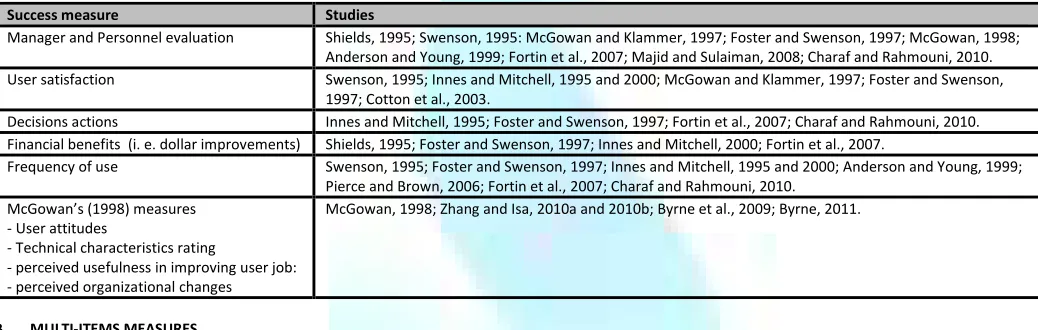
The following table presents the most common approaches to measuring ABC success and examples of research studies adopting each of the approaches.
TABLE 1: APPROACHES TO MEASURING ABC SUCCESS
Success measure Studies
Manager and Personnel evaluation Shields, 1995; Swenson, 1995: McGowan and Klammer, 1997; Foster and Swenson, 1997; McGowan, 1998; Anderson and Young, 1999; Fortin et al., 2007; Majid and Sulaiman, 2008; Charaf and Rahmouni, 2010.
User satisfaction Swenson, 1995; Innes and Mitchell, 1995 and 2000; McGowan and Klammer, 1997; Foster and Swenson,
1997; Cotton et al., 2003.
Decisions actions Innes and Mitchell, 1995; Foster and Swenson, 1997; Fortin et al., 2007; Charaf and Rahmouni, 2010.
Financial benefits (i. e. dollar improvements) Shields, 1995; Foster and Swenson, 1997; Innes and Mitchell, 2000; Fortin et al., 2007.
Frequency of use Swenson, 1995; Foster and Swenson, 1997; Innes and Mitchell, 1995 and 2000; Anderson and Young, 1999;
Pierce and Brown, 2006; Fortin et al., 2007; Charaf and Rahmouni, 2010. McGowan’s (1998) measures
- User attitudes
- Technical characteristics rating
- perceived usefulness in improving user job: - perceived organizational changes
McGowan, 1998; Zhang and Isa, 2010a and 2010b; Byrne et al., 2009; Byrne, 2011.
B. MULTI-ITEMS MEASURES
The multidimensional construct of ABC success has lead Foster and Swenson (1997) to attempt to examine the effect of using alternative of ABC success measures. This was to address a call for research on the development of better success measures (Shields, 1995; McGowan and Klammer, 1997) and to explore further the use of a multiple-item measure. They refined ABC success measures and classified them into four variables:
1. Measure based on the use of ABC information in decision making. This measure presumes that the more extensive the use of ABC information, the more successful the implementation. Foster and Swenson (1997) categorised the use of ABC measures into three based on decision making: (1) rating as compared to the previous cost management system in some specific decisions, (2) the frequency with which each business functional area uses ABC information to make decisions and (3) the frequency with which the different levels of management used ABC.
2. Measure based on the decisions and actions taken with ABC information. This measure focuses on importance of ABC information in changing the course of decision making (for example, process change, pricing strategy change and product mix change).
3. Measure based on the dollar improvement resulting from ABC. This measure helps in the evaluation of either a summary management estimate or an explicit dollar comparison of revenues and costs with and without ABC in some implementation areas.
4. Measure based on the management evaluation of overall ABC success. This measure has required the respondents to rate how successful they believe ABC has been.
Although, Foster and Swenson’s multi-item measure could be explained better than single-item measures, the measures do not recognize the different levels of activity management (Baird, et al. 2007). Thus, Baird et al. (2007) sought an alternative way to evaluate the success of ABC by categorizing the items in the Foster and Swenson’s measure as to whether they were related to any of Gosselin’s (1997) three levels of activity management, namely activity ana