and discomfort in tractor drivers
Farshad Arghavani1, Omid Giahi1, Karim Javanmardi1, Kamal Ebrahimi1,
Farzam Bidarpoor2, Foozieh Bigi2
Abstract
In designing work stations, maintaining best hand posture is particularly important in achieving the highest grip power. This study aims to assess the effect of hand posture on maximum force grip and discomfort in 24 tractor drivers in Sanandaj. maximum force grip in different postures using hydraulic dynamometer, and discomfort level using simulated 10-degree visual scale were measured and recorded. Significant relationships were observed between hand direction and also hand-shoulder distance and maximum force grip and discomfort level. The highest force grip was achieved at hand direction angles above 90 degrees. Maximum force grip was achieved at hand angle 135 degrees and hand-shoulder distance of 100 arm-reach (43.1 kg force). Also, the most discomfort was found at 45 degrees hand direction and hand-shoulder distance 50 of arm-reach (58.8 kg force).
Discomfort level and hand direction angle affect maximum force grip, and unless these ergonomic factors are taken into account in designing hand tools and controls, consequences such as increased accidents, fatigue, and musculoskeletal problems will inevitably follow.
Keywords: Discomfort, Posture, Tractor Drivers
Journal of Research & Health
Social Development & Health Promotion Research Center
Vol. 6, No. 1, Mar & Apr 2016 Pages: 122-128 Original Article
1. Environmental Health Research Center, Kurdistan University of Medical Sciences, Sanandaj, Iran
2. Social Determinants of Health Research Center, Kurdistan University of Medical Sciences, Sanandaj, Iran
Correspondence to: Farshad Arghavani, Environmental Health Research Center, Kurdistan University of Medical Sciences, Sanandaj, Iran
Email: [email protected]
Received: 11 Jan 2014 Accepted: 18 Mars 2014
How to cite this article: Arghavani F, Giahi O, Javanmardi K, Ebrahimi K, Bidarpoor F, Bigi F. Effect of hand posture on maximum force grip and discomfort in tractor drivers. J Research & Health2016; 6(1): 122-128.
Introduction
Force Hand grip is the force exerted by hand onto a specific position or instrument during work [1]. Manual work is part of most routine tasks such as industrial jobs, services, computer, driving, etc., in which force grip is directly and physically involved in the task. One of the problems considered by ergonomists, engineers, and healthcare professionals is the use of hand in performing physical tasks and its association with many harmful symptoms such as early
fatigue, loss of occupational motivation, and high prevalence of musculoskeletal problems including carpal tunnel and Guyon tunnel syndromes in employees [2].
The prevalence of discomfort, pain, and musculoskeletal problems is substantially higher when work stations and tools are designed in such a way that workers are compelled to adopt non-neutral and stressful postures [5]. Computer and video terminal operatives that work in a non-neutral and non-ergonomic posture have reported numerous problems including carpal and Guyon tunnel syndromes and inflammation of tendons and ligaments [6]. More than 40% of computer operatives that worked in a non-ergonomic work station reported musculoskeletal problems and pain [7].
In developed countries, data obtained from population studies relating to the highest force grip and discomfort in different postures have been used in designing work stations and hand-held tools [8]. According to international studies, force grip is affected by posture of distal upper extremities (DUE) [9]. These studies have measured force grip in different postures of upper limbs, which were defined according to different angles of wrist, arm, and shoulder [10]. Workers use physical effort to grasp hand-held tools, machine controls or handles to perform their task [11]. Sengupta et al. confirmed the significant effect of hand posture on maximum force grip, and reported that the highest grip power can be achieved in standing position and at 90 degrees arm angle [12]. In a study on basketball players, Taghread et al. reported that fatigue and discomfort in the DUE significantly reduces all factors relating to force grip[13]. According to a standard protocol for measuring force grip, the person should be in sitting position, with straight shoulders, without rotation, elbow at 90 degrees, and forearm and wrist in neutral position [8]. However, workers perform their tasks using physical effort in different postures that are far from standard [9]. Force Grip depends on several factors, including hand angle and posture [14], wrist [15], arm [16], hand-arm distance [17], hand-shoulder distance [18], and also size and material of hand-held tool [19]. Studies should be conducted to identify the best postures for maximum force grip and least discomfort [20], and force grip [21] and discomfort [22] data should be used to design and redesign
work stations and hand-held tools [22-24]. Specificity of mean data from every nation renders equipment designed and made in other countries useless. Thus, appropriate posture for maximum force grip and least musculoskeletal discomfort in DUE should be identified through ergonomic studies. The present study was conducted on tractor drivers with huge ergonomic problems caused by absence of national standards for appropriate design of agricultural machinery, and especially tractor driver's cabin. Review of literature showed a lack of a domestic study in this area and unavailability of data relating to maximum force grip and discomfort in different postures in Iranians. This study aims to measure the highest force grip and discomfort level in different hand positions in tractor drivers in Sanandaj city, west of Iran in 2013.
Method
Then, anthropometric data, including height, weight and arm-reach were measured, followed by measurement of maximum force grip in one position (using dynamometer). Finally, using visual scale, discomfort level in different postures was assessed.
Before the main test, participants practiced a few times, held dynamometer in their hands, and reported level of discomfort.
In the main test, the designed hand position was established and subjects grasped dynamometer handle (different hand postures were defined according to distance and direction of hand from shoulder and arm). In this study, the test began with an alarm signal that continued throughout the 4-second test, during which subjects grasped dynamometer and exerted their maximum force grip, and stopped when the signal stopped. Afterward, discomfort level was assessed and recorded, and 7 minutes of rest was allowed until the next test in a different position. Subjects that required longer rest time were allowed to do so. Hand position and posture:
Maximum force grip was measured in different hand positions, which were determined according to hand-shoulder distance and hand direction. Hand-shoulder distance is the distance between hand and shoulder joint, known as the percentage of arm-reach. The three hand-shoulder distances included 50%, 75% and 100% of arm-reach. At 100% arm-reach, dynamometer handle is grasped with fully stretched elbow and neutral wrist position. At 75% and 50% arm-reach, dynamometer handle was moved to maintain distance from shoulder equivalent to 75% and 50% of arm-reach respectively. Subjects were asked to grasp handle in a totally comfortable position. Hand direction is determined by the line stretching from shoulder to hand, and is expressed as shoulder bending angle at 100% arm-reach of hand-shoulder distance. Five hand directions tested included 45, 90, 135, and 180 degrees. Thus, maximum force grip was measured in 15 hand positions (3 hand distances×5 hand-shoulder directions).
Discomfort level was measured for every hand position and maximum force grip. Subjects were asked about discomfort level in exerting
maximum force grip. A vertical 10 cm line was used as the scale for measuring discomfort (from no discomfort=0, to maximum discomfort=10), and after every test, subjects marked their level of discomfort on this scale. A hydraulic dynamometer (JAMAR) was used to measure maximum force grip in kg-force. Dynamometer was held by a bar that was easily adjusted according to height and direction.
A visual scale was used to rate discomfort level according to marks placed on the scale by subjects. Data obtained were analyzed in SPSS-19, using descriptive statistics for frequency of variables, and chi-squared and ANOVA tests for relationships between variable, at significance level p<0.05.
Results
Mean and standard deviation (SD) of drivers' age, height, weight, and BMI were 36.14±9.08 years, 1.74±0.79 meters, 77.66±12.18 kg, and 25.58±3.84 kg/m2 respectively.
According to Table 1, hand direction had a significant relationship with maximum force grip (p=0.01) and discomfort level (p=0.0001). Hand-shoulder distance had a significant relationship with maximum force grip (p=0.001) and discomfort level (p=0.0001). Furthermore, hand direction and hand-shoulder distance had a significant relationship with level of discomfort (p=0.0001).
Table 1 Force grip and level of discomfort data
Degree of
freedom Maximum force grip (kg force) Degree of discomfort
F p F p
Hand orientation 4 3.11 0.001 6.73 0.0001
Shoulder-hand
distance 2 52.69 0.001 55.37 0.0001
Shoulder-hand distance × hand
orientation 8 1.06 0.3 6.6 0.0001
Table 2 Mean maximum force grip and level of discomfort in different hand postures of tractor drivers
Different levels Maximum force grip (kg force) Level of discomfort
Mean SD (±) Mean SD (±)
Hand orientation
0 40.3 8.5 47.4 26.8
45 40.4 8.6 44.8 24.1
90 40.9 7.8 39.1 22.1
135 41.6 8.4 43.3 22.2
180 41.3 9.1 48.6 24.5
Hand-shoulder distance
50% arm reach 38.6 8.3 56.7 24.6
75% arm reach 41.3 8.3 42.1 20.6
100% arm reach 32.7 8.3 35.1 22.1
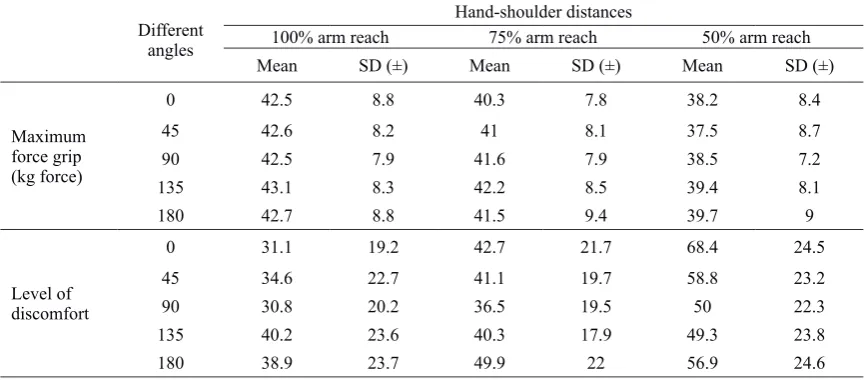
Table 3 Mean and SD of maximum force grip and level of discomfort in different shoulder angles and hand-shoulder distances
Different angles
Hand-shoulder distances
100% arm reach 75% arm reach 50% arm reach
Mean SD (±) Mean SD (±) Mean SD (±)
Maximum force grip (kg force)
0 42.5 8.8 40.3 7.8 38.2 8.4
45 42.6 8.2 41 8.1 37.5 8.7
90 42.5 7.9 41.6 7.9 38.5 7.2
135 43.1 8.3 42.2 8.5 39.4 8.1
180 42.7 8.8 41.5 9.4 39.7 9
Level of discomfort
0 31.1 19.2 42.7 21.7 68.4 24.5
45 34.6 22.7 41.1 19.7 58.8 23.2
90 30.8 20.2 36.5 19.5 50 22.3
135 40.2 23.6 40.3 17.9 49.3 23.8
180 38.9 23.7 49.9 22 56.9 24.6
Discussion
Results obtained showed that study population of 24 drivers was relatively young and tall, but according to BMI, mostly overweight. A significant relationship was observed between hand direction angle and maximum grip power (p=0.001), which agrees with several studies [7-9,19,22,24]. This relationship may be attributed to the fact that when hand angle is not neutral, muscles in this area are static and their
stress or pressure, and thus no fatigue or pain is felt in any of them. By changing position and working in non-neutral postures, after a while, limbs involved become tired due to pressure points on nerves. Continued fatigue turns these symptoms into burn, inertia and pain, leading to loss of initial power in the limb [3,8,11,15]. A significant relationship was also observed between hand-shoulder distance and maximum grip power, which is supported by several studies [5-7,9]. This is explained by the fact that stress and pressure in muscles change with changing muscle length, thereby changing power exerted for the task [11,15].
According to results, there was a significant relationship between hand-shoulder distance and level of discomfort, which was also demonstrated in several studies [3,12,13]. This is due to increased force required to hold hand high due to changes in hand-shoulder distance, resulting in early tiredness of muscles, and feeling of discomfort, also leading to static state in some hand and shoulder muscles, which impairs blood supply to muscles, and energy is reduced due to accumulation of lactic acid, leading to early tiredness [2,4,6,7].
Results obtained showed no significant relationship between combined effect of hand direction with hand-shoulder and the highest grip power, which disagrees with several studies [2,10,19]. This may be due to use of a hand holder to change hand-shoulder distance and hand angle in the present study.
According to the results obtained, level of discomfort was significantly related to the combined effect of hand direction angle and hand-shoulder distance, which agrees with one study [13]. This is probably due to non-neutral posture of DUE that exerted huge pressure on hand and wrist muscles, tendons, and nerves and carpal and Guyon tunnels, resulting in increased discomfort [1,2,7,12].
The present study results also showed the lowest grip power at hand direction of 0 degrees angle, and the highest at 135 degrees, which agrees with several studies [6,7,16,19,22-24], and disagrees with one study [4] that reported the lowest grip power at hand direction 135 degrees
and the highest at 0 degrees. This may be due to inadequately valid and reliable grip power measuring tools used in study [4].
The present study results showed the highest discomfort level at hand direction 0 degrees, and the lowest at 90 degrees, which agree with several studies [1,2,10,21]. This is due to changes in pressure exerted on muscles and also changes in dynamic/static status of muscles in the two directions [10,21].
The highest grip power (41.3 kg force) and the lowest discomfort level (20.6) were achieved at hand-shoulder distance 75% of arm-reach, and the lowest, and this was confirmed in several studies [9,13]. In this state, muscles were more coordinated and dynamic, creating more force and less discomfort [8,9].
Maximum grip power was achieved at 135 degrees hand direction and hand-shoulder distance 100% of arm-reach (43.1 kg force), and minimum [37.5 kg force) at 45 degrees hand direction and hand-shoulder distance 50% of arm-reach, which is supported by several studies [7,13,23].
The highest level of discomfort (58.8) was felt at 45 degrees hand direction and hand-shoulder distance 50% of arm-reach, and the lowest at 90 degrees hand direction and hand-shoulder distance 100% of arm-reach, which agrees with several studies [1,2,3,12].
Conclusion
Results of these kinds of studies can be used in designing work stations, and hand-held machinery and tools to increase operatives' comfort and reduce fatigue.
In the present study, there were no particular limitations, except in procuring dynamometer (due to economic hardships facing the country), which was resolved by cooperation of finance management of Kurdistan university of medical sciences.
postures. Given the importance of the subject, car manufacturers and production factories should design control levers and hand-held equipment in such a way to reduce high risk of hand injury and the prevalence of musculoskeletal problems in DUE, especially in hands, so that hand is positioned at angles above 90 degrees.
The present study results reveal the importance and the need for accounting ergonomic principles and human factors to match work stations and tools with dimensions of the body, which will play an obvious role in enhancing workers' motivation and morale, thereby increasing productivity.
Acknowledgements
The authors wish to express their appreciation to members of the Research Council of Kurdistan University of Medical Sciences and authorities of Kurdistan Agricultural Jihad Organization, and also participating tractor drivers.
Contribution Study design: FA
Data collection and analysis: FA, OG, MJ, KR Manuscript preparation: FA, OG, MJ, KE, FB, FB
Conflict of Interests
"The authors declare that they have no competing interests."
References
1- Cook C, Burgess R. The effect of forearm support on musculoskeletal discomfort during call centre work.
Appl Ergon2004; 35(4): 337-42.
2- Rempel DM, Keir PJ, Bach JM. Effect of wrist posture on carpal tunnel pressure while typing. J Orthop Res2008 ; 26(9): 1269–73.
3- Ferraz MB, Ciconelli RM, Araujo PM, Oliveira LM,
Atra E. The effect of elbow flexion and time of assessment
on the measurement of grip strength in rheumatoid arthritis. J Hand Surg Am1992; 17(6): 1099-103.
4- Kuzala EA, Vargo MC. The relationship between elbow position and grip strength. Am J Occup Ther1992; 46(6): 509-12.
5- Slane J, Timmerman M, Ploeg HL, Thelen DG. The
influence of glove and hand position on pressure over
the ulnar nerve during cycling. Clin Biomech (Bristol, Avon)2011; 26(6): 642-8.
6- Gustafsson E, Hagberg M. Evaluation of exposure and acute effects on comfort, perceived excertion and productivity in work with computer mouse in two different hand positions. Nordiska
Ergonomisälskapet2000; 11(3): 213–8.
7- Sauter SL, Schleifer LM, Knutson SJ. Work posture, workstation design, and musculoskeletal discomfort in a VDT data entry task. Journal of the Human Factors
and Ergonomics Society1991; 33(2): 151-67.
8- De Smet L, Tirez B, Stappaerts K. Effect of forearm rotation on grip strength. Acta Orthop Belg1998; 64(4): 360-2.
9- Goonetilleke R, Hamad B, So R. Grip span and arm position effects on grip strength. Science and
Technology2000; 25(2): 98–104.
10- Kattel B, Fredericks T, Fernandez J, Lee DC. The effect of upper-extremity posture on maximum grip strength. Int J Ind Ergon1996; 18(5-6): 423-9.
11- Richards LG. Posture effects on grip strength. Arch
Phys Med Rehabil1997; 78(10): 1154-6.
12- Sengupta D, Maity P, Pal P. Effect of body posture on hand grip strength in adult bengalee population.
Journal of Exercise Science and Physiotherapy2011;
7(2): 79-88.
13- Ahmed T. Effect of upper extremity fatigue on grip strength and passing accuracy in junior basketball players. J Hum Kinet2013; 37: 71-9.
14- Thomsen JF, Mikkelsen S, Andersen JH, et al. Risk factors for hand wrist disorders in repetitive work.
PMC2012; 28(12): 53–60.
15- Shivers CL, Mirka GA, Kaber DB. Effect of grip span on lateral pinch grip strength. Human Factors2002; 44(4): 569-77.
16- Terrel R, Purswell JL. The influence of forearm
and wrist orientation on static grip strength as a design criterion for hand tools. Proceedings of the Human
Factors and Ergonomics Society Annual Meeting1976;
20(1): 28-32.
17- Richards LG, Olson B, Palmiter-Thomas P. How forearm position affects grip strength. Am J Occup Ther1996; 50(2): 133-8.
18- Balogun J, Akomolafe C, Amusa L. Grip strength: effects of testing posture and elbow position. Arch
Phys Med Rehabil1991; 72(5): 280-3.
21- Berguer R. "Surgical technology and the ergonomics of laparoscopic instruments". Surg Endosc1998; 12(6): 805–8.
22- Saravanan M, Dhrumika P, Kinjal P, Madhuri G, Gujarat I. Grip strength changes in relation to different body posture, elbow and forearm position. Int J Physiother Res2013; 1(4): 116-21.
23- Domizio JD, Mogk JP, Keir PJ. Wrist splint effects on muscle activity and force during a handgrip task. J
Appl Biomech2008; 24(3): 298-303.