i 1 11 21 29 40 50 62 70 79 89 99 111 118 129 139 149 158 166 176
ALT-C 2010
“
Into something rich and strange
” –
making sense of the sea-change
Conference Proceedings
Editorial
0025 The provision of professional development in ICT: a New Zealand perspective
0055 Strategies for mlearning integration: evaluating a case study of staging and scaffolding mlearning integration across a
three-year bachelor’s degree
0070 Interactive learning with Tablet PCs: tips for teachers 0080 Taking ownership of e-learning: a transferable mentoring
model
0094 Where angels fear to tread: online peer-assessment in a large first-year class
0155 ICT’s participatory potential in higher education collaborations: reality or just talk
0163 Placing the student at the heart of the process: using student lifecycle relationship management and service design techniques to enhance the student experience 0176 Empirically based recommendations related to the use of
virtual worlds in education
0177 Software to support student team project working: evaluating a prototype
0188 An analysis of first-year business students’ mobile phones and their use for learning
0200 Electronic resource discovery systems: do they help or hinder in searching for academic material
0207 Shifting themes, shifting roles: the development of research blogs
0212 SWIFT-ly enhancing laboratory learning: genetics in the virtual world
0214 e-Feedback and students’ changing needs and expectations 0222 Web-based collaboration in Higher Education: small steps
towards adoption
0229 Out there and in here: design for blended scientific inquiry learning inspiring new practices
0235 Can student use of Flip camcorders enhance learning with large cohorts?
0256 Hybrid professional learning networks for knowledge workers: educational theory inspiring new practices Index of Authors
Acknowledgements
Production editing by Louise Ryan, ALT
Produced with the assistance of Melanie Fox, ALT and Oxford Abstracts
Design by Lucy Saxton Cover design by Lucy Saxton Printed by Nuffield Press
ALT gives permission for authors to reproduce and distribute their own work on the understanding that the origins of the publication are fully acknowledged. Please use the following format for referencing:
Your name (2010). Your paper title. In, Creanor, L., Hawkridge, D., Ng, K., Rennie, F. (Eds). “Into something rich and strange” – making sense of the sea-change. The 17th Association for
Learning Technology Conference (ALT-C 2010). Held 7–9 September 2010, University of Nottingham, England, UK Copyright of the Editorial and the individual papers remains vested with individual authors and/ or their institutions, but is licensed under a Creative Commons Attribution-NonCommercial-2.0 UK: England & Wales license, see: http:// creativecommons.org/licenses/by-nc-nd/2.0/uk/.
ALT: registered charity, no. 1063519 ISBN 978-0-9566312-0-6
This document is available online at: repository.alt.ac.uk/797
0163
Placing the student at the heart of the process: using student lifecycle
relationship management and service design techniques to enhance
the student experience
Paul Hollins, Sharon Perry | JISC CETIS, Institute for Educational Cybernetics, University of Bolton, Deane Campus, Deane Road, Bolton, England, BL3 5AB | [email protected], [email protected]
The Higher Education (HE) sector is currently under increasing pressure to respond to challenges from a number of quarters. Aside from the obvious economic factors, student expectations are also changing, particularly with regard to Information and Communication Technology (ICT). So how can the HE sector meet these changing (and challenging) expectations? One approach is to focus on the small-scale efforts that can be made to improve an institution’s effectiveness in enhancing the student experience.
This paper describes how using techniques traditionally associated with customer relationship management in the commercial sector can be used in conjunction with the student lifecycle to meet the changing expectations of the student. It should be considered as an early announcement of the research from several of the JISC Relationship Management Programme projects, which have been trialling service design as an approach to Student Lifecycle Relationship Management (SLRM). Examples of some of the small-scale technological changes made are also provided. This approach places the student firmly at the heart of the process and may help institutions be more flexible, efficient and effective.
Keywords: business process, re-engineering, challenges for education, changing services, design, distance learning, early announcement, early research, efficiency, JISC, learner expectations, learner voice, mitigating risk, process streamlining, quality improvement, responding to change, social networking, service design, student lifecycle relationship management
1. Introduction
The Higher Education (HE) sector is currently under increasing pressure to respond to challenges from a number of quarters. These include: reduced Government funding leading to a diversification of funding sources; changing demographics producing a more diverse student base; increased competition as a result of local and international challenges; and rapidly changing technologies; to name but a few. There is also an expectation that universities can adapt quickly enough to meet the changing needs of students, employers, and the community.
Student expectations regarding Information and Communication Technology (ICT) are also changing. Many students are early adopters of new technologies and expect the education sector to be equally adept in the provision and use of such technologies. This presents yet another challenge: in that whilst the rapidly changing technology base – from physical hardware (such as the iPad) to web applications (Twitter, for example) - can easily be adopted at an individual level, it becomes harder to scale this up at an institutional level. Yet there is great potential for universities to exploit these new technologies and the expertise that many students already have in this area.
So how can the HE sector meet these changing expectations? One approach is to look to the commercial sector for strategies. For example, many institutions have started to adopt Customer Relationship
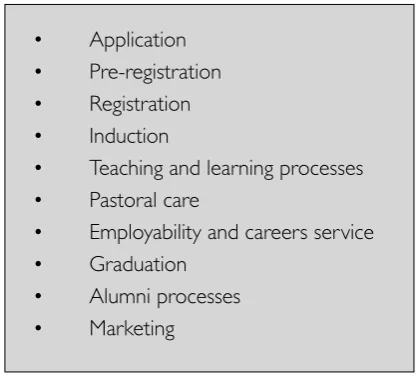
• Application • Pre-registration • Registration • Induction
• Teaching and learning processes • Pastoral care
• Employability and careers service • Graduation
• Alumni processes • Marketing
Figure 1: Example of a Student Lifecycle (Chambers and Paull, 2008)
effectiveness of [institutions’] administrative processes and relationships [will contribute] to adding business value and delivering success” (Chambers and Paull, 2008).
This paper describes how service design techniques have been used to improve the student experience at several stages of the student lifecycle (specifically pre-enrolment, enrolment and induction). It should be considered as an early announcement of some of the research conducted by several of the projects on the JISC Relationship Management Programme (July 2009 to April 2010). The Programme consisted of two strands across HE and Further Education (FE) institutions: one focused on Business Community Engagement Customer Relationship Management (BCE CRM) and the other focused on SLRM. Whilst there are
some elements of overlap between the two strands, this paper concentrates solely on the projects in the SLRM strand. Further information on the Programme is available from http://www.jisc.ac.uk/whatwedo/ programmes/bce/relationshipmanagement.aspx and a full report will be published in late 2010.
2. Background
A student will come into contact with many different ICT systems during their journey through the student lifecycle – from integrated institutional software systems, such as Management Information Systems (MIS), portals, and Virtual Learning Environments (VLEs), to web-based applications, such as webmail and online registration. By identifying the interface points with these different systems and reviewing the operational processes from a student perspective, it is possible to make improvements that will benefit both the student and the institution (JISC, 2009).
2.1 The student lifecycle
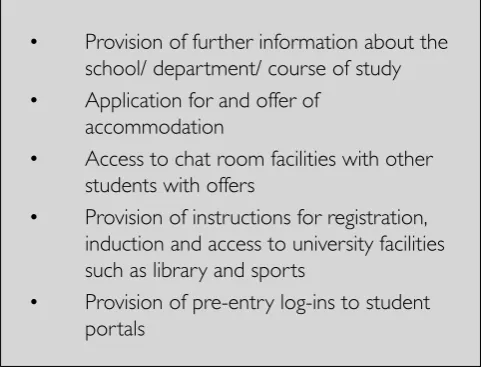
• Provision of further information about the school/ department/ course of study • Application for and offer of
accommodation
• Access to chat room facilities with other students with offers
• Provision of instructions for registration, induction and access to university facilities such as library and sports
• Provision of pre-entry log-ins to student portals
Figure 2. Pre-registration stage broken into further sub-stages (Chambers and Paull, 2008)
These stages can be broken down even further. For example, Chambers and Paull (2008) have split the “Pre-registration” stage into further sub-stages (see Figure 2).
Using the student lifecycle as a framework may help to identify where small changes can be made at specific sub-stages. Focussing on smaller aspects of the student lifecycle ensures that an institution can be more agile in making further changes. Over time, this may have a positive, cumulative effect on the experience of both the institution and the student.
2.2 Student Lifecycle Relationship Management (SLRM)
SLRM can help improve the quality of services provided to students as well as increase the efficiency of university processes and systems. Chambers and Paull (2008) describe SLRM as: “...the development of strategies, policies, and use of ICT, to support institutions, establish, build and manage relationships with students through a range or interactions and engagements they have with them across the lifecycle of their involvement with them...”
Some aspects of SLRM have been in existence for many years, such as policies and strategies around the application, pre-enrolment and alumni relationship stages of the student lifecycle. However, the focus has mainly been on developing policies and procedures to improve the institution’s administrative processes, rather than on understanding the student perspective. There is nothing wrong with this emphasis, as efficient university processes will also benefit the student. Nevertheless, making further improvements as a result of understanding the student viewpoint can have a positive impact on the institution and may even provide a competitive edge.
3. Method
The research being undertaken by the projects in the JISC Relationship Management Programme is now complete and qualitative data is in the process of being drawn out from the project case studies and reports.
to the processes and tested via small-scale pilots designed to assess the impact of the changes made. The final stage is to obtain further feedback and make any further adjustments.
It is expected that by taking this iterative approach of gathering data, implementing change, assessing the impact, and making the necessary adjustments, both the student and the institution will benefit from an improved experience. Such small-scale agile implementations can be revisited on a regular basis and may result in the institution being able to respond more rapidly to challenges in the future.
3.1 Service design
There is little information on the use of service design methods to improve processes in education, despite some universities running modules on service design. It is also difficult to find a de facto definition of service design that is relevant to the education sector. The Copenhagen Institute of Interactive Design (2008) defines service design as: “...an emerging field focused on the creation of well thought through experiences using a combination of intangible and tangible mediums. It provides numerous benefits to the end user experience when applied to sectors such as retail, banking, transportation, and healthcare. Service design as a practice generally results in the design of systems and processes aimed at providing a holistic service to the user. This cross-disciplinary practice combines numerous skills in design, management and process engineering”.
Service design is a relatively new discipline, so it is not surprising that “many senior managers involved in the service sector are still unaware of the benefits that design can bring to their offerings and, as a result, many organisations are operating at a sub-optimum level” (Hollins, 2009). This statement could also be applied to the HE sector. Hollins (2009) also cites the example of the UK eUniversities Worldwide Limited (UKeU), which failed because customer requirements were not understood. He quotes from the Select Committee on Education and Skills (UK House of Commons, 2005), which concluded: “there was no formal market research undertaken to assess either the level of demand, the nature of the demand or [critically] the type of e-learning required. There was no systematic evaluation of the markets... and no understanding of consumer demand”. Would service design have saved the UKeU? Of course, it is impossible to say, but it may have helped to mitigate some of the risks.
So pragmatically, how can service design be applied in the education sector? The first step is to focus on a specific process in the student lifecycle, for example, the way in which online enrolment is handled for distance learning students. It is important to remember that one process may consist of several inter-dependent sub-processes and that changes made to one aspect may affect others. It is also necessary to conduct research into both the student and staff expectations and experience of a particular process, in order to gain a balanced view.
Various techniques can be used, including surveys, video or written diaries, focus groups or interviews, and even ‘mystery shoppers’. For example, a couple of the SLRM projects asked small numbers of students (typically two or three) to act as ‘mystery shoppers’ and describe their experience as they went through the enrolment process. Several of the projects also began by identifying and talking to those students who had had a negative experience, working on the premise that, according to Bill Gates, “your most unhappy customers are your greatest source of learning”.
It is not sufficient to simply change a process and then walk away, because ‘fail points’ may have been transferred from one place to another. It is also vital to assess whether the changes have actually improved the process or made it worse. This can be achieved by running a pilot, obtaining further feedback from students and staff alike and iterating through the cycle until the major difficulties have been ironed out. However, process improvement does not end there. Change is a certainty and, over time, there may be other challenges that will have an impact on a particular process. For example, there may be a change to the software used to handle online registration or students may expect to use a personal rather than institutional e-mail address. Therefore, the design and appropriateness of a process must be tested on a regular basis.
For the education sector, the service design methodology approach means that students are the core focus and that process (or service) improvement should be in response to their needs and expectations. (As a caveat, it should be noted that there may be occasional conflicts of interest between staff (or institutional) and student needs and expectations, which would then require further investigation).
3.2 The student voice
It may be considered inadvisable for an institution to assume that it knows what students want, particularly as student expectations change and universities have to evolve in order to respond to the various challenges they face. Nor is it sufficient to explore process improvement from an institution only perspective, because as most of these projects have shown, staff members do not always know what students want or expect.
Placing the student at the heart of the process and finding out about their experience and expectations may produce some surprising results. For example, one of the projects asked students how they felt about the buildings on campus. The university concerned believed that the peeling paint in some of its buildings gave it an air of ‘shabby chic’. However, the students surveyed saw the peeling paint as a sign of neglect. Although this may be considered a minor detail, first impressions count and may affect the number of students who decide to take courses there.
4. Examples of interventions to improve the student experience
This section gives examples of the technological interventions made by piloting small-scale changes to targeted processes in the student lifecycle by some of the JISC SLRM projects.
4.1 Take advantage of existing skills and technologies
Many students, before they even apply to university, are experienced in ICT - from mobile ‘phones to e-mail – but there are also students who are not familiar with these technologies. When students start a university course, there is a large amount of information to absorb, from coping with a new environment to understanding what is required, and studying course materials. Additionally, they are often expected to quickly master e-learning technologies, such as VLEs. Those students, who struggle to effectively manage all these demands, may lose interest and leave their course.
But what if it were possible to reduce this risk? One approach is to help prospective students become familiar with university systems at the pre-registration stage of the student lifecycle, i.e. before they enrol on a course. As well as reducing any stress associated with acquiring the necessary technical skills in the early months of study, it may also encourage students to feel part of the institution at an early stage. Conversion rates from applicant to student may improve, as well as student retention.
million (TechCrunch, 2009)) may be more popular. Selecting a social networking site that is popular in the UK may disadvantage international students. However, one alternative, which has been considered by the Goldsmiths’ project team, is to use the chat functionality of their VLE. As well as helping prospective students become familiar with the learning technologies they will encounter when they start their course, it may also ease the transition from school (or work) to HE. Such an approach can be considered a low-cost means to encourage students to engage with the institution at the pre-registration stage.
Swansea University has taken a more unusual approach to understanding the student’s experience of the pre-enrolment stage of the student lifecycle. The project team has been assessing how students ‘feel’ about the transition from home to the University and during the enrolment process. Focusing on the emotional aspects, such as stress or anxiety, can help to identify potential ‘fail points’ in the process and identify areas where improvements can be made. The project team obtained feedback from surveys and focus groups and from work being done by an MA student regarding the use of social networking sites by students at the pre-registration stage (Swansea University, 2010). Prospective students already use such sites to make friends, organise events and ask questions of their peers, rather than going through more formal channels. As a result of the project at Swansea University, students unable to obtain university accommodation were encouraged to use Facebook to make contact with each other and set up house-hunting groups (personal conversation with Swansea University Project Team, 2009).
4.2 Ensure all students have access to support, advice and guidance
The diversification of the student base means that the universities must cater for those who do not fall into the category of ‘traditional on-campus student’. Students can be work-based, lifelong (or part-time) or distance learners and they all need access to the support and orientation information offered to full-time on-campus students during the induction stage of the student lifecycle. They may also require additional support and expect to be able to choose the format in which they receive such information.
Distance learners, by their very nature, may feel isolated and may find it harder to develop relationships with their peers or staff. The University of East London has run several pilots to test improvements being made at the induction and orientation stages of the student lifecycle. In order to ensure parity of experience between distance and on-campus students, the University has been running a pilot to inform distance learners of the support and guidance that is available to them from Student Services, such as careers, disability, and health. On-campus students can be made aware of these services via notice boards, personal conversations, and access to support staff. For distance learners, much of this awareness raising must be done virtually, so automated welcome e-mails containing important information, such as web-links to support service information, are now being sent to recently enrolled distance learners. Various web statistics are being monitored to test the success of this approach (results not available at time of writing). However, one of the unforeseen benefits has been improvements to the institution’s administrative process (University of East London, 2010).
4.3 Improve the ‘servicescape’
On-campus students can spend plenty of time queuing during the registration or enrolment stage of the student lifecycle. This may be unavoidable to some extent, although efforts can be made to ameliorate the process. However, students at Kingston College did not consider queuing too onerous (personal conversation with the Kingston College Project Team, 2009), perhaps because it gives them a chance to meet other students on the same course and interact socially.
If a particular aspect of the process cannot be improved, then it may be possible to make improvements to the environment (or ‘servicescape’) in which it takes place. The University of Derby has been examining the environments in which enrolment takes place. One of these sites is simply a corridor. Whilst queuing may be unavoidable, efforts can be made to enhance the student experience and to benefit from a captive audience. Again, borrowing from solutions used in the service sector, Derby is considering installing plasma screens in this area to provide information on the University (in a similar way to the small advertising and information screens in banks and post offices). This may benefit both the student, who receives useful information and the institution, which is able to disseminate important information in an engaging way (personal conversation with the University of Derby Project Team, 2009).
5. Evaluation
The SLRM projects in the JISC Relationship Management Programme have focussed on making small-scale changes that may have a big impact on the student experience. They have concentrated on small aspects of the student lifecycle to identify areas for improvement and applied service design techniques to home in on the actual issues. Running such small pilots that implement SLRM techniques can help to meet changing expectations, enhance the student experience and may lead to improved retention, grades and cost-effectiveness. Is it possible successfully to use commercial sector techniques and solutions in the education sector? At this stage, it is too early to tell. However, the University of Derby has found that the “blueprint has been widely recognised as a valuable tool to plot out a highly complex student experience and business process and combine this with a clear focus for enhancement effort through identifying fail and wait points”. They also found that “interest in the application of service design and enhancement techniques grew exponentially at Derby as the project developed” (University of Derby, 2010).
Some of the improvements being piloted by the projects described in the preceding section have involved the use of technology outside of the institution’s control and this raises issues around the social ownership of technology. Do students want to receive SMS messages from their institution or do they consider this an unsolicited intrusion? Is the use or monitoring of social networking sites by universities in order to improve the student experience considered to be an imposition on the student’s digital world? (Whilst these issues are of interest, they are outside the scope of this paper).
All of the interventions mentioned above involve ICT in its broadest sense. In other words, technology is being used to improve the communication of information to students. Chambers and Paull (2008) state that the “key drivers of change in student relationship management are the changing expectations of students of their higher education experience, and the way in which they communicate with an institution”. This puts the emphasis on the way in which the student communicates with the institution, but perhaps it is the way in which the institution communicates with the student that is key.
6. Conclusion
shaping the courses universities provide and in encouraging universities to adapt and improve their service.” It also states that by being more flexible and responsive to the needs of students, the sector can “respond to the changing modes and models of higher education provision” (UK Department for Business Innovation and Skills, 2009).
Using service design techniques in conjunction with the student lifecycle to improve the student experience is very much in its infancy. It also raises many questions around the commodification of education (and ensuring that the views of staff and other stakeholders are also included), a more balanced and effective outcome may be achieved. This paper has already described examples of conflict between staff perceptions and student perceptions, but by exploring these issues further, it is possible to find solutions that benefit both parties.
The SLRM approach may help institutions be more flexible, efficient and effective, and so improve the overall quality of the student experience. Therefore, “applying the principles of Service Design [amongst other techniques] may be an effective way to examine how to improve the student experience and advance the efficiency of the related administrative processes at the same time” (JISC, 2009). Perhaps the key is simply to understand student expectations and provide agile solutions that can easily be updated to meet future challenges.
7. References
Baranova, P. 2009. Presentation on blueprinting and other techniques.http://wiki.cetis.ac.uk/images/8/8f/JISC_session_1_Services_Design_
Techniques.ppt (accessed February 11, 2010).
Chambers, D., and Paull, A. 2008. JISC landscape study of student lifecycle relationship management. JISC. http://alanpaull.co.uk/srm/
ProjectDocs/Landscape%20Study%20of%20Student%20Relationship%20Management%20report.pdf (accessed February 25, 2010).
Copenhagen Institute of Interactive Design: Service design symposium, 6-7 March 2008. http://www.ciid.dk/symposium/sds/ (accessed February 11, 2010).
Facebook. Blog Post: Six Years of Making Connections, 4th February 2010. http://blog.facebook.com/blog.php?post=287542162130 (accessed May 19, 2010).
Goldsmiths, University of London. 2010. GoSLuRP Draft Case Study (the final version of this report will be publicly available in late 2010).
Hollins, B. 2009. What is service design?http://www.designcouncil.org.uk/About-Design/Design-Disciplines/Service-design-by-Bill-Hollins/ (accessed February 24, 2010).
JISC. 2009. Grant funding 05/09: Relationship management - Business and community engagement: Customer relationship management. JISC organisational support: Student lifecycle relationship management. Call for pilot projects. http://www.jisc.ac.uk/media/documents/funding/
2009/03/0509%20bce%20crm%20-%20slrm%20call%20.doc (accessed February 11, 2010).
Swansea University. 2010. EITM Draft Case Study (the final version of this report will be publicly available in late 2010).
TechCrunch. Chinese Social Networks ‘Virtually’ Out-Earn Facebook And MySpace: A Market Analysis. 5th April 2009.
http://techcrunch.com/2009/04/05/chinese-social-networks-virtually-out-earn-facebook-and-myspace-a-market-analysis/ (accessed May 19, 2010).
The Economic Times. Google unveils new look for Orkut. 30 October 2009.
http://economictimes.indiatimes.com/Google-unveils-new-look-for-Orkut/articleshow/5181314.cms (accessed May 18, 2010).
United Kingdom Department for Business Innovation and Skills. 2009. Higher ambitions: The future of universities in a knowledge economy.http://www.bis.gov.uk/policies/higher-ambitions (accessed January 26, 2010).
United Kingdom House of Commons. 2005. Select Committee on Skills and Education Third Report. Why the UKeU failed. http://
www.publications.parliament.uk/pa/cm200405/cmselect/cmeduski/205/20506.htm (accessed February 25, 2010).
University of Derby. 2010. DERBI – Development and Enhancement Review of Business Interfaces: Final Report (this report will be publicly available in late 2010).