and Teaching English Vol. 1, No. 3, (2013), 59-75
Investigating Developmental Stages of
Acquisition of Phonological Structures Among
EFL Students of Eastern Mediterranean
University: A Case Study
Seyyed Abdollah Razavi
Islamic Azad University, Bandar Abbas Branch [email protected]
Mohammad Naghavi∗
Islamic Azad University, Bandar Abbas Branch [email protected]
Anna Hajizade
Islamic Azad University, Bandar Abbas Branch
Abstract.Doing a piece of research on acquisition of second language phonetics theoretically will justify the exact stages of language trans-fer and further predicts the existence of systematicity and difficulty order (Eckman, 2008). The present research is an attempt to provide new evidence for the efficacy of second language acquisition to devel-opmental stages of acquisition of phonological structures among EFL students of Eastern Mediterranean University. Accordingly, three Ira-nian EFL learners, including two males and a female studying at East-ern Mediterranean University are purposefully selected on the basis of their performance in the interview. In continuation, interviews were con-ducted three times within a range of four months with the interval of at least one month. Each interview was sound-recorded and lasted from 15 to 30 minutes. Next the pools were transcribed according to the latest conventions. Further, to ensure the ethical aspects of the research, the participants were informed about the fact that their interviews were be-ing sound recorded. At the end, it was concluded that it is not possible Received: August 2013; Accepted: October 2013
∗
Corresponding author
to monitor the developmental processes in the acquisition of phonolog-ical structures in a time span of four months and that determining a time scale for the acquisition stage was not possible.
Keywords: Phonological structures, developmental processes, second language acquisition
1. Introduction
Concerns have been made over how to evaluate the amount of countless variables in the process of second language acquisition. At the turn of the century, no viable scope of SLA is available despite the decades of research and relevant findings (Gas & Selinker, 2001). Traditional and current trends of the study both highlight the role of first language in the acquisition of second language among which theories of contrastive analysis error analysis (Corder, 1973) and language transfer are the most prominent ones.
Considering the different types of variations among learners and those existing in psychological Gardener (2007) and social status (Giles & Smith, 1979) of the learning environment, we can imagine how compli-cated the process might be. Therefore, any sort of research in the field has to be narrowed to an applicable research question. The following figure depicts the complexity of studying language learning processes.
Figure 1. First and second language acquisition in adults and children
One possible way to gain more understanding on how second lan-guage is acquired is to monitor their micro and macro linguistics devel-opmental processes, hence, learner language. Apparently, before grasp-ing command of second language, the learner goes through more peri-ods than predicted which are beyond target and native language (Ellis,
�� ������� ��� ������������� ��������� �� ��� ����������� �� ��������� ���� ���������� �� � ���� ���� �� ���� ������ ��� ���� ����������� � ���� ����� ��� ��� ����������� ����� ��� ��� ���������
��������� ������������ ����������� ������������� ���������� ������ �������� �����������
�� ������������
�������� ���� ���� ���� ���� ��� �� �������� ��� ������ �� ��������� ��������� �� ��� ������� �� ������ �������� ������������ �� ��� ���� �� ��� �������� �� ������ ����� �� ��� �� ��������� ������� ��� ������� �� �������� ��� �������� ������� ���� � ��������� ������ ����������� ��� ������� ������ �� ��� ����� ���� ��������� ��� ���� �� ���� �������� �� ��� ����������� �� ������ �������� ����� ����� �������� �� ����������� �������� ����� �������� �������� ����� ��� �������� �������� ��� ��� ���� ��������� �����
����������� ��� �������� ����� �� ���������� ����� �������� ��� ����� �������� �� ������������� �������� ������ ��� ������ ������ ������ � ������ ����� �� ��� �������� ������������ �� ��� ������� ��� ������� ����� ��� ������� ����� ��� ���������� ��� ���� �� �������� �� ��� ���� ��� �� �� �������� �� �� ���������� �������� ��������� ��� ��������� ����� ������� ��� ���������� �� �������� �������� �������� ����������
������ �� ����� ��� ������ �������� ����������� �� ������ ��� ��������
��� �������� ��� �� ���� ���� ������������� �� ��� ������ �������� �� �������� �� �� ������� ����� ����� ��� ����� ����������� ������������� ���������� ������ ������� ��������� ����������� ������ �������� ���� ���� �� ������ ��������� ��� ������� ���� ������� ���� ������� ����
�
������������� ��� ���� �������� ���� ����������� ���� �������� ������ ���� ����������� ���� ����� �� ���������������������������������������������������������������������������� �������������������� ���������������������������������������������������� ����������
����������������������������������������������������������������������
���� ��������� ���� ��� ����� ����� �������������� ��� ���� ������� ��������� ��� ��������� ��� �� ������� ����� ������ ���� ������ ����������� �������������� ���������� ������ �������� ��������� ����������� ������� ��������� �������� ��� ������� ��������� ���� ������� ����� �������� ���� �������� ����� ��������� ����� ��� ������� ������� ���� ������� ��������� �������� ���������� ������ �� ����������������������� ��������� ������������������� ����������������������������������������� ������� ��������� ������� ��������������� ���� ��������������� ����������� ������ ��������� ������ ��� ������ ������������������������������ ���������������������� �������������������������������������� ���������� �������������������������������������������������� ������������������������� ������������ ��������������
��������� ����� ��������� �������������� ������ ��� �������� ������ ����������� ���� �������������� ���������� ���� ��� ���� �������� ������ ���� ��� ����� ���� ������������� ���������� ��� ������� �������� ������������ ��� ������ ��������� ��� �������������� ��������� �� ��������� �������� ��� ��� ������� ��� ��������� ����������� �������������������������������� �������������������������������������������� ������ ��� �������� ������ ������� ���� ���� �������������� ��� ���� ������ �������������� ������� ������� ���� ��������� �������� ��� ������ ����� ���� ����� ������ ������ ���� ����� ��� ��������� ����������������������������������������������
������ ��� ����������� ��������� ���� ��������� ������� �������� ��� ������� ���������� ��� ������������������������������ ������������������� ����������������������������������������������� ��� �� ������������� ������ ��� �� ������ ��� ������������� ��� ������ ������ ������������ ��� �������� ������������������
������������� ���������
���� �������� ��������� ����� ��� ������� �� ������� ��� ���� �������������� ���������� ��� ������������� ����������������������������������������������������������������������������������������������� ������������������������������������������ ����������������������� ���������������������
1987). The study of errors made by learners described two possible stages through which learners move from first to second language called inter-language and intra-inter-language (Gas & Selinker, 2001). Studying these two phases clarify the fact that learners transfer or “carryover of learned behavior from one situation to another their learning is facilitated by positive evidence and interfered or blocked by negative” (Brown, 2004). Evidence from studying interlanguage could be studied under sys-tematic and non-syssys-tematic transfer. One of the initial steps was to deal with phonological processes in second language acquisition by do-ing research on interlanguage produced. A relevant question is to locate the learners’ acquisition of phonetic features by scanning their oral per-formance. Data elicited from a study by Schmidt (1977) showed how the pronunciation of /θ/ sound distinguishes between formal and infor-mal context in which they are used, which proves the role of pragmatic knowledge parallel with linguistic competence.
Based on linguistic evidence, the distance between English and Per-sian lengthens the acquisition of second language phonetic structures due to L1 role. A rather relevant inquiry is to do a longitudinal study on a group of participants to screen their development in grasping phonetic features.
2. Purpose of the Study
The present research aims at giving a report on the developmental pro-cesses of interlanguage data gathered from three Iranian EFL learners at Eastern Mediterranean University. Accordingly, the following research questions are posed to fulfill the purposes of the current study:
1) How do Iranian EFL learners develop the acquisition of beginning and ending consonant clusters in their interlanguage?
2) How do Iranian EFL learners develop the acquisition of/θ/and /w/sound? 3) How do interlanguage processes in the speech of three Iranian EFL learners differ from expected SLA processes?
3. Review of the Related Literature
Although the field of second language acquisition has largely advanced over the last few decades, the area of second language phonology has not been the focus of many studies, evolving from studies that investigated first language impact as a key description for L2 phonology to research that has revolved to universal principles driven by Universal Grammar. The origins of the second language phonology studies can be traced to the contrastive analysis hypothesis posed by Lado (1957), which as-sumed that comparing the first language and the second language of a particular language user will enable the prediction of difficulties that will be encountered in the acquisition of the L2. In fact, all phonemes in second language will not be recognized properly if a certain phonemic difference does not exist in the first language.
What follows is an inclusive account of key theoretical frameworks entailed by major controversies regarding interlanguage phonetics, its development, and current studies.
3.1 Interlanguage transfer
The success of second language learner in producing correct sounds de-pends on their ability to separate their L2 utterance from their repertoire of L1 phonemes and allophones. This separation is crucial because two languages may contain sounds which seem to be the same but are pro-duced by differing articulatory motions. They are therefore acoustically different and may be perceived to be divergent from the target by the listener.
It is a common remark that the more successful producers of near-native sounding pronunciation are rare, gifted or talented. Their suc-cess could be more reasonably attributed to their ability to disassociate phonological aspects of the L1 and L2 and thus minimize the transfer of phonological features from one language to the other.
Therefore, it can be assumed that bearing a resemblance to sounds found in the L1 seems to be a much simpler task. Additionally, fossilized errors, which are related to the negative transfer of first language to second language, may more easily be unlearnt when they are of the foreign rather than the familiar variety. For example, English/ /is totally foreign to Iranians often approximated by /z/.
3.2 Phonological universals
Phonological Universals are referred to as phonological forms which are common to all known languages. In English, for example, /s/is unmarked and/θ/is marked. Another notion, implicational universals, is that the
presence of a marked segment/θ/in a language implies the presence of
an unmarked segment /s/, but the reverse is not true.
Many studies have been undertaken to determine the degree of dif-ficulty in the acquisition of the various elements of L2 phonology based on markedness theory of universals. In all languages, there seems to be a universal preference for the open CV syllable. In a study that was con-ducted by Kozhevnikov and Chistovich (1965), it was revealed that in a stressful situation, speakers tended to revert to very simple CV patterns of pronunciation in their own native language. The languages involving distant contrasting sound systems might provide less successful oppor-tunities to produce an acceptable phonetic target in second language.
Regarding syllabus patterns and the length of vowels, the influence of preceding and following constants depend meaningfully on vowel dura-tion. English language has extremely exaggerated pre-consonantal vowel duration when proceeding voiced consonants (Carey, 2009).
3.2.1 Production and perception of non-native sequences
3.2.2 Errors in the production of non-native sequences (re-pairs)
The awareness that is created by means of producing non-native se-quences has proved to be effective since L2 speakers eventually tried to repair their deviant speech. As a result, several studies have shifted towards the nature of repairs (e.g. deletion, epenthesis, and segment change). Tarone (1983) reports that when non-native speakers produce a consonant cluster, they insert a vowel between the two consonants. Tarone (1983) has claimed that:
“The simple open syllable may be a universal articulatory and per-ceptual unit; that is, the articulators tend to operate in basic CV pro-grams in all languages, and the various languages simply elaborate upon this program by adding various combinations of initial and final conso-nants.”
As such, it could be hypothesized that in interlanguage transfer, first languages with a greater tendency towards open syllables will have a greater degree of difficulty in assimilating the syllable structure of En-glish. Persian has a greater tendency to stay away from open syllable structure than English. Consequently, the syllable structure of English is highly problematic for Iranian second language learners.
3.3 Research in interlanguage phonology
Among a host of unresolved controversies, we might only characterize interlanguage phonology by the process of transfer. Clearly, discussing transfer gets to be a little complicated when introducing the notion of markedness (Eckman, 2008) because of the similarity between SLA research and pidgin and creole studies.
contributing to the linear syllable structure. Furthermore, the lack of ex-planatory power is the theme of the third argument against typological categorization of interlanguage phonology research.
Another challenge that interlanguage phonology faces is the phonetic representation non-native speakers. The fact that the learners pose a single phonological representation of their first language and use new information to build on their L1 is still open to debate.
Apart from theoretical disputes, an urgent need is felt in the field for an incoming intervention at pedagogical level. To this end, Jenkins (1996) delineates pronunciation modification priorities that could help repair the errors which hinder communication.
3.3.1 Significant errors: current views
Apart from theoretical disputes, an urgent need is felt in the field for an incoming intervention at pedagogical level to assist learners to over-come the issue of intelligibility. To this end, Jenkins (1996) delineates pronunciation modification priorities adapted from Jenner’s (1989) list of priorities that could help learners repair the errors which hinder com-munication. Certainly, such modifications are based on native model that could be of great benefit to those learners who return home after studying abroad. Nine aspects were listed as follows:
a) Vowel quantity
Contrary to the common belief that the length of extra-long vowels vary from one NS to another, Jenkins (1996) maintains that the length con-trast of vowels is the source of negative transfer leading to intelligibility problems.
b) Diphthongs
Research in the systems reveals the fact that NSs change the length of diphthongs without damaging the intelligibility while further investiga-tions might shed more light on the issue.
c) Consonant conflations
Bearing in mind the fact that consonant variation can be more problem-atic than vowels (Gimson & Cruttenden, 1994), Jenkins (1996) comes up with an exception, substituting /θ/and/ /. She believes that the above
mentioned consonants do not significantly impede intelligibility.
������� ��� ��������� ����� ����� ���� ��� ���� �������� ������� ����� ���� ��������� ��������� ���� ��������� �������� ���� ��� �������� �������������������������� ����������������������
d) Phonetic realizations
The majority of researchers on interlanguage phonology have a consensus on the fact that most NNSs transfer their phonetic realizations into L2 with no interference with intelligibility. They are mostly attributed to the characteristics of foreign accents.
e) Consonant cluster simplification
One of the most crucial negatively transferable phonetic features in L2 learning situations is the particular prevalence of open (CV) syl-lables. Learners’ strategy in production then is simply adding a vowel in between (epenthesis) or omission (consonant deletion). Jenkins (1996) believes that “where learners use the strategy of epenthesis, intelligi-bility is rarely effected, since listeners are able to recover the original form”.
f ) Word stress
Being the reason for a majority of intelligibility issues between NS and NNS speakers, word stress seems to be more problematic for NS than NNS. As long as no pedagogical intervention is not in progress, we might be expecting such hindrance in communication most often.
g) Prominence and weak forms
Since NNS are not capable of recognizing reduced syllables, they might try to use reduction techniques based on their own experience leading to miscommunication on both sides. Thus, any modifications to assist learners to “attune their ears” to the weak forms can be of benefit (Carey, 2009).
h) Tone groups
Due to the marked contrast between English and other languages in terms of division in the stream of speech, the NNS listeners lag behind resulting in miscommunications and outing pauses in the wrong places.
i) Nuclear/contrastive stress but not tone
3.4 Current perspectives and controversies
Making generalizations on the acquisition of the phonological processes is a source of many problematic issues. Osborne (2010) conducted a study to discover the acquisition process of rhetoric sounds among Brazilian students using Markedness Differential Hypothesis and the Structural Conformity Hypothesis. He found out that the MDH cannot encompass all the complexities found in the participants’ interlanguage phonological processes. The SCH also appears to fail to provide an explanation of the participants’ interlanguage processes, since generalizations found in chil-dren’s acquisition of the retroflex diverge from the processes identified in the participants’ interlanguage.
In another effort to correspond SLA processes with the stages of phonological development in Creole languages, Plag (2008) proved that there are traceable phases in inter language development in case of the encounter between native speakers and the users of Creole language. Moreover, the results indicated that inter language is a phenomenon which does not lend itself to much SLA research explanation.
It is also worth mentioning that performing qualitative experiments has been recently the subject of focus of many studies since frequency measurements of progressively gathered data are narrowed to numerical judgments (Eckman, 2011).
4. Methodology
4.1 Participants
Three Iranian EFL learners including two males and a female studying at Eastern Mediterranean University were purposefully selected. They were from fairly similar ages ranging from 21-25 and had almost the same English proficiency level background in terms of scoring. They attended preparatory school English courses while being interviewed for three pools of interlanguage studies. During this period of time, they did not receive any extracurricular English training.
4.2 Data collection procedures
interlan-guage, quantitative trend of the study was used. However, the proce-dures were only limited to describing and monitoring the phonological acquisition process.
Participants were interviewed three times within a range of four months with the interval of at least one month. Fifteen to 30 minute interviews were sound-recorded. Next, the pools were transcribed ac-cording to the latest conventions. To ensure the ethical aspects of the research, participants were informed about the fact that their interviews were being sound recorded. Finally, following the meticulous analysis of the interlanguage data, attempts were made to locate developmental phonological stages of the subjects’ progress each presented in separate tables.
5. Results and Discussions Participant A
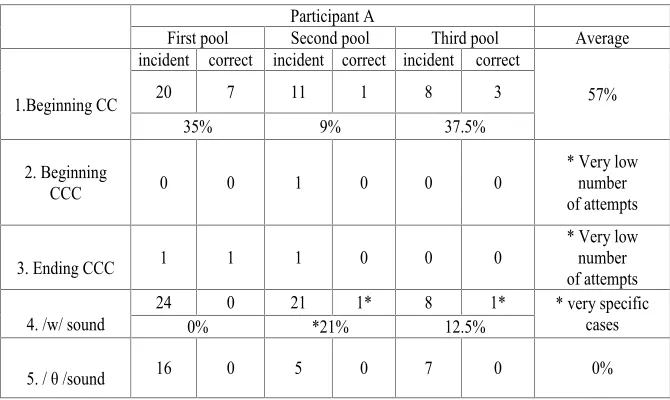
Participant A took part in research with a lot of enthusiasm. In three intervals of time, we managed to extract the interlanguage data. The developmental stages of his progress are shown in Table 1.
Table 1: Phonological development in participant A interlanguage data
����� ���� ���� ������� �� ���������� ��� ���������� ��� ������������ ����������� ��������
������������ ���� ����������� ����� ����� ������ � ����� �� ���� ������ ���� ��� �������� �� �� ����� ��� ������ ������� �� �� ������ ���������� ���� ��������������� ����� ��� ����� ���� ����������� ��� ������� �� ��� ������ ������������ �� ������ ��� ������� ������� �� ��� ��������� ������������ ���� �������� ����� ��� ���� ���� ����� ���������� ���� ����� ����� ��������� �������� ��������� ��� ���������� �������� �� ��� ������������� ����� �������� ���� ���� �� ������ ������������� ������������ ������ �� ��� ��������� �������� ���� ��������� �� �������� �������
�� ������� ��� ����������� ����������� �
����������� � ���� ���� �� �������� ���� � ��� �� ����������� �� ����� ��������� �� ����� �� ������� �� ������� ��� ������������� ����� ��� ������������� ������ �� ��� �������� ��� ����� �� ����� ��
����� �� ������������ ����������� �� ����������� � ������������� ����
�
������������ ������ �������� �������� ������ ������ ������������ ���� ����� ������ ��� ������������� ������������������������������������������������������������� ��������������� ������� ��������� ������������������������������
������������ ������� ��� ����� �������� ���� ������������ �� �������� ���� �������� ������� �� ������������� ���������������������������������������������������������������� �� ��������� ��������� �������� ���� ����������� ����� ����� �������� �� ����������� ���� ����������� ���� ������������ ��������������������
����������������������������������������������������������������������������������������������� ������ ���� ������ �������� ��� �� ������� ����������� ���� ���������������� ����� ���� ������ ���� ������������ ���������� ��� ���� ������� ������������ ��� ������� ���� �������� �������� ��� ��� �������� ������������ ����� ��������� ������ ���� ����� ����� ������ ���������� ����� ������ ������ ��������� ��������� ���������� ���� ����������� ��������� ��� ���� �������������� ������ ��������� ����� ����� �� ������� �������������� ������������� ������� ��� ��� ��������� ��������� ����� ���������� ��� �������� �������
�� ����������������������� � ����������� �
������������ �� ����� ����� ��� ��������� ����� �� ���� ��� ������������ � ��� ������ ���������� ��� ������ �� ����������������������������������������������������������������������������������� ��� ����� �� ��������
��������������������������������������������������������������������� �������������
���������� ����������� ���������� �������
��������������
�������� ������� �������� ������� �������� �������
���
�� � �� � � �
��� �� �����
������������
��� � � � � � �
���������� ������ �����������
��������� ��� � � � � � �
���������� ������ �����������
������������
�� � �� �� � �� ���������������
�����
�� ���� �����
Participants C was a very curious case of those learners who had achieved acceptable levels of proficiency but had not acquired differential for pho-netic variations between two languages. A close look at her performance reveals some interesting points. First, as a very prominent feature, she could self-correct herself during a conversation. In other words, she could be grammatically and phonologically upgraded by listening to herself meaning that she had achieved post-systematic stage of second lan-guage acquisition in which the learner and judges the grammaticality of a structure by a discriminating it.
Another interesting point about participant C was her fluctuations in pronouncing and mispronouncing beginning consonant clusters which half of the time she was right and half of the time she was not. It re-mained a question whether this is a sign of her progress towards achiev-ing newer stages or not.
6. Summary, Conclusion and Suggestions for Further Studies
The purpose of the study was to create a report on the developmental processes in the acquisition of phonological structures by three Iranian EFL learners at EMU. Four research questions were generated to explain developmental stages in SLA phonological acquisition and comparison with first language acquisition processes and describe the phases in ac-quiring /θ/ and /w/ sound.
Participants displayed various performances mainly because of their difference in proficiency levels which could be describe best in terms of Corder (1976) U-shaped learning. Participant A was and remained in systematic stage where he didn’t use a lot of chunks and pre-fabricated structures. For him this meant a lot of adventures and new troubles.
Participant B proved to be higher in terms of proficiency, but system-atic in making errors. He potentially achieved the emergent stage. No self-correction, which was a sign of his uncertainty about the phonology, was noticed. In numerous occasions, the role of L1 was noticed but the volume was not clear.
stage of second language acquisition where she self-corrected herself more frequently. There were even cases of re-structuring in which she learned how to pronounce a word she used to mispronounce and abandoned using the old form.
The result of the study showed that it is not possible to monitor the developmental processes in the acquisition of phonological structures in a time span of four month and determining a time scale for the acquisition stage was not possible.
It was made clear that there is a big difference between using acquired structures or learned ones. During the research, participants showed a higher degree of phonological accuracy while they were producing the learned structures. It seems that spontaneous production of new struc-tures lowers their accuracy.
It was also proved that acquiring phonological structures strictly follow models of Difficulty Hierarchy Access where no item from the bottom of the list were used while the participants were not aware of the items on top. Nonetheless, the limited time span of the study (three recorded extraction within four month) might not be enough to observe such shifts in language behavior.
Regarding the research questions, it has to be noted that no promi-nent shift in the acquisition of phonological structures was observed. As for the constant clusters including more than two consonants, partici-pants apparently used avoidance strategies is such a way that no case of their use was reported.
The results of the study could be applied in conducting further in-vestigations to clarify more on the issues of the phonological structure acquisition. Insightful evidence could be provided if the speech of partici-pants were analyzed in terms of syllabus reduction. Also, higher diversity in data elicitation processes could lead into new perspectives.
The authors:
Seyyed Abdullah Razaviis an assistant professor at the Islamic Azad University of Bandar Abbas, Iran. He graduated from Eastern Mediter-ranean University (EMU) in ELT in Cyprus. He has teaching experience of more than 10 years in different fields such as Linguistics, Sociolinguis-tics, Advanced Grammar, and Academic Writing. His research interests include Sociolinguistics, IELTS, and TOEFL studies.
Mohammad Naghaviis a TEFL instructor at the Islamic Azad Uni-versity of Bandar Abbas. He has taught various TEFL courses at BA level such as grammar, writing courses, and conversations. His research interests include Discourse Analysis and Conversation Analysis.
Anna Hajizadehholds an MA degree from EMU University in Cyprus. She has worked as an assistant of ELT department at the above-mentioned university. Her research interests include Discourse Analysis, GRE, and Curriculum Development.
References
[1] Careye, M. (2009). Interlanguage phonology sources of L2 pronuncia-tion “errors”. In R. Mannell F. Cox and J. Harrington. An introduction to phonetics and phonology. Macquarie University, 1-9.
[2] Carlisle, R. S. (1998). The effect of markedness on epenthesis in Spanish/ English interlanguage phonology.Issues and Developments in English and Applied Linguistics, 3,15-23.
[3] Corder, S. P. (1967). The significance of learner’s [sic] errors.International Review of Applied Linguistics, 5,161-170.
[4] Davidson, L. (2006). Phonology, phonetics, or frequency: Influences on the production of non-native sequences.Journal of Phonetics, 34(1), 104-137. Elsevier.
[5] Davidson, L., Jusczyk, P., & Smolensky, P. (2004). The initial and final states: Theoretical implications and experimental explorations of richness of the base. In R. Kager, W. Zonneveld, & J. Pater (Eds.),Constraints in phonological acquisition.Cambridge: Cambridge University Press. The authors:
Seyyed Abdullah Razaviis an assistant professor at the Islamic Azad University of Bandar Abbas, Iran. He graduated from Eastern Mediter-ranean University (EMU) in ELT in Cyprus. He has teaching experience of more than 10 years in different fields such as Linguistics, Sociolinguis-tics, Advanced Grammar, and Academic Writing. His research interests include Sociolinguistics, IELTS, and TOEFL studies.
Mohammad Naghaviis a TEFL instructor at the Islamic Azad
Uni-versity of Bandar Abbas. He has taught various TEFL courses at BA level such as grammar, writing courses, and conversations. His research interests include Discourse Analysis and Conversation Analysis.
Anna Hajizadehholds an MA degree from EMU University in Cyprus.
She has worked as an assistant of ELT department at the above-mentioned university. Her research interests include Discourse Analysis, GRE, and Curriculum Development.
References
[1] Careye, M. (2009). Interlanguage phonology sources of L2 pronuncia-tion “errors”. In R. Mannell F. Cox and J. Harrington. An introduction to phonetics and phonology. Macquarie University, 1-9.
[2] Carlisle, R. S. (1998). The effect of markedness on epenthesis in Spanish/ English interlanguage phonology.Issues and Developments in English and Applied Linguistics, 3,15-23.
[3] Corder, S. P. (1967). The significance of learner’s [sic] errors.International Review of Applied Linguistics, 5,161-170.
[4] Davidson, L. (2006). Phonology, phonetics, or frequency: Influences on the production of non-native sequences.Journal of Phonetics, 34(1), 104-137. Elsevier.
[6] Eckman, F. R. (2008). Typological markedness and second language phonology. In J. G. Hansen, Phonology and second language acquisition
(Eds.), pp. 95-116. Cambridge: Cambridge University Press.
[7] Eckman, F. R. (2011). Review article: Spanish-English and Portuguese-English interlanguage phonology.Second Language Research, 27(2), 273-282.
[8] Edwards, M. & Zampini, L. (2008). Phonology and second language ac-quisition.Amsterdam, Philadelphia: John Benjamins.
[9] Ellis, R. (1987). Second language acquisition in context. Hamel Hamp-stead: Prentice Hall.
[10] Gardner, R. C. (2007). Motivation and second language acquisition. Por-taLinguarum, 8,9-20.
[11] Gass, S., & Selinker, L. (2001). Language transfer in language learning. Rowley, MA: Newbury House.
[12] Giles, H., & Smith, P. (1979). Accomodation theory: Optimal levels of convergence. In H. Giles, and R. N. Clair (Eds.), Language and social psychology,45-65. Baltimore: University Park Press.
[13] Gimson, A. C. & Cruttenden, A. (1994).Gimson’s pronunciation of En-glish.London: Edward Arnold.
[14] Hansen, J. (2004). Developmental sequences in the acquisition of English L2 syllable codas.Studies in Second Language Acquisition, 26, 85-124.
[15] Ioup, G. (1984). Is there a structural foreign accent? A comparison of syntactic and phonological errors in second language acquisition.Language Learning, 34,1-17.
[16] Jenkins, J. (1996). Changing pronunciation priorities for successful com-munication in international contexts.Speak Out! no.17.
[17] Jenkins, J. (2000).The phonology of English as an international language.
Cambridge University Press.
[18] Jenner, B. (1989). Teaching pronunciation: The common core.Speak Out!
4-24.
[19] Kozhevnikov, V. & Chistovich, L. (1965). Speech: Articulation and per-ception.Joint Publications Research Service, Washington.
[6] Eckman, F. R. (2008). Typological markedness and second language phonology. In J. G. Hansen, Phonology and second language acquisition (Eds.), pp. 95-116. Cambridge: Cambridge University Press.
[7] Eckman, F. R. (2011). Review article: Spanish-English and Portuguese-English interlanguage phonology.Second Language Research, 27(2), 273-282.
[8] Edwards, M. & Zampini, L. (2008). Phonology and second language ac-quisition.Amsterdam, Philadelphia: John Benjamins.
[9] Ellis, R. (1987). Second language acquisition in context. Hamel Hamp-stead: Prentice Hall.
[10] Gardner, R. C. (2007). Motivation and second language acquisition. Por-taLinguarum, 8,9-20.
[11] Gass, S., & Selinker, L. (2001). Language transfer in language learning. Rowley, MA: Newbury House.
[12] Giles, H., & Smith, P. (1979). Accomodation theory: Optimal levels of convergence. In H. Giles, and R. N. Clair (Eds.), Language and social psychology,45-65. Baltimore: University Park Press.
[13] Gimson, A. C. & Cruttenden, A. (1994).Gimson’s pronunciation of En-glish.London: Edward Arnold.
[14] Hansen, J. (2004). Developmental sequences in the acquisition of English L2 syllable codas.Studies in Second Language Acquisition, 26, 85-124.
[15] Ioup, G. (1984). Is there a structural foreign accent? A comparison of syntactic and phonological errors in second language acquisition.Language Learning, 34,1-17.
[16] Jenkins, J. (1996). Changing pronunciation priorities for successful com-munication in international contexts.Speak Out! no.17.
[17] Jenkins, J. (2000).The phonology of English as an international language. Cambridge University Press.
[18] Jenner, B. (1989). Teaching pronunciation: The common core.Speak Out! 4-24.
[20] Lado, R. (1957).Linguistics across cultures. Ann Arbor, MI: University of Michigan Press.
[21] Osborne, D. M. (2010). The production of rhotic sounds by Brazilian speakers of English.Arizona Working Papers in SLA Teaching, 17,1-25.
[22] Plag, I. (2009). Creoles as interlanguages: Phonology. Journal of Pidgin and Creole Languages, 24 (1), 119-138.
[23] Schmidt, R. (1977). Sociolinguistic variation and language transfer in phonology.Working Papers in Bilingualism, 12, 79-95.
[24] Selkirk, E. (1980). Prosodic domains in phonology: Sanskrit revisited. In M. Aronoff & M.-L. Kean (Eds.), Juncture 107-129. Saratoga, CA: AnmaLibri.
[25] Tarone, E. (1983). Some thoughts on the notion of communicative strat-egy. In C. Faerch and G. Kasper (Eds.).Strategies in interlanguage com-munication, 61-74. New York: Longman.
[20] Lado, R. (1957).Linguistics across cultures. Ann Arbor, MI: University of Michigan Press.
[21] Osborne, D. M. (2010). The production of rhotic sounds by Brazilian speakers of English.Arizona Working Papers in SLA Teaching, 17, 1-25.
[22] Plag, I. (2009). Creoles as interlanguages: Phonology. Journal of Pidgin and Creole Languages, 24(1), 119-138.
[23] Schmidt, R. (1977). Sociolinguistic variation and language transfer in phonology.Working Papers in Bilingualism, 12, 79-95.
[24] Selkirk, E. (1980). Prosodic domains in phonology: Sanskrit revisited. In M. Aronoff & M.-L. Kean (Eds.), Juncture 107-129. Saratoga, CA: AnmaLibri.