VOLUME NO.6(2016),ISSUE NO.12(
DECEMBER
) ISSN 2231-5756A Monthly Double-Blind Peer Reviewed (Refereed/Juried) Open Access International e-Journal - Included in the International Serial Directories
Indexed & Listed at:
Ulrich's Periodicals Directory ©, ProQuest, U.S.A., EBSCO Publishing, U.S.A., Cabell’s Directories of Publishing Opportunities, U.S.A., Google Scholar, Open J-Gage, India [link of the same is duly available at Inflibnet of University Grants Commission (U.G.C.)],
Index Copernicus Publishers Panel, Poland with IC Value of 5.09 & number of libraries all around the world.
VOLUME NO.6(2016),ISSUE NO.12(
DECEMBER
) ISSN 2231-5756INTERNATIONAL JOURNAL OF RESEARCH IN COMMERCE, IT & MANAGEMENT
CONTENTS
Sr.
No.
TITLE & NAME OF THE AUTHOR (S)
Page
No.
1
.
PERFORMANCE MANAGEMENT SYSTEM IN TELECOM INDUSTRY: COMPARISON OF INDIAN PUBLIC
AND PRIVATE SECTOR UNDERTAKINGS
ADITYA GAUTAM & SAMEEKSHA JAIN
1
2
.
SUPREME COURT OF INDIA ON GROUNDS OF SETTING ASIDE ARBITRAL AWARD
SUDHIR S. KOTWAL & DR. ASMITA A. VAIDYA
6
3
.
PERFORMANCE EVALUATION OF THE CYBERAGE SCHEME IN GOA: STUDENTS’ PERSPECTIVE
DR. GAJANAN MADIWAL
10
4
.
INFORMATION MANAGEMENT SYSTEM IN THE LIVELIHOOD PROJECT
DR. VIJAY KUMAR & AJAY PUROHIT
13
5
.
TESTING WEAK FORM OF EFFICIENT MARKET HYPOTHESIS IN INDIA: WITH SPECIAL REFERENCE TO
NIFTY MIDCAP 50 INDEX BASED COMPANIES
DR. N. N. PANDEY
18
6
.
THE RETAIL AVALANCHE: A STUDY ON CUSTOMER PERCEPTION
ZOHEB ALI K & DR. RASHMI KODIKAL
22
7
.
INVESTORS ATTITUDE TOWARDS SAFETY AS AN IMPORTANT CRITERION FOR MUTUAL FUND
INVESTMENT – WITH SPECIAL REFERENCE TO CHENNAI CITY
S. PRASANNA KUMAR & DR. T. JOSEPH
27
8
.
FDI IN INDIAN RETAIL SECTOR: BOON OR BANE?
YASMIN BEGUM R. NADAF & SHAMSHUDDIN M. NADAF
32
9
.
UNDERSTANDING THE RELATIONSHIP BETWEEN ETHICAL LEADERSHIP BEHAVIOR AND ETHICAL
CLIMATE IN PRIVATE SECTOR BANKS IN ERNAKULAM DISTRICT
ROHINI. S. NAIR & SMITHA RAJAPPAN
36
10
.
A STUDY ON LECTURERS’ PERCEPTION OF STUDENTS’ FEEDBACK ON COURSES AND TEACHING WITH
REFERENCE TO PRIVATE INSTITUTIONS IN BANGALORE CITY
ASHA RANI.K
39
11
.
THE CHANGING DYNAMICS OF TALENT ACQUISITION IN RECRUITMENT SERVICE CENTERS: A
CONCEPTUAL STUDY
NAMITHA.S
45
12
.
THE AMALGAMATION OF SBI AND ITS SUBSIDIARIES: OPPORTUNITIES AND CHALLENGES
ANAND DHANANJAY WALSANGKAR
49
13
.
ORGANIZATIONAL RESOURCES AND CAPABILITIES FOR KNOWLEDGE STRATEGY IN HIGH VELOCITY
ENVIRONMENTS: THE PERSPECTIVE OF BUSINESS STRATEGY ALIGNMENT
K.UMA LAKSHMI & DR. SUMITHA K
53
14
.
FINANCIAL DISTRESS AND ITS IMPACT ON STOCK PRICES OF MINING SECTOR FIRMS IN INDONESIA
STOCK EXCHANGE
FITRI WAHYUNI, LUKYTAWATI ANGGRAENI & TONY IRAWAN
59
15
.
DISTRICT WISE SITUATION OF THE CHILD LABOUR (AGE 5-14) IN ANDHRA PRADESH
DR. PARUPALLY ANJANEYULU & SRIPARNA BANERJEE
65
16
.
INVESTIGATION OF UNEMPLOYMENT REGISTRATION SYSTEM IN ADDIS ABABA: THE CASE OF BOLE,
ARADA AND YEKA SUB-CITIES
WUBALEM SERAW GEZIE
71
17
.
POVERTY: A COLOSSAL PEST IN INDIA
KHEM RAJ
77
18
.
EXTRADITION AND LAW
SHREEMANSHU KUMAR DASH
83
19
.
COMPARATIVE ANALYSIS OF FARMERS’ SUICIDE IN ODISHA WITH INDIA
IPSITA PRIYADARSINI PATTANAIK
86
20
.
NEED FOR CHANGE IN THE HISTORICAL LEGACY OF CURRENT FINANCIAL YEAR
GUNEEV BRAR
91
VOLUME NO.6(2016),ISSUE NO.12(
DECEMBER
) ISSN 2231-5756INTERNATIONAL JOURNAL OF RESEARCH IN COMMERCE, IT & MANAGEMENT
CHIEF PATRON
PROF. K. K. AGGARWAL
Chairman, Malaviya National Institute of Technology, Jaipur
(An institute of National Importance & fully funded by Ministry of Human Resource Development, Government of India)
Chancellor, K. R. Mangalam University, Gurgaon
Chancellor, Lingaya’s University, Faridabad
Founder Vice-Chancellor (1998-2008), Guru Gobind Singh Indraprastha University, Delhi
Ex. Pro Vice-Chancellor, Guru Jambheshwar University, Hisar
FOUNDER PATRON
LATE SH. RAM BHAJAN AGGARWAL
Former State Minister for Home & Tourism, Government of Haryana
Former Vice-President, Dadri Education Society, Charkhi Dadri
Former President, Chinar Syntex Ltd. (Textile Mills), Bhiwani
FORMER CO-ORDINATOR
DR. S. GARG
Faculty, Shree Ram Institute of Business & Management, Urjani
ADVISORS
PROF. M. S. SENAM RAJU
Director A. C. D., School of Management Studies, I.G.N.O.U., New Delhi
PROF. M. N. SHARMA
Chairman, M.B.A., Haryana College of Technology & Management, Kaithal
PROF. S. L. MAHANDRU
Principal (Retd.), Maharaja Agrasen College, Jagadhri
EDITOR
PROF. R. K. SHARMA
Professor, Bharti Vidyapeeth University Institute of Management & Research, New Delhi
CO-EDITOR
DR. BHAVET
Faculty, Shree Ram Institute of Engineering & Technology, Urjani
EDITORIAL ADVISORY BOARD
DR. RAJESH MODI
Faculty, Yanbu Industrial College, Kingdom of Saudi Arabia
PROF. SANJIV MITTAL
University School of Management Studies, Guru Gobind Singh I. P. University, Delhi
PROF. ANIL K. SAINI
Chairperson (CRC), Guru Gobind Singh I. P. University, Delhi
DR. SAMBHAVNA
VOLUME NO.6(2016),ISSUE NO.12(
DECEMBER
) ISSN 2231-5756INTERNATIONAL JOURNAL OF RESEARCH IN COMMERCE, IT & MANAGEMENT
DR. MOHENDER KUMAR GUPTA
Associate Professor, P. J. L. N. Government College, Faridabad
DR. SHIVAKUMAR DEENE
Asst. Professor, Dept. of Commerce, School of Business Studies, Central University of Karnataka, Gulbarga
ASSOCIATE EDITORS
PROF. NAWAB ALI KHAN
Department of Commerce, Aligarh Muslim University, Aligarh, U.P.
PROF. ABHAY BANSAL
Head, Department of I.T., Amity School of Engineering & Technology, Amity University, Noida
PROF. A. SURYANARAYANA
Department of Business Management, Osmania University, Hyderabad
PROF. V. SELVAM
SSL, VIT University, Vellore
DR. PARDEEP AHLAWAT
Associate Professor, Institute of Management Studies & Research, Maharshi Dayanand University, Rohtak
DR. S. TABASSUM SULTANA
Associate Professor, Department of Business Management, Matrusri Institute of P.G. Studies, Hyderabad
SURJEET SINGH
Asst. Professor, Department of Computer Science, G. M. N. (P.G.) College, Ambala Cantt.
FORMER TECHNICAL ADVISOR
AMITA
Faculty, Government M. S., Mohali
FINANCIAL ADVISORS
DICKIN GOYAL
Advocate & Tax Adviser, Panchkula
NEENA
Investment Consultant, Chambaghat, Solan, Himachal Pradesh
LEGAL ADVISORS
JITENDER S. CHAHAL
Advocate, Punjab & Haryana High Court, Chandigarh U.T.
CHANDER BHUSHAN SHARMA
Advocate & Consultant, District Courts, Yamunanagar at Jagadhri
SUPERINTENDENT
VOLUME NO.6(2016),ISSUE NO.12(
DECEMBER
) ISSN 2231-5756INTERNATIONAL JOURNAL OF RESEARCH IN COMMERCE, IT & MANAGEMENT
CALL FOR MANUSCRIPTS
We invite unpublished novel, original, empirical and high quality research work pertaining to the recent developments & practices in the areas of Com-puter Science & Applications; Commerce; Business; Finance; Marketing; Human Resource Management; General Management; Banking; Economics; Tourism Administration & Management; Education; Law; Library & Information Science; Defence & Strategic Studies; Electronic Science; Corporate Gov-ernance; Industrial Relations; and emerging paradigms in allied subjects like Accounting; Accounting Information Systems; Accounting Theory & Practice; Auditing; Behavioral Accounting; Behavioral Economics; Corporate Finance; Cost Accounting; Econometrics; Economic Development; Economic History; Financial Institutions & Markets; Financial Services; Fiscal Policy; Government & Non Profit Accounting; Industrial Organization; International Economics & Trade; International Finance; Macro Economics; Micro Economics; Rural Economics; Co-operation; Demography: Development Planning; Development Studies; Applied Economics; Development Economics; Business Economics; Monetary Policy; Public Policy Economics; Real Estate; Regional Economics; Political Science; Continuing Education; Labour Welfare; Philosophy; Psychology; Sociology; Tax Accounting; Advertising & Promotion Management; Management Information Systems (MIS); Business Law; Public Responsibility & Ethics; Communication; Direct Marketing; E-Commerce; Global Business; Health Care Administration; Labour Relations & Human Resource Management; Marketing Research; Marketing Theory & Applications; Non-Profit Or-ganizations; Office Administration/Management; Operations Research/Statistics; Organizational Behavior & Theory; Organizational Development; Pro-duction/Operations; International Relations; Human Rights & Duties; Public Administration; Population Studies; Purchasing/Materials Management; Re-tailing; Sales/Selling; Services; Small Business Entrepreneurship; Strategic Management Policy; Technology/Innovation; Tourism & Hospitality; Transpor-tation Distribution; Algorithms; Artificial Intelligence; Compilers & Translation; Computer Aided Design (CAD); Computer Aided Manufacturing; Computer Graphics; Computer Organization & Architecture; Database Structures & Systems; Discrete Structures; Internet; Management Information Systems; Mod-eling & Simulation; Neural Systems/Neural Networks; Numerical Analysis/Scientific Computing; Object Oriented Programming; Operating Systems; Pro-gramming Languages; Robotics; Symbolic & Formal Logic; Web Design and emerging paradigms in allied subjects.
Anybody can submit the soft copy of unpublished novel; original; empirical and high quality research work/manuscriptanytime in M.S. Word format after preparing the same as per our GUIDELINES FOR SUBMISSION; at our email address i.e. [email protected] or online by clicking the link online submission as given on our website (FOR ONLINE SUBMISSION, CLICK HERE).
GUIDELINES FOR SUBMISSION OF MANUSCRIPT
1. COVERING LETTER FOR SUBMISSION:
DATED: _____________
THE EDITOR
IJRCM
Subject: SUBMISSION OF MANUSCRIPT IN THE AREA OF .
(e.g. Finance/Mkt./HRM/General Mgt./Engineering/Economics/Computer/IT/ Education/Psychology/Law/Math/other, please specify)
DEAR SIR/MADAM
Please find my submission of manuscript titled ‘___________________________________________’ for likely publication in one of your journals.
I hereby affirm that the contents of this manuscript are original. Furthermore, it has neither been published anywhere in any language fully or partly, nor it is under review for publication elsewhere.
I affirm that all the co-authors of this manuscript have seen the submitted version of the manuscript and have agreed to inclusion of their names as co-authors.
Also, if my/our manuscript is accepted, I agree to comply with the formalities as given on the website of the journal. The Journal has discretion to publish our contribution in any of its journals.
NAME OF CORRESPONDING AUTHOR :
Designation/Post* :
Institution/College/University with full address & Pin Code : Residential address with Pin Code : Mobile Number (s) with country ISD code : Is WhatsApp or Viber active on your above noted Mobile Number (Yes/No) : Landline Number (s) with country ISD code :
E-mail Address :
Alternate E-mail Address :
Nationality :
VOLUME NO.6(2016),ISSUE NO.12(
DECEMBER
) ISSN 2231-5756INTERNATIONAL JOURNAL OF RESEARCH IN COMMERCE, IT & MANAGEMENT
NOTES:a) The whole manuscript has to be in ONE MS WORD FILE only, which will start from the covering letter, inside the manuscript. pdf. version is liable to be rejected without any consideration.
b) The sender is required to mention the following in the SUBJECT COLUMNof the mail:
New Manuscript for Review in the area of (e.g. Finance/Marketing/HRM/General Mgt./Engineering/Economics/Computer/IT/ Education/Psychology/Law/Math/other, please specify)
c) There is no need to give any text in the body of the mail, except the cases where the author wishes to give any specific message w.r.t. to the manuscript.
d) The total size of the file containing the manuscript is expected to be below 1000 KB.
e) Only the Abstract will not be considered for review and the author is required to submit the complete manuscript in the first instance.
f) The journal gives acknowledgement w.r.t. the receipt of every email within twenty-four hours and in case of non-receipt of acknowledgment from the journal, w.r.t. the submission of the manuscript, within two days of its submission, the corresponding author is required to demand for the same by sending a separate mail to the journal.
g) The author (s) name or details should not appear anywhere on the body of the manuscript, except on the covering letter and the cover page of the manuscript, in the manner as mentioned in the guidelines.
2. MANUSCRIPT TITLE: The title of the paper should be typed in bold letters, centeredand fully capitalised.
3. AUTHOR NAME (S) & AFFILIATIONS: Author (s) name, designation, affiliation (s), address, mobile/landline number (s), and email/al-ternate email address should be given underneath the title.
4. ACKNOWLEDGMENTS: Acknowledgements can be given to reviewers, guides, funding institutions, etc., if any.
5. ABSTRACT: Abstract should be in fully Italic printing, ranging between 150 to 300 words. The abstract must be informative and eluci-dating the background, aims, methods, results & conclusion in a SINGLE PARA. Abbreviations must be mentioned in full.
6. KEYWORDS: Abstract must be followed by a list of keywords, subject to the maximum of five. These should be arranged in alphabetic order separated by commas and full stop at the end. All words of the keywords, including the first one should be in small letters, except special words e.g. name of the Countries, abbreviations etc.
7. JEL CODE: Provide the appropriate Journal of Economic Literature Classification System code (s). JEL codes are available at www.aea-web.org/econlit/jelCodes.php. However, mentioning of JEL Code is not mandatory.
8. MANUSCRIPT: Manuscript must be in BRITISH ENGLISH prepared on a standard A4 size PORTRAIT SETTING PAPER. It should be free from any errors i.e. grammatical, spelling or punctuation. It must be thoroughly edited at your end.
9. HEADINGS: All the headings must be bold-faced, aligned left and fully capitalised. Leave a blank line before each heading.
10. SUB-HEADINGS: All the sub-headings must be bold-faced, aligned left and fully capitalised.
11. MAIN TEXT:
THE MAIN TEXT SHOULD FOLLOW THE FOLLOWING SEQUENCE:
INTRODUCTION
REVIEW OF LITERATURE
NEED/IMPORTANCE OF THE STUDY
STATEMENT OF THE PROBLEM
OBJECTIVES
HYPOTHESIS (ES)
RESEARCH METHODOLOGY
RESULTS & DISCUSSION
FINDINGS
RECOMMENDATIONS/SUGGESTIONS
CONCLUSIONS
LIMITATIONS
SCOPE FOR FURTHER RESEARCH
REFERENCES
APPENDIX/ANNEXURE
VOLUME NO.6(2016),ISSUE NO.12(
DECEMBER
) ISSN 2231-5756INTERNATIONAL JOURNAL OF RESEARCH IN COMMERCE, IT & MANAGEMENT
12. FIGURES & TABLES: These should be simple, crystal CLEAR, centered, separately numbered & self-explained, and the titles must beabove the table/figure. Sources of data should be mentioned below the table/figure. It should be ensured that the tables/figures are referred to from the main text.
13. EQUATIONS/FORMULAE: These should be consecutively numbered in parenthesis, left aligned with equation/formulae number placed at the right. The equation editor provided with standard versions of Microsoft Word may be utilised. If any other equation editor is utilised, author must confirm that these equations may be viewed and edited in versions of Microsoft Office that does not have the editor.
14. ACRONYMS: These should not be used in the abstract. The use of acronyms is elsewhere is acceptable. Acronyms should be defined on its first use in each section e.g. Reserve Bank of India (RBI). Acronyms should be redefined on first use in subsequent sections.
15. REFERENCES: The list of all references should be alphabetically arranged. The author (s) should mention only the actually utilised references in the preparation of manuscript and they may follow Harvard Style of Referencing. Also check to ensure that everything that you are including in the reference section is duly cited in the paper. The author (s) are supposed to follow the references as per the following:
•
All works cited in the text (including sources for tables and figures) should be listed alphabetically.•
Use (ed.) for one editor, and (ed.s) for multiple editors.•
When listing two or more works by one author, use --- (20xx), such as after Kohl (1997), use --- (2001), etc., in chronologically ascending order.•
Indicate (opening and closing) page numbers for articles in journals and for chapters in books.•
The title of books and journals should be in italic printing. Double quotation marks are used for titles of journal articles, book chapters, dissertations, reports, working papers, unpublished material, etc.•
For titles in a language other than English, provide an English translation in parenthesis.•
Headers, footers, endnotes and footnotes should not be used in the document. However, you can mention short notes to elucidate some specific point, which may be placed in number orders before the references.PLEASE USE THE FOLLOWING FOR STYLE AND PUNCTUATION IN REFERENCES:
BOOKS
•
Bowersox, Donald J., Closs, David J., (1996), "Logistical Management." Tata McGraw, Hill, New Delhi.•
Hunker, H.L. and A.J. Wright (1963), "Factors of Industrial Location in Ohio" Ohio State University, Nigeria. CONTRIBUTIONS TO BOOKS•
Sharma T., Kwatra, G. (2008) Effectiveness of Social Advertising: A Study of Selected Campaigns, Corporate Social Responsibility, Edited by David Crowther & Nicholas Capaldi, Ashgate Research Companion to Corporate Social Responsibility, Chapter 15, pp 287-303.JOURNAL AND OTHER ARTICLES
•
Schemenner, R.W., Huber, J.C. and Cook, R.L. (1987), "Geographic Differences and the Location of New Manufacturing Facilities," Jour-nal of Urban Economics, Vol. 21, No. 1, pp. 83-104.CONFERENCE PAPERS
•
Garg, Sambhav (2011): "Business Ethics" Paper presented at the Annual International Conference for the All India Management Asso-ciation, New Delhi, India, 19–23UNPUBLISHED DISSERTATIONS
•
Kumar S. (2011): "Customer Value: A Comparative Study of Rural and Urban Customers," Thesis, Kurukshetra University, Kurukshetra. ONLINE RESOURCES•
Always indicate the date that the source was accessed, as online resources are frequently updated or removed. WEBSITESVOLUME NO.6(2016),ISSUE NO.12(
DECEMBER
) ISSN 2231-5756INTERNATIONAL JOURNAL OF RESEARCH IN COMMERCE, IT & MANAGEMENT
THE RETAIL AVALANCHE: A STUDY ON CUSTOMER PERCEPTION
ZOHEB ALI K
ASST. PROFESSOR & RESEARCH SCHOLAR
CENTER FOR MANAGEMENT STUDIES AND RESEARCH (MBA)
P A COLLEGE OF ENGINEERING
MANGALORE
DR. RASHMI KODIKAL
ASSOCIATE PROFESSOR
CENTER FOR MANAGEMENT STUDIES AND RESEARCH (MBA)
P A COLLEGE OF ENGINEERING
MANGALORE
ABSTRACT
With more than a decade since the onset of globalization initiated in our country India has witnessed tremendous transformation in the field of retailing. They are now well versed with the concepts about quality of products and services and have become more aware of the value of money. This has brought in the emergence of shopping malls in the country in not only metro cities but also in the tier II and tier III cities. With the increase in per capita income, demographical changes have taken place along with improvements in the standards of living and change in patterns of consumption a lot of trans national retail chains find India as their place for business expansion. Retail sector is one which has earned the image of being 'super saver location' in the country for the Indian middle class. One important thing that would bring in product differentiation among these stores is the consumers shopping experience and about how well the gap between consumers’ expectations and their experience is brought down. This paper emphasizes on the gap between expectation and perception of the consumers of retail stores. SERVQUAL model of service quality has been used for research. This empirical paper highlights the gap that exists between customer expectation and perception. It also tries to answer the daunting proposition as how the gap needs to be closed.
KEYWORDS
retail, customer, perception, service quality.
INTRODUCTION
n recent years interest in retailing has grown considerably as retailers' activities have become increasingly complex, over the past three decades the organi-zation’s perceptions of retailing have changed from just selling goods to providing a wonderful shopping experience that makes a positive contribution to the organization by coordinating all efforts related to the workplace. Moreover, contemporary researchers have suggested that achieving best value and enhancing customer satisfaction are the two activities which are of core importance.
Consumer satisfaction is a critical issue in the success of any trade system conventional or online. In a turbulent business environment, in order to sustain the expansion and market share, firms need to understand how to satisfy consumers, since consumer satisfaction is critical for establishing long term customer rela-tionships. What is unclear is the exact nature of the role, how satisfaction should be managed and whether managerial efforts aimed at increasing satisfaction lead to higher store sales. Today, managers in the retail sector undertake substantial efforts to conduct CS surveys.Thus studying customers has become unavoid-able and one of the most reliunavoid-able one is to analyze the perception of the customers.
Customer perception applies the concept of sensory perception to marketing and promotion. Just as sensory perception relate to how human perceive and process sensory stimuli through their five senses, customer perception pertains to how persons form opinion about company and the products they offer through the purchase they make. Merchants apply customer perception theory to determine how their clients perceive them. They also use customer perception theory to develop marketing and promotion strategies intended to retain current consumers and attract new ones.
To study and understand consumer perception and satisfaction towards retail store, service quality is measured using SERVQUAL method developed by Zeithmal.. The different dimensions of servqual are as given below:
1. Reliability 2. Assurance 3. Tangibles
4. Empathy
5. Responsiveness
• Tangibles: Tangibles dimension of service quality refers to those elements, which provide tangibles to the service and includes physical facilities, equipment’s of the service contributor, dress and appearance of the service personnel.
• Reliability: Reliability refers to the ability of the service provider to accurately perform the promised service of right quality goods at right prices.
• Responsiveness: Responsiveness refers to the willingness of the service provider and his staff to provide assistance and prompt service to customers.
• Assurance: Assurance refers to the ability of the service provider and his employees to use their knowledge and courteous behavior to instill trust and confidence in customers regarding the services rendered.
• Empathy: Empathy refers to the care and concern shown to the customers and the capability of the firm to devote individualized attention to its customers.
INDUSTRY
The Indian retail industry has emerged as one of the most dynamic and fast-paced industries due to the entry of several new players. It accounts for over 10 per cent of the country’s Gross Domestic Product (GDP) and around 8 per cent of the employment. India is the world’s fifth-largest global destination in the retail space. The Indian retail industry in the single-brand segment has received Foreign Direct Investment (FDI) equity inflows totaling US$ 275.4 million during April 2000–May 2015, according to the Department of Industrial Policies and Promotion (DIPP).
Organized retailing, in India, refers to trading activities undertaken by licensed retailers, that is, those who are registered for sales tax, income tax, etc. These include the publicly traded supermarkets, corporate-backed hypermarkets and retail chains, and also the privately owned large retail businesses.
Unorganised retailing, on the other hand, refers to the traditional formats of low-cost retailing, for example, the local corner shops, owner manned general stores, paan/beedi shops, convenience stores, hand cart and pavement vendors, etc.
VOLUME NO.6(2016),ISSUE NO.12(
DECEMBER
) ISSN 2231-5756INTERNATIONAL JOURNAL OF RESEARCH IN COMMERCE, IT & MANAGEMENT
may substitute the product, claiming that it is similar or equivalent to the product the consumer is asking for. But now the scenario is rapidly changing With the advent of new middle class that is a large young working population with a median age of 24-26 years with nuclear families residing in the urban setups and rising working women, shopping or buying has not remained any task. It has become more of a fun activity and organized retail has prospered on this idea.There has been tremendous competition to give customers the best shopping experience. Customers can be satisfied only when their expectations are fulfilled and there remains no gap in what they experience and expect from a service.
REVIEW OF LITERATURE
1. Amine et al. (2006) in their study concluded that customers’ perceptions of the assortment range stems from the combination of few indicators, mainly number of stock keeping units proposed and availability of favourite brands. They also concluded that consumers overall evaluation of retail store depends largely on perceived choice within the product categories where they are highly sensitive to the assortment range.
2. Blanchard (1994) was of the opinion that quality is increasingly being seen as a key strategic differentiator within the financial services sector with most major players undertaking some form of quality initiative. The researcher describes an alternative basis for analyzing service quality based on the three dimensions of process/outcome, subjective/objective and soft/hard.
3. Carman (1990) in their paper have thrown light on how a generalized scale such as servqual can be modified and better used for retailing scenario. 4. Dr.Burcu liter (2006) highlighted that with increasing competition deeper understanding of consumer expectations, experiences, and perceptions regarding
mall image has become much more essential. In this study, researcher identified image attributes of participants’ ideal shopping mall, shopping motives and expectations of high school girls. it was found that participants mostly adopt malls for entertainment purpose. For this reason, for malls trying to attract teenage girls, the range offered and quality of fun and special events were crucial. On the other hand, some of participants claimed that if the malls did not renew it they might be bored because of repeated visit. It was suggested that the shopping malls should diversified entertainment venues such as opening a dance clubs in the mall and differentiate them from others, they might attract more adolescents.
5. Lin L Z et al, (June 2013), in their article deliberates the customs of a means-end approach with unsure conceptualization in provoking consumer requirements provides a better understanding of the consumers’ perceptual orientation toward store image.
6. Newman et al (2006) in their study concluded that Computer aided observations, customers may be traced and their behavior analyzed in the context of consumer situation and contingencies. They also concluded that store layout and plan influences customers perception and behavior while purchasing the products.
7. Shergill et al. (2007) in their study compared these preferences across demographics. It explored four critical factors which significantly influence customers’ perceptions of both types of retail store i.e. price, promotion, location and personnel interaction The findings pointed out that factory outlet stores were perceived as having comparatively lower prices and attractive promotions in comparison to traditional department stores, while traditional department stores had competitive advantages in terms of the other three factors. Also it was found that different demographic characteristics played an important role in influencing differences in customer perceptions regarding the different types of stores. The main implication of these findings was that factory outlet stores were perceived favorably and that they need to build more positive marketing strategies accordingly.
8. Tam J L (February 2010), in his article determined that consumer fulfillment, service quality and perceived value have interconnected relationship. These variables are increasingly recognized as being sources of competitive advantage.
9. Thang DCL et al (July 2003), in his study focuses on relationship of consumers in retail scenario. In particular, it focuses on how consumer perception of the attributes of store image affects their preference for the chosen stores. The inducements that relate to store aspects include merchandise display, store ambience, on-store service, convenience, status, campaign, amenities and after sales service. Consumers’ liking is grounded on their after sales visit ranks the stores.
10. Vahie A et al (2006) in their study concluded that store atmosphere and store quality positively influence the perception of private label brand’s quality, whereas the congruence between national brands and store image (NBSI) has negative influence on PLB’s quality.
NEED FOR THE STUDY
Retail stores face more competitions especially the apparel retail stores. The life style is changing every day, which leads to more needs and updates. With this organized retailing also develops high competition. Creating a good brand will need to understand customers perception and satisfaction level. So the study was conducted to know the perception and satisfaction of the customers of retail stores with the outcome which can be better used for marketing strategies and hence attract more and more customers and work on satisfying and retain the customer for long run profit.
Customer perception and satisfaction are important factors in customer decision making. The study was applicable in the area of designing marketing strategies and how well stores can satisfy the customer, and tries to analyze the influence of perception in the consumer’s mind and how this information will be used successfully by marketers to gain entry into the minds of the consumers
OBJECTIVES OF STUDY
The study on customers in retail was undertaken with the objective to investigate the following
1. Measure the different dimensions of service quality (i.e. Reliability, Assurance, Tangibles, Empathy, Responsiveness) 2. Find out the gap in different dimensions of service quality.
3. Analyzing the servqual dimensions that contribute to customer satisfaction
4. To find out the dominant service quality dimensions that influence customer satisfaction in the retail sector
HYPOTHESIS
To have a better understanding the following alternate hypothesis was formulated and tested:
• H1. The level of sophistication of the physical facilities, equipment’s of the service contributor, dress and appearance of the service personnel might play a positive role on service quality. Therefore it can be hypothesized that tangibility has an influence on service quality.
• H2. The ability of the service provider to accurately perform the promised service of right quality goods at right prices is likely to play a critical role on customer’s perception about service quality. Therefore it is hypothesized that reliability has an influence on service quality.
• H3. The ability of the service provider to instill trust and confidence in customers regarding the services rendered might enhance beneficiaries overall expe-rience. Therefore it is hypothesized that assurance has an influence on service quality.
• H4. The willingness of the service provider to provide assistance and prompt service to customers is bound to have an impact on service quality. Therefore it is hypothesized that responsiveness has an influence on service quality.
• H5.The capacity of the service provider to show care and concern and devote individualized attention might play a crucial role in the long run. Therefore it is hypothesized that empathy has an influence on service quality
RESEARCH METHODOLOGY
VOLUME NO.6(2016),ISSUE NO.12(
DECEMBER
) ISSN 2231-5756INTERNATIONAL JOURNAL OF RESEARCH IN COMMERCE, IT & MANAGEMENT
RESULTS & DISCUSSION
ANALYSIS OF THE DEMOGRAPHIC VARIABLES
From the analysis of the demographic variable, it would be concluded that both male and female respondent (54%& 46%) prefer to shop in such a segment. By analyzing the age and occupation variable it’s very clear that the customer bases for such stores are young couples and youngsters and these people are very less loyal to a store as only 35% of them had membership cards. When we analyze the income variable we can understand that most of them belong to the group 0f 1 lakh to 2 lakh (30%).
ANALYSIS OF SERVQUAL DIMENSIONS
TABLE 1
STATEMENT MEAN S.D PERCENTILE GAP
TANGIBILITY
The retail store and its physical facilities are visually appealing 5.67 1.04 81.04 1.33
The employees of the store are well dressed and appear neat. 5.76 0.94 82.28 1.24
The presentation of the merchandise in the store is attractive. 5.68 1.13 81.14 1.32
The store layout is designed to move around and easy to access the merchandise. 5.94 0.98 84.94 1.06 store offer high quality merchandise like, colours don't run out, fitting is good, etc. 5.30 1.28 75.80 1.7 RELIABILITY
The retail store promises to do something by a certain time, they do. 5.59 0.99 79.90 1.41
The retail store performs the service right the first time 5.68 0.96 81.14 1.32
When a customer has a problem, the store shows a sincere interest in solving it. 5.68 1.09 81.23 1.32 ASSURANCE
Employees in the store have the knowledge to answer customers’ questions. 5.76 1.06 82.38 1.24 The behaviour of employees in the retail store instils confidence in customers (security) 5.62 1.03 80.38 1.38 EMPATHY
The retail store employees understand my specific needs. 5.47 1.11 78.11 1.53
The retail store employees are polite. 5.90 0.95 84.38 1.1
Employees are never too busy to respond to customers. 5.72 1.07 81.71 1.28
The store gives customers individual attention. 5.59 1.10 79.90 1.41
RESPONSIVENESS
Speed of Response to Complaints 5.30 1.28 75.80 1.7
Stores operating hours are convenient to the customers. 6.28 0.87 89.80 0.72
By analyzing the tangibility factor we get to know two things firstly, the customers are very happy with the layout of such stores (percentile-84.95, gap of 1.06) which helps them in selecting the products they want. Secondly, the negative side which has come out is that they are not so happy with the quality of products offered not up to the mark, because in such a segment people expect better quality of products. In a service segment, being reliable is perhaps of prime relevance. The details listed in the above table show that on an average the degree of satisfaction is 80% regarding the retail outlets with a gap of 1.35.
Overall analysis of assurance component tells us that the even though there is a gap in the timely delivery of service promised, they are successful in gaining the confidence of the customers by instilling a sense of security in their mind and they are well trained and have appropriate knowledge about their product. The analysis of empathy statement reveals that the employees are very polite and ready to help the customers, but the problem they are facing is that the employees are not able satisfy their customers, as they fail to understand their requirements that is never give individual attention to the customers which they get in the traditional shops in the unorganized sector. If they are able to interact more with their customers it can be a game changer for the stores.
By the analysis of the responsive component we can understand that more customers say they are satisfied with the operating hours of the stores because they feel that it’s matching with their busy schedules (gap of just 0.72). Here the company’s should focus on improving their grievance redressel mechanism because the respondents feel it’s not done in a timely manner (with a gap of 1.7).Service recovery and its management generally are closely related to loyalty and customer word of mouth. Failure in grievance handling has long term repercussion on the brand image of the outlet. It is a gap that needs immediate attention of the organization
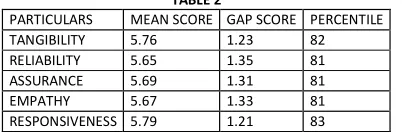
OVERALL ANALYSIS OF 5 DIMENSIONS OF SERVICE QUALITY
TABLE 2
PARTICULARS MEAN SCORE GAP SCORE PERCENTILE
TANGIBILITY 5.76 1.23 82
RELIABILITY 5.65 1.35 81
ASSURANCE 5.69 1.31 81
EMPATHY 5.67 1.33 81
RESPONSIVENESS 5.79 1.21 83
The overall analysis of the five dimensions of service quality revealed that the responsiveness and tangibility gave more satisfaction to customers. The reliability shows a gap score of 1.35 which is high compared to other component. Overall, the customers are happy with quality of service they get at a retail outlet. To get a better picture of the impact of the five dimensions of quality on the overall impact further statistical tools were used. The results of the same are mentioned below:
HYPOTHESIS
In all the five hypothesis the alternate hypothesis was accepted & it could be inferred that all the five service quality dimensions significantly impact the service perceptions leading to an impact on customer satisfaction (p=0.00). Besides that high positive correlation was found in all the five dimensions. The highest corre-lation was found between empathy of employees and customer satisfaction (0.88) followed by tangible aspects in the store (0.87) and then by reliability of the service provider (0.86) followed by assurance given by employees (0.82) and lastly the responsiveness component (0.77).
It can be concluded that a retail outlets tangible and intangible dimensions together has an impact on customer satisfaction. Hence due weightage has to be provided to both.
VOLUME NO.6(2016),ISSUE NO.12(
DECEMBER
) ISSN 2231-5756INTERNATIONAL JOURNAL OF RESEARCH IN COMMERCE, IT & MANAGEMENT
TABLE 3
Regression Statistics
Multiple R 0.87954 ANOVA
R Square 0.773591 df SS MS F P VALUE
Adjusted R Square 0.772051 Regression 1 14753.81 14753.81 502.2686 0.00 Standard Error 5.41981 Residual 299 4318.028 29.37434 Significant
Observations 300
From the above table it’s clear that tangibility has a very significant influence on service quality (PVALUE: 0.00,). So the alternate hypothesis has been accepted.
H2. The ability of the service provider to accurately perform the promised service of right quality goods at right prices is likely to play a critical role on customer’s perception about service quality. Therefore it is hypothesized that reliability has an influence on service quality.
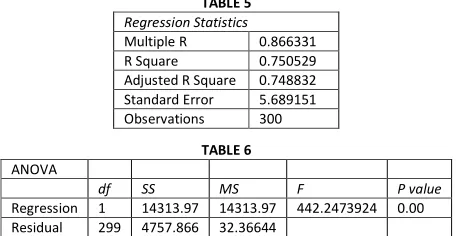
TABLE 5
TABLE 6
From the above data we can infer that reliability has a very significant influence on service quality (PVALUE: 0.00,). So the alternate hypothesis has been accepted
H3. The ability of the service provider to instill trust and confidence in customers regarding the services rendered might enhance beneficiaries overall experience. Therefore it is hypothesized that assurance has an influence on service quality.
TABLE 7
Regression Statistics ANOVA
Multiple R df SS MS F P value
R Square Regression 1 12992.58 12992.58 314.1678 0.00
Adjusted R Square Residual 299 6079.262 41.35553 Significant
Standard Error 6.430826
Observations 300
From the above data we can infer that assurance has a very significant influence on service quality (PVALUE: 0.00,). So the alternate hypothesis has been accepted.
H4. The willingness of the service provider to provide assistance and prompt service to customers is bound to have an impact on service quality. Therefore it is hypothesized that responsiveness has an influence on service quality.
TABLE 8
Regression Statistics
Multiple R 0.776821
R Square 0.60345 ANOVA
Adjusted R Square 0.600753 df SS MS F P value
Standard Error 7.172761 Regression 1 11508.91 11508.91 223.6976 0.00
Observations 300 Residual 299 7562.93 51.4485 Significant
From the above data we can infer that responsiveness has a very significant influence on service quality (PVALUE: 0.00,). So the alternate hypothesis has been accepted.
H5. The capacity of the service provider to show care and concern and devote individualized attention might play a crucial role in the long run. Therefore it is hypothesized that empathy has an influence on service quality
TABLE 9
Regression Statistics
Multiple R 0.888943
R Square 0.79022 ANOVA
Adjusted R Square 0.788793 df SS MS F P value
Standard Error 5.216983 Regression 1 15070.95 15070.95 553.7349 0.00
Observations 300 Residual 299 4000.886 27.21691
From the above data we can come to a conclusion that empathy has a very significant influence on service quality (PVALUE: 0.00,). So the alternate hypothesis has been accepted.
INTER RELATIONS
TABLE 10
TANGIBILITY RELIABILITY ASSURANCE EMPATHY RESPONSIVENESS
TANGIBILITY 1
RELIABILITY 0.75608322 1
ASSURANCE 0.59042746 0.676530543 1
EMPATHY 0.66680458 0.642592309 0.768074788 1
RESPONSIVENESS 0.62976511 0.633351752 0.546070473 0.633033037 1
Correlation matrix helps us in finding out the relationships between different variables.. From the table above it’s very evident that all the dimension has a positive relation and assurance, empathy gives a maximum impact (0.76) followed by tangibility, reliability(0.75) by this we can conclude that a higher service quality can be attained if the employees deal with the customers in an polite and caring manner.
CONCLUSION
In the era of globalization, competition has become a key issue in industry’s as well as service sectors. The study suggests that customer satisfaction and perceived service quality both should be considered together for the stability of a organization in a competitive environment. The customer perception of service quality is
Regression Statistics
Multiple R 0.866331
R Square 0.750529
Adjusted R Square 0.748832 Standard Error 5.689151
Observations 300
ANOVA
df SS MS F P value
VOLUME NO.6(2016),ISSUE NO.12(
DECEMBER
) ISSN 2231-5756INTERNATIONAL JOURNAL OF RESEARCH IN COMMERCE, IT & MANAGEMENT
very important for the emerging and the existing retailers in the market. As the study reveals that perception of service quality is influenced in various ways among various customers. So the retail outlets have to frame their own strategies in order to attract the customers on a longer basis.The research findings indicate that service quality attributes in totality play a vital role in customers’ evaluation of retail stores. The behavioral components are important in the selection of the retail outlets, and the customer gives more importance to the intangible attributes of service quality than the tangibles. This may be attributed to the fact that many of the retailers are shabby in their appearance and conduct. If bigger retail stores, like discount and departmental stores, give importance to service personnel's behavior and conduct with the customers, they may be able to attract customers of the small retailers. The customers frequent the neighborhood stores because of the ‘personal relationship’ they share with the local retailers. This relationship or interaction is the factor affecting service quality. In conclusion it can be said that the service sector depends on the most important “P” of the P’s- people. Emphasizing on the needs of peoples both customer and service personnel will take retailing to an escalated level.
REFERENCES
1. Amine, A. and Cadenat, S., 2003. Efficient retailer assortment: a consumer choice evaluation perspective. International Journal of Retail & Distribution
Man-agement, 31(10), pp. 486-497.
2. Blanchard, R.F. and Galloway, R.L., 1994. Quality in retail banking. International Journal of Service Industry Management, 5(4), pp. 5-23. 3. Carman, J.M., 1990. Consumer Perceptions Of Service Quality: An Assessment Of The servqual dimensions. Journal of retailing, 66(1), p. 33. 4. Dr.Burcu liter “High School Girls’ Shopping Mall expectations: A Qualitative Study”. Journal of Retailing (2006), vol. 80, pg. 73-89.
5. Lin, L.Z. and Yeh, H.R., 2013. A means-end chain of fuzzy conceptualization to elicit consumer perception in store image. International Journal of Hospitality
Management, 33, pp. 376-388.
6. Newman, A.J. and Foxall, G.R., 2003. In-store customer behaviour in the fashion sector: some emerging methodological and theoretical directions.
Interna-tional Journal of Retail & Distribution Management, 31(11), pp. 591-600.
7. Shergill, G.S. and Chen, Y., 2007. Customer Perceptions of Factory Outlet Stores vs. Traditional Department Stores. Traditional Department Stores. 8. Tam, J.L., 2004. Customer satisfaction, service quality and perceived value: an integrative model. Journal of marketing management, 20(7-8), pp.897-917. 9. Thang, D.C.L. and Tan, B.L.B., 2003. Linking consumer perception to preference of retail stores: an empirical assessment of the multi-attributes of store
image. Journal of retailing and consumer services, 10(4), pp.193-200.
10. Vahie, A. and Paswan, A., 2006. Private label brand image: its relationship with store image and national brand. International Journal of Retail & Distribution
VOLUME NO.6(2016),ISSUE NO.12(
DECEMBER
) ISSN 2231-5756INTERNATIONAL JOURNAL OF RESEARCH IN COMMERCE, IT & MANAGEMENT
REQUEST FOR FEEDBACK
Dear Readers
At the very outset, International Journal of Research in Commerce, IT & Management (IJRCM) acknowledges
& appreciates your efforts in showing interest in our present issue under your kind perusal.
I would like to request you to supply your critical comments and suggestions about the material published
in this issue, as well as on the journal as a whole, on our e-mail
for further
improve-ments in the interest of research.
If you have any queries, please feel free to contact us on our e-mail
.
I am sure that your feedback and deliberations would make future issues better – a result of our joint effort.
Looking forward to an appropriate consideration.
With sincere regards
Thanking you profoundly
Academically yours
Sd/-
Co-ordinator
DISCLAIMER
VOLUME NO.6(2016),ISSUE NO.12(
DECEMBER
) ISSN 2231-5756