A Monthly Double-Blind Peer Reviewed (Refereed/Juried) Open Access International e-Journal - Included in the International Serial Directories
Indexed & Listed at:
VOLUME NO.2(2012),ISSUE NO.12(DECEMBER) ISSN2231-5756
INTERNATIONAL JOURNAL OF RESEARCH IN COMMERCE, IT & MANAGEMENT
CONTENTS
CONTENTS
CONTENTS
CONTENTS
Sr.No.
TITLE & NAME OF THE AUTHOR (S)
Page No.
1. EFFECTIVENESS OF PAY-FOR-PERFORMANCE AND FIXED-PAY PRACTICES: AN ASSESSMENT OF PAY SATISFACTION, COMMITMENT AND TURNOVER INTENTION
PRINCY THOMAS & DR. G. NAGALINGAPPA
1
2. ROLE OF CORPORATE GOVERNANCE ON PERFORMANCE OF PRIVATE COMMERCIAL BANKS IN BANGLADESH: AN ECONOMETRIC ANALYSIS
DR. MD NAZRUL ISLAM, MOHAMMAD MASUD ALAM & MOHAMMAD ASHRAFUL FERDOUS CHOWDHURY
6
3. IDENTIFYING OPPORTUNITIES, CHALLENGES AND INFRASTRUCTURE REQUIREMENTS FOR ESTABLISHING SECONDARY MARKETS IN ETHIOPIA
KANNAN SIMHAKUTTY ASURI & LETENAH EJIGU
12
4. A NOVEL BANKRUPTCY PREDICTION MODEL BASED ON SUPPORT VECTOR DATA DESCRIPTION METHOD
ALIREZA DEHVARI, FEZEH ZAHEDI FARD & MAHDI SALEHI
17
5. ANALYSIS OF FACTORS INFLUENCING EXPORT VOLUME: THE NIGERIAN EXPERIENCE
KAREEM, R.O, OKI A.S, RAHEEM, K.A & BASHEER, N.O
24
6. A MODEL FOR ORGANIZING, MEASURING, ANALYZING STUDENTS’ KNOWLEDGE AND PERFORMANCE
ROY MATHEW
32
7. DETERMINANTS OF CUSTOMER LOYALTY AND SUBSCRIBER CHURN OF MOBILE PHONE SERVICES IN GHANA
JACOB NUNOO & CHRISTIAN KYEREMEH
38
8. FACTORS AFFECTING CUSTOMERS’ ATTITUDE TOWARDS INFORMATION TECHNOLOGY ADOPTION IN COMMERCIAL BANKS OF ETHIOPIA: A CASE STUDY OF SELECTED BANKS IN MEKELLE CITY
ZEMENU AYNADIS
42
9. EFFECTIVE USE OF TRAINING FEEDBACK FOR REINFORCEMENT OF LEARNING AND EMPLOYEE DEVELOPMENT
AJAY KR VERMA, SUDHIR WARIER & LRK KRISHNAN
53
10. IMPACT OF DEMOGRAPHIC VARIABLES ON FACTORS OF JOB SATISFACTION OF EMPLOYEES IN PUBLIC SECTOR: AN EMPIRICAL STUDY
DR. RIZWANA ANSARI, DR. T. N. MURTY, NILOUFER QURAISHY & S A SAMEERA
62
11. SUBSCRIBERS’ ATTITUDE TOWARDS DTH SERVICES
M. J. SENTHIL KUMAR & DR. N. R. NAGARAJAN
69
12. ISSUES AND CHALLENGES INDIAN BUSINESS: VISION 2020 WITH THE REFERENCE OF MICRO, SMALL AND MEDIUM ENTERPRISES (MSMEs) IN INDIA
DR. M. L. GUPTA, DR. SHWETABH MITTAL & PRIYANKA GUPTA
73
13. ENHANCING JOB SATISFACTION OF SOFTWARE PROFESSIONALS: THE RELEVANCE OF EMOTIONAL QUOTIENT
V. ANOOPKUMAR & DR. R. GANESAN
82
14. A SURVEY ON CONSUMER ATTITUDE TO CHOOSE AND USE VARIOUS TELECOM SERVICES
V. BALAKUMAR & DR. C. SWARNALATHA
88
15. COUNTERPRODUCTIVE WORK BEHAVIOUR (CWB) AND LOCUS OF CONTROL (LOC) AMONG MANAGERS
DR. RISHIPAL & PAWAN KUMAR CHAND
94
16. CORPORATE GOVERNANCE FAILURES IN INDIA - A REVIEW
KAISETTY. BALAJI & DR. Y. VENU GOPALA RAO
98
17. SIGNIFICANCE OF INCLUSIVE GROWTH IN INDIAN ECONOMIC DEVELOPMENT – A STUDY
DR. T. C. CHANDRASHEKAR
103
18. A STUDY ON EMPLOYEE JOB PERFORMANCE (A COMPARATIVE STUDY OF SELECT PUBLIC AND PRIVATE ORGANIZATIONS)
S.FAKRUDDIN ALI AHMED & DR. G. MALYADRI
110
19. ORGANISATIONAL AND ENVIRONMENTAL DETERMINANTS OF PERFORMANCE APPRAISAL SYSTEM: A REVIEW AND FRAMEWORK FROM CONTEXTUAL PERSPECTIVE
SAPNA TANEJA, DR. RAVIKESH SRIVASTAVA & DR. N. RAVICHANDRAN
117
20. E-LEARNING INITIATIVES TO AUGMENT BUSINESS PERFORMANCE: AN EMPIRICAL STUDY OF SELECT AUTO COMPONENT FIRMS
DR. AISHA M. SHERIFF & GEETHA R
127
21. INTERPRETIVE STRUCTURAL MODELING BASED APPROACH FOR ADOPTING CPFR IN INDIAN INDUSTRIES
RAJESH A. KUBDE & DR. SATISH V. BANSOD
136
22. TECHNOLOGY TRENDS AND IMPACT OF ROBOTICS IN THE CORPORATE WORLD AT DIFFERENT LEVELS OF MANAGEMENT
P. POONGUZHALI & DR. A. CHANDRA MOHAN
141
23. PERFORMANCE APPRAISAL ACT AS A MAJOR MOTIVATIONAL SOURCE
NAILA IQBAL
147
24. FOREIGN DIRECT INVESTMENT FLOWS INTO INDIA AND THEIR CAUSAL RELATIONSHIP WITH ECONOMIC GROWTH SINCE LIBERALISATION
S. GRAHALSKSHMI & DR. M. JAYALAKSHMI
150
25. INCLUSIVE GROWTH AND REGIONAL DISPARITIES IN ANDHRA PRADESH
V. VANEENDRA NATHA SASTRY
159
26. STRATEGIES TO COPE UP WORK - PLACE STRESSORS: AN EMPIRICAL STUDY IN EDUCATIONAL INSTITUTIONS
B. LAVANYA
162
27. DETERMINANTS OF JOB SATISFACTION AMONG EMPLOYEES IN INFORMATION TECHNOLOGY INDUSTRY IN DELHI
BRAJESH KUMAR & DR. AWADHESH KUMAR
166
28. MODERN CHALLENGES TO WOMEN ENTREPRENEURSHIP DEVELOPMENT: A STUDY OF DISTRICT RAJOURI IN JAMMU AND KASHMIR STATE
AASIM MIR
169
29. INTERNATIONAL HRM CHALLENGES FOR MNC’s
B. G. VENKATESH PRASAD & N. CHETAN KUMAR
173
30. INSIDER TRADING: GOVERNANCE, ETHICAL AND REGULATORY PERSPECTIVE
NIDHI SAHORE
177
CHIEF PATRON
CHIEF PATRON
CHIEF PATRON
CHIEF PATRON
PROF. K. K. AGGARWAL
Chancellor, Lingaya’s University, Delhi
Founder Vice-Chancellor, Guru Gobind Singh Indraprastha University, Delhi
Ex. Pro Vice-Chancellor, Guru Jambheshwar University, Hisar
FOUNDER
FOUNDER
FOUNDER
FOUNDER PATRON
PATRON
PATRON
PATRON
LATE SH. RAM BHAJAN AGGARWAL
Former State Minister for Home & Tourism, Government of Haryana
Former Vice-President, Dadri Education Society, Charkhi Dadri
Former President, Chinar Syntex Ltd. (Textile Mills), Bhiwani
CO
CO
CO
CO----ORDINATOR
ORDINATOR
ORDINATOR
ORDINATOR
AMITA
Faculty, Government M. S., Mohali
ADVISORS
ADVISORS
ADVISORS
ADVISORS
DR. PRIYA RANJAN TRIVEDI
Chancellor, The Global Open University, Nagaland
PROF. M. S. SENAM RAJU
Director A. C. D., School of Management Studies, I.G.N.O.U., New Delhi
PROF. M. N. SHARMA
Chairman, M.B.A., Haryana College of Technology & Management, Kaithal
PROF. S. L. MAHANDRU
Principal (Retd.), Maharaja Agrasen College, Jagadhri
EDITOR
EDITOR
EDITOR
EDITOR
PROF. R. K. SHARMA
Professor, Bharti Vidyapeeth University Institute of Management & Research, New Delhi
CO
CO
CO
CO----EDITOR
EDITOR
EDITOR
EDITOR
DR. BHAVET
Faculty, M. M. Institute of Management, Maharishi Markandeshwar University, Mullana, Ambala, Haryana
EDITORIAL ADVISORY BOARD
EDITORIAL ADVISORY BOARD
EDITORIAL ADVISORY BOARD
EDITORIAL ADVISORY BOARD
DR. RAJESH MODI
Faculty, Yanbu Industrial College, Kingdom of Saudi Arabia
PROF. SANJIV MITTAL
University School of Management Studies, Guru Gobind Singh I. P. University, Delhi
PROF. ANIL K. SAINI
Chairperson (CRC), Guru Gobind Singh I. P. University, Delhi
DR. SAMBHAVNA
VOLUME NO.2(2012),ISSUE NO.12(DECEMBER) ISSN2231-5756
INTERNATIONAL JOURNAL OF RESEARCH IN COMMERCE, IT & MANAGEMENT
DR. MOHENDER KUMAR GUPTA
Associate Professor, P. J. L. N. Government College, Faridabad
DR. SHIVAKUMAR DEENE
Asst. Professor, Dept. of Commerce, School of Business Studies, Central University of Karnataka, Gulbarga
ASSOCIATE EDITORS
ASSOCIATE EDITORS
ASSOCIATE EDITORS
ASSOCIATE EDITORS
PROF. NAWAB ALI KHAN
Department of Commerce, Aligarh Muslim University, Aligarh, U.P.
PROF. ABHAY BANSAL
Head, Department of Information Technology, Amity School of Engineering & Technology, Amity
University, Noida
PROF. A. SURYANARAYANA
Department of Business Management, Osmania University, Hyderabad
DR. SAMBHAV GARG
Faculty, M. M. Institute of Management, Maharishi Markandeshwar University, Mullana, Ambala, Haryana
PROF. V. SELVAM
SSL, VIT University, Vellore
DR. PARDEEP AHLAWAT
Associate Professor, Institute of Management Studies & Research, Maharshi Dayanand University, Rohtak
DR. S. TABASSUM SULTANA
Associate Professor, Department of Business Management, Matrusri Institute of P.G. Studies, Hyderabad
SURJEET SINGH
Asst. Professor, Department of Computer Science, G. M. N. (P.G.) College, Ambala Cantt.
TECHNICAL ADVISOR
TECHNICAL ADVISOR
TECHNICAL ADVISOR
TECHNICAL ADVISOR
AMITA
Faculty, Government M. S., Mohali
FINANCIAL ADVISORS
FINANCIAL ADVISORS
FINANCIAL ADVISORS
FINANCIAL ADVISORS
DICKIN GOYAL
Advocate & Tax Adviser, Panchkula
NEENA
Investment Consultant, Chambaghat, Solan, Himachal Pradesh
LEGAL ADVISORS
LEGAL ADVISORS
LEGAL ADVISORS
LEGAL ADVISORS
JITENDER S. CHAHAL
Advocate, Punjab & Haryana High Court, Chandigarh U.T.
CHANDER BHUSHAN SHARMA
Advocate & Consultant, District Courts, Yamunanagar at Jagadhri
SUPERINTENDENT
SUPERINTENDENT
SUPERINTENDENT
SUPERINTENDENT
SURENDER KUMAR POONIA
CALL FOR MANUSCRIPTS
CALL FOR MANUSCRIPTS
CALL FOR MANUSCRIPTS
CALL FOR MANUSCRIPTS
Weinvite unpublished novel, original, empirical and high quality research work pertaining to recent developments & practices in the area of Computer, Business, Finance, Marketing, Human Resource Management, General Management, Banking, Insurance, Corporate Governance and emerging paradigms in allied subjects like Accounting Education; Accounting Information Systems; Accounting Theory & Practice; Auditing; Behavioral Accounting; Behavioral Economics; Corporate Finance; Cost Accounting; Econometrics; Economic Development; Economic History; Financial Institutions & Markets; Financial Services; Fiscal Policy; Government & Non Profit Accounting; Industrial Organization; International Economics & Trade; International Finance; Macro Economics; Micro Economics; Monetary Policy; Portfolio & Security Analysis; Public Policy Economics; Real Estate; Regional Economics; Tax Accounting; Advertising & Promotion Management; Business Education; Management Information Systems (MIS); Business Law, Public Responsibility & Ethics; Communication; Direct Marketing; E-Commerce; Global Business; Health Care Administration; Labor Relations & Human Resource Management; Marketing Research; Marketing Theory & Applications; Non-Profit Organizations; Office Administration/Management; Operations Research/Statistics; Organizational Behavior & Theory; Organizational Development; Production/Operations; Public Administration; Purchasing/Materials Management; Retailing; Sales/Selling; Services; Small Business Entrepreneurship; Strategic Management Policy; Technology/Innovation; Tourism, Hospitality & Leisure; Transportation/Physical Distribution; Algorithms; Artificial Intelligence; Compilers & Translation; Computer Aided Design (CAD); Computer Aided Manufacturing; Computer Graphics; Computer Organization & Architecture; Database Structures & Systems; Digital Logic; Discrete Structures; Internet; Management Information Systems; Modeling & Simulation; Multimedia; Neural Systems/Neural Networks; Numerical Analysis/Scientific Computing; Object Oriented Programming; Operating Systems; Programming Languages; Robotics; Symbolic & Formal Logic and Web Design. The above mentioned tracks are only indicative, and not exhaustive.
Anybody can submit the soft copy of his/her manuscript anytime in M.S. Word format after preparing the same as per our submission guidelines duly available on our website under the heading guidelines for submission, at the email address: [email protected].
GUIDELINES FOR SUBM
GUIDELINES FOR SUBM
GUIDELINES FOR SUBM
GUIDELINES FOR SUBMISSION OF MANUSCRIPT
ISSION OF MANUSCRIPT
ISSION OF MANUSCRIPT
ISSION OF MANUSCRIPT
1. COVERING LETTER FOR SUBMISSION:
DATED: _____________ THE EDITOR
IJRCM
Subject: SUBMISSION OF MANUSCRIPT IN THE AREA OF .
(e.g. Finance/Marketing/HRM/General Management/Economics/Psychology/Law/Computer/IT/Engineering/Mathematics/other, please specify)
DEAR SIR/MADAM
Please find my submission of manuscript entitled ‘___________________________________________’ for possible publication in your journals.
I hereby affirm that the contents of this manuscript are original. Furthermore, it has neither been published elsewhere in any language fully or partly, nor is it under review for publication elsewhere.
I affirm that all the author (s) have seen and agreed to the submitted version of the manuscript and their inclusion of name (s) as co-author (s).
Also, if my/our manuscript is accepted, I/We agree to comply with the formalities as given on the website of the journal & you are free to publish our contribution in any of your journals.
NAME OF CORRESPONDING AUTHOR:
Designation:
Affiliation with full address, contact numbers & Pin Code: Residential address with Pin Code:
Mobile Number (s): Landline Number (s): E-mail Address: Alternate E-mail Address:
NOTES:
a) The whole manuscript is required to be in ONE MS WORD FILE only (pdf. version is liable to be rejected without any consideration), which will start from the covering letter, inside the manuscript.
b) The sender is required to mention the following in the SUBJECT COLUMN of the mail:
New Manuscript for Review in the area of (Finance/Marketing/HRM/General Management/Economics/Psychology/Law/Computer/IT/
Engineering/Mathematics/other, please specify)
c) There is no need to give any text in the body of mail, except the cases where the author wishes to give any specific message w.r.t. to the manuscript. d) The total size of the file containing the manuscript is required to be below 500 KB.
e) Abstract alone will not be considered for review, and the author is required to submit the complete manuscript in the first instance.
f) The journal gives acknowledgement w.r.t. the receipt of every email and in case of non-receipt of acknowledgment from the journal, w.r.t. the submission of manuscript, within two days of submission, the corresponding author is required to demand for the same by sending separate mail to the journal.
2. MANUSCRIPT TITLE: The title of the paper should be in a 12 point Calibri Font. It should be bold typed, centered and fully capitalised.
3. AUTHOR NAME (S) & AFFILIATIONS: The author (s) full name, designation, affiliation (s), address, mobile/landline numbers, and email/alternate email address should be in italic & 11-point Calibri Font. It must be centered underneath the title.
4. ABSTRACT: Abstract should be in fully italicized text, not exceeding 250 words. The abstract must be informative and explain the background, aims, methods,
VOLUME NO.2(2012),ISSUE NO.12(DECEMBER) ISSN2231-5756
INTERNATIONAL JOURNAL OF RESEARCH IN COMMERCE, IT & MANAGEMENT
5. KEYWORDS: Abstract must be followed by a list of keywords, subject to the maximum of five. These should be arranged in alphabetic order separated by commas and full stops at the end.
6. MANUSCRIPT: Manuscript must be in BRITISH ENGLISH prepared on a standard A4 size PORTRAIT SETTING PAPER. It must be prepared on a single space and
single column with 1” margin set for top, bottom, left and right. It should be typed in 8 point Calibri Font with page numbers at the bottom and centre of every page. It should be free from grammatical, spelling and punctuation errors and must be thoroughly edited.
7. HEADINGS: All the headings should be in a 10 point Calibri Font. These must be bold-faced, aligned left and fully capitalised. Leave a blank line before each
heading.
8. SUB-HEADINGS: All the sub-headings should be in a 8 point Calibri Font. These must be bold-faced, aligned left and fully capitalised.
9. MAIN TEXT: The main text should follow the following sequence:
INTRODUCTION
REVIEW OF LITERATURE
NEED/IMPORTANCE OF THE STUDY
STATEMENT OF THE PROBLEM
OBJECTIVES
HYPOTHESES
RESEARCH METHODOLOGY
RESULTS & DISCUSSION
FINDINGS
RECOMMENDATIONS/SUGGESTIONS
CONCLUSIONS
SCOPE FOR FURTHER RESEARCH
ACKNOWLEDGMENTS
REFERENCES
APPENDIX/ANNEXURE
It should be in a 8 point Calibri Font, single spaced and justified. The manuscript should preferably not exceed 5000 WORDS.
10. FIGURES & TABLES: These should be simple, crystal clear, centered, separately numbered & self explained, and titles must be above the table/figure. Sources of data should be mentioned below the table/figure. It should be ensured that the tables/figures are referred to from the main text.
11. EQUATIONS: These should be consecutively numbered in parentheses, horizontally centered with equation number placed at the right.
12. REFERENCES: The list of all references should be alphabetically arranged. The author (s) should mention only the actually utilised references in the preparation
of manuscript and they are supposed to follow Harvard Style of Referencing. The author (s) are supposed to follow the references as per the following:
•
All works cited in the text (including sources for tables and figures) should be listed alphabetically.•
Use (ed.) for one editor, and (ed.s) for multiple editors.•
When listing two or more works by one author, use --- (20xx), such as after Kohl (1997), use --- (2001), etc, in chronologically ascending order.•
Indicate (opening and closing) page numbers for articles in journals and for chapters in books.•
The title of books and journals should be in italics. Double quotation marks are used for titles of journal articles, book chapters, dissertations, reports, working papers, unpublished material, etc.•
For titles in a language other than English, provide an English translation in parentheses.•
The location of endnotes within the text should be indicated by superscript numbers.PLEASE USE THE FOLLOWING FOR STYLE AND PUNCTUATION IN REFERENCES: BOOKS
•
Bowersox, Donald J., Closs, David J., (1996), "Logistical Management." Tata McGraw, Hill, New Delhi.•
Hunker, H.L. and A.J. Wright (1963), "Factors of Industrial Location in Ohio" Ohio State University, Nigeria.CONTRIBUTIONS TO BOOKS
•
Sharma T., Kwatra, G. (2008) Effectiveness of Social Advertising: A Study of Selected Campaigns, Corporate Social Responsibility, Edited by David Crowther & Nicholas Capaldi, Ashgate Research Companion to Corporate Social Responsibility, Chapter 15, pp 287-303.JOURNAL AND OTHER ARTICLES
•
Schemenner, R.W., Huber, J.C. and Cook, R.L. (1987), "Geographic Differences and the Location of New Manufacturing Facilities," Journal of Urban Economics, Vol. 21, No. 1, pp. 83-104.CONFERENCE PAPERS
•
Garg, Sambhav (2011): "Business Ethics" Paper presented at the Annual International Conference for the All India Management Association, New Delhi, India, 19–22 June.UNPUBLISHED DISSERTATIONS AND THESES
•
Kumar S. (2011): "Customer Value: A Comparative Study of Rural and Urban Customers," Thesis, Kurukshetra University, Kurukshetra.ONLINE RESOURCES
•
Always indicate the date that the source was accessed, as online resources are frequently updated or removed.WEBSITES
A NOVEL BANKRUPTCY PREDICTION MODEL BASED ON SUPPORT VECTOR DATA DESCRIPTION METHOD
ALIREZA DEHVARI
LECTURER
DEPARTMENT OF ACCOUNTING
SARAVAN BRANCH
ISLAMIC AZAD UNIVERSITY
SARAVAN
FEZEH ZAHEDI FARD
RESEARCH SCHOLAR
YOUNG RESEARCHERS CLUB
MASHHAD BRANCH
ISLAMIC AZAD UNIVERSITY
MASHHAD
MAHDI SALEHI
ASST. PROFESSOR
DEPARTMENT OF ACCOUNTING
FERDOWSI UNIVERSITY
MASHHAD
ABSTRACT
In today's world, investment security is one of the leading concerns of economic environment and bankruptcy is one of the major problems which associated with. In this paper, we provide a novel bankruptcy prediction model for one year before its outbreak. By background literature review, 42 variables were selected as the variables proposed. Then, using stepwise discriminate analysis, optimal variables were selected for entry into the model. These variables in order of importance are: total liabilities to total assets, retained earnings to total assets, operating income to sales and net income to total assets. Having selected the final variables, by using 10-fold cross-validation technique, the model was built by using Support Vector Data Description (SVDD) algorithm. Empirical tests show that the SVDD model that is a one-classed classifier reached 100% and 95.81% accuracy rates for training and hold-out data.
KEYWORDS
Bankruptcy prediction; Feature selection; Financial ratios; Support Vector Data Description (SVDD); Tehran Stock Exchange.
INTRODUCTION
n today's world, investment security is one of the leading concerns of the economic environment, rapid advances in technology and widespread environmental change, has affected economies. Thus, financial decisions making are more strategic than before and always associated with risk and uncertainty. Increasing knowledge of financial users contributes them in financial decisions-making. Hence, one way to help investors is providing good models and predictors of company's prospects and today's these models having focused the attention of investors and creditors lot.
Generally bankruptcy prediction is a commercial classification and carrying out such research requires a sample of two groups of bankrupt and non-bankrupt (e.g.: Chaudhuri and De, 2011; Chen, 2011; Andrés, Landajo and Lorca, 2012; Brezigar-Masten and Masten, 2012; Olson, Delen and Meng, 2012). In general, two main factors influencing the bankruptcy prediction (Lin, Liang and Chen, 2011):
1) Financial features: Using different variables may end up in different results of prediction. For this reason, in this study accompanied with a review of previous literature, various variables as proposed variables are presented.
2) The classifier used in building model: In addition to statistical techniques, in recent years, data mining techniques in the areas of finance, including bankruptcy prediction has been applied. New algorithms such as Support Vector Machine (SVM) (Chen, 2011; Chaudhuri and De, 2011; Tsai and Cheng, 2012), Particle swarm optimization (PSO)(Chen and et.al, 2011; Chen, 2011), Neural networks(Mokhatab Rafiei, Manzari and Bostanian,2011; Olson, Delen and Meng,2012; Xiao, Yang, Pang and Dang, 2012) are used. This research also examines a novel algorithm to predict bankruptcy.
Also several studies show that other factors affect the bankruptcy phenomenon. Special features of the industry and government regulations can also be effective for financial distress. The results also indicated that recent established companies compared to record companies and small firms compared to large firms are more vulnerable (Dun and Bradstreet Corporation, 1980).
The aim of this study consists of two parts: finding a subset of variables that can efficiently perform its role in classification and providing a model to predict bankruptcy. The results of this study can be used by managers (they want to know which one of financial items is more important to avoid being bankrupt or on the verge of bankruptcy), investors (for decision-making on keeping or selling stock), creditors and banks (for giving credit and loans), auditors (to evaluate the assumption of going concern) and investigators (to select the optimal variables in predicting bankruptcy)
LITERATURE REVIEW
Today, numerous studies have been conducted to predict bankruptcy using different techniques and methods. Generally these techniques are divided into three categories:
1) Statistical techniques: these techniques are the most common and popular techniques to predict bankruptcy. In these models, the standard classical modeling approach is used and focuses on the signs of financial distress. Statistical models are divided into two groups: univariate and multivariate that the multivariate models are the most frequent. Multivariate techniques can be pointed to these methods: discriminant analysis, linear probability model, logit, probit models, Cumulative Sums, Partial Adjustment Processes, Recursive Partitioning Algorithm, Case-Based Reasoning.At the first statistical studies, Beaver (1966) evaluated potential financial ratios to predict financial distress using univariate analysis that most of ratios of cash flows were used. In this study, financial distress is defined as the firm’s inability to perform its financial obligations. Thirty financial ratios that he thought the best indicator of a company's financial health are selected. Afterwards Altman (1968) proposed z-score model using multivariate discriminant analysis. In 1993, he revised his model and this time used four
VOLUME NO.2(2012),ISSUE NO.12(DECEMBER) ISSN2231-5756
INTERNATIONAL JOURNAL OF RESEARCH IN COMMERCE, IT & MANAGEMENT
financial ratios in his model. In 1980 Ohlson used the developed logit model. His sample consisted of 105 bankrupt and 205 non-bankrupt firms between 1970 and 1976. Other research has also been conducted in this area by using statistical methods (e. g.: Zmijewski, 1984; Gentry et al., 1985)
2) Artificial Intelligence techniques: these techniques are non-parametric that based on knowledge, intelligence and wisdom of human. In fact, it is a system that learns and their problem solving performance improves due to past experiences. These days, due to the high performance and the lack of restrictive assumptions of statistical methods are very useful for researchers. In the areas of bankruptcy, these are mainly focus on signs of distress and are multivariate typically. In recent years, researchers have used these techniques to predict bankruptcy (e. g.: Gestel, Baesens and Martens, 2010; Andrés, Landajo and Lorca, 2012; Chaudhuri and De, 2011; Tsai and Cheng, 2012; Sun, He and Li, 2011; Shetty, Pakkala and Mallikarjunappa, 2012; Ashoori and Mohammadi, 2011; Sun and Li, 2011)
3) Theoretical models: Unlike statistical and artificial intelligence models that rely on business distress symptoms, theoretical models seek for "quality reasons" of business distress. These models are multivariable and model statistical technique commonly used to support the theoretical issues. The examples of this theory are: JP Morgan’s credit metrics Model, gambler bankruptcy theory, credit risk theories.
PREDICTION MODEL
ONE-CLASSED CLASSIFIERS AND DATA DESCRIPTION IN A SPECIFIC SCOPE
Nowadays, researchers pay a particular attention to data description as an important issue in machine learning and data mining. To describe and calculate data precisely is the main operation of this classifier, called target. This classifier offers a great application to figure out whether the new data belong to target or outlier data. Of course, it’s crystal clear, to obtain more efficient multi class classifiers can come true by combining a series of one-class models.
In addition to above mentioned features, lace of necessity to employ the samples of other classes is another helpful feature of such classifiers in a learning process. In other words to reach an acceptable decision-making and assessment of belonging data-set to a class, system needs only a limited number of data. Thus, one-classed classifiers are of frequent application in data-mining such as: outlier samples recognition and designing efficient multi-class classifiers. SUPPORT VECTOR DATA DESCRIPTION
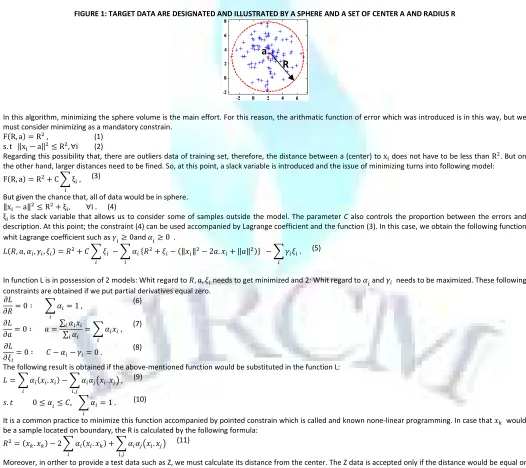
A novel way of data description was presented by Tax and Duin (2004) which steamed from support vector machines. In this method, a range and boundary is specified by center a and radius R>0. In fact, a spherical range is shaped around the target.
FIGURE 1: TARGET DATA ARE DESIGNATED AND ILLUSTRATED BY A SPHERE AND A SET OF CENTER A AND RADIUS R
In this algorithm, minimizing the sphere volume is the main effort. For this reason, the arithmatic function of error which was introduced is in this way, but we must consider minimizing as a mandatory constrain.
(1)
F R, a = R ,
(2)
s. t ‖x − a‖ ≤ R ,∀i
Regarding this possibility that, there are outliers data of training set, therefore, the distance between a (center) to x does not have to be less than R . But on the other hand, larger distances need to be fined. So, at this point, a slack variable is introduced and the issue of minimizing turns into following model:
(3)
F R, a = R + C ξ ,
But given the chance that, all of data would be in sphere. (4)
‖x − a‖ ≤ R + ξ , ∀i .
ξ is the slack variable that allows us to consider some of samples outside the model. The parameter C also controls the proportion between the errors and description. At this point; the constraint (4) can be used accompanied by Lagrange coefficient and the function (3). In this case, we obtain the following function whit Lagrange coefficient such as ≥ 0and ≥ 0 .
(5)
, , , , = + ! − " + − ‖# ‖ − 2 . # + ‖ ‖ % − .
In function L is in possession of 2 models: Whit regard to , , needs to get minimized and 2: Whit regard to and needs to be maximized. These following constraints are obtained if we put partial derivatives equal zero.
(6)
&
& = 0 ∶ = 1 ,
(7)
&
& = 0 ∶ =∑ #∑ = # ,
(8)
&
& = 0 ∶ ! − − = 0 .
The following result is obtained if the above-mentioned function would be substituted in the function L: (9)
= # . # − *+# . #*,
,*
,
(10)
-. . 0 ≤ ≤ !, = 1 .
It is a common practice to minimize this function accompanied by pointed constrain which is called and known none-linear programming. In case that #/ would be a sample located on boundary, the R is calculated by the following formula:
(11)
= #/. #/ − 2 # . #/ + *+# . #*,
,*
Moreover, in orther to provide a test data such as Z, we must calculate its distance from the center. The Z data is accepted only if the distance would be equal or less than R.
(12)
‖0 − ‖ = 0. 0 − 2 0. # + *+# . #*,
,*
≤
In all presented formulas, # are in form of interior-multiplication which is allowed to be replaced by a Kernel-function so as to reach more flexible methods. For this reason, let’s imagine that each function turns into another, there we can reach to such a Lagrange arithmatic formula:
(13)
= 1 # . 1 # − *+1 # .1 #*,
,*
And since the Kernel function is defined in following way: (14)
2+# , #*, = 3 # . 3+#*,
By a simple substitute, a new is obtained in the below form: (15)
= 2 # , # − *2+# , #*,
,*
So we can rewrite the (11) and (12) in scope of Kernel:
(16)
= #/. #/ − 2 2 # . #/ + *2+# . #*,
,*
(17)
‖0 − ‖ = 0. 0 − 2 2 0. # + *2+# . #*,
,*
≤
Now, using various kernel functions is possible. Regarding the conducted experiments, we can reach more acceptable results by employing the model of Gaussian kernel. Gaussian kernel is defined in following way:
(18)
2 #, 4 = 5#6 −‖# − 4‖7
By replacing the Gaussian kernel in the function (15) and regarding that2 #, # = 1, we can simplify the function in this form: (19)
= − *5#6 −‖# − 4‖7
,*
So, by using this technique known as kernel trick we can reach more precise results concerning Support Vector Data Description without any extra calculation. It goes without saying that, to determine a proper amount for parameters S is an affective factor in final result (Tax and Duin, 2004).
DATA COLLECTION AND VARIABLE SELECTION
VOLUME NO.2(2012),ISSUE NO.12(DECEMBER) ISSN2231-5756
INTERNATIONAL JOURNAL OF RESEARCH IN COMMERCE, IT & MANAGEMENT
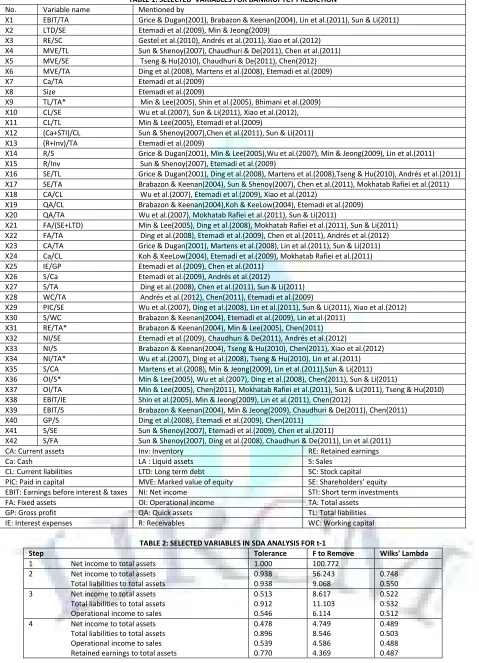
TABLE 1: SELECTED VARIABLES FOR BANKRUPTCY PREDICTION No. Variable name Mentioned by
X1 EBIT/TA Grice & Dugan(2001), Brabazon & Keenan(2004), Lin et al.(2011), Sun & Li(2011) X2 LTD/SE Etemadi et al.(2009), Min & Jeong(2009)
X3 RE/SC Gestel et al.(2010), Andrés et al.(2011), Xiao et al.(2012) X4 MVE/TL Sun & Shenoy(2007), Chaudhuri & De(2011), Chen et al.(2011) X5 MVE/SE Tseng & Hu(2010), Chaudhuri & De(2011), Chen(2012) X6 MVE/TA Ding et al.(2008), Martens et al.(2008), Etemadi et al.(2009) X7 Ca/TA Etemadi et al.(2009)
X8 Size Etemadi et al.(2009)
X9 TL/TA* Min & Lee(2005), Shin et al.(2005), Bhimani et al.(2009) X10 CL/SE Wu et al.(2007), Sun & Li(2011), Xiao et al.(2012), X11 CL/TL Min & Lee(2005), Etemadi et al.(2009)
X12 (Ca+STI)/CL Sun & Shenoy(2007),Chen et al.(2011), Sun & Li(2011) X13 (R+Inv)/TA Etemadi et al.(2009)
X14 R/S Grice & Dugan(2001), Min & Lee(2005),Wu et al.(2007), Min & Jeong(2009), Lin et al.(2011) X15 R/Inv Sun & Shenoy(2007), Etemadi et al.(2009)
X16 SE/TL Grice & Dugan(2001), Ding et al.(2008), Martens et al.(2008),Tseng & Hu(2010), Andrés et al.(2011) X17 SE/TA Brabazon & Keenan(2004), Sun & Shenoy(2007), Chen et al.(2011), Mokhatab Rafiei et al.(2011) X18 CA/CL Wu et al.(2007), Etemadi et al.(2009), Xiao et al.(2012)
X19 QA/CL Brabazon & Keenan(2004),Koh & KeeLow(2004), Etemadi et al.(2009) X20 QA/TA Wu et al.(2007), Mokhatab Rafiei et al.(2011), Sun & Li(2011)
X21 FA/(SE+LTD) Min & Lee(2005), Ding et al.(2008), Mokhatab Rafiei et al.(2011), Sun & Li(2011) X22 FA/TA Ding et al.(2008), Etemadi et al.(2009), Chen et al.(2011), Andrés et al.(2012) X23 CA/TA Grice & Dugan(2001), Martens et al.(2008), Lin et al.(2011), Sun & Li(2011) X24 Ca/CL Koh & KeeLow(2004), Etemadi et al.(2009), Mokhatab Rafiei et al.(2011) X25 IE/GP Etemadi et al.(2009), Chen et al.(2011)
X26 S/Ca Etemadi et al.(2009), Andrés et al.(2012)
X27 S/TA Ding et al.(2008), Chen et al.(2011), Sun & Li(2011) X28 WC/TA Andrés et al.(2012), Chen(2011), Etemadi et al.(2009)
X29 PIC/SE Wu et al.(2007), Ding et al.(2008), Lin et al.(2011), Sun & Li(2011), Xiao et al.(2012) X30 S/WC Brabazon & Keenan(2004), Etemadi et al.(2009), Lin et al.(2011)
X31 RE/TA* Brabazon & Keenan(2004), Min & Lee(2005), Chen(2011) X32 NI/SE Etemadi et al.(2009), Chaudhuri & De(2011), Andrés et al.(2012)
X33 NI/S Brabazon & Keenan(2004), Tseng & Hu(2010), Chen(2011), Xiao et al.(2012) X34 NI/TA* Wu et al.(2007), Ding et al.(2008), Tseng & Hu(2010), Lin et al.(2011) X35 S/CA Martens et al.(2008), Min & Jeong(2009), Lin et al.(2011),Sun & Li(2011) X36 OI/S* Min & Lee(2005), Wu et al.(2007), Ding et al.(2008), Chen(2011), Sun & Li(2011)
X37 OI/TA Min & Lee(2005), Chen(2011), Mokhatab Rafiei et al.(2011), Sun & Li(2011), Tseng & Hu(2010) X38 EBIT/IE Shin et al.(2005), Min & Jeong(2009), Lin et al.(2011), Chen(2012)
X39 EBIT/S Brabazon & Keenan(2004), Min & Jeong(2009), Chaudhuri & De(2011), Chen(2011) X40 GP/S Ding et al.(2008), Etemadi et al.(2009), Chen(2011)
X41 S/SE Sun & Shenoy(2007), Etemadi et al.(2009), Chen et al.(2011)
X42 S/FA Sun & Shenoy(2007), Ding et al.(2008), Chaudhuri & De(2011), Lin et al.(2011)
CA: Current assets Inv: Inventory RE: Retained earnings
Ca: Cash LA : Liquid assets S: Sales
CL: Current liabilities LTD: Long term debt SC: Stock capital PIC: Paid in capital MVE: Marked value of equity SE: Shareholders’ equity EBIT: Earnings before interest & taxes NI: Net income STI: Short term investments FA: Fixed assets OI: Operational income TA: Total assets
GP: Gross profit QA: Quick assets TL: Total liabilities IE: Interest expenses R: Receivables WC: Working capital
TABLE 2: SELECTED VARIABLES IN SDA ANALYSIS FOR t-1
Step Tolerance F to Remove Wilks' Lambda
1 Net income to total assets 1.000 100.772
2 Net income to total assets 0.938 56.243 0.748
Total liabilities to total assets 0.938 9.068 0.550
3 Net income to total assets 0.513 8.617 0.522
Total liabilities to total assets 0.912 11.103 0.532
Operational income to sales 0.546 6.114 0.512
4 Net income to total assets 0.478 4.749 0.489
Total liabilities to total assets 0.896 8.546 0.503
Operational income to sales 0.539 4.586 0.488
Retained earnings to total assets 0.770 4.369 0.487
PREDICTIVE RESULTS
FIGURE 2: 10-FOLD CROSS VALIDATION SCHEME
One problems of SVDD in BFP is noisy samples. This problem is solved by applying the appropriate value for the C coefficient in (3). If C choose 120 or more number of data by sphere, by reducing in (3) noisy samples explained as outliers (see Fig. 3).
FIGURE 3: CHOOSING APPROPRIATE VALUE OF AND OUTLIERS AND FINDING OUTLIERS
SVDD model could classify firms with 100% and 95.81% overall accuracy rate in the training and testing sample, respectively. The results of type I and Type II error is shown in Table 3 and figure 4.
TABLE 3
VOLUME NO.2(2012),ISSUE NO.12(DECEMBER
INTERNATIONAL JOURNAL OF RESEARCH IN COMMERCE
FIGURE 4
SUMMERY AND CONCLUSION
The purpose of this paper is to develop new constitutive model to predict the bankruptcy
contribution of this research is finding a set of important and effective variables in bankruptcy phenomenon. Using these var
developed. This model reached 100% and 95.81% accuracy rates for training and test data. In summary, it can be said that SVDD can predict bankruptcy with high accuracy.
REFRENCES
1. Altman, E.I. (1968), "Financial ratios, discriminant analysis and the prediction of corporate bankruptcy," Journal of Finan 2. Altman E.I. (1993) Corporate Financial Distress and Bankruptcy: A Complete Guide to Predicting & Avoiding Distress and Profit
Edition, John Wiley & Sons.
3. Alpaydin E. (2010) Introduction to machine learning (2th ed.). London: MIT Press.
4. Andrés, J.D., Lorca. P., Juez. F.J. and Sánchez-Lasheras. F. (2011), "Bankruptcy forecasting: A hybrid approach using Fuzzy c Multivariate Adaptive Regression Splines (MARS)", Expert Systems with Applic
5. Andrés. J., Landajo. M. and Lorca. P. (2012), "Bankruptcy prediction models based on multinorm analysis: An alternative to ac Based Systems, doi: 10.1016/j.knosys. 2011.11.005.
6. Ashoori, S. and Mohammadi, S. (2011), "Compare failure prediction models based on feature selection technique: empirical case from Iran," Procedi Computer Science, Vol. 3, pp. 568–573.
7. Beaver, W. (1967), "Financial ratios predictors of failure, Empirical research in accounti pp. 71–111.
8. Bhimani, A., Gulamhussen, M.A. and Lopes, S. (2009), "The effectiveness of the auditor's going Evidence from loan defaults," The International Journal of Accounting, Vol. 44, pp. 239
9. Brabazon, A. and Keenan, B. (2004), "A hybrid genetic model for the prediction of corporate failure," Computational Managemen pp. 293-310.
10. Brezigar-Masten, A. and Masten, I. (2012), "CART doi:10.1016/j.eswa.2012.02.125.
11. Chaudhuri, A. and De, K. (2011), "Fuzzy Support Vector Machine for bankruptcy prediction," Applied
12. Chen, M.Y. (2011), "Predicting corporate financial distress based on integration of decision tree classification and logistic Applications, Vol. 38, pp. 11261–11272.
13. Chen, M.Y. (2012), "Visualization and dynamic evaluation model of corporate financial structure with self Applied Soft Computing, Vol. 12, No. 8, pp. 2274-2288.
14. Chen, H.L., Yang, B., Wang, G., Liu, J., Xu, X., Wang, S.J., and Liu, D.Y. (2011), "A novel bankruptcy prediction model based neighbor method," Knowledge-Based Systems, Vol. 24, pp. 134
15. Ding, Y., Song, X. and Zen, Y. (2008), "Forecasting financial condition of Chinese listed companies based on support vector m Applications, Vol. 34, pp. 3081–3089.
16. Dun and Bradstreet Corporation, (1983) Business Failure
17. Etemadi, H., Anvary Rostamy, A.A. and Farajzadeh Dehkordi, H. (2009), "A genetic programming model for bankruptcy prediction: Iran," Expert Systems with Applications, Vol. 36, pp. 3199
18. Gentry, J.A., Newbold, P. and Whitford, D.T. (1985), "Classifying Bankrupt Firms with Funds Flow Components," Journal of Accounting Research No. 1, pp. 146-161.
19. Gestel, T.V., Baesens, B. and Martens, D. (2010), "From linear to non pp. 2955–2970.
20. Grice, G.S. and Dugan, M.T. (2001), "The Limitations of Bankruptcy Prediction Models: Some Cautions for Researcher," Review o Accounting, Vol. 17, pp. 151-166.
21. Koh, H.C. and Kee Low, C. (2004), "Going concern prediction using data mining techniques," Managerial Auditing Journal, Vol. 22. Leon Li, M.Y. and Miu, P. (2010), "A hybrid bankruptcy prediction model with dynamic loadings on accounting
binary quantile regression approach," Journal of Empirical Finance, Vol. 17, pp. 818
23. Lin, F., Liang, D. and Chen, E. (2011), "Financial ratio selection for business crisis prediction," Expert Systems With
24. Martens, D., Bruynseels. L., Willekens, B.M. and Vanthienen, J. (2008), "Predicting going concern opinion with data mining," 45, pp. 765–777.
25. Min, J.H. and Jeong, C. (2009), "A binary classification method for bankruptcy prediction," Expert Systems with Applications, Vol. 36, pp. 5256 26. Min, J.H. and Lee, Y.C. (2005), "Bankruptcy prediction using support vector machine with optimal choice of kernel function pa
with Applications, Vol. 28, pp. 603–614.
27. Mokhatab Rafiei, F., Manzari, S.M. and Bostanian, S. (2011), "Financial health prediction models using artificial neural netw multivariate discriminant analysis: Iranian evidence," Exper
28. Ohlson, J. (1980), "Financial ratios and the probabilistic prediction of bankruptcy," Journal of Accounting Research, Vol. 18
0
20
40
60
80
100
Accuracy
95.81
ECEMBER)INTERNATIONAL JOURNAL OF RESEARCH IN COMMERCE, IT
FIGURE 4: RESULT OF SVDD IN TEST AND TRAINING DATA
The purpose of this paper is to develop new constitutive model to predict the bankruptcy using Support Vector Data Description (SVDD). An important contribution of this research is finding a set of important and effective variables in bankruptcy phenomenon. Using these var
ccuracy rates for training and test data. In summary, it can be said that SVDD can predict bankruptcy with
Altman, E.I. (1968), "Financial ratios, discriminant analysis and the prediction of corporate bankruptcy," Journal of Finan Altman E.I. (1993) Corporate Financial Distress and Bankruptcy: A Complete Guide to Predicting & Avoiding Distress and Profit
ng (2th ed.). London: MIT Press.
Lasheras. F. (2011), "Bankruptcy forecasting: A hybrid approach using Fuzzy c Multivariate Adaptive Regression Splines (MARS)", Expert Systems with Applications, Vol. 38, pp. 1866–1875.
Andrés. J., Landajo. M. and Lorca. P. (2012), "Bankruptcy prediction models based on multinorm analysis: An alternative to ac Based Systems, doi: 10.1016/j.knosys. 2011.11.005.
mmadi, S. (2011), "Compare failure prediction models based on feature selection technique: empirical case from Iran," Procedi
Beaver, W. (1967), "Financial ratios predictors of failure, Empirical research in accounting: selected studies 1966," Journal of Accounting Research, Vol. 4,
Bhimani, A., Gulamhussen, M.A. and Lopes, S. (2009), "The effectiveness of the auditor's going-concern evaluation as an external governance mechanism: ts," The International Journal of Accounting, Vol. 44, pp. 239– 255.
Brabazon, A. and Keenan, B. (2004), "A hybrid genetic model for the prediction of corporate failure," Computational Managemen
nd Masten, I. (2012), "CART-based selection of bankruptcy predictors for the logit model," Expert Systems with Applications,
Chaudhuri, A. and De, K. (2011), "Fuzzy Support Vector Machine for bankruptcy prediction," Applied Soft Computing, Vol. 11, pp. 2472 Chen, M.Y. (2011), "Predicting corporate financial distress based on integration of decision tree classification and logistic
Visualization and dynamic evaluation model of corporate financial structure with self-organizing map and support vector regression 2288.
Chen, H.L., Yang, B., Wang, G., Liu, J., Xu, X., Wang, S.J., and Liu, D.Y. (2011), "A novel bankruptcy prediction model based Based Systems, Vol. 24, pp. 1348–1359.
Ding, Y., Song, X. and Zen, Y. (2008), "Forecasting financial condition of Chinese listed companies based on support vector m
Dun and Bradstreet Corporation, (1983) Business Failure Record, Author, New York.
Etemadi, H., Anvary Rostamy, A.A. and Farajzadeh Dehkordi, H. (2009), "A genetic programming model for bankruptcy prediction: Iran," Expert Systems with Applications, Vol. 36, pp. 3199–3207.
ewbold, P. and Whitford, D.T. (1985), "Classifying Bankrupt Firms with Funds Flow Components," Journal of Accounting Research
Gestel, T.V., Baesens, B. and Martens, D. (2010), "From linear to non-linear kernel based classifiers for bankruptcy prediction," Neurocomputing, Vol. 73,
Grice, G.S. and Dugan, M.T. (2001), "The Limitations of Bankruptcy Prediction Models: Some Cautions for Researcher," Review o
Koh, H.C. and Kee Low, C. (2004), "Going concern prediction using data mining techniques," Managerial Auditing Journal, Vol. Leon Li, M.Y. and Miu, P. (2010), "A hybrid bankruptcy prediction model with dynamic loadings on accounting-ratio-based and market binary quantile regression approach," Journal of Empirical Finance, Vol. 17, pp. 818– 833.
Lin, F., Liang, D. and Chen, E. (2011), "Financial ratio selection for business crisis prediction," Expert Systems With Applications, Vol. 38, pp. 15094 Martens, D., Bruynseels. L., Willekens, B.M. and Vanthienen, J. (2008), "Predicting going concern opinion with data mining,"
lassification method for bankruptcy prediction," Expert Systems with Applications, Vol. 36, pp. 5256 Min, J.H. and Lee, Y.C. (2005), "Bankruptcy prediction using support vector machine with optimal choice of kernel function pa
Mokhatab Rafiei, F., Manzari, S.M. and Bostanian, S. (2011), "Financial health prediction models using artificial neural netw multivariate discriminant analysis: Iranian evidence," Expert Systems with Applications, Vol. 38, pp. 10210–10217.
Ohlson, J. (1980), "Financial ratios and the probabilistic prediction of bankruptcy," Journal of Accounting Research, Vol. 18
Accuracy
Type I error
Type II error
95.81
3.25
5.18
100
0
0
Test
Train
ISSN2231-5756& MANAGEMENT
using Support Vector Data Description (SVDD). An important contribution of this research is finding a set of important and effective variables in bankruptcy phenomenon. Using these variables, a SVDD model was ccuracy rates for training and test data. In summary, it can be said that SVDD can predict bankruptcy with
Altman, E.I. (1968), "Financial ratios, discriminant analysis and the prediction of corporate bankruptcy," Journal of Finance, Vol. 23, pp. 589–609.
Altman E.I. (1993) Corporate Financial Distress and Bankruptcy: A Complete Guide to Predicting & Avoiding Distress and Profiting from Bankruptcy, Second
Lasheras. F. (2011), "Bankruptcy forecasting: A hybrid approach using Fuzzy c-means clustering and
Andrés. J., Landajo. M. and Lorca. P. (2012), "Bankruptcy prediction models based on multinorm analysis: An alternative to accounting ratios," Knowledge
mmadi, S. (2011), "Compare failure prediction models based on feature selection technique: empirical case from Iran," Procedia
ng: selected studies 1966," Journal of Accounting Research, Vol. 4,
concern evaluation as an external governance mechanism:
Brabazon, A. and Keenan, B. (2004), "A hybrid genetic model for the prediction of corporate failure," Computational Management Science, Springer-Verlag,
based selection of bankruptcy predictors for the logit model," Expert Systems with Applications,
Soft Computing, Vol. 11, pp. 2472–2486.
Chen, M.Y. (2011), "Predicting corporate financial distress based on integration of decision tree classification and logistic regression," Expert Systems with
organizing map and support vector regression,"
Chen, H.L., Yang, B., Wang, G., Liu, J., Xu, X., Wang, S.J., and Liu, D.Y. (2011), "A novel bankruptcy prediction model based on an adaptive fuzzy k –nearest
Ding, Y., Song, X. and Zen, Y. (2008), "Forecasting financial condition of Chinese listed companies based on support vector machine," Expert Systems with
Etemadi, H., Anvary Rostamy, A.A. and Farajzadeh Dehkordi, H. (2009), "A genetic programming model for bankruptcy prediction: Empirical evidence from
ewbold, P. and Whitford, D.T. (1985), "Classifying Bankrupt Firms with Funds Flow Components," Journal of Accounting Research, Vol. 23,
s for bankruptcy prediction," Neurocomputing, Vol. 73,
Grice, G.S. and Dugan, M.T. (2001), "The Limitations of Bankruptcy Prediction Models: Some Cautions for Researcher," Review of Quantitative Finance and
Koh, H.C. and Kee Low, C. (2004), "Going concern prediction using data mining techniques," Managerial Auditing Journal, Vol. 19, no.3, pp. 462-476. based and market-based information: A
Applications, Vol. 38, pp. 15094-15102. Martens, D., Bruynseels. L., Willekens, B.M. and Vanthienen, J. (2008), "Predicting going concern opinion with data mining," Decision Support Systems, Vol.
lassification method for bankruptcy prediction," Expert Systems with Applications, Vol. 36, pp. 5256–5263. Min, J.H. and Lee, Y.C. (2005), "Bankruptcy prediction using support vector machine with optimal choice of kernel function parameters," Expert Systems
Mokhatab Rafiei, F., Manzari, S.M. and Bostanian, S. (2011), "Financial health prediction models using artificial neural networks, genetic algorithm and
29. Olson, D.L., Delen, D. and Meng, Y. (2012), "Comparative analysis of data mining methods for bankruptcy prediction," Decision Support Systems , Vol. 52, pp. 464 – 473.
30. Salehi Moghaddami N. (2011): "Decision Tree based on Support Vector Machine Cost Functoin," Thesis, Ferdowsi University, Iran.
31. Shetty, T.P.M., Pakkala, T. and Mallikarjunappa, A. (2012), "A modified directional distance formulation of DEA to assess bankruptcy: An application to IT/ITES companies in India," Expert Systems With Application, Vol. 39, pp. 1988-1997.
32. Shin, K.S., Lee, T.S., & Kim, H.j. (2005), "An application of support vector machines in bankruptcy prediction model," Expert Systems with Applications, Vol. 28, pp. 127–135.
33. Sun, J., He, K.Y. and Li, H. (2011), "SFFS-PC-NN optimized by genetic algorithm for dynamic prediction of financial distress with longitudinal data streams," Knowledge-Based Systems, Vol. 24, pp. 1013–1023. 1
34. Sun, J. and Li, H. (2011), "Dynamic financial distress prediction using instance selection for the disposal of concept drift," Expert Systems with Applications, Vol. 38, pp. 2566–2576.
35. Sun. L. and Shenoy, P.P. (2007), "Using Bayesian networks for bankruptcy prediction: Some methodological issues," European Journal of Operational Research, Vol. 180, pp. 738–753.
36. Tax, D. and Duin, R. (2004), "Support Vector Data Description," Machine Learning, Vol. 54, pp. 45–66.
37. Tsai, C.F. and Cheng, K.C. (2012), "Simple instance selection for bankruptcy prediction," Knowledge-Based Systems, Vol. 27, pp. 333–342.
38. Tseng, F.M. and Hu, Y.C. (2010), "Comparing four bankruptcy prediction models: Logit, quadratic interval logit, neural and fuzzy neural networks," Expert Systems with Applications, Vol. 37, pp. 1846–1853.
39. Wu, C.H., Tzeng, G.H., Goo, Y.J. and Fang, W.C. (2007), "A real-valued genetic algorithm to optimize the parameters of support vector machine for predicting bankruptcy," Expert Systems with Applications, Vol. 32, pp. 397-408.
40. Xiao, Z., Yang, X., Pang, Y. and Dang, X. (2012), "The prediction for listed companies’ financial distress by using multiple prediction methods with rough set and Dempster–Shafer evidence theory," Knowledge-Based Systems, Vol. 26, pp. 196–206.
VOLUME NO.2(2012),ISSUE NO.12(DECEMBER) ISSN2231-5756
INTERNATIONAL JOURNAL OF RESEARCH IN COMMERCE, IT & MANAGEMENT
REQUEST FOR FEEDBACK
Dear Readers
At the very outset, International Journal of Research in Commerce, IT and Management (IJRCM)
acknowledges & appreciates your efforts in showing interest in our present issue under your kind perusal.
I would like to request you to supply your critical comments and suggestions about the material published
in this issue as well as on the journal as a whole, on our E-mail i.e.
for further
improvements in the interest of research.
If you have any queries please feel free to contact us on our E-mail
.
I am sure that your feedback and deliberations would make future issues better – a result of our joint
effort.
Looking forward an appropriate consideration.
With sincere regards
Thanking you profoundly
Academically yours
Sd/-