*Corresponding author: Santosh Kumar
Department of Mathematics, Statistics and Computer Science, College of Basic Sciences, G. B. Pant University of Agriculture &
ISSN: 0976-3031
Review Article
A REVIEW ON CLIENT-SERVER BASED APPLICATIONS AND RESEARCH OPPORTUNITY
Santosh Kumar
Department of Mathematics, Statistics and Computer Science, College of Basic Sciences,
G. B. Pant University of Agriculture & Technology, Pantnagar India
DOI: http://dx.doi.org/10.24327/ijrsr.2019.1007.3768
ARTICLE INFO ABSTRACT
In the modern Information technology environment, the functions like websites, web-based application, a centralized computing system, mobile apps, e-commerce application or even cloud computing, be subsided with the concept of client-server. The client-server system is a distributed computing between two types of independent and autonomous entities known as server and client. The client-server computing places a vital role in data or information access form remotely stored lactations among the majority. The client-server system plays a significant role in IT evolution. The components involved in the client-server system divided into two major sections physical and logical components. Physical components are servers, client devices, input/output devices, networking, and power supply. Logical components are web pages, data, programming scripts, protocols, e.g., http, https, telnet, IP and API, e.g., ODBC, JDBC.
In this survey, we present a detailed report for the client-server based system, highlighting its key concepts, architectural principles, and state-of-the-art implementation as well as research challenges. This paper aims to provide a better conscious of the design challenges of a client-server based system and identify essential research guidelines.
INTRODUCTION
Client-Server
In the information technology, client-server is a system architecture model consisting of two parts, client systems, and server systems, both communicating over a computer network. A client-server application is a category of a distributed system made up of both client and server software [4]. The client-server application provides an enhanced way to share the workload. The client process continuously launches a connection to the server, while the server process still expects for requests from any client. A client is a computer hardware device with software that accesses a service made available by a server. A server is a computer, a dedicated software run on it and provide services to serve the needs of other machines. Depending on the service that is running, it could be a file server, database server, home media server, print server, web server [32], or even cloud servers that holding virtual machines. The client-server model explained how a server provides services and resources to one or more clients [5]. Each of these servers provides responce to client devices, such as laptop, desktop, tablets, or Smartphone. Generally, a
one-to-many relationship exists between server and clients, meaning a single server can supply internet resources to multiple clients at a single time. When a client requests a link to a server, the server can either accept or reject the link. If the link is allowed, the server establishes and maintains a connection with the client over a specific protocol [5, 8, 32].
Client-server architecture
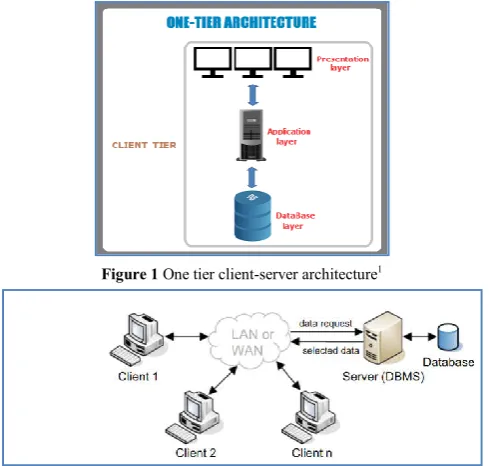
The client-server architecture categorized into four types:-.One tier architecture, two-tier architecture, three-tier architecture, and N-tier architecture. One tier application or standalone application has all the layers such as presentation, business, and data access layers in a single software package. Applications which handle all the three tiers such as MP3 player, MS Office comes under one tier application. Two-tier architecture application architecture is divided into two parts client application (client tier) and database (data tier). Client system handles both presentations, and application layers and server system handles the database layer. It is also known as a desktop based client-server application. The communication takes place between the client and the server. The client device sends the request to the server and the server processes the request and, sends back the request data to the client system [28]. Three-tier
Available Online at http://www.recentscientific.com
International Journal of
Recent Scientific
Research
International Journal of Recent Scientific Research
Vol. 10, Issue, 07(H), pp. 33857-33862, July, 2019
Copyright © Santosh Kumar, 2019, this is an open-access article distributed under the terms of the Creative Commons Attribution License, which permits unrestricted use, distribution and reproduction in any medium, provided the original work is properly cited.
DOI: 10.24327/IJRSR
CODEN: IJRSFP (USA)
Article History:
Received 4th April, 2019
Received in revised form 25th May, 2019
Accepted 23rd June, 2019
Published online 28th July, 2019
Key Words:
architecture or web-based application architecture is divided into three parts the presentation layer (client tier), the application layer (business tier), and a database layer (data tier). Client system handles the presentation layer, and the application server manages the application layer, and the database server system handles the database layer. Another layer is N-tier application. N-tier application distributed the application. It is similar to three-tier architecture, but the number of application servers is increased and represented in individual tiers to distribute the business logic so that the logic will be distributed.
Figure 1 One tier client-server architecture1
Figure 2 Two-tier client-server architecture2
Figure 3 Three-tier client-server architecture2
Figure 4 N-tier client-server architecture2
Table Comparision Tier
Two -tier Three-tier N-Tier
Set up Cost Performance Response time
Reailibillity Security
Components of client-server architecture
1 https://www.softwaretestingmaterial.com/software-architecture/ 2 https://www.softwaretestingmaterial.com/software-architecture/
Components of the client-server system divided into two major categories: - physical and logical components described in the table -1.
Table 1 Components of Client-Server system
Category of
component Examples
Physical Components
Server Device, Client Device, Network, Input/ Output Device, Power supply
Logical Components
Web Server, Database Server, Application Server, Proxy Server,
Program (HTML, Script), Session time, Weblog, Cookies, Ports,
Protocol (TCT/IP, http, https, FTP, SSL, TSL, SMTP, POP) API ( JDBC, ODBC)
Database (RDBMS, SQL, NoSQL)
Client: A client application is a process or program that sends a job request to a server via the communication network. Those jobs request the server to perform a particular task, such as looking up a record in a database or returning a portion or customized report. Examples of clients are a web browser, thin client, remote desktop, emulator, front-end application, mobile app, etc.
Server:-The server is a collection of the programme, listens for client requests that are transmitted via the communication network. Servers perform actions such as database queries or reading files. Server processes typically run on dominant PCs, workstations or mainframe computers.
Web server: A web server is a particular type of server that delivers services or content to client computers. A web server is a server with a server operating system and assists http or https communication. A web server is also recognized as an internet server [35]. Some web servers are Apache, Microsoft's Internet Information Server (IIS), Novell's NetWare server, Google Web Server (GWS), and IBM's Domino servers.
Application server: An application server is a component-based product that resides in the middle-tier of a server-centric architecture. The application server provides middleware services for state maintenance and security, along with data access. Java application server on of example, it is based on the Java 2 Platform, Enterprise Edition (J2EE) is one of an example of the application server. [3].
Figure 5 Application Server3
Database Server: A database server is a type of server that provides services related to accessing and retrieving data from
3https://www.service-architecture.com/articles/application-servers/
International Journal of Recent Scientific Research Vol. 10, Issue, 07(H), pp. 33857-33862, July, 2019
a database [32]. Generally RDBMS, Data files installed here and data can assess using ODBC or JDBC APIs.
Table Comparision SQL NO SQL
File storage, block storage
https://www.thegeekstuff.com/2014/01/sql-vs-nosql-db/
Programming Languages of a client-server system
HTML:Web pages are an essential part of the web application. HTML ( Hyper Text Markup Language ) is a language used to make web pages. In 1990, Tim Berners-Lee first created HTML. The latest version of HTML is HTML 5 [9].
Scripting language: A scripting language is a special programming language designed for integrating into HTML with other programming languages. PHP, JavaScript, VBScript, Perl, Python, Ruby, and ASP are some examples of scripting languages.[34]. Since a scripting language is generally used in conjunction with another programming language, they are often found alongside HTML, Java or C++.
Table Comparision Script Language
Weblog: Weblog file is a log file automatically created and maintained by a web server. Every "hit" to the Website, including each view of an HTML document, image or another object, is logged. The raw web log file format is essentially one line of text for each hit to the website. That contains information about who was visiting the site, where they came from, and precisely what they were doing on the website.
Session time:Session time is a time-out period assign to a web page by the web server. If the user does not refresh or make a new request a page within the time-out period the session ends [27]. It is a queue management system of the web server.
Cookies: Cookies are random numbers given by the web server.A Cookie is an arbitrary term given to a Web browser by a Web server [31]. The primary purpose of a cookie is to identify users and possibly prepare customized Web pages or to save site login information for uses.
Protocols of client-server architecture
Hypertext Transfer Protocol: The Hypertext Transfer Protocol (http) is an application-level protocol for distributed, collaborative, hypermedia information systems. That is the base for data communication for the World Wide Web (i.e., internet) since 1990.The http is a generic and stateless protocol which can be used for other purposes as well using extensions of its request methods, error codes, and headers. The http is a TCP/IP based communication protocol, that is used to deliver data (HTML files, image files, query results, etc.) on the World Wide Web. TCP port 80 is the default port, but other ports can be used as well. It provides a standardized way for computers to communicate with each other. http specification specifies how clients' request data will be constructed and sent to the server, and how the servers respond to these requests [10].
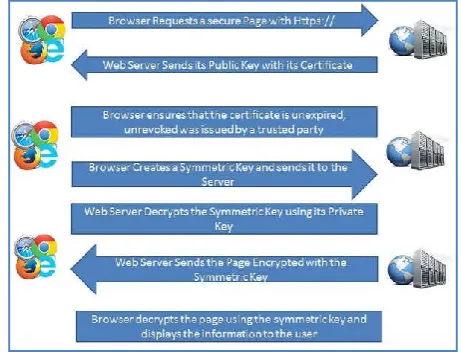
Hypertext Transfer Protocol over Secure Socket Layer: (Hypertext Transfer Protocol over Secure Socket Layer) is a web protocol developed by Netscape that provide more security. [26]. When we browse, we usually send and receive information using the http protocol. So this leads anyone to eavesdrop on the conversation between our computer and the
web server. Many times we need to exchange sensitive information which needs to be secured and to prevent unauthorized access. The https protocol used in the banking websites, payment gateway, shopping websites, All login pages, email apps
Figure 6 Hypertext Transfer Protocol over Secure Socket Layer 4
Secure Sockets Layer: Secure Sockets Layer (SSL) is a communication networking protocol used for securing connections between the web-based application of clients with servers. Due to several protocols and implementation mistakes and vulnerabilities, SSL was deprecated for use on the internet by the Internet Engineering Task Force (IETF) in 2015 and has been changed by the Transport Layer Security (TLS) protocol.
Transport Layer Security: Transport Layer Security (TLS) is a protocol that provides privacy and data integrity between web-based applications. It is the most commonly deployed security protocol used today and is used for Web browsers and other applications that require data to be securely exchanged over a network, such as file transfers, VPN connections, instant messaging and voice over IP.
Transmission Control Protocol/Internet Protocol: Transmission Control Protocol/Internet Protocol. It consists of a group of protocols designed to launch a network of networks to provide a host with access to the internet. TCP/IP is responsible for full-fledged data connectivity and transmitting the data end to end by providing other functions, including addressing, mapping and acknowledgment. TCP/IP contains four layers, which differ slightly from the OSI model [30, 39]. The technology is so standard that one would rarely use the full name. In other words, in common usage, the acronym is now the term itself.
IP address: An Internet Protocol (IP) address, is a unique identification system of networked devices on the Internet. It allows a system to be recognized by other systems connected via the data communication protocol [12].
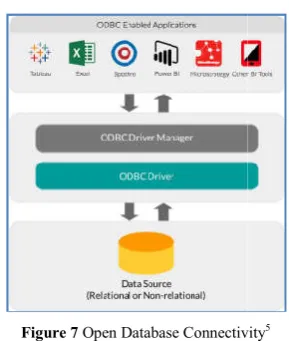
Open Database Connectivity: An Open Database Connectivity (ODBC) is an open standard Application Programming Interface (API) for accessing a database schema. Microsoft partners with Simba to build it in 1992, Databases can access using ODBC statements in a program or web applications[6,36].
Figure 7 Open Database Connectivity
JDBC: Java Database Connectivity Java JDBC is a Java API to connect and execute a query with the database. JDBC API uses JDBC drivers to connect with the database. JDBC API used to access tabular data stored in any relational database. JDBC is a new technology before using JDBC [6,13].
Figure 8 Java Database Connectivity Table: Comparision ODBC/JDBC
Simple Mail Transfer Protocol: SMTP (Simple Mail Transfer Protocol) is a TCP/IP protocol that used to sending and receiving e-mail over the internet. It is typically used with one of two other protocols, POP3 or IMAP, that let the user save messages in a server mailbox and download them periodically from the server. [ 38].
POP3: Post Office Protocol POP3 is designed to remove mail on the server as soon as the user has downloaded it. However, some implementations allow users or an administrator to specify that mail is saved for some period. POP can be thought of as a "store-and-forward" service [37]. The well
number for POP3 is 110.
Figure 9 Simple Mail Transfer Protocol/ Post office Protocol
5 https://www.simba.com/resources/odbc/ 6 https://www.javatpoint.com/java-jdbc 7 https://serversmtp.com/what-is-smtp-server/
Open Database Connectivity5
Java JDBC is a Java API to connect and execute a query with the database. JDBC API uses JDBC drivers to connect with the database. JDBC API used to access tabular data stored in any relational database. JDBC is a
Java Database Connectivity 6
SMTP (Simple Mail Transfer Protocol) is a TCP/IP protocol that used to sending and mail over the internet. It is typically used with one two other protocols, POP3 or IMAP, that let the user save messages in a server mailbox and download them periodically
Post Office Protocol POP3 is designed to remove mail on the server as soon as the user has downloaded it. However, some implementations allow users or an administrator to POP can be thought forward" service [37]. The well-known port
Simple Mail Transfer Protocol/ Post office Protocol7
Related Work
Oliver C. Ibe et al., [19] developed a model for systems in which a set of workstatio
a local area network. A class of stochastic process models the systems. The mean response time, the throughput and the parametric sensitivities are evaluated
Yogesh L. Deshpande [40], inspected the current state of client-server models using of simulation and compared with seven-layers OSI model. Haroon Shakirat Oluwatosin [8], reviewed information about the
its introduction, architecture, a
Lakshmi S. Iyer et al., [14] presented a comprehensive strategy for performance, reliability,
multi-tier web applications. Matthieu Bloch proposed a method that provides a
server communications by introducing an encoding scheme. Neelam Sah et al., [18] investigated the reliability characteristics like availability, reliability, MTTF and cost analysis of a web server and also developed mathematical models. Aditi khazanchi et al
JDBC drivers for web based applications.
[7] worked on performance of computer networks using OMNeT++ Simulation environment and found
throughput better then more servers compare to a
Amit Singh [2], presented a model of XSS obliterator for security at client/server side with the mechanism of the way filter. Madhuri A. Jadhav
comparative analysis of single page web application for save bandwidth which is used for refreshing whole page. Voborník [21], described the transmission of the data for the client-server applications with emphasis of minimizing server load and maximizing user comfort.
Nayeem Khan et al., [17] discussed a specific type of web vulnerability for cross site scripting (XSS).
Zakir Durumeric et al., [41], conducted a
impact of https interception and characterized the TLS. Rajput R.S. et al., [23], proposed an analytical model for redundant three-tier cloud computing system and, investigated system up to components level of the cloud system using concepts of queuing model with Jackson network,
performance of the cloud
reliability of model, various models also described in [24]. Pratham et al. [22], described various security aspects on mobile phone based applications to performe online payment.
Research Opportunity in Client
One of the essential objective of this study to find out the of research challenges in the area of the
Some identified area as under:
Performance evaluation of client
evaluation is the area of, measurement,
modeling of performance. Performance evaluation aims to present a balanced and complete
server system to evaluate performance
Reliability study of the client
statistics and psychometrics
measure. A measure is said to have high produces similar results under consistent conditions.
developed a model for client-server systems in which a set of workstations access a file server over A class of stochastic process models the . The mean response time, the throughput and the are evaluated for a client-server system. Yogesh L. Deshpande [40], inspected the current state of server models using of simulation and compared with layers OSI model. Haroon Shakirat Oluwatosin [8], reviewed information about the client-server model regarding tecture, a recent development, and issues. ., [14] presented a comprehensive strategy for performance, reliability, and scalability testing of tier web applications. Matthieu Bloch et al., [16] proposed a method that provides a security method for client-server communications by introducing an encoding scheme.
[18] investigated the reliability characteristics like availability, reliability, MTTF and cost analysis of a web server and also developed mathematical et al. [1], described architecture of JDBC drivers for web based applications. Dhobale J V et al., [7] worked on performance of computer networks using OMNeT++ Simulation environment and found the average throughput better then more servers compare to a single server. presented a model of XSS obliterator for security at client/server side with the mechanism of the
two-Jadhav et al., [15] introduced tive analysis of single page web application for save bandwidth which is used for refreshing whole page. Petr described the transmission of the data for the server applications with emphasis of minimizing server
ser comfort.
[17] discussed a specific type of web vulnerability for cross site scripting (XSS).
., [41], conducted a study of the security impact of https interception and characterized the TLS. Rajput [23], proposed an analytical model for redundant tier cloud computing system and, investigated system up to components level of the cloud system using concepts of queuing model with Jackson network, aims to estimate the system. Further [25], analyzed reliability of model, various models also described in [24]. . [22], described various security aspects on mobile phone based applications to performe online payment.
Client-Server System
objective of this study to find out the need of research challenges in the area of the client-server system. Some identified area as under:-
Performance evaluation of client-server system: Performance the area of, measurement, evaluation, and . Performance evaluation aims to present a balanced and complete conceptual view of the
client-valuate performance.
International Journal of Recent Scientific Research Vol. 10, Issue, 07(H), pp. 33857-33862, July, 2019
study is one of the challenging open areas of research for a client-server system.
Trusted client-server system design: The trusted computing base (TCB) of a computer system is the set of all hardware, firmware, and software components that are critical to its security, in the sense that bugs or vulnerabilities occurring within the TCB might jeopardize the security properties of the entire system. In this field of research has an opportunity to design TCB for a client-server system.
Secure client-server system development: Computer system protected through specialized hardware, software, policies, and practices against data corruption, destruction, interception, loss, or illegal access. Five essential services provided by a secure system are (1) authentication, (2) authorization, (3) integrity, (4) privacy, and (5) non-repudiation. The secure system development of one of exciting opportunity to design and development of the secure client-server system.
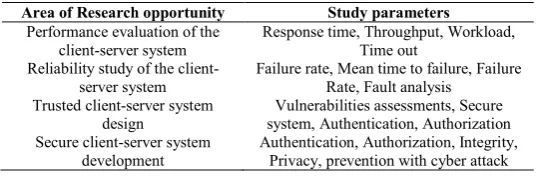
Table 2 Research Opportunity in a client-server system
Area of Research opportunity Study parameters
Performance evaluation of the client-server system
Response time, Throughput, Workload, Time out
Reliability study of the client-server system
Failure rate, Mean time to failure, Failure Rate, Fault analysis
Trusted client-server system design
Vulnerabilities assessments, Secure system, Authentication, Authorization Secure client-server system
development
Authentication, Authorization, Integrity, Privacy, prevention with cyber attack
CONCLUSION
In the present study, we explained the client-server system and its various components; Client-server architecture, physical and logical components of client-server architecture, implementation plan. We also enlightened some real-life examples of client-server. In present circumstances performance, reliability, trusted system design and secure system development are some area emerging fields for research and development.
References
1. Aditi khazanchi, Skshay kanwar, and Lovenish Saluja. "Java Database Connectivity (JDBC) - Data Access Technology," International Journal of Engineering and Computer Science, vol 2(10), pp. 2998-2984, 2013. Available: http://www.ijecs.in 2013
2. Amit Singh, Suraj Singh Tomer. "Securing Server/Client-side Applications against XSS attack via XSS – Obliterator," International Journal of Computer Science and Information Technologies, vol 6(2), pp. 1196-1203, 2015.
3. Barry & Associates. (2013). Application Server Architectures [Online]. Available: https://www.service-
architecture.com/articles/application-servers/application_server_architectures.html
4. Wikipedia. (2018). Client-Server [Online]. Available: https://simple.wikipedia.org/wiki/Client-server
5. Techterms. (2016). Client-Server model definition
[Online]. Available:
https://techterms.com/definition/client-server_model 6. Simba by Magnitude. (2018). Data Access Standards
[Online]. Available:
https://www.simba.com/resources/data-access-standards-glossary
7. Dhobale J. V., Kalyankar N.V., Khamitkar S. D. "Computer Network Performance evaluation based on Network scalability using OMNeT++ Simulation Environment," Int. J. Advanced Networking and Applications, vol 5(5), pp. 2041-2045, 2014.
8. Haroon Shakirat Oluwatosin. "Client-Server Model," IOSR Journal of Computer Engineering (IOSR-JCE), vol-16(1), pp. 67-71, 2014. Available: www.iosrjournals.org
9. Html.com. (2018). Free Lessons to Learn to Code HTML & CSS Today [Online]. Available: https://html.com/
10. Tutorialspoint.com. (2018). HTTP-Overview [Online]. Available: https://www.tutorialspoint.com/http/ http_overview.htm
11. Offbeat New Paper for Hong Kong Police force. (2013). Information security tips series Risk for client/Server
[Online]. Available:
https://www.police.gov.hk/offbeat/991/eng/195.html 12. Techterms. (2018). IP Address [Online]. Available:
https://techterms.com/definition/ip_address
13. Javapoint. (2018). Java JDBC Tutorial [Online]. Available: https://www.javatpoint.com/java-jdbc 14. Lakshmi S. Iyer et al., "Performance, Scalability and
Reliability issues in Web Applications,".Industrial Management & Data Systems, vol 105(5), pp. 561-576, 2005. DOI: 10.1108/02635570510599959
15. Madhuri A. Jadhav, Balkrishna R. Sawant , Anushree Deshmukh, "Single Page Application using AngularJS, " International Journal of Computer Science and Information Technologies, vol 6 (3), pp. 2876-2879, 2015.
16. Matthieu Bloch, "Network Security for Client-Server Architecture Using Wiretap Codes," IEEE Transactions on Information Forensics and Security, vol 3(3), pp. 404-413, 2008.
17. Nayeem Khan, Johari Abdullah, Adnan Shahid Khan, "Towards Vulnerability Prevention Model for Web Browser using Interceptor Approach," in Conf. 9th International Conference on IT in Asia, Kuching, Sarawak, Malaysia August 2015. Available: https://www.researchgate.net/publication/308306636 18. Neelam Sah, S. B. Singh, R.S. Rajput, "Stochastic
analysis of a Web Server with different types of failure," Journal of Reliability and Statistical Studies, vol 3(1),
pp. 105-116, 2011. Available:
https://www.jrss.in.net/assets/3110.pdf
19. Oliver c. Ibe, Hoon Choi, Kishor S. Trivedi, "Performance evaluation of client-server systems," IEEE Transactions on Parallel and Distributed Systems, vol 4(1), pp. 1217-1229, 1993.
20. Perfmatrix. (2017). The core performance testing
[Online]. Available:
http://perfmatrix.blogspot.com/2017/05/software-architecture-and-its-types.html
Communications and Computers, 2015. Available: https://www.researchgate.net/publication/287332891 22. Pratham Singh, R.S. Rajput, "Cybersecurity Analysis in
the Context of Digital Wallets," International Journal of Advanced Studies of Scientific Research, vol 4 (3), pp.
522-525, 2019. Available:
https://ssrn.com/abstract=3355789
23. R. S. Rajput, Dinesh Goyal, S.B. Singh, "Study of performance evolution of three-tier architecture based cloud computing system," Information system & e Business Network, pp. 254-261, 2018. Available: http://dx.doi.org/10.2139/ssrn.3166719
24. R.S.Rajput, Anjali Pant, "Optimal Resource Management in the Cloud Environment- A Review," International Journal of Converging Technologies and Management (IJCTM), vol 4(1), pp. 12-24, 2018. Available:
http://www.gyanvihar.org/researchjournals/ctmpaper201 7/IJCTM%20Vol_4_Iss_1_3.pdf
25. R.S. Rajput, Dinesh Goyal, Anjali Pant, "The survival analysis of three-tier architecture based cloud computing system," International Journal of Advanced Studies of Scientific Research, vol 3 (11), pp. 300-305, 2018. Available: https://ssrn.com/abstract=3320440
26. Tutorialpoint. (2018). Security testing HTTPS protocol
basics [Online]. Available:
http://www.tutorialspoint.com/security_testing/https_pro tocol_basics.htm
27. MSDN.microsoft.com. (2018). Session Timeout [Online]. Available: https://msdn.microsoft.com/en-us/library/ms525473(v=vs.90).aspx
28. Rajkumar. (2017). Software Architecture: One-tier, Two-tier, Three Tier, N Tier [Online]. Available: https://www.softwaretestingmaterial.com/software-architecture/
29. Ramez Elmasri, Shamkant B Navathe, Fundamentals of Database Systems, Pearson Edition, 2008.
30. Tanenbaum Andrew S., Computer Networks, Pearson Education, 2013.
31. Vangie Beal. (2008). What are Cookies and What Do Cookies Do? [Online]. Available: https://www.webopedia.com/DidYouKnow/Internet/all_ about_cookies.asp
32. LearnTomato. (2014). What are the Client, Server, and
Host? [Online]. Available:
https://learntomato.com/what-is-a-client-what-is-a-server-what-is-a-host/
33. Computer Hope. (2017). What is a Database server?
[Online]. Available:
https://www.computerhope.com/jargon/d/database-server.htm
34. Techopedia. (2019). Scripting Language [Online].Available:
https://www.techopedia.com/definition/3873/scripting-language
35. Techopedia. (2019). Web server [Online]. Available: https://www.techopedia.com/definition/4928/web-server 36. Simba by Magnitude. (2018). What Is ODBC? [Online].
Available: https://www.simba.com/resources/odbc/ 37. WhatIs.com. (2007). What is POP3? [Online].
Available:
https://whatis.techtarget.com/definition/POP3-Post-Office-Protocol-3
38. WhatIs.com. (2005). What is SMTP? [Online]. Available:
https://whatis.techtarget.com/definition/SMTP-Simple-Mail-Transfer-Protocol
39. Techopedia. (2019). What is TCP/IP? [Online]. Available:
https://www.techopedia.com/definition/2460/transmissio n-control-protocolinternet
40. Yogesh L Deshpande, "Use of Simulation to test client-server models," Proceedings of the Winter Simulation Conference, pp. 1210-1217, 1996.
41. Zakir Durumeric, et al., (2017). "The Security Impact of HTTPS Interception," in Conf. The Network and Distributed System Security Symposium (NDSS-17), March 2017, San Diego, CA, USA. Available: http://dx.doi.org/10.14722/ndss.2017.23456
42. R.S. Rajput, Dinesh Goyal, Anjali Pant. (2019). The survival analysis of Big Data Application over auto-scaling cloud environment. Emerging Technologies in Computer Engineering microservices in Big Data Analytics, Springer. PP 155:166
How to cite this article:
Santosh Kumar.2019., A Review on Client-Server Based Applications And Research Opportunity. Int J Recent Sci Res. 10(07), pp.33857-33862. DOI: http://dx.doi.org/10.24327/ijrsr.2019.1007.3768