NUMERICAL STUDY OF REDUCTION OF NO
XEMISSION BY HIGH
TEMPERATURE AIR COMBUSTION TECHNOLOGY
S. Tabejamaat
Department of Aerospace Engineering, Amirkabir Univ. of Technology P.O. Box 15875-4413, Tehran, Iran, [email protected]
(Received: January 23, 2003 – Accepted in Revised Form: August 11, 2003)
Abstract A numerical study on NOx emission from an industrial furnace utilizing high temperature air combustion (HTAC) technology was done. The basic concept of the regenerative burner including heating a diluting of fresh air by flue gas was implemented in a two-dimensional furnace model. Governing equations in conjunction with a turbulence model and an overall chemistry model were solved using an implicit numerical scheme. Effect of temperature and O2 concentration of preheated airflow on NOx emission from a furnace were investigated. Numerical results show a drastic increase in NOx emission when temperature or O2 concentration of preheated airflow increases. High combustion efficiency and low NOx emission can be achieved when the inlet airflow is preheated up to a high temperature, for instance, about 1500 ºK, and O
2 reduced to about 5%.
Key Words Combustion, Industrial Furnace, Numerical Study, NOx, HTAC
ﻩﺪﻴﮑﭼ
ﻩﺪﻴﮑﭼ
ﻩﺪﻴﮑﭼ
ﻩﺪﻴﮑﭼ
ﻄﻣ ﺭﺎﺸﺘﻧﺍ ﯼﺩﺪﻋﯼﺯﺎﺳ ﻪﻴﺒﺷﻪﻌﻟﺎ
NOX
ﻱﮊﻮﻟﻮﻨﮑﺗﺯﺍ ﻩﺩﺎﻔﺘﺳﺍ ﺎﺑﻲﺘﻌﻨﺻﯼﺎﻫ ﻩﺭﻮﮐ ﺯﺍ
HTAC
ﻡﺎﺠﻧﺍ
ﺖﺳﺍ ﻪﺘﻓﺮﮔ
. ﻝﺎﻤﻋﺍ ﺎﺑﺖﻬﺟﻦﻳﺍ ﺭﺩ
regenerative burner
ﮏﻳﺭﺩ ﺖﺳﺍﻩﺪﺷ ﻖﻴﻗﺭ ﯼﺍﻮﻫﻡﺮﮔ ﺶﻴﭘ ﻞﻣﺎﺷﻪﮐ
ﻥﺎﻳﺮﺟﻞﺧﺍﺩﻪﺑﻥﺎﺘﻣﻲﺘﺧﻮﺳﺖﺟﺶﺷﺎﭘﺭﺩﻥﮊﻮﻴﻔﻳﺩﻪﻠﻌﺷﻕﺍﺮﺘﺣﺍﺪﻨﻳﺁﺮﻓﯼﺪﻌﺑﻭﺩﻲﺘﻌﻨﺻﻩﺭﻮﮐ ﻪﺟﺭﺩﺎﺑﯼﺍﻮﻫ
ﺖﺳﺍ ﻪﺘﻓﺮﮔ ﺭﺍﺮﻗ ﻪﻌﻟﺎﻄﻣ ﺩﺭﻮﻣ ﻻﺎﺑ ﺕﺭﺍﺮﺣ
. ﻡﺰﻴﻧﺎﮑﻣ ﻭ ﻲﺴﻧﻻﻮﺑﺭﻮﺗ ﻝﺪﻣ ﻩﺍﺮﻤﻬﺑ ﺕﺭﺍﺮﺣ ﻭ ﻥﺎﻳﺮﺟ ﺕﻻﺩﺎﻌﻣ
ﻩﺪﺷﻪﺘﺧﺎﺳﺭﻮﻈﻨﻣﻦﻳﺪﺑﻪﮐﯼﺮﺗﻮﻴﭙﻣﺎﮐﺪﮐﺯﺍﻩﺩﺎﻔﺘﺳﺍﺎﺑﻭﯼﺩﺪﻋﻲﻨﻤﺿ ﻢﺘﻳﺭﻮﮕﻟﺍﮏﻳﻪﻠﻴﺳﻮﺑﻪﻃﻮﺑﺮﻣ ﻲﻳﺎﻴﻤﻴﺷ
ﺪﻧﺍ ﻩﺪﺷﻞﺣﺖﺳﺍ
.
ﻪﻠﻌﺷ ﺭﺎﺘﺧﺎﺳﻲﺳﺭﺮﺑﺖﻬﺟﺭﺩ ﻪﻌﻟﺎﻄﻣﺍﺪﺘﺑﺍ
ﯼﺍﻮﻫﺕﺭﺍﺮﺣ ﻪﺟﺭﺩ ﻪﺑﺖﺒﺴﻧ ﻥﺁ ﺕﺍﺮﻴﻴﻐﺗﻭ
ﺖﺳﺍ ﻪﺘﻓﺮﮔ ﻡﺎﺠﻧﺍ ﻕﺍﺮﺘﺣﺍ
. ﺖﻈﻠﻏ ﻭﺕﺭﺍﺮﺣ ﻪﺟﺭﺩ ﺮﺛﺍ ﺲﭙﺳ
O2
ﺭﺎﺸﺘﻧﺍ ﺮﺑ
NOX
ﺭﺍﺮﻗﻲﺳﺭﺮﺑ ﺩﺭﻮﻣ ﻩﺭﻮﮐ ﺯﺍ
ﺖﺳﺍ ﻪﺘﻓﺮﮔ
.
ﻲﻣﻥﺎﺸﻧﺞﻳﺎﺘﻧ
ﻕﺍﺮﺘﺣﺍﯼﺍﻮﻫﺕﺭﺍﺮﺣﻪﺟﺭﺩﺶﻳﺍﺰﻓﺍﺎﺑﻪﮐﺪﻫﺩ
ﺭﺎﺸﺘﻧﺍ
NOX
ﻲﻣﺶﻳﺍﺰﻓﺍﺕﺪﺷﻪﺑ ﺪﺑﺎﻳ
.
ﺶﻫﺎﮐﻭﻕﺍﺮﺘﺣﺍ ﻥﺎﻣﺪﻧﺍﺭﺶﻳﺍﺰﻓﺍ
NOX
ﺖﻈﻠﻏﻥﺎﻣﺰﻤﻫﺶﻫﺎﮐﻩﺍﺮﻤﻫﻪﺑﯼﺩﻭﺭﻭﯼﺍﻮﻫﺕﺭﺍﺮﺣﻪﺟﺭﺩﺶﻳﺍﺰﻓﺍﺎﺑ
O2
ﺖﺳﺍﺮﻳﺬﭘﻥﺎﮑﻣﺍ
.
ﻲﻣﺖﻳﺍﺪﻫﻢﮐﻲﮔﺪﻨﻳﻻﺁﻭﻻﺎﺑﻥﺎﻣﺪﻧﺍﺭﺎﺑﺪﻳﺪﺟﯼﺎﻫﻩﺭﻮﮐﺖﻤﺳﻪﺑﺍﺭﺎﻣﻉﻮﺿﻮﻣﻦﻳﺍ ﺪﻨﮐ
.
1. INTRODUCTION
NO and NO2, abbreviated as NOx, are emitted from combustion systems which use hydrocarbon fuel. It has been found that NOx is a contributor of photochemical smog and ozone in the troposphere [1]. On the other hand, through a chain reaction it decreases the ozone layer in stratosphere, which may increase ultraviolet radiation on the earth [2]. Consequently, NOx reduction has become a global demand that must be achieved by improving combustion science and technology.
As an effort in this regard, a technological method based on regenerative burning was proposed [3]. In this method, fresh airflow is diluted and heated up to 1200~1500 ºK by circulation of exhaust gas through a heat exchanger. Experimental
reports [4] have shown many advantages for this technology. In addition to NOx reduction, energy saving, high efficiency, and low noise are some of its advantages. However, although this technology has already applied for some industrial furnaces, its combustion mechanism has not been clarified yet. For instance, flame structure and NOx formation mechanism are not well known yet [5].
when such process takes place in the turbulent flow the effect of the flow on the reaction and the interaction of turbulence-chemistry must be considered. Extinction caused by turbulence intensity has a vital effect on the combustion process. Moreover, for a non-premixed flame, turbulence has a significant effect on the mixing of reactant. Nevertheless, the recent increasing trend on research of NOx emission is optimistic [8]. There have been numerous studies on NOx formation mechanism in laminar flame [9,10], in turbulent flame [11], and in high-temperature air combustion [12,13].
For detailed study of the mechanism of NOx emission in turbulent flow, a sophisticated method including fully detailed chemistry is needed. However, for a practical problem similar to what we are dealing with in this study, using a simplified chemical mechanism can qualitatively represent the fundamental characteristics of combustion phenomenon and NOx formation. As was mentioned above, the regenerative burner was experimentally and practically developed and was optimized for industrial furnaces. In order to study the NOx emission of furnace in more details, numerical study was done on a simplified two-dimensional furnace model. The basic concept of the regenerative burner including of heating and diluting of fresh air by flue gas was implemented in this model. NOx distribution in the furnace, and NOx concentration at the flue gas were calculated for different conditions. Of special interest was the effect of temperature and O2 concentration of preheated airflow on NOx emission.
2. PHYSICAL MODEL
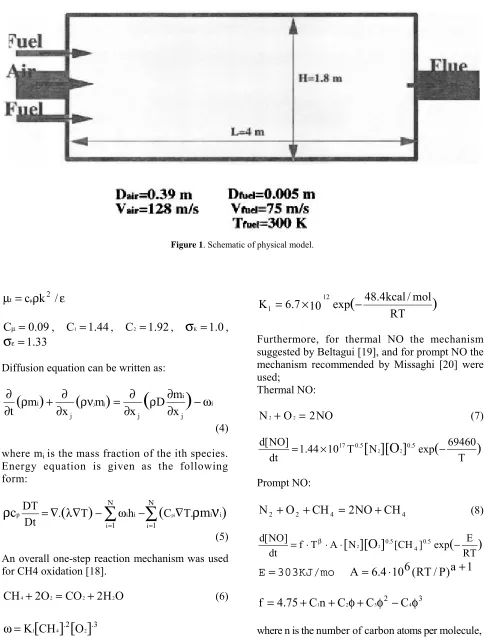
A simplified two-dimensional model of a heating furnace is shown in Figure 1. The model with a real scale is supplied with CH4 fuel by two injectors of 5 mm, which are located up and lower of the airflow jet. The temperature of fuel and velocity of fuel and airflow are respectively, 300ºK, 75 m/s, and 128 m/s. It is assumed that heating material flows on the lower wall, and the left, right and upper walls are at non-adiabatic condition. Based on the data obtained from an experimental furnace, temperature of left, right and upper walls were set at 1399 ºK. Calculation
were done for four temperature of heating material, TH = 300,600,1000,1324 ºK, in which the last one was the maximum temperature obtained by the experimental furnace.
3. GOVERNING EQUATIONS AND NUMERICAL METHOD
The governing equations including two-dimensional, unsteady, compressible, Navier-Stocks equations for a multi-species gas undergoing chemical reaction can be written in the following forms:
i j i e i j j i
S
x
x
)
v
v
(
x
)
v
(
t
j(
)
+
∂
ν
∂
µ
∂
∂
=
ρ
∂
∂
+
ρ
∂
∂
(1))
)
(
x
(
y
x
u
x
x
p
S
u e e∂
ν
∂
µ
∂
∂
+
∂
∂
µ
∂
∂
+
∂
∂
−
=
)
(
)
(
y
u
x
y
y
y
p
S
v e e∂
∂
µ
∂
∂
+
∂
ν
∂
µ
∂
∂
+
∂
∂
−
=
Where µ + µ = µe twhere u and v represent the velocities in x and y directions, respectively. The turbulent viscosity (µt ) quantity can be obtained from the k-ε turbulence model[14]: k j k e j
S
x
k
x
k
x
)
k
(
t
j(
j)
(
)
+
∂
∂
σ
µ
∂
∂
=
ρν
∂
∂
+
ρ
∂
∂
(2)ε ε
∂
+
ε
∂
σ
µ
∂
∂
=
ε
ρν
∂
∂
+
ρε
∂
∂
S
x
x
x
)
(
t
(
j)
e
j j
)
(
j (3)Where
ρε
−
=
K kG
S
)
(
c
1G
Kc
2k
S
ε=
ε
−
ρε
]
)
(
2x
y
u
)
y
v
(
2
)
x
u
(
2
[
G
2 22
k
c
t=
ρ
µ
µ /ε09
.
0
C
µ=
, C1=1.44, C2=1.92,σ
K=1.0,33 . 1 = ε
σ
Diffusion equation can be written as:
i j
i
j j
i
(
)
x
m
D
x
m
x
m
t
(
)
(
j j)
∂
−
ω
∂
ρ
∂
∂
=
ρν
∂
∂
+
ρ
∂
∂
(4)where mi is the mass fraction of the ith species. Energy equation is given as the following form:
)
(
)
(
i i i i i i p N 1 N 1m
c
. T h C T.Dt DT pi
ν
∑
∑
= =ρ
ρ
=∇ λ∇ − ω − ∇(5) An overall one-step reaction mechanism was used
for CH4 oxidation [18].
O H 2 CO O 2
CH4+ 2= 2+ 2 (6)
3 . 2 .
[
]
]
[
4 21
CH
O
K
=
ω
)
(
RT
mol
/
kcal
4
.
48
exp
10
7
.
6
K
1=
×
12−
Furthermore, for thermal NO the mechanism suggested by Beltagui [19], and for prompt NO the mechanism recommended by Missaghi [20] were used;
Thermal NO:
NO 2 O
N2+ 2= (7)
)
(
]
O
][
[
T 69460 exp N T 10 44 . 1 dt ] NO [d 17 0.5 0.5
2 2 − × = Prompt NO: 4 4 2
2
O
CH
2
NO
CH
N
+
+
=
+
(8))
(
]
O
][
[
RT E exp ] CH [ N A T f dt ] NO [d 0.5
4 5 . 0 2 2 − ⋅ ⋅ ⋅ = β
303KJ/mo
E
=
A
=
6
.
4
⋅
10
6
(
RT
/
P
)
a
+
1
3 2
4 3
2
1
n
C
C
C
C
75
.
4
f
=
+
+
φ
+
φ
−
φ
and φ is the equivalence ratio, Ci is constant. For solving the governing equations the well-known SIMPLE scheme of Patankar [15] was used. Specific heat, Cp, for each species at a constant pressure was computed by a fourth-older polynomial
fitted to the data tabulated in the JANAF tables [16]. The molecular viscosity, thermal conductivity and diffusion coefficient were determined by the methods, which are recited in Reference 17.
were used for the entire of the computational domain. 102×6 grid points just were used for fuel nozzle region to ensure high resolution at this
walls where the gradient is sharp.
4. RESULTS AND DISCUSSION
Three kinds of calculation were done in this study.
is done at high temperature, preheated airflow may enter in the furnace at equilibrium or semi-equilibrium condition. At such condition there should be a considerable amount of NOx in the preheated airflow. Calculation was done to investigate the effect of such pre-produced NOx on NOx emission.
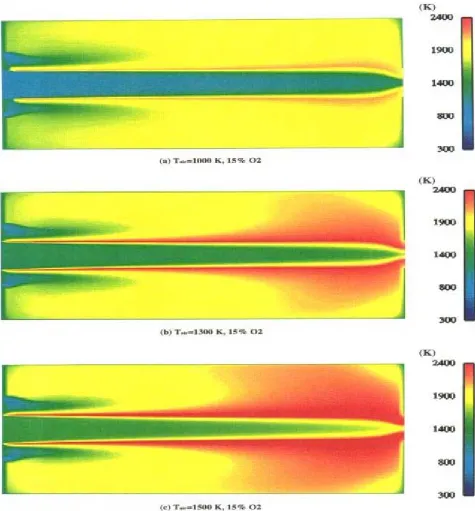
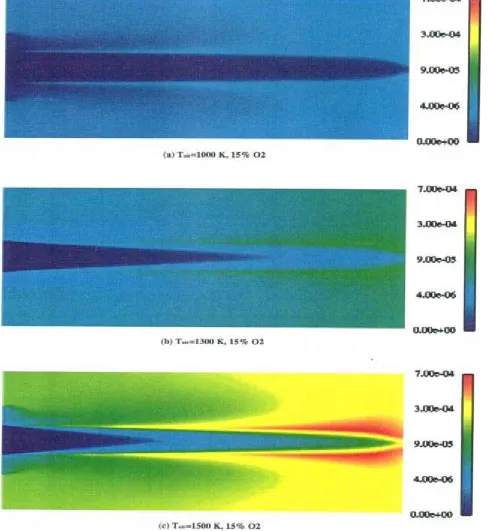
In Figures 2 and 3 distribution of temperature and NOx mass fraction are shown, respectively. The fuel temperature was kept constant at 300
º
K, while the temperature of preheated airflow is changed from 1000 to 1500º
K. As it can be seen in Figure 2, with increasing of Tair, the high temperature zone is expanded in the furnace andflame temperature significantly increases. As a result, NOx emission drastically rises, so that, its peak amount at the furnace exit for Tair = 1500
º
K becomes more than 85 times of it for Tair =1000º
K. However, the combustion efficiency for these two cases stands at 90.5% and 81.3%, respectively. Here combustion efficiency was calculated as the ratio of fuel consumption to inlet fuel. As Figure 2 shows even for preheated airflow of Tair =1000º
K, flame temperature in about 60% area of the furnace is more than 1800º
K. At such high temperature condition, formation of NOx is significantly dominated by thermal NO. Figure 3 clearly shows that, the more the temperature increases the more the NOx mass fraction raises in the furnace. However, at relatively low flame temperature Figure 7. Experimental results by Hasegawa et al. [4].Figure 8. Variation of maximum concentration of NOx at the exit of furnace against temperature of heating material.
Figure 9. NOx mass fraction against temperature of preheated air at equilibrium condition.
area in the furnace (about 1000
º
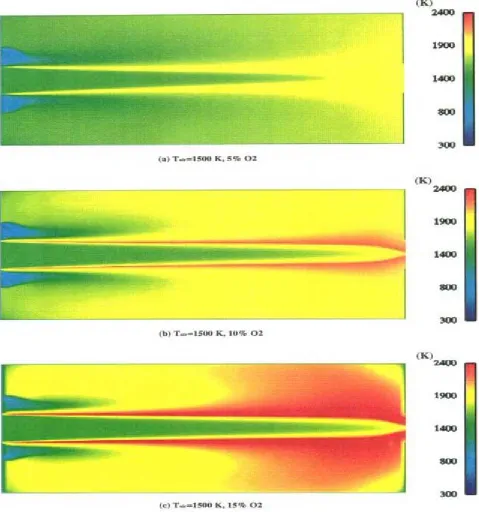
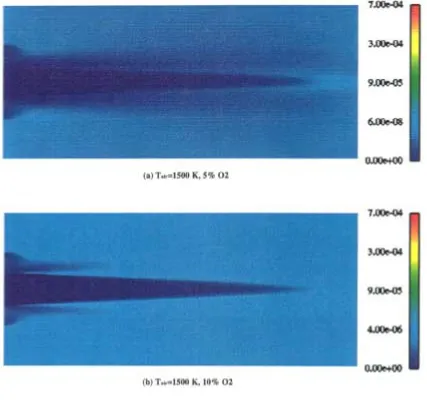
K) formation of thermal NO is negligible because of its high activation energy. At such condition, prompt NO is produced, particularly, at fuel-rich condition. Calculation was conducted to investigate the effect of O2 concentration of preheated airflow on emission of NOx in the furnace. Figures 4 and 5 show the temperature distribution and NOx mass faction, respectively. Airflow was diluted by CO2 to reduce O2 concentration, and temperature of preheated airflow was kept at 1500º
K, while fuel condition was the same as before. As it can be seen in Figure 4, by reducing O2 concentration of preheated airflow the high temperature zone becomes smaller and the flame temperature decreases considerably. For the typical cases shown in Figure 4, a 50% reduction of O2 causes about 20% decrease in flame temperature. O2 deficiency is one of the responsible factors for flame temperature reduction. However, the injection of dilution gas such as CO2 whose additional heat capacity lowers the peak temperature is another important factor. As a result of flame temperature reduction, NOx concentration reduces sharply as shown in Figure 5. Variation of maximum concentration of NOx at the exit of furnace against temperature of preheated airflow at different O2 mass fraction is shown in Figure 6. It can be clearly seen that by reduction of O2 mass faction, NOx concentration sharply drops at any temperature of preheated airflow. Furthermore, it can be seen that whentemperature of preheated airflow increases from 1000
º
K to 1500º
K, NOx concentration increases 3.5 times for O2 5%, but for O2 10%, NOx concentration increases 330 times. In fact, such behavior is a primary effect of high heat capacity of CO2. Experimental result [4] clarified that if N2 is used as dilution gas instead of CO2, NOx emission increases more than 2 times. Considering that the heat capacity of CO2 is much larger than N2 one can conclude that if a dilution gas with heat capacity more than CO2 is used, NOx emission even becomes smaller.The other fact that may reveal the mechanism of NOx reduction in Figure 6 is the effect of O2 reduction on combustion regime. Reducing O2 concentration in the furnace shifts the combustion regime to the fuel-rich condition. And we know that NOx formation at the fuel-rich is much smaller than stoichiometry flame, particularly at lower temperature.
In a heating furnace, heating material with initial temperature of 300
º
K are heating up to about 1200~1300º
K. Of our interest is to find the effect of such temperature variation on NOx emission. For a typical preheated airflow of 1300º
K and O2 10%, calculation was done at 4 different temperatures of heating material, TH, while keeping other walls temperature constant at 1399º
K. The results of maximum concentration of NOx at the exit of furnace are shown in Figure 7 when temperature of heating material rises to 1300º
K from its initial temperature of 300º
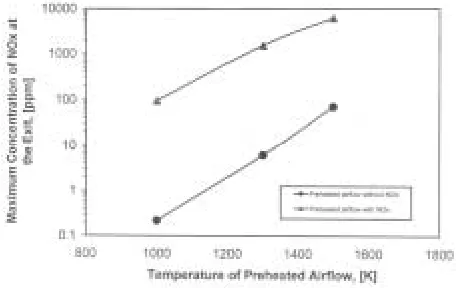
K, only there is about 0.3% increase in NOx concentration.As was mentioned before, preheated airflow may enter in the furnace at equilibrium condition. At such condition there should be a considerable amount of NOx in preheated airflow. Calculation was done to investigate the effect of such phenomena on NOx emission from the furnace. First, NOx formation in high temperature airflow at equilibrium condition was calculated [21]. The results of this calculation are shown in Figure 8. The NOx mass fraction gradually increases by increasing of temperature of airflow, and as it is expected, reduction of O2 concentration results in lower NOx formation; Figure 8. By injection preheated airflow at equilibrium condition with NOx mass faction given in Figure 8, calculation was done for O2 10% at three temperature of Figure 10. Variation of maximum concentration of NOx at the
preheated airflow; 1000, 1300 and 1500 ºK. The calculated results are compared with the results of injection of preheated airflow without NOx in Figure 9. Clearly, it shows a drastic effect on NOx emission from the furnace. However, further investigation showed that the inlet NOx, which is produced at the equilibrium condition, directly causes the increasing of NOx in the furnace. Therefore, the flame temperature in the furnace not only doesn’t increase but in fact slightly decreases.
5. CONCLUSION
NOx emission from a furnace utilizing regenerative burner technology was numerically investigated. Influences of inlet airflow temperature and reduction of O2 concentration of preheated airflow on NOx formation were studied. Calculations were also done to consider the effects of heating material temperature and pre-production of NOx in the heat exchanger on NOx emission from the furnace. Numerical results showed a drastic increase in NOx emission as temperature or O2 concentration of preheated airflow increases. A furnace with high efficiency and low NOx emission can be achieved when the inlet airflow is preheated up to a high temperature, about 1500 ºK, and O2 reduced to about 5%.
6. REFERENCE
1. Seinfeld, J. K., “Atmospheric Chemistry and Physics of Air Pollution”, John Wiley and Sons, New York, (1986). 2. Johnston, H. S., “Atmospheric Ozone”, Annual Rev.
Phys. Chem., 43:1, (1992), 251-260.
3. Tanaka, R., Kishimoto, K. and Hasegawa, T., (in Japanese), Combust. Sci. Technol., Vol. 2, (1994),
257-269.
4. Hasegawa, T., Tanaka, R. and Niioka, T., “High Temperature Air Combustion to Energy Saving and Pollutant Reduction in Industrial Furnace”, Joint Power Generation Conference, Tokyo, EC-Vol. 5, (1997),
259-266.
5. Niioka, T., “Fundamental and Application of High-Temperature Air Combustion”, 5th ASME /JSME Joint Thermal Engineering Conference, San Diego, (1999).
6. Miler, J. A. and Bowman, C. T., “Mechanism and
Modeling of Nitrogen Chemistry in Combustion”, Prog. Energy Combust. Sci., Vol. 15, (1989), 287-338.
7. Nishioka, M., Nakagawa, S., Ishikawa, Y. and Takeno, T., “NO Emission Characteristics of Methane-Air Double Flame”, Combust., Vol. 98, (1994), 127-138.
8. Warantz, J., Mass, U. and Dibble, R. W., “Combustion, Spring-Verlag”, Heidelberg, New York, (1996).
9. Miller, J. A., Branch, M. C., Mclean, W. J., Chandler, D. W., Smooke, M. D. and Kee, R. J., “The Conversion of HCN to NO and N2 in H2-HCN-Ar Flames at Low Pressure”, Proc. 20th Int. Symp. on Combustion, The
Combustion Institute, Pittsburgh, PA, (1984), 673-684. 10. Smooke, M. D., Ern, A., Tanoff, M. A., Valdati, B. A.,
Mohamad, R. K., Marran, D. F. and Long, M. B., “Computational and Experimental Study of NO in an Axisymmetric Laminar Diffusion Flame”, Proc. 26th Int. Symp. On Combustion, The Combustion Institute,
Pittsburgh, PA, (1996), 2161-2170.
11. Fujimori, T., Richelman, D. and Sato, J., “Experimental Study of NOx Reduction by Lifted Turbulent Jet Flame in Highly Preheated Flows”, First Asia-Pacific Conference on Combustion, (1997), 298-301.
12. Ju, Y. and Niioka, T., “Computation of NOx Emission of a Methane-Air Diffusion Flame in a Two Dimensional Laminar Jet with Detailed Chemistry”, Combustion Theory and Molding, Vol. 1, (1997), 243-257.
13. Gou, H., Ju, Y., Maruta, K., Niioka, T. and Sato, J., “Numerical Study of NOx Formation in High Temperature Air Combustion”, JSME International Journal, Series B, Vol. 41, (1998), 331-337.
14. Launder, B. E. and Spalding, D. B., “The Numerical Computation of Turbulent Flows”, Comp. Methods Apple.Mech.Eng., Vol. 3,(1974), 269-289.
15. Patankar, S.V., “Numerical Heat Transfer and Fluid Flow”, Hemisphere, Washington, DC, (1980).
16. Chase, M. W., Davies, C. A., Downey, J. R., Frurip, D. J., McDonald, R. A. and Syverud, A. N., “JANAF Thermochemical Table”, 3rd Ed., Vol. 14, American Inst. Physics, New York, (1985).
17. Tabejamaat, S. “Study on Flame-Holding in Supersonic Airflow by Two-Stage Combustion”, Ph.D. Dissertation, Tohoku Unit., (1998).
18. Westbrook, C. K. and Dryer, F. L., “Simplified Reaction Mechanisms for the Oxidation of Hydrocarbon Fuels in Flame”, Combust. Sci. Technol., Vol. 27, (1981), 31.
19. Kenbar, A. M. A., Beltagui, S. A., Ralston, T. and Maccallum, N. R. L., “Measurements and Modeling of NOx Formation in a Gas Fired Furnace”, Combust. Sci. Technol., Vol. 93, (1993), 173-192.
20. Missaghi, M., Pourhashanian, M., Yap, L. T. and Williams, A., “The Prediction of NO Emission from an Industrial Burner”, Proceeding of the American Flame Foundation Conference, San Francisco, IFIR Publication, The Netherlands, (1990).